
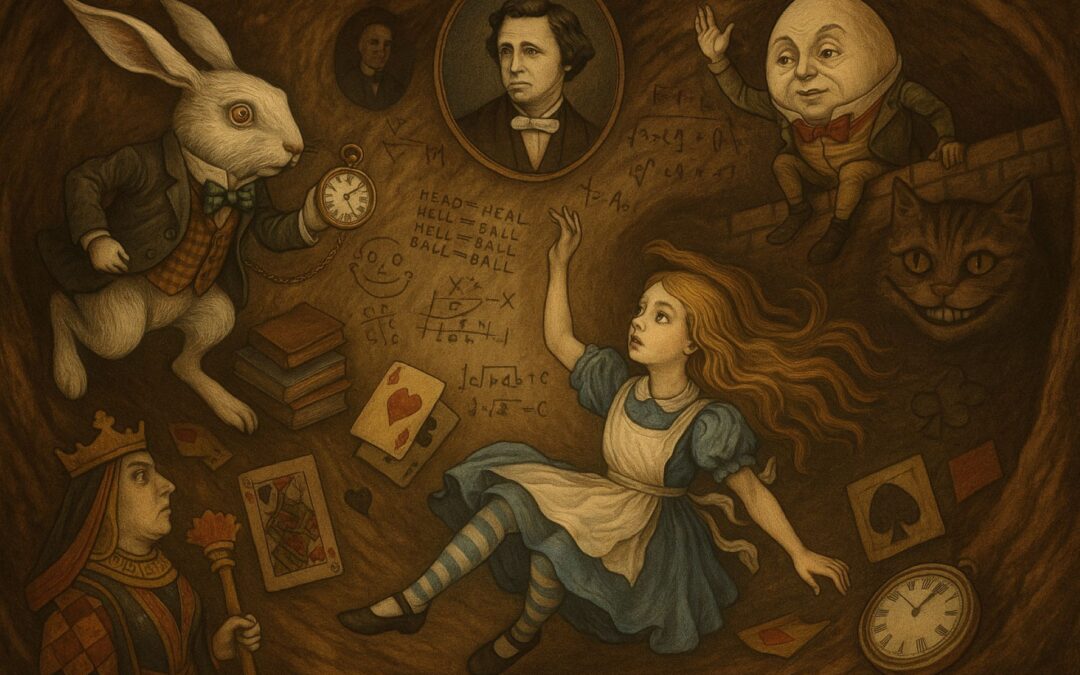
The phrase “going down a rabbit hole” has become a staple of modern language, symbolizing the plunge into the unexpected and bizarre. This vivid metaphor springs directly from Alice’s Adventures in Wonderland, a book that has captivated readers for generations with its labyrinthine logic and surreal whimsy. When Alice follows the White Rabbit underground, she tumbles into a world where conventional rules—social, physical, and logical—are mercilessly upended. But behind this kaleidoscopic fantasy lies a mind deeply anchored in mathematics and logic: Lewis Carroll, the pseudonym of Charles Dodgson.
Dodgson’s dual life as a rigid mathematician and a playful literary innovator created a tension that fueled the very essence of Alice in Wonderland. On the surface, the book appears to be a whimsical, illogical romp. Yet this apparent nonsense is a deliberate and masterful exploration of logic’s boundaries, riddled with paradoxes, puzzles, and linguistic curiosities that challenge the reader to rethink the nature of reason itself.


Lewis Carroll: The Victorian Renaissance Man
Charles Lutwidge Dodgson was a figure of fascinating contradictions, embodying the disciplined mind of a Victorian scholar and the boundless imagination of a literary innovator. Born in 1832 into a strict and devout Anglican family, Dodgson’s upbringing was shaped by the stern moral and intellectual codes of his time. Victorian England prized order, hierarchy, and adherence to convention—values that were especially entrenched in academic institutions. Yet, within this austere environment, Dodgson flourished as a polymath, a man whose intellectual curiosity extended far beyond his formal role as a mathematics professor at Oxford’s Christ Church College.
Dodgson’s interests spanned a remarkable range: mathematics, logic, poetry, satire, photography, and invention. He was not content to remain within the boundaries of a single discipline. Instead, he explored the intersections between them, demonstrating a rare synthesis of analytical precision and playful creativity. His prolific output included scholarly treatises, whimsical poems, innovative photographic techniques, and, most famously, literary works that defied easy categorization.
His pen name, Lewis Carroll, is a masterstroke of linguistic legerdemain—an anagrammatic transformation of his first two given names rendered in Latin and then reversed. This playful disguise reflects more than just a desire for anonymity; it signals the duality of his existence. By day, he was Charles Dodgson, the meticulous academic devoted to the rigors of mathematical proof and logical structure. By night—or rather, in his literary pursuits—he became Lewis Carroll, a conjurer of worlds where logic is twisted, language dances on the edge of nonsense, and the impossible becomes ordinary.
Victorian society revered logic, structure, and decorum. Mathematics, the epitome of certainty and rationality, was both Dodgson’s profession and his passion. Yet, Dodgson was acutely aware of its limitations and paradoxes. His literary works, particularly Alice’s Adventures in Wonderland, are a testament to his fascination with the interplay between order and chaos, reason and absurdity. They reveal a mind unafraid to challenge orthodoxy, to step beyond the neatly drawn lines of geometry into a world where parallel lines meet, and reason stumbles into whimsy.
Dodgson’s unique position as a man of logic who celebrated nonsense allowed him to create works that continue to captivate because they operate on multiple levels. They are, simultaneously, children’s stories, philosophical explorations, linguistic experiments, and mathematical puzzles. This layered complexity is the hallmark of a true Victorian Renaissance man—a thinker and creator who defied the limits of his age and crafted a legacy that endures in the modern imagination.
The Mathematical Heart of Wonderland
Beneath the fanciful veneer of talking animals, mad tea parties, and ever-shifting landscapes, Alice’s Adventures in Wonderland is deeply infused with the mathematical and logical preoccupations of its creator. Charles Dodgson’s identity as a mathematician is not incidental but central to understanding the text’s architecture and enduring appeal.
Dodgson’s passion for puzzles and logical games was profound and multifaceted. One of his most enduring inventions, the “word ladder,” exemplifies this fascination. In this puzzle, the challenge is to morph one word into another by changing a single letter at a time, ensuring each intermediate form is a valid word. This linguistic game embodies the mutable, fluid nature of language and meaning—a theme that echoes throughout Wonderland, where words and concepts shift like shadows.
Mathematics itself is both a subject and a tool in the Alice books. Dodgson’s work as a professor of mathematics was rooted in the Victorian ideal of logical rigor, yet he was also keenly attuned to the paradoxes and fallacies that arise when logic is applied without nuance. This duality is dramatized through characters like the White Queen, who quizzes Alice on arithmetic in a manner that is both absurd and revealing, and the Mock Turtle, whose education is comically nonsensical. Through these figures, Dodgson gently mocks the sometimes rigid and pretentious nature of academic instruction.
Other characters personify the pitfalls of flawed reasoning. The Duchess’s irrational temper and nonsensical logic, the King’s bumbling authority, and Humpty Dumpty’s anxious obsession with “un-birthdays” all illustrate how pure logic, when divorced from practical common sense, can lead to ludicrous conclusions. These moments underscore a critical insight: logic is not infallible, and human reasoning is often vulnerable to error and misunderstanding.
Alice herself engages with mathematical concepts in ways that reveal her precociousness and the book’s layered complexity. Her calculations during the fall down the rabbit hole—estimating distances and rates—are surprisingly precise for a child, grounding the fantasy in real-world knowledge. Yet, as she journeys through Wonderland, the rules she understands begin to unravel, reflecting a broader philosophical inquiry into the nature of knowledge and certainty.
The Knight’s convoluted explanation of his method for crossing a gate is a pointed satire of deductive reasoning that ignores practical wisdom. Alice’s immediate understanding that logic without common sense is worthless encapsulates the tension at the heart of Carroll’s work: a celebration of reason’s power, coupled with a recognition of its limitations.
Ultimately, the mathematical heart of Wonderland beats with a restless energy that questions, probes, and delights. It challenges the reader to look beyond the surface of logic, to embrace ambiguity and paradox, and to revel in the puzzles that define both the book and the human experience.
The Real Alice and the Birth of a Heroine
The genesis of Alice’s Adventures in Wonderland is inseparable from the real-life figure of Alice Liddell, the young daughter of Henry Liddell, Dean of Christ Church College, Oxford. Dodgson’s relationship with the Liddell family was warm and affectionate, especially his bond with Alice herself, who became the muse and inspiration for his most famous creation. Their frequent outings along the Thames, often involving leisurely boat trips, were the crucible for the imaginative tales Dodgson would spin — tales filled with peculiar creatures, curious adventures, and puzzles that delighted and confounded in equal measure.
Alice Liddell’s spirited personality shines through in the character of the literary Alice. At a time when Victorian ideals prescribed that children—and particularly girls—should be quiet, obedient, and largely invisible in adult society, Carroll’s Alice was a striking departure. She is audacious, inquisitive, and assertive, unafraid to challenge authority figures or speak her mind. Her curiosity propels her journey through Wonderland, and her boldness allows her to navigate the bewildering challenges she encounters.
This portrayal was radical. In Victorian England, childhood was often viewed as a preparatory stage for adulthood, one where discipline and conformity were paramount. Alice’s character shattered this mold by embracing childhood as a unique, vibrant phase of life with its own logic, struggles, and triumphs. She is not a mere passive observer but an active agent—often bossy, occasionally frustrated, yet deeply empathetic and brave. She demands attention, questions rules, and carves out her own identity amidst chaos.
Alice’s role as the first major female protagonist in children’s literature who embodies independence and rebellion makes her a literary heroine for all ages. She challenges the oppressive social norms of her time, embodying a youthful alternative to the rigid, often dull world of Victorian adulthood. In doing so, Carroll did more than tell a children’s story; he pioneered a new vision of childhood—one that respects individuality, values imagination, and recognizes the complex inner life of children.
Through Alice, Carroll invites readers to see childhood as a realm of wonder and agency, where questions about identity, reality, and morality are actively explored. Her adventures serve as a metaphor for the journey toward self-awareness and personal growth, a journey marked by confusion, discovery, and resilience. This profound character continues to resonate because she embodies the timeless struggle to understand oneself in a world that often resists such exploration.
Language, Logic, and the Limits of Reason
Alice’s Adventures in Wonderland is as much a linguistic experiment as it is a narrative journey. Carroll’s fascination with language permeates every page, inviting readers into a realm where words lose their fixed meanings and grammar bends to the whims of imagination. Language becomes a fluid, often slippery medium—a puzzle to be solved, twisted, and reassembled.
At the Mad Hatter’s tea party, language dissolves into playful chaos. Conversations loop endlessly, meanings invert, and the rules of polite discourse disintegrate. The Dormouse’s fragmented tale of the three sisters who learned to draw epitomizes this linguistic absurdity, where coherence is sacrificed for whimsy and sound over substance takes precedence.
Humpty Dumpty’s famous declaration—that words mean exactly what he chooses them to mean—challenges foundational assumptions about language. This assertion exposes the arbitrary nature of semantics and the power dynamics inherent in communication. By controlling language, Humpty Dumpty wields authority, highlighting how meaning is often subjective and contested rather than stable and universal.
Carroll’s subversion extends beyond language into the fabric of reality itself. In Through the Looking Glass, the sequel to Alice in Wonderland, the world operates under inverted laws. Cause and effect run backward, time flows in reverse, and logic contorts into paradox. The Red Queen’s observation that one must run faster and faster merely to stay in place is a profound metaphor for the relentless, sometimes futile struggle to maintain equilibrium in a chaotic world.
This conceptual reversal anticipates themes found in existential and dystopian literature. The unsettling sense that the normal order can be upended—where punishment precedes crime or where effort yields no progress—resonates with Kafkaesque absurdity and Orwellian foreboding. Carroll’s playful fantasy thus becomes a vehicle for profound philosophical reflection.
By destabilizing language and logic, Carroll dismantles the Victorian faith in order, certainty, and rationality. He exposes the gaps and contradictions that lie beneath the surface of meaning and reason, inviting readers to question how knowledge is constructed and communicated. In doing so, Alice transcends its fairy tale trappings to engage with the very foundations of epistemology and linguistics.
This exploration encourages a more flexible, questioning approach to understanding the world—one that recognizes ambiguity, embraces paradox, and acknowledges the limits of human comprehension. Carroll’s linguistic labyrinth challenges readers not only to follow Alice down the rabbit hole but to rethink the assumptions they carry about language, logic, and reality itself.
Darkness Beneath the Whimsy
While Alice’s Adventures in Wonderland is often remembered as a delightful children’s fantasy brimming with whimsy and humor, there exists an undercurrent of darkness that complicates its tone and themes. The seemingly lighthearted world of Wonderland is riddled with unsettling elements that reflect anxieties about authority, identity, and mortality—issues that were deeply resonant in Victorian society and remain compelling today.
The Queen of Hearts is perhaps the most vivid embodiment of this darker undercurrent. Her infamous cry of “Off with their heads!” echoes throughout the narrative, introducing an atmosphere of arbitrary violence and capricious power. Her unpredictability and the constant threat of punishment generate a sense of precariousness, where order is enforced through fear rather than justice. This tyrannical presence casts a shadow over the whimsical adventures, reminding readers that beneath the surface of playful nonsense lies a world where danger and cruelty coexist with absurdity.
Similarly, the Duchess is a figure of caprice and volatility. Her sudden shifts from affection to rage, her disregard for social niceties, and her abrasive behavior suggest an instability lurking beneath polite society’s veneer. The Duchess’s household, marked by chaos and discomfort, stands in stark contrast to the Victorian ideal of domestic harmony, hinting at deeper societal tensions and the fragility of social order.
Alice herself is frequently confronted with challenges to her identity and self-understanding. Throughout her journey, she undergoes physical transformations—growing larger and smaller—and encounters characters who question her very nature. This instability reflects the broader human struggle with self-definition, particularly poignant in a world that demands conformity and certainty. In Victorian times, mental illness and disability were stigmatized and often hidden from public view. Dodgson’s own struggles with physical ailments and a debilitating stutter may have informed his sympathetic portrayal of difference and “madness” in Wonderland.
Rather than marginalizing eccentricity, Alice embraces it as a form of liberation. Characters who defy societal norms and conventional logic are not only accepted but celebrated, creating a subversive commentary on the restrictive norms of the era. The narrative invites readers to question what is considered “normal” or “sane,” encouraging an exploration of alternative modes of thinking and being.
This tension between whimsy and menace generates an atmosphere of precarious unpredictability. The reader is invited to navigate a world where rules are fluid, authority is suspect, and reality itself is unstable. The book’s underlying anxieties mirror the complexities of the human psyche, the challenges of growing up, and the disorienting experience of entering adulthood—a process fraught with doubt, fear, and transformation.
Cultural Impact and Legacy
The influence of Alice’s Adventures in Wonderland extends far beyond the confines of Victorian literature, permeating diverse artistic, philosophical, and cultural domains with a resonance that spans centuries and continents. What began as a whimsical story told to children on a leisurely Oxford riverboat evolved into a foundational text whose themes and imagery continue to inspire and provoke.
The Surrealist movement, deeply interested in the unconscious mind and dream logic, found in Carroll a kindred spirit. Artists such as Salvador Dalí, René Magritte, Max Ernst, and Dorothea Tanning drew extensively on Wonderland’s blending of reality and fantasy, the uncanny, and the illogical. Dalí’s melting clocks and distorted figures echo the dreamlike, fluid nature of Carroll’s world, while Magritte’s juxtapositions and paradoxes reflect its playful subversion of meaning.
In the realm of popular culture, Alice has remained a wellspring of inspiration. Peter Blake, famed for his album cover art for The Beatles, incorporated Carrollian imagery into his psychedelic compositions, linking the story’s surreal qualities with the countercultural movements of the 1960s. More recently, Japanese artist Yayoi Kusama’s trademark polka dots adorned editions of the book, bringing a contemporary and avant-garde sensibility to Carroll’s timeless narrative.
Literary giants have also acknowledged Carroll’s profound impact. James Joyce’s complex linguistic play and exploration of consciousness bear echoes of Alice’s verbal inventiveness and philosophical depth. Henry Miller and Philip Pullman, among others, have cited Carroll as an influence, recognizing his ability to intertwine language, logic, and imagination in ways that challenge conventional storytelling.
The book’s cinematic legacy is equally impressive. The first Alice in Wonderland film, produced in 1903, was a pioneering work featuring innovative trick photography that astonished audiences. Since then, there have been over forty adaptations—ranging from live-action to animation, from faithful renditions to surreal reinterpretations—in numerous languages and cultural contexts. This multiplicity of forms testifies to the story’s adaptability and universal appeal.
Beyond film, Alice has been reimagined through operas, ballets, stage plays, graphic novels, and even video games. Each iteration underscores different facets of Carroll’s creation, whether its playful absurdity, philosophical inquiry, or psychological complexity.
The cultural impact of Alice lies not only in its artistic proliferation but also in its enduring thematic relevance. It encourages a spirit of curiosity, imagination, and rebellion against conformity. It challenges readers to question reality, language, and identity, fostering a mindset that embraces uncertainty and celebrates the strange and unexpected.
Carroll’s masterpiece continues to thrive as a living, breathing cultural artifact—an infinite wellspring of creativity that invites each generation to explore its depths anew.
Embracing Curiosity, Imagination, and Weirdness
At its core, Alice’s Adventures in Wonderland is an invitation—a call to relish curiosity, to laugh in the face of absurdity, and to embrace the messy, beautiful chaos of imagination. Alice herself embodies the virtues of courage, inquisitiveness, and rebellion against conformity.
Her journey through Wonderland remains a powerful metaphor for our own encounters with the unknown, the illogical, and the mysterious. The book urges us to question everything, to delight in puzzles, and to revel in the “just plain weird.” As Virginia Woolf so perfectly encapsulated, Carroll’s work is not merely a children’s story but a profound meditation on language, logic, and the human experience.
The rabbit hole awaits. Are you ready to fall?