
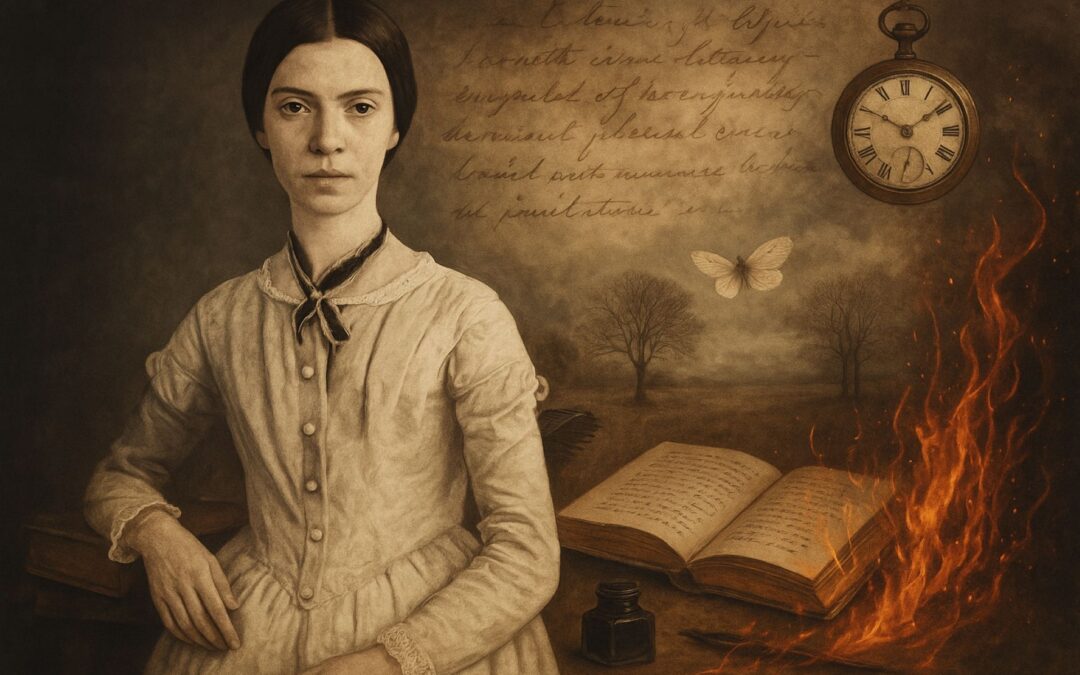
Emily Dickinson’s life and poetry form an enigmatic tapestry woven with threads of mystery, intensity, and singularity. Beneath the unassuming white dress that cloaked her modest figure lay a mind aflame with revolutionary ideas and an unparalleled poetic voice. Her world was one of profound interiority, where language became a conduit for ecstatic expression and the boundaries of convention dissolved.
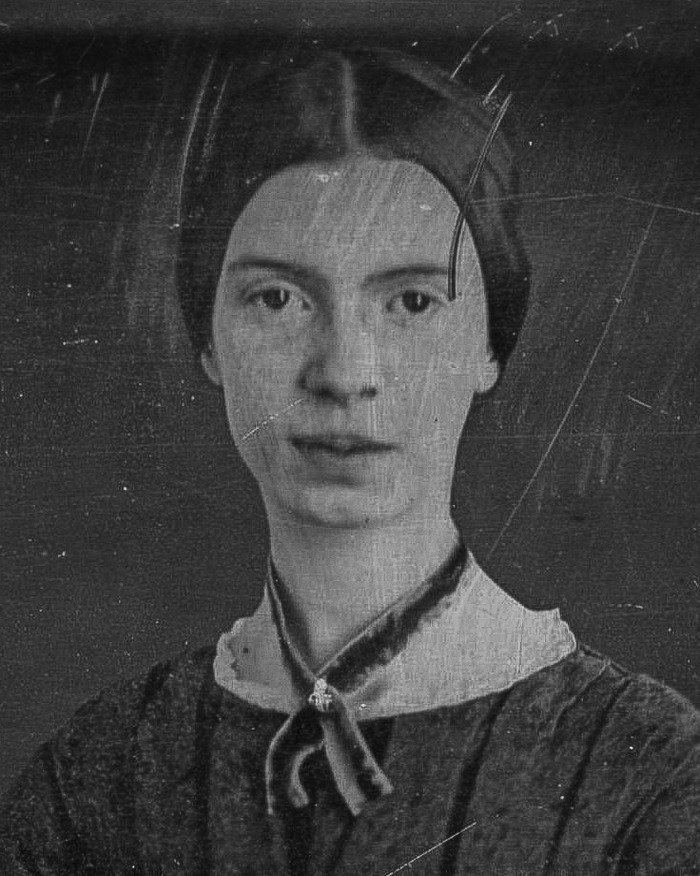
The White Dress: A Symbol Beyond Simplicity
Emily Dickinson’s white dress is iconic—etched into literary history as a symbol of her enigmatic persona. Yet, it is far more than a mere outfit; it functions as a visual manifesto, a deliberate sartorial choice loaded with nuance and contradiction. The dress was modest in cut, loose and shapeless, intentionally eschewing the tight corsetry and defined waistlines fashionable for women in the mid-19th century. This lack of a waistline not only defied societal expectations of femininity but also created an aura of simplicity that masked the complexity beneath.
Twelve delicate buttons made of mother-of-pearl ran down the front, glinting subtly in the light, adding an understated elegance. The collar and cuffs were edged with lace, a soft ornamentation that softened the austerity of the garment without making it frivolous. The dress bore a single pocket on the right hip—a small, practical detail hinting at the woman’s preference for subtle utility over ostentation.
The color white itself, universally associated with purity and innocence, takes on a startlingly different meaning in Dickinson’s world. In her poetry, white is a symbol of luminous intensity and raw, blazing passion. Rather than innocence, it evokes the “white heat” of forging metal, an alchemical transformation of soul and spirit. The white dress thus becomes a metaphorical armor, concealing the fiery intellect and emotional depth beneath a seemingly placid exterior.
This paradox—of simplicity masking intensity—defines Dickinson’s public image. To the people of Amherst, she was the “myth in white,” a spectral figure cloaked in mystery and otherworldliness. The dress marked her as separate, not merely in fashion but in essence, a woman who rejected conventional femininity and social roles. It was both a shield and a banner, signaling her detachment from societal norms while emphasizing her singular, incandescent presence.
A Life Enclosed: Amherst’s Quiet Rebel
Emily Dickinson’s life was marked by a gradual, purposeful retreat into physical seclusion—a retreat that only deepened the intrigue surrounding her. Born in 1830 into a prominent family in Amherst, Massachusetts, she lived most of her 55 years within the confines of her family’s homestead and its immediate grounds. In an era when women’s roles were rigidly prescribed, Dickinson’s choice—or perhaps necessity—to remain within these boundaries made her an object of fascination and speculation.
Initially a sociable, intellectually curious young woman, Dickinson’s social interactions waned over time. She became known as an outsider, eccentric and enigmatic, especially after she adopted her signature white dress and increasingly limited her physical appearances. Amherst townsfolk whispered about her mental health, questioned her beliefs, and speculated on her sexuality—rumors fueled by her refusal to conform to the expectations of marriage and social engagement.
The reclusiveness was extreme: Dickinson rarely left the family property, and when visitors came, she often communicated through a partially closed door, maintaining a literal and figurative barrier between herself and the outside world. This physical threshold encapsulates the paradox of her existence—withdrawn yet intensely engaged with ideas, nature, and human connection through other means.
The reasons behind her self-imposed isolation remain elusive, but there are compelling hints of psychological and physical struggles. Letters allude to crises of mind and body, including episodes that suggest epilepsy—a neurological condition then poorly understood and heavily stigmatized, especially for women. Epilepsy was often linked to hysteria and seen as a disqualifier for marriage and normal social life. If Dickinson suffered from such seizures, it would help explain both her retreat from public life and the intensity with which she channeled her inner experiences into poetry.
Despite her seclusion, Dickinson’s life was far from limited. Her intellectual world expanded through voracious reading, correspondence with literary figures, and deep immersion in nature’s cycles. She crafted a vibrant interior landscape where solitude became a sanctuary for creativity and reflection, rather than a prison. Her enclosure was not confinement but a chosen space of autonomy, where she redefined what it meant to live and create on her own terms.
The Poetic Fire Within: Wit, Mathematics, and Nature
Emily Dickinson’s intellectual curiosity was as expansive as it was unconventional for a woman of her time. Raised in a family that prized education—her father, Edward Dickinson, was a successful lawyer and an advocate for the education of his daughters—Emily absorbed a rigorous academic foundation that went beyond the typical curriculum offered to women in mid-19th century America. She excelled in subjects like science, mathematics, and geometry, areas generally reserved for male students. This foundation left an indelible imprint on her poetic sensibility.
Her poetry is sprinkled with mathematical and scientific terminology, revealing a mind fascinated by precision and the underlying order of the universe. Geometry, for example, provided her with metaphors of shapes, angles, and measurements that helped her articulate complex emotional and philosophical ideas. In her work, the soul might be described as undergoing the “white heat” of forging metal, a metaphor borrowed from the physical world of science but loaded with spiritual significance. This fusion of the empirical and the ecstatic is a hallmark of Dickinson’s voice—she moves effortlessly between cold logic and fervent feeling.
At the same time, Dickinson’s wit—sharp, playful, and at times irreverent—animates much of her poetry. Even as she wrestles with profound themes like mortality, divinity, and existence, her poems often contain a delicate humor. For example, when she addresses God’s “punctuality,” she simultaneously invokes reverence and skepticism, inviting readers to engage with theological concepts in a personal, almost conversational manner. This ability to combine solemnity with lightness reveals her unique poetic alchemy, making her work rich in emotional nuance.
Nature also plays a pivotal role in Dickinson’s creative universe. Unlike many poets who viewed nature solely as a backdrop, Dickinson saw it as a living, breathing participant in the human experience. Her acute observations of flowers, birds, seasons, and landscapes are suffused with symbolic resonance. She dissected the minutiae of the natural world with the same rigor and curiosity she applied to mathematics, finding in these details reflections of life’s transient beauty and complexity. This intimate dialogue with nature grounds her often abstract meditations, rooting them in tangible reality.
Through this blend of wit, scientific inquiry, and profound natural observation, Dickinson crafted a poetic voice that defied categorization. It is a voice both exacting and expansive, rigorous and wildly imaginative—a testament to a mind that embraced complexity and contradiction as essential to understanding the self and the world.
The Quiet Volcano: Creativity Amid Isolation
The years between 1858 and 1865 mark the most prolific and intense creative period in Emily Dickinson’s life. During this time, she composed the vast majority of her nearly 1,800 poems—a breathtaking output considering her reclusive lifestyle. This surge of creativity coincided with her gradual withdrawal from the external world, transforming her solitude into a crucible for poetic genius.
Dickinson’s life during these years was marked by a paradox: outward quietude juxtaposed with inner tumult. Her poems from this period often contain vivid imagery of explosions, convulsions, and volcanic eruptions—metaphors that suggest a psychological and emotional energy simmering just beneath her calm exterior. This “quiet volcano” metaphor encapsulates her ability to harness intense feelings and channel them into disciplined, yet explosive, poetic form.
The language she employs in these poems reflects a tension between control and chaos. Phrases evoke convulsions, throes, and spasms, conjuring images of both physical affliction and emotional upheaval. Some scholars speculate that Dickinson’s use of such imagery may be autobiographical, reflecting episodes of epilepsy or other neurological disturbances. While the exact nature of her condition remains uncertain, the intensity and frequency of these motifs suggest that her poetry was deeply intertwined with her bodily experiences.
Yet, rather than crippling her creativity, these “volcanic” impulses appear to have fueled it. In her isolation, Dickinson cultivated a heightened sensitivity to the nuances of perception and feeling. Removed from societal distractions, she could explore the depths of consciousness with unflinching honesty. Her poetry from this period captures moments of transformation, spiritual revelation, and raw emotional power—flashes of brilliance erupting from the stillness.
Her isolation was not merely physical but also intellectual and emotional, creating a fertile environment for experimentation with language and form. This seclusion allowed Dickinson to reject conventional poetic norms and develop her idiosyncratic style, marked by unconventional punctuation, slant rhyme, and compressed imagery. In this way, her “quiet volcano” was both a source of personal challenge and creative liberation, producing work that continues to resonate with readers for its intensity and originality.
Mortality’s Shadow: Death as Muse
Death was an omnipresent force in Emily Dickinson’s world, casting a long and intricate shadow over both her personal life and poetic imagination. Living through the turbulent years of the American Civil War, Dickinson witnessed death not as a distant abstraction but as a raw and intimate reality. The war brought daily reports of loss, injury, and sacrifice into her small New England town, seeping into the collective consciousness of her community and profoundly shaping her worldview.
This pervasive proximity to death was compounded by personal tragedies that deeply scarred her psyche. Childhood friends succumbed to illness, beloved family members and mentors passed away suddenly, and the omnipresence of mortality became inescapable. The early death of Leonard Humphrey, her school principal and a significant mentor, plunged her into profound mourning. These experiences embedded a heightened awareness of life’s fragility into her work.
Yet, Dickinson’s poetry does not reflect a morbid obsession with death but rather a complex and nuanced meditation on mortality’s inevitability and meaning. She often adopts a contemplative, even curious stance toward death, treating it as both an end and a transformation. In poems like “Because I could not stop for Death,” she personifies death as a courteous suitor—an intimate companion who guides her toward eternity with calm inevitability.
Her reflections extend beyond personal loss to universal themes of impermanence and transcendence. She explores the boundary between life and afterlife, questioning the nature of the soul and the possibility of immortality. Death, in her hands, becomes a prism through which to examine existence itself, stripping away superficialities to reveal essential truths.
The language she uses to describe death is often tender, evocative, and surprisingly gentle, eschewing terror for mystery and acceptance. Her work invites readers into a space where death is neither enemy nor foe but an integral part of the human journey—an enigmatic presence that shapes our understanding of life’s value and urgency.
Letters: The Theatrical Heartbeat of a Recluse
Though Emily Dickinson shunned public life, her letters form a vibrant and revealing counterpoint to her physical seclusion, pulsating with emotional intensity and intellectual vitality. Over one thousand of her correspondences survive, showcasing not only a remarkable epistolary skill but also a deeply theatrical and expressive personality that challenges the image of the withdrawn recluse.
Her letters were more than functional communications; they were crafted with the precision and artistry of her poetry. Dickinson carefully drafted and redrafted them, embedding poetic rhythms, vivid imagery, and a linguistic elegance that elevates these exchanges to a form of literary art. The letters often unfold like miniature dramas, rich with irony, humor, and poignancy.
One of the most significant relationships revealed through her letters was with Susan Gilbert Dickinson, her sister-in-law. Their correspondence, numbering 276 poems sent to Susan alone, suggests an intimate, emotionally charged bond. Many scholars interpret these letters as evidence of a romantic relationship, noting the heartfelt expressions of longing, sorrow, and passion. Poems and letters exchanged between them reveal a tenderness and depth of feeling that defy 19th-century conventions, offering a rare glimpse into Dickinson’s capacity for love and connection despite her physical isolation.
Dickinson’s letters also display a playful and self-aware theatricality. She often signed off with whimsical titles such as “your scholar” or “your gnome,” teasing readers and correspondents alike with her enigmatic persona. At other times, she asserted herself emphatically simply as “Dickinson,” claiming her unique voice with quiet authority.
Beyond personal relationships, her letters served as a bridge to the intellectual world, engaging in literary discussions, sharing her thoughts on poetry, philosophy, and spirituality. Through this epistolary network, Dickinson maintained a social and creative life that was as rich and complex as any public existence.
These letters dismantle the myth of Dickinson as merely a reclusive hermit. Instead, they reveal a woman deeply engaged with the world around her—intellectually, emotionally, and artistically—who crafted a vibrant and lasting legacy through the art of intimate written conversation.
A Distinctive Style: Dashes, Rhymes, and Originality
Emily Dickinson’s poetry stands out immediately through its unconventional stylistic features, which have fascinated and challenged readers and critics alike. Her distinctive use of dashes as primary punctuation is among the most notable aspects of her craft. Unlike the standard commas, colons, or periods used by her contemporaries, Dickinson’s dashes serve multiple intricate functions: they fragment the rhythm, create unexpected pauses, and introduce an almost breath-like quality to her verse. These dashes often interrupt the flow, compelling the reader to slow down, hesitate, and ponder the layered meanings embedded within each line.
This punctuation choice is far from arbitrary; it is a deliberate tool that shapes the tone and musicality of her poetry. The dashes signal shifts in emphasis or thought, sometimes marking abrupt emotional turns, subtle irony, or moments of spiritual uncertainty. By destabilizing conventional syntactic expectations, Dickinson invites readers into a space of interpretive openness, where meaning is fluid and layered rather than fixed. Her use of dashes often mimics the cadence of natural speech or the irregular rhythm of thought itself, making her poems intimate, immediate, and deeply personal.
Equally striking is her innovative approach to rhyme. Dickinson frequently employed slant rhyme or near rhyme—pairs of words that almost, but don’t quite, rhyme, such as “pain” and “thorn” or “one” and “heaven.” This technique creates a subtle tension within the soundscape of her poems, lending them an austere and haunting quality. The slant rhymes disrupt the predictable musicality of traditional rhyme schemes, reflecting the complexity and ambiguity of human experience that Dickinson sought to express. They mirror emotional discord, uncertainty, or unresolved longing.
Her compressed lines, elliptical phrasing, and economical vocabulary further underscore her originality. Dickinson mastered the art of saying profound and multi-layered things with startling brevity, packing emotional intensity and philosophical depth into concise stanzas. Her willingness to break poetic rules—not only in punctuation and rhyme but also in syntax and meter—reveals a fearless commitment to authenticity and innovation.
In sum, Dickinson’s stylistic idiosyncrasies are the very essence of her genius. They signal a poet who was utterly herself, rejecting conformity and forging a voice both radical and timeless. Her poetry’s distinctive texture continues to captivate readers, inviting them into a uniquely intimate and challenging encounter with language.
Posthumous Fame: From Obscurity to Immortality
Despite her prodigious output, Emily Dickinson published only a handful of poems during her lifetime—two confirmed works, and a few others that appeared anonymously or without her explicit permission. She was cautious, even secretive, about sharing her poetry, bundling her creations into small notebooks and storing them away. This reticence contributed to her obscurity, leaving the public largely unaware of the revolutionary voice that had been quietly shaping a new poetic landscape from within a domestic seclusion.
After Dickinson’s death in 1886, her family discovered these hidden collections and entrusted them to Thomas Wentworth Higginson, a literary mentor and critic with whom Dickinson had corresponded. Higginson recognized the remarkable originality and power of her work, though he also found it challenging and unconventional. Together with others, he undertook the task of editing and preparing her poems for publication.
The first volume of Dickinson’s poetry was published in 1890. It was met with surprising enthusiasm, selling 10,000 copies—a remarkable achievement for a poet so long unknown to the wider world. However, early editions often altered Dickinson’s distinctive punctuation, rhyme, and syntax to conform to prevailing literary tastes, somewhat diluting the radical originality of her voice. Later editors and scholars would work to restore her unique style and provide a more authentic representation of her work.
The posthumous publication transformed Dickinson’s reputation. From a virtually unknown recluse, she emerged as one of America’s most important and influential poets. Her work resonated deeply with readers and writers, inspiring generations to explore themes of individuality, mortality, and the power of language.
Her legacy is not only a testament to the enduring quality of her poetry but also a powerful example of how true artistic genius can remain hidden for a time, only to ignite the literary world with fresh light once unveiled. Dickinson’s journey from obscurity to immortality reminds us that profound art often transcends the limitations of its era, speaking across time with undiminished intensity and insight.
Conclusion
Emily Dickinson’s life and poetry embody the extraordinary power of introspection, resilience, and fearless innovation. Through her modest white dress and profound solitude, she forged a poetic voice that shattered conventions and illuminated the depths of human experience with unparalleled intensity. Her unique style—marked by daring punctuation, slant rhymes, and compressed language—invites us to reconsider the boundaries of expression. Though she lived apart from the world, her words continue to resonate across generations, reminding us that true genius often blossoms in silence and solitude. Dickinson’s legacy is a luminous testament to the transformative power of language and the enduring spirit of a visionary who dared to live and create on her own uncompromising terms.