
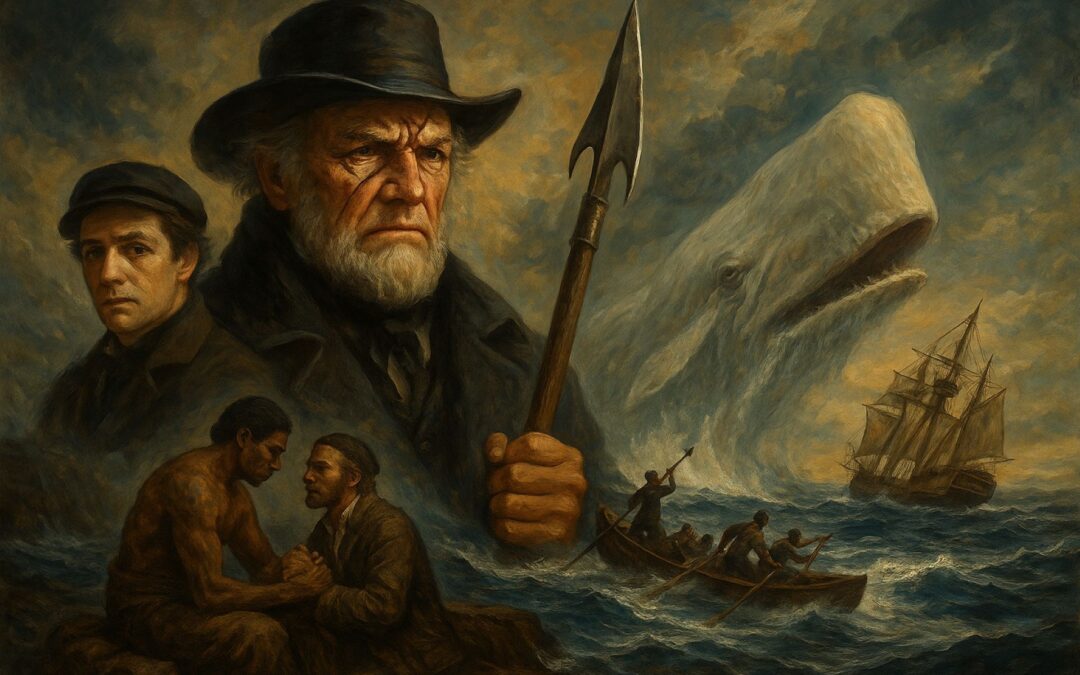
“Call me Ishmael.” Those three words open one of the most enigmatic and profound novels in American literature. Herman Melville’s Moby-Dick is far more than a sea adventure; it is a sprawling epic of obsession, psychology, and metaphysical inquiry. Drawing on Melville’s own harrowing experiences as a whaler, combined with the poetic grandeur of Shakespeare and the spiritual gravitas of the King James Bible, Moby-Dick plunges us deep into the turbulent waters of human nature itself.
The Raw Reality of Whaling and Melville’s Journey
Herman Melville’s intimate acquaintance with the merciless world of whaling is foundational to the authenticity and texture of Moby-Dick. Unlike many literary creations that emerge solely from imagination, Melville’s narrative breathes because it is steeped in lived experience. At the tender age when most youths are still sheltered by the comforts of home, Melville found himself thrust into the unforgiving life of a whaler—a job as physically brutal as it was psychologically taxing. The role of harpoonist was not for the faint-hearted; it required a unique blend of courage, precision, and endurance. Harpoonists stood at the very edge of the hunt, launching their spears into enormous, writhing leviathans whose sheer size and strength could shatter boats and lives alike.
Each whale was a monstrous colossus, weighing tens of tons and commanding respect bordering on fear. The process of capturing and processing such a creature was a three-day marathon of relentless labor, involving the cutting, boiling, and dissection of flesh and blubber to extract valuable whale oil. This oil was the lifeblood of 19th-century industry and domestic life—a primary source of illumination before the widespread adoption of kerosene and a vital lubricant for the cogs and pistons driving America’s industrial boom. Whaling was, in essence, an engine of economic growth, and the ports of Nantucket and New Bedford thrived as bustling hubs for this trade. They were, in fact, the nerve centers of the world’s whaling fleet, with the United States controlling an astonishing 70 percent of the global industry.
Melville’s personal transformation from a privileged son of a well-off New York family to a rugged mariner is emblematic of broader social upheavals. The Panic of 1837 devastated his family financially, and the death of his father forced him from the safety net of wealth into the harsh reality of earning a living. Enrolled by his older brother as a cabin boy bound for Liverpool, Melville embarked on a five-year maritime odyssey that included stints aboard whaling vessels in the Caribbean and South Seas. These voyages exposed him to not just the physical rigors of the sea but to the psychological landscape of isolation, danger, and human endurance.
Through this crucible, Melville amassed a wealth of firsthand knowledge that would infuse his writing with vivid immediacy and nuanced understanding. He witnessed the camaraderie and conflict that brewed in the tight quarters of a ship’s crew, the delicate balance between man and nature, and the existential questions that arise when staring into the vast, indifferent ocean. This blend of gritty realism and profound philosophical inquiry sets Moby-Dick apart, making it a novel not only about whales and ships but about the human condition writ large against the backdrop of the merciless sea.
Ahab and Ishmael: The Tale of Two Men
At the narrative and thematic core of Moby-Dick stand two men whose contrasting personalities and destinies illuminate the novel’s profound inquiries: Captain Ahab and Ishmael. Ahab, the vessel’s captain, is a figure wrought from obsession itself—a man whose very being is consumed by a singular, all-encompassing vendetta against the white whale that maimed him. His character is painted with strokes both grand and grim: scarred, brooding, and almost mythic in presence, Ahab embodies the archetype of the tragic hero, flawed and larger than life. His relentless pursuit is not just a physical hunt but a metaphysical struggle—a defiance against fate, nature, and possibly the divine. His charisma and indomitable will seize the hearts and minds of his crew, compelling them to join in a quest that blurs the line between righteous vengeance and self-destructive mania.
In stark counterpoint stands Ishmael, the novel’s narrator and moral compass. Ishmael’s journey to sea is initially motivated by a restless curiosity and a desire to escape the confines of shorebound life. Unlike Ahab’s fiery monomania, Ishmael represents inquiry, contemplation, and the democratic impulse. He is the observer, the philosopher, and the seeker—curious about the world, human nature, and the deeper mysteries that the voyage presents. His voice is reflective, often digressive, and laden with a keen sensitivity to the absurdities and beauties of existence.
The interplay between these two figures crafts a dual narrative: the external drama of the whale hunt and the internal exploration of obsession, knowledge, and identity. Ahab’s path is one of destructive singularity, while Ishmael’s is one of open-ended questioning and survival. Together, they embody the tension between force and reflection, tyranny and democracy, compulsion and curiosity. Their stories intertwine to chart a voyage not merely across the physical ocean but deep into the turbulent, often shadowy waters of the human psyche. This duality elevates Moby-Dick beyond a maritime adventure, transforming it into a profound meditation on what it means to be human amid forces both external and internal that are vast, indifferent, and sometimes incomprehensible.
Shakespeare and the Bible: Literary Pillars of Moby-Dick
The scaffolding of Moby-Dick rises on the immense foundations of William Shakespeare’s literary genius and the profound spiritual resonance of the King James Bible. Melville, who regarded Shakespeare as “The Divine William,” channels the Bard’s grandeur and tragic depth to infuse his narrative with layers of dramatic intensity and poetic eloquence. Ahab’s character, in particular, is steeped in Shakespearean influence—his speeches echoing the grandeur of tragic soliloquies from plays like King Lear and Macbeth. These speeches reveal a soul ravaged by fury, doubt, and unrelenting will, exposing the contradictions and complexities of a man both majestic and monstrous. The Pequod itself becomes a floating amphitheater where passions erupt, alliances falter, and fate looms like an unseen playwright scripting the inexorable tragedy.
Melville’s narrative frequently adopts theatrical conventions—complete with stage directions and dramatic pauses—blurring the lines between novel and play. This layering elevates the novel’s psychological and existential conflicts into a grand spectacle, where human folly and ambition are played out with the intensity of classical tragedy.
Parallel to this theatrical lineage is Melville’s profound engagement with the King James Bible, the spiritual and cultural cornerstone of 19th-century American life. The Bible saturates the novel, its influence audible in the cadence of the prose and visible in the symbolic architecture of the story. Names carry heavy theological weight: Ishmael, the narrator, evokes the biblical outcast condemned to wander, symbolizing alienation and the search for identity. Captain Ahab’s name recalls the idolatrous King of Israel, infamous for leading his people astray, paralleling Melville’s Ahab’s destructive obsession that verges on modern idolatry.
The Pequod’s name and its counterpart, the Rachel—an allusion to the biblical figure who pleads for the end of exile—extend this symbolism. Rachel’s role in rescuing Ishmael at the novel’s end suggests themes of redemption, mercy, and the fragile possibility of salvation amid chaos and destruction. Biblical references permeate the text beyond names, echoing through sermons like the Jonah and the Whale allusion, and culminating in allusions to the Book of Job’s trials and faith.
This intricate weave of Shakespearean drama and biblical allegory imbues Moby-Dick with a richness that transforms the novel from a mere sea tale into a sprawling meditation on human destiny, divine mystery, and the eternal conflict between pride and submission.
The Enigmatic Whale: Symbol of the Unknown
Moby Dick—the elusive white whale—stands at the heart of Melville’s narrative as an inscrutable, multifaceted symbol that defies singular interpretation. Unlike the fully fleshed human characters, the whale’s nature remains shrouded in ambiguity, casting a vast shadow over the novel’s philosophical landscape. This inscrutability elevates Moby Dick beyond a mere animal; he becomes an elemental force, an unknowable presence that mirrors the mysteries and terrors of existence itself.
Scholars and readers have long grappled with the whale’s symbolism, each interpretation reflecting different facets of human thought and cultural critique. To some, Moby Dick is an allegory for God: an omnipotent, indifferent deity whose motives and designs are beyond human comprehension. The whale’s inscrutable behavior and overwhelming power embody divine mystery and the limits of human understanding. Others see the whale as nature incarnate—immense, indifferent, and unconquerable—a force that mocks human arrogance and challenges the illusion of mastery over the natural world.
The whale also serves as a potent symbol in political and social readings. It has been interpreted as a representation of imperialism’s destructive reach, or conversely, as a symbol of resistance against colonial and racial oppression. Its whiteness—the subject of an entire chapter dedicated to exploring its paradoxical meanings—acts as a blank canvas, simultaneously evoking purity, terror, emptiness, and the ineffable. This ambiguity forces readers to confront the fragility of symbolic interpretation and the tendency of human consciousness to project its fears, hopes, and prejudices onto the unknown.
Moby Dick’s indifference to Ahab’s vendetta accentuates the existential gulf between man and the vast, unfeeling universe. The whale neither acknowledges nor comprehends Ahab’s rage; it simply exists as a monumental enigma. This tension embodies the novel’s core theme: humanity’s ceaseless struggle to find meaning in a world that offers no easy answers, where the unknown remains stubbornly impenetrable.
Ultimately, the whale symbolizes the unknowable—a profound abyss that demands humility, respect, and awe, even as it invites obsessive pursuit and existential confrontation. In this sense, Moby Dick is less a character than a cosmic question, an emblem of the mysteries that lie beyond the horizon of human knowledge.
Brotherhood at Sea: Ishmael and Queequeg
At the heart of Moby-Dick lies one of its most striking and progressive portrayals: the profound friendship between Ishmael, the contemplative narrator, and Queequeg, the tattooed harpooner from a distant Pacific island. This relationship transcends mere companionship and enters the realm of intimate brotherhood, reflecting Melville’s deep exploration of human connection beyond the barriers of culture, race, and geography.
Thrown together by circumstance—sharing not only a room at the Spouter-Inn but a bed—these two men form a bond described in terms remarkably akin to marriage. The tenderness and mutual respect that characterize their relationship were exceptional portrayals for Melville’s time, especially considering prevailing racial attitudes and social norms of the mid-19th century. Their friendship becomes a powerful symbol of the possibility of unity and understanding amidst difference, an idealized model of how men from disparate worlds might forge deep emotional and spiritual ties.
Onboard the Pequod, the cramped quarters and shared hardships compel the crew into a tightly knit community where traditional hierarchies based on race or class give way to merit, skill, and mutual reliance. This microcosm is a testament to the human capacity for solidarity under extreme conditions. Melville captures this spirit with nuance and sensitivity, showing how survival at sea demands cooperation, trust, and genuine human intimacy, even among strangers thrown together by fate.
The relationship between Ishmael and Queequeg thus becomes more than a subplot—it embodies a hopeful, if fragile, vision of brotherhood that counters the novel’s darker themes of obsession and destruction. It’s a quiet but powerful testament to the bonds that sustain humanity, even in the face of chaos and the vast unknown.
The Viscera of Whaling: A Dance with Death and Dignity
Melville’s depiction of whaling is unapologetically visceral, plunging readers into the raw, often gruesome realities of a brutal industry. The Pequod’s decks transform into a scene of primal chaos, where the leviathan’s massive carcass dominates every sense. Blood, blubber, and guts spill relentlessly into the ocean, while the fiery furnace consumes the whale’s blubber in flames likened to the fires of Hell itself. This tableau evokes a hellish carnival of death and industry, where nature’s majesty and horror intertwine.
Yet, amid this visceral carnage, Melville discovers moments of dignity and even grace. In the memorable chapter “A Squeeze of the Hand,” Ishmael recounts the intimate, almost ecstatic ritual of extracting spermaceti—the waxy substance found in the sperm whale’s head. The act of “squeezing” becomes symbolic, transcending mere labor to embody fellowship and shared purpose. Ishmael’s enthusiasm infuses the moment with a spiritual dimension, as he and his shipmates grasp each other’s hands, united in their arduous task.
This duality—whaling as both grotesque and sacred—captures the paradoxical nature of humanity’s engagement with the natural world. It is a dance on the razor’s edge between destruction and reverence, where survival demands brutality but also inspires profound human connection. Melville’s narrative refuses sentimentalizing or vilifying; instead, it presents the whalers’ toil in all its complexity, recognizing the dignity born of endurance and the tenderness that can emerge even amid death and decay.
The Pequod: A Microcosm of America
The Pequod is more than a whaling ship; it is a potent allegorical vessel representing America in the turbulent mid-19th century. Named after the Pequot tribe—a Native American people devastated by colonial violence—the ship carries a legacy of conquest, loss, and historical tragedy embedded in its very identity. This naming foreshadows the Pequod’s doomed fate, suggesting the destructive consequences of imperialism and human hubris.
The ship’s crew is a microcosm of the nation’s complex and often fractious social fabric. Thirty men of diverse ethnicities, religions, and backgrounds sail together, reflecting the rapidly changing demographics of the United States amid mass immigration and growing racial tensions. This melting pot aboard the Pequod mirrors the challenges facing America as it grappled with the contradictory forces of expansion, slavery, abolition, and cultural pluralism.
Melville’s timing was prescient; as the country edged toward the Civil War, the Pequod’s voyage becomes a metaphor for the nation’s fragile unity under threat from internal discord. The ship’s hierarchical structure echoes America’s social stratification, while its multiracial crew embodies both the promise and peril of a society striving to forge identity and cohesion from diversity.
In this reading, the Pequod is not merely a vessel for a whale hunt but a symbolic stage upon which the dramas of democracy, division, and destiny play out. It questions whether such a disparate collection of individuals can truly find strength in unity or whether their collective fate is bound for destruction, echoing the historical trajectory of the United States in Melville’s era.
An Epic of Style: From Narrative to Poetic Philosophy
Moby-Dick defies conventional literary boundaries through its kaleidoscopic and experimental style, making it as much a philosophical treatise and epic poem as a novel. Melville’s prose fluidly shifts between genres and registers, confounding readers who expect a straightforward sea tale. The narrative intertwines adventure storytelling with dense encyclopedic digressions, dramatic dialogues, poetic monologues, and scientific catalogues of whales and whaling practices. This stylistic hybridity transforms the reading experience into an intellectual odyssey, reflecting the chaotic and multifaceted nature of human understanding.
One of the novel’s remarkable features is its theatricality. At times, the text unfolds like a play, complete with stage directions and carefully orchestrated dialogue. Chapter 40, for example, reads as a dramatic script where actors’ movements and expressions are meticulously described. Elsewhere, Melville indulges in exhaustive lists of whale species or anatomical details that verge on scholarly compendiums, such as the famous chapter devoted entirely to the whiteness of the whale. These digressions, far from distracting, enrich the thematic texture and invite readers to contemplate the vast scope of knowledge and mystery surrounding the natural world.
Melville’s refusal to outline the novel before writing resulted in a work that simulates the wandering nature of Ishmael’s own quest for meaning—sometimes erratic, sometimes profound. This loose structure anticipates the stream-of-consciousness and modernist narrative experiments of later writers like Virginia Woolf and James Joyce, who similarly sought to capture the complexity of thought and perception. Ultimately, Moby-Dick is less about delivering a linear story and more about immersing the reader in the quest itself—an intellectual and spiritual voyage that demands patience, curiosity, and openness to ambiguity.
Themes That Resonate: Obsession, Madness, and Leadership
At its core, Moby-Dick is a profound exploration of some of humanity’s most potent and perilous traits: obsession, madness, and the dynamics of charismatic leadership. Captain Ahab embodies these themes with tragic intensity. His monomaniacal pursuit of the white whale transcends mere revenge; it becomes a consuming madness that blinds him to reason, humanity, and ultimately his own destruction. Ahab’s obsession is a study in hubris—a defiant refusal to submit to forces larger than himself, whether nature, fate, or the divine.
This obsessive madness is not contained within Ahab alone. Through his commanding presence and persuasive rhetoric, Ahab draws the entire crew into his vendetta, transforming personal fixation into collective frenzy. The Pequod becomes a microcosm of societies led by charismatic but dangerous leaders whose will dominates, often to ruinous effect. Melville’s portrayal anticipates modern concerns about power, fanaticism, and the vulnerability of democratic institutions to manipulation.
Moreover, Moby-Dick wrestles with the existential tension between human striving and the indifference of the universe. Ahab’s battle is as much internal as external; he fights not only the whale but his own demons, wrestling with the limits of knowledge, control, and mortality. Melville’s insight into the human psyche—long before psychology formalized these ideas—makes the novel a prescient inquiry into obsession’s capacity to destroy, and the thin line between visionary greatness and self-destructive madness.
The Enduring Legacy: A Vexing Masterpiece
Despite its monumental status today, Moby-Dick was a perplexing and largely neglected work in Herman Melville’s lifetime. Its unconventional style, sprawling digressions, and philosophical depth baffled 19th-century readers and critics who expected a conventional adventure narrative. As a result, the novel struggled commercially and fell out of print before Melville’s death, consigning the author to obscurity and financial hardship.
It was not until the 20th century that literary scholars and readers rediscovered Moby-Dick, recognizing it as a revolutionary work that challenged and expanded the possibilities of the novel form. Its thematic richness—ranging from metaphysical inquiry to social commentary—has since been mined for insights into the human condition, leadership, environmentalism, and the complexities of obsession and identity.
Melville himself acknowledged the novel’s enigmatic nature, writing cryptically to his friend Nathaniel Hawthorne that Moby-Dick leaves readers “unknowing.” This deliberate opacity is part of the novel’s enduring power; it refuses easy interpretation or closure, instead inviting each generation to wrestle anew with its mysteries. Like the vast ocean it depicts, Moby-Dick remains a deep, unfathomable text—an eternal challenge to human curiosity, resilience, and the quest for meaning.