
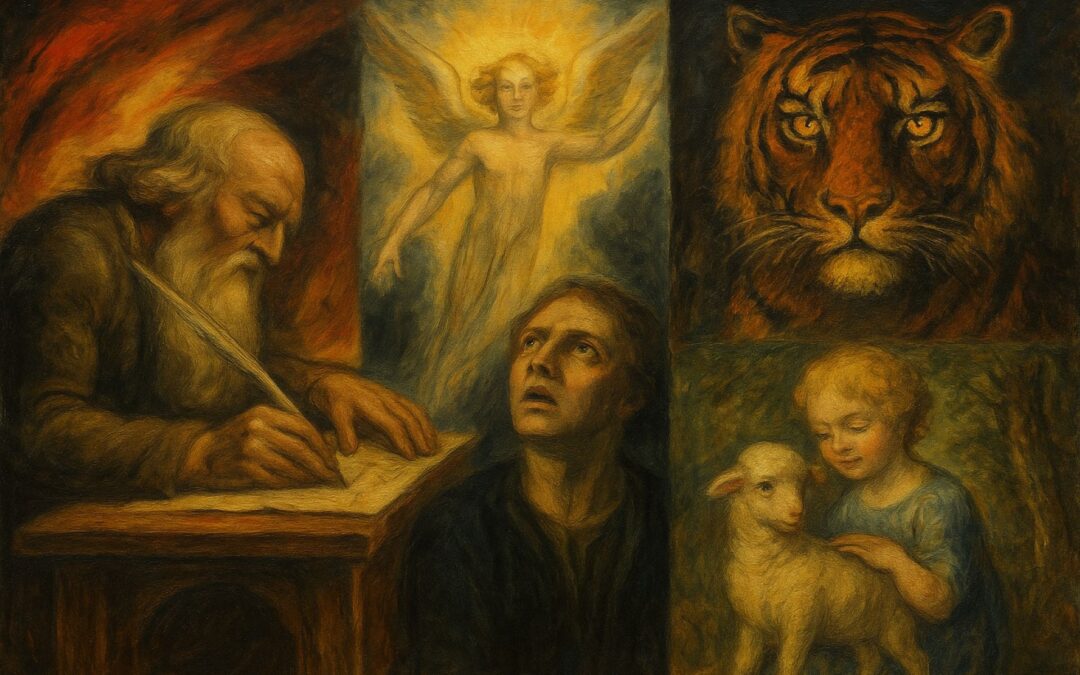
William Blake stood at the intersection of tumult and transformation. At 32, as the Bastille fell and the French Revolution shook Europe, Blake was not merely a witness but a visionary poised to channel the seismic upheaval into art and poetry that would ripple through centuries. His creative fervor, ignited by the clarion calls of liberty, would birth some of his most enduring works—works that appear deceptively simple but conceal a radical, almost incendiary heart.

Songs of Innocence and of Experience: The Dual Soul of Humanity
William Blake’s Songs of Innocence and of Experience is a singular achievement in the poetic canon, a profound exploration of the human psyche’s bifurcated nature. This two-part collection was more than a mere juxtaposition of light and dark; it was a carefully constructed dialectic, an artistic endeavor to map the complex terrain between naïveté and disillusionment, trust and skepticism, joy and despair.
Songs of Innocence, published in 1789, emerged during a moment of fervent optimism. The French Revolution had ignited imaginations across Europe, and Blake was swept up in this wave of hope for a more just and egalitarian society. The poems in this volume are marked by their apparent simplicity—childlike voices singing in clear, rhythmic patterns reminiscent of lullabies and nursery rhymes. But beneath this accessible veneer lies a deeply spiritual and philosophical foundation. Innocence here is not ignorance but a state of openness and faith, a communion with nature and the divine that imbues existence with meaning and possibility.
In these poems, authority figures such as shepherds, angels, and nurturing mothers symbolize a benevolent guardianship. They are present not to dominate but to guide, protect, and encourage growth. The world in Songs of Innocence is suffused with light and harmony, where the boundaries between humanity, nature, and spirituality dissolve into a unified whole. The trust in authority is not blind submission but a reciprocal relationship grounded in care and mutual respect.
However, this innocence is perilously vulnerable. As the revolutionary fervor gave way to reaction and repression, Blake’s vision darkened. By the time he composed Songs of Experience in 1794, the idealistic promises of liberty had been marred by the guillotine’s shadow and the brutal realities of power. This second volume reflects a world hardened by betrayal, fear, and cynicism. The poems grow darker, imbued with irony and bitterness. Authority transforms from guardian to oppressor. Priests who once comforted become tyrants who beat children. Parents impose shame and restriction. Teachers hammer conformity into young minds.
The voice of experience is one of awakening and bitter knowledge. It reveals how innocence can be corrupted, how freedom can be shackled, and how the soul wrestles with moral ambiguity. The language is sharper, the imagery starker, the tone more sardonic.
What distinguishes Blake’s work is that he refused to let these states be read in isolation. He re-ordered poems between the two volumes multiple times, signaling his belief in their interdependence. Innocence and experience are not polar opposites locked in eternal conflict; they are interwoven aspects of human existence. This synthesis is vividly illustrated by paired poems such as The Lamb and The Tyger, which must be read together to grasp the full spectrum of divine creation and human perception.
Ultimately, Blake invites readers into a dynamic, living dialogue between hope and despair, faith and doubt, light and shadow. He demands that we hold these tensions simultaneously, recognizing that to live fully is to navigate the liminal space between innocence and experience. This profound duality forms the spiritual and emotional backbone of his poetic vision.
Visions Beyond Reason: Blake’s Mystical Imagination
William Blake’s creative universe was not built on mere observation or intellectual abstraction; it was forged in the crucible of vivid, transformative visions. From early childhood, Blake claimed to experience profound encounters with the supernatural—angels, demons, saints, biblical figures, and even historical artists emerged in his waking life with startling immediacy. These were not whimsical flights of fancy or the fanciful inventions of an eccentric mind; to Blake, they were tangible realities, as integral to existence as the physical world.
Unlike many mystics who often depict their visions with awe or tentative reverence, Blake’s accounts are marked by an unshakeable conviction and an almost casual acceptance. In The Marriage of Heaven and Hell, he describes meeting an angel as an ordinary event, devoid of doubt or irony, illustrating how deeply the visionary realm permeated his consciousness.
This immersion in the mystical was a radical counterpoint to the dominant Enlightenment worldview of his time, which championed reason, empirical evidence, and scientific rationality as the exclusive paths to truth. Blake vehemently rejected this confinement, positing imagination as the highest faculty and the true gateway to understanding. For him, reason alone was insufficient—indeed, it was a form of spiritual blindness that obscured deeper truths.
His depiction of Jesus in The Everlasting Gospel as a rebellious, back-talking youth exemplifies his iconoclastic approach to religious orthodoxy. By humanizing the divine figure, Blake challenged institutional dogma and invited a more intimate, personal engagement with spirituality.
Blake’s visionary experiences were not isolated moments but continuous threads woven through his life and art. They provided the thematic and symbolic substance for much of his work, informing its vivid imagery, its mythic narratives, and its complex symbolism. These encounters endowed his poetry with an otherworldly dimension that transcends conventional categories of art and religion.
Moreover, Blake’s unflinching belief in the reality of his visions lent his work an extraordinary intensity and authenticity. His language pulsates with the immediacy of lived experience rather than abstract speculation. This visceral connection between visionary insight and poetic expression distinguishes Blake as a unique figure—a mystic who was also a master craftsman of language and image.
In embracing these visions, Blake invites readers to expand their horizons, to acknowledge that reality is not limited to what can be seen or measured but includes vast, unseen dimensions accessible through the creative spirit. His mystical imagination remains a profound challenge to modern readers, urging a reconsideration of the boundaries between perception and faith, reason and revelation.
Imagination as Liberation: Seeing Beyond the Five Senses
At the core of William Blake’s radical philosophy lies a profound conviction: the human experience should never be confined to the narrow prison of the five senses. He viewed the empirical worldview—limited to what is seen, heard, touched, tasted, and smelled—as a constricting veil that dulls the spirit and blinds us to the boundless realities beyond physical perception. For Blake, the imagination was not a mere fanciful escape; it was the supreme faculty through which the soul glimpses truth, freedom, and transcendence.
Blake argued that most people live in a state of “self-imposed limitations,” trapped in a monochromatic existence shaped by rigid societal norms, dogmatic beliefs, and the unquestioned authority of sensory data. This myopia enforces a narrow, fragmented reality, where wonder and mystery are suppressed in favor of routine and materialism. But beneath the surface of everyday life, he insisted, lies a vibrant, infinite world waiting to be unlocked by the creative imagination.
This expansive vision demands a complete reorientation of perception. The imagination enables us to dissolve the boundaries between the ordinary and the extraordinary, to see the miraculous within the mundane. A single leaf ceases to be a simple fragment of nature and becomes a cosmos teeming with life, spirit, and meaning. A child’s laughter is no longer a fleeting sound but a profound revelation of innocence and joy. The world, in Blake’s eyes, is a living tapestry where every detail contains multitudes—“worlds within worlds”—if only we are willing to look with openness and wonder.
Furthermore, Blake’s embrace of imagination is not passive but active and liberating. It is a call to break free from the “dark satanic mills” of repression—whether cultural, religious, or psychological—that chain human creativity and potential. The imagination offers a means to transcend not only external oppression but also internal imprisonment. It invites us to confront and integrate the full spectrum of human emotions—love and hatred, joy and despair, innocence and corruption—without denial or suppression.
This emphasis on emotional authenticity anticipates later psychological insights. Blake’s metaphor of the “poisonous tree” vividly encapsulates the dangers of repressed feelings. As bitterness, resentment, and hatred fester beneath the surface, they grow into a toxic force that corrupts the individual psyche and, by extension, society at large. His poetic warnings resonate strongly with modern understandings of neurosis and the destructive consequences of emotional repression.
Ultimately, Blake’s vision champions a radical liberation: freeing the self from sensory and societal limitations through the transformative power of imagination. This liberation is not escapism but a deeper engagement with reality—a fuller, richer experience of existence that embraces complexity, paradox, and the infinite possibilities latent within everyday life.
The Tyger and The Lamb: Divine Contradictions
Few poetic pairings capture the paradoxes of existence as poignantly as Blake’s The Tyger and The Lamb, two poems that together embody the complex dualities at the heart of his worldview. These emblematic works serve as complementary mirrors reflecting the profound mysteries of creation, divinity, and human perception.
The Tyger stands as a ferocious meditation on the sublime—the terrifying and beautiful forces entwined within nature and the cosmos. From its opening lines, the poem seizes the reader with vivid, apocalyptic imagery: “burning bright” eyes, “fearful symmetry,” and a heart “hammering” in a glowing furnace. Blake invokes the image of a blacksmith’s forge, with “hammers,” “chains,” and “furnaces” evoking both industrial power and mythic creation. The poem throbs with energy and violence, a raw celebration of the tiger’s dangerous beauty.
But beneath this vivid spectacle lies a haunting question: What kind of God could fashion such a creature? This inquiry is not idle curiosity but a profound theological challenge. Blake asks us to grapple with the coexistence of innocence and ferocity, beauty and terror, creation and destruction. The tiger is not merely an animal but a symbol of the fearsome aspects of divine power—the unpredictable, the violent, the inscrutable.
This tension unsettles traditional Christian conceptions of a wholly benevolent and gentle God. The Tyger acknowledges the universe’s contradictions and complexities, suggesting that divine creation encompasses both nurturing and wrathful forces. This ambivalence was a daring and controversial stance in the 18th century, when religious orthodoxy rarely entertained such unsettling reflections.
In contrast, The Lamb offers a serene, comforting counterpoint. Written in a gentle, songlike rhythm, it portrays God as a tender shepherd and protector. The lamb is a classic Christian symbol of innocence, vulnerability, and sacrifice. Blake emphasizes God’s intimacy with creation, portraying the divine as a being who “clothed thee with tender care” and who “became a little child” in Jesus—the “Lamb of God.” This poem radiates warmth, reassurance, and simplicity.
Together, The Tyger and The Lamb invite readers to hold two seemingly contradictory visions of the divine simultaneously: one of fierce, awe-inspiring power, and one of gentle, nurturing love. They embody Blake’s insistence on embracing complexity rather than seeking simplistic moral binaries. Good and evil, fear and comfort, innocence and experience are not separate realms but interwoven threads in the fabric of existence.
By pairing these poems, Blake forces us to confront the uncomfortable reality that divinity—and by extension, life itself—is not reducible to easy answers. Instead, it demands a courageous engagement with paradox, a recognition that beauty and terror coexist, and that understanding requires embracing the full spectrum of human and cosmic experience.
This dialectic remains deeply relevant, challenging us to question our assumptions about God, nature, and morality, and to expand our capacity for empathy, wonder, and critical reflection.
Authority and Its Discontents
Authority is a persistent and multifaceted theme throughout William Blake’s Songs of Innocence and of Experience, serving as a prism through which he examines the dynamics of power, control, and rebellion. Blake’s poetic landscape is populated by a variety of authority figures—parents, priests, nurses, angels—each embodying different expressions of power and influence. The nuanced portrayal of these figures across the two collections reveals Blake’s evolving perspective on how authority shapes human life, often with profound consequences.
In Songs of Innocence, authority is largely benevolent and nurturing. The poems paint a world where figures of power serve protective, guiding roles, fostering a sense of safety and spiritual harmony. For example, the shepherd and angelic guardians are depicted as compassionate caretakers, gently shepherding souls and encouraging moral growth without harsh imposition. This form of authority is intertwined with trust and faith, aligning with the innocence of the poems’ voices. It reflects a worldview where power is exercised responsibly, and where the governed are participants in a nurturing relationship rather than victims of domination.
However, this idealized vision is deliberately destabilized in Songs of Experience, where authority often becomes synonymous with oppression, cruelty, and hypocrisy. Priests who once symbolized spiritual guidance emerge as harsh enforcers of rigid doctrine, meting out punishment and instilling fear rather than comfort. Parents, instead of protectors, are depicted as agents of repression who constrain love and natural desire, binding children with metaphorical “swaddling bands” that symbolize societal and familial control. Schoolmasters hammer rules and conformity into young minds with relentless severity, suppressing individuality and freedom.
Blake’s critique extends beyond individual authority figures to a broader indictment of institutional power structures, particularly organized religion and monarchy. He viewed these institutions as instruments of control that impose arbitrary restrictions on human desire and expression. The church’s prohibitions—against alcohol, sexual freedom, and other natural impulses—are portrayed as destructive forces that deny the sacredness of desire and creativity. In Blake’s radical vision, desire is not a vice but a divine gift, essential for vitality and spiritual growth.
The poem Infant Sorrow encapsulates this theme with striking clarity. The newborn’s immediate struggle against constricting swaddling bands serves as a powerful metaphor for the myriad ways society seeks to control and limit individuals from birth onward. This repression stifles not only physical freedom but also the imaginative and emotional potential intrinsic to human nature.
Blake’s scathing social commentary reaches a crescendo in London, a poem that serves as a violent protest against the industrial revolution’s dehumanizing effects, the monarchy’s complicity in oppression, and the church’s moral hypocrisy. The poem’s bleak imagery—“marks of weakness, marks of woe,” “the mind-forged manacles”—evokes a city and a society suffocated by systemic injustice, poverty, and spiritual decay. Here, Blake’s political outrage is fused with his artistic vision, presenting his poetry as a vehicle for revolutionary dissent.
Throughout these poems, Blake’s ambivalence towards authority is clear: while he acknowledges its necessity in certain contexts, he vehemently opposes its abuse and corruption. He warns of the soul-crushing consequences when authority becomes an instrument of domination rather than a force for guidance and care. His work implores readers to scrutinize and challenge unjust power, championing freedom, imagination, and emotional authenticity as antidotes to oppression.
Radical Politics and Enduring Legacy
William Blake’s work cannot be divorced from the political tumult of his era; his poetry and art are deeply embedded in the revolutionary spirit and social upheavals of the late 18th century. Yet Blake’s radicalism transcended conventional political discourse, fusing fervent activism with mystical vision and a profound critique of all forms of tyranny.
The age in which Blake lived was one of seismic change: the American War of Independence and the French Revolution ignited hopes for liberty, equality, and fraternity. Blake embraced these ideals passionately, seeing in them the possibility of overturning centuries of entrenched oppression. His poems resonate with a fierce denunciation of colonialism, war, slavery, and the systemic exploitation of vulnerable populations, including women, children, and animals.
Blake’s radicalism was remarkably prescient and comprehensive. He condemned not only political despotism but also social and economic injustices perpetuated by class hierarchies. His critique extended to the dehumanizing effects of industrialization, the suppression of creative and emotional expression, and the hypocrisy of religious institutions that preached compassion while enforcing rigid moral codes.
Importantly, Blake’s political vision was inseparable from his mystical worldview. He rejected the Enlightenment’s exaltation of reason as the sole path to truth, instead affirming the primacy of imagination and spiritual insight. This synthesis of visionary mysticism and revolutionary zeal set him apart as a truly unique figure—both a prophet and a radical agitator.
Blake’s legacy is vast and enduring. His insistence on embracing paradox—the coexistence of innocence and experience, good and evil, freedom and constraint—continues to challenge reductive thinking and simplistic moral judgments. His poetry urges us to confront the complexities of human nature and society with courage and nuance.
In the modern context, Blake’s work remains a powerful call to resist oppression in all its guises. His vision of liberation encompasses not only political freedom but also the emancipation of the imagination and the soul. By breaking down the barriers imposed by authority, repression, and narrow perception, Blake’s art continues to inspire those who seek a more just, creative, and spiritually vibrant world.
His radical world, forged in the crucible of revolution and revelation, stands as a testament to the enduring power of art to provoke, to challenge, and to transform.
Conclusion
William Blake’s world is one of profound complexity—a radical fusion of visionary mysticism, fierce political critique, and unyielding faith in the power of imagination. Through Songs of Innocence and of Experience, he challenges us to embrace the contradictions within ourselves and the world around us: the interplay of light and darkness, authority and rebellion, beauty and terror.
His unapologetic rejection of limited perception and his call to liberate the soul through creative vision remain as urgent today as they were centuries ago. Blake’s legacy endures not merely as a collection of poems or artworks but as an invitation—a summons to expand our horizons, question established truths, and courageously navigate the paradoxes that define the human experience. In doing so, we honor a poet who understood that our divided nature is not a weakness but the wellspring of our greatest strength and potential.