
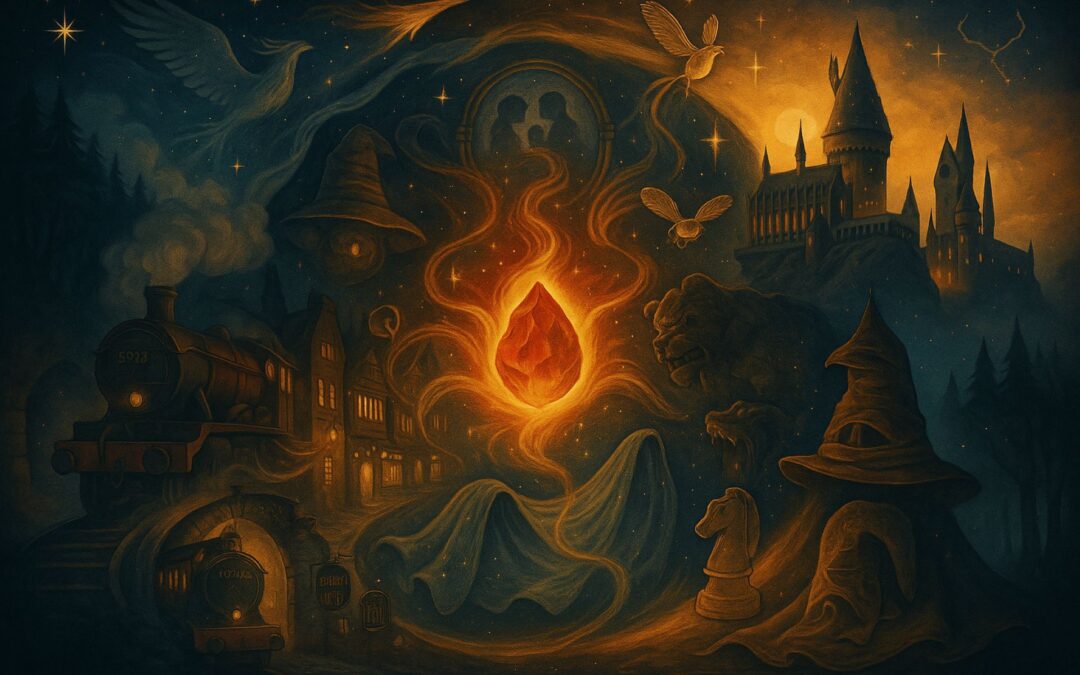
Overview: The Awakening of a Hidden World
Harry Potter and the Sorcerer’s Stone unfolds like a bridge between two worlds — the gray, stifling ordinariness of human life and the dazzling, perilous realm of magic. At its heart lies an awakening: a lonely orphan discovers that he belongs to a world far greater than he ever imagined. J.K. Rowling crafts the story not merely as a fantasy of spells and monsters but as an allegory of self-discovery, friendship, and courage.
The tone begins modest and domestic — a cupboard under the stairs, a boy ignored and unloved — and gradually expands into myth. As Harry enters Hogwarts, the tone shifts to one of wonder tempered by danger; behind every enchanted corridor lies a test of loyalty or virtue. The novel becomes a modern initiation myth: a child called by fate, entering a hidden order, facing trials, and returning with a new understanding of himself and the world.
Through this transformation, Rowling reclaims the classical structure of the hero’s journey for a new generation. The Sorcerer’s Stone is not only the genesis of a magical saga but the story of belonging itself — of finding one’s place in a world that finally recognizes you.
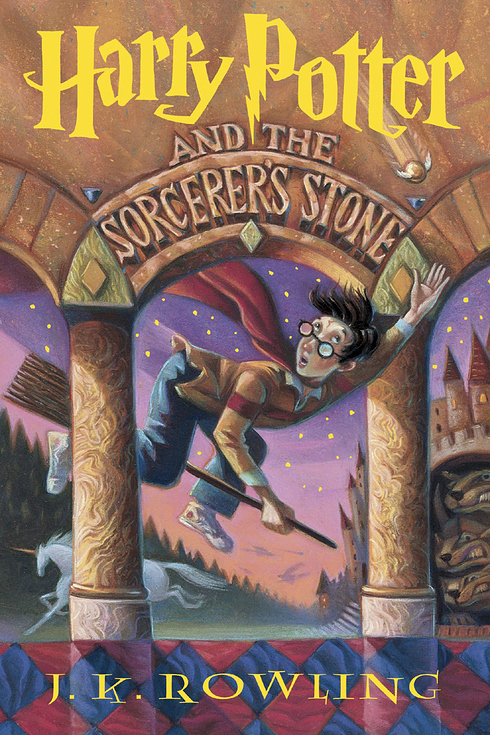
Plot Summary: From the Cupboard to the Castle
Harry Potter and the Sorcerer’s Stone begins as all great myths do — with the ordinary masking the extraordinary. Rowling builds the transition from bleak suburbia to a hidden magical realm with patience and wonder, letting the reader awaken alongside Harry. Each step forward feels like a crossing, from neglect to discovery, from loneliness to belonging.
The Ordinary World
The story begins not with the hero, but with the world that has tried to erase him. On a perfectly normal street — Privet Drive — the Dursleys lead a life of denial. Vernon Dursley sells drills, his wife Petunia prides herself on being “normal,” and their son Dudley is spoiled beyond measure. Theirs is a life scrubbed of wonder, obsessed with appearances, allergic to strangeness.
But outside their narrow world, the wizarding realm stirs in celebration. Owls fly by day, cloaked figures whisper in the streets, and strange shooting stars light up the sky. Something monumental has occurred — the downfall of Lord Voldemort, the most feared dark wizard of all time. His reign of terror has ended because of an infant: Harry Potter, the boy who inexplicably survived the Killing Curse that destroyed his parents.
That night, on the quiet doorstep of Number Four, three figures gather. Albus Dumbledore, the wise headmaster of Hogwarts; Professor McGonagall, transformed from a cat into a stern woman in emerald robes; and Hagrid, the giant keeper of keys, carrying baby Harry in his arms. Dumbledore leaves a letter explaining everything — that Harry’s parents are dead, that he bears the lightning scar of Voldemort’s curse, and that he must stay hidden for his own safety. As the Dursleys sleep inside, unaware, the child who changed the course of the wizarding world is left on their doorstep — alone, anonymous, and marked by destiny.
This opening establishes the emotional architecture of the series: light and darkness intertwined, love and fear at war, magic existing quietly beneath the surface of ordinary life.
The Cupboard Under the Stairs
Ten years pass. The wizarding world may revere Harry Potter as a legend, but in the Dursley household he is treated as less than human. He lives in a cramped cupboard under the stairs, wears Dudley’s old clothes, and endures endless scorn from Aunt Petunia and Uncle Vernon. To them, Harry’s existence is a stain — a reminder of the magical sister Petunia resents and the world she refuses to acknowledge.
Harry’s life is defined by invisibility and small acts of quiet endurance. Yet, strange things sometimes happen around him. His hair grows back overnight after being shaved off. He finds himself suddenly on the school roof after being chased by Dudley’s gang. He has no explanation — only a sense that he is different, and that something inside him does not obey the ordinary laws of the Dursleys’ world.
The pivotal moment comes on Dudley’s birthday trip to the zoo. While the others gawk, Harry finds himself sympathizing with a lonely boa constrictor. When Dudley pushes him aside, the glass vanishes — the snake escapes, and chaos ensues. Though Harry feels a flicker of exhilaration, he’s punished once again. This scene is not mere comic mischief; it is the first expression of Harry’s innate power and empathy — the magic that manifests not as control, but connection.
Life returns to monotony — until the letters arrive. One morning, a strange envelope addressed in emerald-green ink appears, reading:
Mr. H. Potter, The Cupboard Under the Stairs.
Vernon burns it. But more arrive — dozens, then hundreds, flooding the house, bursting through chimneys and cracks. The ordinary world can no longer contain what it has denied. Vernon panics, dragging the family to remote hideouts: first a hotel, then a crumbling hut on a rocky island. Yet even in isolation, the magic finds them.
The Arrival of the Letter
At the stroke of midnight on Harry’s eleventh birthday, the door shudders under a massive knock. A giant bursts through — Rubeus Hagrid, towering, bearded, kind-eyed. He carries a pink umbrella, a birthday cake, and the truth Harry has been denied all his life.
“You’re a wizard, Harry.”
With those words, the veil between worlds lifts. Hagrid explains that Harry’s parents were not drunks killed in a car crash, as the Dursleys claimed, but brilliant wizards murdered by Voldemort. The curse meant to kill Harry rebounded, leaving him alive and Voldemort nearly destroyed. Hagrid’s revelation is both liberation and burden — it gives Harry identity, but also history, one written in blood and sacrifice.
When Vernon insults Dumbledore, Hagrid’s temper flares. He gives Dudley a pig’s tail — a comic punishment that reveals both the power and danger of magic. Hagrid then hands Harry his Hogwarts letter, officially inviting him to attend the school of witchcraft and wizardry.
The world expands overnight. From neglect and invisibility, Harry steps into wonder. He learns about Gringotts Bank, Diagon Alley, wands, broomsticks, and spellbooks — a hidden civilization humming beneath London’s surface. Yet, at this threshold, Rowling weaves subtle contrasts: wonder intertwined with menace, joy tinged with loss. Every revelation reminds Harry of what he’s gained — and what he never had.
The Magical Awakening
Harry’s journey into the wizarding world begins with Hagrid as his guide — half giant, half guardian angel. The two travel to London, where the magic hidden beneath ordinary reality begins to unfold. Their first stop is Gringotts Wizarding Bank, a cavernous underground fortress run by goblins. Here, Harry learns what it means to possess value in both worlds — he discovers a vault filled with gold left by his parents and another, secret vault from which Hagrid retrieves a small, mysterious package under Dumbledore’s orders. This detail, subtle at first, becomes central to the novel’s mystery: the Sorcerer’s Stone.
Hagrid introduces Harry to Diagon Alley, a hidden marketplace that bursts with life — cauldrons, spellbooks, robes, wands, and owls for sale. It’s a scene of revelation, where everything Harry had imagined becomes tactile and real. He buys his school supplies, and then, in Ollivanders’ Wand Shop, experiences his first act of true magic: the wand chooses him. It’s a moment of eerie destiny — the phoenix feather in Harry’s wand comes from the same bird that gave a feather to Voldemort’s. Two lives intertwined by fate.
Through Hagrid’s stories, Harry begins to piece together fragments of his parents’ world: their courage, their friendship, and their defiance of Voldemort. He also learns that fame precedes him — strangers recognize his scar and whisper his name with reverence. Yet, for Harry, fame feels hollow. He has lived his whole life unseen; being seen now is disorienting, even painful. Rowling crafts this awakening not as triumph, but as tension — the child’s dream of being special collides with the burden of inherited destiny.
When Harry boards the Hogwarts Express at Platform 9¾, the threshold between worlds closes behind him. The train becomes a corridor of transformation — a moving passage from loneliness to belonging. Onboard, he meets Ron Weasley, whose humor and warmth cut through Harry’s self-consciousness, and Hermione Granger, whose intelligence and earnestness both impress and irritate. In that train compartment, the golden trio of the series is born — a friendship grounded in contrast, challenge, and fierce loyalty.
Life at Hogwarts
The arrival at Hogwarts is one of the most enchanting transitions in modern literature. The castle looms like a dream made stone, illuminated by floating candles and alive with magic. The students are sorted into four houses — Gryffindor, Slytherin, Hufflepuff, and Ravenclaw — each representing a moral or intellectual ideal. When the Sorting Hat hesitates between Slytherin and Gryffindor for Harry, it foreshadows an inner conflict that will haunt him for years: the pull between light and shadow, courage and ambition.
Hogwarts itself becomes a character — a living, breathing organism filled with secrets and sentience. Portraits whisper, staircases move, ghosts glide through corridors. Each class offers a different philosophy of the magical world: Professor McGonagall’s transfiguration lessons teach discipline and precision; Professor Snape’s potions class becomes a study in hostility and restraint; and Defense Against the Dark Arts — taught by the timid Professor Quirrell — hides its own dark irony.
Harry’s sense of belonging crystallizes on the Quidditch field. Discovered for his natural flying talent, he becomes the youngest Seeker in a century. In the air, he feels pure freedom — an echo of the exhilaration he felt at the zoo, magnified into purpose. Quidditch, like the story itself, becomes a metaphor for agility, balance, and moral risk — how one flies is as important as whether one wins.
Yet beneath the wonder, unease grows. The third-floor corridor is forbidden. Harry, Ron, and Hermione’s curiosity leads them to a terrifying discovery: a three-headed dog guarding a trapdoor. It’s a moment that signals the novel’s tonal shift — from the innocence of arrival to the awareness of danger.
Harry’s fame also isolates him. Draco Malfoy’s sneering privilege reminds him of the hierarchies within this new world. Snape’s inexplicable hatred adds another layer of mystery. And his scar — once a mere mark — becomes a symbol of connection to something dark and watching.
The Mystery of the Sorcerer’s Stone
The school year deepens into intrigue. A break-in at Gringotts links directly to the forbidden corridor — the stolen vault was the one Hagrid had opened. Someone is trying to seize the Sorcerer’s Stone, a legendary alchemical artifact capable of granting eternal life and unlimited wealth.
Harry and his friends begin piecing together clues, convinced that Professor Snape is the culprit. Their suspicions grow after Harry’s broom malfunctions during a Quidditch match — a hex seemingly cast from the stands, with Snape muttering under his breath. Hermione’s quick thinking saves Harry, but the question lingers: why would a teacher want him dead?
At Christmas, Harry receives an Invisibility Cloak — once belonging to his father — and discovers the Mirror of Erised. When he gazes into it, he sees his parents smiling back at him. It’s a heartbreaking encounter: the mirror shows “the deepest desire of one’s heart.” For Harry, it is not power or fame but family — the love he never knew. Dumbledore’s gentle warning, that the mirror can trap those who live in dreams instead of reality, becomes one of the novel’s moral touchstones.
As the term progresses, Hagrid unintentionally reveals that he was given the three-headed dog, Fluffy, by a mysterious stranger who asked about music — the key to bypassing the creature. The puzzle snaps into focus: someone is planning to steal the Stone.
The trio resolves to act. This decision — impulsive, dangerous, but guided by conscience — marks their moral initiation. Children who once broke rules for curiosity now break them for principle. The shift is subtle but crucial: heroism begins not in power, but in responsibility.
The Descent Below
The final act of Harry Potter and the Sorcerer’s Stone unfolds as a descent into both the literal and symbolic underworld — a journey from childhood wonder into moral awakening. When the trio learns that Dumbledore has been called away from Hogwarts, they realize that the thief will strike that very night. Trusting no one, not even their professors, they decide to intervene themselves.
Armed with the Invisibility Cloak and courage far beyond their years, Harry, Ron, and Hermione slip past the castle’s defenses and reach the forbidden corridor. Using Hagrid’s clue, they lull Fluffy to sleep with a soft tune from Harry’s flute and open the trapdoor. What follows is a sequence of trials, each one testing a different virtue.
First comes the Devil’s Snare, a living plant that constricts around its victims — a symbol of fear and panic. Hermione’s quick thinking saves them; she remembers that the plant recoils from light and heat, illuminating how knowledge and composure defeat chaos. Next, they enter a chamber filled with flying keys, where Harry’s natural gift for flight and intuition leads him to the right one — a moment that fuses his emotional instincts with skill.
The third challenge is a life-sized chessboard. Ron, the strategic mind of the group, takes command. Every move is a calculated sacrifice; to win, he must allow himself to be struck down. It’s the first moment in the series where friendship demands loss, and Ron’s quiet courage foreshadows the selflessness that defines true heroism.
The trio then faces a room lined with bottles — a logic puzzle designed by Snape. Hermione, grounded in reason and intellect, solves it, proving that bravery alone is not enough; wisdom, too, has its place in courage. With her guidance, Harry proceeds alone to the final chamber.
Each of these trials mirrors the children’s strengths and weaknesses — heart, logic, and loyalty — while symbolizing the triad of virtues Rowling builds the series upon. What lies beyond them is not just danger, but destiny.
The Confrontation with Voldemort
In the last chamber, Harry finds not Snape as expected, but Professor Quirrell — the nervous, stammering man who had seemed harmless all along. The revelation reframes the entire mystery: it was Quirrell who had hexed Harry’s broom, Quirrell who had let the troll into the castle, Quirrell who had been seeking the Stone for his master — Lord Voldemort.
The true horror is unveiled when Quirrell removes his turban, revealing Voldemort’s face, pale and snake-like, growing out of the back of his head. This grotesque image is not only a moment of shock but a metaphor — evil as parasitic, feeding on weakness and fear. Voldemort’s voice, whispering from the back of Quirrell’s skull, tempts Harry with promises of greatness. He speaks of immortality, of resurrecting his parents, of the power to rise above the mediocrity of others. It’s the serpent’s whisper of Genesis, the seduction of forbidden knowledge.
The Mirror of Erised stands before them, showing each person their heart’s desire. For Quirrell, it reveals the Stone; for Harry, it shows his parents. But because Harry wants not to use the Stone but to keep it safe, the magic rewards his purity — the Stone appears in his pocket.
When Quirrell attacks, Harry discovers that his very touch burns him. Dumbledore later explains that Harry’s mother’s sacrificial love left a protective charm upon him — love, in Rowling’s world, is not sentiment but power, ancient and unbreakable. Voldemort cannot bear to touch what is pure.
Quirrell collapses, consumed by his master’s presence. Voldemort’s spirit, still bodiless, tears free and escapes into the night, leaving Harry unconscious on the cold stone floor. The confrontation is not merely a victory over evil, but a revelation: that strength without love consumes itself, and innocence, when protected by sacrifice, becomes its own form of magic.
The Return Home
Harry awakens in the white serenity of the Hogwarts hospital wing. Dumbledore sits beside him, calm and knowing. Their conversation serves as the book’s quiet denouement — a philosophical reflection disguised as a bedside talk. Dumbledore explains that the Stone has been destroyed to prevent its misuse, and that Nicholas Flamel, its ancient creator, will at last die — not with fear, but with acceptance. Mortality, Dumbledore suggests, is the proper shape of life. “To the well-organized mind, death is but the next great adventure.”
Harry learns that Ron and Hermione are safe, and that Gryffindor has won the House Cup, their bravery earning enough points to triumph over Slytherin. Yet what lingers is not the victory but the peace that follows understanding. Harry’s mother’s love, invisible yet invincible, becomes the moral foundation of his life to come.
The year ends with the feast — laughter, color, the return of joy. But beneath it lies quiet wisdom: that evil can be defeated but not destroyed, that courage begins in fear, and that friendship is the true magic binding their world together.
As the train departs, Harry looks out at the green hills, his heart split between two worlds — the ordinary and the extraordinary. When Ron asks if he dreads returning to the Dursleys, Harry smiles: “They don’t know I can’t use magic outside school.” It’s a small moment of triumph — the orphan who once had nothing now carries within him a secret world, a sense of belonging, and the unspoken promise of return.
Character Analysis: The Faces of Friendship and Fear
At the heart of the story lies a constellation of souls — flawed, brave, and deeply human. Through them, Rowling maps the moral landscape of the wizarding world: friendship as light, ambition as shadow, and love as the thread binding both. Each character mirrors a different form of courage, revealing what it means to live truthfully in a world ruled by illusion.
Harry Potter
Harry begins as a figure of neglect and invisibility — a boy erased by circumstance. His upbringing under the Dursleys has stripped him of confidence but not of goodness. What defines Harry is not the power he unknowingly possesses but the empathy he naturally expresses. His compassion for the snake at the zoo, his loyalty to friends, and his instinct to defend the weak all foreshadow the leader he will become.
Unlike many mythic heroes, Harry’s awakening is quiet and reluctant. He does not crave destiny; it finds him. His humility, forged in deprivation, becomes his moral compass. Even as he learns he is famous, he resists pride. The scar on his forehead — his mark of survival — functions as both a physical reminder of loss and a symbol of resilience. It binds him to his parents’ love and to the darkness that seeks to consume him.
Throughout the book, Harry’s greatest growth lies in learning to trust — first Hagrid, then Ron and Hermione, and finally himself. His courage is not born of arrogance but of necessity, his heroism not in victory but in the willingness to act despite fear. Rowling portrays him as the archetype of moral choice: the child who chooses goodness even when power tempts him otherwise.
Hermione Granger
Hermione enters as the embodiment of intellect — brilliant, precise, and at times insufferably rule-bound. Her early arrogance masks insecurity; as a Muggle-born witch, she compensates with perfectionism. Yet beneath her know-it-all exterior lies immense heart. When she apologizes after the troll incident, her humility marks the birth of true friendship.
Her intelligence becomes invaluable during the trio’s trials — especially the logic puzzle protecting the Stone. Rowling uses Hermione to bridge intellect and morality, showing that knowledge gains meaning only when paired with compassion. She evolves from student to strategist, from outsider to indispensable ally.
Hermione’s development also reflects a broader theme in Rowling’s work: the reclaiming of intellect as a form of courage. In a world that celebrates daring over diligence, Hermione proves that wisdom is itself heroic.
Ron Weasley
Ron represents the human core of the trio — flawed, funny, and fiercely loyal. As the youngest son in a large, modest family, he lives in the shadow of others’ achievements. His friendship with Harry restores his sense of worth, while his humor grounds their adventures in warmth.
Ron’s defining moment comes in the giant chess game, where he sacrifices himself so the others can advance. This act, understated but profound, transforms him from comic relief into moral center. Ron’s courage is not flamboyant; it’s domestic, born of love and loyalty rather than ambition. He embodies the courage of the ordinary — the quiet bravery that holds friendships and worlds together.
Albus Dumbledore
Dumbledore is the novel’s moral architect — a figure of both mystery and wisdom. He operates at a remove, allowing Harry to make his own choices while quietly guiding him toward truth. His demeanor blends eccentric humor with profound insight, concealing an understanding of good and evil that runs deeper than mere authority.
In the hospital wing conversation, Dumbledore articulates the story’s spiritual core: love as protection, death as inevitability, and knowledge as responsibility. His mentorship teaches Harry not what to think, but how to think — how to navigate uncertainty with compassion.
Rubeus Hagrid
Hagrid embodies innocence in strength. His towering frame and wild appearance belie a childlike tenderness. He rescues Harry from neglect, introduces him to the magical world, and serves as his emotional anchor throughout the story. Hagrid’s flaws — his inability to keep secrets, his impulsiveness — make him endearing and human.
He represents the bridge between worlds: half giant, half man, belonging fully to neither. His loyalty to Dumbledore and love for magical creatures reflect Rowling’s recurring theme of misunderstood beings — that what society fears or ridicules often possesses the purest heart.
Severus Snape
Snape’s presence in The Sorcerer’s Stone is a masterclass in misdirection. Cold, sarcastic, and seemingly vindictive, he becomes the story’s red herring. His animosity toward Harry appears personal and irrational, yet behind his bitterness lies complexity — hints of old wounds, unspoken debts, and loyalty concealed beneath disdain.
Rowling’s portrayal of Snape introduces the idea that goodness is not always visible, and evil not always obvious. Though the full scope of his character unfolds later in the series, his early presence injects the story with moral ambiguity — a reminder that perception often distorts truth.
Voldemort
Though physically absent for most of the novel, Voldemort’s shadow defines it. His name evokes fear even in silence, his survival as a bodiless spirit personifies the persistence of evil — never destroyed, only diminished. His philosophy is the antithesis of Dumbledore’s: domination over compassion, immortality over integrity, control over love.
In The Sorcerer’s Stone, Voldemort functions as a mythic symbol of corrupted desire — the human fear of death pushed to its extreme. His confrontation with Harry becomes an allegory for moral resistance: the power of love to repel the seduction of power itself.
Themes and Motifs: Love, Power, and the Choices That Define Us
Rowling’s debut novel shimmers with moral depth beneath its enchantment. Every spell, object, and encounter becomes a lesson in what it means to choose — between fear and compassion, ambition and humility, control and surrender. The book’s themes operate like invisible magic, shaping the heart as much as the plot.
The Power of Love
At the center of Harry Potter and the Sorcerer’s Stone lies the oldest and simplest magic: love. It is not conjured through incantations or potions but through sacrifice. Lily Potter’s decision to die protecting her son becomes the unseen enchantment that shields Harry from Voldemort — love as both weapon and armor.
Rowling redefines heroism through this lens. Where Voldemort seeks immortality through domination, Harry’s survival stems from compassion freely given. Love is depicted as an ancient power that transcends even death — unquantifiable, unteachable, yet more potent than any spell. Dumbledore’s quiet insistence that “love leaves its own mark” becomes the moral cornerstone of the entire series.
Friendship and Belonging
Harry’s journey is as much emotional as magical. Having grown up in isolation, his first real sense of belonging comes through friendship. Ron and Hermione represent two halves of his own humanity — loyalty and reason, heart and mind. Together they form a trinity of virtues that balance and strengthen one another.
Friendship, in Rowling’s world, is not decorative but redemptive. It grants courage to act, wisdom to choose, and love to endure. The trio’s willingness to risk expulsion or even death for one another transforms youthful companionship into moral fellowship. In a world defined by secrecy and division, friendship becomes resistance.
The Seduction of Power
The Sorcerer’s Stone itself embodies the novel’s moral question: What would you do if given absolute power? The Stone grants immortality and limitless wealth — yet every character who desires it does so for selfish reasons. Voldemort seeks resurrection; Quirrell seeks significance; even the mirror’s promise tempts with illusion.
Harry’s virtue lies not in rejecting the Stone but in desiring only to protect it. His purity of intention allows him to obtain it — and this paradox forms the moral heart of the story: power can only be trusted to those who do not crave it.
Choice and Destiny
Rowling blurs the line between fate and free will. Harry is “the boy who lived,” bound by prophecy, yet his life is defined by his choices. He could follow the path of ambition (Slytherin) but chooses the path of courage (Gryffindor). His decisions — to confront danger, to protect the innocent, to trust his friends — shape his destiny more than his birthright.
The Sorting Hat scene encapsulates this theme: “It is our choices, Harry, that show what we truly are, far more than our abilities.” Rowling thus elevates moral choice above innate talent — a principle that echoes throughout the series and challenges the deterministic myth of “chosen ones.”
The Hidden World Within the Ordinary
Perhaps the most enchanting motif of all is the coexistence of two realities — the magical and the mundane. Privet Drive and Diagon Alley, the Muggle world and Hogwarts, coexist like two dimensions of the same moral landscape. Rowling suggests that wonder is never far from reach; it merely hides behind walls of disbelief.
This duality serves as both fantasy and metaphor: every child lives between two worlds — the imagination and the ordinary. By stepping through the wall at Platform 9¾, Harry does not abandon reality; he discovers its hidden depths.
The Mirror of Desire
The Mirror of Erised is one of the most poignant symbols in the novel. It reflects not the world as it is, but the soul’s deepest yearning. To Harry, it shows his parents; to Dumbledore, something he refuses to reveal. Its message is deceptively simple: desire can comfort but also consume.
The mirror’s name itself — “Erised” (desire spelled backward) — captures the theme of inversion: what we long for most often blinds us to what we have. Rowling uses this object to warn against nostalgia and fantasy, reminding readers that living in dreams denies life its present meaning.
The Triumph of Innocence
The novel celebrates innocence not as ignorance, but as moral clarity. Harry’s strength lies in his uncorrupted heart — in his ability to see goodness and evil without cynicism. In contrast, Voldemort, consumed by intellect and ambition, sees only fear.
Through this contrast, Rowling reframes innocence as wisdom — the courage to love in a world that worships control. The boy who lived does not win through cunning or violence, but through purity of spirit.
Setting and Atmosphere: Where Magic Breathes Beneath the Ordinary
The world of The Sorcerer’s Stone feels both new and eternal — a fusion of the mundane and the miraculous. Rowling’s imagination re-enchants the familiar, turning train platforms, classrooms, and corridors into thresholds of transformation. Every setting carries mood and meaning, inviting readers to sense that wonder has always lived just out of sight.
The Ordinary and the Magical
Rowling’s genius lies in her seamless fusion of the everyday and the extraordinary. Harry Potter and the Sorcerer’s Stone begins in the drab, colorless suburbia of Privet Drive — a world of order, monotony, and emotional sterility. The Dursleys’ home, with its manicured lawns and beige walls, becomes a metaphor for repression: a place where imagination, love, and difference are treated as threats.
From this stifling normalcy, the magical world emerges not as a complete escape but as a revelation of what reality could be if wonder were allowed to exist. The transition from Privet Drive to Diagon Alley marks a shift in sensory register — from gray to gold, from silence to symphony. The wizarding world feels not invented but remembered, as if it had always been hidden beneath the folds of the ordinary world, waiting to be seen.
Hogwarts: The Living Castle
Hogwarts School of Witchcraft and Wizardry serves as the heart of Rowling’s imaginative architecture. The castle is both sanctuary and labyrinth — a microcosm of the moral and emotional growth that defines the series. Its enchanted staircases, talking portraits, and hidden chambers make it feel alive, constantly shifting like the minds it shelters.
The four Houses — Gryffindor, Slytherin, Ravenclaw, and Hufflepuff — create an ecosystem of values: courage, ambition, wisdom, and loyalty. These are not static traits but moral orientations, each with its shadow. The castle thus becomes a moral map, reflecting the choices and contradictions of its inhabitants.
At the sensory level, Hogwarts glows with medieval warmth: candlelight, wooden banquets, echoes in stone corridors. It evokes the nostalgic comfort of an old boarding school while infusing it with magic, ritual, and danger. The Great Hall, with its floating candles and enchanted ceiling, represents community and belonging — the antithesis of the isolation Harry endured at the Dursleys’.
Diagon Alley: The Marketplace of Wonder
If Hogwarts is the mind of the magical world, Diagon Alley is its beating heart. The street overflows with sensory delight — shimmering spellbooks, chattering owls, steaming cauldrons, and wizards in eccentric attire. It captures the childlike ecstasy of discovery, where every object hums with unseen life.
But beneath its whimsy lies structure. The Alley is capitalism reimagined as enchantment — where commerce and magic intertwine, and the act of buying a wand or robe becomes a rite of passage. It is also a cultural crossroads, introducing readers to the vast, layered society that Rowling will explore in later books.
The Forbidden and the Shadowed
Even within Hogwarts’ magic, there are shadows. The Forbidden Forest and the third-floor corridor embody the ever-present boundary between curiosity and danger. The forest, teeming with centaurs, unicorns, and unseen terrors, is the archetypal dark wood of myth — the place where innocence is tested.
Its most haunting scene — the image of Voldemort drinking unicorn blood — fuses beauty with desecration. It is in these settings that Rowling’s fairy-tale imagery deepens into moral allegory: purity consumed by evil, light corrupted for survival.
Atmosphere: Between Wonder and Dread
The emotional atmosphere of The Sorcerer’s Stone oscillates between awe and anxiety. Rowling never allows magic to become purely safe or sentimental. Each marvel carries an undercurrent of danger, every act of discovery shadowed by moral cost.
The tone is reminiscent of the English fairy-tale tradition — whimsical yet edged with darkness. Like Alice in Wonderland or Peter Pan, the novel treats childhood as a place of imagination and peril. But Rowling modernizes this mood with emotional realism: beneath the spells and creatures lie loneliness, courage, and choice.
In the end, Hogwarts is not just a setting — it is a metaphor for growth itself: mysterious, unpredictable, and full of rooms still undiscovered.
Tone and Style: A Voice That Rediscovers Wonder
Rowling writes with a storyteller’s intuition — her sentences moving between humor and awe, simplicity and depth. The tone of the novel grows with its hero, shifting from the comic to the mythic, from laughter to longing. Her voice reminds us that magic is not just spectacle but the rediscovery of faith in goodness.
A Modern Fairy Tale
J.K. Rowling’s tone in Harry Potter and the Sorcerer’s Stone walks the delicate line between wonder and wisdom. She writes with the cadence of an old storyteller — the comfort of “once upon a time” blended with the immediacy of a modern voice. The tone begins gently comic and domestic, evoking the humor and rhythm of Roald Dahl, before deepening into the moral clarity of classic myth.
The novel’s first chapters — with their satirical treatment of the Dursleys — establish a playful tone that lures readers into laughter before slowly shifting toward awe. As the story unfolds, humor gives way to discovery, and discovery to danger. This tonal evolution mirrors Harry’s own emotional journey: from bewilderment to belonging, from innocence to awareness. Rowling’s mastery lies in this tonal elasticity — her ability to make a sentence shimmer with both whimsy and gravity.
The Language of Magic
Rowling’s prose is deceptively simple — brisk, rhythmic, and accessible — yet charged with mythic resonance. Her language evokes enchantment not through ornamentation but through precision. Every name, object, and spell carries etymological playfulness: “Hogwarts” (a mix of rustic and grotesque), “Diagon Alley” (a pun on “diagonally”), “Erised” (desire reversed). These linguistic puzzles invite readers into collaboration; magic, in Rowling’s world, begins in words themselves.
Her descriptions are tactile and sensorial — the smell of treacle tart at the Great Feast, the glint of gold in Gringotts, the echoing hush of the Forbidden Forest. Through this sensory richness, Rowling builds a world that feels lived-in, not invented. She achieves what C.S. Lewis called “the kappa element in romance” — that elusive realism in fantasy which makes the unreal feel inevitable.
Humor and Humanity
Even in moments of peril, Rowling’s humor persists. Hagrid’s malapropisms, Ron’s exasperations, and the Weasley twins’ antics inject levity into scenes of tension. This humor isn’t mere comic relief; it’s moral balance. Laughter, in Rowling’s universe, is an antidote to fear — a small act of rebellion against darkness.
Her dialogue sparkles with authenticity. The banter among friends feels spontaneous, the teachers’ wit subtly archaic, and Dumbledore’s eccentric remarks hover between jest and philosophy. Through these tonal shifts, Rowling reminds readers that goodness is not solemnity; it often wears the face of laughter.
Narrative Perspective
The story unfolds through a third-person limited perspective anchored in Harry’s consciousness. This choice gives readers a child’s-eye view of the world — open, questioning, and emotionally immediate. We see through Harry’s astonishment, his fear, his longing for belonging. This perspective also sharpens the mystery: the reader, like Harry, learns the truth in fragments, never ahead of him.
By aligning narrative discovery with emotional development, Rowling ensures that plot and psychology move together. Magic is not external spectacle but an extension of feeling — enchantment as empathy.
The Emotional Architecture
Beneath its adventure structure, the novel’s style is anchored in sentiment — not sentimentality, but emotional precision. Rowling writes with tenderness toward the wounded child at the story’s heart, and with quiet fury toward cruelty, neglect, and moral blindness. Her tone treats wonder as sacred but never naive; every spell is shadowed by consequence.
In essence, The Sorcerer’s Stone is written in the voice of faith — not religious faith, but belief in meaning: in courage, friendship, and love as real forces. The tone invites not escape from the world but re-enchantment with it.
Symbolism and Imagery: The Scar, the Mirror, and the Stone
In Rowling’s universe, symbols do more than decorate the story — they reveal its hidden moral code. Each object and image carries emotional resonance, translating spiritual truths into tangible form. Through these emblems, she transforms fantasy into philosophy, and magic into meaning.
The Scar: Memory Made Flesh
Harry’s lightning-shaped scar is the novel’s most enduring symbol — at once a wound, a signature, and a prophecy. It marks him as “the boy who lived,” yet also binds him to the darkness that tried to destroy him. Unlike a typical heroic emblem, it is not a badge of glory but a reminder of pain — a constant link between past trauma and present identity.
The scar throbs whenever Voldemort is near, serving as both alarm and echo — the external manifestation of the inner struggle between love and fear, good and evil. In literary terms, it functions as what Jung would call a “numinous mark”: a visible reminder that transformation begins through suffering.
The Mirror of Erised: The Heart’s Illusion
The Mirror of Erised is one of Rowling’s most haunting creations — a reflection not of the face, but of the soul’s deepest longing. Its inscription, “Erised stra ehru oyt ube cafru oyt on wohsi,” when read backward, reveals its secret: “I show not your face but your heart’s desire.”
For Harry, it becomes a doorway to impossible love — the chance to see his parents alive. Yet the mirror’s seduction lies precisely in its comfort. Dumbledore’s warning — that those who dwell on dreams may forget to live — transforms the mirror into a moral allegory about the perils of nostalgia. It stands for every human temptation to live in reflection rather than reality.
The Sorcerer’s Stone: Desire and Corruption
The Stone, or the Philosopher’s Stone as it is known in alchemical tradition, represents the ancient quest for immortality — the human impulse to transcend death and decay. In Rowling’s retelling, it becomes both a literal object and a spiritual metaphor.
To Voldemort, it symbolizes absolute control — the power to conquer mortality. To Dumbledore and Flamel, it is a symbol of knowledge’s restraint — the wisdom to destroy what cannot be responsibly used. To Harry, it is temptation without attachment. His ability to possess the Stone only because he does not seek to use it encapsulates the paradox of virtue: true power is accessible only to those who do not crave it.
The Chess Game: The Logic of Sacrifice
The enchanted chessboard near the story’s climax transforms a childhood game into a battlefield of moral principle. Ron’s decision to sacrifice himself so that Harry and Hermione can continue reflects the novel’s recurring theme — that victory requires loss, and friendship demands courage in the face of danger.
The chessboard, with its calculated risks and hierarchical pieces, mirrors the broader struggle of the magical world — a world where power must yield to love, and strategy must serve purpose. It is one of Rowling’s clearest metaphors for leadership: to move forward, one must sometimes choose to stand still or step aside.
The Forbidden Forest: The Shadow Realm
The Forbidden Forest, vast and ancient, is the dark mirror of Hogwarts — the subconscious of the magical world. Here, the boundaries between beauty and terror blur. Centaurs speak in riddles, unicorns bleed silver, and evil preys on innocence. The scene in which Voldemort drinks unicorn blood distills the story’s central moral tension: to preserve one’s life by destroying purity is to forfeit the soul.
The forest symbolizes the space of confrontation — where innocence meets corruption, and knowledge begins in fear. Like every mythic hero, Harry must descend into darkness before emerging with insight.
The Invisibility Cloak: The Gift of Perspective
The Cloak, passed down from Harry’s father, is more than a magical garment — it represents humility and perception. While invisibility often implies deceit, Rowling reclaims it as empathy — the ability to observe without being seen, to witness the world without interfering.
In mythic terms, it aligns Harry with the archetype of the hidden hero — the one who acts unseen, guided by conscience rather than recognition. Its quiet magic contrasts Voldemort’s hunger for spectacle and domination.
Light and Shadow
Throughout the novel, light and darkness operate as visual metaphors for truth and ignorance. Candles illuminate the Great Hall; the golden snitch glimmers in pursuit; even the spark of a wand becomes a gesture of defiance. Conversely, Voldemort’s presence is marked by cold, silence, and absence.
Yet Rowling avoids binary simplicity. Darkness is not evil itself — it is the condition in which courage reveals itself. The interplay of light and shadow reflects her larger belief: that morality is tested not in perfect brightness but in the half-lit spaces where choice resides.
Moral and Philosophical Reflection: Love as the Only True Magic
Beneath its adventure and wonder, The Sorcerer’s Stone unfolds as a meditation on moral choice and human nature. Rowling turns the child’s journey into a philosophical parable — a dialogue between love and fear, humility and power. The result is both intimate and universal, a fable about what makes the soul endure.
Love as the Highest Law
At its philosophical core, Harry Potter and the Sorcerer’s Stone is a meditation on love as the supreme organizing principle of life. Where most fantasy celebrates power, Rowling sanctifies care — the quiet, sacrificial kind that expects nothing in return. Lily Potter’s final act — choosing to die for her son — embodies an ancient truth: that love is not mere emotion, but an energy that alters the laws of the world.
Dumbledore’s insight, that love leaves “a mark,” reframes moral philosophy through tenderness. In his worldview, love is both knowledge and magic, both shield and mirror. Voldemort, by rejecting it, reduces himself to a spectral existence — a being of intellect severed from empathy. Rowling suggests that evil is not simply cruelty, but lovelessness — the refusal to recognize another as fully human.
The Ethics of Power
Rowling’s treatment of the Sorcerer’s Stone reimagines one of philosophy’s oldest dilemmas: can absolute power ever be moral? The Stone promises immortality — humanity’s most enduring temptation — yet it is only those who refuse to use it who prove worthy of holding it. Harry’s purity of motive allows him to claim what those who covet cannot.
This paradox resonates with both classical and spiritual traditions — from the Taoist notion of wu wei (action through non-action) to the Christian idea that the meek inherit the earth. Rowling implies that moral strength lies in restraint, that the most trustworthy heart is the one indifferent to power.
Death, Mortality, and the Meaning of Life
Beneath its youthful surface, the novel is an initiation tale about confronting mortality. Voldemort’s quest for the Stone springs from his terror of death — his name itself meaning “flight from death.” Dumbledore, by contrast, welcomes it as “the next great adventure.” These opposing views form the philosophical axis of the entire series: the distinction between fearing death and understanding it.
Rowling’s vision aligns with the Stoics — that to live well is to accept transience. The destruction of the Stone is thus not a loss but a moral victory. It restores balance, affirming that the purpose of magic, like life, is not control but comprehension.
The Morality of Choice
When the Sorting Hat pauses between Slytherin and Gryffindor, Harry’s whispered plea — “Not Slytherin” — becomes an existential choice. The scene dramatizes the central ethical principle of the novel: that character is not destiny, but decision. In rejecting ambition and embracing courage, Harry begins to author his own moral narrative.
Dumbledore’s later counsel — “It is our choices, Harry, that show what we truly are” — distills Rowling’s humanism. Goodness is not inherited; it is enacted. The story, for all its spells and symbols, is ultimately about agency — the responsibility to choose kindness in a world that rewards power.
The Child as Philosopher
Through Harry’s eyes, Rowling reclaims childhood as a moral vantage point. The innocence of a child — curious, open, empathetic — becomes a philosophical stance rather than naiveté. Harry’s lack of cynicism allows him to see truths that adults overlook. In him, the novel proposes that ethical clarity belongs not to those who know the world’s rules, but to those who still question them.
The child’s wonder is not ignorance but vision — the ability to see what truly matters. By the novel’s end, Harry’s triumph is not over an enemy, but over indifference. He has learned that to care is the highest form of wisdom.
Author and Context: The Woman Who Re-enchanted the World
Behind every spell and scene lies the voice of an author who wrote from both grief and grace. J.K. Rowling’s own story — one of hardship, imagination, and persistence — breathes through every page. Understanding her world is to understand the emotional truth that built it: hope born out of struggle, and magic drawn from memory.
J.K. Rowling: From Struggle to Story
Joanne Kathleen Rowling’s journey from anonymity to global phenomenon mirrors her protagonist’s passage from obscurity to destiny. Conceived in moments of personal hardship — a single mother writing in cafés while living on welfare — Harry Potter and the Sorcerer’s Stone was born out of perseverance as much as imagination. The story’s genesis, famously said to have struck Rowling on a delayed train from Manchester to London in 1990, reflects the spontaneous origin of many great myths: an idea that arrives as revelation rather than invention.
Her own biography seeps subtly into the moral texture of the novel. The sense of loss that hovers over Harry — the absence of parents, the longing for belonging — echoes Rowling’s grief after the death of her mother. The insistence on love’s redemptive power, the value of friendship, and the dignity of the marginalized all stem from her lived empathy. The magical world, for all its wonder, is a deeply human one — populated not by ideals but by flaws, humor, and heart.
A Revival of Myth and Morality
When The Sorcerer’s Stone (published as The Philosopher’s Stone in the U.K.) appeared in 1997, the literary landscape was dominated by realism and irony. Rowling’s achievement was not just to reintroduce magic, but to re-enchant morality. She reawakened the narrative of the quest — a structure that had nearly vanished from modern children’s fiction.
Her influences are far-reaching. The mythic underpinnings of the novel echo Joseph Campbell’s “hero’s journey,” C.S. Lewis’s moral allegory, and the school stories of British tradition — The Famous Five, Tom Brown’s Schooldays, and the boarding-school adventures that once defined English childhood. Yet Rowling infused this inheritance with distinctly modern concerns: identity, prejudice, authority, and moral choice.
The result was a story that spoke simultaneously to children and adults. Its tone bridged innocence and irony, nostalgia and renewal. Where many postmodern narratives deconstructed meaning, Rowling dared to restore it.
The Cultural Phenomenon
Upon release, Harry Potter and the Sorcerer’s Stone revitalized not only children’s literature but reading itself. It transcended age barriers, creating a global community of readers bound by shared imagination. The book’s cinematic adaptations, translations, and cultural footprint turned it into more than a series — it became a myth of modern civilization.
Yet beneath the franchise lies a singular truth: Rowling’s world endures because it is emotionally credible. Hogwarts, though fantastical, operates by moral logic; its magic feels like a metaphor for learning, growth, and ethical awakening.
Rowling’s creation redefined fantasy for a generation. She made magic plausible because she grounded it in human yearning — the need to be loved, to belong, to matter. Her success was not in inventing a world but in reminding readers that wonder already exists within the real one.
Key Quotes and Interpretations: Wisdom from the Halls of Hogwarts
“It takes a great deal of bravery to stand up to our enemies, but just as much to stand up to our friends.” — Albus Dumbledore
This line, spoken during the House Cup ceremony, encapsulates Rowling’s nuanced understanding of courage. True bravery is not confined to battle or defiance of evil; it is moral integrity in moments of social risk. By rewarding Neville Longbottom for confronting his own friends, Dumbledore redefines heroism as conscience rather than combat — the quiet, human courage that sustains community.
“There is no good and evil, there is only power, and those too weak to seek it.” — Lord Voldemort
This declaration distills Voldemort’s nihilistic worldview. To him, morality is a construct for the powerless, and domination is the only truth. The line stands as Rowling’s philosophical antithesis — a chilling echo of totalitarian ideologies that mistake control for strength. Through this contrast, Rowling frames the novel’s moral axis: love and restraint as the antidotes to nihilism.
“The truth. It is a beautiful and terrible thing, and should therefore be treated with great caution.” — Albus Dumbledore
Here, Dumbledore articulates the novel’s epistemological core. Knowledge itself is neutral; its moral value depends on how it is wielded. In a world of secrets, half-truths, and hidden powers, Rowling suggests that wisdom is not accumulation but discernment — the humility to recognize when not to know.
“To the well-organized mind, death is but the next great adventure.” — Albus Dumbledore
This serene reflection transforms death from fear into transition. It encapsulates the book’s deepest philosophy: that life’s finitude gives it meaning. Dumbledore’s acceptance contrasts sharply with Voldemort’s terror of mortality, defining them as moral opposites — one ruled by love’s surrender, the other by the ego’s grasp.
“It is our choices, Harry, that show what we truly are, far more than our abilities.” — Albus Dumbledore
Perhaps the most resonant line in the entire series, this statement elevates ethical action above innate talent or destiny. In a world divided by bloodlines and hierarchies, it is a declaration of moral democracy — that virtue is chosen, not inherited. It anchors Rowling’s moral universe in free will and accountability, transforming the story from fantasy into ethical fable.
“After all, to a well-organized mind, death is but the next great adventure.” — Albus Dumbledore
This recurring line underscores the acceptance of life’s impermanence, returning as a refrain for reflection. It teaches that courage is not the denial of fear but its integration — a truth that matures across the series, from Harry’s childhood wonder to his later confrontation with mortality.
“The Boy Who Lived.” — Narrative Motif
The phrase that opens the saga operates on multiple symbolic planes. It denotes survival, prophecy, and identity — but also the paradox of living through loss. Harry’s life is both miracle and memory; to live, for him, is to carry the dead within. This title becomes the ethical question of the series: what does it mean to live rightly after being saved?
One-Paragraph Moral Summary: The Power That Lives in the Heart
Harry Potter and the Sorcerer’s Stone endures because beneath its spells lies a quiet moral revelation: that love, freely given and fearlessly held, is the deepest form of magic. Rowling transforms the fantasy of wizardry into an allegory of human growth — the passage from innocence into moral clarity. Through Harry’s journey from the cupboard under the stairs to the heart of Hogwarts, the novel reminds us that true power is not found in domination, wealth, or immortality, but in the courage to choose compassion over cruelty, friendship over fear, and truth over desire. In a world that worships control, it teaches that strength is measured not by how loudly one conquers, but by how gently one loves.