
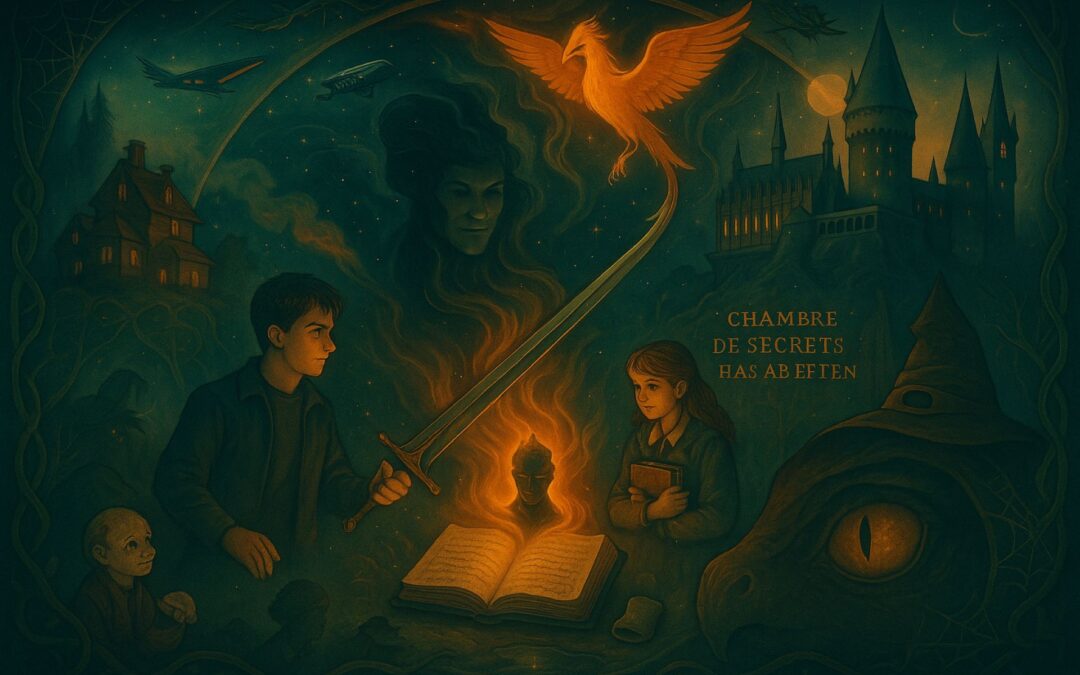
Overview: The Whisper Beneath the Walls
Darkness stirs beneath the wonder this time. Harry Potter and the Chamber of Secrets begins where innocence still lingers — the golden glow of friendship, the thrill of magic — but that glow is quickly shadowed by whispers that crawl through the castle walls. J.K. Rowling’s second book deepens the moral and emotional gravity of the series: it is no longer just about discovering a magical world, but confronting the rot that hides within it.
The tone is tighter, more secretive. Hogwarts, once purely enchanting, becomes a maze of fear and rumor. The danger doesn’t roar; it hisses — through pipes, in walls, and in blood-written warnings. Every character seems to move between light and dark, between who they are and who they might become when tested.
At its heart, The Chamber of Secrets explores a question that defines both childhood and destiny: what makes someone truly “good”? Is it birth, lineage, or the choices made when fear whispers from the shadows? Rowling answers not with lectures but with mirrors — through a monster that preys on purity, a diary that traps the past in ink, and a boy who must learn that courage often begins in doubt.
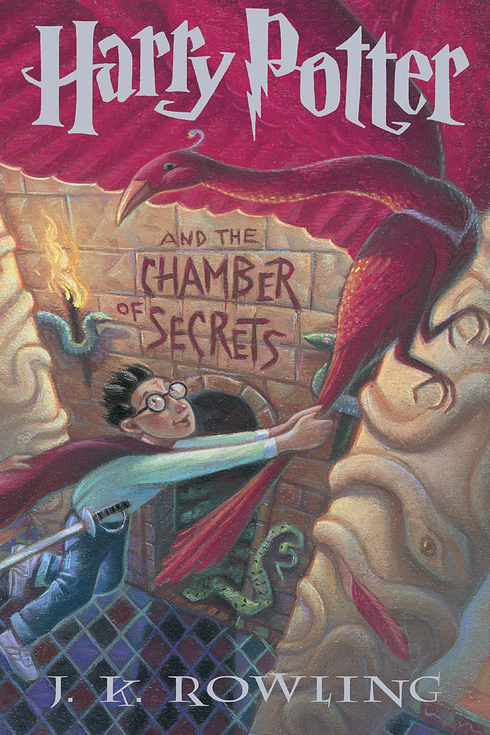
Full Plot Summary: The Unfolding of the Chamber’s Secret
Before the school year begins, Rowling grounds the reader in confinement — the quiet cruelty of Privet Drive. This stillness isn’t filler; it’s contrast. It reminds us that Harry’s world of wonder exists against a backdrop of neglect. The story’s descent into mystery begins not in a castle of spells, but in a locked room filled with longing.
The Elf’s Warning and a Summer of Captivity
Summer at Privet Drive feels heavier this year. The thrill of Harry’s first year at Hogwarts has faded into the stifling monotony of the Dursleys’ house, where his magical life is treated like a shameful secret. He is a guest only in name, a boy confined to the smallest room, unseen and uncelebrated. But the stillness of that suburban prison is broken by an unexpected visitor: a small, trembling creature with wide green eyes — Dobby the house-elf.
Dobby’s arrival is both comic and tragic. His reverence for Harry borders on worship, yet his fear is palpable. Bound by a cruel servitude, Dobby tries to warn Harry not to return to Hogwarts, insisting that “terrible things” are about to happen there. His loyalty to Harry clashes with his magical bindings, and every time he disobeys his masters to speak, he punishes himself — banging his head, choking back words, desperate to serve and to rebel all at once.
When Harry refuses to abandon the school that gives his life meaning, Dobby resorts to desperate measures. He sabotages the Dursleys’ dinner party, using magic to drop a pudding on a guest’s head — an act that earns Harry both the wrath of his uncle and a warning from the Ministry of Magic for underage sorcery. Furious and humiliated, Uncle Vernon locks Harry in his room, installs bars on his window, and slides food through a hatch in the door.
But isolation cannot imprison destiny. Late one night, headlights flash across Harry’s window — and there, hovering in the moonlight, is the Weasleys’ flying Ford Anglia, with Ron, Fred, and George grinning from inside. They tear the bars from the window and pull Harry into freedom. The scene is exhilarating — a literal jailbreak that symbolizes the friendship and warmth Harry has been starved of.
As they soar above the sleeping town, Harry feels something he hasn’t felt all summer — belonging. It is the first of many moments this book will explore the theme of liberation: from prejudice, from fear, from the invisible cages others build around you.
The Burrow and the Journey Back to Hogwarts
Harry’s arrival at The Burrow — the Weasleys’ crooked, cozy home — is like stepping into a living heartbeat. Everything hums with magic and life. The house is cluttered but welcoming; its clock tracks family members instead of hours; gnomes scurry through the garden; and Mrs. Weasley’s affection radiates warmth and exasperation in equal measure. For the first time, Harry sees what a real family looks like — not perfect, but bound by love.
Here, Arthur Weasley embodies a different kind of curiosity — a fascination with the Muggle world that mirrors Harry’s awe of magic. The Weasleys’ humble circumstances contrast sharply with the Dursleys’ sterile obsession with status. Poverty here feels rich with spirit; their home, though small, glows with care.
Soon, the time comes to return to Hogwarts. The day at King’s Cross Station seems ordinary until, at the last moment, the magical barrier to Platform Nine and Three-Quarters seals shut. Panicked and unable to reach the train, Harry and Ron make a reckless decision — to fly the Ford Anglia to school. Their journey is part wonder, part disaster: swooping over the countryside, invisible to Muggles, until the car sputters out of control and crashes violently into the Whomping Willow, the violent tree that nearly crushes them both.
The crash marks a tonal shift. The adventure that began in laughter ends in reprimand. Professor Snape seizes the opportunity to demand their expulsion, though Dumbledore tempers justice with mercy. They are punished, but not banished. The thrill of flight turns to humility — a recurring lesson throughout the novel: that bravery without wisdom can quickly become recklessness.
As the term begins, Harry senses that Hogwarts itself feels different. The air carries unease, a tremor of something ancient waiting to wake beneath the castle stones. The warmth of The Burrow fades into whispers in the walls — and the story’s true descent begins.
Whispers, Warnings, and a School in Fear
The new school year begins with an unease that no one can quite name. Hogwarts, usually a sanctuary of wonder and mischief, feels watchful. A presence lingers in the corridors — not of ghosts, but of something older, waiting. The introduction of the new Defense Against the Dark Arts teacher, Gilderoy Lockhart, only deepens the strangeness. Preening and self-absorbed, Lockhart’s obsession with fame becomes both comic relief and a quiet warning: that illusion often masks incompetence.
Yet it is not Lockhart who captures the students’ imagination, but the whisper of an ancient legend — the Chamber of Secrets. When a blood-red message appears scrawled on a wall — “The Chamber of Secrets has been opened. Enemies of the heir, beware.” — the castle’s heartbeat stops. Nearby, the caretaker’s cat, Mrs. Norris, lies petrified, eyes wide in frozen terror. Rumors ignite overnight.
The legend tells of Salazar Slytherin, one of Hogwarts’s founders, who believed only pure-blood wizards deserved to study magic. Before leaving the school, he supposedly built a secret chamber and sealed within it a monster that would one day cleanse Hogwarts of the unworthy. For years, the story was dismissed as myth. Now, the myth breathes again.
Fear creeps through the corridors like mist. Some students whisper that the Heir of Slytherin walks among them. Draco Malfoy, with his family’s proud bloodline, basks in the rumor’s power, calling Hermione a “Mudblood” — a slur that slices through her like a curse. Hermione, ever the rationalist, buries herself in research, desperate to find the truth behind the legend. Ron, meanwhile, becomes haunted by shame for his family’s status, the sting of poverty now sharpened by bigotry.
The attacks continue. Colin Creevey, the Muggle-born boy with a camera always in hand, is found petrified next. Then Justin Finch-Fletchley and Nearly Headless Nick. The school’s joy is drained, replaced by whispers and footsteps in empty halls. When Harry accidentally speaks Parseltongue — the language of snakes — during a Dueling Club demonstration, the tide turns against him. The gift that once saved his life now brands him as dangerous. Even his friends waver. The question of whether Harry might indeed be Slytherin’s Heir infects the air like poison.
The castle feels colder, its magic sharpened with suspicion. The invisible monster that stalks the pipes mirrors the inner one that lurks in everyone — prejudice, fear, and the need to find someone to blame.
The Mystery of Tom Riddle’s Diary
One gray morning, Harry stumbles upon an object that seems ordinary yet hums with quiet power: a small black diary, blank and unmarked, bearing the name Tom Marvolo Riddle. It appears empty, but when Harry writes in it, the ink vanishes — and new words form in response. The diary writes back.
Through its pages, Tom Riddle becomes a ghostly confidant. He reveals fragments of Hogwarts fifty years ago, when another Chamber incident occurred and a student was killed. Riddle’s story paints Hagrid as the culprit — the boy who kept dangerous creatures and once opened the Chamber himself. The revelation shakes Harry, yet something feels off. Riddle’s tone is too calm, too calculated. Still, in his loneliness and doubt, Harry begins to trust the voice in the diary more than he should.
The diary’s power is seductive. It listens without judgment, answers without hesitation, and offers the illusion of truth. When it suddenly disappears, Harry feels an absence deeper than logic can explain. Later, he learns that Ginny Weasley had been confiding in it too — pouring her fears and insecurities into its pages, unaware that Riddle was feeding on her very soul. The diary is more than a memory; it is a parasite.
Meanwhile, Hermione’s relentless curiosity leads her close to the truth. Before she can share it, she too is found petrified — clutching a torn page from a library book in her frozen hand. The clue she leaves behind reveals the monster’s identity: a Basilisk, a giant serpent whose gaze kills, and whose movement through the pipes explains the disembodied voice only Harry can hear.
Hagrid is arrested and sent to Azkaban on Riddle’s long-shadowed accusation, leaving Harry and Ron to uncover the truth on their own. The diary, the snake, the whispers — all form a pattern pointing back to the heart of Slytherin’s legend. Yet what they are about to uncover goes far beyond schoolyard mystery. The past, it turns out, has been patiently waiting to live again.
Descent into the Chamber
The tension in Hogwarts reaches a breaking point when the attacks escalate and Ginny Weasley vanishes. Her disappearance isn’t just another mystery — it’s personal. It shatters the fragile calm the students clung to, and for Harry and Ron, it transforms fear into purpose. They must find her, no matter the cost.
Clues begin to converge. Hagrid’s advice before his arrest — “Follow the spiders” — leads them deep into the Forbidden Forest, where they encounter Aragog, a monstrous acromantula once raised by Hagrid. Though terrifying, Aragog reveals a crucial truth: Hagrid was innocent. The creature in the Chamber was never a spider but something far worse, something even Aragog feared — a snake.
When Professor McGonagall announces the imminent closure of the school, Harry and Ron realize that the adults have failed to understand the threat. It is up to them. Returning to the castle, they find Hermione’s frozen clue: a note about the Basilisk, and in the margin, a single word — “pipes.” Everything falls into place. The monster is moving through Hogwarts unseen, killing with its gaze, and the entrance to the Chamber must be hidden in the plumbing.
Guided by Moaning Myrtle’s ghost, they discover the entrance in her bathroom — the site of her death fifty years earlier. Harry speaks the word to open it in Parseltongue, and the sinks slide aside, revealing a dark tunnel that drops deep into the earth. As they descend, the weight of centuries presses around them — the cold air of a buried secret.
The tunnel leads them to a vast stone chamber lined with serpent carvings. At its heart stands Tom Riddle, solid and smirking, though he should be long dead. The diary in Ginny’s lifeless hand pulses faintly beside him. Riddle explains the horrifying truth: he is not alive in the human sense but sustained through the diary — a fragment of his sixteen-year-old self, preserved and powerful. He has been feeding on Ginny’s energy, manipulating her to reopen the Chamber, write the warnings, and unleash the Basilisk. Riddle’s memory has grown stronger as Ginny’s life has ebbed away.
And then, the final revelation — Tom Marvolo Riddle rearranges his name into the anagram: “I am Lord Voldemort.” The past and present fuse into one nightmare. The monster that once terrorized Hogwarts now stands reborn before Harry, wearing the face of his younger self.
The Sword and the Phoenix
As Riddle summons the Basilisk, the chamber trembles. The serpent’s massive body slides into the open, its scales glistening like oil, its eyes deadly mirrors. Harry runs, dodging pillars, the echoes of the snake’s hissing filling the chamber like thunder. He is alone — until help arrives from a force beyond courage: Fawkes the phoenix, sent by Dumbledore, bearing the Sorting Hat.
Riddle mocks the sight, calling it the weapon of fools. Yet within that hat lies the true magic of Gryffindor — the idea that courage, not heritage, defines worth. From its depths, Harry draws the Sword of Godric Gryffindor, shimmering with light. Fawkes blinds the Basilisk by attacking its eyes, giving Harry the chance to strike. In a desperate, heroic act, he drives the sword through the serpent’s mouth, killing it — but not before one of its fangs pierces his arm, venom flooding his veins.
As death begins to take him, Fawkes weeps beside him, and the phoenix’s tears — imbued with healing power — close the wound. Weak but alive, Harry drives the Basilisk fang through Riddle’s diary, and ink spills out like blood. Riddle screams, fading into nothingness, his memory burned away. Ginny stirs, free at last. The Chamber falls silent.
This moment is more than a triumph of bravery — it is the victory of will over legacy. Harry defeats not just the serpent but the echo of Voldemort’s ideology: that power and blood determine greatness. The boy once dismissed as “nothing special” proves that moral strength outweighs magical might.
Resolution and the Quiet Triumph of Freedom
Emerging from the Chamber, Harry carries both Ginny and the truth. The ordeal shatters illusions and exposes the roots of fear that plagued Hogwarts. Hagrid is released from Azkaban, his name cleared. Dumbledore returns, restoring warmth and calm to the castle. He praises Harry not for his fame, but for his loyalty — the quality that separates him from Voldemort, whose cleverness was never tempered by love.
Harry confronts Lucius Malfoy, the man who slipped the diary into Ginny’s cauldron, spreading evil under the guise of purity. Their exchange is charged with quiet defiance — the power dynamic inverted. When Harry hands Lucius the diary wrapped around a sock, and Lucius passes it to Dobby in irritation, the elf becomes free. The look on Dobby’s face — awe, disbelief, and gratitude — captures the emotional heartbeat of the story: liberation.
The Chamber’s mystery dissolves, but its echoes remain. The petrified students are revived, and laughter once again fills the Great Hall. Exams are cancelled, feast tables overflow, and for a brief, golden moment, innocence returns. Yet something deeper has changed.
Harry understands now that darkness can exist even in the brightest places, that evil often hides not in monsters but in ideas — in pride, in prejudice, in the past that refuses to die. As the train leaves Hogwarts, he looks out the window not with triumph but quiet resolve. The battle is won, but the shadow of Voldemort — of Riddle’s memory — still lingers, whispering faintly beyond the edges of childhood.
Character Analysis: The Many Masks of Friendship and Fear
By the second year, Rowling’s characters no longer live in pure adventure; they live in reflection. Each faces an interior conflict disguised as an external one — fear of failure, fear of truth, fear of being misunderstood. Their evolution isn’t heroic spectacle but human testing. The Chamber becomes a crucible, revealing not who they wish to be, but who they already are.
Harry Potter: Courage in the Shadow of Doubt
In The Chamber of Secrets, Harry’s heroism matures. Gone is the wide-eyed wonder of the boy who first entered Hogwarts; in his place stands a young man beginning to grapple with fear, isolation, and identity. The whispers about him — that he might be Slytherin’s heir — wound him deeply because they reflect a question he secretly fears himself: What if I am more like Voldemort than unlike him?
Harry’s gift of Parseltongue, once a fluke of survival, becomes a symbol of otherness. It alienates him, forcing him to confront the uncomfortable truth that goodness isn’t always cleanly inherited or easily proven. Yet it is precisely this tension — the fear of becoming what he despises — that shapes his moral strength.
What defines Harry in this book is his refusal to let fear dictate who he becomes. Where others freeze, he acts. Where others follow, he questions. His empathy for Dobby, loyalty to Ginny, and belief in Hagrid reveal a heart that stays open even under suspicion. Rowling uses him to explore the essence of courage — not fearlessness, but the will to act despite fear.
Ron Weasley: Loyalty as Strength and Burden
Ron’s arc deepens the theme of insecurity. His life stands in constant contrast — to Harry’s fame, Hermione’s brilliance, and his own family’s poverty. Yet his courage surfaces most powerfully when loyalty is tested. His reckless decision to fly the car to rescue Harry, his unwavering defense of Hermione against Malfoy’s insults, and his descent into the Chamber despite terror all spring from love.
In this book, Ron’s fear of inadequacy becomes his quiet crucible. He vomits slugs after trying to hex Malfoy, panics at spiders, and often doubts his worth. Yet through it all, he remains steadfast. Rowling crafts Ron as the imperfect yet indispensable heart of the trio — proof that bravery is not the absence of fear, but the triumph of friendship over self-doubt.
Hermione Granger: The Mind that Saves the Day
Though Hermione spends much of the story petrified, her intellect never leaves the narrative. Her dedication to truth — her endless reading, questioning, and planning — saves the school. The note in her frozen hand is the story’s turning point, the key to the Basilisk mystery.
Hermione embodies a different kind of heroism: the courage to think, to seek reason amid chaos. She represents the rational conscience of the group, grounding Harry’s instinct and Ron’s emotion in method and logic. Her marginalization as a “Mudblood” also makes her the emotional core of the prejudice theme. Through her, Rowling shows how intellect and compassion can coexist as acts of defiance in a world obsessed with bloodlines.
Ginny Weasley: Innocence, Possession, and the Birth of Strength
Ginny’s journey is one of the most haunting in the book. Once a shy, blushing girl with a crush on Harry, she becomes the vessel for an ancient evil. Her loneliness makes her vulnerable; her diary becomes her confidant, her curse. Tom Riddle manipulates her insecurities, proving that evil rarely begins with malice — it begins with longing.
By the story’s end, Ginny emerges reborn. She carries the trauma of possession, but also the quiet courage of survival. This experience forges the strength that will later define her character — the ability to face darkness and still find herself within it.
Tom Riddle: The Seductive Face of Evil
Riddle is the book’s most chilling creation — not a monster, but a memory. His youth and charm make him almost sympathetic at first, but beneath the politeness lies the same cold ambition that will one day define Voldemort. The diary serves as a metaphor for memory weaponized: a remnant of the past that refuses to die.
Through Riddle, Rowling dissects the psychology of evil. He is not driven by pain but by pride, not by survival but by control. His manipulation of Ginny is intimate and insidious — an echo of how ideology can possess the innocent. He mirrors Harry in power and potential, yet his emptiness exposes the novel’s central truth: that greatness without empathy leads only to destruction.
Dobby: The Voice of Servitude and Freedom
Dobby begins as comic relief but ends as the book’s moral compass. His trembling attempts to protect Harry, despite magical punishment, reveal both courage and the cruelty of enslavement. His liberation — through the simple act of receiving a sock — becomes one of the most profound moments in the series.
Dobby represents the cost of servitude and the joy of emancipation. His freedom is not just physical but spiritual — the victory of will over control. His reverence for Harry is not hero worship but gratitude toward someone who saw him as more than property.
The Supporting Web: Hagrid, Lockhart, and the Malfoys
Hagrid, wrongly accused yet steadfastly kind, personifies misunderstood goodness. His exile and return mirror the theme of redemption and loyalty beyond appearances. Lockhart, in contrast, is vanity incarnate — a parody of fame without substance. His cowardice in the Chamber stands as a foil to Harry’s authentic bravery.
Lucius Malfoy embodies aristocratic prejudice — elegant, cold, and convinced of his own superiority. Through him, Rowling personifies the ideology that fuels the Chamber’s horrors: the belief that purity is power. Draco, his son, imitates this arrogance but not yet its depth; he is still a boy playing at cruelty, a shadow of what indoctrination can breed.
The Trio as a Moral Unit
Together, Harry, Ron, and Hermione function as a single moral organism — courage, loyalty, and intellect intertwined. Each represents a different response to fear, and only when all three operate in harmony does truth emerge. The Chamber is defeated not by one hero, but by the alchemy of friendship — by the balance of heart, mind, and will.
Themes and Motifs: Echoes of Prejudice and Loyalty
The moral veins of The Chamber of Secrets run deep beneath the school’s enchanted corridors. Rowling uses fantasy to expose the machinery of discrimination — how prejudice hides behind tradition, and loyalty becomes rebellion. Every clue in the mystery doubles as a question of ethics. What begins as rumor about monsters becomes a reckoning with the monsters people create themselves.
The Illusion of Purity and the Poison of Prejudice
At the core of The Chamber of Secrets lies a timeless confrontation between inclusion and exclusion, between human worth and inherited privilege. The myth of the Chamber — a place created to purge Hogwarts of “impure” students — becomes an allegory for every system that divides people by birth, race, or class. Through Salazar Slytherin’s ideology, Rowling exposes the emptiness of purity as a moral measure.
The book’s recurring word — “Mudblood” — strikes like a curse because it condenses centuries of inherited hatred into a single insult. For Hermione, it becomes a scar of humiliation; for Ron, a trigger for outrage; for Harry, a lesson in empathy. The prejudice of Slytherin’s legacy seeps through both history and personality — embodied in Draco Malfoy’s arrogance, Lucius Malfoy’s manipulation, and even in the institutional silence that allows such beliefs to persist.
By the end, Rowling dismantles this ideology not through lectures but through example. The hero who saves the day is not the heir of a pure line, but a boy who chooses compassion over cruelty. The monster born from prejudice — the Basilisk — is destroyed by a child of “impure” background wielding a founder’s sword.
The Power and Fragility of Memory
The diary of Tom Riddle transforms memory into a weapon. It is both artifact and apparition — a reminder that the past, when unexamined, can infect the present. Through the diary, Rowling explores how evil often survives not through action but remembrance. Riddle’s preserved memory gains agency because no one questioned it; it manipulates the living because its lies were never challenged.
Hermione’s petrified hand clutching a page from a library book mirrors Riddle’s diary — two forms of memory, one corrupted, one pure. The diary erases truth; Hermione’s note restores it. In this contrast lies the moral center of the story: knowledge can enslave or liberate depending on how it is used.
Loyalty as the Highest Magic
Every major act of heroism in this book stems from loyalty — not from raw skill or intellect. Dobby risks punishment to warn Harry out of devotion. Ron and Harry brave death to rescue Ginny because friendship demands it. Fawkes appears in the Chamber because Harry’s loyalty to Dumbledore calls him. Even the Sorting Hat’s magic answers not to blood or power but to courage born of loyalty.
This faithfulness acts as a counter-spell to the cold logic of purity. Where prejudice divides, loyalty binds. It bridges families, houses, and even species — between humans and elves, between students and teachers, between past and present. Rowling makes it clear: in a world obsessed with hierarchy, fidelity to love and truth is the truest rebellion.
Fear, Isolation, and the Growth of Courage
Fear in The Chamber of Secrets is not only external — embodied by the Basilisk — but deeply psychological. It manifests in whispers, suspicions, and self-doubt. The petrified students, frozen mid-expression, symbolize what happens when fear halts motion, when curiosity turns to paralysis.
Harry’s journey is a descent into those very fears — of rejection, of evil within, of being alone in the dark. But courage, Rowling reminds us, grows not in the absence of fear but in its company. Every act of bravery in the story — Dobby’s warning, Hermione’s research, Ginny’s confession, Harry’s descent — begins in trembling.
Identity Beyond Lineage
A subtler theme running through the novel is the question of identity — how much of who we are comes from where we come from. The story continually contrasts heritage with choice. Harry and Voldemort share powers, traits, and even a link of magic, yet their moral paths diverge. Where Voldemort believes lineage defines destiny, Harry proves that character does.
Dumbledore’s wisdom crystallizes this idea: “It is our choices, Harry, that show what we truly are, far more than our abilities.” That single line distills the book’s philosophy — that freedom lies not in escaping the past but in choosing how to bear it.
Setting and Atmosphere: Hogwarts in Shadow and Light
In this second year, Hogwarts shifts from sanctuary to labyrinth. Its walls whisper, its portraits watch, its history breathes uneasily through the floorboards. Rowling transforms setting into psyche — the school reflecting the fears of its students. The familiar turns strange; the light feels temporary. Even the magic itself seems to sense what the children do not yet understand: something is awakening.
The Dual Nature of Hogwarts
In The Chamber of Secrets, Hogwarts transforms from a sanctuary of wonder into a labyrinth of fear. What was once a symbol of discovery in the first book now becomes a mirror of secrecy — the same corridors that rang with laughter now echo with whispers. Rowling turns the castle itself into a character: ancient, sentient, layered with magic and memory. Its hidden chambers, shifting staircases, and whispering pipes become the physical embodiment of the novel’s central tension — that good and evil coexist not in separate worlds, but within the same walls.
Hogwarts thus exists in two halves: the daylight world of classes, feasts, and friendship, and the subterranean shadow world beneath — the Chamber itself, buried like the subconscious of the school. The transition between these realms marks Harry’s journey from innocence to understanding. Every hidden passage, every forbidden corridor suggests that truth in Rowling’s universe is never found in plain sight; it must be sought in darkness.
The Chamber of Secrets as Psychological Space
The Chamber is more than a setting — it is a metaphorical descent into the human psyche. Its serpentine architecture, carved in Slytherin’s likeness, represents the recesses of fear and pride. Entering it means confronting not just monsters, but what they symbolize: prejudice, control, and the hunger for purity.
When Harry enters the Chamber, he doesn’t merely step underground; he crosses into the mythic layer of Hogwarts — the memory of its founding, its buried flaws, its unspoken divisions. The stone pillars, the snake motifs, the still water reflecting the serpent’s face — all create a mood of ritual and revelation. It is in this claustrophobic underworld that the past literally rises to claim the present.
The Burrow and the Warmth of Belonging
In contrast, The Burrow radiates everything Hogwarts temporarily loses: light, imperfection, and love. The Weasley home is chaotic, crooked, and alive with magic that feels handmade rather than grand. Its mismatched furniture and clattering charm form an emotional counterpoint to the cold grandeur of the Chamber. If the Chamber represents the buried rot of the magical world, The Burrow represents its heartbeat — proof that goodness need not be pure to be powerful.
For Harry, The Burrow becomes the first true home he’s ever known, a place where affection replaces duty and warmth replaces silence. This grounding in love is what allows him to face the darkness later; it’s the emotional architecture that sustains his courage when the school itself feels like an enemy.
The Atmosphere of Fear and Suspicion
Rowling’s tone throughout the novel oscillates between cozy enchantment and creeping dread. The air grows colder with each attack; candles flicker uneasily in the Great Hall; voices drop to whispers as eyes linger a bit too long on Harry. The castle becomes a social crucible, amplifying suspicion and dividing students by lineage.
Fear manifests physically: in the petrified bodies lining the hospital wing, in the silent hallways after curfew, in the echo of something moving through the pipes. Rowling’s control of atmosphere is meticulous — the fear feels domestic, creeping, never explosive. It’s the kind of terror that grows through rumor, not revelation.
Hogwarts as Microcosm of the World
Finally, Hogwarts stands as a microcosm of the broader wizarding world — a place of learning that still carries the stains of its founders’ prejudices. Its shifting magic and living architecture symbolize both promise and peril. Within its walls coexist kindness and cruelty, brilliance and blindness — all the contradictions of humanity distilled into stone.
By the book’s end, light returns to Hogwarts, but not the same light as before. The shadows remain, subdued but remembered. The castle stands once more as a place of safety, but also of truth — a reminder that the pursuit of knowledge, like magic itself, always carries a moral cost.
Tone and Style: The Mystery of Innocence Lost
Rowling’s tone evolves like growing up — wonder still glimmers, but it now coexists with dread. The playful rhythm of discovery slows into a measured pulse of mystery. Each sentence carries both laughter and warning. The story, once about magic’s arrival, becomes about what it costs to keep believing in it when the shadows start to whisper back.
From Wonder to Unease
In The Chamber of Secrets, Rowling’s tone undergoes a deliberate evolution. What began in The Sorcerer’s Stone as a childlike celebration of wonder now bends toward disquiet. The magic remains whimsical — flying cars, howling letters, enchanted duels — yet threaded through it all is an unsettling maturity. The reader, like Harry, realizes that the magical world is not immune to darkness; it merely hides it behind its own marvels.
Rowling’s writing balances charm and foreboding with surgical precision. Humor cushions horror, but never cancels it. The laughter in The Burrow, the absurd vanity of Lockhart, the slapstick chaos of Dobby — these moments of levity make the ensuing terror sharper, more human. The tone feels like childhood meeting its first real consequence: enchantment laced with dread.
The Texture of Suspense
Rowling crafts suspense not through grand theatrics but through rhythm — whispers, footsteps, and silences that last half a page too long. The pacing mirrors investigation: every clue discovered births two new questions. Scenes of revelation — like the diary’s conversation or the discovery of Hermione’s note — are written with careful restraint. What’s frightening here is not what is seen but what is suspected.
The voice that Harry hears in the walls — “Kill…kill…” — is Rowling’s purest stroke of horror. It’s both literal and symbolic: the hiss of prejudice and the voice of fear itself. This minimalism makes the terror more intimate. Rather than staging horror externally, Rowling lets it echo within the reader’s mind, where it cannot easily be dispelled.
A Portrait of Growing Consciousness
Stylistically, the book reflects Harry’s growing consciousness. The sentences grow slightly longer, the emotions more layered, the moral stakes clearer. Where the first book thrived on discovery, this one thrives on doubt. Rowling’s language moves from wide-eyed awe to introspection, from “Look what magic can do!” to “What does magic mean?”
She begins to use narrative irony — especially in Lockhart’s exaggerated self-importance and the blind faith of the Ministry — to reveal how institutions distort truth. This shift in tone foreshadows the more political and philosophical layers of later books.
The Balance of Humor and Darkness
One of Rowling’s most deft accomplishments is maintaining buoyancy amid gloom. The domestic humor of the Weasleys, Fred and George’s mischievous asides, and the whimsical quirks of the magical world (singing Valentines, self-writing quills) coexist naturally with petrified students and deadly serpents. This tonal harmony gives the story depth rather than dissonance.
The world feels real precisely because it contains both laughter and fear. Rowling understands that darkness without humor is despair, and humor without darkness is denial. Together, they create emotional truth.
The Language of Revelation
Rowling’s prose in The Chamber of Secrets is slightly more lyrical and symbolic than in its predecessor. She begins to rely more on echo and foreshadowing — the recurring hissing sound, the motif of reflection, the imagery of mirrors and memory. These linguistic patterns foreshadow both the immediate climax and the greater mythos of the series.
The tone of the final chapter — quiet, restorative, yet tinged with wisdom — captures the essence of the novel’s stylistic growth. Childhood is still intact, but innocence has dimmed. The world hasn’t lost its magic; it has gained its shadows.
Symbolism and Imagery: Stones, Serpents, and Memory
Beneath the spells and duels, Rowling constructs a tapestry of recurring symbols — creatures, artifacts, and elements that speak a silent language. Each object carries the memory of something moral or mythic: fear, pride, loyalty, rebirth. The world feels layered, as though every hallway or relic remembers more than it reveals. Meaning here is hidden in plain sight, waiting to be read.
The Basilisk: The Embodiment of Fear and Prejudice
The Basilisk is more than a monster — it is fear given form. Its ability to kill with a glance mirrors the paralyzing effect of bigotry and terror on society. Those who look directly into its eyes die, while those who see it indirectly — through mirrors, reflections, or ghosts — are petrified, suspended between life and death. Rowling uses this to portray how prejudice operates: it can destroy the brave outright, but it freezes the rest into silence.
The Basilisk’s underground movement through Hogwarts’ pipes symbolizes how hatred flows unseen beneath institutions, feeding on neglect and secrecy. Its allegiance to Slytherin’s heir ties it to the ideology of purity — an ancient venom that, once released, infects even the innocent. By killing it, Harry doesn’t just slay a creature; he symbolically breaks a lineage of fear inherited from the past.
The Chamber of Secrets: The Hidden Past
The Chamber itself functions as a metaphor for collective denial — a buried vault of unresolved guilt. Hidden beneath the foundation of the school, it represents the sins of the founders and the prejudices that continue to shape the wizarding world. The fact that the Chamber is literally within Hogwarts underscores Rowling’s point: darkness does not exist outside civilization but within it, sealed off, waiting for a voice to call it forth.
When the Chamber is opened, the past comes alive — not as a ghostly echo, but as a living threat. Rowling’s imagery of descending into darkness becomes both physical and psychological: the characters must confront what their society has chosen to forget.
Tom Riddle’s Diary: The Power and Peril of Memory
The diary is one of the most potent symbols in the entire series — an object of innocence that hides corruption. It embodies the idea that memory can deceive as much as it can preserve. Unlike a normal diary, which holds the writer’s truth, this one rewrites it. It listens, manipulates, and entraps. Its blank pages lure the reader into projection — a perfect reflection of how evil often disguises itself as understanding.
The diary’s destruction by the Basilisk fang, spilling ink like blood, is both literal and symbolic: a violent purging of false memory. This act prefigures the destruction of future Horcruxes, making the diary the first glimpse of Voldemort’s fragmented soul.
Stone and Petrification: The Cost of Silence
The petrified victims throughout the novel represent more than collateral damage — they embody the paralysis of fear. To be “petrified” is to be silenced, immobilized, trapped in the moment of terror. Rowling’s choice of stone, the most lifeless of materials, evokes a chilling sense of suspended humanity.
Yet stone also holds permanence — history, resilience, endurance. The victims are frozen but not gone; their revival at the end suggests that truth, though delayed, cannot be permanently silenced. The school’s ability to recover from its petrification mirrors the moral recovery of a society facing its hidden wrongs.
Fawkes the Phoenix: Redemption and Renewal
If the Basilisk represents destruction, Fawkes stands as its counterforce — the symbol of rebirth. The phoenix’s tears heal mortal wounds, and its cyclical life defies finality. Its intervention in the Chamber isn’t just a miracle; it’s an allegory for grace — salvation arriving not from power, but from loyalty and love.
The phoenix’s song during battle fills the Chamber with courage, transforming terror into transcendence. Fawkes embodies the novel’s spiritual dimension: that goodness, though fragile, can resurrect itself endlessly if nurtured by faith.
Reflections and Mirrors: Seeing Truth Indirectly
Reflections recur throughout the story — in mirrors, puddles, water, and eyes. They remind us that truth is rarely seen head-on; it must be glimpsed through indirection. The mirrored view that saves each petrified victim symbolizes perception filtered through caution — the wisdom to face horror without succumbing to it.
Rowling’s imagery invites the reader to look beyond surfaces. What seems magical often hides moral decay, and what seems ordinary — like a sock or a diary — can carry immense symbolic weight.
In The Chamber of Secrets, every object becomes a metaphor, every creature a reflection. The story’s imagery works like its architecture — layered, hidden, and whispering from beneath the surface.
Moral and Philosophical Reflection: The Price of Purity and the Power of Choice
At its philosophical core, the story steps beyond plot into inquiry. Rowling isn’t merely entertaining; she’s dissecting belief — how people justify cruelty, how innocence survives temptation. The Chamber itself becomes a question about human nature: whether we’re defined by what we inherit or what we decide. Before we face the serpent, she asks us to face ourselves.
The Fallacy of Purity
At its moral core, The Chamber of Secrets is an allegory about the corruption of purity. The obsession with “pure blood” — the notion that some are born superior — becomes Rowling’s clearest moral critique of inherited prejudice. The book reveals how the idea of purity, when exalted, inevitably decays into cruelty. The so-called purity of the Slytherin legacy is built on exclusion; its preservation demands the silencing or destruction of others.
Rowling uses the Chamber’s mythology to expose a timeless truth: that the pursuit of purity, whether in blood, belief, or ideology, is the seed of tyranny. Those who claim to defend tradition often serve only their own fear — fear of difference, of dilution, of power slipping from their grasp. The monster unleashed is not just a serpent, but the very idea that goodness can be determined by ancestry.
The Ethics of Choice
This novel refines the moral axis of the entire series — that it is choice, not birth, that defines character. The parallel between Harry and Tom Riddle underscores this: both are orphans, both speak Parseltongue, both were sorted with potential for Slytherin. Yet their paths diverge because of the choices they make. Where Riddle seeks control, Harry seeks connection. Where Riddle uses others as vessels, Harry risks himself to save them.
Dumbledore’s words to Harry — “It is our choices, Harry, that show what we truly are, far more than our abilities” — summarize not just this book but the moral heartbeat of Rowling’s entire world. Talent, heritage, and even destiny are secondary to moral will. This principle transforms the series from fantasy into philosophy: magic becomes an extension of moral agency.
The Nature of Evil and the Seduction of the Past
Through Tom Riddle’s diary, Rowling explores evil as something intimate rather than monstrous. Riddle does not coerce by force; he seduces through attention, sympathy, and understanding — the tools of trust. Evil thrives, she suggests, not when people are wicked, but when they are lonely. Ginny’s vulnerability becomes the mirror for humanity’s oldest weakness: the yearning to be heard.
The diary’s power also reveals how the past manipulates the present. It doesn’t simply haunt; it reanimates. Evil survives through nostalgia — the temptation to restore an imagined purity, to resurrect a world “as it was.” Rowling’s moral warning is clear: history, when idolized rather than understood, breeds repetition.
Innocence and Responsibility
Harry’s second year marks his first confrontation with moral complexity. The world no longer divides neatly between good and bad; authority falters, heroes are flawed, and evil wears a student’s face. In saving Ginny, Harry learns that responsibility is not a matter of age but of empathy — that courage often means acting even when you are not certain you are right.
This growing moral awareness separates heroism from impulse. In the first book, bravery meant defying external obstacles; here, it means facing inner uncertainty. Harry’s willingness to act amid doubt — to choose love over fear, loyalty over safety — is what transforms him from a boy into a moral being.
Redemption Through Freedom
Finally, Dobby’s emancipation closes the book with a quieter, equally profound moral note. His liberation, achieved not through war but through wit, suggests that even small acts of justice can restore dignity to the world. The sock that frees him becomes a symbol of compassion weaponized against cruelty — proof that goodness does not require grandeur.
In a story full of serpents, spells, and secrets, Rowling’s message remains human: true magic is moral, not mystical. It lies in the courage to choose empathy over arrogance, connection over control. The Chamber is a metaphor for the human heart — capable of both venom and renewal — and the decision of which will prevail rests, always, in choice.
Author and Context: The Imagination of J.K. Rowling
To understand this story’s gravity, one must glimpse the life that shaped it. Rowling wrote not from distance but from the edges of her own struggle — poverty, loss, perseverance. That personal battle against despair gives her fantasy its pulse. Her imagination doesn’t deny hardship; it redeems it, turning loneliness into myth and endurance into enchantment.
The Life Behind the Legend
When J.K. Rowling wrote Harry Potter and the Chamber of Secrets, she was living in Edinburgh, working tirelessly to continue the story that had unexpectedly transformed her from an unemployed single mother into a literary phenomenon. The first book had enchanted readers with its optimism and charm; the second needed to prove the magic could deepen rather than repeat. Rowling, drawing from her own experiences of struggle, judgment, and perseverance, infused this sequel with greater moral complexity.
Her own life — marked by moments of invisibility and resilience — echoes in Harry’s journey. The sense of being unseen, underestimated, or trapped within the expectations of others finds voice in the boy under the stairs, in Dobby’s servitude, in Ginny’s possession, and even in the petrified students who become metaphors for paralysis under fear. Rowling’s characters, though fantastical, emerge from emotional truths she knew intimately: the longing for freedom, the courage to resist conformity, and the quiet strength of love.
The Literary Continuum
While The Sorcerer’s Stone introduced readers to the architecture of Rowling’s magical universe, The Chamber of Secrets marked her first step into mythmaking. Here, the wizarding world grows darker, older, and more self-reflective. The introduction of the diary and the idea of memory as a sentient force lays the groundwork for the concept of Horcruxes, which will later form the philosophical backbone of the series.
Rowling’s influences are varied — British boarding school tales, Gothic literature, and classical mythology converge in her storytelling. The Chamber itself evokes the descent into the underworld, a motif seen from Orpheus to Dante, while the serpent reflects both Biblical and mythic imagery — the tempter, the secret keeper, the voice beneath paradise. By blending mythic archetypes with domestic realism, Rowling elevates a children’s fantasy into a moral allegory for modern times.
Social and Cultural Resonance
Written in the late 1990s, The Chamber of Secrets mirrors the social anxieties of its age — the rise of cultural divisions, the tension between progress and purity, the temptation to retreat into inherited hierarchies. The rhetoric of “pure-blood” and “Mudblood” reflects the language of exclusion found in every era — racism, classism, nationalism. Rowling’s world becomes a mirror held to the reader’s own, inviting young minds to see how prejudice disguises itself as tradition.
Her treatment of authority also reflects postmodern skepticism: Lockhart’s vanity mirrors celebrity culture; the Ministry’s incompetence hints at bureaucratic blindness; Dumbledore’s faith in individual conscience counters both. Beneath its humor and adventure, the book contains a political undercurrent — a defense of moral independence against collective delusion.
The Evolution of Voice
The Chamber of Secrets stands as the threshold of Rowling’s tonal evolution. Her language retains the playfulness of the first book but begins to grow shadows — a complexity of rhythm, a subtle layering of meaning. The prose matures alongside its readers. She begins to plant moral seeds that will only bloom years later, trusting in the long attention span of her audience.
This balance — accessibility and depth, innocence and insight — became her literary hallmark. By the time the second book ends, it’s clear that Rowling’s imagination is not merely creating a world of magic but a mirror to human nature itself: flawed, divided, and capable of redemption.
Key Quotes and Interpretations: Words That Leave a Mark
“It is our choices, Harry, that show what we truly are, far more than our abilities.” — Albus Dumbledore
This single line captures the philosophical essence of the novel — that morality is not inherited, but constructed. Dumbledore’s wisdom reframes the entire conflict between Harry and Riddle: both share similar origins and gifts, yet their choices diverge. The line becomes the compass for the entire series, grounding its magic in ethics rather than destiny.
“The Chamber of Secrets has been opened. Enemies of the heir, beware.”
The message written in blood across Hogwarts’s walls is both literal and metaphorical. It announces the story’s external threat, but also the eruption of the school’s suppressed fears — classism, xenophobia, and the corruption of tradition. The writing on the wall is prophecy and accusation in one, a haunting reminder that evil often announces itself through ideology before action.
“Dobby is free.”
These three words close the story on an emotional crescendo. Dobby’s freedom — earned through wit and kindness, not violence — becomes a miniature revolution. It redefines heroism as compassion enacted in small, human gestures. The moment restores faith that even systems of cruelty can be undone by the simplest form of rebellion: empathy.
“You must have shown me real loyalty down in the Chamber. Nothing but that could have called Fawkes to you.” — Albus Dumbledore
Fawkes’s appearance is not random magic but moral recognition. Loyalty — not power or intellect — becomes the summoning spell for salvation. Rowling’s world operates on a moral physics: the pure of heart command forces greater than any spell. This line distills that invisible law of magic, tying courage to conscience.
“Ginny Weasley opened the Chamber of Secrets.” — Tom Riddle
Riddle’s revelation inverts innocence and guilt, transforming a naïve child into an unwitting agent of evil. The quote reflects Rowling’s deeper concern with manipulation — how evil exploits vulnerability. It exposes the psychological dimension of corruption: that possession begins with persuasion.
“Fear of a name increases fear of the thing itself.” — Hermione Granger
Hermione’s observation speaks to the moral paralysis that defines much of the wizarding world. By refusing to name Voldemort, people keep his power alive. It’s a subtle lesson in language — that silence can sustain evil as much as action can defeat it. Naming becomes both act of defiance and reclaiming of truth.
“You’ll find that I will only truly have left this school when none here are loyal to me.” — Albus Dumbledore
This line foretells not just Dumbledore’s influence but the spirit of the series: authority rooted in principle outlives its physical presence. Loyalty, in Rowling’s world, is sacred — the invisible bond that keeps good alive even in absence. The quote also underscores the novel’s emotional axis: faith that moral presence transcends power.
These lines, taken together, trace the moral trajectory of The Chamber of Secrets — from fear to choice, from manipulation to loyalty, from inherited identity to chosen integrity. Each quote leaves a mark not just on the page but on the reader’s sense of what it means to be good in a world that prizes the wrong virtues.
One-Paragraph Moral Summary: The Lesson Beneath the Legend
Harry Potter and the Chamber of Secrets is a story about the courage to choose compassion when fear demands conformity. Beneath its magic and monsters lies a mirror held to every society that worships purity and punishes difference. Rowling reminds us that evil rarely announces itself with fangs — it seeps through pride, prejudice, and silence. True strength, she suggests, is not inherited through blood or brilliance but revealed through choice — through the moments we act with loyalty when suspicion tempts us, speak truth when fear hushes others, and free even one soul from bondage when cruelty insists it is right. The Chamber is not merely under Hogwarts; it lives within every human heart — a sealed place of shadow that only courage, empathy, and love can open and transform.