
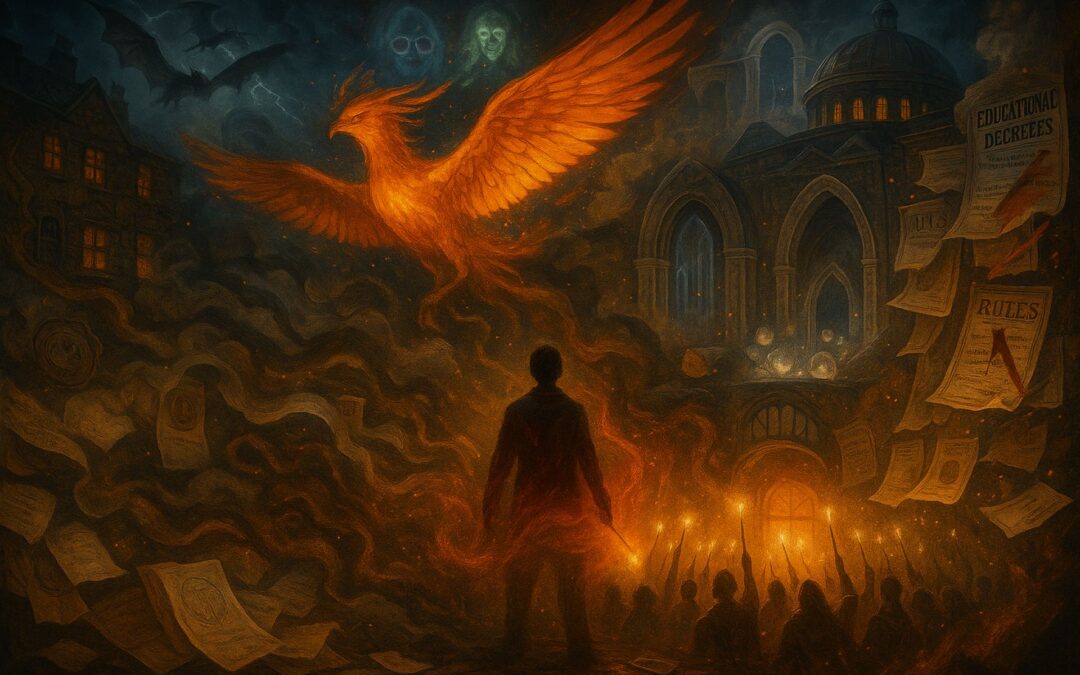
Overview: A War of Truth, Lies, and Growing Shadows
The fifth chapter of Harry Potter’s journey marks the moment when childhood wonder gives way to the heavy weight of truth. The Order of the Phoenix unfolds in a world unwilling to face the return of evil — a society suffocated by denial and propaganda. As the Ministry of Magic suppresses the truth about Voldemort’s return, Harry finds himself not only battling external enemies but the creeping doubt of those he thought were his allies.
This is a story of disillusionment — of a young boy realizing that even in the world of magic, institutions can be corrupt, authority can lie, and courage sometimes means standing alone. Hogwarts, once a sanctuary, becomes a battlefield for ideas and loyalty. And within Harry, the battle deepens: between rage and restraint, isolation and belonging, fear and the will to fight.

Plot Summary: The Rebellion Against Silence and Control
The fifth year at Hogwarts is not a tale of adventure, but of awakening — political, emotional, and moral. Harry’s journey in The Order of the Phoenix unfolds like a slow-burning revolution, both within himself and the world he thought he knew. Below is a detailed retelling that mirrors the book’s cinematic scope and psychological weight.
The Summer of Isolation
Harry Potter’s fifth year begins not with magic, but with suffocating mundanity. The once-hopeful boy who longed to leave Privet Drive now lies in the overgrown garden of Number Four, restless, angry, and alone. The world has grown quiet around him — too quiet. No letters from Ron or Hermione, no word from Dumbledore, and worst of all, no acknowledgment from the wizarding world about Voldemort’s return. The silence feels deliberate, like an erasure.
This isolation is not mere neglect; it’s psychological warfare. The Ministry of Magic, led by Cornelius Fudge, begins a campaign of denial, painting Harry and Dumbledore as liars. Newspapers mock him. Neighbors whisper. His only outlet is the nightly vigil for news, crouched beside a transistor radio under the blazing suburban sky — the image of a boy caught between two worlds that no longer fit.
When the Dementors descend on Little Whinging, it’s as if Harry’s worst fear — that the darkness has followed him — takes form. Their attack on him and Dudley is jarring not only for its violence but for what it signifies: no place is safe anymore, not even the ordinary. Forced to use his Patronus Charm, Harry becomes both savior and criminal. Within hours, an owl delivers a letter threatening his expulsion from Hogwarts — a bureaucratic absurdity that encapsulates the novel’s moral crisis.
The following days unfold in a blur of letters and conflicting messages. The Dursleys, terrified yet vindictive, try to contain him. Then rescue arrives — Tonks, Moody, Lupin, and others from the Order of the Phoenix. They escort him through the night sky to Number 12, Grimmauld Place, the hidden headquarters of Dumbledore’s resistance movement. It’s a breathtaking flight — a momentary return of wonder amid fear — but the magic feels colder now, edged with danger.
The climax of this section is the disciplinary hearing before the Wizengamot, the magical world’s high court. Fudge’s paranoia and political insecurity turn the trial into a farce, complete with public humiliation and legal manipulation. Dumbledore appears, elegant and aloof, saving Harry with calm logic and quiet authority — yet not once does he meet his eyes. That avoidance stings more than the trial itself. Harry’s victory is hollow. Though acquitted, he senses that something has fundamentally shifted: the boy who once sought safety in authority now stands before it as its adversary.
The summer of isolation ends not with freedom, but with foreboding. The silence has been broken — not by comfort, but by conflict. Harry steps into his fifth year already changed, more watchful, angrier, and carrying the uneasy knowledge that truth can make one an enemy.
Grimmauld Place and the Secrets of the Order
Number 12, Grimmauld Place, is less a home than a mausoleum — a repository of old prejudices and decaying grandeur. The ancestral house of the Black family mirrors the moral rot spreading through the wizarding world. Its walls are heavy with history: portraits of pure-blood fanatics, doxies in the drapes, and a cursed tapestry chronicling generations of pride and cruelty. It’s a haunting space, and Rowling makes it pulse with the gothic melancholy of a world unwilling to let go of its past.
For Harry, it’s a revelation. This is the headquarters of the Order of the Phoenix — a secret resistance led by Dumbledore and composed of witches and wizards who fought in the first war against Voldemort. Here are faces he knows — Sirius, Lupin, Moody, and the Weasleys — yet even surrounded by allies, Harry feels excluded. Every conversation halts when he enters, every mission shrouded in secrecy. The very people he trusts most — Dumbledore chief among them — treat him as someone to protect, not to inform.
Sirius, too, is trapped — not by magic, but by memory. Confined to the home he despises, he becomes restless and reckless, projecting his defiance onto Harry. He wants to relive his youth through Harry’s rebellion, urging him to see himself as a soldier in the coming war. In Sirius, Harry finds both father figure and warning — the embodiment of courage untamed by caution.
The Weasleys represent another dimension of resistance. Molly’s maternal anxiety clashes with Sirius’s recklessness, exposing the generational tension within the Order. Fred and George bring levity and subversion, their experimental inventions and open mockery of authority symbolizing the creative spark of rebellion. Meanwhile, Ron and Hermione — caught between loyalty to their elders and empathy for Harry — begin to see the fractures in their once-stable world.
Amid the cleaning, bickering, and whispered strategy meetings, Grimmauld Place becomes a microcosm of the book’s central conflict: truth versus control. Every room holds a relic of denial — the screaming portrait of Mrs. Black, the hidden dark artifacts, the family’s obsession with blood purity. The house itself is a metaphor for the wizarding world — noble on the surface, corrupt in its foundations, and in desperate need of cleansing.
By the time Harry leaves for Hogwarts, he understands two things. First, that Voldemort is rebuilding his power quietly, systematically, and with terrifying intent. And second, that Dumbledore’s silence is not indifference but strategy — one that demands Harry’s patience, though his heart rebels against it.
This chapter of the story is where rebellion first takes root — not through action, but through awareness. Harry begins to question the moral structure around him, sensing that justice and authority are no longer the same thing. It’s a subtle but irreversible shift: the end of innocence, the beginning of defiance.
The Ministry’s Infiltration of Hogwarts
When Harry returns to Hogwarts, the magic feels hollow — as though the castle itself has changed its allegiance. The familiar corridors now echo with suspicion. The students whisper about his supposed lies, parroting Daily Prophet headlines that brand him an attention-seeker. The sense of community that once defined Hogwarts fractures into factions: those who believe Harry and Dumbledore, and those who trust the Ministry’s comforting narrative of denial.
This transformation is embodied by Dolores Jane Umbridge, the Ministry’s appointed Defense Against the Dark Arts professor and Senior Undersecretary to Cornelius Fudge. Her arrival is deceptively sweet — pastel pink robes, a saccharine smile, and an unsettlingly childish voice — but beneath that façade lies bureaucratic tyranny in its purest form. She is the perfect instrument of control: polite, smiling, and ruthless. Her classroom is not a place of learning but indoctrination. She forbids the practical use of defensive spells, insisting that students study theory only. Her justification is bureaucratic: there is “no need” for self-defense if danger “does not exist.”
Through Umbridge, Rowling captures how evil often masquerades as order. She brings Fudge’s paranoia to Hogwarts under the guise of “educational reform.” Each week brings a new decree: banning organizations, censoring speech, replacing critical thinking with obedience. Even the teachers become targets — Hagrid is interrogated, Trelawney publicly humiliated, McGonagall undermined. It’s the slow suffocation of freedom, disguised as discipline.
Harry’s defiance is instinctive. He cannot abide silence in the face of lies. When Umbridge calls him a liar during class, his outburst earns him detention — a punishment that reveals her sadism. Forced to write “I must not tell lies” with a quill that carves the words into his skin, Harry becomes both student and symbol: the bearer of truth punished by the system that fears it. The physical scar becomes a spiritual one — the first mark of his transformation from boy to revolutionary.
Meanwhile, the social climate worsens. Cho Chang’s grief, Seamus Finnigan’s skepticism, and Hermione’s pragmatism mirror the confusion of a generation caught between fear and denial. Even Dumbledore seems distant, avoiding Harry’s eyes and refusing explanations. The headmaster’s silence, once a comfort, now feels like abandonment.
By midyear, Hogwarts is no longer a school but a miniature dictatorship. The Ministry’s presence seeps into every corner, from the Inquisitorial Squad that spies on students to the ominous proclamations nailed to the walls. The magic of Hogwarts — once defined by curiosity and wonder — is replaced by fear and control. Yet, amid the oppression, rebellion begins to stir in secret corners.
Dumbledore’s Army: The Rebirth of Agency
Rebellion begins with a whisper. It’s Hermione who first proposes the idea: if the adults won’t prepare them, they will prepare themselves. What begins as a clandestine meeting in the Hog’s Head pub becomes a movement — a quiet revolt against both ignorance and fear.
Harry, initially reluctant, accepts the role of teacher. His leadership is reluctant but natural, forged from experience rather than ego. The Room of Requirement — a space that appears only to those who need it — becomes their sanctuary. It symbolizes everything the Ministry suppresses: adaptability, creativity, and belief. Within those hidden walls, the students reclaim their power. Spells flash, laughter returns, and courage rekindles. For many, like Neville Longbottom, Luna Lovegood, and Ginny Weasley, this is the first time they feel capable of shaping their own fate.
The D.A. meetings carry a tone of almost sacred defiance. The students name themselves “Dumbledore’s Army” in deliberate provocation — a reclaiming of a label the Ministry invented to accuse Dumbledore of sedition. Through practice and perseverance, Harry imparts not only magical skills but moral strength. He teaches them what the institutions refuse to: that defense is not aggression, that standing up is not insubordination, and that fear feeds tyranny.
The bond among them deepens. Neville, once timid, begins to show bravery that foreshadows his later heroism. Luna’s eccentricity becomes a form of resilience. Cho’s vulnerability exposes Harry to the complexities of grief and affection. Every meeting is an act of rebellion — not through violence, but through learning, unity, and trust.
Outside the Room, the world darkens. Umbridge tightens her grip. The walls close in, both literally and metaphorically, as new decrees are posted almost daily. Spies infiltrate classrooms, and fear of exposure looms over every lesson. Yet even under surveillance, the D.A. thrives — proof that resistance often flourishes most fiercely under oppression.
Harry’s visions of Voldemort begin to intensify, bleeding into his waking life. He starts to experience moments of rage and emotion not entirely his own. The scar that once burned only in danger now throbs with shared consciousness. It is both a gift and a curse — his insight into the enemy’s mind and his greatest vulnerability.
When the D.A. is finally betrayed — exposed by Marietta Edgecombe, Cho’s conflicted friend — it feels like a shattering of innocence. Dumbledore steps forward to protect his students, claiming responsibility for the group. In a dazzling moment of defiance, he vanishes before the Ministry can arrest him, leaving Umbridge in full control.
This marks the end of Hogwarts as a haven and the beginning of open rebellion. The students’ courage has outgrown their teachers’ protection. The seeds of defiance sown in the D.A. will carry them into the wars to come. For Harry, it is the moment he truly assumes leadership — not of children, but of future soldiers in a moral battle for truth.
Visions, Possession, and the Fragile Mind
As the year progresses, the thin membrane separating Harry from Voldemort begins to fray. What once felt like a scar now behaves like a channel — a conduit through which emotions, impulses, and even memories pass unbidden. The connection, first established in the graveyard during Voldemort’s rebirth, grows increasingly invasive. Harry’s dreams are no longer his own. He wakes drenched in sweat, haunted by flashes of corridors, doors, and serpentine eyes glimmering in the dark.
The most chilling of these visions strikes deep into the heart of the Order. Harry dreams of a snake — enormous, cold, and merciless — attacking a man in a shadowy corridor. When he awakens, he realizes the attack is real. The victim is Arthur Weasley, guarding the Department of Mysteries at the Ministry of Magic. Acting on instinct, Harry raises the alarm, saving Mr. Weasley’s life — but his heroic act comes at a psychic cost. He has seen through the serpent’s eyes. He has been the serpent.
This revelation terrifies everyone around him. The notion that Voldemort could influence or even possess Harry transforms him from savior to potential threat. The atmosphere at Grimmauld Place grows tense, as whispers of fear ripple through even the most loyal allies. Dumbledore’s behavior becomes even more remote; he avoids eye contact, avoids conversation — and, to Harry, avoids him. The sense of abandonment metastasizes into resentment.
To help Harry control the connection, Dumbledore arranges for him to study Occlumency — the art of defending the mind — under the tutelage of Severus Snape. The irony is cruel. Snape, who despises Harry for his father’s arrogance, becomes the gatekeeper of Harry’s mind. Their lessons are brutal, intrusive, and emotionally draining. Snape’s sharp commands to “empty your mind” only deepen Harry’s frustration, for the boy’s strength has always been his emotion — his compassion, anger, and love — the very things Occlumency demands he suppress.
Their fragile truce collapses when Harry, driven by curiosity and pain, peers into Snape’s Pensieve and witnesses a memory that destroys his illusions. He sees his father, James Potter — the hero of every story he was told — mocking and humiliating a young Snape by the lake, cheered on by Sirius and the others. The moment is devastating. The line between hero and bully blurs, and Harry’s inherited identity shatters. He no longer knows who to trust — not Dumbledore, not his dead parents, not even himself.
Meanwhile, Voldemort’s presence in Harry’s consciousness grows more insidious. The Dark Lord’s emotions — rage, triumph, anticipation — bleed into Harry’s own. He feels moments of elation that aren’t his, bursts of fury he cannot explain. Rowling uses this psychic overlap to explore one of the book’s deepest questions: How much of the darkness we fight lives within us?
By spring, the psychological pressure is unbearable. Harry begins to fear that Voldemort will use him as a weapon — a sleeper agent hidden in plain sight. His isolation deepens even among his friends. When he finally experiences the vision of Sirius being tortured in the Department of Mysteries, it feels like both a warning and a trap — the culmination of a year’s manipulation. Blinded by emotion and desperate to save the only father figure he has left, Harry decides to act, setting in motion the tragedy that follows.
Rebellion and Ruin
The spark of rebellion that began in secret now erupts into open defiance. With Dumbledore gone and Umbridge’s tyranny tightening its grip, Hogwarts transforms into an occupied territory. The castle’s spirit — once alive with mischief and warmth — now feels hollow, policed, and paranoid. Teachers tiptoe around edicts, students whisper under surveillance, and Umbridge’s Inquisitorial Squad prowls the halls like informants. The regime thrives on humiliation and fear, and yet, even in this bleak atmosphere, resistance flourishes in flashes of brilliance and humor.
Fred and George Weasley become the faces of rebellion. Their fireworks sabotage — a magnificent explosion of chaos — is not merely comic relief; it is symbolic liberation. Fireworks burst through corridors, swamp the floors, and chase Umbridge from her own office. For one radiant afternoon, Hogwarts remembers joy. The Weasley twins’ departure, soaring away on their brooms into the setting sun, marks the triumph of imagination over control.
But the victory is fleeting. When Harry receives the vision of Sirius tortured by Voldemort in the Department of Mysteries, all reason dissolves. Every warning he’s ignored, every lesson about deception, collapses under the weight of fear and love. The very emotions that make him human also make him vulnerable. Despite Hermione’s hesitation, Harry gathers Ron, Hermione, Ginny, Luna, and Neville and rushes to London. Their decision — impulsive yet brave — reflects a truth at the heart of adolescence: the refusal to wait for permission when someone they love is in danger.
The Ministry of Magic at night feels alien, sterile, and vast — a temple of bureaucracy hiding its secrets in endless corridors. The group’s journey through the Department of Mysteries is a descent into symbolism: the Hall of Prophecy lined with fragile glass orbs, each containing a truth too dangerous to speak. When the Death Eaters emerge from the shadows, the students finally face the reality they’ve been training for — a battle between youth and experience, courage and cruelty.
The fight is chaotic and raw. Neville’s nose breaks, Hermione falls unconscious, Ron is disoriented by a curse, and Harry is forced into a desperate struggle for survival. The prophecy shatters, the orbs fall, and time itself seems to break apart in the confusion. Just as defeat seems inevitable, the Order arrives — Lupin, Tonks, Kingsley, Moody, and Sirius. The adults clash with the Death Eaters in a blur of spellfire, but the cost is devastating.
In a heartbeat, everything changes. Bellatrix Lestrange — Voldemort’s most fanatical disciple — strikes Sirius with a killing curse, sending him tumbling through the veiled archway. The moment is horrifying in its quietness. There is no flash, no scream — just disappearance. Harry runs forward, waiting for Sirius to emerge, to laugh, to return. But he never does. The veil has claimed him.
What follows is grief in its purest form — raw, animal, and bewildered. Harry chases Bellatrix in a blind fury, consumed by hatred so intense it mirrors the darkness he despises. When Voldemort himself appears, the confrontation reaches its symbolic peak. The Ministry witnesses the Dark Lord’s return as Dumbledore arrives to protect his student. Their duel — fire against water, power against restraint — is not just a display of magic, but of philosophy: Voldemort seeks domination; Dumbledore embodies balance.
When the dust settles, truth finally pierces denial. The wizarding world can no longer ignore what it has seen. Fudge stands amid the wreckage, staring into the face of the evil he tried to suppress. The war has officially begun.
But for Harry, there is no triumph. Sirius is gone, Dumbledore’s secrecy has fractured trust, and the prophecy — that “neither can live while the other survives” — hangs over him like a curse. He learns that he was marked from birth not as a savior, but as a sacrifice. The rebellion has won its first truth, but at the cost of innocence.
The Death of Sirius and the Weight of Prophecy
The duel between light and darkness in the Department of Mysteries reaches its devastating crescendo with the death of Sirius Black — not through spectacle, but through stillness. Bellatrix Lestrange’s curse strikes him squarely, sending him backward through the Veil — that ancient, whispering curtain that separates the living from the beyond. The death is shocking precisely because it defies the conventions of fantasy heroism. There is no time for farewell, no heroic last words. Sirius is there, and then he is not.
For Harry, it is a rupture that tears through everything he has built since leaving Privet Drive. Sirius was not merely a guardian or friend; he was the embodiment of the freedom Harry longed for — defiant, passionate, flawed, and utterly human. In Sirius, Harry found both a father figure and a mirror: a man scarred by injustice, who refused to conform to authority. His death is not only personal tragedy but thematic consequence — the rebellion against control inevitably demands sacrifice.
Rowling renders Harry’s grief with raw psychological precision. He screams for Sirius to return, to step back through the Veil, refusing to believe that death could be so absolute. The others drag him away as Bellatrix flees, her manic laughter echoing through the hall. It is grief’s cruelest truth: the world keeps moving when you cannot.
Consumed by rage, Harry pursues Bellatrix into the Atrium of the Ministry. His hatred is feral, blinding — the mirror image of the very evil he fights. When Voldemort himself materializes, it’s not just a confrontation of power, but of ideology. Voldemort taunts him, using Sirius’s death as proof of love’s futility, trying to break his will through despair. For a brief, terrifying moment, Voldemort enters Harry’s mind completely — an act of possession that brings Harry to the brink of annihilation.
And yet, it is love — the very emotion Voldemort cannot understand — that saves him. Harry’s grief becomes a weapon of purity. In remembering Sirius, his parents, and all he has lost, Harry fills his mind with emotion so powerful, it drives Voldemort out. Dumbledore arrives, and the battle that follows between him and the Dark Lord is mythic — a clash of fire and water, of raw destruction against measured wisdom. The Ministry witnesses what it has long denied: Voldemort’s undeniable return.
The aftermath is quiet, somber, and heavy with truth. The newspapers, the politicians, the skeptics — all are forced to confront their complicity in denial. Fudge’s regime collapses overnight. But for Harry, there is no vindication. He retreats into grief, unwilling to speak, hollowed out by loss. Dumbledore finally breaks his silence, revealing the secret he has withheld since Harry’s first year — the prophecy.
The prophecy, delivered by Sybill Trelawney before Harry’s birth, foretells that one will have “the power the Dark Lord knows not,” and that “neither can live while the other survives.” Voldemort, in attempting to kill Harry as a baby, fulfilled the prophecy by choosing him as his equal. It is an unbearable revelation: Harry’s life has never truly been his own. He was marked not by destiny, but by someone else’s fear.
Yet in this revelation lies clarity. The prophecy does not dictate how the end must come, only that it will. Dumbledore’s insight reframes Harry’s suffering: he has been chosen not by fate, but by Voldemort’s failure to understand love. What Voldemort sees as weakness — compassion, loyalty, grief — are the very forces that give Harry strength.
The scene between Dumbledore and Harry in his office is one of the series’ emotional peaks. Harry’s rage finally erupts. He smashes objects, shouts at Dumbledore, demands to know why he was kept in ignorance. For the first time, Dumbledore allows his own humanity to show — admitting his fear that affection for Harry clouded his judgment. It’s a rare moment of vulnerability between mentor and pupil, authority and youth. Both are flawed, both grieving, both imprisoned by the same war.
By the end, the prophecy becomes less a curse than a truth about existence itself: that to live with purpose is to confront mortality; that meaning is born not from certainty, but from courage in the face of it.
A World Awakened
The closing chapters of The Order of the Phoenix shift from grief to grim awakening. The Ministry can no longer deny what has been witnessed: Voldemort has returned, and the wizarding world stands on the brink of war. Yet this admission brings no relief — only the sobering recognition that the time for comfort and pretense is over.
Hogwarts itself feels altered when the students return. Umbridge’s reign ends in humiliation as she is dragged into the Forbidden Forest by the centaurs — a poetic justice that mirrors the collapse of bureaucratic power. McGonagall, Hagrid, and the other teachers reclaim the school, but the atmosphere remains subdued. The innocence that once animated the castle has been replaced by quiet vigilance.
The wizarding world, like Harry, has grown up. Newspapers that once printed ridicule now issue warnings. Families begin choosing sides again, echoing the divisions of the first war. The Order resumes its clandestine work, recruiting allies and preparing for open conflict. The sense of inevitability — of history repeating itself — settles like ash over every conversation.
Harry spends his final days of term steeped in mourning. The empty spaces left by Sirius’s laughter haunt him; Grimmauld Place now stands as a tomb rather than a refuge. Yet even in loss, he begins to understand something deeper. The love that fuels his pain is also what sets him apart from Voldemort. Where the Dark Lord seeks control, Harry learns surrender — to grief, to truth, to human fragility.
In the final scene, Harry’s quiet resolve marks the beginning of his transformation from student to soldier, from orphaned boy to reluctant leader. He does not yet have a plan, only conviction — a belief that truth must be fought for, even when it brings suffering.
The war has begun, and though the world seems poised on the edge of despair, Harry stands as its first light. His courage is no longer born from defiance alone, but from understanding — that loss and love, intertwined, are what give resistance its meaning.
Character Analysis: The Weight of Leadership and the Birth of Defiance
If The Goblet of Fire was about the awakening of fear, The Order of the Phoenix is about the awakening of responsibility. Here, Rowling dismantles the myth of the boy hero and reveals the young man beneath — vulnerable, volatile, and uncomfortably human. Each major character embodies a fragment of the book’s emotional architecture: grief, rebellion, loyalty, authority, and truth.
Harry Potter: The Anger of Awakening
In this installment, Harry undergoes his most complex psychological transformation. He is no longer the wide-eyed child who stumbled into wonder, nor the brave contestant who faced dragons and trials. Instead, he becomes a symbol of disillusionment — a young man learning that courage and rage are often indistinguishable when justice is denied.
Throughout the story, Harry’s anger simmers at the edges of every interaction. He lashes out at friends, challenges authority, and despises being kept in the dark. Yet this anger is not petulance — it’s moral fury. He has witnessed death, tasted truth, and been met with silence. The world gaslights him, the media mocks him, and even Dumbledore withholds comfort. This isolation is the crucible through which his leadership is forged.
Harry’s defiance in forming Dumbledore’s Army marks his coming of age. He moves from passive obedience to active creation — transforming trauma into purpose. But the same qualities that make him a leader — emotional intensity, instinctive bravery, empathy — also make him vulnerable to manipulation. Voldemort exploits these traits, using Harry’s compassion against him through the vision of Sirius.
By the end, when Harry confronts Dumbledore and learns the prophecy, he emerges as something new — not a hero chosen by destiny, but a person choosing to bear it. He no longer seeks approval or safety. His leadership is born from loss, tempered by grief, and defined by choice.
Sirius Black: The Tragic Rebel
Sirius stands as both mentor and warning — the embodiment of rebellion without direction. Once a defiant member of the Black family, he escaped the tyranny of blood purity only to fall into another prison: his own bitterness.
Confined to Grimmauld Place, Sirius becomes restless, reckless, and emotionally dependent on Harry. He sees in Harry a reflection of the boy he once was — fiery, brave, and misunderstood — and treats him not as a godson, but as an equal in defiance. This blurred boundary is what makes his death so devastating. He represents freedom corrupted by confinement, courage untethered from patience.
Sirius’s impulsiveness contrasts sharply with Dumbledore’s restraint, and in this contrast, Rowling presents two forms of leadership: one born of fire, the other of foresight. His death forces Harry to reconcile the two — to find a balance between passion and prudence.
Dumbledore: The Silent Strategist
Albus Dumbledore’s absence throughout the novel is not neglect but necessity. He becomes a study in restraint — a leader burdened by foresight, forced to withhold comfort to protect the greater good. His silence is infuriating, and intentionally so. It reveals the loneliness of wisdom and the cost of power.
In his conversation with Harry after Sirius’s death, Dumbledore’s mask finally cracks. He admits his failures, his fear of losing Harry, and his own humanity. This confession transforms him from the archetypal wise mentor into something rarer — a flawed leader who recognizes that compassion, not intellect, is his greatest vulnerability.
Dumbledore’s duality — both savior and strategist — mirrors Harry’s own struggle. His decision to shield Harry from the prophecy’s truth may be morally ambiguous, but it underscores one of the book’s central themes: that even the purest intentions can cause harm.
Dolores Umbridge: The Face of Bureaucratic Evil
Unlike Voldemort, Umbridge does not represent chaos but control. She is the evil of banality — the cruelty that thrives behind polite smiles and paperwork. Her tyranny is chilling precisely because it is institutional, not magical. She weaponizes order, rules, and structure to suppress truth and erase dissent.
Her punishments are grotesque in their normalcy: quills that draw blood, inspections that humiliate, decrees that stifle. Yet Umbridge’s true danger lies in her ability to make oppression feel ordinary. In her, Rowling captures the small-minded authoritarian — a reminder that evil often wears pink and speaks softly.
She is also a mirror to Fudge’s government: obsessed with appearances, allergic to truth, and terrified of losing control. When she is finally carried into the forest by centaurs, her fall feels less like revenge and more like retribution — the collapse of a system built on denial.
Hermione Granger and Ron Weasley: Reason and Loyalty in a Shifting World
Hermione’s arc in this book reflects the evolution from intellect to moral courage. It is she who first conceives Dumbledore’s Army, understanding that knowledge without action is complicity. Her defiance is pragmatic, her rebellion strategic — a counterpoint to Harry’s impulsive heroism. She represents the mind’s form of resistance: measured, ethical, and deeply loyal.
Ron, meanwhile, embodies emotional endurance. Though less vocal, his loyalty is unyielding. He stands beside Harry even when he doubts him, providing stability amid chaos. The D.A. reveals his growing confidence, while his exposure to danger matures him quietly. Together, Hermione and Ron are the grounding forces that keep Harry human when grief and rage threaten to consume him.
Severus Snape: The Ghost of Memory
Snape’s role in this book deepens from antagonist to enigma. Through the Occlumency lessons and Harry’s intrusion into his past, we see the boy he once was — humiliated, isolated, and shaped by cruelty. The revelation of James Potter’s bullying reframes Snape’s bitterness not as simple malice, but as wounded pride and unresolved trauma.
He despises Harry not only for resembling his father but for representing everything he was denied — love, friendship, and acceptance. Yet beneath the hostility lies a tragic kind of duty. Snape teaches Harry Occlumency not out of kindness but necessity, and though he fails, his effort signals reluctant allegiance. In him, Rowling explores the paradox of moral complexity: that one can do good for reasons rooted in pain.
Luna Lovegood, Neville Longbottom, and the Generation of the D.A.
If Harry, Hermione, and Ron are the heart of the rebellion, Luna and Neville are its soul. Luna, with her ethereal detachment and quiet conviction, represents faith unshaken by ridicule. She sees what others overlook — the unseen connections between belief and truth. Neville, once clumsy and timid, becomes the embodiment of courage born from quiet endurance. His willingness to fight in the Department of Mysteries foreshadows his later greatness.
Together, the D.A. symbolizes the passing of the torch. The war will not be fought by old heroes but by the young who learned under oppression. Their unity, born from fear and defiance, becomes the foundation for the resistance to come.
Themes and Motifs: Truth, Power, and the Price of Rebellion
The fifth entry in the Harry Potter saga transforms the narrative from mythic adventure into moral reckoning. Rowling abandons the comfort of clear good and evil, exposing instead the mechanisms of control, the fragility of truth, and the cost of resistance. Every corridor of Hogwarts, every whispered conversation, every act of defiance contributes to an evolving meditation on power — not only how it is wielded, but how it is denied.
Truth and the Machinery of Denial
At its heart, The Order of the Phoenix is about the suppression of truth. The wizarding world, in its willful blindness, becomes a study in collective delusion. The Ministry of Magic’s propaganda campaign — painting Harry and Dumbledore as dangerous conspirators — mirrors the real-world psychology of institutions that prefer comfortable lies to uncomfortable realities.
Through Dolores Umbridge, Rowling illustrates how denial becomes an instrument of governance. The Ministry’s fear of panic leads to censorship, misinformation, and the rewriting of history. Truth is treated as contagion, and those who speak it — Harry, Dumbledore, the members of the Order — are treated as the disease. The Daily Prophet becomes an accomplice in this manipulation, its headlines reinforcing the illusion of stability.
In this world, truth is not simply a moral value but a revolutionary act. When Harry insists on speaking it, even at personal cost, he exposes the novel’s core paradox: that truth often isolates before it liberates. His punishment — the words “I must not tell lies” carved into his skin — becomes the book’s central symbol of resistance. The scar, unlike his lightning bolt, is self-earned. It signifies not destiny but choice.
Power, Control, and the Corruption of Order
The Ministry’s intrusion into Hogwarts transforms the school into a metaphor for authoritarianism — the quiet erosion of freedom beneath layers of bureaucracy. The “Educational Decrees” introduced by Umbridge represent how control expands through procedure rather than force. Every rule, every inspection, every smiling assertion of “for your own good” becomes a link in a chain.
Rowling uses Umbridge to contrast two forms of power: Voldemort’s overt tyranny and institutional oppression. Where Voldemort seeks domination through fear, Umbridge achieves it through paperwork and charm. She represents the evil of the small-minded — cruelty sanitized by civility. The horror of her rule is not its brutality but its normalization.
Even Dumbledore is implicated in this exploration of power. His decision to withhold the prophecy and distance himself from Harry stems not from cruelty but from calculation. His moral authority, once unquestioned, now carries weight and consequence. The novel suggests that leadership, no matter how wise, risks dehumanization when it subordinates empathy to strategy.
Rebellion and the Birth of Agency
Rebellion in The Order of the Phoenix begins not with a battle, but with a conversation — the moment Hermione proposes that students take their education into their own hands. Dumbledore’s Army becomes the crucible of self-determination, the reclaiming of knowledge as a form of resistance.
The Room of Requirement, appearing only when needed, serves as the perfect symbol of freedom through necessity. It adapts, hides, and provides — the spatial embodiment of moral agency. Inside it, hierarchy dissolves: Harry becomes teacher, Neville becomes warrior, Luna becomes prophet. What begins as a defense club evolves into a movement — a rehearsal for rebellion that will later define the war.
This theme also intersects with adolescence. The D.A. is as much a rebellion against political authority as it is against the infantilization of youth. Harry, Hermione, and Ron no longer wait for adults to fix the world; they begin to shape it themselves. It is in defying Umbridge that they learn what Dumbledore could not teach: that the most powerful magic is conviction.
Grief and Emotional Maturity
Grief is the emotional axis of the novel. From the lingering trauma of Cedric’s death to the devastating loss of Sirius, Rowling charts the anatomy of sorrow in all its forms — rage, denial, guilt, and growth.
Harry’s anger throughout the story is not simply teenage volatility; it is the human mind’s reaction to unprocessed pain. The Ministry’s denial compounds it, making him feel invisible even in the face of truth. His outbursts, his isolation, and his longing for Sirius all stem from an internal conflict between mourning and survival.
Sirius’s death becomes both a wound and a revelation. It strips away Harry’s last illusion of safety, forcing him to confront the nature of mortality. Through this loss, he learns that courage is not the absence of fear, but the decision to keep acting in its presence. The grief that once silenced him becomes the force that fuels his future defiance.
Memory, Identity, and the Inner War
The recurring motif of the mind — dreams, visions, and Occlumency — reflects the blurred boundary between self and other. Harry’s connection with Voldemort is both psychic and symbolic: the ultimate confrontation between empathy and domination.
The struggle to control one’s thoughts becomes an allegory for resisting corruption. Occlumency is not just magical discipline; it’s the battle for inner sovereignty. Snape’s failed lessons reveal how trauma destabilizes identity — how the past, if left unexamined, becomes an entry point for invasion.
Through the image of the snake and the mirror, Rowling explores duality. The serpent represents temptation and manipulation, while the mirror — particularly the prophetic visions — reflects self-recognition through suffering. The book’s final truth is psychological: to defeat the enemy without, one must first master the one within.
The Price of Rebellion
Every act of resistance in The Order of the Phoenix carries a cost. The Weasley twins lose their place in Hogwarts to make room for laughter in despair. Harry loses Sirius. Dumbledore loses trust. Even victory comes tainted with grief. Rowling refuses the fantasy of consequence-free heroism.
The novel insists that rebellion is not defined by triumph but by endurance. Truth does not guarantee safety, and courage often brings suffering. Yet it is precisely through this suffering that moral clarity emerges. The phoenix — the book’s enduring symbol — c
Setting and Atmosphere: Between Bureaucracy and Battle
The world of The Order of the Phoenix is no longer a playground of magic but a landscape of unease. Rowling transforms the familiar — Hogwarts, the Ministry, even Grimmauld Place — into spaces charged with tension, deceit, and psychological claustrophobia. The atmosphere itself becomes a living antagonist: thick with propaganda, secrecy, and grief. Every location mirrors the moral decay of a society retreating into denial while darkness gathers at its edges.
The Shifting Mood of Hogwarts
Once a symbol of belonging, Hogwarts now feels hostile, bureaucratic, and alien. The enchanted castle that once offered comfort and curiosity has been colonized by fear. Its shifting staircases and hidden passages, once whimsical, now resemble traps in a system designed to monitor and control. The “Educational Decrees” nailed to the walls act as visible scars — proclamations of obedience replacing the freedom of thought that once defined magical learning.
The presence of Umbridge transforms the school into a microcosm of totalitarianism. Her office — dripping with pink lace, kitten plates, and false warmth — is a masterstroke of irony. Its aesthetic cheerfulness masks the machinery of cruelty. Her classroom is sterile, devoid of laughter or experimentation. Even the Great Hall, once echoing with communal joy, becomes silent and surveilled.
Yet in contrast to this suffocating order, the Room of Requirement glows with symbolic defiance. It is the physical embodiment of rebellion — mutable, responsive, and alive to human need. Within its walls, Hogwarts breathes again. It reminds readers that even within institutions of control, imagination remains a weapon.
Rowling crafts a dual atmosphere: one of fear imposed from above and freedom born from below. This contrast heightens the emotional stakes — the realization that rebellion is not fought on distant battlefields but in classrooms, corridors, and minds.
Number 12, Grimmauld Place: The House of Ghosts
Grimmauld Place functions as both refuge and prison. Its air feels heavy with ancestry and regret. The ancestral home of the Black family, steeped in dark magic and prejudice, mirrors the wizarding world’s failure to purge itself of its own history. The screaming portrait of Mrs. Black — shrieking “filth” at every visitor — serves as the literal voice of bigotry, impossible to silence completely.
Within these walls, the members of the Order plan resistance while surrounded by relics of a corrupt past. The paradox is striking: the fight for progress takes place in a museum of hatred. Rowling’s description of the home’s gloom — the peeling wallpaper, cursed heirlooms, and lurking shadows — reflects not only Sirius’s personal entrapment but the collective weight of memory.
Sirius’s own psychology is entwined with the setting. The house suffocates him, dragging him back into the trauma he escaped. His confinement there is a grim echo of Azkaban — freedom granted only within walls that mock it. For Harry, Grimmauld Place becomes a painful contradiction: the seat of the rebellion he admires, yet the site of his godfather’s slow unraveling.
The atmosphere of the house seeps into the narrative’s emotional tone — a constant reminder that revolutions often begin in ruins.
The Ministry of Magic: The Heart of Denial
The Ministry stands as Rowling’s most chilling setting — not because of overt evil, but because of its bureaucratic banality. Its polished floors, endless corridors, and golden statues exude the illusion of order. Yet beneath the gleaming surfaces lies moral rot. The Fountain of Magical Brethren — a grand sculpture celebrating harmony between magical beings — becomes a hollow emblem of hypocrisy, its beauty masking exploitation.
The Ministry is a labyrinth of denial. Meetings, memos, and regulations serve as tools of suppression. Even in its architecture, the institution reflects hierarchy and opacity: countless levels descending into the earth, suggesting that truth lies buried deep below. When Harry and his friends infiltrate it during the climactic battle, the descent feels almost mythological — a journey into the underworld of lies.
The Department of Mysteries, at the Ministry’s core, is the novel’s most haunting space. Its infinite rows of prophecies — fragile glass spheres glowing with latent truth — symbolize knowledge weaponized by secrecy. The room is timeless, dreamlike, and terrifying in its stillness. It is here that the illusions of order shatter, both literally and morally. The prophecies break, the truth is revealed, and the world above can no longer pretend ignorance.
London and the Ordinary World
Rowling’s use of Muggle London contrasts sharply with the gothic intensity of the magical world. Privet Drive’s sterile conformity, the mundane streetlights, and the monotonous hum of suburban life frame the story’s beginning in eerie normalcy. When the Dementors invade this space, the boundary between worlds collapses. The mundane is no longer safe — magic has infected reality.
This blending of worlds contributes to the book’s oppressive tone. The ordinary can no longer shield the extraordinary. The war has spilled into the streets of London, reminding readers that denial offers no sanctuary once truth has been unleashed.
The Emotional Weather of War
Atmosphere in The Order of the Phoenix is not merely spatial — it’s psychological. Rowling crafts a climate of paranoia, where even laughter feels defiant. The colors darken, the weather turns volatile, and the tone grows brittle with frustration. The narrative breathes the air of suppression, where every glimmer of hope feels earned through resistance.
The world of this book feels perpetually on the verge of storm — clouds gathering above an unaware populace, thunder rumbling behind the laughter of students, lightning flashing in the fury of truth tellers. It’s an atmosphere of anticipation, both fearful and exhilarating, where rebellion is no longer a question of if, but when.
Tone and Style: Anger, Resistance, and the Fractured Voice of Youth
In The Order of the Phoenix, Rowling abandons the whimsical tone of earlier volumes and embraces a darker, more psychologically driven voice. The novel pulses with emotional turbulence — anger, grief, and defiance woven into every sentence. The style mirrors Harry’s internal state: fragmented, restless, and volatile. Through tone alone, Rowling captures the tension of adolescence under siege and the larger moral collapse of a world refusing to face truth.
The Evolution of Voice
This is the first book where Rowling’s narrative perspective truly fractures. Though written in the third person, the story is deeply filtered through Harry’s consciousness — his irritation, confusion, and resentment color every scene. The shift is subtle but radical. Earlier, Hogwarts was filtered through wonder; here, it’s filtered through exhaustion. Spells, corridors, and Quidditch matches lose their innocence and take on the grim weight of survival.
Rowling’s prose becomes denser, her sentences longer, the rhythm more deliberate. The language slows in moments of reflection — Dumbledore’s office, Grimmauld Place, the dreams — and quickens during bursts of frustration or conflict. She mirrors the tempo of teenage emotion: the rapid shifts from rage to silence, certainty to despair.
This evolution marks Harry’s entry into moral complexity. The world no longer divides neatly into good and evil, and Rowling’s style refuses simplicity. Humor becomes rarer and sharper; exposition gives way to argument. The text reads less like a fairytale and more like an awakening — a confrontation with reality.
The Language of Anger
Anger is the dominant emotional register of the book, and Rowling writes it with startling authenticity. Harry’s fury erupts in words that feel raw, unpolished, and deeply human. He shouts, interrupts, snaps — his dialogue loses the careful politeness of youth. This verbal aggression, though often misread by other characters, is a survival mechanism. His anger is the only language left to him when truth is silenced.
The tone of his interactions with Dumbledore, Hermione, and Ron carries this jagged energy. Even moments of intimacy are laced with volatility. Rowling captures how grief mutates into resentment — how the need to be heard can sound like rage. Through Harry’s voice, the novel articulates the psychology of trauma: anger not as rebellion alone, but as mourning unspoken.
This emotional directness gives the novel its urgency. In every scene where Harry challenges authority, the rhythm tightens; Rowling’s syntax shortens, mirroring breathlessness. When he feels isolated or powerless, the prose expands into long, spiraling introspection, echoing entrapment. The writing itself becomes a battleground between expression and repression.
Bureaucratic Irony and Political Satire
Rowling’s tone also expands beyond emotion into sharp social critique. The portrayal of the Ministry of Magic and the Daily Prophet introduces an undercurrent of bureaucratic satire. The politeness of tyranny, the empty jargon of official memos, and the self-congratulatory speeches of Cornelius Fudge all highlight the absurdity of institutional blindness.
Umbridge’s dialogue is a study in tonal contradiction — her simpering sweetness overlaying cruelty. Rowling uses her speech patterns as instruments of unease: the exclamation points, the prim vocabulary, the repetition of phrases like “hem, hem” — all evoke the infantilizing voice of authority that hides behind decorum. It’s the tonal equivalent of velvet shackles.
This satirical strain grounds the book’s moral realism. By blending political irony with adolescent fury, Rowling blurs the line between fantasy and social commentary. The magical world becomes a distorted reflection of our own — a society that chooses convenience over conscience.
Darkness and Restraint
The tonal darkness of this volume is not merely aesthetic but psychological. Shadows, silence, and confinement pervade the text. Rowling uses restraint — the quiet moment, the withheld answer — as a narrative weapon. Dumbledore’s absence is not only physical but tonal: the silence of wisdom amid chaos. The result is an atmosphere of muted dread, a slow suffocation that mirrors both the Ministry’s censorship and Harry’s internal conflict.
Even humor becomes a form of resistance. The Weasley twins’ pranks, Luna’s serene absurdity, and McGonagall’s dry wit function as acts of tonal rebellion. In a world that rewards conformity, laughter becomes defiance — a reminder that joy itself can be revolutionary.
Symbolic Shifts in Style
The novel’s stylistic symbols — mirrors, doors, corridors, and veils — create a tone of disorientation. Rowling’s imagery becomes less tactile and more psychological, with repeated references to boundaries and thresholds. The style mirrors the theme of blurred identities: self and enemy, teacher and tyrant, freedom and control.
Even the dream sequences adopt a detached, cinematic quality. The third-person narration slips into Voldemort’s perception, using sensory minimalism — cold, hunger, precision — to evoke a chilling contrast with Harry’s emotive humanity. The oscillation between these two voices forms the book’s moral pulse: emotion as life, detachment as death.
The final chapters, following Sirius’s death, move with elegiac restraint. Rowling’s prose softens into rhythmical simplicity — no longer explosive but hollow, echoing grief’s quiet aftermath. The tone transitions from resistance to reckoning, from fury to endurance.
The Voice of a Generation
Through tone and style, Rowling captures the universal rhythm of adolescence under moral strain. The fractured voice — oscillating between outrage and vulnerability — becomes the collective voice of a generation inheriting a broken world. The Order of the Phoenix is not just Harry’s rebellion; it’s youth itself demanding to be believed.
The novel’s tonal complexity — alternating between satire, grief, and courage — mirrors the truth of growing up: that anger and empathy coexist, that defiance is born from love, and that silence, however heavy, is never final.
Symbolism and Imagery: Mirrors, Snakes, and the Mind’s Hidden Rooms
The Order of the Phoenix is saturated with symbols — recurring images that echo its emotional and philosophical core. Rowling’s world-building, while grounded in fantasy, operates through metaphor. Every object, creature, and spell doubles as a reflection of inner conflict: between truth and denial, freedom and control, self and shadow. The novel’s imagery is psychological rather than ornamental, mirroring Harry’s descent inward — into fear, anger, and finally, understanding.
The Mirror and the Veil: Between Worlds Seen and Unseen
Two of the book’s most haunting symbols — the two-way mirror and the Veil — frame the story’s meditation on death and communication. Sirius gives Harry the mirror as a way to stay in touch, yet Harry, in his pride and isolation, never uses it. After Sirius’s death, the mirror becomes a symbol of regret — the physical embodiment of what could have bridged them but didn’t. It stands for all the conversations that were left unspoken, all the comfort refused out of stubbornness or pride.
The Veil, by contrast, is the mirror’s dark twin. While the mirror reflects across distance, the Veil separates across death. It is the boundary between life and whatever lies beyond, fluttering softly in the still air of the Department of Mysteries. Its whispering voices suggest not horror, but mystery — a seduction toward the unknown. The fact that Harry and Luna can hear them, while others cannot, signifies their shared sensitivity to loss. Both symbols — the mirror unused and the Veil crossed — encapsulate the novel’s tragic thesis: that communication, not confrontation, is what sustains life.
Snakes and Serpentine Vision
The serpent, long a biblical and mythological emblem of duality, becomes central to this story’s exploration of selfhood. In earlier books, the snake symbolized Harry’s connection to Voldemort — a mark of his difference. Here, it evolves into an emblem of moral ambiguity.
When Harry experiences Arthur Weasley’s attack through the snake’s eyes, the serpent transforms from external threat to internal reflection. The boundaries between victim and predator, self and enemy, blur. Rowling reconfigures the serpent from a traditional villainous symbol into a psychological one: the manifestation of intrusive thoughts, of rage that does not feel like one’s own.
This shift recasts the Parseltongue gift — once a source of wonder — as a source of terror. The snake is no longer just the language of Voldemort; it is the language of trauma, the voice that speaks from within when pain becomes unbearable. It represents the fragility of identity under possession — how easily anger can disguise itself as purpose.
The Phoenix: Fire and Rebirth
Though it appears only briefly, Fawkes the phoenix remains the novel’s spiritual center. The bird of fire — who dies and is reborn in flame — embodies both Dumbledore’s wisdom and the cyclical nature of truth. In a story where loss dominates, the phoenix stands as quiet testimony that destruction and renewal are inseparable.
Its song, which surfaces at moments of deepest despair, symbolizes consolation through endurance. It does not erase pain but sanctifies it. The phoenix’s tears — capable of healing wounds — echo the emotional alchemy at the heart of Harry’s transformation: suffering transmuted into empathy, rage into resilience.
Fawkes’s symbolism also ties to the Order itself — a collective rebirth of those who refuse to die in silence. The organization’s name, The Order of the Phoenix, becomes more than a title; it’s a statement of faith that hope survives immolation.
The Room of Requirement: Manifestation of Need
The Room of Requirement is one of Rowling’s most elegant inventions — a living metaphor for adaptability, secrecy, and moral agency. It appears only when one truly needs it, shifting its form to match intention. In a world ruled by surveillance and control, the Room represents freedom of thought — the last uncolonized space in Hogwarts.
Its ability to shape itself around necessity mirrors the evolution of rebellion: resistance as something improvised, reactive, and profoundly human. The room becomes the D.A.’s heart, a sanctuary of learning, courage, and unity. On a symbolic level, it represents the inner self — a space one must discover within to withstand external oppression. The fact that it cannot be summoned by the unworthy underlines a deeper truth: liberation requires sincerity of purpose.
The Quill and the Scar: The Body as Battlefield
Umbridge’s blood quill is perhaps Rowling’s most chilling symbol — a bureaucratic instrument transformed into a weapon of domination. Its function is simple and cruel: it makes the victim write their own suffering into their flesh. When Harry’s hand bleeds the words “I must not tell lies,” he becomes the embodiment of institutional violence against truth. The scar, however, resists erasure; it becomes permanent testimony, a quiet triumph of endurance over cruelty.
This scene extends a motif that runs throughout the series: the body as moral text. Harry’s original lightning-bolt scar signified fate — a mark imposed upon him by others. The new scar, carved by Umbridge, signifies defiance — a mark he bears willingly in the name of truth. Between these two scars lies the evolution of his identity: from chosen victim to conscious rebel.
The Prophecy and the Glass Sphere
The prophecy orbs stored in the Department of Mysteries serve as physical representations of truth withheld. Fragile, glowing, and easily shattered, they encapsulate the precariousness of destiny. When the prophecy concerning Harry and Voldemort finally breaks, scattering its light, it signifies liberation through understanding. Knowledge, like glass, must sometimes be broken to be grasped.
The prophecy’s imagery connects with the broader motif of reflection — mirrors, orbs, and eyes — all surfaces that reveal but distort. The truth within them is never simple, never without consequence. The shattered glass becomes the novel’s final visual metaphor: clarity achieved through destruction.
The Architecture of Mind: Doors, Corridors, and Dreams
The recurring image of doors — particularly the locked door in Harry’s dreams — symbolizes the unconscious. The Department of Mysteries, with its endless corridors and shifting rooms, mirrors the architecture of the mind: memory, love, time, death, thought, and prophecy — each compartmentalized, yet interconnected.
Harry’s struggle to open the door is the struggle to confront hidden truth. When the door finally gives way, it leads not to enlightenment but to loss. The journey through those corridors becomes an allegory for self-discovery — painful, uncertain, and irreversible. Rowling uses these dreamscapes not as detours but as revelations, pulling the subconscious into the plot’s very center.
Moral and Philosophical Reflection: The Courage to Speak Against Power
At its philosophical core, The Order of the Phoenix is not about victory or defeat, but about the moral act of witnessing truth when the world chooses blindness. Rowling constructs a story where evil is not only a dark wizard’s tyranny, but the collective cowardice of a society that refuses to see. Beneath its magical surface lies a profound meditation on power — who wields it, who resists it, and who remains silent in its presence.
The Nature of Power and Its Counterforce
The novel’s moral architecture contrasts two kinds of power: domination and integrity. Voldemort’s power is absolute, fueled by fear, control, and the denial of death. Umbridge’s, though smaller in scale, is more insidious — the power of conformity and process, of cruelty performed under the guise of order. Both forms thrive on submission and silence.
Against them stands a different force, quieter but far more resilient: the moral power of truth. Dumbledore’s Army, composed of students barely old enough to vote, embodies this resistance. Their defiance is not about aggression but autonomy — the belief that learning, questioning, and acting with conscience are revolutionary acts.
Rowling thus redefines heroism: not as defeating evil through might, but confronting it through truth. The courage to question authority, to refuse compliance, becomes the truest form of strength. The story’s moral compass points not toward conquest but toward conscience.
The Silence of the Good
Perhaps the book’s most uncomfortable philosophical insight lies in its depiction of complicity. The Ministry of Magic does not fall to Voldemort overnight; it decays gradually through self-interest and apathy. Most citizens of the wizarding world are not villains but spectators. They prefer comfort to confrontation, order to justice. Rowling captures how evil often advances not through bold acts, but through quiet compliance — the refusal of the majority to listen when truth is inconvenient.
Even Dumbledore, who stands for good, is not immune. His strategic silence throughout the novel — meant to protect Harry — also isolates him. Rowling presents this not as a failure of morality but as a lesson in its cost: that even the wise can err when love and fear intertwine. The silence of the good, the hesitation of the powerful, allows injustice to deepen.
In this light, Harry’s impulsiveness — so often criticized — becomes a moral necessity. His refusal to stay silent, even when it brings punishment, reaffirms the novel’s central ethical stance: that truth, however costly, must be spoken aloud.
The Ethics of Rebellion
Rebellion in this story is not romanticized. It is painful, uncertain, and often misunderstood. Harry’s defiance isolates him from his peers; his anger alienates those who care for him. Rowling’s moral vision is clear: rebellion without empathy becomes rage, and obedience without question becomes moral decay. The challenge is balance — to resist without becoming what one resists.
The members of Dumbledore’s Army embody ethical rebellion — united not by vengeance but by purpose. Their training sessions are acts of hope disguised as practice, each spell a quiet affirmation that knowledge can outlast tyranny. Through them, Rowling argues that resistance is sustained not by grand gestures but by small, consistent acts of courage.
Even the Weasley twins’ humor becomes ethical — a laughter that exposes hypocrisy, a joy that refuses to die in despair. The book’s moral logic thus expands beyond heroism: rebellion can take the form of compassion, creativity, and community.
The Psychology of Truth and Self-Mastery
The battle within Harry’s mind — the link with Voldemort — serves as the novel’s metaphysical axis. Their connection is not just magical but moral: Voldemort represents power without empathy, control without love. The more Harry succumbs to anger and despair, the closer he comes to becoming his enemy.
Occlumency, therefore, is not merely a defensive skill but a spiritual practice — the discipline to govern one’s inner life, to prevent external corruption. Rowling’s philosophy of resistance extends inward: before one can fight injustice in the world, one must master the shadows within.
When Harry ultimately repels Voldemort through love and grief, he enacts this moral truth. His pain — the very emotion Voldemort despises — becomes his strength. The scene reframes suffering not as weakness but as moral clarity: that to feel deeply, even at the risk of breaking, is to remain human in the face of dehumanization.
The Cost of Truth
The book ends not in triumph but in loss. Sirius’s death, the collapse of denial, the revelation of the prophecy — each underscores a painful reality: truth liberates, but it also wounds. Rowling refuses the comfort of closure. The world that finally accepts Voldemort’s return does so only after blood has been shed.
In this, she articulates a mature moral philosophy — that truth is never free. It demands sacrifice, isolation, and often grief. But without it, freedom is illusion. Harry’s scars, both literal and emotional, testify to this understanding: that integrity is not about victory but endurance.
By confronting lies, challenging authority, and embracing grief as part of love, Harry achieves a different kind of strength — not invulnerability, but acceptance. The courage to speak, to feel, and to remain kind amid darkness becomes the book’s final moral lesson.
The Human Condition Beneath the Magic
Beyond its political allegory, The Order of the Phoenix becomes an inquiry into what it means to grow up in a corrupt world. The journey from childhood innocence to adult consciousness is not marked by loss of wonder, but by the discovery of complexity. The truth is not pure; good people err; justice costs dearly.
Rowling’s philosophy is ultimately Stoic at heart — endurance without despair, moral action without certainty. Her vision of courage is quiet and human: the willingness to act rightly when no one believes you, and to carry pain without letting it harden into hate.
In a world ruled by deceit and fear, the book’s message resounds like a whisper against the storm: that conscience, however small, is the truest form of magic.
Author and Context: Rowling’s War on Complacency and Control
By the time J.K. Rowling published Harry Potter and the Order of the Phoenix in 2003, both she and her readers had matured. The cultural phenomenon that began as children’s fantasy had become a mirror for a generation coming of age in an age of fear — an era shadowed by the war on terror, media manipulation, and political doublespeak. The fifth book’s tone of frustration and mistrust reflects that global climate: a world where authority used fear to consolidate power and truth became a contested narrative.
Rowling, now a single mother turned literary icon, wrote Order of the Phoenix while confronting her own exhaustion with fame, creative pressure, and the public’s expectations of heroism. She channeled this emotional fatigue into the story’s psychological density. Harry’s anger and isolation echo the author’s own confrontation with the burden of leadership — both within a story and beyond it. In interviews, Rowling has described this novel as the most difficult to write, not for its length but for its emotional gravity.
Her portrayal of Dolores Umbridge and the Ministry’s propaganda machine drew consciously from twentieth-century authoritarianism and bureaucratic cruelty. The Ministry’s denial of Voldemort’s return, its persecution of dissent, and its manipulation of the press serve as Rowling’s critique of complacent institutions that prize order over justice. It was, in many ways, her response to the moral fatigue of modern democracies — where civility often masks complicity.
At the same time, the novel reflects Rowling’s lifelong interest in moral education. Having grown up under the influence of post-war idealism and religious humanism, she sought to write not about faith itself, but about ethical courage — how conscience survives in corrupt systems. Order of the Phoenix thus bridges the personal and the political: a tale of adolescence written during an age of anxiety, where the fight for truth felt newly urgent.
Thematically, it marks Rowling’s artistic turning point. The earlier books were fairy tales of discovery; this one is a psychological drama of confrontation. Her language grows denser, her humor sharper, her moral vision clearer. In exposing the failures of government, the limitations of mentors, and the loneliness of truth tellers, Rowling crafted a work that speaks not only to her fictional world but to ours.
Ultimately, The Order of the Phoenix stands as her most socially conscious novel — an allegory of resistance written by an author weary of illusion. It is Rowling’s warning against moral passivity and her appeal to vigilance: that every generation must relearn the art of questioning power before it becomes too late.
Key Quotes and Interpretations: The Words That Ignite the Fire
Rowling’s fifth installment is filled with moments where language cuts deeper than magic. The words spoken — or withheld — reveal the novel’s moral and emotional architecture. Here are several lines that crystallize its themes of truth, defiance, and human endurance.
1. “You’re not a bad person. You’re a very good person who bad things have happened to.” – Sirius Black
This reassurance, given to Harry during one of his moments of guilt and self-loathing, captures Rowling’s humane moral philosophy: suffering does not corrupt goodness; it tests it. Sirius’s words define the novel’s understanding of moral resilience — that darkness within us does not negate the light, only reveals its depth.
2. “The world isn’t split into good people and Death Eaters.” – Sirius Black
This line dismantles the simplistic moral binaries of earlier books. Rowling uses Sirius to articulate the adult truth that morality is fluid, situational, and often ambiguous. It’s a statement against ideological purity and a reminder that evil often hides within institutions that claim righteousness.
3. “I must not tell lies.” – Harry Potter
Carved into Harry’s hand by Umbridge’s blood quill, this phrase becomes the novel’s central paradox. The sentence meant to enforce obedience becomes an emblem of resistance. The wound turns into testimony — truth etched into flesh. It’s one of Rowling’s most haunting metaphors for moral courage: that sometimes, integrity must bleed to exist.
4. “Youth cannot know how age thinks and feels. But old men are guilty if they forget what it was to be young.” – Albus Dumbledore
This confession, delivered after Dumbledore’s long silence, bridges the gap between wisdom and youth. It acknowledges the failure of authority to empathize — a failure that defines much of the novel’s conflict. Dumbledore’s humility here humanizes him, transforming him from omniscient mentor to flawed guardian. The line speaks to the novel’s generational divide: the responsibility of the old not merely to teach, but to remember.
5. “The one with the power to vanquish the Dark Lord approaches… neither can live while the other survives.” – The Prophecy
The prophecy, though grand in tone, carries an existential weight rather than a heroic promise. It’s not a declaration of destiny but a mirror of choice. By revealing that Voldemort’s fear fulfilled the prophecy, Rowling dismantles determinism. Power is not predestined; it is chosen. The moral victory lies not in fate, but in agency.
6. “We’ve all got both light and dark inside us. What matters is the part we choose to act on. That’s who we really are.” – Sirius Black
This may be the novel’s most encompassing truth — a statement that transcends the series itself. It reframes morality as continual decision-making, not permanent identity. In a story filled with blurred loyalties and conflicting emotions, this line becomes the compass by which both characters and readers navigate the storm.
7. “Indifference and neglect often do much more damage than outright dislike.” – Albus Dumbledore
Here Rowling delivers her quiet indictment of apathy. Evil, the novel argues, is not sustained by hatred alone but by indifference — by those who look away, delay action, or deny reality. This line stands as a moral axiom for the entire series: that goodness requires vigilance, not comfort.
8. “The mind is not a book, to be opened at will and examined at leisure.” – Severus Snape
This reflection during Harry’s Occlumency lessons encapsulates one of the book’s psychological themes: the sanctity of the inner self. Snape’s words, though defensive, articulate a moral truth about boundaries and autonomy — that even in a world of magic, privacy is sacred.
9. “We are only as strong as we are united, as weak as we are divided.” – Albus Dumbledore
Spoken at the book’s end, this line restores the emotional balance after chaos. It affirms unity not as conformity, but as collective moral courage. In a society fractured by lies, Dumbledore’s statement becomes both elegy and call to arms — the closing note of a story that began with isolation and ends with solidarity.
Each of these lines serves as a spark within the greater fire of the novel — sentences that linger because they distill Rowling’s vision of moral endurance: that truth must be spoken, compassion must be chosen, and power must be tempered by empathy.
One-Paragraph Moral Summary: The Strength Found in Speaking What Others Fear
Harry Potter and the Order of the Phoenix is the story of how truth survives when the world conspires to bury it. Beneath its spells and prophecies lies a moral reckoning — a portrait of a young man discovering that courage is not glory, but endurance. Harry learns that to resist evil is not simply to fight monsters, but to confront indifference, to question authority, and to keep feeling when numbness seems safer. The novel insists that silence enables tyranny and that every act of honesty, however small, chips away at deceit’s empire. Its wisdom is both political and personal: that rebellion begins within, that grief is proof of love, and that strength is not in power’s roar but in the quiet conviction to speak when others fall silent.