
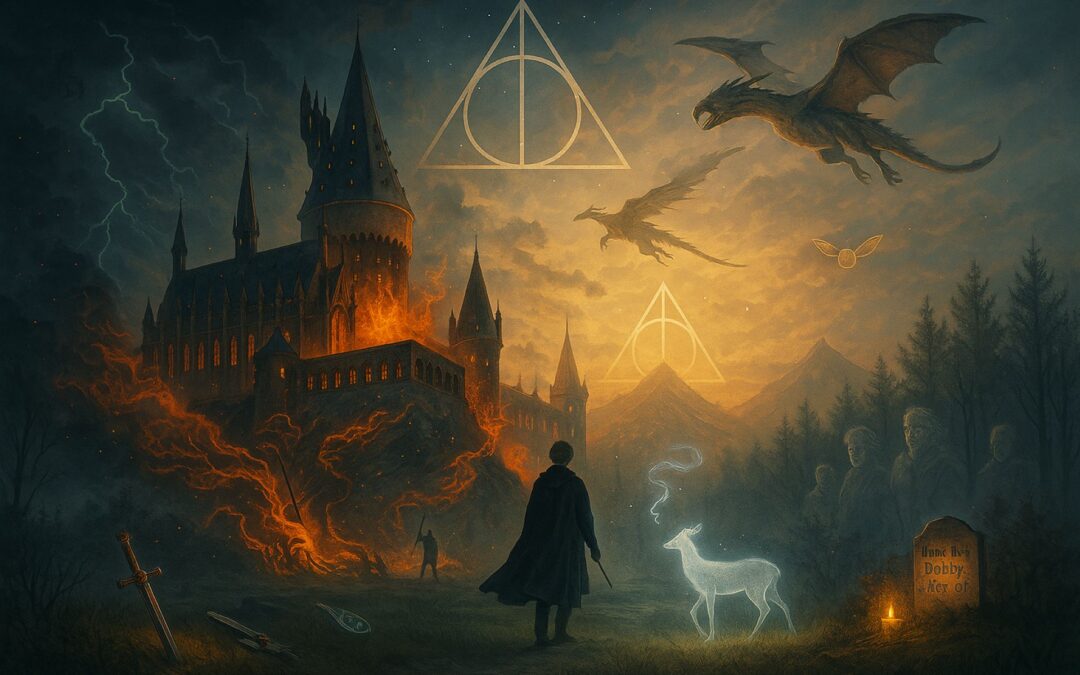
Overview: A World on the Edge of Darkness
The light that once flickered within Hogwarts has gone out. The wizarding world is no longer merely shadowed by fear — it is ruled by it. Harry Potter and the Deathly Hallows opens not with the comfort of familiar halls, but with exile, uncertainty, and the suffocating reach of Voldemort’s dominion. The Ministry has fallen. Truth has become treason. Every friend could be a spy; every letter, a death warrant.
Yet amid this collapse, a quieter resistance endures. Harry, Hermione, and Ron embark on a wandering pilgrimage across a Britain haunted by war and silence. Gone are the mentors and maps — now, they must follow intuition, memory, and the faint pulse of hope that remains. Their quest for Horcruxes is not simply a hunt for objects, but a stripping away of illusion — of magic as safety, and of victory as certainty.
Where the earlier books celebrated discovery, this final volume embraces loss as revelation. It transforms heroism from spectacle to surrender, showing that true power lies not in domination or prophecy, but in understanding what must be let go.
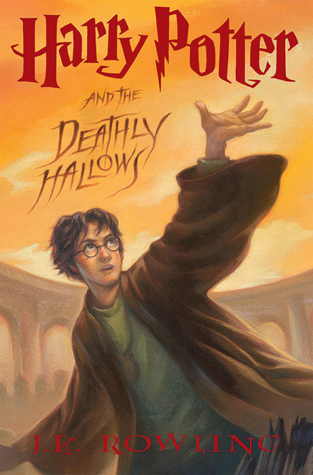
Full Plot Summary: The Long Walk to the Forest
At the end of The Half-Blood Prince, the world had tilted. Dumbledore — the only figure Voldemort ever feared — lay dead, the lightning-struck tower still echoing with betrayal. Hogwarts was no longer a sanctuary but a fortress under siege.
Snape, once the ambiguous protector, had fled with Draco into the darkness, and Harry, stripped of guidance, made a solemn vow beside Dumbledore’s tomb: he would not return to school.
He would finish what his mentor began — find and destroy the Horcruxes, the dark anchors of Voldemort’s immortality. That vow becomes the heartbeat of The Deathly Hallows, driving the story through exile, loss, and revelation toward one final reckoning in the forest.
The Flight of the Seven Potters: A Sky of Fire and Loss
As the story opens, Harry stands on the brink of manhood and mortality. Dumbledore is gone, his grave still new, and the wizarding world trembles beneath Voldemort’s shadow. Even Privet Drive — once the cold cradle of Harry’s early life — becomes a battlefield. The protective spell cast by his mother’s sacrifice will break when he turns seventeen, and the home that once confined him now represents his last fragile shield.
The Order of the Phoenix assembles for one final act of guardianship. Moody, Lupin, Tonks, Hagrid, and the Weasleys join in a daring, almost suicidal mission: to smuggle Harry to safety before the Death Eaters strike. The plan itself feels symbolic — seven Potters created through Polyjuice Potion, each willing to risk their life to preserve one. The scene unfolds with a sense of foreboding grandeur — a swarm of broomsticks, thestrals, and a flying motorbike splitting through storm clouds as spells explode around them.
Then, chaos: Death Eaters ambush them mid-flight. Hedwig, Harry’s first companion and silent witness to his growth, dies suddenly — a streak of white cut down in a storm of green light. Mad-Eye Moody falls next, the most battle-hardened of them all, killed by Voldemort himself. Hagrid and Harry barely escape, their motorbike crashing through suburban skies in flames. The sequence marks a shift from youthful adventure to the full brutality of war — no longer a story of lessons learned, but of survival earned.
When the survivors regroup at the Burrow, they do so under a shadow. George Weasley’s ear is blasted off, Lupin and Tonks stagger back wounded, and the sense of collective grief is palpable. Each scar feels like a prelude. As Harry watches his friends tend to the wounded, he realizes that every person near him becomes a target. It’s the curse of being “the Chosen One” — salvation for some, doom for others.
Still, the world insists on moments of grace. Bill and Fleur’s wedding provides one last celebration before the descent into chaos — music, laughter, a fleeting reminder of normal life. It is at this wedding, however, that reality pierces through festivity: the news that the Ministry has fallen, Rufus Scrimgeour is dead, and Voldemort now controls the government. Within minutes, Death Eaters descend upon the gathering, and the dream of safety evaporates completely. The trio Disapparates into darkness, leaving behind the ruins of everything they knew.
The Mission Without a Map: The Horcrux Hunt Begins
With the Burrow destroyed as a refuge, the trio turns to Grimmauld Place — the ancestral home of Sirius Black, now both sanctuary and tomb. It is here, amid the dust and whispers of the past, that the pieces of Dumbledore’s mystery begin to surface. R.A.B., the unknown figure who once stole one of Voldemort’s Horcruxes, is revealed to be Regulus Arcturus Black — Sirius’s brother, who died defying Voldemort after realizing the horror of his master’s immortality. The missing Horcrux, a locket, is now in the possession of Dolores Umbridge, who flaunts it as a symbol of purity and power at the Ministry.
To retrieve it, the trio plans their most audacious infiltration yet. Using Polyjuice Potion, they disguise themselves as Ministry employees and walk into the lion’s den. The Ministry, once a symbol of order, now mirrors every tyranny of history: propaganda posters smear Muggle-borns as thieves of magic; whispers of fear echo through bureaucratic corridors; the “Magic is Might” statue depicts wizards crushing helpless figures beneath their feet. The sequence is Kafkaesque — familiar spaces twisted into instruments of oppression.
They find Umbridge leading an inquisition against “undesirable” citizens, wearing the stolen locket as though it were a medal of virtue. When Hermione stuns her and they seize the Horcrux, they escape in chaos — spells flying, alarms blaring, reality shattering. They Disapparate to the countryside, but safety proves an illusion. The trio begins a long, nomadic existence, camping across forests and hills, moving nightly under Disillusionment charms, living on rationed food and tension.
The locket, their only prize, turns into a parasite. It emanates despair, whispering insecurities and resentments into whoever wears it. The slow poisoning of their spirits mirrors the corruption it embodies: fragments of Voldemort’s soul feeding on their fear. Ron, already burdened by jealousy and frustration, becomes its easiest prey. He argues with Harry — bitterly, explosively — before storming off into the night. His absence shatters the fragile stability of the group.
Harry and Hermione’s solitude that follows is haunting. They move through desolate winter landscapes — forests thick with silence, rivers frozen, their reflections dim. Hermione, ever rational, clings to Dumbledore’s clues and keeps them moving. Harry, meanwhile, wrestles with doubt. Dumbledore’s omissions — his past with Grindelwald, his secrecy about the Hallows — begin to erode Harry’s faith. He starts to suspect he’s a pawn in a larger, incomprehensible plan.
This phase of wandering becomes a symbolic descent — a pilgrimage without revelation, mirroring the wilderness before a prophet’s awakening. It is the moment when faith must either die or deepen.
Exile and Revelation: The Silver Doe
Winter falls heavy and absolute — a season of exile in every sense. With Ron gone, the rhythm of the journey changes. The tent feels larger and emptier, the silence between Harry and Hermione weighted with things unsaid. They move from forest to forest, relying on the radio’s faint static for news of the outside world — snippets of hope interspersed with names of the dead. “Potterwatch,” the secret broadcast of the resistance, becomes their only link to humanity.
Hermione reads and rereads The Tales of Beedle the Bard, Dumbledore’s final gift to her, tracing the strange symbol that keeps appearing in its pages — a triangle enclosing a circle and a line. It is seen again in unexpected places: on the grave of Ignotus Peverell in Godric’s Hollow, on Xenophilius Lovegood’s pendant, even in Dumbledore’s old letters. Its meaning taunts them, a mystery entangled with Dumbledore’s past and Voldemort’s obsession.
The visit to Godric’s Hollow becomes an act of pilgrimage. There, in the churchyard, Harry kneels before the graves of his parents. The inscription — “The last enemy that shall be destroyed is death” — cuts through him like prophecy and irony combined. For the first time, he stands not as “the Boy Who Lived,” but as the boy who was left behind. They visit Bathilda Bagshot, historian of Dumbledore’s youth, hoping for guidance, but the encounter turns to horror. Bathilda’s body is long dead, her form inhabited by Nagini. The attack that follows is violent, disorienting — a grotesque mockery of the homecoming Harry sought. In their desperate escape, his wand is shattered, severing his most personal link to magic.
The loss of the wand deepens the despair that has already begun to consume him. The snow grows thicker, the cold more merciless, and the Horcrux around his neck pulses like a living thing. Harry dreams of Dumbledore and Grindelwald — glimpses of two men bound by power and guilt — and wonders if he’s walking the same path of error.
Then, in the dead of night, a silver doe glides through the trees — silent, luminous, and inexplicably familiar. She leads Harry to a frozen pond where, beneath the ice, gleams the Sword of Gryffindor. The symbolism is unmistakable: a weapon of courage hidden beneath stillness, waiting for those who dare to submerge themselves in faith. Harry dives in, only to find himself strangled by the locket’s chain — his own fear pulling him under.
In that suffocating moment, a hand hauls him up — Ron’s hand. His return is both shock and absolution. Guided by the Deluminator Dumbledore left him, Ron had followed the sound of Hermione’s voice in the darkness, drawn back to them as if by destiny. When he takes the sword and drives it through the locket, the Horcrux retaliates, conjuring illusions of Harry and Hermione entwined in betrayal. It preys on jealousy, self-doubt, and shame — but Ron’s will holds. The destruction of the Horcrux is as much a moral victory as a magical one: the purging of envy, the renewal of friendship, the quiet resurrection of faith.
By the time Hermione forgives him, the frost is beginning to thaw. The trio is reunited — older, harder, but somehow purer for the ordeal.
The Legend of the Deathly Hallows
When they visit Xenophilius Lovegood, the eccentric father of Luna, it is partly curiosity, partly desperation. The symbol that has haunted their journey — the triangle, the circle, the line — is everywhere in his house, etched on walls, scrawled on parchment. He tells them it is the mark of the Deathly Hallows, a myth so ancient that even wizards treat it as a fairy tale.
Through The Tale of the Three Brothers, he explains its meaning. Once, three brothers cheated Death by building a bridge across a dangerous river. Offended yet impressed, Death granted each a boon. The eldest asked for an unbeatable wand — the Elder Wand. The second sought to recall the dead — the Resurrection Stone. The youngest requested something to hide him from Death — the Invisibility Cloak. The first two brothers met ruin: one murdered for his wand, the other driven to suicide by grief. Only the youngest lived a full life and greeted Death as an equal.
The story functions as both myth and mirror. For Hermione, it’s an allegory — a moral warning about hubris. For Harry, it’s revelation: a pattern emerging behind Dumbledore’s cryptic clues. The Cloak he inherited from his father may be the third Hallow, one of the true relics of legend. His wand and the Resurrection Stone, too, begin to echo in his thoughts. The temptation grows — the idea that by mastering all three, he could finally defeat Voldemort, not through sacrifice but through dominance.
Yet beneath that temptation lies deeper confusion. Dumbledore’s past, revealed through Rita Skeeter’s biography and Aberforth’s accusations, begins to haunt Harry. The wise old mentor who preached humility once sought the Hallows himself, alongside Grindelwald, with dreams of power “for the greater good.” Harry begins to fear that his own quest mirrors that same arrogance — that the pursuit of victory may be indistinguishable from the lust for control.
When Xenophilius betrays them — summoning Death Eaters in exchange for his daughter’s safety — the allegory becomes reality. Even noble motives can be twisted by fear and love. The trio escapes, but the episode leaves a scar of mistrust. They now carry two burdens: the hunt for Horcruxes and the haunting possibility that another, more seductive quest — the Hallows — might lead them astray.
As they vanish into the wilderness again, the legend of the Hallows becomes both a guiding light and a moral test. The reader feels the tension tightening — between the path of power and the path of surrender, between the desire to conquer death and the courage to accept it.
The Fall at Malfoy Manor
The slow unraveling of the trio’s fragile refuge reaches its breaking point when, one night, a misfired name seals their fate. Harry accidentally speaks Voldemort’s name aloud — now magically tracked — summoning Snatchers to their hiding place. The chase through the woods is brutal and swift; the trio is captured, stripped of their wands, and dragged to the newly christened seat of terror: Malfoy Manor.
The manor is more than a home — it is a symbol of the new order. Its marble halls gleam with cruelty; its portraits seem to watch with disdain. Inside, the Death Eaters convene under Voldemort’s invisible authority, awaiting their master’s return from distant murder. Lucius Malfoy, once arrogant and composed, now trembles with desperation, trying to regain favor by identifying the captives. His hesitation betrays him — fear has devoured pride.
Hermione, under the scrutiny of Bellatrix Lestrange, becomes the target of sadistic delight. Bellatrix’s unhinged laughter echoes through the halls as she tortures Hermione for information about the Sword of Gryffindor, which the trio had used to destroy a Horcrux. The scene is harrowing — Hermione’s screams from above, Harry and Ron locked in the cellar below, clawing at stone walls in helpless fury.
In the darkness of the cellar, the story intersects with others long displaced. Luna Lovegood, Ollivander the wandmaker, and the goblin Griphook are already imprisoned there, proof that Voldemort’s terror spares no one — child, craftsman, or creature. The moment brims with despair until a faint pop of magic breaks the tension: Dobby, the free elf, arrives.
The little creature’s appearance carries immense emotional weight. Once a symbol of servitude, Dobby now embodies defiance — the freedom to choose loyalty. He disarms Pettigrew, who meets his end by his own enchanted hand — a poetic justice for a lifetime of cowardice. The rescue is frantic and chaotic: spells ricochet, the chandelier crashes, and Bellatrix’s shriek cuts through the smoke. In the chaos, Dobby Apparates them to safety — to Shell Cottage — but Bellatrix’s dagger strikes as they vanish.
When they land, the triumph turns instantly to grief. Dobby dies in Harry’s arms, whispering that he is happy to be “with friends.” The quiet that follows is heavier than any battle — the kind of silence that defines the cost of war. Harry digs the grave himself without magic, each stroke of the spade a prayer and a penance. In that act of manual humility, Harry changes. No longer the boy chasing destiny, he becomes a man accepting its burden.
Dobby’s grave — Here lies Dobby, a free elf — stands as one of the most human moments in the series. It is the moral center of the book: love as rebellion, compassion as resistance.
Breaking into Gringotts: The Price of Greed
Even as the trio mourns, their mission sharpens into focus. Guided by fragments from Voldemort’s thoughts — an unintentional bond that still links their minds — Harry realizes another Horcrux lies within the Lestrange vault at Gringotts. But retrieving it means infiltrating the most secure vault in the wizarding world — one guarded by enchantments, dragons, and distrust.
The plan they craft at Shell Cottage is part desperation, part audacity. Griphook agrees to help them break in, lured by the promise of Gryffindor’s Sword, though his loyalty is uncertain. The alliance between wizard and goblin trembles under centuries of mistrust. Hermione disguises herself as Bellatrix with Polyjuice Potion, a cruel irony considering the woman’s recent torture. The transformation unsettles her deeply — power worn as a mask feels like a moral compromise.
Their arrival at Gringotts is tense from the first step. The bank’s marble grandeur now radiates oppression, its goblin guards both servile and suspicious. Harry’s use of the Imperius Curse to control a goblin marks a turning point — a violation of boundaries he once held sacred. It’s the cost of war: every victory tinged with corruption.
Inside Bellatrix’s vault, the air itself seems alive with greed. The moment they touch a single object, everything multiplies and burns. Cups, coins, and jewelry swell into avalanches of gold, scalding their skin, suffocating them in illusionary wealth. It’s a perfect metaphor — the more one takes, the more one is consumed. Amid the chaos, they spot the true treasure: Hufflepuff’s Cup, gleaming faintly through the heap. They seize it, but their escape is already compromised. Griphook betrays them, snatching the sword and leaving them surrounded by guards.
Cornered and desperate, Harry makes a decision that borders on madness — they mount the dragon chained within the vaults. The beast, long tortured by enchantments, thrashes and bellows as they break its shackles. When it bursts through the roof of Gringotts and into the open sky, the image is apocalyptic — gold and fire raining down on London, the dragon’s roar echoing freedom and fury.
As they cling to its back, blinded by wind and sunlight, Harry feels something elemental shift. The trio is no longer merely running from danger; they’re tearing through the very heart of the corrupt order Voldemort built. The flight on dragonback is both literal and symbolic — the triumph of wild courage over system, of instinct over fear.
When they leap from the dragon’s back into a lake miles away, soaked, bruised, and breathless, the victory is fleeting. They have gained a Horcrux, but lost an ally, their sword, and much of their faith in the old distinctions between good and evil.
It is in this moral twilight that Harry begins to see the final pattern forming. Every object destroyed, every death endured, draws him closer to the truth that has been circling the story since its beginning: that to end Voldemort, he will not need mastery — he will need surrender.
The Battle for Hogwarts: The Last Stand
The trail from Gringotts leads Harry, Ron, and Hermione back to where everything began — Hogwarts. The castle, once a beacon of sanctuary and discovery, now lies beneath the shadow of tyranny. Severus Snape, branded a murderer and installed as headmaster, rules the school under the watch of the Carrow siblings, whose sadism passes for discipline. Students are cowed into obedience; resistance is met with torture. But even here, rebellion breathes in secret corridors — Dumbledore’s Army, led by Neville Longbottom, Ginny Weasley, and Luna Lovegood, has survived underground, transforming the Room of Requirement into a living fortress.
When the trio arrives through a hidden passage from the Hog’s Head, they are greeted not by fear but by resolve. The students who once looked to Harry for answers now stand as equals in defiance. Word spreads like wildfire — Harry’s back. In that instant, Hogwarts itself seems to awaken. The castle walls echo with purpose; old alliances rekindle. The teachers, long bound by cautious neutrality, take their stand. Professor McGonagall duels Snape in the Great Hall with fierce precision, driving him from the castle. The victory is short-lived but profound — the first moment in which the school openly reclaims itself from darkness.
Harry knows that one final Horcrux remains hidden somewhere in the castle. Clues point toward something of Ravenclaw’s, and it is the ghost of Helena Ravenclaw — the Grey Lady — who provides the missing piece. Her confession, laced with sorrow and pride, reveals how she stole her mother’s diadem long ago and hid it in Albania, where it was later found and corrupted by Voldemort. The realization strikes like lightning: the diadem must be in the Room of Requirement, concealed amid centuries of forgotten things.
Inside that chaotic labyrinth of discarded magic, the trio encounters Draco Malfoy, Crabbe, and Goyle — boys now thrust into a war they scarcely comprehend. The confrontation spirals into catastrophe when Crabbe unleashes Fiendfyre, cursed fire that devours everything it touches. The room becomes a storm of flame and living beasts of heat and smoke. Harry and Ron save Draco and Goyle, but Crabbe is consumed by his own spell — an ironic reflection of the destructive arrogance that has fueled the series’ villains from the beginning. As they escape, the Fiendfyre incinerates the diadem, destroying the Horcrux.
Outside, the storm breaks. Voldemort’s forces, alerted by his link with Harry, descend upon the castle. Giants and werewolves crash through the walls; Death Eaters swarm the grounds; the defenders — students, professors, house-elves, and centaurs — rise as one. The Battle of Hogwarts unfolds not just as war, but as reckoning: the culmination of seven years of choices, loyalties, and love. Fred Weasley falls amid laughter, Tonks and Lupin die side by side, Colin Creevey is found lifeless among giants. Each loss deepens the silence between spells. Yet even as the castle burns, the defenders do not retreat. They are fighting not for victory, but for meaning — for the belief that love, however fragile, is still worth dying for.
Meanwhile, Voldemort, stationed in the Shrieking Shack, waits for destiny to come to him. He confides in Nagini as his only companion, unaware that his reign is already unraveling. He believes the Elder Wand resists him because its true master still lives: Snape. In a moment of cold calculation, he orders Nagini to strike, murdering Snape to claim the wand’s allegiance. Hidden in the shadows, Harry watches as the man he once despised bleeds out. With his dying breath, Snape releases a silver memory, his last truth. “Look… at… me,” he whispers — the plea of a man who dies gazing into the eyes that mirror the woman he loved.
The battle rages on, but Harry has already entered a different war — the one inside the Pensieve, where Snape’s memories unravel everything he thought he knew.
The Forest Again: The Master of Death
Snape’s memories rewrite the entire story. Harry sees a lifetime of contradictions: the cruel professor revealed as Dumbledore’s most loyal ally, a man who lived in secrecy and suffering for the sake of a promise made to Lily Potter. He learns that his mother’s protection still flows through him — not as a spell, but as living grace — and that it is precisely this love that gave him the power Voldemort could never understand.
But the revelation carries a crueler truth: part of Voldemort’s soul lives within Harry himself. The boy who lived was also the vessel of the Dark Lord’s immortality. To end the war, Harry must die. The prophecy that once seemed about power now reveals itself as paradox — the boy destined to defeat Voldemort must let himself be killed by him.
As he walks through the ruined halls of Hogwarts, Harry sees the faces of those he loves — Ginny comforting a wounded child, Neville rallying the frightened, Mrs. Weasley kneeling over Fred’s body — and feels the weight of every sacrifice made for him. Yet there is no bitterness, no resistance. His fear dissolves into clarity.
In the quiet of the Forbidden Forest, he opens the Snitch left by Dumbledore. “I open at the close,” it reads. Inside lies the Resurrection Stone, one of the fabled Deathly Hallows. When he turns it, the dead come to him — his parents, Sirius, Lupin — walking beside him like pale guardians. They do not offer escape or reassurance; they simply make the path bearable. “You’ll stay with me?” he asks. “Until the end,” his mother replies.
Harry steps into the clearing where Voldemort waits. The Death Eaters stand in a ring of silence. There is no speech, no plea. Harry’s calm becomes unbearable even to his enemies. He drops the Stone, closes his eyes, and accepts death. The flash of green light that follows feels less like destruction than release.
In the white, misted void that follows, Dumbledore greets him like an old friend. The conversation is quiet, stripped of all grandeur. Dumbledore confesses his ambition, his mistakes, his hunger for power, and his eventual awakening — how his pursuit of the Hallows nearly ruined him. He tells Harry that by offering himself willingly, he has undone Voldemort’s magic; love has once again conquered fear. “Do not pity the dead, Harry,” Dumbledore says, “pity the living, and above all, those who live without love.”
Harry chooses to return. He awakens on the forest floor, alive, his body unclaimed. Voldemort, believing him dead, sends Narcissa Malfoy to confirm it. She feels his pulse and, learning that Draco lives, lies to her master. The living world tilts back toward hope.
As Voldemort marches to the castle with Harry’s limp body, triumph hollow in his voice, the defenders’ cries fade into despair. But it is in that despair that rebellion kindles anew. Neville, thought a mere bystander, draws the Sword of Gryffindor from the Sorting Hat and slays Nagini — the final Horcrux. In that single, defiant act, the web of Voldemort’s immortality unravels completely.
The next moments — the final confrontation, the shattering of curses, the death of the Dark Lord — are inevitable, almost quiet in their moral symmetry. For now, what matters is that the war has reached its spiritual apex: courage against control, humility against hubris, love against the void. The story has turned full circle — the boy who once survived death now walks willingly into it, mastering it not by defiance, but by grace.
The Final Duel: What Dies and What Endures
The illusion of Voldemort’s triumph lasts only moments. He parades through the shattered courtyard of Hogwarts, Harry’s seemingly lifeless body floating in Hagrid’s arms, and declares the war over. His voice carries through smoke and silence, offering mercy in exchange for submission — the same hollow bargain tyranny always makes. Yet beneath the despair, something flickers: defiance that will not die.
Neville Longbottom steps forward, the embodiment of that defiance. Once mocked for his clumsiness, he now stands alone before the Dark Lord. Voldemort mocks him, scorches him with a curse, and conjures the Sorting Hat, placing it on Neville’s head as if to humiliate him. But magic born of courage cannot be controlled. The Hat bursts into flame — and from it, the Sword of Gryffindor emerges, summoned by Neville’s bravery. With one stroke, he severs Nagini’s head. The final Horcrux falls, and the balance shifts. Voldemort’s power, tethered to fragments of his soul, begins to crumble.
In the chaos that follows, Harry stirs. Still cloaked in invisibility, he moves among the living and the dead, watching Voldemort’s forces fracture. Mothers protect their children, house-elves charge at Death Eaters wielding kitchen knives, centaurs rain arrows from the Forbidden Forest. The war’s imagery collapses into one truth: love and loyalty, however humble, outlast fear.
When Harry reveals himself alive, the Great Hall becomes the stage for the story’s final reckoning. The duel between Harry and Voldemort is not one of spectacle, but of meaning. Their wands meet in silence, not fury. Harry calls Voldemort by his true name — Tom Riddle — stripping away illusion and title. He tells him the truth of the Elder Wand, of how it never belonged to Snape, nor to Voldemort, but to Draco, whom Harry disarmed at Malfoy Manor. The wand’s allegiance, therefore, lies with him.
The realization dawns on Voldemort too late. In the next instant, he casts the Killing Curse even as Harry releases his Disarming Charm. The spells collide — green and red intertwining — before Voldemort’s own curse rebounds upon him. The Elder Wand refuses to kill its master’s master. The tyrant dies not with thunder, but with a whisper — his body crumpling to the floor like dust finally settling. There is no echo, no music, no victory cheer. Only silence — the quiet relief of a world that can breathe again.
The war ends not in celebration but in exhaustion. The Great Hall becomes both chapel and graveyard — wands lowered, heads bowed. Fred lies still beside Lupin and Tonks; George sits motionless, staring at a world that feels smaller without laughter. The survivors gather in small groups — Ginny resting her head on her mother’s shoulder, Luna staring up at the skylight where dawn breaks through soot. In this fragile peace, Harry feels no glory, only gratitude and sorrow intertwined.
When he looks down at Voldemort’s body, it is not with hatred. The creature who spent his life fleeing death lies still, as human as anyone. There is no triumph in this — only the awareness that all paths, even those carved in blood, end in the same place.
Harry takes the Elder Wand in his hand — the most powerful wand in existence, the final Hallow, the prize of so many lives lost — and chooses to destroy it. He snaps it in two, the sound small but immense. For the first time in the saga, he acts without prophecy, guidance, or fear. He acts freely. In rejecting the pursuit of power, he becomes what Dumbledore never could — a man unchained from the illusion of mastery.
Peace, when it comes, feels sacred. The castle still burns, but life already begins to mend its edges.
Nineteen Years Later: The Circle Restored
Time moves quietly after great wars. The world rebuilds, not with spells or fanfare, but with ordinary acts of living. Nineteen years later, Platform Nine and Three-Quarters hums with the same mingled noise of magic and mundane life — the hiss of the Hogwarts Express, the laughter of children, the calls of parents pretending not to worry.
Harry stands there with Ginny, watching their three children — James, Albus, and Lily — prepare for departure. Ron and Hermione are beside them, their own family woven into this circle of continuity. The scars of war have softened into memory, their grief worn down by years of quiet, unremarkable peace. There are gray hairs now, laugh lines, and an ease that once seemed impossible.
When Albus Severus Potter hesitates, fearing his house placement, Harry kneels beside him. His words — “You were named for two headmasters of Hogwarts. One of them was a Slytherin, and he was the bravest man I ever knew” — distill the moral heart of the entire series. Mercy and understanding, once distant ideals, have become Harry’s inheritance to the next generation.
The train departs, steam curling through sunlight. The moment carries both ending and renewal — the story closing where it began, at the threshold between childhood and the unknown. Harry’s scar, the symbol of both his pain and his survival, has not pained him for nineteen years. The line carries quiet weight: not triumph, but wholeness.
The circle is complete. The child who once sought to escape death now lives fully within life, at peace with its boundaries. The magic remains — not in wands or spells, but in forgiveness, friendship, and love unafraid of loss.
Character Analysis: The Faces of Sacrifice and Resolve
At the heart of The Deathly Hallows lies not only the conclusion of a story, but the culmination of its characters’ moral evolution. Every figure — from hero to villain, from mentor to martyr — is drawn to a moment of truth. The masks they wore across six books finally fall away, revealing what each has always feared or desired most: freedom, redemption, love, or peace.
Harry Potter: The Willing Martyr
Harry’s final journey is not about learning magic, but mastering mortality. For six books, he has been defined by survival — the boy who lived through others’ sacrifice. In this last chapter, he becomes the one who sacrifices. Gone is the impulsive adolescent who fought to prove himself; in his place stands a man who fights to protect others, even when victory seems impossible.
His faith is tested in every way: Dumbledore’s death leaves him directionless, his friends’ loyalty falters, and even the moral certainty that once guided him begins to erode. Yet, paradoxically, it is in the wilderness — hungry, hunted, and hopeless — that Harry learns clarity. The locket Horcrux that poisons him also purifies him: it forces him to confront envy, rage, and despair, and to choose compassion instead.
When he discovers that a piece of Voldemort lives inside him, his transformation is complete. Death no longer terrifies him; it humbles him. His walk into the forest is the purest expression of moral courage — not defiance, but acceptance. He embraces death willingly, proving that the power Voldemort sought to conquer is only conquered through surrender.
In the end, Harry’s choice to destroy the Elder Wand signifies the final act of self-liberation. He renounces mastery itself, embodying the lesson that true greatness lies in restraint. He becomes what Dumbledore hoped to be and what Voldemort never could be: a man unenslaved by power.
Hermione Granger: Wisdom Under Siege
Hermione’s brilliance, long her defining strength, evolves into moral intellect — the ability to discern not only what is right, but when rightness costs too much. Her rational mind becomes the trio’s compass amid chaos, yet even she falters when knowledge fails. Her faith in books, plans, and reason is tested as the war forces her to confront the limits of logic.
The act of erasing her parents’ memories at the novel’s outset — to protect them from Death Eaters — is perhaps her most wrenching sacrifice. It is an act of both love and violence, intellect turned to pain. Later, her steadfast commitment to the Horcrux mission, even in exile, keeps the group alive. She is the thinker in a story of believers and fighters, yet her courage is never detached — it is human, trembling, and hard-earned.
In the face of Bellatrix’s torture at Malfoy Manor, Hermione’s silence becomes heroic. She endures pain not for knowledge or glory, but for loyalty — proving that courage does not always roar; sometimes it simply refuses to break.
By the war’s end, Hermione embodies the union of mind and heart, intellect and compassion. Her survival, like Harry’s, feels less like luck and more like proof of moral endurance.
Ron Weasley: Loyalty Tested by Fear
Ron’s journey in The Deathly Hallows is one of reckoning with insecurity. He has always been the third figure — not “the Chosen One,” not the genius, but the friend in the shadow of greatness. The Horcrux locket exposes that vulnerability, amplifying his fears of inadequacy and jealousy. When he abandons Harry and Hermione, it is the culmination of years of unspoken resentment.
But Ron’s return — heralded by the silver doe and sealed by his destruction of the locket — marks his rebirth. In conquering the hallucination of his worst self, he conquers the fear that once defined him. His remorse is sincere, his courage earned, and his humor restored. By the end, he is not merely loyal; he is loyal with awareness — his faith now chosen, not assumed.
Ron’s arc mirrors the human experience of friendship: failure, forgiveness, and the rediscovery of worth. He represents the truth that even the ordinary can rise to extraordinary heights when guided by love.
Severus Snape: The Double Shadow
Snape is the novel’s most complex and devastating revelation — a man whose cruelty masked a lifetime of penance. For years, he embodied contradiction: a Death Eater trusted by Dumbledore, a villain who saved the hero, a spy who hated what he protected. In the end, his memories untangle the riddle of his life: everything he did — every deceit, every cruelty, every risk — was bound to a single, unending love for Lily Potter.
His protection of Harry was not affection, but expiation — a promise fulfilled through suffering. Yet even in his bitterness, Snape remains a tragic figure rather than a saint. His love is obsessive, his morality conflicted, his life steeped in secrecy. He dies not vindicated but misunderstood, his heroism known only after death.
Snape’s redemption is not sentimental. It is human. His story demonstrates that atonement does not erase guilt, but transforms it into purpose. His legacy lives not in glory, but in the quiet respect Harry grants him later — naming his son Albus Severus, and declaring that one of those names belonged to “the bravest man I ever knew.”
Voldemort: The Tyrant Consumed by Death
If Harry’s life is the story of love mastering fear, Voldemort’s is its inversion — the chronicle of fear consuming love. His entire existence revolves around denial: denial of mortality, compassion, and equality. In seeking to fragment his soul to preserve it, he loses it entirely. Each Horcrux, each act of murder, strips him further from humanity until his death feels less tragic than inevitable.
In The Deathly Hallows, Voldemort’s character descends into irony. The man who kills to evade death is destroyed by his inability to understand it. The Elder Wand — his ultimate obsession — refuses to obey him precisely because he cannot comprehend loyalty, empathy, or selflessness. The same weapon he wields to dominate turns on him, echoing the moral symmetry of the series: destruction born from the refusal to change.
Even in victory, Voldemort is small. His final defeat is not thunderous, but silent — the fall of a man already hollow. His death is the ultimate lesson: fear of death is fear of life itself.
Supporting Figures: The Courage of the Ordinary
The final book elevates the peripheral into the profound. Neville Longbottom’s defiance in the face of torture, his unwavering belief in goodness, and his slaying of Nagini embody courage stripped of glamour. Luna Lovegood’s quiet faith — her ability to see truth when others see madness — remains unshaken even in captivity.
The Weasleys, too, represent the emotional fabric of the story’s world. Molly’s duel with Bellatrix — “Not my daughter, you bitch!” — is not mere vengeance but the culmination of a mother’s love that has always stood in contrast to Voldemort’s barren ambition.
Even Dobby, the free elf, transforms the idea of servitude into a parable of dignity. His death, small in scale yet infinite in meaning, becomes a moral center for the narrative — proof that nobility is not a matter of birth, but of choice.
Collectively, these supporting characters expand the novel’s vision: heroism belongs not to the exceptional, but to the willing — those who act despite fear, who love despite loss.
Themes and Motifs: Death, Destiny, and the Power of Choice
The Deathly Hallows is the grand synthesis of every theme that has coursed through the series — death, love, choice, memory, and the moral weight of power. But where earlier books treated these ideas as lessons to be learned, the final volume transforms them into truths to be lived. Each thread of the story converges toward one central question: What makes life worth living when death is inevitable?
The Nature of Death
Death, once the shadowy antagonist of childhood, becomes the book’s deepest teacher. In earlier volumes, it haunted the margins — a curse, a tragedy, an injustice. Here, it steps into the light. Dumbledore’s wisdom, Snape’s secrets, and Harry’s surrender all orbit a single moral truth: that acceptance of mortality is the key to freedom.
The Deathly Hallows themselves are symbols of humanity’s three responses to death — domination, denial, and acceptance. The Elder Wand represents the lust to conquer; the Resurrection Stone, the yearning to undo; and the Invisibility Cloak, the grace to coexist. Only the third path — walking alongside death rather than fleeing or mastering it — leads to peace.
Harry’s final act is a mirror to this lesson. By offering himself willingly, he turns death from an enemy into an ally. The magic that saves him is not in his blood, but in his understanding. In contrast, Voldemort’s quest for immortality turns him into a living corpse, proof that to fear death is to decay while breathing.
The novel thus reframes mortality not as defeat, but as completion — the moment when one’s choices, virtues, and love crystallize into legacy.
The Burden of Leadership
Harry’s transformation from reluctant boy hero to moral leader carries a heavier tone than any previous book. Leadership in The Deathly Hallows is not about command but conscience. Dumbledore’s absence forces Harry to act without direction, to make decisions where no choice feels entirely right.
Throughout the journey, he wrestles with disillusionment: the discovery of Dumbledore’s youthful ambition, his hidden flaws, and his silence about the full truth. Yet this disappointment is essential. It liberates Harry from dependence and teaches him that integrity is not the absence of error, but the courage to continue despite it.
His leadership is rooted in empathy — the ability to see humanity even in enemies. He spares Draco, grieves for Snape, and regards Voldemort with pity rather than vengeance. In contrast, Voldemort’s “leadership” is defined by control, fear, and isolation. His followers obey, but they do not believe. The novel’s final contrast is not between victory and defeat, but between leadership born of love and power born of terror.
Love as the Ultimate Defense
From the first book onward, love has been the invisible current beneath every spell and battle. In The Deathly Hallows, it becomes explicit — the elemental force that outlasts all others. Lily’s sacrifice, once mythic backstory, now reaches its full significance. Her love is not a charm that protects Harry, but a seed that grows within him, shaping every moral choice he makes.
The most powerful moments of the book — Dobby’s rescue, Ron’s return, Snape’s memories, Narcissa’s lie to Voldemort — are all acts of love expressed through defiance. Each subverts Voldemort’s worldview, which sees affection as weakness. Even minor gestures — Luna’s unwavering belief, Neville’s courage, Mrs. Weasley’s rage — reveal love as an energy that transforms fear into purpose.
By the end, Harry’s triumph is not the result of superior magic, but of emotional maturity. He wins not by outcasting spells, but by outloving his enemy.
Memory and Legacy
Memory saturates the novel — in Dumbledore’s posthumous guidance, in Snape’s Pensieve revelations, in the dead who walk beside Harry through the forest. The act of remembering becomes both painful and redemptive. Every loss carries meaning when it is borne in memory.
Where Voldemort clings to life by fragmenting his soul, Harry embraces mortality by preserving others within him. The Resurrection Stone scene crystallizes this duality: Voldemort’s dead enslave him; Harry’s dead liberate him. Memory, when guided by love, becomes a living continuity rather than a chain to the past.
The closing scene at King’s Cross Station nineteen years later affirms this continuity. The next generation departs with the weight of history behind them — not as burden, but as inheritance. Legacy, the novel suggests, is not what one leaves for others, but what one leaves within them.
The Power of Choice
Perhaps the most defining motif of the series, choice returns here as the measure of the soul. Dumbledore’s words — “It is our choices, Harry, that show what we truly are, far more than our abilities” — echo through every sacrifice made in this final book.
What separates Harry from Voldemort is not power, but how each responds to it. Both are orphans, both shaped by prophecy and loss. Yet Harry’s choices — compassion over cruelty, surrender over control — rewrite destiny. The book’s moral structure rests on this Stoic paradox: one cannot choose circumstances, only responses.
Even in moments of despair, choice reaffirms agency. Ron’s decision to return, Snape’s to atone, Narcissa’s to lie, and Neville’s to stand — each act, large or small, bends the moral arc of the story toward hope. The novel insists that freedom is not found in mastery, but in moral clarity.
The Hallows and Horcruxes: Two Philosophies of Power
Woven through the narrative is a symbolic duality — two quests reflecting two worldviews. Horcruxes embody division, violence, and fear; the Hallows, unity, legend, and transcendence. Voldemort seeks to preserve life by destroying it; Harry learns to honor life by accepting its limits.
The choice between the Hallows and Horcruxes is ultimately the choice between self and soul. To pursue the Hallows is to seek power without wisdom; to destroy the Horcruxes is to seek wholeness without possession. Harry’s rejection of both extremes — destroying the Horcruxes but renouncing the Hallows — becomes the ethical resolution of the series.
In the end, The Deathly Hallows teaches that the true magic of the world lies not in defeating death, but in living rightly within its shadow. The boy who lived becomes the man who understood why.
Setting and Atmosphere: A Britain Under Siege
The world of The Deathly Hallows has transformed into something far removed from the whimsical wizarding Britain that once enchanted readers. Gone are the enchanted corridors of Hogwarts glowing with candlelight and laughter; gone, too, the bustling marketplaces of Diagon Alley filled with color and curiosity. What remains is a nation hollowed by fear — a landscape steeped in shadows, propaganda, and silence. Rowling reimagines the setting as a reflection of moral collapse, turning the familiar magical world into a mirror of wartime Britain: gray skies, whispered rumors, and the quiet courage of resistance.
A World Ruled by Fear
The book opens under the pall of authoritarian control. With the fall of the Ministry, Voldemort’s regime imposes itself upon every institution. The once-vital wizarding press becomes a machine of manipulation, the Daily Prophet reduced to spreading state-approved lies. Muggle-borns are hunted and labeled “thieves of magic,” forced to undergo “registration hearings” that echo the darkest chapters of human history. Even the act of speaking Voldemort’s name — the “Taboo” — becomes an instrument of surveillance, turning speech itself into a weapon.
This world is one where safety is indistinguishable from complicity. Homes are raided, wands are tracked, trust is a liability. Rowling’s atmosphere of dread carries the texture of lived totalitarianism — a society eroded not only by violence but by the corrosion of truth. The familiar English countryside, once a place of escape, becomes a no man’s land dotted with ruins, safe houses, and gravestones.
The Wandering Wilderness
As Harry, Ron, and Hermione move through forests, moors, and abandoned villages, the British landscape becomes psychological terrain — an outward reflection of their internal desolation. Each location feels transitory, wrapped in cold mist and uncertainty. The trio’s tent, enchanted though it is, feels less like refuge and more like exile. Snowfall muffles sound; rivers freeze over; silence reigns. The world has shrunk to a few square feet of survival.
These wanderings are also a kind of pilgrimage. The trio traverses not just space but moral ground — from fear to faith, from frustration to resolve. Godric’s Hollow, the place of Harry’s parents’ deaths, functions as both graveyard and birthplace, sacred and haunted. Shell Cottage, Dobby’s final resting place, becomes an island of mourning and renewal — a temporary pause in a story otherwise marked by flight.
In stripping away the comfort of Hogwarts, Rowling strips away childhood itself. The vast, open wilderness symbolizes the loneliness of moral awakening — the realization that growing up means walking without guidance, choosing without certainty.
The Siege of Hogwarts
When the trio finally returns to Hogwarts, the shift in tone is monumental. The castle that once represented belonging now bears scars of occupation. Its corridors are patrolled by Death Eaters masquerading as educators, its classrooms transformed into spaces of fear. Yet within its hidden chambers, life persists — students whispering in code, the Room of Requirement beating like a hidden heart.
As the Battle of Hogwarts unfolds, the castle reawakens in mythic grandeur. Statues leap from pedestals, staircases move with purpose, portraits shout orders. The school becomes a living organism of resistance, embodying the spirit of unity that Voldemort’s tyranny sought to erase. The setting itself fights back — a literalization of the idea that goodness, though buried, can never be fully subdued.
When dawn breaks over the aftermath, the ruins of Hogwarts evoke both tragedy and triumph. The shattered stone and broken towers stand not as symbols of loss, but of endurance. The school, like the soul, has survived its trial by fire.
The Forest and the Threshold
Among all the locations in the novel, none holds greater symbolic power than the Forbidden Forest. From the first book, it has represented the border between innocence and knowledge, safety and danger. Here, it becomes the final threshold — the liminal space between life and death.
As Harry walks through it to meet his end, the forest transforms into a sanctuary of acceptance. The darkness is not menacing but serene, filled with ancestral presence. The trees, once foreboding, seem to enclose him in stillness rather than threat. It is both grave and cathedral — nature reclaiming its role as witness to the eternal cycle of ending and renewal.
When Harry returns to life, the forest remains untouched, indifferent to human victory or suffering. It embodies the larger truth that the natural world endures beyond all human struggle — the timeless stillness into which every life eventually dissolves.
A Post-War Landscape
By the epilogue, the world has shifted once again. King’s Cross Station, bright and ordinary, replaces the war-torn battleground as the stage of meaning. The everyday — trains, children, parents — becomes the new form of magic. Peace is no longer an absence of danger, but a presence of ordinary joy.
Rowling’s Britain at the end of the saga mirrors postwar Europe: scarred, humbled, but alive. The atmosphere is quieter now — not triumphant, but grateful. The magic that once defined the world through spectacle has evolved into something intimate and moral. What endures is not the grandeur of spells, but the tenderness of continuation.
Tone and Style: From Adventure to Elegy
The Deathly Hallows marks the transformation of Rowling’s voice — from the buoyant wonder of childhood adventure to the solemn cadence of myth. The tone of this final book is elegiac, charged with the weight of endings and the quiet dignity of acceptance. Every sentence carries the residue of loss, every moment of levity feels haunted by memory. The story no longer rushes toward discovery; it moves, instead, with the gravity of farewell.
A Language of Shadows and Silence
Rowling’s prose in The Deathly Hallows sheds much of the playfulness that characterized earlier installments. The whimsical flourishes of The Sorcerer’s Stone — chocolate frogs, moving staircases, mischief and charm — are replaced by restraint. Her language becomes spare, often minimalist, allowing emotion to speak through absence rather than description. The rhythm slows, the pauses lengthen.
This stylistic evolution mirrors Harry’s own journey from wonder to wisdom. The sentences, once filled with curiosity and reaction, now linger in reflection and inevitability. When Harry walks into the forest, Rowling writes with near-liturgical calm — short, steady lines that evoke ritual rather than action. The prose itself becomes a form of ceremony, preparing the reader for the spiritual culmination of the saga.
At the same time, she resists melodrama. Death scenes — Dobby’s, Snape’s, Fred’s — are rendered with restraint rather than spectacle. The silence that follows each loss carries more weight than the event itself. This choice gives the novel a mature tonal discipline; grief is not exploited, but honored.
Pacing and Structure: A Pilgrimage of Revelation
The book’s structure follows a rhythm of exile and return, echoing epic and religious archetypes. The first half unfolds like a wandering psalm — the trio’s journey through wilderness and uncertainty — while the latter half erupts into prophecy’s fulfillment. The pacing alternates between long stretches of quiet tension and sudden bursts of violence, reflecting the disorientation of war.
Rowling’s use of space and stillness gives the narrative a contemplative texture. The long winter in the tent, for example, is deliberately slow, its monotony serving as emotional groundwork for later clarity. The reader feels the fatigue, the hunger, the moral stagnation — all essential for understanding the transcendence that follows.
By contrast, the Battle of Hogwarts compresses chaos into clarity. The pacing accelerates, but the focus narrows. Amid explosions and duels, Rowling often cuts away to moments of intimacy — a single gesture, a look, a final word. This counterpoint between grandeur and intimacy prevents the climax from devolving into mere spectacle. It remains personal, human, and reflective.
A Voice Aged by Experience
Across seven books, Rowling’s style matures alongside her characters. The narrative voice that once saw the world through a child’s astonishment now observes it with the tempered vision of adulthood. Humor persists — often dark, often weary — but the playfulness of youth gives way to irony and moral clarity.
The dialogue mirrors this evolution. Characters who once bickered with innocence now speak with the gravity of lived pain. Even moments of wit — McGonagall’s sharp retorts, Fred and George’s gallows humor — carry an undertone of fragility. Language becomes a form of endurance, a way of asserting humanity in a dehumanized world.
From Fantasy to Myth
In tone and composition, The Deathly Hallows transcends the boundaries of children’s fantasy. It moves into the territory of myth — a universal story of death and rebirth told through the idiom of modern imagination. The imagery and structure evoke ancient patterns: the hero’s descent into the underworld, the temptation of forbidden power, the redemptive act of self-sacrifice.
Rowling achieves this mythic resonance not through ornament but through simplicity. The scene of Harry walking into the forest, guided by his parents’ spirits, could belong as easily to Homer or Dante as to Hogwarts. Her prose strips away the decorative trappings of fantasy, leaving behind something elemental: a child, a wand, a forest, and the silence of death.
Emotional Tonality: From Fear to Grace
The emotional arc of the novel mirrors the spiritual journey of grief — denial, anger, despair, acceptance, renewal. Yet Rowling refuses to resolve this progression neatly. Even in peace, there remains sorrow; even in victory, there remains fatigue. The book’s closing pages are suffused not with triumph but with stillness. The tone of the final line — “All was well” — is not naïve reassurance but quiet transcendence. It signifies not the absence of conflict, but the endurance of meaning.
In the end, Rowling’s tone and style achieve what few modern fantasies do: they evolve with their readers. The language of innocence matures into the language of truth, and the story that began with a letter to a cupboard ends as an elegy for growing up — the recognition that wonder, once tempered by loss, becomes wisdom.
Symbolism and Imagery: Hallows, Snakes, and the Mirror of Sacrifice
By the final installment, the Harry Potter saga has evolved into an intricate tapestry of symbols — objects and creatures charged not merely with magical function but with moral meaning. The Deathly Hallows is, in essence, a novel written in symbols: every object carries a philosophy, every creature reflects an aspect of the human condition. Rowling uses these motifs to bridge myth and mortality, to turn fantasy into metaphor.
The Deathly Hallows: Three Faces of Power
The Hallows form the novel’s spiritual backbone, each one representing a human response to death. The Elder Wand stands for domination — the illusion that mastery can conquer mortality. Its legacy is a trail of murder and betrayal; every wielder dies by another’s hand. The wand’s fate mirrors Voldemort’s: both are destroyed by their refusal to submit to natural limits.
The Resurrection Stone symbolizes longing — the refusal to let go of what time has taken. Its wielder calls back the dead but cannot truly touch them, illustrating that grief turns toxic when it tries to reverse loss instead of honoring it. Harry’s use of the Stone — to walk toward death with his loved ones beside him — restores it to purity. He uses it not to undo death, but to understand it.
The Invisibility Cloak, the final and purest Hallow, embodies acceptance. It does not defy death or manipulate it; it simply allows one to walk beside it in peace. Its wearer hides not out of fear but out of wisdom — a humility that preserves life without desecrating it. Together, the Hallows narrate a moral evolution: from control, to grief, to grace.
Harry’s rejection of the Elder Wand and gentle use of the Stone signify the triumph of the third brother’s path — greeting Death as an equal. The Hallows, in the end, are not tools of conquest but lessons in perspective.
Horcruxes: The Fragments of a Broken Soul
If the Hallows represent transcendence, the Horcruxes embody corruption — the mutilation of the soul through selfishness. They are symbols of what happens when fear of death becomes moral decay. Each Horcrux — the diary, ring, locket, cup, diadem, and Nagini — reflects Voldemort’s attempt to divide his essence, and in doing so, erase humanity itself.
Their destruction charts the moral cleansing of the story. Each object’s end requires courage, sacrifice, or humility: the Sword of Gryffindor burns through darkness not only as weapon but as conscience. The process is both physical and spiritual — a dismantling of evil’s architecture and an assertion that integrity cannot be divided.
The contrast between Horcruxes and Hallows becomes the novel’s governing metaphor. The first fragments the self; the second restores it. The Horcrux is born from fear, the Hallow from acceptance. The choice between them is the choice between ruin and redemption.
The Snake and the Mirror
The serpent, one of the saga’s oldest symbols, reaches its full meaning in The Deathly Hallows. Nagini, Voldemort’s final Horcrux, represents not merely danger but enslavement — the unnatural tethering of life to death. She is his last living fragment, both companion and prison. Her death by Neville’s sword is liberation in multiple forms: the breaking of the final chain, the reclamation of courage by the once-timid boy, and the cleansing of evil’s oldest emblem.
The mirror, in contrast, threads through the series as a symbol of truth and reflection. From the Mirror of Erised in the first book to the two-way mirror Sirius gives Harry, its meaning deepens. In The Deathly Hallows, it reappears shattered, its fragments reflecting only partial images. It becomes a metaphor for perception — that understanding is always incomplete until one sees through love. The final revelations through Snape’s memories complete that reflection; Harry finally sees himself and his world without distortion.
The Forest: Threshold Between Worlds
The Forbidden Forest is more than a setting — it is the novel’s sacred geography. It represents both the beginning and end of the journey, the liminal space where life and death meet in silence. The forest is the oldest mythic symbol of transformation: in folklore, those who enter it either emerge reborn or never return. For Harry, it becomes the site of transcendence.
When he walks through it to die, the forest transforms from fear into grace. It is not a place of monsters, but of reconciliation. His loved ones walk beside him not as phantoms but as conscience. The forest stands as nature’s answer to human ambition — vast, patient, and eternal. It asks for nothing, promises nothing, and in its neutrality, grants peace.
Light, Fire, and Shadow
Rowling weaves elemental imagery throughout the book to delineate moral and emotional shifts. Light, once symbolic of innocence, becomes sacred — the patronus glow, the dawn after battle, the candle in Dobby’s burial scene. Light is no longer safety; it is revelation.
Fire, conversely, is dual — destructive and purifying. Fiendfyre annihilates the Horcrux but also consumes its creator. In the Battle of Hogwarts, fire becomes judgment: consuming illusion, leaving only truth.
Shadow evolves from menace into necessity. The story’s power lies in its chiaroscuro — courage existing only because of fear, goodness proving itself only when darkness presses close. Rowling’s imagery insists that moral light is meaningful only when it has learned to live alongside shadow.
The Scar and the Circle
At the deepest symbolic level, the saga’s final image — Harry’s scar — becomes the story’s signature of completion. Once a mark of trauma and difference, it ends as a symbol of integration. “The scar had not pained him for nineteen years.” The line closes the circle: pain transformed into memory, memory into wisdom.
The structure of the series mirrors this symbol — circular, self-returning. Each beginning foreshadows its end: the cupboard to the forest, the mirror to the truth, the wand to the grave. In The Deathly Hallows, every object, creature, and color finds resolution.
Through its symbols, Rowling translates moral philosophy into narrative: the Hallows for acceptance, the Horcruxes for corruption, the forest for transcendence, and the scar for peace. The imagery is no longer just descriptive — it becomes devotional, a language of faith disguised as fantasy.
Moral and Philosophical Reflection: The Meaning of a Good Death
At its core, The Deathly Hallows is not a story about defeating evil — it is a meditation on what it means to die well, and therefore, to live well. Across its pages, Rowling confronts the oldest philosophical question: whether mortality is a curse to be escaped or a truth to be embraced. In answering it, she constructs a moral universe where courage is inseparable from acceptance, and where the mastery of death lies not in control, but in understanding.
Death as the Mirror of Life
In the world of The Deathly Hallows, death is not the opposite of life but its measure. Every character is defined by how they confront their end. Voldemort flees from it and, in doing so, creates the very fate he fears. Harry walks toward it and transcends it. Between these two poles — denial and acceptance — the novel sketches its moral geometry.
The message is profoundly Stoic. To the Stoics, death is not tragedy but inevitability; the only moral question is whether one meets it with fear or integrity. Rowling transposes this philosophy into modern myth. Harry’s final walk into the forest is not an act of despair, but of discipline — the serene courage of one who understands that control ends where acceptance begins.
Even Dumbledore’s long-hidden flaws reinforce this truth. His youthful desire for mastery — for the Elder Wand, for the “greater good” — mirrors Voldemort’s in miniature. Wisdom, for him, is the long process of learning humility. His final conversation with Harry, in that luminous in-between world, becomes the book’s moral epilogue: “Do not pity the dead, Harry. Pity the living, and above all, those who live without love.” Death is not to be pitied, only lovelessness.
Love as the Soul’s Immortality
Love, throughout the saga, has been described as magic deeper than spellcraft — and in this final book, it assumes its full metaphysical dimension. It is not simply emotion, but essence: the continuity that outlasts death. Lily’s sacrifice, Snape’s devotion, Dobby’s loyalty, Narcissa’s lie — each act of love defies the logic of power and redefines what it means to win.
Love in Rowling’s moral system is not sentimental but sacrificial. It demands risk, pain, and surrender of the self. Its endurance grants the only kind of immortality that matters — the persistence of meaning beyond physical existence. When Harry uses the Resurrection Stone, his parents and friends return not as ghosts but as embodiments of this truth. They are memory transfigured into moral presence — proof that what we love remains alive in what we choose to carry forward.
Power, Hubris, and the Ethics of Mastery
If love redeems, power corrupts — not by nature, but by misunderstanding. Both Dumbledore and Voldemort embody the tragedy of gifted men who sought mastery without compassion. One learns too late; the other never learns at all.
The Elder Wand and the Horcruxes are two faces of the same delusion: the belief that one can secure permanence through possession. Yet possession, Rowling suggests, is the antithesis of peace. Harry’s rejection of the wand — his decision to break the most powerful artifact ever made — is a philosophical gesture, not a magical one. It is a renunciation of the will to dominate. In that act, he restores the moral order that Voldemort destroyed.
The Ethics of Choice and Consequence
The novel affirms moral agency above destiny. Prophecy, in Rowling’s universe, is never absolute; it is potential, awaiting the decision that will give it meaning. Harry is “the Chosen One” only because he continues to choose rightly, even when the outcomes are unclear.
Every character’s arc reinforces this ethic of choice. Snape chooses atonement over resentment. Ron chooses forgiveness over shame. Neville chooses courage over safety. Even Narcissa Malfoy, once complicit, chooses love for her son over loyalty to the Dark Lord. These choices, grounded in love rather than ideology, become the architecture of moral victory.
The book’s insistence on freedom of will is also its quiet political statement. Evil thrives not only through violence but through the abdication of choice — when people surrender conscience to comfort or fear. The Ministry’s corruption, the silence of the bystanders, the cowardice of bureaucrats — all mirror the timeless truth that moral failure often comes not from malice, but from apathy.
The Meaning of a Good Death
A “good death,” in Rowling’s universe, is one aligned with love and integrity — one that completes rather than interrupts a life. Dumbledore’s planned death, Snape’s redemptive one, Dobby’s loyal one, and Harry’s symbolic one each embody this principle. These are not deaths of despair, but of fulfillment.
What separates them from Voldemort’s is acceptance. The Dark Lord’s every act is an attempt to escape the inevitable, to control what cannot be controlled. His demise — the soul unraveling from within — is therefore not punishment but consequence. He dies as he lived: consumed by the denial of truth.
In contrast, Harry’s resurrection is not the reversal of death, but the realization that he never truly died. His surrender cleanses him of fear, making him “master of death” not through immortality, but through wisdom. The lesson is ancient and simple: to live rightly is to die without regret.
The Philosopher’s Gift: From Knowledge to Wisdom
Beneath its fantasy, The Deathly Hallows closes with a distinctly philosophical gesture. Knowledge — of spells, history, even prophecy — is shown to be insufficient without moral understanding. The book’s final movement is from intellect to insight, from learning to wisdom.
Harry’s last conversation with Dumbledore echoes the Socratic paradox: to know the limits of power is to begin to live well. In a world obsessed with control, Rowling reclaims humility as the highest intelligence.
The saga ends, therefore, not with answers, but with clarity. Death is not the opposite of magic; it is its mirror. Love does not prevent loss; it redeems it. The good life, like the good death, is measured not by conquest, but by compassion.
Author and Context: Rowling’s Vision of Ending and Renewal
By the time The Deathly Hallows was published in 2007, J.K. Rowling had not only completed a story but a cultural epoch. What began as a children’s fantasy written in Edinburgh cafés evolved into a moral epic that defined a generation’s coming of age. The final book’s tone of loss and renewal reflects not only its narrative trajectory, but also the author’s own transformation — from a single mother writing about hope in hardship to one of the most influential storytellers of her time.
A Life Shaped by Loss and Perseverance
Rowling’s preoccupation with mortality was never an abstract theme; it was autobiographical. The death of her mother when she was twenty-five became the emotional nucleus around which the entire series was built. In interviews, Rowling has often acknowledged that Harry Potter could not exist without that grief. The story’s central premise — a child shaped by the absence of his parents — is a reimagining of her own attempt to find meaning amid loss.
Her years of financial struggle before publication also surface in the novels as a moral texture. The world of the Weasleys — warm, resourceful, perpetually poor — mirrors her belief that dignity resides in compassion, not wealth. The triumph of ordinary goodness over corrupt grandeur is not simply thematic; it is autobiographical philosophy.
By The Deathly Hallows, Rowling channels her own maturation into Harry’s. The tone of the final book — sparse, somber, deeply moral — reflects the perspective of someone who has lived through despair and emerged with gratitude rather than cynicism. The book’s focus on quiet endurance, humility, and mercy carries the imprint of lived hardship refined into wisdom.
The Historical Mirror: War, Fascism, and the Fragility of Freedom
The Britain of The Deathly Hallows is more than a fantasy setting; it is an allegory for the real world under the shadow of authoritarianism. Written in the early 2000s — an era marked by political fear, surveillance, and global instability — the novel’s depiction of Voldemort’s regime resonates with historical and contemporary parallels.
The “Magic is Might” statue at the Ministry, showing wizards standing upon the crushed bodies of Muggles, recalls fascist art and propaganda. The Muggle-born Registration Commission evokes racial purity laws. Even the Taboo placed on Voldemort’s name parallels censorship and the policing of language in totalitarian states. Rowling, whose childhood included lessons about the Second World War, wove these resonances deliberately, translating historical warnings into a moral fable for a new century.
The underground resistance — from Potterwatch broadcasts to Dumbledore’s Army — echoes wartime networks of courage: the BBC broadcasts to occupied Europe, the resistance cells of young students, the moral defiance of those who refused to comply. Through these details, Rowling connects her fantasy to the long human struggle between conscience and control.
Literary Inheritance and Mythic Form
Rowling’s influences in The Deathly Hallows are literary as much as philosophical. The structure of the final book — exile, temptation, descent, revelation, return — follows the classical hero’s journey, but reframed through the lens of moral self-discovery rather than conquest.
From Tolkien, she inherits the quiet heroism of the ordinary individual, the mingling of myth and domestic life, and the moral suspicion of absolute power. From C.S. Lewis, she borrows the motif of sacrificial love and resurrection, though she grounds it in human choice rather than divine destiny. Echoes of Greek tragedy, Christian allegory, and postwar British realism all converge in her writing, producing a style both ancient in theme and modern in sentiment.
Yet Rowling’s greatest innovation lies in her synthesis of myth with realism. Unlike many fantasies, The Deathly Hallows never allows magic to obscure consequence. Every spell has moral cost, every death reshapes the living. The supernatural serves not as escape but as instrument — a way of revealing what cannot be said plainly: that the ultimate magic is the endurance of love in a broken world.
The Cultural Moment of Closure
When The Deathly Hallows released, the anticipation was not merely literary; it was generational. Millions of readers who had grown up alongside Harry were themselves entering adulthood. The book’s darker tone met them exactly where they stood — at the threshold between wonder and disillusionment. Rowling’s decision to end the saga not with grandeur but with calm — “All was well” — was an act of emotional wisdom. It was not triumphalism, but benediction.
The closing image of the next generation boarding the train is a gesture toward renewal: a reminder that peace is not permanence but continuity, that goodness must be rebuilt in each new life. The world Harry leaves behind is not perfect — prejudice, bureaucracy, and frailty remain — but it is kinder. That modest hope is Rowling’s truest gift to her readers: not the promise of utopia, but the assurance of meaning.
Rowling’s Vision of Moral Imagination
Across seven books, Rowling’s worldview matures from moral clarity to philosophical nuance. In The Deathly Hallows, she arrives at her final conviction — that courage without compassion is hollow, and knowledge without humility is dangerous. Her imagination operates in moral dimensions rather than ideological ones. The novel’s great act of defiance is not rebellion against power, but redemption through love.
Her achievement, therefore, is not only literary but ethical. She reclaims fantasy — so often dismissed as escapism — as a vessel for moral inquiry. Through the language of spells and wands, she asks her readers to contemplate mortality, integrity, and mercy. In doing so, she ensures that the world of Hogwarts remains not a retreat from reality, but a rehearsal for it.
Key Quotes and Interpretations: Fragments of Light in Darkness
Throughout The Deathly Hallows, Rowling’s language achieves a rare synthesis of simplicity and depth. Her sentences often read like moral inscriptions — brief, direct, and resonant with layers of meaning. The following lines capture the spiritual and emotional essence of the novel: the surrender to mortality, the endurance of love, and the triumph of conscience over fear.
1. “Do not pity the dead, Harry. Pity the living, and above all, those who live without love.” — Albus Dumbledore
This line, spoken in the white stillness of King’s Cross, distills the book’s ethical core. Death is not the greatest misfortune; lovelessness is. Dumbledore reframes morality as an inner orientation rather than an external condition. To live without love — whether through greed, fear, or indifference — is a spiritual death more tragic than the physical one Voldemort fears.
2. “Of course it is happening inside your head, Harry, but why on earth should that mean it is not real?” — Albus Dumbledore
Here, Rowling unites imagination and faith. The border between perception and reality dissolves; what matters is not literal truth but moral resonance. The line is an invitation to trust the unseen — to recognize that inner conviction, empathy, and hope are as real as any spell. It also speaks to the novel’s mythic nature: that fantasy, though born of imagination, is a real form of wisdom.
3. “Here lies Dobby, a free elf.”
Six words, yet perhaps the most moving epitaph in the series. Dobby’s death is the book’s moral turning point — a moment of quiet grace amid war. The phrase embodies freedom earned through love and sacrifice. It redefines heroism: not grand deeds, but the courage to act kindly in a cruel world.
4. “You’ll stay with me?” “Until the end,” said James.
This exchange, whispered in the forest as Harry walks to die, carries an ancient stillness. The line transforms death into communion; love becomes accompaniment. In this moment, the departed are not gone but present in the space between fear and faith. It is one of Rowling’s most profound expressions of spiritual continuity — the living sustained by the memory of the loved.
5. “Not my daughter, you bitch!” — Molly Weasley
A single line of maternal fury that pierces the grandeur of war. In one outburst, Rowling collapses the distance between myth and domestic life. Molly’s rage is not political but primal — love turned into defense. The moment elevates the everyday mother into a mythic warrior, reminding readers that the power to protect what we love is the truest form of strength.
6. “Look… at… me.” — Severus Snape
Snape’s dying words are at once command, confession, and plea. In asking Harry to look at him, he seeks to glimpse Lily’s eyes — his final link to redemption. The line encapsulates the novel’s meditation on love and remorse. It is the paradox of Snape’s life: he dies not to be seen as hero, but to see the one thing that ever made him human.
7. “The last enemy that shall be destroyed is death.” — Inscription on the Potters’ Grave
Borrowed from Corinthians, this verse frames the entire narrative. It appears early in the novel and foreshadows the philosophical resolution: death is not conquered through resistance, but through acceptance. The inscription unites Christian resurrection imagery with Stoic virtue and secular love — Rowling’s moral synthesis in miniature.
8. “The scar had not pained him for nineteen years. All was well.”
The closing line of the series is deceptively simple. It carries the rhythm of a benediction, not a conclusion. The absence of pain signifies reconciliation — between life and death, past and present. “All was well” is not denial of suffering but the hard-earned peace that follows it. The phrase closes the circle of the narrative and releases its moral blessing: that wholeness, not perfection, is the true form of healing.
9. “The world had ended, so why had the battle not ceased?”
This brief, understated observation occurs in the aftermath of Fred’s death, and it articulates the incomprehension of grief. Rowling’s power lies in understatement — the ability to translate cosmic loss into human bewilderment. In this line, war becomes deeply personal; time fractures under sorrow.
10. “The boy who lived came to die.”
The paradoxical prophecy realized — the phrase captures the heart of the saga’s irony. Life and death are not opposites but mirrors. The line elevates Harry’s story to mythic stature: survival finds its purpose only through sacrifice. The hero who began by escaping death completes his journey by embracing it.
Each of these lines serves as a moral fulcrum — moments where emotion turns into insight. Rowling’s great strength as a storyteller lies in her ability to encode philosophy in plain language, to make wisdom feel lived rather than taught.
One-Paragraph Moral Summary: What Remains When All Is Lost
The Deathly Hallows ends not with victory, but with understanding — the recognition that life’s truest magic lies in surrender, not control. Through death, loss, and choice, Rowling guides her characters — and her readers — toward a moral awakening: that love is the only force that transforms mortality into meaning. Power fades, glory passes, and even great legacies crumble, yet compassion endures quietly, stitching broken worlds together. In Harry’s final act of sacrifice, in Snape’s remorse, in Dobby’s loyalty, and in every small defiance of despair, we find the same truth: to live well is to accept the limits of life without bitterness. What remains when all is lost is not fear or triumph, but peace — the kind born from having met one’s fate with grace.