
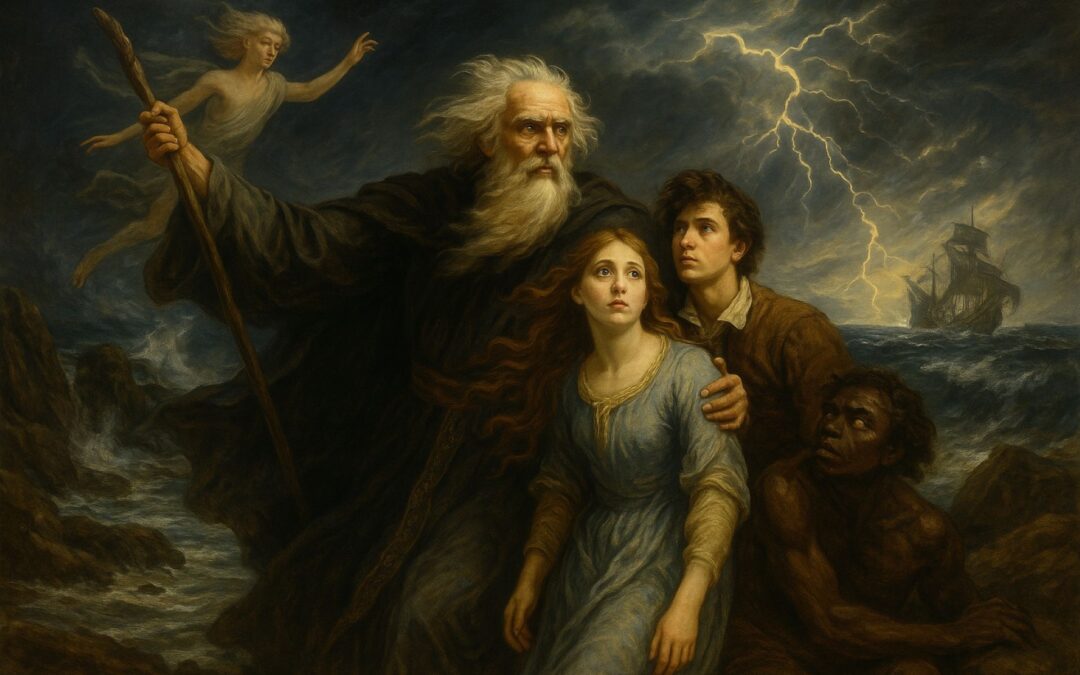
The Tempest is often described as Shakespeare’s final farewell to the stage, but it is far more than a curtain call. In just a few acts, it compresses storms and sorcery, betrayal and reconciliation, colonial conquest and political theatre—while also holding up a mirror to the nature of storytelling itself. It is a play about control: control over land, over people, over the narrative.
Yet it is also a meditation on the moment when that control must be relinquished. Beneath its shimmering surface of magic and music lies a work steeped in the politics of its age, alive with questions that remain urgent in ours. It invites us into an island world where nothing is quite as it seems, and where power—no matter how absolute—exists only as long as the audience believes in it.

A Storm of Power and Vengeance
The opening scene of The Tempest is a masterclass in dramatic immersion. Shakespeare wastes no time in drawing the audience into a world of chaos—there is no gentle exposition, no gradual introduction of characters. Instead, the curtain rises to the raw soundscape of survival: sailors shouting orders over the deafening crash of waves, noble passengers losing their composure as the vessel pitches violently in the tempest’s grip. The wind becomes a living thing, howling against the sails, while lightning flares briefly to reveal the terror on human faces.
This storm is no accident of nature. We quickly learn it is the calculated work of Prospero, the rightful Duke of Milan who was stripped of his title by his own brother Antonio in a coup fuelled by political ambition and betrayal. Banished to a remote island, Prospero has spent twelve long years in exile, his only companion his young daughter Miranda. She was a child when they arrived; now a young woman, she has known no other world but this strange shore. For her, the island is home; for him, it is both a prison and a laboratory for the arts of magic.
The tempest he conjures is as precise as it is violent. Prospero’s goal is not slaughter but dispersal. He means to strand the ship’s passengers—his enemies—alive but scattered across the island, each group vulnerable to the manipulations he has planned. His brother Antonio, the usurper, is among them. So is King Alonso of Naples, who abetted the theft of Prospero’s dukedom, and Alonso’s son Ferdinand, whose fate Prospero intends to entwine with Miranda’s in a marriage that will cement political alliance between Milan and Naples.
Prospero’s plan is multi-layered. It is revenge, but it is also restoration—of title, of legacy, of dignity. To execute it, he commands Ariel, a spirit of air and light whom he rescued from imprisonment but bound into service. Ariel’s powers are formidable: the ability to manipulate weather, conjure apparitions, and weave sound and song into enchantment. With Ariel’s help, the island becomes a mutable stage, shifting from serene grove to haunted wilderness, from banquet hall to prison cell, depending on Prospero’s will.
Every movement of the storm and its aftermath is choreographed to achieve a precise emotional effect—fear, wonder, confusion—pushing each player toward the resolution Prospero envisions. The tempest is not just a meteorological event; it is an overture, announcing that the island is a place where the normal laws of reality are suspended, and where one man’s will can become the very weather itself.
Shakespeare’s Farewell to the Stage
By the time Shakespeare wrote The Tempest in 1611, he was no longer merely a playwright but a cultural institution. His plays had entertained queens, kings, and commoners alike for decades. He had mastered every genre the Elizabethan and Jacobean stage could offer—blood-soaked histories, lyrical comedies, grand tragedies—and now stood at the summit of his powers. The Tempest reads as the work of an artist reflecting on the totality of his craft and, perhaps, on the approach of his own curtain call.
This was the last play he wrote alone, and it bears the marks of a final performance: a compact structure, a distilled thematic core, and a self-awareness that borders on confession. The setting—an isolated island—feels like a symbolic counterpart to the theatre itself, a bounded space where magic happens because the creator wills it so. The economy of the plot, the tight interweaving of storylines, and the emphasis on artifice all point to a playwright conscious of shaping his legacy.
The play’s debut was a performance at the court of King James I, whose fascination with magic, prophecy, and the supernatural was well known. James was no passive consumer of such themes; he saw sorcery as both dangerous and politically potent, even publishing his treatise Daemonologie to outline his beliefs and to warn of supernatural threats. Shakespeare, attuned to the tastes of his royal patron, infused The Tempest with enchantments that would resonate on both a personal and political level. Prospero’s command of unseen forces could be read as a reflection of a king’s idealised sovereignty—power exercised through knowledge, control, and divine-like authority.
The king’s appreciation for the play was not casual. Just a year later, he ordered a special production of The Tempest for the wedding of his daughter, Princess Elizabeth, to Frederick V of the Palatinate—a union with profound political consequences. The marriage was a strategic alliance linking England to an influential faction within the Holy Roman Empire, an act of dynastic statecraft. On stage, the union of Miranda and Ferdinand mirrored this real-world event, turning the play into a courtly mirror that reflected and flattered the king’s political aspirations.
Thus, The Tempest is more than an entertainment; it is a finely tuned instrument of cultural diplomacy. It satisfied the appetite of a monarch enthralled by magic, echoed the political theatre of royal marriages, and allowed Shakespeare to stage his own quiet exit—offering a work that is part spectacle, part allegory, and part personal testament. In doing so, he ensured that his farewell would be both a performance for his patron and a lasting enigma for the ages.
Prospero as Shakespeare’s Mirror
Prospero is one of Shakespeare’s most layered creations—a figure who operates simultaneously within the story’s fiction and as a symbolic stand-in for the playwright himself. On the island, Prospero is supreme. His staff and his books are not merely tools but the very instruments of creation. With them, he calls forth storms, bends spirits to his will, and orchestrates every encounter between the shipwrecked nobles. Nothing happens by accident; every step, every vision, every manipulation has been premeditated.
This godlike control mirrors the role of a dramatist. Just as Prospero shapes the reality his characters inhabit, Shakespeare shapes the theatrical world. The stage, like the island, is bounded in physical space yet limitless in imaginative scope. The characters—Antonio, Alonso, Ferdinand, Miranda—are at once inhabitants of Prospero’s world and actors in Shakespeare’s own. The layering is deliberate, blurring the line between character and creator.
As the play advances, Prospero’s arc begins to echo an artist’s journey toward closure. His reign on the island has been long and absolute, but he knows it cannot continue forever. The end of his project—the restoration of his dukedom, the marriage of his daughter, the resolution of past wrongs—also signals the end of his power. In one of the most resonant symbolic gestures in Shakespeare’s canon, Prospero decides to break his staff and drown his books. This is more than a rejection of magic; it is the voluntary relinquishment of control, an acknowledgment that his role as creator is complete.
Ariel, his airy servant, takes on a further allegorical dimension here. Ariel represents the spark of creative inspiration—quick, mercurial, infinitely adaptable. Under Prospero’s direction, Ariel conjures music to stir the heart, visions to deceive the senses, storms to alter destinies. Yet Ariel’s existence is not independent; he is bound by Prospero’s command. When Prospero frees Ariel, it is as though Shakespeare is releasing his own muse, letting his imagination take flight beyond the confines of the stage.
In contrast, Caliban embodies the ungoverned, primal force of creation—earthy, resentful, and unwilling to conform. Caliban’s presence reminds us that creation is not all light and harmony; it has its rough edges, its rebellions. If Ariel is the polished performance, Caliban is the raw impulse from which all art begins. The dynamic between them encapsulates the tension in the artistic process: between refinement and instinct, between submission to form and resistance to it.
By embedding these dual aspects within his characters, Shakespeare makes Prospero’s farewell to magic resonate as his own farewell to the theatre—a parting act in which the artist steps away, leaving his creations to live on without him.
The Masque and the Fragility of Power
The masque in Act IV is one of The Tempest’s most striking and multi-layered sequences. Masques were elaborate entertainments popular in the Jacobean court, combining music, dance, elaborate costumes, and symbolic imagery to celebrate political events or flatter royal authority. In this scene, Prospero conjures a pageant to bless the betrothal of Miranda and Ferdinand. What unfolds is a spectacle of harmony and abundance: goddesses descend to offer their blessings, nature’s bounty overflows, and the air itself seems charged with the promise of a golden future.
At the surface level, the masque is a celebration of love and union. Yet it is also a piece of political theatre within the play’s fiction, serving to bind Naples and Milan in mutual prosperity—mirroring the real-world dynastic ambitions of King James I, who sought to unite realms under his rule. For the king’s audience, the parallel would have been unmistakable: the masque flattered his vision of stability through marriage and alliance.
But Shakespeare refuses to leave the scene as mere flattery. At the height of the performance—when the music soars, the pageantry dazzles, and the vision of unity seems at its most secure—Prospero abruptly ends it. The figures vanish; the music stops. His sudden declaration, “Our revels now are ended,” lands with an almost physical force. The magic dissolves into nothing, leaving only the bare stage.
This interruption transforms the masque from a scene of splendour into a meditation on impermanence. The shift is deliberate and jarring, reminding both characters and audience that all human creations—whether a marriage, a kingdom, or a theatrical performance—are transient. The grandeur evaporates like mist, and what remains is the awareness of its fragility.
In this moment, the masque also becomes a commentary on theatre itself. Just as Prospero can conjure and dismiss visions at will, so too can the playwright create worlds that live only for the span of a performance. The breaking of the illusion invites the audience to question not only the nature of the spectacle they’ve just seen but also the illusions that underpin power and politics. It is as if Shakespeare is saying: all pageantry is temporary, all authority is performed, and all performances—no matter how glorious—must one day yield to silence.
Colonial Shadows
Beneath The Tempest’s shimmering surface of magic and romance lies a darker political undercurrent—the unmistakable imprint of England’s early colonial ambitions. In the early 17th century, when the play debuted, England was actively extending its reach across the Atlantic, planting settlements in the Americas and exploiting newly encountered lands. Reports of the “New World” poured back to Europe, carrying tales of strange peoples, unfamiliar landscapes, and resources ripe for exploitation. These accounts were often filtered through the lens of European superiority, portraying indigenous populations as either noble innocents or savage threats—images used to justify conquest.
Shakespeare’s portrayal of Prospero’s rule over the island is steeped in these realities. When Prospero arrives, the island is not empty. It is inhabited by Caliban, son of the exiled witch Sycorax, who regards himself as its rightful ruler. Prospero’s arrival marks a shift from native sovereignty to foreign occupation. Using the tools of his advantage—his books, his knowledge, his magic—Prospero imposes a new order, subjugating Caliban and forcing him into servitude. This mirrors the colonial dynamic in which technological superiority, firearms, and organised military force allowed European powers to dominate and displace indigenous societies.
One of Shakespeare’s key sources for the play was Michel de Montaigne’s essay Of Cannibals, which circulated widely in England. Montaigne’s radical argument—that so-called “savages” might live with greater virtue and moral clarity than Europeans—struck a nerve. He questioned whether European warfare, greed, and political treachery were not themselves a form of savagery. Shakespeare channels this critique into The Tempest, contrasting the treachery and plotting of shipwrecked nobles with Caliban’s deep poetic sensibility and connection to the natural world.
Language, too, becomes a battleground. Prospero teaches Caliban his tongue, presenting it as a gift of civilisation. Yet language here is a double-edged weapon—it is a means of control, forcing Caliban into the linguistic and conceptual framework of his conqueror. Caliban’s resistance—turning the very language he’s been taught into a tool of defiance—becomes an act of rebellion. In this way, Shakespeare captures the paradox at the heart of colonial encounters: the coloniser claims to uplift, yet in doing so strips away autonomy; the colonised adapts and survives, yet risks erasure of their original culture.
Prospero’s magic thus reads as a metaphor for imperial power—its ability to reshape reality, impose its own order, and maintain dominance through both force and ideology. But by giving Caliban not only agency but eloquence, Shakespeare refuses to reduce him to a mere caricature of savagery. Instead, he complicates the colonial narrative, leaving open the question: who is the real barbarian—the native who lives in harmony with his land, or the conqueror who enslaves it in the name of civilisation?
Doubling and Moral Ambiguity
One of The Tempest’s most sophisticated devices is Shakespeare’s use of doubling—creating parallel situations and characters that mirror each other, forcing the audience to grapple with moral relativism. These repetitions are subtle yet insistent, destabilising easy judgments about who is virtuous and who is corrupt.
The most striking example lies in the relationship between Prospero and Caliban. Both are, in their own histories, dispossessed rulers. Prospero was overthrown by his brother Antonio and cast adrift; Caliban inherited the island from his mother Sycorax only to have it seized by Prospero. Each now inhabits the other’s former role—Prospero as the usurper, Caliban as the dispossessed. Their mutual enmity is born not just of cultural difference but of mirrored ambition: each wants dominion over the island. By presenting this symmetry, Shakespeare invites the uncomfortable realisation that the moral labels we assign to power struggles often depend on perspective rather than absolute truth.
This doubling extends to Prospero and Sycorax. Both are wielders of supernatural power, both were exiled to the island, and both use magic to impose their will. Yet in the narrative we are given, Sycorax’s magic is branded as dark, chaotic, and malevolent, while Prospero’s is framed as wise, just, and benevolent. Why? Because Prospero controls the story. His voice dominates the play, defining Sycorax’s legacy without giving her a chance to speak for herself. This imbalance reflects how victors in history often shape the narrative to justify their authority and vilify their rivals.
Even the political treachery that set the play’s events in motion is doubled. Antonio’s betrayal of Prospero mirrors the plot by Sebastian, Alonso’s brother, to murder the sleeping king during their time on the island. The nobles, supposedly the bearers of refinement and civilisation, reveal themselves capable of the same ruthless opportunism they might condemn in others.
Through these mirrored situations, Shakespeare dismantles the illusion of moral clarity. Is revenge noble when sought by a wronged duke but ignoble when attempted by a “savage” or a rival courtier? Is magic virtuous when practised by a learned man but corrupt when wielded by a woman of another culture? These questions are not resolved neatly, because Shakespeare’s intent is not to hand down moral verdicts but to illuminate the shifting, subjective nature of justice and authority. In the world of The Tempest, as in life, who wears the crown and who wears the chains often depends on who tells the story.
Forgiveness and Release
By the time The Tempest reaches its final act, Prospero’s elaborate plan has run its course. Every pawn has been moved, every thread of the tapestry woven tight. His enemies—Antonio, Alonso, and the others—now stand before him defeated, stripped of their confidence, and shaken by the island’s supernatural trials. This is the moment when vengeance could be fully claimed, when Prospero could repay betrayal with humiliation and loss. Yet the turning point arrives not from Prospero’s own calculations, but from Ariel, the servant who has carried out his designs with unwavering skill.
Ariel’s voice becomes a moral compass. Reporting on the state of the captives, Ariel notes their despair and brokenness, then adds something unexpected—were Ariel human, he would feel pity for them. These words pierce Prospero’s armour of bitterness. The magician who has so long valued control over emotion is moved by compassion. It is a significant shift: the master is being taught humanity by the servant, the wielder of power reminded of mercy by one bound in service.
Prospero’s decision to forgive is not straightforwardly pure. It comes after he has secured what he wanted—his dukedom restored, his daughter’s marriage arranged, his enemies humbled. This timing complicates the moral reading. Is his forgiveness a selfless act of grace, or a calculated move once the risks have been neutralised? Shakespeare leaves this tension unresolved, allowing the audience to wrestle with the possibility that benevolence can exist alongside self-interest.
In a quiet but telling moment, Prospero finally addresses Caliban as a “thing of darkness” that he acknowledges as his own. It is the first time in the play that he grants Caliban a measure of equality, recognising their shared humanity—or at least their shared flaws. This acknowledgement does not undo the years of domination, but it marks the beginning of reconciliation.
Prospero’s renunciation of magic is both a symbolic and practical release. Breaking his staff and drowning his books severs his ability to command the world around him. It is the surrender of the very thing that has defined him, a gesture that mirrors Shakespeare himself stepping away from the power of the stage. In relinquishing magic, Prospero restores the balance between himself and others; in relinquishing authorship, Shakespeare restores the balance between himself and his audience. The final appeal for applause is more than tradition—it is the transfer of authority. The story belongs to us now, the spectators, and the spell is broken only when we choose to release it.
A Play for Our Time
Although written over four centuries ago, The Tempest resonates with uncanny modernity. Its central themes—authority, spectacle, manipulation of narrative—speak to a world where power often depends on controlling perception rather than wielding brute force. Prospero’s island is not just a magical space; it is a laboratory for crafting realities, a place where illusions can become indistinguishable from truth if repeated and reinforced enough. In this, it mirrors the information landscapes of our own age, where images, stories, and political theatre shape public belief.
The play’s structure is a constant interplay between isolation and contact. Each group of shipwrecked characters experiences the island differently, encountering visions, temptations, and deceptions that alter their understanding of reality. In our era of digital echo chambers and geopolitical fragmentation, this feels strikingly relevant. Nations, like the characters, behave as self-contained islands—protective of their own narratives, wary of intrusion, and prone to conflict when those narratives clash.
The colonial thread, too, has lost none of its edge. The questions it raises about ownership, cultural dominance, and the suppression or assimilation of other voices remain pressing in the context of globalisation and post-colonial reckoning. Caliban’s struggle for dignity, his refusal to be erased despite the loss of sovereignty, echoes the voices of marginalised peoples still fighting to reclaim history on their own terms.
The masque scene’s commentary on impermanence can be read in light of modern political cycles, where moments of unity or grandeur are fleeting, and public attention quickly shifts. Shakespeare’s reminder—that even the most splendid visions dissolve into nothing—feels like a caution against placing too much faith in the spectacle of leadership or the permanence of power.
In the end, The Tempest refuses to give us a simple moral resolution. It is a story of betrayal that becomes a story of forgiveness, a display of control that ends in surrender, a celebration of artifice that exposes its own mechanics. In an age where the line between truth and performance grows ever thinner, Shakespeare’s island feels less like a distant fantasy and more like a mirror—showing us how easily storms can be summoned, and how hard it is to choose calm once we have the power to command the winds.