
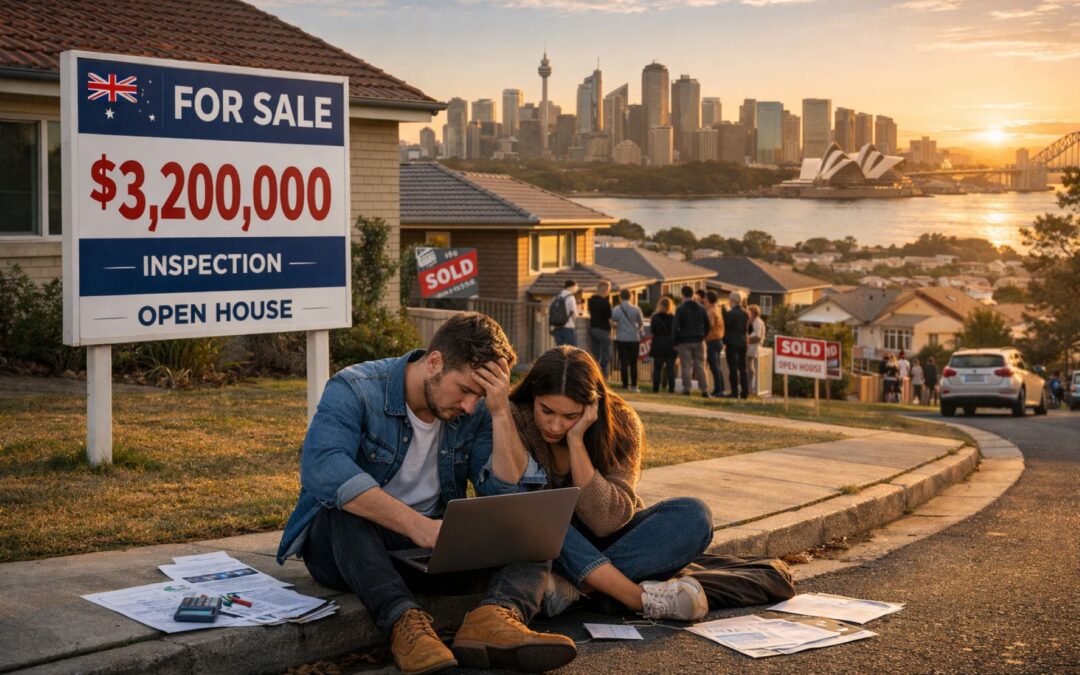
For decades, Australia has been marketed to the world as one of the most desirable places to live. Endless beaches, vibrant cities, strong institutions, and a high quality of life helped build the image of Australia as a modern paradise. From Sydney’s iconic harbor to Melbourne’s cultural energy, the country consistently ranks among the most livable places on Earth.
But behind this image lies a growing economic reality that is becoming increasingly difficult for ordinary Australians to ignore.
In 2023, Australia entered a per-capita recession for only the third time in forty years. While the broader economy still appeared stable on the surface, the experience for everyday Australians was very different. Wages stagnated, productivity slowed, and the cost of living surged. When Australians were asked what affected them most, the answer was overwhelmingly clear: the rising cost of living.
At the center of this crisis sits one issue that touches nearly every household in the country—housing.
Over the past few decades, Australia has experienced one of the most dramatic housing booms in the world. Since the early 1970s, home prices across the country’s major cities have increased roughly thirty-six times. Cities like Sydney and Melbourne are now among the most expensive housing markets on the planet. For many Australians, buying a home is no longer just difficult—it is increasingly unrealistic.
To purchase the median home in Melbourne today, a household typically needs an annual income of around $170,000. In Sydney, that figure rises to roughly $260,000. Yet the median household income in both cities is closer to $100,000, leaving a massive gap between what people earn and what homes actually cost.
The consequences are already visible. Younger Australians are falling further behind in the property market, home ownership rates are declining, and renting has become fiercely competitive and increasingly expensive. What was once considered the foundation of the Australian middle-class lifestyle—a stable job, a home, and a comfortable future—is beginning to feel out of reach.
So how did a country with vast land, a strong economy, and decades of prosperity arrive at a housing crisis of this magnitude?
To understand why living in Australia is becoming so difficult, we need to look beyond simple explanations. The crisis is not caused by a single factor or a single government decision. Instead, it is the result of decades of policy choices, cultural preferences, tax incentives, and economic distortions that together have transformed housing into one of the most powerful—and problematic—forces shaping the Australian economy.
And for many Australians today, the consequences are impossible to ignore.
The Paradise That Became Unaffordable
For much of the late twentieth century, Australia represented something close to an ideal lifestyle. The country combined a stable democracy, strong economic growth, abundant natural resources, and relatively high wages. Cities like Sydney, Melbourne, and Brisbane consistently ranked among the world’s most livable urban areas. For millions of Australians, the formula for a comfortable life seemed straightforward: work hard, buy a home, raise a family, and gradually build wealth over time.
For decades, that system largely worked.
Home ownership was a central pillar of the Australian middle class. Throughout the 1970s, 1980s, and even much of the 1990s, a typical Australian household could realistically expect to purchase a home within a reasonable distance of major cities. Housing was not cheap, but it was achievable.
But over the past few decades, this balance began to break down.
Today, Australia’s cost-of-living crisis has reached a point where many people feel that the traditional path to stability is slipping away. Housing costs have surged far beyond wage growth, creating a widening gap between what people earn and what it takes to afford a home.
The numbers tell the story clearly.
In cities like Melbourne, the income required to purchase a median home has climbed to roughly $170,000 per year. In Sydney, it rises even higher to around $260,000 annually. Meanwhile, the median household income in both cities sits close to $100,000.
This mismatch has made home ownership increasingly unrealistic for many Australians, particularly younger workers who are just entering the housing market. Even households with stable, well-paying jobs often find themselves unable to compete with rising prices.
And the problem is no longer limited to the country’s largest cities.
Over the past few years, housing prices have surged across nearly every major urban center in Australia. Since 2020, cities such as Brisbane, Adelaide, and Perth have seen housing prices increase by more than 50 percent, while wages have grown by only around 12 percent during the same period.
The result is a growing sense that the economic system is no longer working the way it once did.
For many Australians, the promise that hard work leads to a stable and prosperous life is starting to feel uncertain. Younger generations are finding themselves locked out of the housing market, renters are facing increasingly intense competition for available homes, and the cost of basic living expenses continues to climb.
Australia may still look like a paradise from the outside. But for a growing number of people living inside it, the reality is becoming far more complicated.
Australia’s Historic Housing Boom
Australia’s housing crisis did not appear overnight. The current situation is the result of a housing boom that has been building for decades—one of the most dramatic and sustained increases in property prices anywhere in the developed world.
Over the long term, housing prices in Australia have risen at a pace that far exceeds wage growth, inflation, and even the growth of the broader economy. What began as steady appreciation gradually transformed into an enormous asset boom that reshaped the country’s economy.
How Home Prices Increased 36× Since 1973
Since the early 1970s, housing prices in Australia’s major cities have increased by an astonishing margin. Across the capital cities, the average price of homes has increased roughly thirty-six times since 1973.
To understand how extraordinary this is, it helps to compare housing prices with incomes. Over the same period, wages have grown steadily but nowhere near at the same pace. As a result, the ratio between household income and home prices has steadily widened.
Several forces contributed to this long-term price explosion.
Interest rates gradually declined over the past few decades, making mortgages cheaper and allowing buyers to borrow more money. Financial deregulation expanded access to credit, making it easier for households to take on larger loans. Population growth in major cities increased demand for housing, while supply struggled to keep pace.
But as housing prices rose year after year, another powerful dynamic began to emerge: housing became one of the most profitable investments in the country.
For many Australians, buying property was no longer just about owning a place to live. It became a primary strategy for building wealth. Investors entered the market in large numbers, purchasing second and third properties with the expectation that prices would continue rising.
This shift fundamentally changed the nature of the housing market. Homes were no longer simply consumer goods—they became financial assets.
And once housing became an investment vehicle, the upward pressure on prices intensified.
Sydney And Melbourne Among The World’s Most Expensive Cities
Today, the results of this long housing boom are visible in Australia’s largest cities.
Sydney, in particular, has become one of the most expensive housing markets in the world. By many international affordability measures, it now ranks as the second most unaffordable city globally, trailing only Hong Kong in some comparisons.
Melbourne is not far behind. While slightly cheaper than Sydney, housing prices in Melbourne have also surged to levels that place them among the most expensive urban markets on Earth.
The affordability problem becomes even clearer when looking at income comparisons. In many developed countries, the price of a typical home might be six to eight times the median household income. In Australia’s major cities, the ratio is often far higher.
This creates a situation where even middle- and upper-middle-class households struggle to enter the housing market.
And as prices rise further, the gap between homeowners and non-homeowners continues to widen. Those who bought property decades ago have seen enormous increases in wealth. Those who did not are increasingly locked out.
The result is a housing market that has generated massive gains for some Australians—while making it progressively harder for others to participate at all.
The Collapse Of Home Ownership For Young Australians
Perhaps the clearest sign that Australia’s housing market has fundamentally changed is the sharp decline in home ownership among younger generations.
For much of the twentieth century, buying a home was considered a normal milestone of adulthood in Australia. By the time people reached their early thirties, many had already purchased their first property. This pattern helped build one of the highest home ownership rates in the developed world and played a major role in the country’s middle-class stability.
But that pattern is rapidly disappearing.
As housing prices surged far beyond wage growth, younger Australians increasingly found themselves unable to enter the property market. The deposits required to purchase a home have become extraordinarily large, and mortgage repayments now consume a far greater share of household income than in previous generations.
The result has been a steep drop in home ownership among younger Australians.
For people under the age of 34, home ownership rates have declined by nearly 25 percent compared with previous decades. By contrast, the overall home ownership rate across the broader population has only declined by about 8 percent.
This difference highlights a growing generational divide.
Older Australians who purchased homes decades ago have benefited enormously from the housing boom. Many have seen the value of their properties multiply several times over, generating substantial wealth.
Younger Australians, however, entered the market much later—often after prices had already surged beyond their reach. Instead of benefiting from rising home values, they are forced to chase a market that continues to move further away.
Even saving for a deposit has become increasingly difficult. As rents rise and living costs increase, young workers struggle to accumulate the large sums required for down payments. In cities like Sydney and Melbourne, deposits can easily exceed hundreds of thousands of dollars, creating an enormous financial barrier.
And the problem is not limited to entry-level homes.
Even properties that would once have been considered modest or undesirable are now selling at astonishing prices. In one widely reported example, a small home in Sydney sold for $3.5 million despite lacking basic features such as a functioning kitchen, electricity, or even a toilet. Yet intense bidding wars still drove the price upward.
Stories like this illustrate how distorted the housing market has become.
For many young Australians today, home ownership no longer feels like an achievable goal. Instead, it has become something closer to a financial lottery—one that depends heavily on family wealth, inheritance, or extraordinary income.
And for those who cannot buy a home, the only alternative is renting. Unfortunately, that market is becoming just as difficult.
Australia’s Rental Crisis
For Australians who cannot afford to buy a home, renting should theoretically provide a reasonable alternative. In most housing markets around the world, renting offers flexibility and a more affordable way to live in expensive cities.
But in Australia today, the rental market has become almost as difficult as the housing market itself.
Rents have surged across the country, vacancy rates have collapsed, and competition for available properties has intensified to levels rarely seen before. For many renters, simply finding a place to live has become a major challenge.
Skyrocketing Rents Since 2020
For decades, rental prices in Australia increased at a relatively predictable pace. While rents generally rose each year, increases were usually modest and somewhat aligned with wage growth.
That stability disappeared after 2020.
Since the pandemic, rental prices across Australia have risen dramatically. In cities like Sydney, median rents now exceed $3,000 per month, while Brisbane has climbed close behind with rents around $2,500 per month.
At the same time, wage growth has remained sluggish.
This creates a difficult situation for many Australians. People are effectively trying to pay 2024 rental prices with wages that have barely improved since the early 2010s. As housing costs consume an ever-larger portion of income, households have less money available for other basic expenses such as food, transportation, and utilities.
For many renters, the financial pressure is constant.
Competition And Scarcity In The Rental Market
Even more troubling than rising rents is the sheer lack of available housing.
Across major Australian cities, rental vacancy rates have dropped to extremely low levels. When a rental property becomes available, it often attracts dozens—or even hundreds—of applications.
Prospective tenants frequently line up around city blocks just to attend property viewings. Many renters submit multiple applications before finally securing a home. Others spend weeks or months searching without success.
This intense competition creates a stressful environment where renters feel pressured to accept almost any available property, often at rapidly increasing prices.
In some cases, renters have begun offering higher payments than the advertised rent simply to secure a place to live. Others agree to unfavorable lease terms or crowded living arrangements just to remain competitive in the market.
For many Australians, the rental market now feels less like a normal housing system and more like a survival contest.
And while rising rents and fierce competition are the visible symptoms of the crisis, they are not the root cause. To understand why the situation has become so extreme, we need to examine the deeper forces driving housing demand in Australia.
Immigration And Housing Demand
When discussing Australia’s housing crisis, one of the most commonly cited explanations is immigration. In recent years, the country has experienced a sharp surge in population growth driven largely by international migration, and many observers believe this has intensified pressure on the housing market.
At first glance, the argument seems straightforward: more people arriving in the country means more demand for housing. If the supply of homes does not increase at the same pace, prices will naturally rise.
While immigration is not the sole cause of Australia’s housing crisis, it has certainly played a role in amplifying the problem—particularly in the rental market.
Record Migration After The Pandemic
Following the pandemic, Australia experienced one of the largest spikes in immigration in its modern history.
Between 2022 and 2023, the country welcomed nearly 740,000 migrants, the highest number ever recorded in a single year. This figure was roughly 200,000 higher than pre-pandemic levels, marking a dramatic increase in population growth over a short period of time.
For a country with a population of roughly 26 million people, such a rapid influx represents a significant shock to the housing market.
New arrivals need somewhere to live, and most immigrants initially enter the rental market rather than purchasing homes. As a result, sudden increases in migration can create immediate pressure on rental housing supply.
This effect is particularly noticeable in major cities such as Sydney and Melbourne, which receive the largest share of international migrants. Neighborhoods with high immigrant populations have seen some of the fastest increases in rental prices.
In Melbourne’s southeast and Sydney’s inner southwest, for example, rents have jumped by nearly 18 percent in a single year.
Why Immigration Impacts Rental Prices More Than Home Prices
However, while immigration clearly increases demand for housing, its effect is often misunderstood.
Most migrants entering Australia are temporary visa holders, including students and workers. Roughly 70 percent of them rent rather than purchase homes, meaning their primary impact is concentrated in the rental market rather than the property ownership market.
In addition, migrants often adapt their living arrangements to cope with high costs. Many share apartments with multiple roommates or live in crowded housing situations in order to reduce expenses. While this allows migrants to manage rising rents, it can also intensify competition for available rental units.
In some cases, landlords prefer tenants willing to share housing because it increases total rental income. This dynamic can further tighten the market for individuals or families seeking traditional rental arrangements.
Despite these pressures, immigration alone cannot explain the scale of Australia’s housing crisis. Migration levels have fluctuated over the decades, but housing affordability problems have been building for much longer.
To understand the deeper roots of the problem, we must look beyond demand and examine the other side of the housing equation: supply.
And in Australia, the supply of housing has been falling short for decades.
The Real Problem: Australia’s Housing Supply Shortage
While rising demand has certainly placed pressure on Australia’s housing market, the deeper problem lies on the supply side. For decades, the number of homes being built has failed to keep pace with population growth.
This imbalance between supply and demand has slowly created a structural shortage of housing across the country. As a result, even relatively small increases in demand—whether from migration, economic growth, or population expansion—can trigger sharp increases in prices.
In other words, the housing crisis is not just about how many people want homes. It is about how few homes are actually being built.
Falling Housing Construction Rates
Australia’s construction industry has struggled to produce enough housing to meet the country’s needs. In recent years, the number of new homes completed annually has fallen to some of the lowest levels in decades.
In 2023, Australia completed roughly 170,000 new dwellings, the lowest total in about ten years. This slowdown occurred at the same time that population growth surged following the reopening of international borders.
The result was predictable: more people competing for a limited supply of housing.
Complicating matters further is the rising cost of construction. Over the past several years, building materials, labor costs, and financing expenses have all increased significantly. Developers now face much higher costs to build new homes than they did just a decade ago.
These rising costs discourage new construction projects, especially when profit margins become uncertain. Builders may delay projects or cancel them entirely, further reducing the number of homes entering the market.
At the same time, construction companies themselves have faced financial pressure. Several large building firms have collapsed in recent years, adding even more disruption to the housing supply pipeline.
The Long-Term Supply Gap
The shortage of housing did not begin in the last few years. In reality, Australia has been building too few homes relative to its population growth for decades.
Since the 1960s, the number of homes constructed per capita has gradually declined. While Australia’s population continued to expand, housing construction failed to keep pace.
Around the year 2000, this trend worsened dramatically. The rate of housing construction relative to population effectively fell off a cliff, creating a persistent supply gap that has continued to widen over time.
This means the current housing shortage is not simply the result of recent economic shocks. Instead, it reflects a long-term structural imbalance that has been building for more than twenty years.
Today, the consequences of that imbalance are becoming impossible to ignore.
With too few homes being built and population growth continuing, housing scarcity has become a defining feature of Australia’s economy. Prices rise because supply cannot expand quickly enough to meet demand.
And while economic forces play a role in this shortage, they are not the only factor. Cultural preferences, urban planning decisions, and regulatory barriers have also played a major role in limiting how much housing can actually be built.
To understand why Australia struggles to increase housing supply, we need to look at how its cities are designed.
Suburban Culture And The Density Problem
One of the less obvious factors behind Australia’s housing shortage is the way its cities are designed.
Unlike many major cities around the world, Australian urban areas are remarkably low in density. Instead of building upward with large numbers of apartment buildings, Australian cities have historically expanded outward through suburban development.
This pattern reflects a long-standing cultural preference.
For generations, the ideal Australian lifestyle has been closely tied to the suburban home: a detached house with a yard, located in a quiet neighborhood with space for families. This vision of suburban living has shaped both public expectations and government planning policies.
As a result, Australia’s major cities are some of the least densely populated urban areas in the developed world.
Sydney and Melbourne, the country’s two largest cities, have population densities of roughly 2,000 people per square kilometer. Compared to other global cities, this is exceptionally low. London has a density of around 6,000 people per square kilometer, Munich roughly 4,400, and Amsterdam approximately 3,600.
These differences matter because density plays a crucial role in housing supply.
High-density cities can accommodate large populations within relatively small areas by building apartment towers and multi-family housing. Lower-density cities rely heavily on detached homes and suburban expansion, which requires significantly more land and infrastructure.
Australia theoretically has the land to support this model. The country is geographically vast, and large areas around major cities remain sparsely populated.
In theory, cities like Sydney could continue expanding outward for decades. Some estimates suggest that Sydney’s greenfield development areas alone could eventually accommodate hundreds of thousands of new homes.
But in practice, expanding suburban housing has proven far more complicated.
Infrastructure requirements such as roads, public transportation, water systems, and schools make new suburban developments expensive and slow to build. Meanwhile, attempts to increase density within existing urban areas often face intense resistance from local communities.
This resistance has created another powerful obstacle to expanding housing supply in Australia—one that goes far beyond economics.
NIMBYism And Government Red Tape
If Australia has vast amounts of land and a clear need for more housing, the obvious question is why new homes are not being built faster.
A large part of the answer lies in a combination of community resistance and bureaucratic regulation that makes development slow, expensive, and often politically contentious.
This phenomenon is commonly described as NIMBYism, short for “Not In My Backyard.”
Many Australians recognize that the country faces a serious housing shortage. However, when new housing developments are proposed near existing neighborhoods, residents frequently oppose them. Concerns about increased traffic, changing neighborhood character, environmental impact, and declining property values often lead communities to resist new construction.
This resistance can significantly slow down housing development.
Why Housing Approvals Take Months
Beyond community opposition, developers must navigate a complex web of planning regulations and approval processes before construction can even begin.
In many parts of Australia, receiving approval to build a home or housing development can take months—or even years.
For example, in the state of New South Wales, the average approval time for a single housing development is around 111 days. In some areas such as Liverpool, the process can stretch to 288 days or more.
By contrast, in parts of the United States, housing approvals can sometimes be completed in less than a week.
These lengthy approval timelines create major obstacles for developers. Projects are delayed, financing costs increase, and uncertainty makes it riskier to invest in new construction. Some developers abandon projects entirely if regulatory hurdles become too difficult to overcome.
The result is fewer homes being built, even when demand is extremely high.
Artificial Land Scarcity
Ironically, Australia’s housing shortage is not caused by a lack of physical land. Instead, it is often the result of artificial scarcity created through zoning restrictions, planning rules, and slow approvals.
When development becomes difficult, the amount of land available for housing effectively shrinks. Developers must compete for a limited number of approved sites, driving land prices higher.
This dynamic helps explain why the price of detached homes has been rising faster than apartments. Since 2020, the value of houses has increased roughly three times faster than apartment prices, reflecting the scarcity of land suitable for new developments.
In many ways, this scarcity benefits existing homeowners. Rising property values increase household wealth for those who already own homes.
But the same dynamic makes it increasingly difficult for new buyers to enter the market.
Young Australians and first-time buyers are particularly affected. As land becomes more expensive and approvals remain slow, the supply of new homes remains constrained.
And when supply cannot expand fast enough to meet demand, prices almost inevitably continue to rise.
The Tax Policies Fueling Property Speculation
Beyond supply shortages and regulatory barriers, another powerful force has been quietly shaping Australia’s housing market for decades: tax policy.
Over time, the Australian government introduced a series of tax incentives designed to encourage investment in housing. While these policies were originally intended to increase the supply of rental properties, they ultimately had another effect—turning real estate into one of the most attractive investment vehicles in the entire economy.
As a result, housing in Australia is not just a place to live. For many investors, it has become a highly favorable financial asset.
Negative Gearing
One of the most controversial policies in Australia’s housing market is known as negative gearing.
Negative gearing allows property investors to deduct losses on rental properties from their personal taxable income. If an investor owns a property that generates less rental income than the cost of maintaining it—including mortgage interest, maintenance, and other expenses—the resulting loss can be used to reduce the investor’s income tax.
For example, imagine someone earning $100,000 per year who loses $10,000 annually on a rental property. Under negative gearing rules, that investor can deduct the $10,000 loss from their taxable income, effectively paying taxes as if they earned only $90,000.
This policy makes it financially attractive for investors to purchase rental properties even if those properties lose money in the short term.
The expectation is that property prices will rise over time, allowing investors to eventually sell the property for a large capital gain. In the meantime, the tax system helps offset the annual losses.
Australia’s use of negative gearing is unusually generous by international standards. Among OECD countries, only New Zealand and Japan maintain similar policies.
As a result, negative gearing has become a central feature of Australia’s property investment culture. In fact, estimates suggest that between 50 and 80 percent of investment properties in Australia are negatively geared, meaning the owners are deliberately accepting short-term losses in exchange for future gains.
Capital Gains Tax Discounts
Negative gearing is only part of the story.
In 1999, the Australian government introduced another major incentive for property investors by reducing the capital gains tax on certain assets.
Under current rules, individuals who sell an investment property after holding it for more than one year receive a 50 percent discount on capital gains tax. This means that only half of the profit from a property sale is subject to taxation.
For investors who purchased properties decades ago, this policy has dramatically increased the profitability of selling real estate.
Combined with negative gearing, the capital gains tax discount creates a powerful incentive structure: investors can deduct losses while holding the property and pay significantly reduced taxes when they eventually sell it.
This combination strongly encourages long-term speculation in real estate.
Real Estate Inside Retirement Accounts (Super)
Australia’s retirement system adds yet another layer of tax advantages for property investors.
The country’s retirement accounts, known as superannuation funds, offer substantial tax benefits similar to retirement accounts like IRAs in the United States.
Within these accounts, investment income—including rental income from property—is taxed at a much lower rate than normal personal income.
For example, rental income earned within a super fund is typically taxed at around 15 percent, significantly lower than many personal income tax rates.
In addition, capital gains on properties held inside super funds may also receive favorable tax treatment.
Unlike in some countries where purchasing real estate through retirement accounts is complex and heavily restricted, Australia allows this practice relatively easily. This has encouraged some investors to accumulate property within their retirement portfolios.
Taken together, these tax incentives make Australia one of the most favorable environments in the developed world for property investment.
But these policies also have unintended consequences. By making real estate such an attractive investment, they have encouraged large amounts of capital to flow into housing rather than into other parts of the economy.
And that shift has begun to affect Australia’s broader economic performance.
How Housing Speculation Is Hurting Australia’s Economy
Australia’s housing market has not only transformed the cost of living—it has also reshaped the country’s broader economy.
When real estate becomes the most attractive investment in a country, capital tends to flow toward property rather than into businesses, innovation, or productive industries. Over time, this shift can slow economic development and reduce long-term growth.
This is increasingly visible in Australia today.
Capital Flowing Into Property Instead Of Innovation
Because the Australian tax system strongly favors property investment, many individuals and institutions choose to allocate their savings into housing rather than productive enterprises.
From a purely financial perspective, this behavior is rational. Property investments often benefit from tax advantages, rising asset prices, and relatively low perceived risk. By comparison, starting or investing in businesses carries greater uncertainty and often receives fewer tax benefits.
The result is an economy where large amounts of capital are tied up in real estate rather than being used to create new industries, technologies, or companies.
In effect, housing has become one of the country’s dominant financial assets.
This concentration of investment in property has significant long-term consequences. When economic resources are directed toward non-productive assets, productivity growth tends to slow. New businesses receive less funding, innovation declines, and the overall economy becomes less dynamic.
Weak Productivity Growth
Australia’s productivity growth has been slowing for years, and many economists believe the housing market plays a role in this trend.
Between 2010 and 2020, Australia’s average annual labor productivity growth was approximately 1.1 percent, significantly lower than the levels seen in previous decades.
Productivity growth is one of the most important drivers of long-term economic prosperity. When productivity rises, workers produce more value per hour, allowing wages and living standards to increase.
But when productivity stagnates, wages often stagnate as well.
This helps explain why many Australians feel that their income is not keeping up with rising living costs. While housing prices and rents continue to climb, wage growth has remained relatively slow.
Low Research And Development Investment
Another indicator of Australia’s economic imbalance is its relatively low level of investment in research and development.
In 2022, Australia spent roughly 1.7 percent of its GDP on research and development. While this may sound substantial, it is actually well below the OECD average of about 2.4 percent.
Major developed economies invest far more in innovation. Countries such as the United States, Germany, and the United Kingdom allocate significantly larger shares of their economies to research and technological development.
Lower levels of innovation can limit the growth of new industries and reduce the country’s ability to compete in high-tech sectors.
At the same time, Australia’s economic growth has increasingly relied on a narrow set of industries—particularly mining, services, and real estate.
This concentration makes the economy more vulnerable to shocks and reduces the diversity of opportunities available to workers.
Meanwhile, housing prices continue rising, absorbing ever larger amounts of household wealth and investment capital.
Over time, this dynamic creates a troubling feedback loop: as more wealth flows into housing, fewer resources remain available to drive innovation and productivity in the broader economy.
Australia’s Tax System And Distorted Incentives
At the heart of Australia’s housing crisis lies a deeper structural issue: the way the country’s tax system shapes economic incentives.
In any economy, incentives matter. Governments influence behavior through taxes, subsidies, and regulations. These policies determine where people invest their money, what industries grow, and how wealth is created.
In Australia, the incentive structure increasingly favors property ownership over productive economic activity.
One of the clearest examples can be seen in the country’s reliance on income taxes.
Compared to many other developed nations, Australia collects a disproportionately large share of its government revenue from personal income taxes. Workers and businesses shoulder a significant portion of the tax burden, while property—despite being one of the largest sources of wealth in the country—is taxed relatively lightly.
This imbalance sends a powerful signal to investors.
If income from work and business is taxed heavily, but capital gains from property are taxed lightly, investors naturally gravitate toward real estate. Over time, this shifts economic behavior away from entrepreneurship and productive investment and toward asset accumulation.
Corporate taxation follows a similar pattern.
Australia’s corporate tax rate sits noticeably above the average for OECD countries. For small businesses in particular, the tax burden can be significantly higher than in comparable economies. In fact, Australia’s small business tax rate is estimated to be more than twice as high as Canada’s.
This creates another distortion.
Starting a business or investing in productive enterprises becomes relatively less attractive compared to purchasing property. While entrepreneurs face higher taxes and greater risk, property investors benefit from tax deductions, capital gains discounts, and rising asset values.
Over time, this dynamic reinforces the dominance of real estate within the economy.
Economist and investor Charlie Munger once summarized this concept with a simple observation: “Show me the incentives and I’ll show you the outcome.”
In Australia’s case, the incentives are clear.
The system rewards property ownership, encourages speculation on land, and places heavier tax burdens on income and business activity. The outcome is an economy where housing prices surge while productivity growth slows.
For those who already own property, this system can generate enormous wealth. But for younger Australians and first-time buyers, it creates a growing sense that the economic game is rigged against them.
Why Both Political Parties Failed To Solve The Crisis
One of the most frustrating aspects of Australia’s housing crisis is that it has persisted across multiple governments and political parties.
Over the past several decades, power has shifted repeatedly between Australia’s two major political forces—the Labor Party and the Liberal–National Coalition. Yet throughout these changes in leadership, housing prices have continued to climb and affordability has continued to decline.
This suggests that the crisis is not simply the result of a single administration or a single political ideology.
The roots of the problem stretch back many years.
During the early 1990s, under Prime Minister Paul Keating, Australia experienced a period of economic modernization and reform. While housing prices rose modestly during this period, the broader economy expanded rapidly, and the housing market remained relatively balanced compared to what would come later.
The situation changed dramatically in the late 1990s and early 2000s under John Howard’s government.
During Howard’s tenure, housing prices surged dramatically. By the end of his time in office, property values had more than doubled. Several policy changes introduced during this period—including tax incentives that benefited property investors—helped accelerate the housing boom.
Following Howard, the Labor Party returned to power multiple times throughout the late 2000s and early 2010s. Despite opportunities to reform housing policies, affordability continued to deteriorate. The global financial crisis briefly slowed housing price growth, but the long-term upward trend remained intact.
The Liberal–National Coalition then governed again through the 2010s under leaders such as Tony Abbott, Malcolm Turnbull, and Scott Morrison.
During these years, housing prices continued rising sharply, particularly in major cities like Sydney and Melbourne. While some policy discussions around housing reform occurred, meaningful structural changes remained politically difficult.
More recently, the Labor government led by Anthony Albanese has faced the same challenge. Despite growing public concern about housing affordability, prices and rents remain high, and the structural issues behind the crisis persist.
The reality is that housing policy in Australia is extremely difficult to reform.
A large portion of the population already owns property and has benefited significantly from rising home values. Any policy that meaningfully reduces housing prices risks angering homeowners and voters who rely on property as their primary source of wealth.
As a result, governments often face a political dilemma.
Policies that would improve affordability—such as reducing tax advantages for property investors or dramatically increasing housing supply—could potentially reduce property values. While these changes might help future buyers, they could also harm existing homeowners.
This creates powerful political pressure to maintain the status quo.
Over time, this dynamic has allowed the housing crisis to deepen across multiple administrations. Rather than being solved by a single policy change, the problem has gradually grown into a structural feature of Australia’s economy.
What Would Actually Fix Australia’s Housing Crisis
If Australia’s housing crisis has been decades in the making, solving it will require more than short-term political fixes. The underlying problem is structural, meaning that meaningful solutions must address the incentives, policies, and planning systems that have shaped the housing market for generations.
While no single reform will solve the crisis overnight, several policy changes could significantly improve affordability over time.
One of the most widely discussed solutions is reforming the tax incentives that currently encourage property speculation. Policies such as negative gearing and the capital gains tax discount make real estate investments unusually attractive compared to other assets. Reducing or restructuring these incentives could gradually redirect investment toward more productive sectors of the economy.
Another critical step would involve encouraging greater housing supply.
This means simplifying planning regulations, reducing approval delays, and allowing more housing development in areas where demand is highest. Faster approvals and fewer bureaucratic barriers could help builders bring new homes to market more quickly.
Increasing urban density could also play an important role. Allowing more apartment buildings and multi-family housing within existing cities would make it possible to accommodate larger populations without relying solely on suburban expansion.
At the same time, governments could reconsider how infrastructure and transportation investments shape housing development. Expanding public transit networks and supporting new urban growth corridors could make additional areas viable for residential construction.
Beyond housing policy itself, broader economic reforms may also be necessary.
Encouraging innovation, increasing research and development investment, and lowering barriers to starting businesses could help diversify the Australian economy. A stronger and more productive economy would ultimately support higher wages and improve living standards.
Finally, meaningful reform will likely require public awareness and political engagement.
Housing affordability has become one of the defining economic challenges of modern Australia. Addressing it will require voters, policymakers, and communities to recognize the long-term consequences of current policies and support changes that prioritize sustainable growth over short-term asset gains.
Australia still possesses many advantages—strong institutions, vast natural resources, and highly livable cities. But without structural reforms, the gap between the country’s reputation and the economic reality experienced by many of its citizens may continue to grow.
The future of housing in Australia will ultimately depend on the choices the country makes in the years ahead.
Conclusion
Australia’s housing crisis did not emerge from a single mistake or a single policy decision. It is the result of decades of economic incentives, cultural preferences, and political compromises that gradually transformed housing into one of the most powerful forces shaping the country’s economy.
Over time, the system began rewarding property ownership far more than productive investment. Tax policies encouraged speculation, planning regulations slowed construction, suburban development limited density, and political pressure protected rising home values. Together, these forces created a housing market where prices grew much faster than wages and where the dream of home ownership steadily drifted out of reach for many Australians.
The consequences are now visible across the country.
Young Australians are increasingly locked out of the property market. Renters face intense competition and rapidly rising costs. Workers struggle to keep pace with the cost of living, while more and more wealth becomes concentrated in housing assets.
Meanwhile, the broader economy is beginning to show the side effects of this imbalance. Capital flows toward property instead of innovation, productivity growth slows, and the country becomes increasingly dependent on a narrow set of industries.
Yet the situation is not irreversible.
Australia remains one of the wealthiest and most stable nations in the world, with strong institutions and significant economic potential. Addressing the housing crisis will require political courage, thoughtful reforms, and a willingness to rethink the incentives that currently dominate the housing market.
Ultimately, the future of housing in Australia will depend on whether policymakers and voters are willing to prioritize long-term economic sustainability over short-term gains in property values.
If those changes occur, Australia’s cities could once again become places where prosperity is broadly shared.
If not, the gap between the country’s reputation as a paradise and the reality experienced by its residents may continue to widen.