
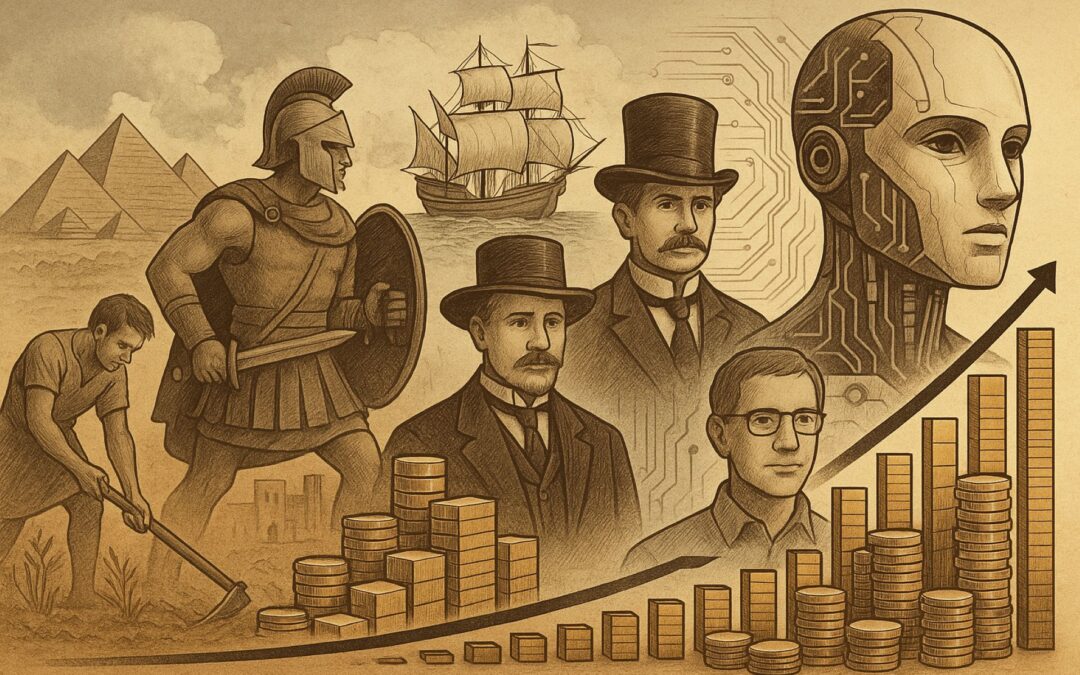
From the first seeds planted in ancient river valleys to the race for dominance in artificial intelligence, the ways humans create and measure wealth have never stood still. Every era rewrites the rules—transforming land into power, armies into empires, trade routes into global monopolies, machines into industrial empires, and code into borderless fortunes.
The most successful players in history weren’t just hard workers; they were visionaries who sensed the shift before it arrived and positioned themselves to ride it. This is the story of how getting rich has evolved across thousands of years, what it looks like today, and where it might take us in the centuries to come.
The Agricultural Age – Wealth Rooted in Soil and Strength
Fourteen thousand years ago, the story of human wealth began with a single, radical decision—stop moving. For millennia, our ancestors had been nomadic, roaming in small bands, following herds of game and the seasonal ripening of wild plants. Life was precarious. A bad hunt, a poor harvest of wild berries, or a sudden storm could mean hunger or death. Then, somewhere in the fertile crescent between the Tigris and Euphrates, humans discovered the immense power of permanence.
They planted seeds. They learned that domesticated grains would grow where they wanted them, year after year. They bred livestock to stay close instead of fleeing into the wilderness. This shift didn’t just alter the food supply—it redefined the very nature of power.
In this new order, land was not just property—it was life itself. Whoever controlled fertile soil controlled the heartbeat of the community. A chieftain with a stretch of lush riverbank could dictate who ate and who went hungry. He could store grain in clay granaries, feeding his people through lean seasons while hosting elaborate feasts to showcase abundance. These gatherings weren’t mere celebrations; they were political theatre, reinforcing his role as provider and ruler.
Wealth at this time wasn’t tallied in coins or jewels—it was measured in acres of arable land, herds of animals, clay jars overflowing with grain, and the human labor to cultivate them. Owning these meant controlling the survival of others. Servants and workers pledged loyalty in exchange for sustenance and protection. The wealthy lived in sturdier dwellings—mud-brick homes with courtyards—while the rest survived in simpler huts.
This was a world where power was maintained by muscle as much as by management. Rivals could appear at any moment to seize your fields, and drought or flood could ruin an entire season’s yield. The shrewdest leaders fortified their holdings, forged alliances with neighboring tribes, and kept warriors close at hand. Wealth was agricultural dominance backed by the credible threat of force. Those who thrived in the agricultural age understood one truth—control the land, and you control life itself.
The Age of Empire and Conquest – Wealth Forged in War
Five thousand years ago, agriculture had already transformed scattered settlements into bustling cities. Irrigation systems fed growing populations, and with abundance came ambition. The small, isolated communities of the past began to merge into complex political states. Land still mattered, but a new, decisive factor emerged: the size and strength of your army.
This was the birth of the age of empire. Wealth was no longer tied to what your own land could yield—it depended on what you could take from others. Pharaohs in Egypt, emperors in China, and kings in Mesopotamia learned that conquest was the fastest route to unimaginable riches.
Victory in war brought a cascade of rewards. Conquered lands yielded fertile fields, bustling markets, and valuable mines. The defeated were often enslaved, their labor adding to the conqueror’s wealth. Tribute in gold, silver, spices, and livestock flowed into imperial treasuries. Even the cultural treasures—art, manuscripts, craftsmen—were absorbed into the victor’s realm, enriching it far beyond material gain.
Powerful rulers displayed their wealth not just in the size of their armies, but in the grandeur of their cities. Palaces rose on massive stone foundations, decorated with rare woods, intricate mosaics, and silks from distant lands. Markets overflowed with goods brought along trade routes secured by military might. Coins stamped with the ruler’s likeness circulated widely, ensuring their image—and authority—traveled further than their armies.
Yet this kind of wealth was both intoxicating and unstable. Expanding empires required constant military campaigns to protect borders, crush rebellions, and deter ambitious rivals. Maintaining large armies drained treasuries as quickly as conquest filled them. The mightiest empires could be undone not by foreign armies, but by overreach, internal strife, or the sheer cost of maintaining their dominance.
In this era, the richest figures were often the most feared. They didn’t negotiate for their fortunes—they seized them. Wealth was built on the back of warhorses, in the shadows of siege engines, and in the roar of soldiers marching toward another city destined to fall. The currency of the age was blood and steel, and those who could command both became the richest and most powerful humans in history up to that point.
The Age of Trade and Exploration – Wealth Across Oceans
By the 1400s, the winds of fortune had shifted yet again. The old empires still stood, but the locus of wealth began to migrate from inland capitals to bustling coastal ports. The world was opening up in ways that would have seemed impossible just a few generations earlier. Ships, once timid coastal vessels, had evolved into robust ocean-crossing galleons. The compass and astrolabe allowed sailors to venture into waters previously considered suicide. The Earth, once fragmented by the limits of human reach, was slowly becoming a single, interconnected marketplace.
When Christopher Columbus crossed the Atlantic in 1492 and Vasco da Gama reached India by rounding Africa’s Cape of Good Hope in 1498, they didn’t just discover new routes—they unlocked entire economic systems. Wealth now flowed along sea lanes like blood through the arteries of a vast global body.
The cargo holds of these ships brimmed with treasures: spices from the Malabar Coast, porcelain from Jingdezhen kilns in China, silver mined in the Americas, sugar from Caribbean plantations, and gold from West African kingdoms. Each voyage was a gamble—the seas were ruthless, storms unforgiving, and pirates or rival fleets always a threat. But the returns could be astronomical. A single successful expedition might yield profits that could bankroll a merchant’s rise into nobility.
Enter the Dutch East India Company (VOC), a corporation so powerful it blurred the line between commerce and empire. At its height, it commanded its own navy and army, conquered territory, minted its own currency, and negotiated treaties with kings. It wasn’t just moving goods; it was shaping geopolitics. Shareholders in Amsterdam grew rich without ever leaving their homes, while company officials in far-off colonies exercised authority rivaling monarchs.
To succeed in this era required a blend of daring and calculation. Merchants had to read shifting political tides, manage vast sums of capital, and broker deals across cultures and languages. Trade was no longer a local affair—it was a theater of diplomacy, espionage, and logistical mastery.
Wealth in the age of trade was often conspicuous. Merchants built stately homes in port cities, adorned with exotic goods from every corner of the globe. Fine rugs from Persia, lacquerware from Japan, tropical hardwood furniture from the Indies—all served as subtle (and sometimes not-so-subtle) displays of global reach. Yet, for all its opulence, this system was fragile. Wars between European powers could close routes overnight, and monopolies could crumble when a single expedition failed. It was an age of fortunes made on the crest of a wave—and lost in its trough.
The Industrial Age – Wealth in Machines and Monopolies
The dawn of the 19th century marked a break from every system of wealth that had come before. The old order—where riches came from land, conquest, or trade—gave way to something new: industry. The steam engine, mechanized looms, and advances in metallurgy transformed production from a craft into a machine-powered juggernaut.
Factories rose like fortresses in cities across Britain, the United States, and continental Europe. No longer did output depend on the number of hands in a workshop—machines could run day and night, churning out goods at volumes unimaginable to previous generations. Raw materials streamed in—cotton from American plantations, iron ore from Welsh mines, coal from Yorkshire pits—and finished products streamed out: textiles, steel rails, locomotives, and later, automobiles.
The new titans of wealth were industrialists, men who mastered scale. Cornelius Vanderbilt, beginning with a single ferry boat, built a transportation empire that spanned railroads and steamships. Andrew Carnegie harnessed the Bessemer process to produce steel faster and cheaper than anyone else, enabling skyscrapers and bridges that redefined city skylines. John D. Rockefeller cornered the oil market, refining kerosene that lit homes around the world before gasoline powered the automobile revolution.
Their wealth wasn’t just vast—it was strategically fortified. Through vertical integration, they controlled every stage of production, from raw material extraction to distribution networks. Competitors were either bought out, driven to bankruptcy, or absorbed into monopolistic conglomerates. These were the architects of modern capitalism—both admired for their vision and criticized for their ruthlessness.
The lifestyle of the industrial elite was a spectacle in itself. They commissioned sprawling estates with manicured gardens, hosted banquets in ballrooms lit by the first electric chandeliers, and traveled in private railcars outfitted like luxury hotels. They had early access to the marvels of the modern age: telephones, elevators, and eventually, automobiles. Their philanthropy left libraries, universities, and hospitals as monuments to their names, even as their business practices fueled debates over labor rights and economic inequality.
But the industrial age also carried inherent volatility. New inventions could upend entire industries overnight. A single technological breakthrough could dethrone even the most entrenched magnate. The same mechanization that enriched factory owners also displaced workers, sparking strikes, protests, and political unrest.
Still, for those who understood its mechanics, the industrial age offered an unprecedented opportunity: the chance to harness the power of machines, scale beyond imagination, and etch one’s name into the very architecture of modern civilization.
The Information Age – Wealth in Code and Connectivity
By the middle of the 20th century, the relentless momentum of industrial expansion had set the stage for yet another seismic transformation. The smokestacks and steel mills that had once been symbols of power gave way to something far less tangible yet infinitely more scalable—information.
It began quietly, with wartime research into computational machines. What started as room-sized calculators for codebreaking and ballistics gradually evolved into programmable computers. Then came the breakthrough that would change everything: networking. The U.S. military’s ARPANET in the late 1960s demonstrated that computers could “speak” to one another, laying the groundwork for the modern internet.
This shift shattered the geography of wealth. No longer tethered to land, factories, or shipping routes, fortunes could now be built from ideas alone. Software, algorithms, and digital platforms became the new levers of economic power. The cost of replicating a physical product was high; the cost of replicating a line of code was almost zero.
Entrepreneurs like Bill Gates saw the future in operating systems—digital skeletons upon which entire software ecosystems could be built. Microsoft’s Windows became the interface through which hundreds of millions interacted with their computers. Steve Jobs at Apple fused design with technology, creating devices that were not just functional but desirable cultural artifacts. Jeff Bezos took the ancient act of buying and selling and moved it online, transforming Amazon from an online bookstore into a global retail infrastructure that reshaped commerce itself.
In the information age, wealth came from platforms that scaled exponentially. A social network like Facebook didn’t just connect friends—it monetized attention at a planetary level. Google turned search queries into a trillion-dollar advertising machine. A single app could be deployed worldwide within minutes, its user base swelling by millions overnight without a single new factory built.
The richest of this era enjoyed luxuries that even industrial tycoons could not imagine: private jets that doubled as mobile offices, estates integrated with smart technology, the ability to oversee global operations from a beachfront villa, and influence over billions of people’s daily habits through algorithms alone.
But the rewards came with new battlegrounds. Cybersecurity, privacy, and data ethics emerged as critical concerns. Competition was no longer fought in boardrooms or on factory floors—it played out in server farms, code repositories, and user acquisition metrics. In this world, speed was paramount; the first to capture market share often became unassailable. The industrialists had built physical empires—these new titans built invisible ones, made of bits and bandwidth, yet just as real and far more agile.
The Age of Intelligence – Wealth in Data and Algorithms
Now, we are in the early throes of the intelligence age, a period defined not just by processing information but by teaching machines to understand, predict, and create. Artificial intelligence is not an incremental upgrade to the information age—it is a wholesale redefinition of how value is generated.
In this new landscape, the most coveted resource is not oil, steel, or even raw human attention—it is data. The companies that control vast, high-quality datasets hold the keys to training the most capable AI systems. Those systems, in turn, become the infrastructure upon which the next generation of businesses will be built.
Tech giants like Google, Microsoft, OpenAI, and Nvidia are locked in an arms race worth trillions, each vying to develop foundation models powerful enough to dominate industries yet to be fully imagined. These models can write, design, diagnose, translate, and even create new forms of art and entertainment. And unlike previous technological leaps, AI doesn’t just amplify human labor—it can autonomously generate outputs that once required entire teams.
The richest players in this era will not necessarily be those who write code themselves. The true wealth will belong to those who can think in systems: designing AI-driven workflows, integrating them into products and services, and capturing the downstream value as industries are reshaped. Creativity, adaptability, and the ability to simplify complex technology for mass adoption are as valuable as technical prowess.
AI is collapsing the traditional limits of scale. A single entrepreneur can deploy automated systems that run around the clock, servicing millions without adding headcount. The cost of experimentation has plummeted; new products can be prototyped and iterated in days rather than months. The competitive advantage lies in speed of adaptation, the ability to spot emerging use cases, and the vision to build ecosystems that others depend on.
For the early winners, luxury will take on futuristic forms: AI-personalized living environments, predictive health interventions, entirely automated wealth management, and the ability to direct teams of both humans and machines from anywhere on the planet. Influence will extend beyond borders, industries, and perhaps even planetary limits.
Yet, like every wealth revolution before it, the age of intelligence carries its own fragility. Regulation, ethical concerns, and public trust will shape its trajectory. The question is not whether AI will transform the economy—it already has—but who will adapt quickly enough to harness its potential without being overtaken by its pace.
The Future – Wealth Beyond Money
Projecting wealth into the future means standing on a knife’s edge between history and speculation. Yet, if the last 14,000 years have taught anything, it’s that the engines of prosperity never stay still—they mutate with technology, culture, and human ambition. The only constant is change, and the pace of that change is accelerating.
In the next five years, the victors will be those who not only adopt artificial intelligence but weave it into the very DNA of their work. This isn’t about dabbling in a few AI tools—it’s about building self-sustaining systems that operate in the background, generating revenue without constant human input. Picture automated supply chains adjusting themselves in real time, content ecosystems that grow without intervention, and digital products that improve autonomously as they learn from users. Some fortunes will appear overnight, but most will be the product of quiet, methodical system-building—wealth compounding invisibly until it suddenly becomes impossible to ignore.
Fifty years from now, AI will no longer be a frontier—it will be infrastructure, as invisible and indispensable as electricity. Entire generations will have been born into a world where humans and machines collaborate seamlessly. The center of wealth may shift toward control over resources that machines cannot fabricate: renewable energy grids, advanced biomedical solutions, and proprietary intellectual ecosystems that govern health, longevity, and emotional well-being. The physical and digital worlds will bleed into one another so completely that “real” and “virtual” prosperity will be indistinguishable. A person’s estate might be split equally between tangible holdings on Earth and curated environments in the metaverse, both carrying equal weight in value and status.
Looking out five centuries, the very definition of wealth could dissolve. If technological progress leads to a post-scarcity society, where energy is abundant, food is synthesized on demand, and advanced fabrication can create nearly any object at negligible cost, the traditional scarcity-driven economy collapses. In such a world, money may exist only as a symbolic token rather than a survival necessity.
Exclusivity will pivot toward experiences and capabilities that cannot be easily replicated. Private space colonies orbiting distant worlds. Personal AI entities evolved over centuries to understand and anticipate every nuance of their human counterpart’s desires. Bioengineered longevity that allows lifespans of hundreds of years—or, for the truly elite, the uploading of consciousness into secure, private simulations where time itself can be altered.
In this far horizon, wealth could be measured in influence over reality itself. Who controls the most immersive simulations? Who has the ability to engineer an entirely new planet? Who possesses the rarest forms of consciousness—whether biological, artificial, or a hybrid of the two? The elite may travel between star systems as casually as today’s billionaires charter private jets. Legacy will not be written in marble or on paper but in enduring, self-replicating systems—data, habitats, and civilizations that persist long after their creators have moved beyond human limitations.
It sounds fantastical, but so would our present have seemed to the emperors of Rome or the merchants of the 15th century. They could not have imagined a world where invisible networks carry voices and images across continents in seconds, where a single individual can speak to millions without leaving their home, or where machines generate human-like language and art.
The through-line remains unchanged: those who adapt first, think beyond the boundaries of their time, and seize opportunities before they are widely recognized will define the next chapters of human wealth. The currency may change, the symbols of success may shift, but the core dynamic endures. In every age—past, present, and future—wealth belongs to the visionaries.