
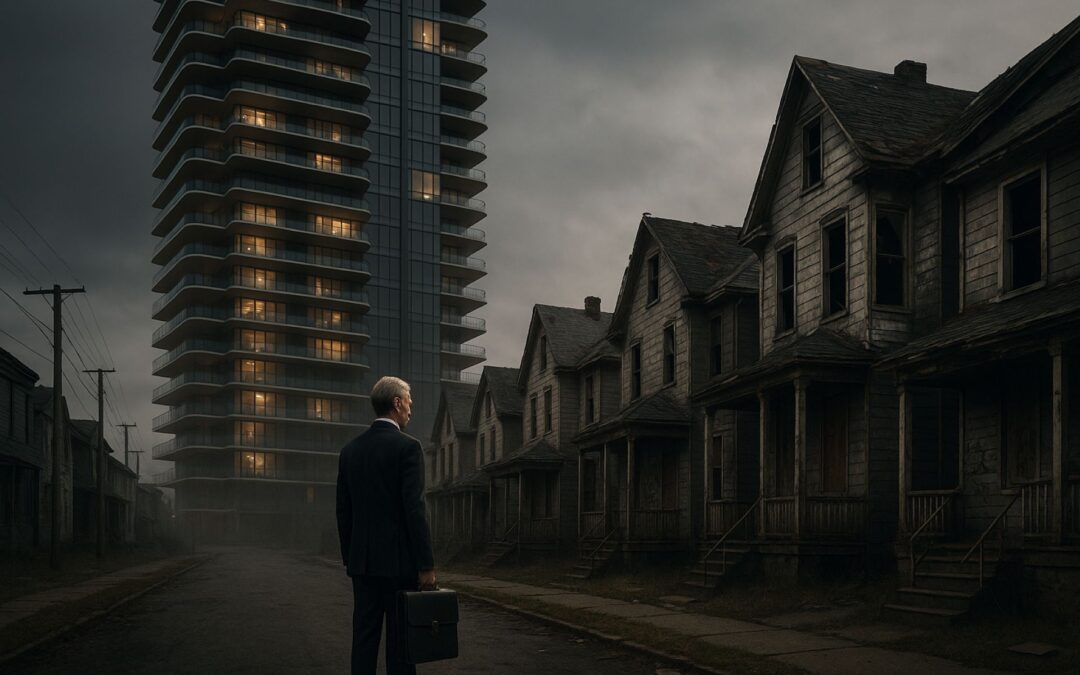
Owning a home was once the hallmark of success—the proof that you had “made it.” For decades after World War II, it seemed attainable for anyone with steady work and a bit of discipline. But that window is closing fast. Today, the cost of a home has skyrocketed far beyond wages, developers build luxury towers instead of starter homes, and institutions treat houses less as shelter and more as financial assets. The result? Wealth is consolidating at the top while ordinary families are quietly being pushed out of ownership.
Fifty years from now, the divide will be stark. A small, wealthy elite will hold the deeds, and the rest will be perpetual renters. Communities will weaken, mobility will be forced, and equity—the cornerstone of intergenerational wealth—will be out of reach for most. To understand why, we have to trace the arc of history, see how the post-war middle-class miracle was only an anomaly, and confront the filters that now lock everyday people out of the housing market.
The Vanishing Dream of Ownership
The story of property in the 21st century is not simply about square footage, mortgages, or interest rates—it is about power and who gets to wield it. For generations, the belief was that homeownership was within reach for anyone disciplined enough to save, work hard, and stay the course. That belief is crumbling.
Between 2010 and 2020, property values rose significantly, yet the distribution of that wealth revealed a brutal truth. High-income households captured 71% of the gains. The middle class—once seen as the sturdy backbone of ownership—managed to hold on to just 26%. At the very bottom, low-income earners saw a meager 4%. These numbers expose a tectonic shift: wealth is not spreading, it is consolidating.
For ordinary families, this plays out in small, painful ways. The dream of buying a starter home turns into years of renting and saving, only to find the prices racing faster than their wages. Down payments balloon into unreachable targets. Even those who succeed often stretch themselves to breaking point, tying up decades of income in a mortgage that feels more like a chain than a key.
Renting, once considered temporary—a stopgap on the journey to ownership—has quietly become a lifelong arrangement for many. A rented apartment no longer signals youth or transience; it increasingly defines adulthood. Generations are growing up without the stability of inherited homes or the security of appreciating assets. Instead, they pay rent into the pockets of those who already own, reinforcing the cycle of upward wealth transfer.
The dream that once symbolized progress—buying a home, building equity, passing wealth to the next generation—has been hollowed out. It is not just a fading aspiration; it is becoming an impossibility for millions. And this erosion isn’t accidental—it is the natural consequence of how the system is designed.
A Return to the Old Order
To fully understand why homeownership is vanishing, we must step back and realize that the middle-class dream of property was not the norm throughout history. It was the exception. For centuries, property was the exclusive domain of the elite, a gate that remained firmly shut to the masses.
In feudal Europe, kings and nobles parceled land as rewards for loyalty. In imperial China, vast estates were the privilege of ruling families and wealthy merchants. In colonial societies, land was granted by monarchs to favored subjects, while locals labored on it without rights. Across continents and cultures, one pattern repeated: those at the top owned, while those at the bottom rented or worked the land with little chance of escape.
Ordinary people were trapped not only by poverty but by the absence of tools to break free. Credit did not exist for commoners. Banks, where they existed, lent only to those with collateral—land itself. Inheritance laws ensured that property stayed within rich families, keeping wealth concentrated across generations. If you were born a tenant, you likely died one, regardless of how hard you worked.
The statistics from the 1800s are sobering. The bottom half of the population controlled just 5–15% of global income. The top 10% held over half, and the top 1% alone commanded nearly 10%. Ninety percent of people were “poor” by definition: they earned enough to eat and rent shelter but had no pathway to education, healthcare, or upward mobility.
Property ownership was more than an economic fact—it was a social weapon. Landlords decided not only who lived where, but who could work, who could be evicted, and who could attempt to rise. The very structure of society was built on dependence, with the rich pulling the strings while the poor remained tethered to the land they did not own.
The emergence of a broad middle class after World War II shattered this ancient pattern, but only temporarily. What looks like decline today is, in truth, a reversion to the historical baseline: a world where the divide is simple and stark. A small, wealthy elite owns property. Everyone else pays them for the right to exist upon it.
The Post-War Window of Opportunity
The decades following World War II were unlike any that had come before. After years of deprivation, rationing, and destruction, societies in the West experienced a renaissance of economic optimism. Soldiers came home with government-backed benefits, war bonds, and accumulated wages they had been unable to spend during service. Women, having stepped into industrial and clerical jobs while men were away, had become a permanent presence in the workforce, adding an additional stream of income to households.
The numbers made homeownership more than a fantasy—it was a straightforward calculation. In the United States during the 1950s, the average home cost $7,400, while the median household income was $3,300. This ratio—roughly 2.2 times annual earnings—meant that even a single income could cover the cost of a house, pay off a mortgage in under two decades, and still leave room for saving and consumption. Compare that with today’s reality, where homes routinely cost five to six times household income, and the contrast is staggering.
Governments also intervened in ways that opened the gates to mass ownership. The GI Bill in the United States provided veterans with low-interest loans and subsidies, helping them buy homes with little down payment. Britain rolled out council housing programs and rebuilt its bombed-out cities with affordable housing stock. Australia expanded suburban developments at breakneck speed. These policies combined with an unprecedented building boom: suburbs mushroomed outside cities, complete with schools, shops, and roads designed for car-owning families.
Banks played their part by lowering interest rates and extending loans to families who had never before been considered creditworthy. The rules of the game changed. No longer did one need inherited wealth to buy property—steady employment and government backing were enough.
This period also reshaped culture. Owning a home became synonymous with adulthood, success, and stability. A white picket fence was not just wood and paint; it was a symbol of financial ascent, a promise that one’s children would inherit not only shelter but equity. For the first time in history, millions of ordinary families in countries like the US, UK, and Australia could dream of passing wealth forward.
But this post-war prosperity was not inevitable—it was circumstantial. A unique alignment of high wages, low costs, cheap credit, and mass construction produced the middle-class miracle. Once those conditions shifted, the dream began to fracture.
The Great Reversal
The cracks in the system began to appear by the 1970s. Inflation surged, oil shocks rattled economies, and interest rates climbed into double digits. The very mechanisms that had once enabled widespread ownership—affordable loans, mass construction, and favorable price-to-income ratios—began to erode.
For a few decades, the illusion held. From the 1950s to the early 1980s, the ratio of home prices to household income remained relatively stable. But beneath the surface, structural changes were underway. Globalization and automation exerted downward pressure on wages, while land and construction costs continued to rise.
By the 1980s, the cost of a home was already 2.9 times the average annual household income. By 2019, that ratio had ballooned to 3.9, and today it hovers around 5.6. The mathematics of ownership no longer favored ordinary families. Saving for a down payment now took a decade or more, and monthly mortgage payments consumed disproportionate shares of income.
This wasn’t just economics—it was a reversion to history’s default setting. The middle-class boom of the post-war years had been a fragile anomaly, a brief disruption in the long tradition of ownership concentrated in elite hands. Once the favorable winds of cheap credit, mass building, and high wages died down, the pendulum swung back.
The reversal also revealed cultural fractures. Where owning a home had once been seen as an achievable milestone, it became a burden and a risk. Younger generations found themselves locked out entirely, watching as their parents’ homes appreciated into unreachable assets. The cultural narrative shifted from “when you buy a home” to “if you can buy a home.”
In effect, the middle class that had risen on the back of post-war prosperity began to hollow out. The rich, cushioned by their accumulated assets, weathered the changes. The poor remained excluded, as always. And the once-stable middle, stretched and strained, slowly began to slide back toward dependency.
The Filters That Lock People Out
The decline of homeownership for ordinary families doesn’t happen in a single sweeping blow—it unfolds through a sequence of filters. Each filter quietly eliminates swathes of would-be buyers, tightening access until only the wealthy can slip through. What looks like a fair market on the surface is, in reality, a multi-layered sieve designed to sort people by income, assets, and resilience.
Scarcity by Law
The first filter is scarcity—engineered not by nature but by policy. In the United States, Canada, and much of Europe, zoning regulations and environmental laws often masquerade as protective measures for communities. Originally meant to separate noisy factories from quiet neighborhoods, these rules have hardened into rigid barriers that limit how and where homes can be built.
Take Los Angeles as a stark example: 75% of its residential land is zoned for single-family homes only. That means you cannot construct duplexes, townhouses, or apartment complexes on three-quarters of the land. The result? Artificial scarcity. Demand continues to rise in fast-growing cities, but supply is deliberately throttled. Homeowners benefit as their property values soar, while newcomers and renters are locked out.
These rules serve the interests of those already inside the ownership club. Restricting supply ensures competition stays low, prices stay high, and existing property holders see their assets appreciate. For the wealthy, this isn’t a problem—it’s a feature. For everyone else, it’s the first gate slammed shut.
The Rising Cost of Construction
The second filter is the spiraling cost of building itself. Permits, zoning fees, labor, and raw materials have all surged over the past few decades. This creates a perverse incentive for developers: if they’re going to build, they’d rather build luxury homes. Why? Because the margins are far higher.
Building affordable starter homes simply isn’t as profitable. Banks, investors, and landowners all stand to gain more from high-end projects. As a result, cities are dotted with gleaming glass towers filled with million-dollar apartments, while demand for modest, family-sized homes goes unmet. The very people who need entry-level housing are left with nothing to buy.
Population Growth and Urban Migration
Even if regulations and costs weren’t enough, demographic trends form a third filter. The global population has more than doubled since 1950, and the majority of that growth has funneled into cities. Rural economies shrank as service and tech industries concentrated in urban centers. People move to where the jobs are, and the jobs are in cities.
Household sizes also shrank dramatically. In the 1950s, an American household averaged 3.5 people. Today, it’s closer to 2.5. That means the same number of people now require far more units. For a city of 350,000, that’s the difference between needing 100,000 homes and 140,000. Demand multiplies not just because of population growth, but because of how people live. Smaller families, later marriages, more single households—each one adds to the pressure.
When supply lags behind these demographic realities, prices spiral. Urban areas become feeding frenzies, with too many people chasing too few homes.
Debt as a Trap
For those who somehow make it through the first three filters, debt becomes the fourth and perhaps most merciless barrier. In the 1950s, buying a starter home might have cost twice a family’s annual income. Saving for a down payment could take just a few years. Today, homes cost five to six times household income, stretching savings timelines into decades.
Higher interest rates magnify the pain. A $400,000 mortgage that once cost $1,700 a month can easily balloon to $2,700 when rates rise by just four points. For families already struggling with stagnant wages and rising living costs, this pushes ownership beyond reach.
Meanwhile, wealthy buyers enjoy the opposite experience. Their existing assets make them “safe” borrowers in the eyes of banks, giving them access to loans at lower rates. They can leverage debt to acquire properties that earn more than the cost of borrowing, turning debt into a wealth-building tool. For the middle class, debt is a trap; for the rich, it’s a ladder.
The Advantage of the Wealthy
Economic downturns devastate ordinary families but act as accelerants for the wealthy. Recessions, housing crashes, and periods of high inflation all create moments when regular buyers are pushed out of the market while affluent investors step in to seize opportunities. This asymmetry is not accidental—it’s baked into the way capital and credit function.
When a recession hits, middle-class families face job losses, reduced hours, or wage stagnation. Savings evaporate as everyday costs mount, and mortgage payments quickly become unmanageable. Many are forced to sell their homes just to stay afloat, often at a loss. Meanwhile, banks tighten lending standards, making it even harder for working families to qualify for mortgages. The pipeline to ownership constricts at the very moment people most need stability.
Wealthy buyers, however, enter these downturns armed with liquidity. They have cash reserves, diversified investments, and most importantly, privileged access to cheap credit. Banks are eager to lend to them because their assets act as collateral. When property prices dip during a crisis, the wealthy treat it like a clearance sale. They buy up foreclosures, scoop up distressed properties, and expand their portfolios at a fraction of the cost.
The 2008 financial crisis offers a striking example. Millions of American families lost their homes to foreclosure, but private equity firms like Blackstone swooped in and purchased thousands of these homes at 30–50% discounts. These properties were then converted into rental units, effectively turning former homeowners into tenants. The very crisis that destroyed the financial security of millions became a wealth transfer event for those with deep pockets.
The pandemic created a similar pattern. As uncertainty spiked and interest rates dropped below 3%, the wealthy went on a buying spree. In the U.S. alone, the median home price jumped more than 40% between 2020 and 2023. Investors, hedge funds, and high-net-worth individuals bought aggressively while ordinary families struggled with job instability and higher living costs. The result: the rich emerged from the crisis with larger portfolios and greater leverage, while many families found themselves permanently priced out of the market.
This “buy, borrow, repeat” cycle compounds over time. The rich don’t just recover after downturns—they expand. Their portfolios grow faster than the middle class can save for a single down payment. Each economic shock accelerates the transfer of property ownership from the many to the few, widening the gulf until the idea of ownership for average families becomes more illusion than possibility.
The Financialization of Homes
The shift from homes as shelter to homes as financial instruments was one of the most profound economic transformations of the late 20th century. Beginning in the 1980s, leaders like Ronald Reagan in the U.S. and Margaret Thatcher in the U.K. spearheaded policies that reduced taxes on capital gains, deregulated financial markets, and encouraged private investment. Housing, once primarily about providing stability for families, became a vehicle for speculation, wealth storage, and corporate expansion.
At the domestic level, affluent investors began acquiring multiple properties not to live in, but to rent out. Housing was no longer a basic necessity—it was a cash flow machine. Meanwhile, international capital flooded into global cities. Wealthy individuals from politically unstable countries parked money in real estate in London, New York, and Sydney, treating property not as homes but as vaults for safeguarding their fortunes. This locked up supply and drove local prices sky-high, leaving ordinary residents unable to compete.
The institutionalization of housing changed the landscape even further. Hedge funds, private equity firms, and real estate investment trusts (REITs) turned homes into scalable portfolios. After the 2008 crisis, these firms bought foreclosed properties en masse, often at steep discounts, converting them into permanent rental stock. By 2022, giants like BlackRock and Invitation Homes owned hundreds of thousands of single-family residences across booming cities like Phoenix, Atlanta, and Austin.
Mortgage-backed securities added another layer of financial complexity. Bundling home loans into tradeable products transformed mortgages into Wall Street instruments. This encouraged risky lending before 2008, but it also entrenched the idea of housing as an asset class, not just a necessity. Every house became a financial product, to be leveraged, traded, and securitized.
The consequences are visible everywhere. Cities are filled with vacant luxury apartments, bought purely as safe-deposit boxes for global elites. Starter homes have vanished as developers chase higher margins from luxury construction. Ordinary families, once the primary participants in housing markets, are now crowded out by institutional buyers with billion-dollar funds.
The result is a feedback loop. As wealthy investors buy more property, scarcity increases, prices rise, and renters are forced into dependence. Meanwhile, those locked out cannot build equity, ensuring they stay in the renter’s class indefinitely. Housing has ceased to be a ladder of upward mobility—it has become a fortress of wealth preservation for the elite.
The World 50 Years From Now
Project the trajectory forward half a century, and the outcome is chillingly clear: ownership will become a rarefied privilege, not a rite of passage. Property will no longer be the cornerstone of middle-class stability—it will be a fortress reserved for the wealthy.
For ordinary families, housing will devolve into a perpetual expense. Rent will feel like a subscription fee for existence, paid endlessly without the prospect of ever converting into equity. Unlike a mortgage, which eventually ends and leaves an asset behind, rent is infinite. It consumes without creating. That means families will spend lifetimes paying for shelter but never build the intergenerational wealth that comes from ownership.
The societal ripples will be profound. Communities will lose their cohesion. Without the anchor of ownership, mobility will be imposed, not chosen. Families will be forced to relocate when rents spike or when landlords sell, erasing stability and weakening ties to schools, local businesses, and neighbors. A neighborhood’s character will shift rapidly as turnover accelerates, making it harder to build lasting bonds. Roots—once deepened through property—will remain shallow.
Education and family wealth will reflect these divides starkly. Children of owners will inherit appreciating assets, creating a cycle of prosperity. Children of renters will inherit little more than stories of struggle, perpetuating a cycle of dependence. As ownership concentrates, so does power. Property owners will dictate not just rents but politics, policy, and even cultural life in cities. The influence of landlords—be they wealthy individuals, private equity firms, or global corporations—will shape entire communities.
The economic data already points in this direction. The richest 1% today hold nearly 40% of global wealth, while the bottom half of the world holds just 2%. In the U.S., first-time homebuyers made up half the market in 2010 but have now dropped to around 24%. Similar patterns unfold across Europe. Ownership is not spreading; it is consolidating.
There will be exceptions. In nations like China, India, and Brazil, looser building laws and rapid construction have kept ownership rates more stable despite massive urbanization. But in much of the developed world, the path forward looks like a return to the past—a feudal echo where the wealthy few hold the land, and everyone else rents their place on it.
Two Paths Ahead
Faced with this looming reality, society stands at a crossroads. Two choices present themselves: change the game or play the game.
To change the game requires systemic reform. Governments would need to tackle restrictive zoning laws that choke supply, opening the gates to higher-density housing in urban areas where demand is greatest. Empty homes bought for speculation could be taxed heavily, discouraging investors from hoarding properties simply to park wealth. Shared equity programs could be expanded, allowing first-time buyers to purchase homes in partnership with governments or nonprofits, reducing the barrier to entry. Mortgage rates could be lowered through policy intervention, and subsidies could be provided for affordable housing construction.
But here lies the catch: those with the power to change the rules often benefit from the current arrangement. Policymakers, wealthy property owners, and institutional investors all profit from scarcity. Their portfolios grow as supply is restricted. Asking them to dismantle the system that enriches them is like asking a landlord to voluntarily lower the rent. Reform is possible but politically unlikely without immense public pressure.
That leaves the second option: play the game as it is. This means aspiring owners must become wealth builders themselves. To secure a place in tomorrow’s housing market, one must build capital outside it first—through entrepreneurship, investing, or acquiring assets that compound over time. It requires learning the rules of leverage, credit, and portfolio growth, using the very strategies the wealthy deploy.
The choice is stark but urgent. Either fight to bend the system toward inclusivity or adapt to it and climb into the ranks of owners. What is certain is that standing still is no longer an option. In 50 years, the divide will be absolute: those who own and those who pay them. The decision is whether to influence the system or master it.