
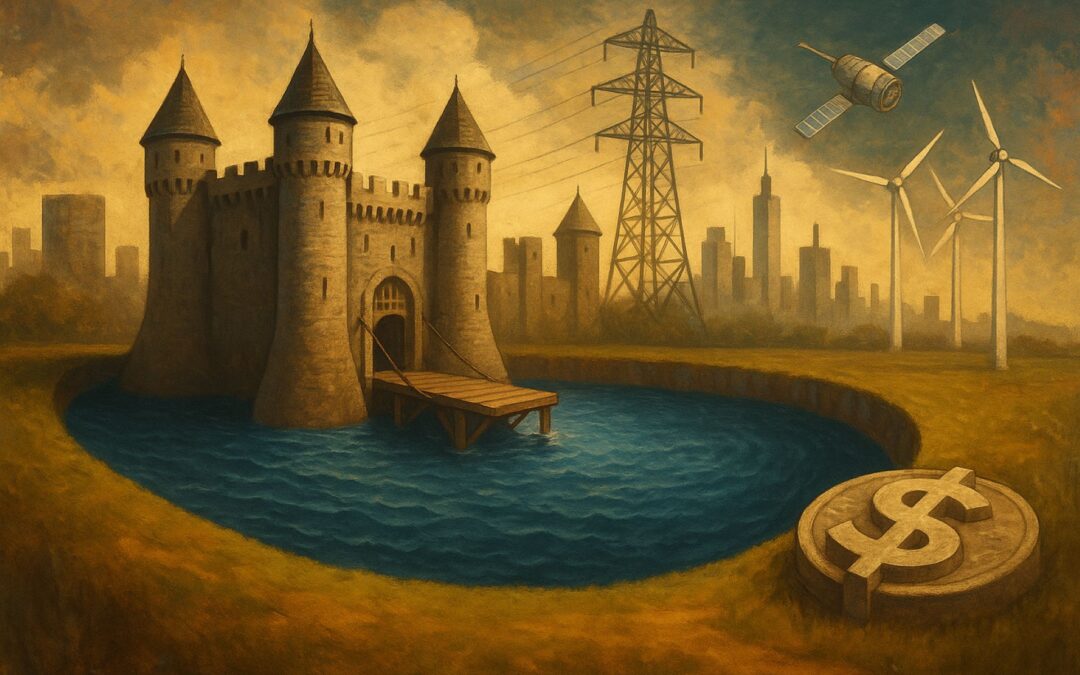
Every empire—whether carved in stone or code—relies on defenses. In the medieval world, castles were ringed with moats to keep invaders at bay. In business, the moat has become the metaphor for what separates lasting dynasties from fragile ventures. It’s the hidden advantage that keeps competitors out, profits in, and wealth compounding for generations.
Warren Buffett popularized the term, but billionaires today are expanding it in ways he could scarcely have imagined. The moats of the future won’t just be brands, patents, or factories. They’ll be licenses no one else can secure, power grids only a few can control, testbeds where tomorrow’s cities take shape, and rules that define how entire industries operate. These are the modern fortresses where future fortunes will be safeguarded.
The Origins of the Moat
The moat is one of the simplest yet most powerful metaphors in finance. Picture a medieval castle: high stone walls, archers on the battlements, and most importantly, a deep trench filled with water surrounding the fortress. That trench—the moat—kept invaders at bay. Even if they reached the walls, the moat slowed them down, drained their resources, and gave defenders time to strike.
In business, the concept works the same way. Every enterprise faces attackers—competitors looking to undercut prices, imitate products, or lure away customers. Without defenses, profits get chipped away until nothing remains. But a wide and durable moat creates barriers that rivals cannot easily cross. It protects not just the company, but the cash flows that feed future growth.
In the industrial age, moats were built from physical assets. John D. Rockefeller’s oil empire thrived because he controlled wells, pipelines, and refineries. Andrew Carnegie’s steel dynasty dominated because of colossal furnaces and economies of scale. Railroads, too, exemplified the moat: once you owned the tracks connecting cities, nobody could realistically duplicate them without ruinous cost. These were moats of muscle—tangible, heavy, and expensive to replicate.
Fast forward to today, and the landscape looks radically different. The strongest defenses are no longer carved into land or machinery, but into the minds and habits of consumers. Coca-Cola doesn’t dominate because its formula is irreplaceable—scientists have recreated near-identical tastes countless times. What keeps rivals at bay is the brand moat: a century of advertising that has embedded Coke into memories, rituals, and emotions. The red can is not just a drink, it’s an icon. That psychological fortress keeps customers loyal even when cheaper options abound.
Apple takes a different path, weaving a moat from ecosystems. An iPhone is just the gateway. Once a customer pairs it with AirPods, syncs with a MacBook, tracks health with an Apple Watch, or backs up to iCloud, leaving becomes costly and inconvenient. Every purchase locks the user deeper into Apple’s walled garden. Competitors may create better specs or cheaper devices, but they can’t replicate the seamless integration Apple has cultivated. That integration is the moat.
These examples show how moats evolve with time. What mattered in Rockefeller’s world was steel, oil, and land. In today’s economy, the decisive factors are loyalty, networks, and lock-in. But the underlying principle remains the same: the moat is what separates fleeting businesses from dynasties.
Permission: The Gatekeeper Advantage
In the past, entrepreneurs could build fortunes with little more than ingenuity and capital. Patents secured inventions, factories scaled production, and ownership of resources cemented dominance. But those protections are increasingly fragile. Patents expire. Factories can be cloned with global supply chains. Capital flows wherever opportunity lies. What cannot be cloned, however, is permission.
Modern wealth creation increasingly depends on navigating industries so sensitive and high-stakes that governments regulate who can participate. Nuclear energy, biotech, artificial intelligence, space exploration—these are not domains where any clever startup can simply “move fast and break things.” The potential consequences are too great. Permission to operate, granted by regulators and reinforced by precedent, has become the new moat.
Commonwealth Fusion Systems illustrates this perfectly. For decades, scientists have pursued fusion power—the holy grail of clean, limitless energy. But every attempt fell short, consuming more energy than it produced. CFS, born from MIT research, has broken new ground with magnet technology. Yet their true advantage lies not only in science, but in gatekeeping rights. They’ve secured regulatory approval to build a 400-megawatt fusion plant in Virginia. They’ve signed power purchase agreements with Google, locking in a first customer before the plant is even finished. They’ve won permits and partnerships that competitors cannot replicate overnight.
This combination of proof, permission, and precedent forms a fortress more durable than any patent portfolio. Even if a rival lab achieves a similar scientific breakthrough, they would still need to persuade regulators, communities, and investors to grant them equal trust. That takes years, if not decades. In the meantime, CFS will already be entrenched as the de facto leader, shaping safety standards and securing supply chains.
Permission moats work because they intertwine with trust. Governments do not hand out licenses lightly. Once a company earns that trust, it becomes the default choice. And as industries like energy, health, and space increasingly define the future, permission will separate the dreamers from the dynasties.
Power: The Right to Switch the Lights On
Power is the bloodstream of modern civilization. Every app you open, every financial transaction, every click on a traffic light is underpinned by one thing—electricity. Yet, when people speak of power, they often forget it’s not just about raw energy. It’s also about influence, control, and leverage. Whoever dictates the flow of electricity dictates the pace of the world.
In earlier centuries, power was coal-fired or oil-driven. The barons who owned wells and refineries controlled industries because they literally controlled the fuel that ran factories and locomotives. Today, energy demand has shifted from furnaces to servers. The digital economy runs on sprawling data centers and the artificial intelligence models humming within them. Banking systems, logistics networks, hospitals, ride-sharing apps—all invisible to the naked eye—are powered by racks of servers consuming colossal amounts of electricity.
This shift has created a new kind of vulnerability. The more energy our digital lives consume, the more fragile the system becomes. When supply falters, entire economies wobble. Blackouts halt trade, disrupt hospitals, and paralyze transportation. Power isn’t just an expense—it’s the fulcrum on which society balances.
Reflect Orbital is attempting to fortify itself with a moat here, one that fuses science fiction with hard economics. Their vision is audacious: launching satellites into orbit fitted with giant reflective mirrors that redirect sunlight back to Earth. The goal isn’t endless daylight—it’s precision. By extending solar production into the twilight hours, when energy demand spikes and prices soar, Reflect Orbital would control the most valuable minutes in the electricity market.
Why does this matter? Because peak-hour electricity is a goldmine. Prices can surge five to ten times higher than normal. That half-hour window after sunset is when grids strain and utilities scramble. If Reflect Orbital can provide an extra trickle of energy, it could stabilize entire systems and sell power at premium rates. Their moat isn’t just the hardware—it’s time itself. They would own the twilight, dictating when the world’s lights stay on and at what cost.
Competitors could flood the landscape with wind farms or solar parks, but without control over those precious after-dark intervals, they remain price-takers. Reflect Orbital, if successful, becomes the price-setter. And in energy, being the switch-holder is the ultimate moat.
Place: Owning the Testing Grounds
The notion of “place” as a moat once meant controlling physical chokepoints: the harbor that funneled trade, the mine that supplied ore, the railroad that linked cities. Whoever owned the infrastructure owned the profits. In the digital age, however, place has taken on a subtler meaning. It now refers to the controlled environments where the future can be tested, refined, and eventually deployed.
Technology today is too complex—and too risky—to be trialed recklessly in the wild. Self-driving cars can’t simply flood highways without years of calibration. Hydrogen-powered systems can’t be scattered across neighborhoods until proven safe. New urban innovations need not only proof of concept, but proof of resilience in the messy, unpredictable context of daily life. That’s where place becomes critical.
Toyota’s Woven City is perhaps the most ambitious embodiment of this philosophy. Nestled at the base of Mount Fuji, on land once occupied by an old factory, it is a $10 billion living laboratory. Streets are layered like threads in fabric: one reserved for autonomous vehicles, another for bicycles and micro-mobility, a promenade for pedestrians, and subterranean tunnels for logistics. Homes, shops, and labs are woven into this carefully curated urban tapestry.
The inhabitants—called “weavers”—aren’t passive residents. They are test subjects in an ongoing experiment. Every shuttle ride, grocery purchase, or interaction with home robots feeds into Toyota’s feedback loops. Vending machines that monitor health data and recommend drinks are more than novelties—they are prototypes for a new kind of consumer ecosystem.
By owning Woven City, Toyota secures two priceless assets. First, they hold the keys to entry. Any startup or corporation wanting to prove a mobility service or urban technology must pass through their gates. Second, they harvest the data. Every experiment, success or failure, becomes Toyota’s proprietary learning advantage. This monopoly on feedback accelerates their innovation cycle, leaving rivals perpetually a step behind.
In essence, Woven City is not about real estate—it’s about gatekeeping the future. Just as Silicon Valley became the proving ground for software, Woven City is positioning itself as the crucible for mobility, energy, and smart living. The moat here is not made of walls, but of access. Toyota owns the testing ground, and in doing so, they own the narrative of tomorrow.
Rules: Writing the Playbook
Some moats are forged not from products or places, but from the rules everyone else must follow. This type of moat is subtle yet profoundly powerful—it dictates the standards by which industries operate. Once entrenched, these rules become invisible scaffolding, shaping markets for decades.
History is full of such examples. Microsoft cemented its dominance not simply by building software, but by making Windows the default operating system in the corporate world. Visa and Mastercard didn’t just provide convenient cards—they established the rails of global payments. When merchants refused to accept them, they lost business. Over time, the standards became non-negotiable. Competing networks either conformed or vanished.
The same dynamic defined the internet. In its infancy, giants like IBM tried to create closed ecosystems that only worked with their products. But open protocols like HTTP and HTML prevailed. They weren’t glamorous, but they became the default. Because everyone built on them, they became moats—moats so deep that we still live within their boundaries today.
The next frontier for rule-making lies not on Earth, but above it. With the International Space Station nearing retirement by 2030, low Earth orbit will transition to private hands. Governments like NASA are signaling they don’t want to build another massive, taxpayer-funded lab. Instead, they will rent space from private companies. This shift opens the door for new gatekeepers to write the rulebook.
Vast Space is positioning itself at the forefront. Their initial station, Haven 1, is slated to launch with SpaceX, offering short-term stays. Haven 2 goes further—its ambition is to introduce artificial gravity, solving one of the greatest barriers to long-term human presence in space. If they succeed, their advantage won’t just be technological. It will be regulatory and procedural.
Think of the implications: docking standards, crew rotations, supply chains, and even medical protocols in orbit will need definition. The first company to demonstrate sustainable operations will have disproportionate influence in writing these standards. Once codified, they become the de facto rules for everyone else—research labs, space tourism companies, manufacturing ventures, even governments.
This is the essence of a rules-based moat. It doesn’t matter if a competitor builds a flashier station. If they can’t align with the standards already in place, they will be locked out. The moat is not the hardware—it is the playbook itself.
The Ocean Frontier
While the skies capture headlines, another frontier stretches quietly beneath our feet: the oceans. They cover over 70% of the planet, endlessly churning with waves that carry untapped power. For centuries, inventors have dreamed of harnessing this energy. Now, with climate urgency pressing harder than ever, the race is accelerating. Whoever succeeds first won’t just capture a new energy source—they’ll define the standards that shape the entire sector.
Core Power Ocean, a Swedish startup, is one of the most serious contenders. Inspired by the pumping mechanics of the human heart, their engineers developed wave energy converters that mimic organic resilience. In 2023, their full-scale prototype braved violent storms off the coast of Portugal. Where earlier systems broke down under pressure, Core Power’s unit endured and continued to deliver electricity back to the grid. That endurance was more than a technical victory—it was proof of reliability, the first building block of trust.
Reliability matters because energy markets run on confidence. Investors won’t fund billion-dollar rollouts without assurances of consistency. Insurers won’t underwrite projects unless they can model risk. Governments won’t approve deployments unless safety is proven. The company that first checks these boxes establishes the benchmark everyone else must follow.
If Core Power Ocean’s system becomes the reference point, their designs will shape financing models, insurance contracts, and regulatory frameworks. Rivals will be judged against their standards. That creates a moat invisible to the casual eye, yet extraordinarily durable. It’s the same story seen in other industries: the first mover who proves viability earns not just market share but rule-setting authority.
Wave energy may seem less glamorous than space tourism or AI, but its implications are profound. The world’s energy hunger is insatiable, and unlike solar or wind, waves never sleep. If Core Power Ocean locks in its moat, it will not only sell electricity but also control the framework of an entire industry. That framework—once in place—will be nearly impossible to dislodge.
The Future Castles of Wealth
The moats of tomorrow may not resemble the ones Warren Buffett praised decades ago, but their essence remains the same: they protect treasure, ensure continuity, and force others to play by rules not of their own making. Instead of railroads and oil rigs, the fortresses of the 21st century are built around permission, power, place, and rules. Each one acts as a gatekeeper, deciding who gets in, who stays out, and who pays the toll.
Commonwealth Fusion Systems is digging a moat with permission—winning licenses and regulatory trust that no competitor can conjure up overnight. Reflect Orbital is anchoring its moat in power, manipulating the most precious commodity of the digital age: energy at peak demand. Toyota’s Woven City secures its advantage through place, becoming the proving ground where future technologies must be tested before they reach the wider world. Vast Space builds its defenses through rules, striving to write the playbook for orbital living and commerce. And Core Power Ocean shows how even the untamed sea can be captured as a moat, setting the standards for a new wave-powered economy.
These projects may seem speculative—strange even—but that’s how moats always look at first. In Rockefeller’s time, pipelines seemed an unglamorous tangle of steel; in Henry Ford’s day, assembly lines looked mechanical and soulless. Yet those moats defined empires. The futuristic moats of today—fusion reactors, orbital mirrors, experimental cities, floating power converters—are simply the modern iterations of the same principle.
The lesson is clear: fortunes are not built on fleeting advantages. They are built on barriers that harden with time, forcing competitors to exhaust themselves in vain attempts to breach them. Whether dug into law, energy, geography, or governance, the moat is what transforms a clever idea into generational wealth.
When the dust settles, the companies that control the gates will secure the castles. And for decades to come, the rest of the world will pay rent—sometimes in money, sometimes in data, sometimes in compliance—to cross their bridges.
Conclusion
The shape of wealth may evolve, but its defense always follows the same principle: build barriers others cannot cross. Yesterday’s industrial tycoons leaned on oil fields and railroads. Today’s giants lean on ecosystems and data. Tomorrow’s billionaires will guard their fortunes with permissions, power, places, and rules so entrenched they will seem like part of the landscape itself.
The companies digging these moats—whether in the heart of a city, in orbit above Earth, or in the restless depths of the sea—are not just creating products. They are creating fortresses. Once their walls are built, competitors may imitate the idea, but they will never match the position. And for decades to come, those moats will not just protect castles—they will define who rules the future of wealth.