
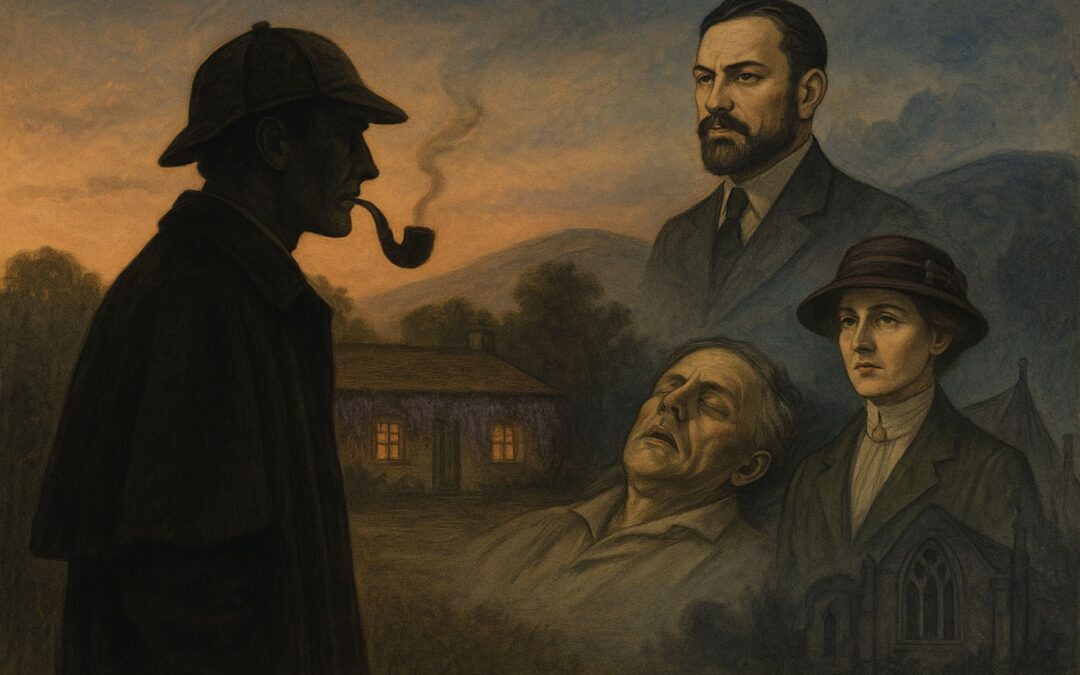
When His Last Bow appeared in 1917, it marked a turning point in the saga of Sherlock Holmes. Unlike the earlier collections, which dazzled with riddles of stolen jewels, vanished racehorses, and domestic intrigues, these stories unfolded against a broader canvas—one that included espionage, international conspiracies, and the looming shadow of global war.
Holmes is no longer merely the consulting detective of Baker Street; he is a seasoned figure, drawn into matters that shape nations as much as they resolve private dramas. The collection showcases Doyle’s evolution as a storyteller and Holmes’s transformation into something larger than life: a guardian of justice, intellect, and, finally, country.

The Adventure of Wisteria Lodge
The story opens with an unusual visitor to Baker Street—John Scott Eccles, a respectable and rather conventional gentleman, who bursts into Holmes’s rooms in visible agitation. His tale is extraordinary: he had recently accepted the invitation of Mr. Aloysius Garcia, a charismatic man of foreign descent, to spend a few days at his country residence, Wisteria Lodge. Eccles describes his host as hospitable yet oddly excitable, surrounded by servants who seemed more like guards than domestics.
During the night of his stay, Eccles was awakened by noises—whispering voices, hurried footsteps, a strange sense of panic in the air. Yet when dawn broke, he found the entire house deserted. Not a soul remained: no servants, no Garcia, not even a farewell note. Disturbed and bewildered, Eccles traveled back to London, only to learn that Garcia’s corpse had been found brutally slain in a nearby lane.
Holmes is intrigued, though he admits the case bears “an uncanny air.” Inspector Baynes of the Surrey Constabulary soon enters the investigation, and his competence surprises Holmes, who rarely gives high praise to official detectives. Together they unravel a conspiracy that stretches far beyond the sleepy English countryside.
Garcia, it turns out, was entangled with Don Murillo—once known as “The Tiger of San Pedro,” a deposed and notoriously cruel South American dictator now living in exile under an assumed name. Murillo’s household, including his sinister accomplices, was a façade to mask his identity and safeguard his ill-gotten wealth. Garcia, realizing the danger of his position and hoping to betray Murillo to the authorities, had reached out to Eccles as a sort of alibi. But before he could act, he was murdered—his killers desperate to silence him before he could expose the ex-dictator.
The case concludes with Murillo and his cohort brought to justice, their past crimes in the tropics catching up with them on English soil. Eccles, though shaken, is cleared of all suspicion, and Holmes reflects on the unusual international dimensions of the affair. Unlike many of his domestic puzzles, Wisteria Lodge paints a world where the tentacles of political violence and tyranny reach even the quiet lanes of Surrey.
It stands out in the canon for two reasons: first, for its treatment of Holmes as not the sole authority—Inspector Baynes emerges as an unexpectedly capable ally; and second, for its portrayal of crime not as an isolated act but as a ripple of wider geopolitical turbulence.
The Adventure of the Red Circle
Mrs. Warren, a respectable London landlady, seeks Holmes’s help with a matter that, at first glance, seems trivial but gnaws at her peace of mind. She has taken in a new lodger under unusual terms. The tenant insists on strict privacy, communicates only through written notes pushed under the door, requests abundant meals left outside without face-to-face interaction, and pays handsomely for these peculiar arrangements. While no crime has been committed, the unnatural secrecy unsettles her enough to risk calling upon Baker Street.
Holmes, ever alive to the strangeness hidden in the ordinary, takes her concerns seriously. He instructs Mrs. Warren to leave matters undisturbed for the moment but keeps a close eye on her lodgings. When Mrs. Warren later reports further oddities—strange messages, shifting shadows in the window, and her husband’s growing suspicion—Holmes begins to suspect the lodger’s hidden identity may be tied to something far more dangerous than eccentricity.
The truth proves far more dramatic than either Mrs. Warren or Watson had imagined. The mysterious lodger is not a criminal at all but a terrified young woman, Emilia Lucca, in hiding. Her husband Gennaro, once entangled with a notorious Italian secret society called the Red Circle, has fled to England with her to escape its deadly grip. Yet the society has tracked them across the Channel, sending its most brutal enforcer, Black Gorgiano, to punish their defiance.
The lodger’s secrecy was not a ploy but an act of survival. She concealed her identity for fear that revealing herself would put her directly in harm’s way. Gennaro, meanwhile, prowled the streets, trying to intercept the assassin before he reached Emilia. When Holmes and the police finally intervene, they discover Gorgiano dead—killed in a desperate struggle with Gennaro.
What makes this story striking is not the puzzle of clues, but its shift in scope. The apparent eccentricity of a London lodger unravels into a tale of immigrant struggle, loyalty, and the long reach of criminal brotherhoods across borders. Holmes shows not only deductive brilliance but also cultural sensitivity, recognizing that beneath the veil of secrecy lay not malice but fear.
The case also highlights a recurring theme in Doyle’s later stories: the globalization of crime. No longer confined to domestic thefts or personal vendettas, the threats in Holmes’s world now carry the mark of international syndicates and political conspiracies. The Red Circle captures this shift, reminding readers that even in the heart of London, one might find echoes of violence rooted in faraway lands.
The Adventure of the Bruce-Partington Plans
One of the most politically charged cases in the Holmes canon begins on a fog-heavy morning in London. The body of Arthur Cadogan West, a young clerk employed at Woolwich Arsenal, is discovered beside the underground railway tracks. At first glance, it seems he may have fallen accidentally from a train. But the discovery of seven stolen sheets of the top-secret Bruce-Partington submarine plans in his pocket transforms the case from a simple tragedy into a matter of national security. The submarine project represents Britain’s naval edge; in the wrong hands, it could alter the balance of world power.
The urgency of the matter brings Mycroft Holmes into the fold. Though rarely leaving his government chambers, Mycroft impresses upon Sherlock the gravity of the theft: three sheets remain missing, and those are the most critical to the design. Sherlock immediately perceives that West’s body could not have fallen from a moving train, as there was no blood or damage consistent with such an accident. The corpse must have been placed on the tracks post-mortem, a deliberate attempt to disguise murder as misadventure.
Holmes retraces West’s final movements. He was engaged to Violet Westbury, whose brother Hugo Oberstein is a foreign agent masquerading as a respectable engineer. It emerges that Oberstein had been intercepting the submarine plans through bribery and treachery. West, loyal to his country, stumbled upon Oberstein’s betrayal and attempted to stop him. Instead, he was killed and his body disposed of to cover the crime.
The masterstroke of Holmes’s deduction lies in the smallest details: he notes that Oberstein placed coded advertisements in the Daily Telegraph to communicate with his foreign contacts. By responding to one of these ads with a clever trap, Holmes lures Oberstein into exposing his network. The recovery of the missing plans restores security, though the shadow of espionage lingers.
The story is notable for several reasons. It pulls Holmes away from drawing rooms and countryside estates into the dangerous world of international intrigue, where the fate of nations hangs on a single document. It also demonstrates the dynamic between the Holmes brothers: Sherlock’s fieldcraft paired with Mycroft’s political weight. Together, they dismantle a spy ring at a moment when Britain’s enemies were probing for weakness.
In tone and content, The Bruce-Partington Plans feels less like a classic detective puzzle and more like a precursor to the espionage thrillers of the 20th century. Doyle was writing at a time of rising European tensions, and here Holmes becomes not merely a solver of private crimes, but a silent sentinel guarding the state itself.
The Adventure of the Dying Detective
The story begins with a summons that throws Dr. Watson into panic. Mrs. Hudson, Holmes’s long-suffering landlady, rushes to Watson in terror, declaring that her famous tenant is gravely ill. She insists that Holmes has not eaten in days, is delirious with fever, and is near death. Watson, horrified, hastens to Baker Street, his medical instincts ignited and his loyalty to Holmes unquestioning.
When he enters, he is struck by the ghastly sight before him. Holmes lies gaunt and hollow-eyed, his face drawn with suffering, his voice weak but sharp enough to enforce strange demands. He warns Watson not to touch him, not to examine him, for his disease is a rare and deadly Eastern infection that could spread by mere contact. Holmes insists that he has only hours to live.
Watson’s professional training clashes with his devotion. He longs to examine his friend, but Holmes’s stern refusals—so unlike the rational detective’s usual demeanor—halt him. Instead, Holmes makes an unusual request: he asks Watson to fetch a man named Culverton Smith, a reclusive tropical planter known for his expertise in strange diseases. Though Watson finds the request unsettling, he obeys, for Holmes’s condition appears desperate.
When Smith arrives, the truth begins to unfurl. Smith is no healer but a murderer. He had poisoned his own nephew with a deadly eastern disease to test its effects and now has attempted the same on Holmes. Convinced Holmes is dying, Smith gloats over his supposed victory, confessing his crimes with chilling satisfaction. At the climactic moment, Holmes suddenly rises from his sickbed, revealing he has been feigning illness all along. The ruse was designed to draw Smith into a confession under the illusion of triumph.
Holmes explains to a stunned Watson that he had deliberately excluded him from the deception. Not only was Watson’s medical concern likely to give the game away, but Holmes also spared his friend the moral burden of lying. Watson’s role was simply to play the part of the unwitting accomplice, fetching Smith at just the right moment.
This story stands out in the canon for its theatricality. Holmes, ever the master of disguise, here disguises not his appearance but his very state of being. He transforms his body into a stage, using weakness, delirium, and suffering as props to ensnare his adversary. It also highlights the deep trust between Holmes and Watson: though kept in the dark, Watson’s loyalty never falters, and his obedience ensures the success of Holmes’s stratagem.
The Dying Detective is, at its heart, a meditation on deception and loyalty. Holmes risks everything on a performance that only he could sustain, while Watson demonstrates the unshakable devotion that makes him Holmes’s indispensable companion. The case reminds readers that beneath the logic and deduction lies a friendship tested in fire, one that endures even through the shadow of apparent death.
The Disappearance of Lady Frances Carfax
Unlike many of Holmes’s adventures, this case begins not with a dramatic crime but with a troubling absence. Lady Frances Carfax, an independent, middle-aged aristocrat of considerable means, has vanished while traveling across Europe. With Holmes preoccupied in London, he dispatches Watson to Lausanne, Switzerland, to investigate her last known movements.
Watson quickly discovers that Lady Frances lived a life marked by solitude. Unmarried and traveling alone, she carried with her valuable jewels—making her an obvious target for those willing to prey upon her independence. In Lausanne, Watson hears conflicting accounts: Lady Frances had been pursued by two very different men. The first, the Hon. Philip Green, a rough but honest suitor rejected years before, had followed her across Europe, seemingly desperate to protect her. The second, a sinister bearded clergyman named Dr. Shlessinger, and his wife, had insinuated themselves into Lady Frances’s company, cloaking themselves in piety while concealing darker motives.
The trail leads Watson to London, where Holmes finally joins him. Holmes quickly senses that Lady Frances is in imminent danger. Using his network of informants and his talent for deduction, he uncovers that Dr. Shlessinger is, in fact, a notorious confidence man named Henry Peters, with his wife acting as his accomplice. Their scheme is both audacious and macabre: they had drugged Lady Frances into unconsciousness, declared her “dead,” and concealed her body in a coffin in preparation for burial. Their aim was simple—secure her jewels and dispose of her quietly, leaving no trace of murder.
The climax is one of the most dramatic rescues in the canon. Holmes, racing against time, intercepts the coffin just before interment. When the lid is pried open, Lady Frances is discovered inside, pale and barely breathing, her life suspended by drugs but not yet extinguished. Thanks to Holmes’s intervention, she is restored to safety.
The case reveals several themes that distinguish the later Holmes stories. It shows the vulnerability of women who step outside conventional roles—Lady Frances’s independence and wealth make her both admirable and exposed. It also demonstrates Holmes’s moral fervor: he admits that the “ruffian” Philip Green, though violent in manner, was genuinely concerned for Lady Frances’s welfare, while the respectable-seeming Shlessinger embodied true villainy.
In tone, The Disappearance of Lady Frances Carfax balances gothic suspense with detective precision. The image of a living woman sealed in a coffin remains one of Doyle’s most chilling tableaux. And in structure, it reinforces the enduring partnership of Holmes and Watson—Watson serving as the diligent legman across Europe, and Holmes arriving at the crucial moment to piece together the truth and save a life teetering on the edge of death.
The Adventure of the Devil’s Foot
Holmes and Watson, worn down by the unrelenting demands of London life, retreat to the Cornish coast for rest. Yet even in the quiet of Cornwall, darkness finds them. Mortimer Tregennis, a local man, seeks Holmes’s help after a nightmarish tragedy strikes his family. His three siblings—two brothers and a sister—were found in the morning transformed by madness: the men raving incoherently, and the sister dead with her face twisted in an expression of indescribable terror.
The atmosphere is one of dread. Villagers whisper of supernatural forces, even of the Devil himself. The strangeness of the crime seems to resist rational explanation. Holmes, however, remains unmoved by superstition. He visits the Tregennis home and examines the scene with his usual precision. The expressions of horror on the victims’ faces suggest they had seen or felt something beyond ordinary human experience. Holmes suspects not an evil spirit, but a rare and potent substance at work.
His suspicions sharpen when the tragedy repeats. Mortimer Tregennis himself is later found dead in a similar fashion, his features frozen in fear, after spending an evening with Dr. Sterndale, an African explorer and family acquaintance. Holmes deduces that the deaths must be linked to a substance brought from abroad. He identifies it as the root of a West African plant known as “Devil’s Foot,” which, when burned, produces fumes that induce terrifying hallucinations and death.
To prove his theory, Holmes conducts one of his most dangerous experiments. He seals himself and Watson in a room, sprinkles the powdered root on a lamp flame, and records the results. Almost immediately, the two men are overwhelmed by visions of horror. Watson feels his sanity slipping, while Holmes, though equally afflicted, retains just enough control to extinguish the lamp before they succumb. Both collapse, shaken but alive.
The truth comes out at last. Mortimer Tregennis had murdered his siblings by exposing them to the poison in order to inherit their property. But his own death was an act of retribution: Dr. Sterndale, who loved the late sister, took justice into his own hands by turning the same poison on Tregennis. Holmes, though recognizing Sterndale’s guilt, chooses not to expose him to the law, acknowledging the moral complexity of vengeance and grief.
The tale is one of the most haunting in the canon. Its atmosphere is thick with gothic menace: isolated cottages, whispering villagers, sudden madness, and death by fear. At its heart lies Holmes’s rationality—his refusal to yield to superstition even in the face of seemingly supernatural horror. Yet it also demonstrates Doyle’s willingness to let Holmes stand in the gray space between justice and law, acknowledging that morality cannot always be reduced to black and white.
The Devil’s Foot endures as one of the darkest and most psychologically disturbing of Holmes’s adventures, a story that pushes the detective to the brink of both science and sanity.
His Last Bow: The War Service of Sherlock Holmes
Unlike the other tales in this collection, His Last Bow is not a detective puzzle but a wartime vignette. It takes place in August 1914, on the eve of the First World War, and shows Holmes in an entirely new role—not as a consulting detective solving private crimes, but as a quiet sentinel standing guard over England itself.
The story introduces Von Bork, a German spymaster who has spent years in England, skillfully collecting military and political secrets. Doyle paints him as calm, methodical, and supremely confident in the superiority of German intelligence. He has compiled a dossier of stolen information, which he plans to deliver to Berlin as Europe teeters on the brink of war. The tone is different from the start: this is a battle of nations, not individuals.
Von Bork’s final task is to meet with his informant, an Irish-American who has been supplying him with information. But the man who enters his study is not who he seems. In a moment that reverses the hunter and the hunted, the “informant” reveals himself to be Sherlock Holmes in disguise. Holmes has spent years constructing his false identity, feeding Von Bork carefully managed scraps, all to win his trust.
Watson appears too, now older and grayer, but still Holmes’s loyal companion. Together, they seize Von Bork’s trove of secrets, neutralizing years of espionage in a single stroke. For Holmes, the triumph is not one of ego but of duty. He makes clear that this will be his final mission; the great detective of Baker Street has retired, not to his bees in Sussex alone, but to history itself.
The story’s resonance lies in its closing moments. Holmes, gazing eastward, reflects on the storm gathering over Europe: “There’s an east wind coming, Watson. Such a wind as never blew on England yet. It will be cold and bitter, and a good many of us may wither before its blast. But it’s God’s own wind all the same, and a cleaner, better, stronger land will lie in the sunshine when the storm has cleared.”
This farewell cements Holmes as more than a detective; he becomes a symbol of endurance, intelligence, and national spirit. Doyle, writing in 1917 as the war raged, offered readers reassurance that even in times of darkness, vigilance and character would prevail.
His Last Bow closes the collection not with a riddle solved but with a curtain drawn—a conscious farewell to the detective who had defined a literary era.
Conclusion
His Last Bow is more than a collection of mysteries; it is a portrait of transition. From the political crimes of Wisteria Lodge to the gothic horror of The Devil’s Foot, and finally to the espionage duel in the title story, we see Holmes navigating a world increasingly defined by international tension rather than parlor puzzles.
Doyle gives readers both the familiar brilliance of deduction and the somber recognition that times have changed. The final vision of Holmes, standing on the eve of war, is not simply a farewell to a detective but an elegy to an era. It reminds us that even legends must adapt, and that true greatness lies not just in solving mysteries, but in rising to meet history when it calls.