
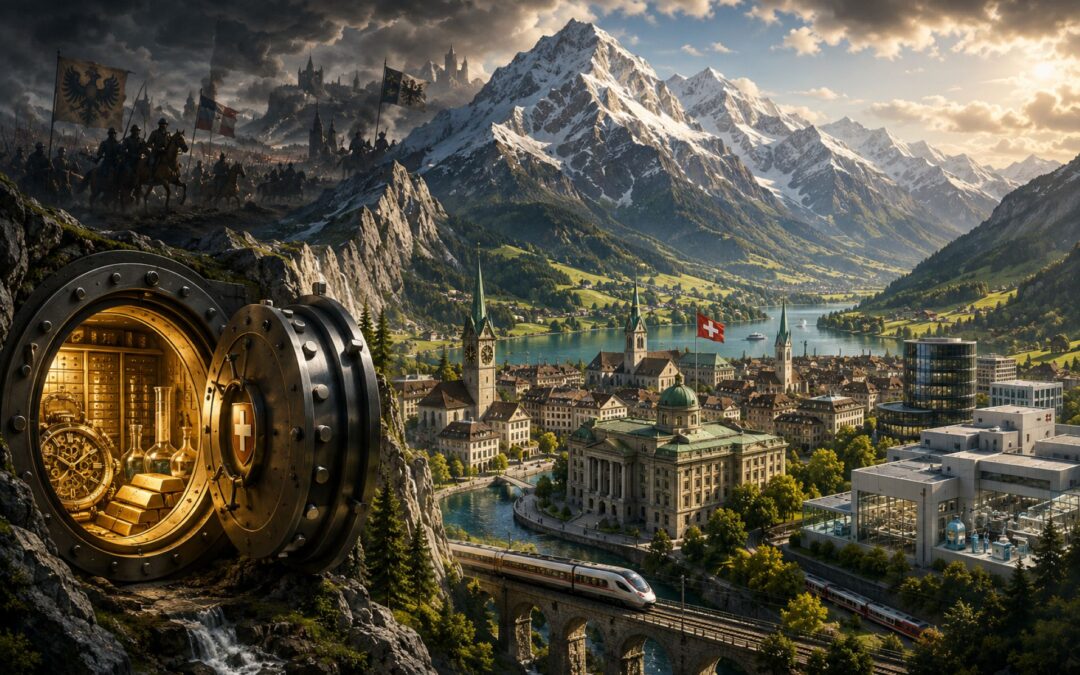
Switzerland looks like a country designed to lose.
It is small. It is landlocked. Much of it is mountainous. It has no ocean ports, no vast oil fields, no great mineral empire, and no single language holding the country together. It sits in the middle of Europe, surrounded by larger powers that spent centuries building armies, redrawing borders, and swallowing weaker neighbors.
And yet Switzerland became one of the richest, most stable, and most trusted countries in the world.
That did not happen because of one clever trick. It was not just banking. It was not just neutrality. It was not just watches, chocolate, trains, or mountains.
Switzerland became rich because it learned how to turn weakness into strategy.
Its mountains became protection. Its neutrality became a product. Its political fragmentation became federalism. Its lack of natural resources forced it into high-value industries. Its reputation for stability became something the rest of the world was willing to pay for.
In a continent repeatedly shaken by war, revolution, inflation, and empire, Switzerland built the rarest asset of all.
Trust.
The Country That Should Have Struggled
On paper, Switzerland should not be an economic powerhouse.
It has no coastline. That alone is a serious disadvantage. Countries with ports can trade more easily, build naval power, and plug themselves into global commerce at lower cost. Switzerland had to move goods through other people’s territory.
Its geography is difficult too. The Alps are beautiful, but beauty is not the same as convenience. Mountains make transport harder, settlement more fragmented, and agriculture more limited. For much of history, they separated communities as much as they protected them.
Then there is the language problem.
Switzerland has four national languages — German, French, Italian, and Romansh — and the Swiss government itself describes multilingualism as a defining part of the country’s identity (About Switzerland). In many countries, that kind of linguistic diversity becomes a permanent political fault line. One group feels ignored. Another feels dominated. A third wants autonomy. Sometimes, the country breaks apart.
Switzerland did something stranger.
It built a country without forcing everyone to become the same.
There is no Swiss equivalent of Paris or London dominating national life. Bern is the federal city, but Zurich, Geneva, Basel, Lausanne, Lucerne, and other cities all have their own weight. Switzerland developed less like a centralized kingdom and more like a negotiated arrangement among communities that wanted protection without surrendering too much control.
That matters because Switzerland’s wealth story begins long before modern banking.
It begins with survival.
Switzerland Began As A Survival Pact, Not A Nation-State
The traditional origin story of Switzerland goes back to 1291, when rural communities in the central Alps formed an alliance for mutual defense. The details of early Swiss history are more complicated than the national myth, but the larger point holds: Switzerland did not begin as a grand nation-state.
It began as a pact.
That is an important distinction. France, England, Spain, and Austria developed around monarchies, dynasties, capitals, courts, and armies. Switzerland developed around local communities trying to preserve autonomy in a dangerous neighborhood.
The early Swiss confederates were not pacifists. Far from it. They earned a fierce military reputation. Swiss infantry became famous for discipline, aggression, and effectiveness, especially in a Europe where aristocratic cavalry still carried enormous prestige.
The Battle of Morgarten in 1315 became an early symbol of this identity: mountain communities resisting a stronger Habsburg force. Whether every dramatic detail of the traditional story is perfectly clean is less important than what the memory represented. Switzerland’s political identity was forged around the idea that ordinary local communities could defend themselves against larger powers.
That gave the Swiss Confederation a different kind of logic.
It was not trying to become a polished imperial state. It was trying to remain unconquered.
Over time, more cities and regions joined the confederation. Lucerne, Zurich, Bern, and others became part of a loose but growing network. These places were not identical. They had different languages, economies, religious loyalties, and political traditions.
But they shared a practical interest: survival through cooperation.
That habit would become one of Switzerland’s greatest strengths. It learned to make unity out of negotiation, not uniformity.
The Defeat That Helped Create Swiss Neutrality
For a time, Switzerland was not merely defensive. It was ambitious.
Swiss fighters defeated powerful enemies, expanded influence, and became some of the most feared soldiers in Europe. In the late 15th and early 16th centuries, Swiss troops were deeply involved in the violent politics of northern Italy. They were good enough to terrify their enemies and valuable enough to be hired by foreign rulers.
Then came Marignano.
In 1515, Swiss forces were defeated by the French near Milan. The battle was brutal, costly, and psychologically important. The Swiss government’s own account links the roots of Swiss neutrality to the defeat at Marignano, while noting that neutrality was formally recognized much later, in 1815, at the Congress of Vienna (Swiss neutrality).
This is one of the great turning points in Switzerland’s story.
Many countries respond to defeat with revenge. They rebuild, rearm, and look for the next opportunity to restore glory. Switzerland gradually moved in the opposite direction. It pulled back from great-power ambition.
That retreat was not weakness. It was strategic realism.
Switzerland was not going to become France. It was not going to become Austria. It was not going to build a vast colonial empire or dominate Europe through military power. Its geography, scale, and political structure made that unrealistic.
So Switzerland stopped trying to win the same game as everyone else.
That decision shaped everything that followed.
Swiss soldiers continued to fight abroad as mercenaries for centuries. Swiss manpower became one of the country’s early exports. But Switzerland itself increasingly avoided becoming a battlefield for other people’s ambitions.
A small country surrounded by larger powers had found a better strategy than conquest.
It would become useful by staying out.
Neutrality Turned Geography Into Strategy
Neutrality did not become fully secure overnight.
Switzerland was invaded by revolutionary France in 1798. Napoleon reshaped the old confederation into the Helvetic Republic, a centralized state that never really fit Swiss political habits. After several years of instability, Switzerland moved back toward a federal arrangement.
The decisive international moment came after Napoleon’s defeat. In 1815, the Congress of Vienna recognized Swiss neutrality as part of the new European order. From that point, neutrality was not just a Swiss preference. It was an internationally recognized arrangement.
This changed Switzerland’s position in Europe.
The country’s mountains had always made invasion difficult. But mountains alone do not create security. Afghanistan has mountains. So do many poor and unstable countries. Geography helps only when it is combined with institutions, diplomacy, and credible defense.
Switzerland built that combination.
It made itself hard to invade, but also less tempting to invade. It did not threaten its neighbors with expansion. It did not offer an easy road for foreign armies. It maintained armed neutrality, meaning it was not defenseless, but it avoided joining military alliances or external wars.
That combination turned Switzerland into something unusual: a protected space in the middle of a violent continent.
Neutrality also had economic consequences.
When Europe went to war, capital looked for safety. Wealthy families, businesses, and political elites wanted somewhere stable to store assets, conduct diplomacy, and preserve wealth. Switzerland’s value rose whenever the rest of Europe looked dangerous.
This is one of the uncomfortable truths of Swiss history.
Switzerland often benefited from other countries’ instability.
It did not create every war around it. But it became very good at offering shelter when wars came.
Federalism Held A Multilingual Country Together
Switzerland’s political structure is easy to underestimate because it sounds boring.
Federalism. Cantons. Referendums. Local autonomy. Consensus.
These are not dramatic words. They do not make for thrilling battlefield scenes. But they are central to why Switzerland works.
A multilingual country with strong regional identities needs a way to prevent politics from becoming a winner-takes-all struggle. Switzerland did this by giving enormous importance to cantons — its member states — and by keeping many decisions close to the local level.
This allowed different communities to remain Swiss without becoming identical.
German-speaking Zurich did not need to become French-speaking Geneva. Italian-speaking Ticino did not need to disappear into a German-speaking majority. Romansh-speaking communities, though small, still had constitutional recognition as part of the national fabric. Switzerland’s Federal Constitution lists German, French, Italian, and Romansh as national languages, and the federal language framework reflects that multilingual arrangement (Fedlex).
This is one reason Switzerland avoided the fate of many fragmented states.
It did not try to solve diversity by crushing it.
It managed diversity by distributing power.
That made the country slower, more complicated, and sometimes frustrating. But it also made it durable. People are more likely to trust a political system when they do not feel permanently ruled by outsiders.
In Switzerland, local identity and national identity did not have to be enemies.
They could coexist.
Direct Democracy Made Switzerland Slow But Stable
Switzerland’s system of direct democracy is one of its most distinctive features.
Citizens do not merely vote for representatives and then disappear from politics. They can challenge laws through referendums and propose constitutional changes through popular initiatives. The Swiss government portal explains that a popular initiative needs 100,000 valid signatures within 18 months to trigger a national vote on a constitutional amendment (ch.ch).
This gives Swiss citizens an unusually direct role in shaping public policy.
The upside is legitimacy. People may disagree with a result, but the process itself has deep roots. Major changes often require broad consent. That reduces the risk of sudden political swings and makes Switzerland attractive to investors, companies, and wealthy individuals who value predictability.
The downside is slowness.
Direct democracy can delay reform. It can preserve outdated arrangements. It can make the country cautious when faster change might be morally or economically necessary. Switzerland was late in granting women the right to vote at the federal level, doing so only in 1971. That delay is a reminder that political stability is not automatically the same as justice.
Still, from an economic perspective, Switzerland’s system created something extremely valuable.
Reliability.
Businesses like reliability. Banks like reliability. Wealthy clients like reliability. Pharmaceutical companies, watchmakers, insurers, logistics firms, research institutions, and global organizations all benefit from a country where rules are not rewritten every time a new government comes to power.
Swiss democracy is not fast.
But it is trusted.
And trust compounds.
Swiss Banking Sold The World A Safe Harbor
No part of Switzerland’s wealth story is more famous than banking.
Swiss banking became powerful because it offered a rare combination: political neutrality, legal stability, discretion, strong currency, international access, and a reputation for safety.
For wealthy Europeans, that combination was irresistible.
If your country was about to go to war, raise taxes, collapse into revolution, or seize assets, Switzerland looked like a lifeboat. It was nearby, multilingual, politically stable, and outside the great-power rivalries that kept tearing Europe apart.
Banking secrecy made that lifeboat even more attractive.
In 1934, Switzerland strengthened bank secrecy protections under federal law, making unauthorized disclosure of client information a criminal offense. That helped cement the global image of the numbered Swiss bank account: discreet, secure, and nearly untouchable.
The appeal was not only secrecy. It was continuity.
A bank account in a country that stays neutral during war carries a different emotional weight. It promises that your money will not vanish because a government falls, a currency collapses, or a capital city burns.
That promise became an industry.
Today, Switzerland remains one of the most important wealth-management centers in the world. The Swiss Bankers Association says the country’s financial sector manages close to CHF 8.4 trillion in assets, with a large share coming from foreign-domiciled clients, and describes Switzerland as the world’s leading hub for cross-border private wealth management (Swiss Banking).
That is not an accident.
Switzerland learned to export safety.
The Dark Side Of Swiss Banking
But the Swiss banking story has a shadow.
Discretion can protect legitimate wealth. It can also protect stolen wealth. A stable vault does not ask, by nature, whether the money inside it came from inheritance, business success, tax evasion, corruption, or violence.
During and after the Second World War, Swiss banks faced serious scrutiny over their handling of assets connected to Nazi Germany, stolen gold, and dormant accounts belonging to victims of the Holocaust. Switzerland’s wartime neutrality became morally complicated because the country continued economic dealings while Europe was being destroyed around it.
The problem did not end with the war.
For decades, Swiss banking secrecy attracted not only cautious families and legitimate businesses, but also tax evaders, dictators, criminals, and politically exposed clients. Investigations such as the Guardian-led reporting on the Suisse Secrets leak showed how Swiss banking’s reputation for secrecy continued to raise uncomfortable questions about dirty money and global inequality (The Guardian).
This is where the romantic version of Switzerland becomes too simple.
Swiss banking was built on trust, but trust can serve different masters.
To a client, secrecy can mean privacy.
To a tax authority, it can mean obstruction.
To a dictator, it can mean protection.
To a victim, it can mean disappearance.
In recent decades, international pressure has weakened the old model of Swiss banking secrecy. Switzerland now participates in automatic exchange of information with partner countries, a major shift from the older world of near-absolute discretion (Swiss Banking).
So the story is not “Swiss banks are secret and therefore Switzerland is rich.”
The better story is more nuanced.
Switzerland became rich partly because it sold financial safety to the world. But that safety created moral hazards, especially when secrecy protected people who deserved investigation rather than privacy.
Switzerland Was Never Just A Bank Vault
The biggest mistake in explaining Swiss wealth is to stop at banking.
Banking matters. A lot. But Switzerland is not rich merely because rich people hide money there. That explanation is too narrow, too cynical, and too incomplete.
Switzerland became wealthy because it built an economy around high-value work.
When a country lacks abundant natural resources, it has two choices. It can remain poor, or it can move up the value chain. Switzerland chose the second path.
It became excellent at things where precision, trust, skill, regulation, and reputation matter.
Watches are the obvious example. Switzerland does not dominate the world by producing the most watches. It dominates the high end, where craftsmanship, brand heritage, and perceived reliability allow companies to sell small objects at enormous value. Even in a weaker year, Swiss watch exports reached CHF 26 billion in 2024, according to the Federation of the Swiss Watch Industry (FH).
But watches are only the visible symbol.
The deeper story is pharmaceuticals, chemicals, medical technology, machinery, precision instruments, insurance, research, and advanced manufacturing. Companies such as Roche and Novartis are not side notes in the Swiss economy. They represent the country’s ability to compete in complex, knowledge-heavy industries where quality matters more than cheap labor.
This is also why Switzerland consistently ranks highly in global innovation. The Swiss government describes the country as having a strong, innovative economy, and Switzerland has long been recognized near the top of international innovation rankings (About Switzerland).
That innovation culture did not appear out of nowhere.
It grew from constraints.
If you cannot rely on oil, coal, empire, or endless farmland, you must rely on skill. You must train people well. You must make products others cannot easily copy. You must protect intellectual property. You must build institutions that companies trust. You must make your small domestic market a base for global exports.
Switzerland did exactly that.
It turned scarcity into discipline.
Why Switzerland Is Still Rich Today
Modern Switzerland is wealthy because its advantages reinforce each other.
Its neutrality helped create trust. Trust helped build banking. Banking strengthened the country’s global financial role. Political stability attracted companies and capital. Federalism kept internal tensions manageable. Direct democracy gave the system legitimacy. Education and technical skill supported high-value industries. Infrastructure connected a difficult landscape. Tourism turned mountains from an obstacle into an asset.
None of this works alone.
Mountains without institutions are just rocks.
Neutrality without defense is just hope.
Banking without trust is just accounting.
Innovation without education is just branding.
Switzerland’s strength comes from the way these pieces fit together.
Its trains matter because they make a mountainous country function smoothly. Its multilingualism matters because it connects the country to German, French, and Italian economic worlds. Its cities matter because no single metropolis has to carry the whole national identity. Its cantons matter because local autonomy makes diversity livable. Its currency matters because stability itself is part of the Swiss brand.
Even Switzerland’s slowness has an economic function.
A country where change requires broad agreement may frustrate reformers, but it reassures investors. It tells the world that Switzerland will probably not lurch wildly from one policy extreme to another. In a volatile world, predictability is valuable.
That does not mean Switzerland is perfect.
It has high living costs. It faces pressure from global tax transparency rules. Its banking sector has lost some of its old mystique. Its relationship with the European Union remains complex. Its neutrality has become harder to define in a world of sanctions, financial warfare, and geopolitical blocs.
But the core Swiss model remains powerful because it is not based on one industry.
It is based on credibility.
The Real Secret Of Switzerland’s Wealth
Switzerland became rich by becoming useful in a world that did not trust itself.
When Europe fought, Switzerland offered neutrality.
When currencies shook, Switzerland offered stability.
When wealthy families feared confiscation, Switzerland offered discretion.
When global markets demanded precision, Switzerland offered quality.
When a multilingual country could have fractured, Switzerland offered federal compromise.
Its real resource was never gold, oil, coal, or empire.
Its real resource was trust.
That trust was not always innocent. It protected good money and bad money. It sheltered victims and villains. It made Switzerland admired, envied, criticized, and investigated.
But as an economic force, it was extraordinary.
Switzerland did not become rich by escaping its disadvantages. It became rich by converting them into a national strategy. A landlocked country became a global safe harbor. A mountainous country became a transport and tourism success. A multilingual country became a model of federal stability. A resource-poor country became a precision economy.
That is why Switzerland’s story is so unusual.
It should have struggled.
Instead, it became the place people run to when the rest of the world feels uncertain.
Last Updated on June 7, 2026 by Aseem Gupta