
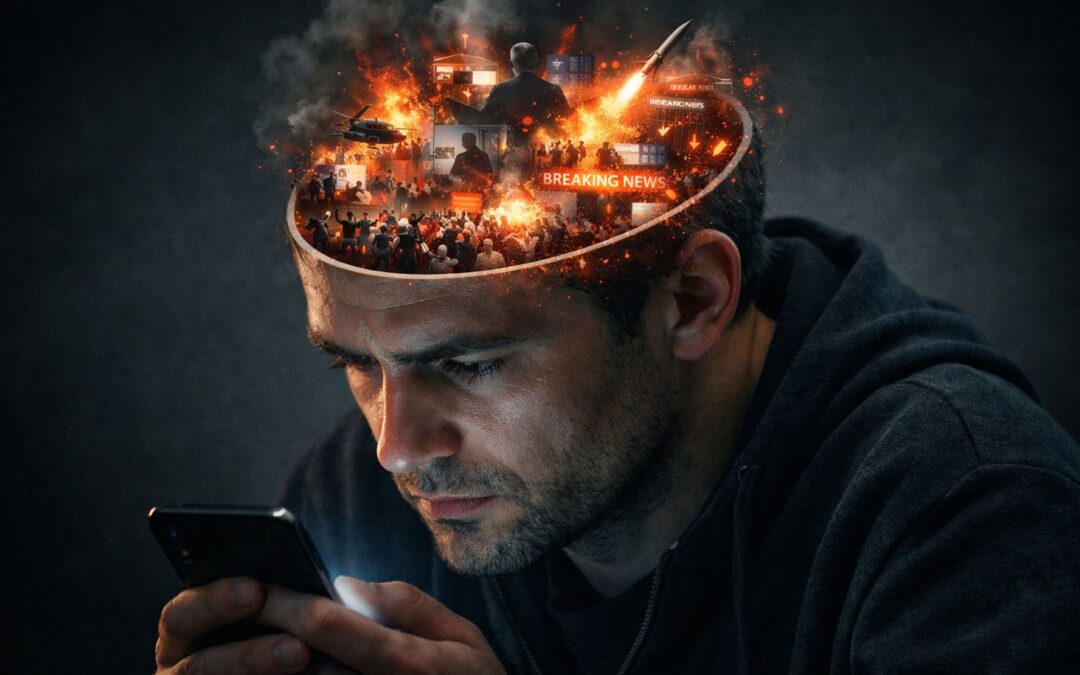
The Quiet Rise of Hopelessness
“The news we hear, for the most part, is not news to our genius. It is the stalest repetition.”
— Henry David Thoreau
Maybe it’s just you. Or maybe it isn’t.
There’s a subtle shift that’s been taking place—not loudly, not dramatically, but persistently enough to leave a mark. A kind of quiet heaviness that lingers in conversations, in scrolling habits, in the background hum of daily life. You notice it in passing remarks about the future, in the tone of online discussions, in the way optimism now feels almost naïve.
Hopelessness isn’t always dramatic. It rarely announces itself. More often, it seeps in gradually, disguised as awareness, disguised as being “informed.”
Turn on any screen—your phone, your laptop, your television—and you step into a constant stream of updates. Breaking news. Expert analysis. Urgent opinions. Everything framed as important, everything demanding attention. And yet, when you step back from it, a pattern emerges: the overwhelming majority of it leans toward the bleak.
Political unrest. Cultural conflict. Economic anxiety. Technological fear. A future that is repeatedly presented not as uncertain, but as threatening.
At first, this doesn’t seem unusual. After all, the world is complex, and problems exist. But the issue isn’t that negative events happen—it’s that they become the dominant lens through which reality is interpreted.
And that lens doesn’t leave you unchanged.
You don’t simply consume information; you absorb atmosphere. The more you expose yourself to a steady stream of urgency, conflict, and catastrophe, the more your internal world begins to mirror it. What starts as curiosity turns into concern. Concern quietly shifts into anxiety. And anxiety, if left unchecked, settles into a persistent sense that something, somewhere, is always going wrong.
What makes this especially deceptive is that it feels justified. You’re not imagining things. You’re reacting to real headlines, real events, real narratives. Which makes the emotional impact harder to question.
But there comes a point where you have to ask something uncomfortable:
Is the world actually becoming unbearable—or is your perception of it being shaped in a way that makes it feel that way?
Because if the latter is even partially true, then the problem is no longer just “out there.” It’s also in the relationship you’ve developed with the information you consume.
And that’s where things start to get interesting.
The Illusion of Being Informed
There’s a quiet assumption most people carry without ever examining it:
If you follow the news, you’re informed.
If you’re informed, you understand the world better.
And if you understand the world better, you’re better equipped to navigate it.
It sounds reasonable. Almost obvious.
But the moment you look closer, the entire chain begins to wobble.
Because what does it actually mean to be “informed”?
If being informed simply means being updated, then yes—the news does that exceptionally well. It delivers a constant stream of events, statements, reactions, and developments. It ensures you are never out of the loop.
But being updated is not the same as understanding.
In fact, the two often move in opposite directions.
The more you consume fragmented, rapidly changing pieces of information, the harder it becomes to form a coherent picture of anything. One headline contradicts the next. One expert disagrees with another. Yesterday’s certainty becomes today’s correction. What you’re left with is not clarity, but a kind of intellectual noise that mimics clarity.
And yet, it feels like knowledge.
You recognize names, places, and issues. You can follow conversations. You have opinions. This creates the comforting illusion that you’re grasping reality more accurately than those who “don’t pay attention.”
But ask yourself something simple:
How often does the news actually deepen your understanding of anything?
Not momentary awareness—but real understanding. The kind that allows you to explain causes, patterns, consequences, and context in a meaningful way.
Most of the time, it doesn’t.
It offers snapshots, not systems. It shows you events, not the structures behind them. It feeds you outcomes, not the underlying mechanisms that produced them.
And because these snapshots are constantly replaced by new ones, you never stay with any single issue long enough to truly understand it.
It’s like trying to understand a novel by reading random pages from different chapters every few minutes.
You’re exposed to everything, but you grasp nothing.
This is where the illusion becomes dangerous.
Because once you believe you’re informed, you stop seeking deeper knowledge. You stop questioning the surface. You start reacting instead of reflecting. And gradually, your worldview becomes shaped not by understanding, but by a rapid sequence of impressions.
The paradox is simple but unsettling:
The more news you consume, the more informed you feel.
But the less you actually understand.
Noise Disguised as Knowledge
If the illusion of being informed rests on constant updates, then the deeper problem lies in what those updates actually consist of.
Because not all information is equal.
Some information builds understanding. It reveals patterns, explains causes, and connects ideas across time. Other information does none of that. It flashes briefly, demands attention, and disappears—leaving behind nothing but a vague impression.
The modern news cycle overwhelmingly belongs to the second category.
It gives you events, but rarely insight. It gives you volume, but not depth. And over time, it conditions you to confuse activity with meaning.
You scroll past headlines, watch short clips, skim analyses. Each piece feels relevant in isolation. But taken together, they don’t accumulate into knowledge—they cancel each other out.
One crisis replaces another. One outrage eclipses the last. One narrative is amplified until it is suddenly forgotten.
Nothing stays long enough to matter, yet everything feels urgent.
This is where the distinction between knowledge and noise becomes critical.
Knowledge requires time. It demands patience, repetition, and context. It involves sitting with an idea long enough for it to unfold, to challenge you, to reshape your thinking.
Noise does the opposite.
It fragments your attention. It keeps you moving. It prevents you from staying with anything long enough to understand it. And because it’s packaged as something important, you don’t recognize it as noise—you experience it as necessity.
This is why the experience of consuming news can feel strangely exhausting without being fulfilling.
You’ve taken in a lot, but gained very little.
And yet, you keep going. Because the system is designed to make stopping feel like missing out.
The philosopher Henry David Thoreau saw this long before the age of smartphones. To him, much of what passed as news was little more than repetition—variations of the same stories, told over and over again. Different names, different locations, but fundamentally the same events.
If you’ve read about one robbery, haven’t you read about them all?
It’s a provocative question, but it points to something real: the human tendency to mistake variation for novelty.
We are presented with endless “new” information, but very little of it is genuinely new in any meaningful sense. The patterns remain the same—conflict, fear, power struggles, disaster—only the details change.
And so we consume, not because we’re learning, but because we’re being stimulated.
The result is a mind that is constantly occupied, yet increasingly unclear.
Full, but not enriched.
Engaged, but not enlightened.
At some point, you have to ask:
If the information you consume doesn’t make you wiser, calmer, or more capable of navigating your life—what exactly is it doing to you?
The Machinery Behind the News
At some point, the question shifts.
It’s no longer just what the news contains, but why it looks the way it does.
Because the patterns you’ve noticed—the repetition, the urgency, the negativity, the fragmentation—aren’t accidental. They are the natural output of a system optimized for something very specific.
Not truth.
Not depth.
Not even understanding.
But attention.
Modern news exists within an economic structure where attention is the currency. The longer you watch, the more you click, the more you return—the more valuable you become. And so, everything within that system is shaped by a single objective:
Keep you engaged.
This is why neutrality struggles to survive. Balanced, nuanced, and carefully contextualized information tends to be slower, more demanding, and less emotionally stimulating. It doesn’t provoke immediate reactions. It doesn’t spread as easily. It doesn’t hold your attention in the same way.
But outrage does.
Fear does.
Conflict does.
These are psychologically sticky. They trigger something ancient within us—a sensitivity to threat, a need to stay alert, a tendency to scan for danger. In evolutionary terms, this made sense. In a digital environment, it becomes a vulnerability.
Because once engagement becomes the goal, content adapts accordingly.
Headlines become sharper.
Narratives become more polarized.
Events become more dramatic.
Subtlety is stripped away, not because it’s untrue, but because it’s ineffective.
And this doesn’t only apply to traditional media. The same logic governs social media platforms, independent creators, and algorithm-driven feeds. Once you interact with a certain type of content—especially content that provokes a strong emotional response—the system learns.
It begins to serve you more of the same.
Not because it’s trying to inform you, but because it’s trying to keep you there.
What starts as a few clicks turns into a pattern. What feels like choice gradually becomes conditioning. You think you’re exploring the world, but in reality, you’re being guided through a very narrow slice of it—one that is optimized for maximum engagement.
And the more you consume, the more the system refines itself around you.
This is why it becomes so difficult to step away.
It’s not just habit. It’s design.
The philosopher Neil Postman argued that modern media doesn’t merely inform—it transforms information into entertainment. Serious topics are packaged in a way that competes for attention, which inevitably changes their nature. What should provoke thought is instead made to provoke reaction.
And once everything becomes content, everything must compete.
Which means that even reality itself is filtered through what is most clickable, most shareable, most emotionally charged.
So when you look at the news and feel that it is overwhelming, dramatic, or relentlessly negative, it’s worth recognizing something important:
You’re not just seeing the world.
You’re seeing the world as filtered through a system designed to keep you watching.
Why Bad News Dominates Everything
Once you understand that the system is driven by attention, another pattern becomes impossible to ignore:
Most of what you see is bad.
Not occasionally negative. Not balanced with equal parts optimism and progress. But overwhelmingly tilted toward conflict, crisis, and catastrophe.
And this isn’t simply because the world is collapsing.
It’s because bad news works.
Human beings are not neutral processors of information. We are wired to notice threats more quickly than opportunities, to remember negative experiences more vividly than positive ones, and to react more strongly to danger than to stability. From an evolutionary perspective, this made perfect sense. Missing a potential threat could be fatal; overlooking something positive rarely was.
But in the context of modern media, this bias becomes a lever.
If negative information captures attention more reliably, then a system that depends on attention will naturally amplify it. Not necessarily through conspiracy or deliberate deception, but through selection. Out of everything that happens in the world on any given day, only a tiny fraction is chosen to be presented—and that fraction tends to be the most emotionally charged.
This is what psychologists call a kind of “publication bias.” Positive developments—slow improvements, long-term progress, quiet successes—rarely make compelling headlines. They don’t trigger urgency. They don’t demand immediate reaction. They don’t spread as easily.
But disaster does.
Conflict does.
Outrage does.
So the feed fills with what performs best, not what represents reality most accurately.
The result is subtle but powerful.
You begin to experience the world not as it is, but as a continuous stream of its most extreme moments. A protest here, a conflict there, a crisis unfolding somewhere else. Each one real in isolation, but collectively creating the impression that instability is everywhere, all the time.
And because these events are presented without proportion, without context, and without the vast backdrop of ordinary life continuing as usual, they begin to distort your sense of scale.
A rare event starts to feel common.
A distant issue starts to feel immediate.
A possibility starts to feel inevitable.
This is how perception shifts.
You don’t consciously decide that the world is worse than it is. You absorb that conclusion through repeated exposure.
The philosopher Arthur Schopenhauer once remarked that exaggeration is essential to journalism—that it is, in a sense, its defining feature. Not necessarily falsehood, but amplification. The tendency to make things appear larger, more urgent, more significant than they might otherwise be.
In a competitive environment, exaggeration isn’t a flaw. It’s an advantage.
Because subtlety doesn’t spread.
Measured analysis doesn’t go viral.
But alarm does.
And so, over time, a quiet distortion takes hold:
Not that bad things don’t happen—but that they appear to be happening everywhere, all the time, without relief.
And when that becomes your default perception, it’s no surprise that your outlook begins to darken.
Because you’re no longer reacting to isolated events.
You’re reacting to a world that has been filtered to look like it’s constantly on fire.
A Distorted Picture of Reality
At this point, something subtle but profound has happened.
It’s not just that you’ve been exposed to a lot of negative information. It’s that your mental image of the world has quietly reshaped itself around that exposure.
And once that image changes, everything else follows.
The world begins to feel more dangerous than it is. More chaotic than it is. More unstable, more divided, more on the brink of collapse. Not because you’ve carefully analyzed reality and arrived at that conclusion—but because you’ve been repeatedly shown a very specific slice of it.
This is where the idea of selective perception becomes crucial.
Out of the countless things happening across the world at any given moment, only a tiny fraction is selected, amplified, and presented to you. Entire layers of reality—ordinary life, stability, cooperation, gradual progress—remain largely invisible, not because they don’t exist, but because they don’t compete well for attention.
What you see, then, is not the world.
It’s a curated version of the world.
And like any curation, it reflects certain priorities.
This creates a strange asymmetry. You are constantly exposed to rare, extreme, and often distant events, while the ordinary, stable, and familiar aspects of life remain in the background. Over time, this imbalance begins to distort your sense of proportion.
You start to overestimate the frequency of dramatic events.
You begin to underestimate how much of life is actually uneventful.
You lose sight of the difference between possibility and probability.
And perhaps most importantly, you begin to feel personally implicated in events that are far removed from your sphere of influence.
A conflict thousands of miles away feels like something you need to react to. A political development in another country feels like it demands your emotional investment. A crisis you have no control over begins to occupy your mental space as if it were unfolding in your immediate surroundings.
This is not awareness.
It’s displacement.
Your attention is pulled away from the domain where your actions actually matter—your life, your environment, your relationships—and redirected toward a vast, uncontrollable landscape of global events.
And the more time you spend in that landscape, the more your sense of agency begins to erode.
Because in that space, you can do very little.
You can watch. You can react. You can worry.
But you cannot meaningfully intervene.
The philosopher Henry David Thoreau believed that an overexposure to such distant concerns distracts us from what is immediately real and meaningful. Instead of engaging deeply with our own lives and environments, we become spectators of a world that is largely beyond our reach.
And spectatorship, over time, has consequences.
It creates a passive relationship with reality. It replaces direct experience with mediated experience. It encourages a habit of observation without participation.
You are informed about everything, yet connected to very little.
And in that disconnect, a particular kind of unease begins to grow.
Because somewhere beneath the constant stream of information, there is an unspoken realization:
You are carrying the weight of a world you cannot change, while neglecting the part of it that you actually can.
The Psychological Cost of Constant Exposure
At first, it doesn’t feel like a cost.
You check the news out of curiosity. You scroll to stay updated. You follow developments because it feels responsible—almost necessary. Nothing about it seems harmful in isolation.
But the effects don’t come from a single moment.
They come from accumulation.
A headline here. A video there. A comment thread that pulls you in for a few extra minutes. None of it is overwhelming on its own. But together, day after day, it begins to shape your internal state in ways that are easy to overlook.
You start to notice small shifts.
Your baseline mood becomes slightly heavier.
Your thoughts drift more often toward uncertainty.
Your conversations carry a subtle undertone of concern.
And eventually, you realize that you’re not just observing negativity—you’re carrying it.
This is the psychological cost of constant exposure.
The human mind is not designed to process an endless stream of global problems. It evolved to deal with immediate, local challenges—things that could be acted upon directly. But the modern information environment exposes you to crises at a scale and frequency that far exceed your capacity to respond.
You are made aware of everything, but equipped to handle almost nothing.
And that imbalance creates tension.
Because awareness without agency doesn’t feel like knowledge. It feels like helplessness.
This is why prolonged exposure to news often leads to a peculiar mix of emotions: anxiety, frustration, anger, and fatigue. You feel responsible enough to care, but powerless enough to act. You are engaged, but not effective.
Over time, this can harden into a more persistent outlook.
The world begins to feel overwhelming.
The future begins to feel uncertain.
And your own role within it begins to feel unclear.
What makes this especially tricky is that the process is self-reinforcing.
The more uneasy you feel, the more you seek information—hoping to regain a sense of control. But the information you find often amplifies the very feelings you’re trying to resolve. So you consume more, which leads to more unease, which leads to more consumption.
A loop forms.
And like most loops, it’s difficult to break from the inside.
The philosopher Neil Postman warned that when information is detached from meaningful action, it ceases to be useful. It becomes something we react to emotionally rather than something we use constructively.
That’s exactly what happens here.
You are no longer engaging with information as a tool.
You are experiencing it as a stimulus.
And the longer that continues, the more it shapes not just what you think, but how you feel—about the world, about the future, and, eventually, about your own life within it.
The Illusion of Control
One of the most subtle traps in all of this is the feeling that, by staying updated, you are somehow staying in control.
It doesn’t announce itself explicitly. It hides behind a quiet assumption:
If you know what’s happening, you’re better prepared.
And to a certain extent, that’s true. There are situations where being informed is useful, even necessary. But the vast majority of what fills the news cycle doesn’t fall into that category.
It exists far outside your sphere of influence.
And yet, your mind doesn’t always make that distinction.
You follow political developments in countries you’ll never visit. You track economic shifts you cannot affect. You analyze decisions made by leaders you will never meet. And as you do, you begin to feel involved—as if your attention itself carries some degree of participation.
But it doesn’t.
Knowing about an event is not the same as having any control over it.
And this is where the illusion forms.
Because the more you consume, the more it feels like you’re doing something. You’re staying alert. You’re keeping up. You’re not being ignorant. There’s a sense of engagement that mimics agency.
But when you strip it down, very little of it translates into action.
You cannot influence global conflicts by reading about them.
You cannot stabilize economies by following their fluctuations.
You cannot alter political outcomes through passive observation.
What you can do is react.
You can feel anxious. You can feel outraged. You can feel concerned.
And over time, these reactions begin to accumulate without resolution.
This is what makes the illusion so costly.
Because your emotional energy is being invested in things that offer no return. You are expending attention, concern, and mental bandwidth on events that remain entirely unaffected by your involvement.
The Stoic philosopher Seneca addressed this dynamic long before the modern news cycle existed. He argued that much of human suffering comes from focusing on things beyond our control—things governed by what he called Fortune, the unpredictable unfolding of events.
According to this view, the more you tie your mental state to external circumstances you cannot influence, the more unstable your inner world becomes.
And the news, by its very nature, pulls your attention toward exactly those circumstances.
It invites you to invest yourself in outcomes you cannot shape.
So the question isn’t whether these events matter. Many of them do.
The question is whether your relationship to them is serving you.
Because if staying informed consistently leads to worry without action, concern without clarity, and engagement without influence, then what you’re experiencing is not control.
It’s the illusion of it.
Adversity Is Not the Problem—Our Resistance Is
At this point, it’s tempting to draw a simple conclusion:
If the news makes us anxious, distorted, and overwhelmed—then the world itself must be the problem.
But that conclusion doesn’t quite hold.
Because even if you were to remove the news entirely, something uncomfortable would remain:
The world has always been uncertain.
Adversity has always existed.
And it isn’t going anywhere.
There have always been conflicts, injustice, disease, instability, and human flaws. Long before the modern media landscape, people still lived with the possibility of loss, hardship, and sudden change. The difference is not the presence of adversity—it’s the constant exposure to it.
But even that is only part of the story.
The deeper issue lies in how we relate to what we cannot control.
We tend to carry an unspoken expectation that the world should be stable, fair, and predictable. That events should align, at least roughly, with our sense of how things ought to be. And when reality fails to meet that expectation—as it often does—we experience friction.
That friction is resistance.
We resist uncertainty.
We resist injustice.
We resist outcomes we didn’t choose.
And while this resistance feels natural, even justified, it comes at a cost.
Because the more we mentally fight what is already happening, the more we entangle ourselves in it.
You see this clearly when certain issues begin to dominate your attention. A political figure you strongly dislike appears on your screen again and again. A social issue you feel deeply about resurfaces in every discussion. A global event you find troubling continues to unfold.
And each time, the reaction is immediate.
Frustration. Anger. Disbelief.
Not just because the event exists, but because it shouldn’t.
This is where suffering intensifies.
It’s not only the presence of the event—it’s the gap between reality and expectation.
The Stoics understood this well. They didn’t deny that hardship exists. They didn’t pretend the world is ideal. Instead, they made a more radical observation:
Much of our distress comes not from events themselves, but from our refusal to accept them.
This doesn’t mean passive resignation. It doesn’t mean approving of injustice or abandoning all effort to improve the world. It means recognizing a simple boundary:
There are things you can influence, and things you cannot.
When you blur that boundary, you end up directing your emotional energy toward what cannot be changed—while neglecting what can.
And the news, by constantly presenting you with large-scale, uncontrollable events, quietly encourages that blur.
It invites you to resist reality on a scale that your mind cannot sustain.
Which is why the solution doesn’t lie in hoping for a world without adversity.
It lies in changing your relationship to it.
Because the world may remain unpredictable, imperfect, and, at times, harsh.
But the way you respond to it—that is where your freedom begins.
The Stoic Shift: From Outer Chaos to Inner Order
If the problem is not adversity itself, but our relationship to it, then the solution cannot be found in the outside world.
It has to be found within.
This is where the Stoics offer something both confronting and liberating.
They begin with a simple distinction:
Some things are within your control.
Most things are not.
It sounds almost trivial. But if you take it seriously, it changes everything.
Because once you see this clearly, a lot of your mental energy starts to look misplaced.
You begin to notice how often your thoughts drift toward outcomes you cannot influence. How frequently your emotional state depends on events unfolding far beyond your reach. How easily your peace of mind is tied to things that will happen regardless of how you feel about them.
And in that realization, a shift becomes possible.
Instead of trying to stabilize the world, you begin to stabilize yourself.
Instead of trying to control outcomes, you begin to control your responses.
Instead of resisting what happens, you learn to meet it differently.
The Stoics didn’t promise safety. In fact, they were quite clear about the opposite.
Life is uncertain. Circumstances change. Loss, illness, conflict—these are always possibilities. There is no permanent security, no guaranteed stability. The idea that we can eliminate risk entirely is an illusion.
But this is precisely where their insight becomes powerful.
If you cannot control what happens, you can still control how you relate to what happens.
You can train your attention.
You can shape your judgments.
You can decide how much emotional weight you give to external events.
This doesn’t make you indifferent. It makes you grounded.
Because instead of being pulled in every direction by the latest development, you establish a center—a place from which you observe, interpret, and respond.
The Roman emperor Marcus Aurelius wrote repeatedly about this idea. For him, the world was in constant flux—events rising and falling, people acting unpredictably, circumstances changing without warning. But within that flux, he sought something stable.
Not in the world.
In himself.
This is the essence of the Stoic shift.
You stop looking outward for certainty, and start building inward resilience.
And once you begin doing that, something interesting happens.
The same news that once disturbed you starts to lose its grip. Not because the events are less serious, but because your relationship to them has changed. You no longer treat every headline as something that must shape your internal state.
You create space.
And in that space, you regain something that constant exposure tends to erode:
Perspective.
You begin to see that not everything requires your reaction. Not everything deserves your attention. Not everything needs to be carried.
And that realization doesn’t disconnect you from the world.
It reconnects you to it in a more stable, deliberate way.
Because instead of being swept up in chaos, you learn to stand within it—without becoming it.
Reducing News Intake Without Becoming Ignorant
At this point, a practical question naturally arises:
If the news has all these downsides, should you just stop consuming it altogether?
For some, the answer might be yes.
But for most people, the goal isn’t total avoidance—it’s a healthier relationship.
Because there’s a difference between being informed and being overwhelmed.
And the solution lies in finding that boundary.
The first step is surprisingly simple, though not always easy:
Reduce your intake.
Not as an act of ignorance, but as an act of selectivity.
When you begin to pay attention to how different types of content affect you, patterns emerge quickly. Certain headlines pull you in and leave you unsettled. Certain videos spark curiosity but end in frustration. Certain comment sections drain your energy almost immediately.
These are not neutral experiences.
They shape your mood, your thoughts, and, over time, your outlook.
So instead of treating all information as equally necessary, you begin to filter.
You become intentional about what you expose yourself to.
This might mean limiting how often you check the news—once a day, once a week, or even less. It might mean replacing constant updates with a single, structured summary that gives you the essentials without the noise. It might mean avoiding formats that are designed to provoke rather than inform.
And perhaps most importantly, it might mean stepping away from spaces that amplify emotional extremes.
Comment sections, for example, often function less as places for discussion and more as echo chambers. They pull you into cycles of reaction and counter-reaction, where the goal is not understanding, but expression—often at its most unfiltered.
Engaging there rarely leads to clarity.
More often, it leads to agitation.
Another useful shift is to move away from passive consumption toward deliberate learning.
Instead of following every new development, you choose a few topics that genuinely matter to you and explore them in depth. You read books. You engage with long-form analysis. You seek sources that prioritize context over immediacy.
This changes the entire experience.
You’re no longer chasing information.
You’re building understanding.
The writer Rolf Dobelli takes a more radical stance, advocating for a complete break from the news. While that may not be necessary for everyone, his core point remains valuable:
Much of what we consume under the label of “news” has little to no impact on our lives, yet a disproportionate impact on our mental state.
Recognizing that imbalance is key.
Because once you see it clearly, reducing your intake doesn’t feel like missing out.
It feels like reclaiming space.
Space to think.
Space to focus.
Space to engage with the parts of life where your attention actually makes a difference.
And in that space, something begins to shift.
You are still aware of the world.
But the world is no longer constantly inside your head.
Acceptance and the Practice of Amor Fati
Reducing your exposure changes the input.
But it doesn’t fully resolve the deeper tension.
Because even with less noise, the fundamental reality remains: things will happen that you cannot control, cannot predict, and often cannot prevent.
And when they do, the question returns in a different form:
How do you relate to what you cannot change?
This is where acceptance becomes more than a cliché.
It becomes a skill.
Not passive resignation. Not indifference. But a clear-eyed recognition of reality as it is, rather than as you wish it to be.
Most of the distress we experience is not caused directly by events, but by our internal resistance to them. We replay situations in our minds, argue with outcomes, imagine alternatives that never occurred. We create a second layer of suffering on top of what has already happened.
Acceptance dissolves that second layer.
It doesn’t erase difficulty. It removes the unnecessary friction around it.
This idea finds one of its most powerful expressions in the Stoic concept of amor fati—the love of fate.
At first glance, it sounds extreme.
To not only accept what happens, but to embrace it? To welcome even the things you would never have chosen?
But when you look closer, it reveals a different logic.
If something is unavoidable, resisting it does not make it disappear. It only prolongs the discomfort. But if you meet it willingly—if you align yourself with reality instead of fighting it—you remove the internal conflict.
You conserve energy.
You remain steady.
You deal with the situation as it is, rather than as it should have been.
The philosopher Viktor Frankl captured this shift succinctly: when we are no longer able to change a situation, we are challenged to change ourselves.
This doesn’t mean abandoning action where action is possible. It means recognizing the boundary where action ends and acceptance begins.
And that boundary matters.
Because without it, you carry everything.
Every headline becomes a burden. Every uncertainty becomes a threat. Every potential future becomes something to fear.
With it, something changes.
You begin to meet life more directly.
Instead of bracing yourself for what might happen, you develop a quiet confidence that, whatever comes, you will face it when it arrives. Not in imagination, not in anticipation—but in reality, where you are far more capable than your fears suggest.
There’s a kind of freedom in that.
A release from the constant need to control, predict, and prepare for every possible outcome.
And in that release, a different relationship with the world begins to emerge.
One that is not based on avoiding adversity—but on no longer being undone by it.
Impermanence and the Relief of Perspective
Even with acceptance, there’s still something that unsettles us.
The feeling that what is happening now will continue. That the current tension, the current uncertainty, the current sense of instability is not just temporary—but permanent.
This is where perspective quietly collapses.
Because when you’re immersed in the present moment—especially one filled with alarming headlines and constant updates—it becomes difficult to see beyond it. The immediate feels absolute. The current situation feels definitive.
But it isn’t.
Nothing is.
Impermanence is one of the most overlooked yet stabilizing truths available to us.
Everything changes.
Not occasionally. Not unpredictably. But constantly.
What feels dominant today fades tomorrow. What seems like a defining crisis eventually becomes a distant memory. Entire eras that once felt overwhelming dissolve into brief chapters in the larger arc of history.
This isn’t speculation. It’s pattern.
The Roman emperor Marcus Aurelius reflected on this endlessly. To him, the world was a continuous flow—people rising and falling, events unfolding and disappearing, entire generations passing like leaves in the wind. What seemed significant in one moment was, in time, forgotten.
Not because it didn’t matter to those who experienced it.
But because nothing holds its place forever.
When you internalize this, something shifts.
The intensity of the present begins to loosen its grip.
The crisis that dominates today is placed in a wider frame. The uncertainty you feel is no longer unique—it becomes part of a recurring cycle that humanity has always moved through.
Epidemics have come and gone.
Conflicts have risen and fallen.
Political systems have changed, collapsed, and reformed.
And through it all, life has continued.
This doesn’t minimize suffering. It contextualizes it.
Because without context, everything feels overwhelming. With context, things become bearable.
Even the recent past offers a reminder. There are moments that once felt all-consuming—events that dominated every conversation, every headline, every thought. At the time, they seemed like they would define an entire generation.
And yet, not long after, they begin to fade.
Not completely. But enough to show that even the most intense periods are not fixed.
They move.
They pass.
The Buddhists describe this through the idea of constant change—the recognition that nothing we experience is permanent. The Stoics approached it similarly, not as a source of despair, but as a source of relief.
Because if nothing lasts, then neither does the worst of what you fear.
Even the things that feel heavy now—personally or globally—are part of a process that continues to unfold.
And that realization creates space.
Space between you and the immediacy of your reactions. Space to step back, to observe, to remember that what feels overwhelming now is not the final state of things.
In that space, perspective returns.
And with it, a quieter, more stable way of relating to the world—one that isn’t defined by the urgency of the moment, but informed by the understanding that every moment, no matter how intense, is passing through.
Conclusion: Reclaiming Your Mind in a Noisy World
At the surface level, the problem seems simple: the news is negative, overwhelming, and often misleading.
But beneath that lies something deeper.
It’s not just about what you consume—it’s about how that consumption shapes your perception, your emotions, and ultimately, your relationship with reality.
Left unchecked, the constant stream of information pulls you into a world that feels urgent, chaotic, and endlessly troubled. It fragments your attention, distorts your sense of proportion, and ties your inner state to events far beyond your control.
And slowly, almost imperceptibly, it changes how you feel about life itself.
But the solution is not to deny reality, nor to pretend that nothing matters.
It’s to see clearly.
To recognize that much of what is presented as essential is, in fact, noise. To understand that being constantly updated is not the same as being truly informed. To accept that the world has always contained uncertainty, conflict, and change—and always will.
And from that clarity, to make different choices.
To reduce unnecessary exposure.
To focus on what you can influence.
To accept what you cannot.
To remember that even the most intense moments are temporary.
None of this requires withdrawing from life.
In fact, it does the opposite.
It brings you back to the part of the world where your presence actually matters—your actions, your relationships, your immediate environment. It restores a sense of agency that gets lost when your attention is scattered across events you cannot affect.
And perhaps most importantly, it allows you to step out of a cycle that many mistake for awareness, but which is, in reality, a form of quiet exhaustion.
Reclaiming your mind doesn’t mean becoming indifferent.
It means becoming deliberate.
Choosing what deserves your attention.
Choosing how you respond.
Choosing the kind of inner world you cultivate, regardless of the outer one.
Because while you may never control what happens in the world—
You always have a say in how much of it you carry.