
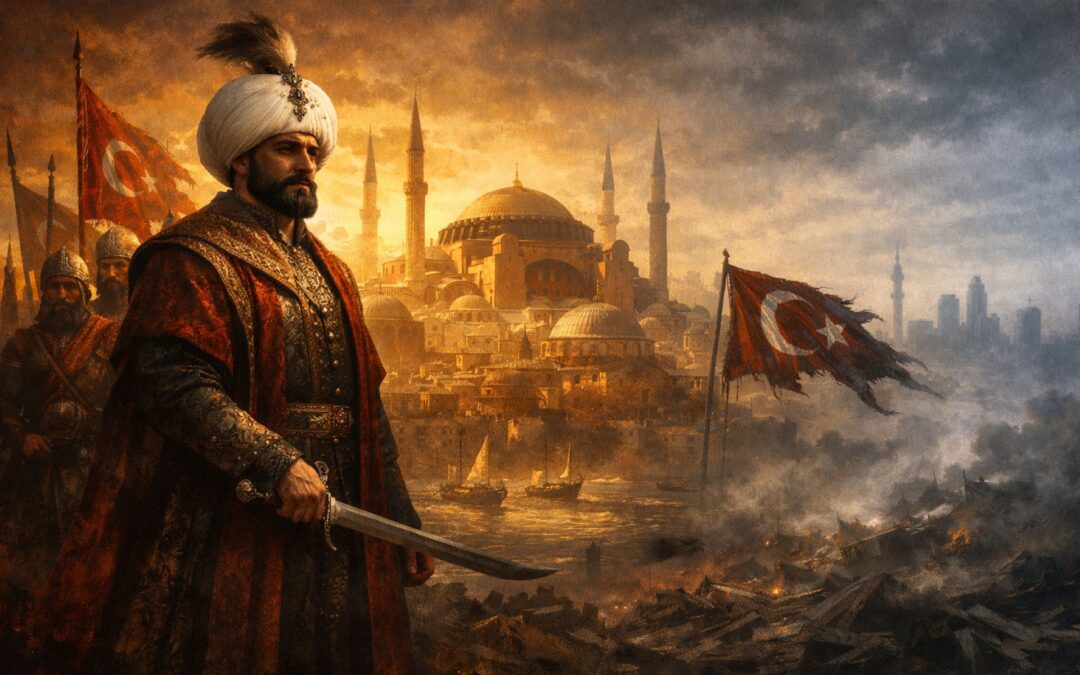
On the 29th of October 1923, a new nation formally entered the modern world: the Republic of Turkey. It was born not from the slow evolution of a state, but from the ashes of an empire—an empire that had endured for over six centuries, stretched across three continents, and shaped the political, cultural, and economic landscape of much of the known world. That empire was the Ottoman Empire.
At its height, the Ottomans ruled over vast territories that spanned southeastern Europe, the Middle East, and North Africa. From the Danube to the Nile, from the gates of Vienna to the Persian frontier, their authority touched some of the most strategically and culturally significant regions in history. They controlled key trade routes, governed diverse populations, and stood for centuries as one of the great imperial powers alongside—and often in opposition to—the rising states of Europe.
Yet the Ottoman Empire did not emerge fully formed as a dominant force. Its origins were far more modest. It began as a small frontier principality in northwestern Anatolia, led by a relatively obscure warlord named Osman. From this fragile beginning, the Ottomans built a state that would outlast many of its contemporaries, including the Byzantine Empire, which had once dominated the eastern Mediterranean for over a thousand years.
The story of the Ottoman Empire is, in many ways, a story of transformation. It is the story of how a nomadic warrior culture adapted into a sophisticated imperial system. It is the story of conquest and consolidation, of administrative innovation and military excellence. It is also the story of gradual decline—of an empire that struggled to adapt to the shifting economic and technological realities of a rapidly changing world.
Unlike many empires that fell swiftly, the Ottoman Empire declined slowly, over the course of centuries. Its power waned unevenly, marked by periods of reform, resurgence, and renewed crisis. By the 19th century, it had come to be known in European diplomatic circles as the “Sick Man of Europe,” a once-mighty state increasingly vulnerable to both internal fragmentation and external pressure.
Its final chapter unfolded in the crucible of the First World War. Defeat in that global conflict, combined with nationalist movements from within, brought the Ottoman system to an end. In its place emerged a new political order, led by Mustafa Kemal Atatürk, which would redefine the identity of the region and sever the institutional continuity with its imperial past.
To understand the Ottoman Empire, then, is not simply to trace the rise and fall of a state. It is to understand a central thread in the history of Eurasia and the Mediterranean world. It is to explore how empires are built, how they endure, and how they ultimately give way to new forms of political life.
This is the story of the Ottoman Empire—from its origins on the Anatolian frontier to its transformation into modern Turkey.
The Turkic Migrations and the Rise of the Seljuks
The origins of the Ottoman Empire cannot be understood without stepping back into a much older story—one that begins far from Anatolia, deep in the vast grasslands of Central Asia. Long before the Ottomans emerged as a political force, the peoples who would eventually give rise to their empire were part of a broader pattern of migration that reshaped the map of Eurasia over centuries.
The Turkic peoples were originally nomadic groups who inhabited the regions of northeastern Asia. Living in the harsh and expansive environment of the Eurasian steppe, they developed a way of life centered around mobility, horsemanship, and tribal cohesion. These were not static societies tied to cities or fixed borders, but dynamic, resilient communities that moved across enormous distances in search of pasture, opportunity, and security.
Beginning in the early centuries of the first millennium, waves of Turkic migration pushed steadily westward. By the 7th century, Turkic groups had reached the regions around the Altai Mountains, near the modern borders of Russia, Kazakhstan, and Mongolia. Over time, these movements continued, driven by a combination of environmental pressures, internal conflicts, and the broader currents of steppe politics.
As these groups moved further west and south, many settled in areas around the Caspian and Aral Seas, gradually transitioning from purely nomadic lifestyles to more semi-settled forms of existence. It was in this shifting frontier between nomadic and settled worlds that new political formations began to emerge.
One of the most significant of these was the rise of the Seljuks. Originating from a branch of the Oghuz Turkic tribes, the Seljuks were initially just one of many tribal confederations competing for power and influence. However, under the leadership of a chieftain named Seljuk, and later his descendants, they began to distinguish themselves through military success and political ambition.
In the late 10th and early 11th centuries, the Seljuks moved into Persia, where they encountered a far more urbanized and culturally sophisticated environment than the steppe. Rather than remaining outsiders, they adapted. They adopted the Persian language for administration, embraced elements of Persian court culture, and, crucially, converted to Islam.
This combination of Turkic military strength and Persian administrative tradition proved to be extraordinarily powerful. The Seljuks were not merely conquerors; they became rulers capable of governing complex, multi-ethnic societies. Their empire expanded rapidly, stretching across much of Iran, Iraq, and beyond.
By the mid-11th century, the Seljuks had reached the frontiers of the Byzantine Empire in Anatolia. Tensions between the two powers eventually culminated in one of the most decisive battles of the medieval world: the Battle of Manzikert in 1071. In this confrontation, the Seljuk forces inflicted a crushing defeat on the Byzantine army, capturing the emperor himself.
The consequences of Manzikert were profound. It shattered Byzantine control over much of Anatolia and opened the region to large-scale Turkic settlement. Over the following decades, Anatolia—once a core territory of the Byzantine world—was transformed into a predominantly Turkic and Muslim region.
However, the Seljuk Empire, like many steppe-derived states, struggled with internal cohesion. By the 12th and 13th centuries, it had begun to fragment into smaller successor states. In Anatolia, this led to the emergence of the Sultanate of Rum and, eventually, a patchwork of even smaller principalities known as beyliks.
These beyliks were often in competition with one another, but they also existed in the shadow of declining larger powers, including the remnants of the Byzantine Empire. It was within this fractured and fluid political landscape that a new force would emerge—one that would eventually eclipse all others.
Among the many minor rulers of Anatolia was a leader named Osman. His domain was small, his resources limited, and his origins relatively obscure. Yet from this unlikely beginning, he would lay the foundations of a state that would grow into one of the most enduring empires in history.
Osman and the Birth of the Ottoman State
By the late 13th century, Anatolia was a fractured and contested frontier. The once-powerful Seljuk Sultanate of Rum had largely disintegrated under the combined pressures of internal division and the devastating Mongol invasions. In its place, a mosaic of small Turkic principalities—known as beyliks—emerged across the region. These states were often unstable, frequently at war with one another, and constantly negotiating their survival between larger forces, including the Mongols and the remnants of the Byzantine Empire.
It was within this environment of political fragmentation and opportunity that the foundations of the Ottoman state were laid.
Osman I, from whom the Ottomans take their name, was the leader of one such small principality located in northwestern Anatolia, near the Byzantine frontier. Compared to more established beyliks, Osman’s domain was modest in both size and resources. Yet its geographic position would prove decisive. Situated along the borderlands between the Islamic world and the Christian Byzantine territories, Osman’s state occupied what might be described as a zone of constant conflict and expansion.
This frontier environment gave rise to a distinct warrior culture, often referred to as the ghazi ethos. The term “ghazi” broadly described warriors who fought in the name of Islam, but in practice it also reflected a broader culture of raiding, conquest, and the pursuit of land and wealth. For leaders like Osman, the Byzantine frontier was not just a line of division—it was an opportunity.
As the Byzantine Empire continued to weaken, particularly in Anatolia, its ability to defend its territories eroded. Internal instability, economic decline, and external pressures had reduced what was once a dominant imperial force into a shadow of its former self. This created a vacuum along its eastern borders—one that ambitious frontier rulers were quick to exploit.
Osman distinguished himself among these rulers through a combination of military success, political skill, and perhaps most importantly, the ability to attract followers. His campaigns against nearby Byzantine strongholds brought both material rewards and prestige, drawing warriors, adventurers, and displaced peoples into his expanding domain. In a fragmented landscape, momentum mattered—and Osman had it.
Unlike some of his contemporaries, Osman appears to have focused less on conflict with neighboring Turkic states and more on expanding into Byzantine territory. This strategy allowed him to grow without becoming entangled in the constant internecine struggles that weakened other beyliks. Each victory not only expanded his territory but also reinforced his reputation as a successful and divinely favored leader.
The early Ottoman state was not yet a formal empire. It lacked the complex administrative structures that would later define Ottoman governance. Instead, it was a flexible, evolving polity built around personal loyalty, military success, and the distribution of land to followers. Authority was closely tied to the person of the ruler, and expansion was both a necessity and a means of maintaining cohesion.
Yet even in this early stage, the foundations of something more enduring were being laid. The Ottomans demonstrated an ability to integrate different populations, to adapt administrative practices from those they conquered, and to maintain a degree of continuity across generations of leadership. These traits would prove essential as the state grew in size and complexity.
By the time of Osman’s death in the early 14th century, his principality had transformed from a minor frontier state into a rising regional power. The process of expansion he had initiated would accelerate under his successors, particularly his son Orhan, who would begin to institutionalize the structures of governance and military organization.
What began as a small, opportunistic polity on the edges of a declining empire was, within a few generations, on a trajectory toward something far greater. The Ottoman state was no longer just one beylik among many—it was becoming a force capable of reshaping the balance of power in Anatolia and beyond.
Expansion into the Balkans and the Early Empire
Following the death of Osman, the task of transforming a fast-growing frontier principality into a durable state fell to his successors. It was under his son, Orhan, and the rulers who followed that the Ottomans began to move beyond opportunistic raids and toward sustained territorial expansion, administrative organization, and imperial ambition.
One of the earliest and most significant developments of this period was the steady capture of key Byzantine strongholds in northwestern Anatolia. The city of Nicaea, an important political and cultural center of the Byzantine world, fell to the Ottomans in 1331 after a prolonged campaign. Its capture was more than just a military victory—it marked the beginning of the Ottomans inheriting and adapting the institutional legacy of the Byzantine state. Rather than destroying the city’s existing structures, the Ottomans repurposed them, incorporating administrative practices that would later underpin their own system of governance.
From this point onward, Ottoman expansion gained momentum. The weakening of Byzantine authority, combined with internal divisions within the empire, meant that resistance was often fragmented and inconsistent. The Ottomans exploited this effectively, pressing forward not only in Anatolia but also looking westward into Europe.
The crossing into the Balkans marked a turning point. In the mid-14th century, the Ottomans established a foothold in southeastern Europe, initially taking advantage of Byzantine civil conflicts to secure positions across the Dardanelles. Once there, they rapidly expanded into the Balkan interior, encountering a patchwork of kingdoms and principalities that were often divided among themselves.
A major milestone came with the capture of Adrianople (modern-day Edirne) in 1369. Located strategically near the borders of present-day Greece, Bulgaria, and Turkey, the city became the new Ottoman capital for a time. Its location allowed the Ottomans to project power deeper into Europe while maintaining their base in Anatolia. This dual-continent presence would become a defining characteristic of the empire.
The expansion into the Balkans was not simply a series of isolated conquests—it was a systematic process of incorporation. Serbian and Bulgarian territories fell under Ottoman control through a combination of military campaigns and political arrangements. Local rulers were sometimes allowed to retain authority as vassals, provided they recognized Ottoman supremacy and contributed troops or taxes. This pragmatic approach enabled the Ottomans to expand rapidly without overextending their administrative capacity.
At the same time, the early structures of the Ottoman state began to take clearer shape. Military organization became more formalized, with the development of standing forces that could be deployed across multiple fronts. Systems of land distribution emerged, whereby loyal soldiers and officials were granted revenues from conquered territories in exchange for service. These arrangements helped bind the expanding empire together, creating a network of obligations that reinforced central authority.
Despite these advances, the early Ottoman state was not without its challenges. The rapid pace of expansion occasionally outstripped the ability to govern effectively, and periods of internal instability did arise. In the early 15th century, for instance, the empire experienced a brief but significant crisis following the defeat of the Ottomans by the forces of Timur (Tamerlane) at the Battle of Ankara in 1402. The aftermath saw a temporary fragmentation of Ottoman authority as rival claimants struggled for control.
Yet even this setback proved to be temporary. Within a few decades, the Ottomans had reasserted their unity and resumed their expansionist trajectory. The resilience they demonstrated during this period was indicative of a deeper strength—an ability to recover from disruption and reestablish central control.
By the mid-15th century, the Ottomans had firmly established themselves as the dominant power in both Anatolia and the Balkans. The Byzantine Empire, once their greatest regional rival, had been reduced to little more than the city of Constantinople and a handful of surrounding territories.
The stage was now set for a confrontation that would not only mark the end of one empire, but also signal the arrival of another as a major force in world history.
The Fall of Constantinople and the End of Byzantium
By the mid-15th century, the Byzantine Empire—once the dominant power of the eastern Mediterranean—had been reduced to a shadow of its former self. Its territories had shrunk dramatically, its resources were exhausted, and its political influence had waned to the point where it could no longer meaningfully resist external threats. At its center remained Constantinople, a city of immense historical, strategic, and symbolic importance.
For over a thousand years, Constantinople had stood as one of the greatest cities in the world. Founded by Constantine the Great in the 4th century, it had served as the capital of the Eastern Roman Empire and later the Byzantine Empire. Its formidable defensive walls, particularly the Theodosian Walls, had withstood numerous sieges across centuries, earning it a reputation as an impregnable stronghold.
For the Ottomans, however, Constantinople was more than just a fortified city—it was the key to imperial legitimacy and strategic dominance. Its capture would not only eliminate the last vestige of Byzantine power but also unify Ottoman territories in Europe and Asia, creating a cohesive and continuous empire. It would grant control over critical trade routes and establish a capital worthy of a rising imperial state.
This task fell to Mehmed II, who ascended to the Ottoman throne in 1451. Unlike many of his predecessors, Mehmed was singularly focused on achieving what generations of rulers had failed to accomplish: the conquest of Constantinople. He approached this objective with meticulous planning, combining military innovation with strategic foresight.
In preparation for the siege, Mehmed undertook extensive measures. He commissioned the construction of massive cannons capable of breaching the city’s ancient walls—an unprecedented use of gunpowder artillery at such a scale. He also secured control over the surrounding regions and constructed fortifications along the Bosporus to cut off any potential aid from the Black Sea.
The siege began in early April 1453. For nearly seven weeks, the Ottoman forces bombarded the city’s defenses while attempting to break through its walls. The Byzantines, led by Emperor Constantine XI, mounted a determined defense despite being vastly outnumbered. The city’s defenders included not only Byzantine soldiers but also volunteers from across Europe, all united by the desperate hope of preserving what remained of the empire.
Yet the balance of power was decisively in favor of the Ottomans. Their numerical superiority, combined with the relentless use of artillery, gradually weakened the city’s defenses. On the 29th of May 1453, the Ottomans launched a final, coordinated assault. After hours of intense fighting, breaches in the walls allowed Ottoman forces to pour into the city.
Emperor Constantine XI is said to have died in the fighting, marking the end of a line of rulers that stretched back over a millennium. With his death, the Byzantine Empire—one of the longest-lasting political entities in history—came to an end.
The fall of Constantinople was a moment of profound historical significance. It signaled not only the collapse of Byzantine power but also the definitive rise of the Ottoman Empire as a major imperial force. The city itself was quickly transformed. Renamed and reimagined as the Ottoman capital, it became the political, economic, and cultural center of the empire.
One of the most symbolic acts following the conquest was the conversion of the Hagia Sophia—from a grand Byzantine cathedral into a mosque. This transformation encapsulated the broader shift in power and identity that the fall of the city represented. Constantinople was no longer the heart of a Christian empire; it had become the seat of an Islamic one.
From this new capital, the Ottomans would launch further campaigns of expansion, extending their reach across continents. The conquest of Constantinople was not the culmination of Ottoman ambition—it was the beginning of a new phase of imperial growth.
With the last major obstacle in Anatolia and southeastern Europe removed, the Ottomans were now positioned to become one of the most powerful empires of the early modern world.
Imperial Expansion and the Age of Conquest
The fall of Constantinople in 1453 did not mark the peak of Ottoman power—it marked its true beginning. With their new capital firmly established and their position consolidated across Anatolia and the Balkans, the Ottomans entered a phase of sustained and aggressive expansion that would transform them into one of the most formidable empires of the early modern world.
At the center of this transformation was Mehmed II, whose ambitions extended far beyond the conquest of Constantinople. Having secured the symbolic heart of the Byzantine world, he moved swiftly to eliminate remaining pockets of resistance and extend Ottoman authority across neighboring regions. In the early 1460s, his forces overran the Despotate of the Morea in southern Greece, bringing the Peloponnese under Ottoman control. Shortly thereafter, the Empire of Trebizond—one of the last remnants of Byzantine rule on the Black Sea—was also conquered, further cementing Ottoman dominance in Anatolia.
Expansion continued into the Balkans, where Bosnia was incorporated into the empire, and into Albania, where resistance was eventually overcome after prolonged conflict. By the time of Mehmed’s death in 1481, the Ottomans had secured a vast and strategically coherent domain, linking their European and Asian territories and establishing a durable imperial core.
His successor, Bayezid II, adopted a somewhat more cautious approach but continued the process of consolidation and expansion. Under his rule, the empire strengthened its hold over existing territories while also engaging in conflicts that extended its influence across key maritime and trade routes. Notably, wars against the Republic of Venice between 1499 and 1503 resulted in greater Ottoman control over the Aegean Sea, allowing them to dominate crucial channels of commerce and communication in the eastern Mediterranean.
The pace of expansion accelerated once again under Selim I, whose short but decisive reign between 1512 and 1520 dramatically reshaped the geopolitical landscape of the region. Unlike his predecessors, Selim turned his attention east and south, targeting the powerful Mamluk Sultanate, which controlled Egypt, Syria, and much of the Levant.
In a series of rapid and decisive campaigns, Selim defeated the Mamluks, most notably at the Battle of Ridaniya in 1517. This victory brought Egypt, one of the wealthiest and most strategically vital regions of the Islamic world, under Ottoman control. With it came not only immense economic resources but also religious prestige, as the Ottomans assumed stewardship over the holy cities of Mecca and Medina.
At the same time, Ottoman influence expanded across North Africa. Local rulers in regions such as Algeria and Tunisia increasingly aligned themselves with the empire, often accepting Ottoman suzerainty in exchange for protection and support. This extended Ottoman reach along the southern shores of the Mediterranean and reinforced their position as a dominant maritime power.
By the early 16th century, the Ottoman Empire had evolved into a transcontinental superpower. It controlled vast territories spanning southeastern Europe, Anatolia, the Middle East, and North Africa. Its strategic position allowed it to dominate key trade routes connecting East and West, while its growing administrative sophistication enabled it to govern an increasingly diverse population.
What distinguished the Ottomans during this period was not merely the scale of their conquests, but the consistency with which they expanded and consolidated power. Each new territory was integrated into a broader imperial system that balanced central authority with local administration. Military success was paired with political pragmatism, allowing the empire to maintain stability even as it grew.
This era of expansion laid the groundwork for what would soon become the high point of Ottoman power. The empire was no longer simply rising—it was approaching its zenith. Under the rule of its most famous and capable sultan, it would reach a level of influence and authority that placed it among the foremost powers of the world.
That ruler was Suleiman, later known as “the Magnificent.”
Suleiman the Magnificent and the Ottoman Golden Age
If the conquest of Constantinople marked the true beginning of Ottoman imperial power, then the reign of Suleiman the Magnificent marked its zenith. Ruling from 1520 to 1566, Suleiman presided over an empire that reached the height of its territorial extent, military strength, administrative sophistication, and global influence.
By the time Suleiman ascended to the throne, the Ottoman Empire was already one of the dominant powers of the early modern world. Yet under his leadership, it transformed into something even greater—a state that could rival, and often surpass, the leading European and Middle Eastern powers of its time.
Suleiman inherited a vast and strategically positioned empire, but he did not simply maintain it—he expanded it decisively. In Europe, his campaigns pushed deep into the heart of the continent. Following earlier Ottoman victories against Hungary, Suleiman secured control over much of the region, extending Ottoman authority into Central Europe. His most ambitious effort came in 1529, when he laid siege to Vienna, the capital of the Habsburg Empire. Although the siege ultimately failed, it demonstrated the reach of Ottoman military power and brought the empire to the doorstep of Western Europe.
In the Mediterranean and North Africa, Ottoman expansion continued under Suleiman’s rule. The empire captured key coastal cities and fortified its naval presence, challenging the dominance of European powers such as Spain. In 1551, the Ottomans took Tripoli, further consolidating their influence along the southern Mediterranean coast. Their reach extended westward across North Africa and eastward into the Arabian Peninsula and Iraq, creating a vast and interconnected imperial system.
Suleiman also secured control over strategic islands and maritime routes. The capture of Rhodes in 1522 from the Knights of St. John eliminated a major obstacle to Ottoman naval operations in the eastern Mediterranean. This victory not only strengthened Ottoman dominance at sea but also ensured safer passage for trade and military movements across the region.
By the end of Suleiman’s reign, the Ottoman Empire stretched from Hungary and the northern shores of the Black Sea in the north, to Egypt and parts of the Arabian Peninsula in the south, and from Algeria in the west to the edges of the Caspian Sea in the east. Few empires in history had achieved such geographic breadth combined with sustained political cohesion.
Yet Suleiman’s significance was not limited to military conquest. His reign also represented the high point of Ottoman governance and legal organization. Known in the Islamic world as “Kanuni,” or “the Lawgiver,” Suleiman oversaw the codification of laws that complemented religious legal traditions and provided a more unified framework for governing the empire’s diverse populations. These legal reforms helped stabilize the empire internally and ensured a degree of consistency across its vast territories.
Culturally and economically, the empire flourished during this period. Constantinople—now firmly established as the imperial capital—became one of the great cities of the world, a center of trade, culture, and political power. The empire’s position along key trade routes facilitated the flow of goods, ideas, and people between Europe, Asia, and Africa.
The Ottoman military also reached its peak during this era. Its effectiveness was built on a balanced and highly organized structure that combined disciplined infantry, skilled cavalry, and advanced artillery. This integration of different military elements allowed the Ottomans to adapt to a wide range of battle conditions and maintain their superiority over many of their rivals.
Despite these achievements, Suleiman’s reign also revealed the limits of Ottoman expansion. The failure to capture Vienna in 1529, and the challenges of sustaining campaigns deep in Europe, hinted at the logistical and strategic constraints that would become more apparent in later years. Nevertheless, these limitations did little to diminish the perception of Ottoman dominance during his lifetime.
By the time of Suleiman’s death in 1566, the Ottoman Empire stood as one of the preeminent powers of the world. It was a state defined not only by its vast territory but also by its administrative sophistication, military prowess, and cultural vitality.
This period is often remembered as the Ottoman Golden Age—a time when the empire reached the height of its power and influence. Yet beneath this surface of strength, subtle shifts were already underway. The systems that had enabled such rapid expansion would, in time, face new pressures and challenges.
The empire had reached its peak. The question now was whether it could sustain it.
The Ottoman Military and Administrative System
The extraordinary success of the Ottoman Empire—its rapid expansion, long endurance, and ability to govern vast and diverse territories—was not accidental. It was the product of a highly effective combination of military organization and administrative structure, both of which were carefully developed and refined over time. At its core, the Ottoman system was designed to balance centralized authority with practical flexibility, allowing it to function across continents and cultures.
The Ottoman military was one of the most advanced and disciplined fighting forces of its time. Unlike many of its contemporaries, which relied heavily on feudal levies or temporary armies, the Ottomans developed a more structured and professional system. Their forces were composed of several key elements: infantry, cavalry, and artillery, each playing a distinct and coordinated role on the battlefield.
Among the most important components of this system were the Janissaries. These elite infantry soldiers formed the backbone of the Ottoman military and were widely regarded as one of the most effective standing forces in the early modern world. What made the Janissaries unique was not just their discipline or training, but their origins.
They were recruited through a system known as devshirme, in which young boys were taken from Christian communities in the Balkans and converted to Islam. These boys were then rigorously trained and educated, not only in military skills but also in administration and governance. Cut off from their original social ties and bound directly to the authority of the Sultan, the Janissaries developed a strong sense of loyalty and identity tied to the state.
This system, while harsh by modern standards, allowed the Ottomans to create a class of highly capable and loyal servants who could be deployed in both military and bureaucratic roles. It also helped to reduce the influence of hereditary nobility, which in many other empires posed a challenge to centralized authority.
In addition to the Janissaries, the Ottomans made extensive use of cavalry forces, particularly those granted land in exchange for military service. This system, often referred to as the timar system, involved assigning revenues from specific territories to cavalrymen, who in return were expected to provide soldiers when called upon. This created a decentralized but highly responsive military structure, linking local governance directly to imperial defense.
Artillery was another key strength of the Ottoman military. From the siege of Constantinople onward, the Ottomans demonstrated an early and effective use of gunpowder technology. Their ability to deploy large cannons and integrate them into their military strategy gave them a significant advantage over many opponents, particularly in siege warfare.
Complementing this military strength was an administrative system that allowed the empire to function efficiently despite its size. At the top stood the Sultan, who held ultimate authority over both political and religious matters. However, the day-to-day governance of the empire relied heavily on a complex bureaucracy.
The most powerful figure after the Sultan was the Grand Vizier, who acted as a chief administrator and, in many respects, as a prime minister. The Grand Vizier oversaw a network of officials responsible for managing different aspects of governance, including finance, law, and provincial administration. This structure allowed for continuity in governance even when individual sultans were less directly involved in state affairs.
One of the defining features of the Ottoman administrative approach was its relative flexibility. Rather than imposing a rigid, uniform system across all territories, the empire often allowed local customs and practices to continue, provided they did not conflict with imperial interests. This pragmatic approach made it easier to govern a population that was ethnically, linguistically, and religiously diverse.
Religious tolerance was a notable aspect of this system. While Islam held a privileged position within the empire, non-Muslim communities—particularly Christians and Jews—were generally allowed to practice their faiths and manage their own internal affairs. Through arrangements often described as the millet system, these communities were granted a degree of autonomy in matters such as education, law, and religious practice.
Economically, the empire benefited from its control over major trade routes that connected Europe, Asia, and Africa. Cities like Constantinople, Alexandria, and Damascus became major centers of commerce, facilitating the movement of goods ranging from spices and textiles to precious metals. This flow of trade contributed significantly to the empire’s wealth and stability.
What made the Ottoman system particularly effective was its integration of these various elements. The military supported expansion and defense, the administrative structure ensured governance and continuity, and the economic networks sustained the empire’s resources. Together, they created a system that was both robust and adaptable.
However, the very features that contributed to the empire’s success would, over time, become sources of strain. As conditions changed—both within the empire and in the wider world—the balance between central authority and local autonomy, between military strength and administrative efficiency, would become increasingly difficult to maintain.
For now, though, at the height of its power, the Ottoman Empire stood as a model of imperial organization—one that few of its contemporaries could match.
Conflict with Europe and the Limits of Expansion
At the height of its power in the 16th century, the Ottoman Empire was not only expanding—it was colliding with other great powers. Nowhere was this more evident than in its prolonged and multifaceted conflicts with Europe. These confrontations would test the limits of Ottoman expansion and gradually reveal the constraints of even the most formidable imperial system.
One of the central arenas of this conflict was the Mediterranean. For centuries, this sea had been a vital artery of trade, communication, and military movement. Control over it meant influence over the economic and political life of the region. By the time of Suleiman, the Ottomans had established themselves as a dominant naval force in the eastern Mediterranean, but they now faced a powerful rival: Spain.
The Spanish Empire, under the Habsburgs, controlled significant territories in southern Italy and the western Mediterranean. It also saw itself as a defender of Christian Europe against Ottoman expansion. This ideological dimension added an extra layer of intensity to the conflict, framing it not just as a struggle for territory, but as a broader civilizational contest.
One of the earliest major confrontations came in 1565, during the Siege of Malta. The Ottomans sought to capture the island from the Knights of St. John, who had previously been expelled from Rhodes. Malta was strategically positioned, and its capture would have strengthened Ottoman naval dominance. However, after a prolonged and costly campaign, the Ottomans failed to take the island. The siege demonstrated that Ottoman expansion, while powerful, was not unstoppable.
A few years later, in 1571, another pivotal confrontation took place: the Battle of Lepanto. A coalition of European powers, led by Spain, assembled a large naval force to challenge Ottoman control of the Mediterranean. The battle, fought off the coast of northwestern Greece, was one of the largest naval engagements of its time, involving hundreds of ships and tens of thousands of men.
The result was a significant defeat for the Ottomans. Although they were able to rebuild their fleet relatively quickly, Lepanto had a profound psychological impact. It showed that European powers, when united, could successfully challenge Ottoman naval supremacy. The balance of power in the Mediterranean was no longer decisively in Ottoman favor.
Following these setbacks at sea, the Ottomans increasingly focused their attention on Central Europe. The ambition to expand deeper into the continent had long been a part of Ottoman strategy, particularly after their earlier successes against Hungary. However, one major obstacle remained: Vienna.
The city stood as a gateway to Central Europe, and its capture would have opened the path to further expansion. The Ottomans had already attempted to take Vienna in 1529 under Suleiman, but the siege had failed. Decades later, in 1683, a second and even larger attempt was made.
The Second Siege of Vienna represented one of the largest military efforts undertaken by the Ottomans. With an army numbering in the hundreds of thousands, they laid siege to the city once again. For weeks, the outcome hung in the balance. Yet, as before, the Ottomans were unable to secure a decisive breakthrough.
The turning point came with the arrival of a relief force led by the Polish king John III Sobieski. In a dramatic and decisive engagement, the combined Christian forces launched a counterattack that broke the Ottoman lines. The battle is often remembered for the massive cavalry charge that swept through the Ottoman camp, leading to a decisive defeat.
The failure at Vienna in 1683 marked a critical turning point. It was not merely a lost battle—it signaled the end of Ottoman expansion into Central Europe. From this point onward, the empire would no longer be on the offensive in the same way. Instead, it would increasingly find itself defending its existing territories against a growing number of challenges.
These conflicts revealed an important reality: the Ottoman Empire, despite its strength, had limits. Logistics, geography, and the growing coordination among European powers all constrained its ability to expand indefinitely. What had once seemed like an unstoppable force was now encountering resistance that it could not easily overcome.
At the same time, the broader context of global change was beginning to shift. European states were undergoing transformations in military organization, technology, and economic systems. These developments would, over time, alter the balance of power in ways that increasingly disadvantaged the Ottomans.
The age of rapid expansion was coming to an end. What lay ahead was a more complex and uncertain period—one in which maintaining the empire would prove far more difficult than building it.
The Long Decline of the Ottoman Empire
The failure at Vienna in 1683 did not immediately bring about the collapse of the Ottoman Empire. There was no sudden سقوط, no single moment where the empire ceased to function as a major power. Instead, what followed was a slow and uneven process—a gradual decline that unfolded over decades and centuries, often imperceptible at first, but increasingly difficult to ignore.
In the late 17th and early 18th centuries, the Ottoman Empire remained vast, wealthy, and militarily capable. Yet beneath this surface stability, deeper structural issues were beginning to take hold. The systems that had once driven expansion and ensured cohesion were no longer as effective in a changing world.
One of the most significant shifts occurred in the nature of leadership. During the empire’s earlier centuries, many sultans had been directly involved in governance, military campaigns, and administrative decision-making. Figures like Mehmed II and Suleiman had embodied a model of active, engaged rulership. Over time, however, this pattern began to change.
Later sultans increasingly withdrew from direct participation in state affairs. Governance became more reliant on court politics, palace life, and the influence of advisors. The center of power shifted toward the Grand Vizier and the broader bureaucratic elite, who took on greater responsibility for the day-to-day functioning of the empire. While this allowed for a degree of administrative continuity, it also created a system where authority was more diffuse and sometimes less accountable.
At the same time, the military system that had once given the Ottomans a decisive edge began to lose its effectiveness. The Janissaries, once an elite and disciplined force, gradually became more entrenched and resistant to change. Over the years, their role evolved from that of a strictly controlled military corps into a more socially and politically influential group. Membership became less rigorously managed, discipline declined, and their effectiveness on the battlefield diminished.
Meanwhile, European powers were undergoing significant military transformations. Advances in technology, organization, and training gave them a growing advantage. The Ottomans, by contrast, were slower to adopt these changes, and this gap in military capability became increasingly evident in conflicts with rivals such as Austria and Russia.
Economic factors also played a crucial role in the empire’s decline. For centuries, the Ottomans had benefited from their position along major overland trade routes connecting Europe and Asia. Cities like Constantinople had thrived as hubs of commerce, facilitating the exchange of goods across continents.
However, from the late 15th century onward, global trade patterns began to shift. European powers developed new maritime routes that bypassed traditional overland pathways. The discovery of sea routes to the Americas and Asia redirected the flow of goods and wealth toward the Atlantic world. As a result, the economic centrality of the Ottoman-controlled routes diminished.
This shift had long-term consequences. Reduced trade revenues weakened the empire’s financial base, limiting its ability to sustain large military forces and invest in infrastructure. Economic stagnation, combined with administrative inefficiencies, made it increasingly difficult to respond to emerging challenges.
Despite these difficulties, the Ottoman Empire did not collapse. It adapted where it could, maintained control over large territories, and continued to function as a significant political entity. But the balance had changed. Where once the empire had been expanding and shaping the world around it, it was now reacting—responding to pressures both internal and external.
This period of decline was not a simple downward trajectory. There were moments of reform and attempts at renewal, as well as periods of relative stability. Yet the overall trend was clear: the empire was gradually losing the advantages that had once made it dominant.
By the 18th century, this reality was becoming increasingly apparent to both the Ottomans themselves and to the outside world. The empire was no longer the unstoppable force it had once been. Instead, it was entering a new phase—one defined not by expansion, but by the struggle to preserve what remained.
The long decline had begun, and it would shape the course of Ottoman history for generations to come.
Internal Strains and External Pressures in the 18th Century
As the Ottoman Empire moved deeper into the 18th century, the patterns of decline that had begun to emerge earlier became more pronounced and more difficult to reverse. What had once been subtle imbalances in governance, military effectiveness, and economic strength now translated into tangible losses—of territory, influence, and strategic control.
One of the most immediate and visible pressures came from the empire’s northern frontiers. The rise of powerful neighboring states, particularly Russia and Austria, introduced a new and persistent threat. Unlike earlier adversaries, these were centralized, expanding powers with increasingly modernized armies and clear geopolitical ambitions.
Russia, in particular, posed a formidable challenge. Driven by a desire to expand southward and gain access to warm-water ports, Russian rulers saw the weakening Ottoman position as an opportunity. Throughout the 18th century, a series of wars between the two empires resulted in significant territorial losses for the Ottomans, especially along the northern shores of the Black Sea and in the Caucasus region.
Austria, too, capitalized on Ottoman weakness. Conflicts in Central and Eastern Europe led to the gradual erosion of Ottoman control in the Balkans. Territories that had once been securely integrated into the empire were now increasingly contested, and in some cases lost altogether.
These military setbacks were not isolated events—they reflected deeper structural weaknesses. The Ottoman military, once a decisive instrument of expansion, was now struggling to compete with the evolving tactics and technologies of its European rivals. Efforts at reform were often inconsistent or resisted by entrenched interests, making it difficult to implement meaningful change.
At the same time, the empire faced growing challenges from within. In North Africa, regions such as Algeria, Tunisia, and Egypt began to assert greater autonomy. While they remained nominally under Ottoman authority, in practice they operated with increasing independence. Local rulers controlled taxation, military forces, and political decision-making, reducing the effective reach of the central government.
This trend toward decentralization was not limited to North Africa. Across the empire, provincial authorities gained more power, often at the expense of central control. While this flexibility had once been a strength—allowing the empire to accommodate diversity—it now contributed to fragmentation. The ability of the central administration to coordinate policy and respond to crises was increasingly constrained.
Economically, the empire continued to feel the effects of shifting global trade patterns. The rise of Atlantic commerce had permanently altered the flow of wealth, and the Ottoman Empire struggled to adapt. Revenue collection became less efficient, corruption grew more entrenched, and the financial strain of continuous warfare placed additional burdens on the state.
Despite these challenges, the empire did not simply collapse under pressure. It continued to function, to govern, and to defend its interests where possible. However, the balance of power had shifted decisively. The Ottomans were no longer shaping the geopolitical landscape—they were increasingly reacting to it.
By the end of the 18th century, the cumulative impact of these internal and external pressures had fundamentally altered the position of the Ottoman Empire. It was still a vast and significant state, but it was no longer dominant. Its authority was contested, its institutions strained, and its future uncertain.
The stage was now set for an even more turbulent period. The 19th century would bring new forces—nationalism, industrialization, and intensified European intervention—that would push the empire closer to its breaking point.
The 19th Century Crisis and the “Sick Man of Europe”
By the dawn of the 19th century, the Ottoman Empire was no longer simply a declining power—it was a state in crisis. The pressures that had been building over the previous century now converged into a series of upheavals that fundamentally threatened the empire’s territorial integrity and political survival. It was during this period that European observers began to refer to the Ottomans as the “Sick Man of Europe,” a phrase that captured both their weakness and their lingering strategic importance.
One of the most destabilizing forces to emerge during this time was nationalism. Across the Balkans, various ethnic and religious groups that had long been part of the Ottoman system began to seek independence. These movements were often fueled not only by local grievances but also by the broader ideological currents sweeping through Europe in the aftermath of the French Revolution.
The first major challenge came in 1804, with an uprising in Serbia. Although initially limited in scope, it signaled a shift in the relationship between the Ottoman state and its European provinces. What had once been manageable unrest now took on a more organized and ideological character, laying the groundwork for further revolts.
This was followed by the Greek War of Independence, which began in 1821. Unlike earlier uprisings, the Greek movement quickly attracted international attention and support. European powers—particularly Britain, France, and Russia—intervened both diplomatically and militarily, motivated by a combination of strategic interests and cultural affinity with the Greek cause. By 1829, Greece had successfully established itself as an independent state, marking a significant loss for the Ottoman Empire and setting a precedent for future breakaways.
At the same time, the empire was losing control over territories beyond the Balkans. In 1830, France invaded and colonized Algeria, effectively ending Ottoman authority in the region. This loss underscored the empire’s inability to defend its distant provinces against increasingly aggressive European powers.
Throughout the mid-19th century, Russia continued to press its advantage, seeking to expand into Ottoman territories around the Black Sea and the Balkans. This culminated in the Crimean War (1853–1856), a conflict that highlighted the complex geopolitical position of the Ottoman Empire. While Russia aimed to capitalize on Ottoman weakness, Britain and France intervened—not to destroy the empire, but to preserve it.
This apparent contradiction reflected a broader strategic calculation. European powers did not necessarily want the Ottoman Empire to collapse entirely, as this could create a power vacuum that might be exploited by rivals. Instead, they sought to manage its decline in a way that maintained a balance of power.
The Crimean War temporarily stabilized the Ottoman position, but it did little to address the underlying issues. In the decades that followed, the empire continued to fragment. Romania and Serbia moved toward independence, while Bulgaria gained increasing autonomy. Each of these developments further reduced Ottoman influence in Europe.
Internally, efforts were made to reform and modernize the state. These reforms aimed to centralize authority, improve administration, and modernize the military. However, they often faced resistance from conservative elements within the empire and were not always implemented effectively. The gap between ambition and execution remained a persistent challenge.
By the late 19th century, the Ottoman Empire had lost much of its former strength. Its territories had shrunk, its authority was contested, and its institutions were under strain. Yet it remained a key player in international politics, not because of its power, but because of its position.
The “Sick Man of Europe” was still alive—but increasingly fragile. And as the 20th century approached, the forces that had been reshaping the empire for generations were about to converge in ways that would determine its ultimate fate.
Reform, Revolution, and the Young Turks
By the late 19th and early 20th centuries, it had become increasingly clear—both to outside observers and to many within the Ottoman Empire itself—that the existing system could not continue unchanged. The empire’s decline was no longer a matter of slow erosion; it was now a visible and pressing crisis. The question was no longer whether reform was needed, but whether it could be achieved in time.
Efforts to modernize the empire had already begun in earlier decades. Reformist leaders recognized that the Ottomans were falling behind European powers in military organization, administrative efficiency, and technological development. Attempts were made to restructure the army, centralize governance, and introduce new legal and educational systems. However, these reforms were often partial and uneven, limited by resistance from entrenched interests and the sheer complexity of transforming a centuries-old imperial structure.
At the same time, a new generation of intellectuals, officers, and administrators began to emerge—many of whom had been exposed to European ideas of nationalism, constitutionalism, and modern statecraft. Unlike earlier reformers, who had sought to strengthen the existing system, these individuals increasingly believed that more fundamental political change was necessary.
This growing movement coalesced into what became known as the Young Turks. It was not a single, unified organization, but rather a loose coalition of groups and individuals who shared a common goal: to modernize the Ottoman state and limit the absolute authority of the Sultan.
Their primary demand was the establishment of a constitutional government. They sought to replace the traditional system of centralized imperial rule with a more modern political structure—one that included a parliament, a constitution, and a more accountable administrative framework. In essence, they aimed to transform the Ottoman Empire into a constitutional monarchy that could compete with the modern nation-states of Europe.
In 1908, these tensions came to a head. The Young Turks launched a revolution that forced the restoration of the Ottoman constitution and the reopening of parliament. For a brief moment, it appeared as though the empire might successfully reinvent itself. The revolution was met with widespread optimism, both domestically and internationally, as a sign that meaningful reform was finally underway.
However, this optimism proved short-lived.
The Young Turk movement, despite its shared objectives, was deeply divided. It included liberals who favored decentralization and greater regional autonomy, as well as more conservative and nationalist elements who sought to strengthen central authority. These internal divisions made it difficult to govern effectively or to build consensus around a coherent reform agenda.
Political instability followed. Power struggles, shifting alliances, and competing visions for the future of the empire created an environment of постоян uncertainty. The very forces that had driven the revolution—diversity of thought and urgency for change—now contributed to fragmentation at the highest levels of government.
At the same time, external pressures continued to mount. The empire faced ongoing territorial losses, particularly in the Balkans, where nationalist movements and regional conflicts further weakened Ottoman control. The Balkan Wars of the early 1910s resulted in the loss of most remaining Ottoman territories in Europe, dealing a severe blow to both the empire’s strategic position and its sense of identity.
In response to these challenges, elements within the Young Turk movement began to adopt a more centralized and authoritarian approach. The hope of creating a broadly inclusive constitutional system gave way, in some cases, to efforts to consolidate power and impose unity from above. This shift further complicated the political landscape and deepened internal divisions.
By the eve of the First World War, the Ottoman Empire was a state in transition—but an incomplete and unstable one. It had attempted to reform, to modernize, and to adapt, yet it remained burdened by structural weaknesses and unresolved tensions.
The revolution of 1908 had opened the door to change, but it had not resolved the empire’s fundamental problems. Instead, it set the stage for the final and most decisive chapter in Ottoman history—one that would unfold amid the global conflict of the First World War.
World War I and the Collapse of the Empire
By the early 20th century, the Ottoman Empire stood at a crossroads. Decades of reform, conflict, and territorial loss had left it weakened but still intact. When the First World War broke out in 1914, the empire faced a critical decision: remain neutral and risk isolation, or align with one of the major power blocs and attempt to reclaim its strategic position.
The Ottoman leadership chose the latter. Seeking to counter the long-standing threat posed by Russia and to regain influence, the empire aligned itself with Germany and Austria-Hungary, joining the Central Powers. This decision would prove to be one of the most consequential in its history.
The war exposed both the strengths and the deep vulnerabilities of the Ottoman state.
In some theaters, the Ottomans achieved notable success. The most famous of these was the Gallipoli Campaign (1915–1916), where Ottoman forces successfully repelled a major invasion by British, French, and ANZAC troops. The defense of the Dardanelles was a significant morale victory and demonstrated that, under capable leadership, the Ottoman military could still perform effectively against modern European armies.
However, these successes were overshadowed by a series of setbacks elsewhere. In the Middle East and the Levant, Ottoman control began to unravel. One of the most damaging developments was the Arab Revolt (1916–1918), in which Arab nationalist forces, supported by the British, rose against Ottoman rule. This revolt disrupted Ottoman supply lines, weakened their hold over key territories, and accelerated the fragmentation of the empire.
At the same time, Ottoman forces struggled to maintain cohesion across multiple fronts. The demands of modern industrial warfare placed enormous strain on the empire’s limited resources. Logistics, coordination, and supply became persistent challenges, and over time, the military situation deteriorated.
The war also brought with it one of the darkest chapters in Ottoman history. Beginning in 1915, the Ottoman government carried out systematic deportations and mass killings of its Armenian population. These actions, widely recognized as the Armenian Genocide, resulted in the deaths of an estimated one to one and a half million people. This event not only caused immense human suffering but also left a lasting legacy that continues to shape historical memory and political discourse.
By 1918, the overall situation had become untenable. The Central Powers were collapsing under the combined pressure of the Allied forces, and the Ottoman Empire was no exception. Its armies were in retreat across multiple fronts, its territories were being overrun, and its capacity to continue the war had effectively been exhausted.
With the end of the war, the consequences for the Ottoman Empire were severe. The victorious Allied powers—primarily Britain and France—moved quickly to occupy key regions and dismantle what remained of Ottoman authority. Large portions of the empire in the Middle East were divided into mandates, effectively bringing them under European control.
What remained of the Ottoman state was largely confined to Anatolia, but even this core territory was threatened. Greece and Italy, among others, sought to claim parts of the region, while the Allied occupation of Constantinople further undermined the legitimacy of the existing Ottoman government.
The empire that had once spanned three continents was now reduced to a fragment of its former self. Its political structures were collapsing, its territorial integrity was under threat, and its future was deeply uncertain.
Yet even in this moment of defeat, a new force was beginning to emerge from within the ruins. Nationalist sentiment, which had been growing in previous decades, now coalesced into a movement that would challenge both the Allied occupation and the remnants of the Ottoman system.
The collapse of the empire was no longer just a possibility—it was a reality in motion. What followed would determine not only how the Ottoman story ended, but also what would take its place.
The Turkish War of Independence and the End of Empire
The end of the First World War did not immediately conclude the Ottoman story. Instead, it created a power vacuum—one that exposed the remnants of the empire to occupation, partition, and external control. What followed was not a quiet dissolution, but a final conflict over the future of Anatolia itself.
In the aftermath of the war, Allied forces moved quickly to assert their influence. Constantinople was occupied, and large parts of Ottoman territory were either seized directly or placed under foreign administration. The empire’s former provinces in the Middle East were divided between Britain and France, while even the core Anatolian lands were subject to competing claims.
Greece, in particular, sought to expand into western Anatolia, motivated by both strategic interests and historical aspirations tied to ancient and Byzantine-era territories. Italian forces also established a presence in parts of southwestern Anatolia, while other regions faced the prospect of fragmentation under international agreements.
The Ottoman government, still formally based in Constantinople, found itself in a weakened and compromised position. In an effort to preserve what little authority remained, it adopted a conciliatory approach toward the Allied powers. However, this stance was increasingly viewed as ineffective—and even illegitimate—by many within the empire.
Out of this кризис emerged a new political force: Turkish nationalism.
At the center of this movement was Mustafa Kemal, a former Ottoman general who had already distinguished himself during the Gallipoli Campaign. Unlike the leadership in Constantinople, Kemal rejected the idea of accepting Allied terms. Instead, he called for organized resistance to foreign occupation and for the creation of a new, independent political order.
Beginning in 1919, nationalist forces mobilized across Anatolia. This marked the start of the Turkish War of Independence, a conflict that would last for several years and fundamentally reshape the region. The struggle was not only against foreign armies, but also against the authority of the existing Ottoman government, which the nationalists increasingly saw as disconnected from the interests of the people.
In the early stages of the war, the situation was uncertain. Greek forces advanced deep into Anatolia, supported by Allied backing, and posed a serious threat to nationalist positions. However, over time, the balance began to shift. Under Kemal’s leadership, nationalist forces reorganized, consolidated their позиции, and launched effective counteroffensives.
By 1921 and 1922, the nationalists had gained the upper hand. Greek forces were pushed back and eventually expelled from mainland Anatolia. Other foreign presences were similarly reduced or eliminated. The success of these campaigns not only secured territorial control but also strengthened the legitimacy of the nationalist movement.
Politically, this transformation was formalized through the establishment of a new governing body: the Grand National Assembly, based in Ankara. This institution positioned itself as the true representative of the Turkish people, directly challenging the authority of the Ottoman government in Constantinople.
The conflict came to a decisive end in 1922, when the nationalists secured a favorable armistice. Shortly thereafter, the Ottoman Sultanate was formally abolished. This act marked the definitive end of the imperial system that had governed the region for over six centuries.
In 1923, the process was completed with the signing of the Treaty of Lausanne, which recognized the sovereignty of the new Turkish state. The Republic of Turkey was officially established, with Ankara as its capital and Mustafa Kemal—later known as Atatürk—as its founding leader.
With this transition, the Ottoman Empire ceased to exist.
What had begun as a small frontier principality had grown into one of the longest-lasting and most influential empires in history. Its legacy, however, did not end with its سقوط. The political boundaries, cultural influences, and historical trajectories shaped by the Ottoman centuries would continue to define the regions it once ruled.
The empire was gone, but its imprint on the world remained.
Conclusion
The history of the Ottoman Empire is not simply the story of a state that rose and fell—it is the story of a system that endured, adapted, and ultimately transformed over the course of more than six centuries. From its origins as a small frontier principality under Osman to its emergence as a transcontinental superpower, the Ottoman Empire reshaped the political and cultural landscape of Eurasia and the Mediterranean in ways that continue to echo into the present.
At its height, the empire stood as one of the great organizing forces of the early modern world. It controlled strategic trade routes, governed a remarkably diverse population, and developed administrative and military systems that allowed it to function across vast distances. Its ability to combine different traditions—Turkic, Persian, Islamic, and Byzantine—gave it a flexibility that few empires possessed.
Yet the very scale and complexity that sustained the empire also made it difficult to adapt in a rapidly changing world. As global trade shifted, as European powers modernized, and as new political ideas such as nationalism took hold, the Ottoman system struggled to keep pace. Its decline was not the result of a single failure, but of a gradual accumulation of pressures—economic, military, and political—that it could no longer fully absorb.
What makes the Ottoman story particularly striking is the nature of its ending. Unlike many empires that collapse abruptly, the Ottoman Empire dissolved through a process of transformation. Its final years were marked not only by defeat, but by reinvention. Out of its remnants emerged a new nation-state, one that deliberately broke from many aspects of its imperial past while still inheriting its historical legacy.
Modern Turkey, founded under Mustafa Kemal Atatürk, represents both a continuation and a departure. It carries forward the geographical core of the Ottoman world, yet it redefines its identity in fundamentally different terms. This transition from empire to nation-state reflects a broader shift that occurred across the world in the early 20th century—a shift away from imperial systems toward new forms of political organization.
To study the Ottoman Empire, therefore, is to engage with one of the central threads of global history. It is to understand how power is built and maintained across cultures and continents, how institutions evolve over time, and how even the most enduring systems must eventually confront change.
The Ottomans were not merely participants in history—they were architects of it. And though their empire has long since passed into the past, the world they helped shape remains very much alive today.