
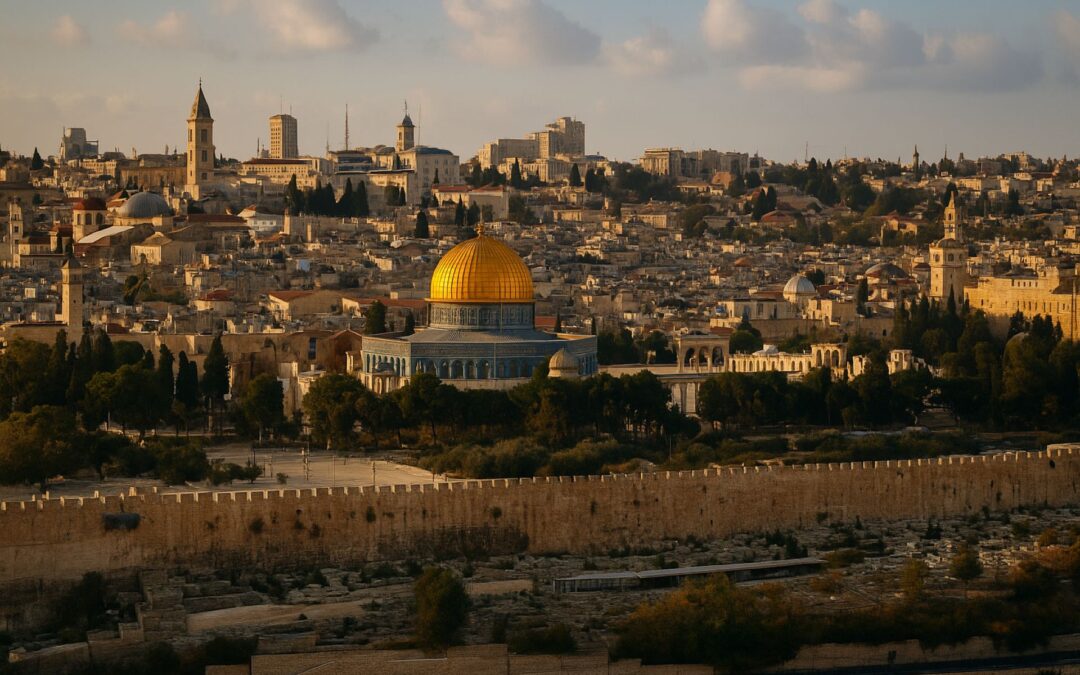
Jerusalem is unlike any other city on Earth. For nearly 5,000 years, it has stood at the intersection of history, faith, and power—revered, contested, destroyed, and rebuilt more times than almost any place known to humankind. Jews, Christians, and Muslims alike look to its stones as sacred; empires have risen and fallen fighting to possess it.
Within its walls, the echoes of prophets, kings, crusaders, and conquerors linger, each leaving their mark upon its streets. Yet behind its holiness lies a more complex truth: Jerusalem has been as much a battleground of politics and identity as it has been a beacon of devotion. To trace its history is to trace the story of humanity’s enduring struggle between belief and ambition, memory and empire.
The Earliest Beginnings
Long before Jerusalem was crowned in sanctity, it was defined by something as simple as water. Around 3000 BC, settlers gathered near the Gihon Spring, a bubbling source that sustained life in a parched and rugged land. The spring allowed the cultivation of cereals, the domestication of livestock, and the permanence of settlement. Without it, Jerusalem would likely have remained barren hills—one of countless nameless ridges in Canaan.
The Canaanites, pragmatic and resourceful, understood its strategic importance. They constructed imposing walls of stone to protect the spring from rival tribes. Within those walls, life thrived: homes of sun-baked mudbrick, narrow paths winding toward terraced fields, and shrines dedicated to their gods. The settlement was small but secure, a rare island of stability in a turbulent age.
By 2000 BC, the Egyptians had begun recording the name “Rusalimum” in their annals, marking Jerusalem’s entry into written history. At this time, the city sat on the margins of the Egyptian Middle Kingdom—a frontier outpost rather than a capital. Yet its very survival in an unforgiving landscape made it notable. By 1500 BC, Jerusalem was absorbed into Egypt’s expanding New Kingdom. For centuries it existed as a vassal, a pawn in the struggles of pharaohs, supplying tribute, garrison space, and loyalty in exchange for protection.
This arrangement was temporary. By the 12th century BC, Egypt’s authority collapsed during the Late Bronze Age turmoil. Empires fell to ruin, trade networks disintegrated, and once-mighty cities were reduced to rubble. Out of this chaos emerged new, smaller polities, one of which would change Jerusalem’s destiny forever.
Babylon, Persia, and the Exile
In the wake of Egypt’s retreat, new powers pressed forward. Among them were the Israelites, who around 1000 BC under King David wrested Jerusalem from the Jebusites. David, more than a warrior, was a strategist. By placing his throne there, he turned Jerusalem into the capital of a united kingdom—politically neutral between the northern and southern tribes and spiritually resonant as the site of the Ark of the Covenant.
David’s successor, Solomon, built upon this vision. His crowning achievement was the Temple, later known as Solomon’s Temple. Rising above the city, it became the sacred dwelling of the divine in Jewish belief, a place where ritual sacrifice and prayer bound people to their God. Jerusalem was no longer just another Canaanite hill town—it was the heart of a faith and the capital of a kingdom.
Yet unity proved fragile. Within a century, the kingdom split: Israel in the north, Judah in the south, with Jerusalem as Judah’s capital. For 400 years, it endured as a center of Jewish culture and worship, but also as a city perpetually under threat from stronger neighbors—Assyria, Egypt, and later Babylon.
In 597 BC, Jerusalem’s worst fears materialized. Nebuchadnezzar II of Babylon besieged the city and forced it into submission. A decade later, after rebellion, he returned with vengeance. The walls crumbled, Solomon’s Temple was reduced to ash, and much of the population was exiled eastward. This was not just military defeat—it was spiritual devastation, a rupture that reshaped Jewish identity into one bound by memory, exile, and hope.
In 539 BC, Persia under Cyrus the Great swept aside Babylon’s empire. Unlike Nebuchadnezzar, Cyrus pursued conciliation. He allowed Jewish exiles to return, to rebuild their city and restore their temple. The Second Temple rose, a phoenix from the ashes, though always under the shadow of foreign rule.
For the next two centuries, Jerusalem survived as a client city within Persia’s vast dominion. When Alexander the Great toppled Persia in 332 BC, the city changed hands again. Though Jerusalem endured, it did so as a jewel fought over by empires, never quite free, always caught between the ambitions of powers far greater than itself.
Rome, Christianity, and Destruction
By the 1st century BCE, Rome’s shadow loomed large over the eastern Mediterranean. Herod the Great, installed in 37 BCE as a client king, transformed Jerusalem with his immense architectural ambition. He rebuilt and expanded the Temple on a scale never before seen, creating what came to be known as the Second Temple—a sprawling complex of courtyards, colonnades, and sanctuaries clad in gleaming white stone. He also raised palaces, fortresses, and aqueducts, imprinting the city with a grandeur that rivaled the Roman world’s finest. Yet beneath these monuments seethed resentment. Herod’s reign was remembered as one of splendor built on oppression.
After Herod’s death, Jerusalem fell increasingly under direct Roman administration. The city’s population grew, reaching perhaps 100,000, mostly Jewish but with a widening diversity of sects and beliefs. Amidst this mix, a carpenter’s son from Galilee began teaching in the Temple courts. Jesus of Nazareth preached of humility, compassion, and a kingdom not of this earth. His execution by crucifixion around 30 CE—ordered under Pontius Pilate, the Roman governor—might have ended his story, but his followers proclaimed his resurrection. In Jerusalem they gathered, spreading his teachings and forming the earliest Christian communities.
Rome, however, tolerated neither separatism nor zealotry. Tensions between the Jewish population and Roman rule escalated into open revolt in 66 CE. Jerusalem became the epicenter of the uprising. The Romans responded with overwhelming force. In 70 CE, after a five-month siege, legions under Titus breached the walls. Fires consumed the city. The Temple, center of Jewish worship for centuries, was obliterated—its golden menorah carried triumphantly to Rome. Only a section of the western retaining wall survived, later venerated as the Western Wall.
Yet the embers of rebellion still smoldered. In 132 CE, the Bar Kokhba Revolt erupted, uniting Jews in one last desperate attempt to reclaim Jerusalem. The Romans, under Emperor Hadrian, crushed the revolt with brutality. Survivors were slaughtered or sold into slavery. Jerusalem was rebuilt as a Roman colony, renamed Aelia Capitolina. A temple to Jupiter rose where the Jewish Temple had once stood, and Jews were barred from entering the city except on Tisha B’Av, the day of mourning for their destroyed sanctuary.
But Rome itself was changing. In the 4th century, Emperor Constantine embraced Christianity, ending centuries of persecution. His mother Helena journeyed to Jerusalem in search of holy sites. She identified the hill of Golgotha as the place of Christ’s crucifixion and burial. There, Constantine ordered the construction of the Church of the Holy Sepulchre in 335 CE, establishing Jerusalem as the spiritual heart of Christendom. Under the Byzantine Empire, the city thrived as a Christian metropolis, its streets lined with basilicas and monasteries. The Temple Mount, once the focus of Jewish worship, was left desolate—a scar of divine judgment, as Christian theology of the time understood it.
Islam’s Arrival
In the early 7th century, another tide swept across the Middle East: the rise of Islam. Within a decade of the Prophet Muhammad’s death in 632 CE, Muslim armies united under the Rashidun Caliphate surged northward. In 638 CE, Caliph Umar ibn al-Khattab entered Jerusalem. Unlike Rome’s violent sieges, his entry was peaceful. The Christians surrendered the city, and Umar, respecting its sanctity, signed agreements guaranteeing protection of holy sites and freedom of worship. For the first time in centuries, Jews were permitted to return, ending the ban imposed since Hadrian’s day.
Jerusalem swiftly acquired sacred significance in Islam. Tradition holds that Muhammad journeyed by night to the “farthest mosque” (Al-Aqsa) and ascended to heaven from the Temple Mount. To honor this, the Umayyads commissioned two monumental structures. In 691 CE, the Dome of the Rock rose in radiant gold atop the Temple Mount, enshrining the rock from which Muhammad was believed to have ascended. Adjacent to it, the Al-Aqsa Mosque was completed, a place of prayer and gathering. Together, these edifices elevated Jerusalem into the triad of Islam’s holiest cities, alongside Mecca and Medina.
The early Islamic rulers fostered relative tolerance. Christians continued their pilgrimages, monasteries functioned, and synagogues reappeared. The city became a mosaic of faiths, its narrow streets echoing with church bells, calls to prayer, and Jewish chants. Pilgrims from all over the Islamic world streamed into Jerusalem, marveling at its shrines and markets.
Yet this harmony was fragile. In 969 CE, the Fatimid Caliphate seized control. Though initially permitting pilgrims, the regime grew increasingly hostile. In 1009, Caliph al-Hakim bi-Amr Allah ordered the destruction of the Church of the Holy Sepulchre, shocking the Christian world. Though it was later rebuilt, the desecration ignited bitterness. By the 11th century, disputes between Christians of East and West over control of Jerusalem’s churches deepened, exacerbated by the Great Schism of 1054.
Thus, on the eve of the Crusades, Jerusalem stood as a city sanctified by three faiths, but one also straining under rivalries and suspicion. For Jews, it was a long-lost homeland. For Christians, the place of Christ’s death and resurrection. For Muslims, the site of the Prophet’s night journey. Three claims, three devotions, and an inevitability: conflict.
The Crusades and Saladin
By the late 11th century, Jerusalem had become a fault line of faith and empire. In 1073, the Seljuk Turks seized it from the Fatimids, and reports soon reached Europe of Christian pilgrims being harassed on their journey to the holy sites. Though these accounts were often exaggerated, they struck a chord with a Christian world already divided after the Great Schism of 1054. To the Latin Church in Rome, Jerusalem symbolized the very soul of Christendom, and its loss under Muslim control became intolerable.
When Byzantine Emperor Alexios I Komnenos appealed to the West for aid against the Seljuks, Pope Urban II seized the opportunity. At the Council of Clermont in 1095, he called for a holy war to liberate Jerusalem. His words electrified Europe. Knights, peasants, and princes—driven by faith, greed, or the promise of salvation—marched eastward in the First Crusade. After a grueling journey of nearly 2,000 miles, they reached Jerusalem in June 1099.
The siege was brutal. For weeks the Crusaders starved, prayed, and fought before finally breaching the walls on July 15. What followed was a massacre. Muslim and Jewish inhabitants were slaughtered in the thousands, their bodies piled in the streets. Chroniclers claimed rivers of blood ran knee-deep in the courtyards of the Temple Mount. Over the carnage, the Crusaders established the Kingdom of Jerusalem, a Christian Crusader state carved into the Holy Land.
Within the walls, the city was remade in Western image. The Church of the Holy Sepulchre was rebuilt in Romanesque style. The Dome of the Rock and Al-Aqsa Mosque were seized and repurposed: the former became a church, the latter the headquarters of the Knights Templar. New institutions arose to protect the flow of pilgrims from Europe—the Hospitallers, who cared for the sick and weary, and the Templars, who guarded the roads with swords and shields. Jerusalem, once a mosaic of faiths, was now a fortress of Christian dominion.
But this dominion was not unchallenged. The Muslim world, fragmented at first, rallied under a new leader: Saladin. Founder of the Ayyubid dynasty, he united Egypt and Syria under his banner, declaring jihad to reclaim the Holy Land. In 1187, at the Battle of Hattin, his forces annihilated the Crusader army, capturing relics, banners, and kings alike. With Jerusalem defenseless, Saladin laid siege. After a week, the city surrendered. Unlike the Crusaders, Saladin spared lives, allowing Christians to ransom themselves and Jews to return after centuries of exile.
His recapture of Jerusalem sent shockwaves through Europe. The Third Crusade, led by Richard the Lionheart of England and Philip II of France, sought to retake the city. Though they regained coastal strongholds, Jerusalem remained out of reach. The Crusader dream of a permanent Christian Jerusalem slowly faded. By 1291, with the fall of Acre, the last Crusader stronghold, their presence in the Holy Land ended. Jerusalem remained firmly within the Muslim world, though its significance now lay less in politics and more in pilgrimage.
Ottoman Stability and Decline
When the Mamluk Sultanate fell to the Ottomans in 1516, Jerusalem entered a new chapter. Sultan Selim I’s conquest brought the city under the vast Ottoman Empire, which stretched from the gates of Vienna to the deserts of Arabia. Under his successor, Suleiman the Magnificent, Jerusalem was revitalized. Between 1537 and 1541, he ordered the construction of massive stone walls around the Old City—walls that still define its silhouette today. Eight gates pierced the fortifications, opening onto labyrinthine streets where mosques, churches, and synagogues stood side by side.
For centuries, Jerusalem enjoyed a relative stability it had not known in millennia. The Ottomans, pragmatic rulers, allowed each religious community to govern itself through a system known as the millet. Armenians, Orthodox Christians, Catholics, Jews, and Muslims all maintained their own institutions, courts, and holy places. The Church of the Holy Sepulchre became a stage of rivalry, with different Christian denominations vying for control of altars and chapels, often descending into quarrels so fierce that Ottoman guards had to intervene. The Western Wall, meanwhile, became the heart of Jewish prayer.
Yet beneath this tapestry of devotion, Jerusalem’s importance waned. Politically, it was a provincial backwater, far from the centers of Ottoman power in Istanbul and Cairo. Economically, it stagnated. By the 18th century, the city had dwindled into a small, dusty town of perhaps 8,000 inhabitants. Its narrow streets echoed less with commerce than with prayer, its life sustained more by pilgrims than by trade.
But the 19th century rekindled interest. As the Ottoman Empire weakened, European powers turned their gaze eastward. Britain, France, and Russia established consulates and built new churches, hospitals, and schools. Missionaries arrived to care for pilgrims, often competing fiercely for influence. Jerusalem once again became a prize—not of empires with armies, but of nations seeking prestige.
At the same time, Jewish migration increased. Waves of Jews fleeing persecution in Eastern Europe returned to their ancestral homeland, building new neighborhoods outside the Old City walls. Figures such as Sir Moses Montefiore spearheaded housing projects, and by the 1880s Jewish immigrants numbered in the tens of thousands. Their presence began reshaping the city’s demographics and sowing the seeds of the modern conflict.
By the dawn of the 20th century, Jerusalem was a paradox: a holy city revered across continents, yet physically a small, impoverished town. Its population barely exceeded 25,000, divided into quarters—Muslim, Christian, Jewish, and Armenian—each jealously guarding its sacred spaces. But the winds of change were gathering. The Ottoman Empire was in its death throes, and Jerusalem, as always, stood at the crossroads of history, waiting for the next conqueror.
British Mandate and Division
The First World War marked the twilight of Ottoman power. In December 1917, after four centuries of Turkish rule, British General Edmund Allenby entered Jerusalem on foot through the Jaffa Gate, symbolically humbling himself before the sanctity of the city. Crowds lined the streets, sensing a new era had begun. But Britain’s arrival brought not peace—it brought paradox.
Even before Allenby’s troops marched in, London had issued two conflicting promises. The Balfour Declaration of November 1917 pledged support for “a national home for the Jewish people” in Palestine, igniting hopes among Zionists scattered across Europe and the Middle East. At the same time, the British had assured Arab leaders that, in return for their rebellion against the Ottomans, they would receive independence across much of the Arab world. These promises—irreconcilable from the start—cast Jerusalem into the role of prize and battleground in a larger imperial game.
In 1920, the British established Mandatory Palestine, governing under a League of Nations mandate. Jerusalem became its administrative capital. Its population swelled from 52,000 to over 165,000 within two decades. Jewish immigration accelerated, fueled by pogroms in Eastern Europe and later by the rise of Nazi Germany. Entire new districts such as Rehavia and Mea Shearim expanded beyond the Old City walls, reshaping Jerusalem into a modern metropolis. At the same time, Arabs—both Muslim and Christian—saw their dominance slipping away, their land threatened by purchases from wealthy Jewish organizations.
By the late 1920s, tensions had boiled into violence. Riots erupted in 1929, with bloody clashes over access to the Western Wall leaving hundreds dead. In the 1930s, as Nazi persecution drove tens of thousands of Jewish refugees toward Palestine, Arab resistance hardened into revolt. The British, caught in the middle, alternately suppressed uprisings and tried to limit Jewish immigration, pleasing no one.
The Second World War only intensified the stakes. Survivors of the Holocaust flooded toward Jerusalem and its surrounding lands, desperate for sanctuary. In 1947, the United Nations attempted a solution: partition Palestine into two states, one Jewish, one Arab, with Jerusalem placed under international control. It was meant as a compromise, a neutral guarantee for all faiths. Instead, it became the spark for civil war.
By May 1948, as the British withdrew, fighting engulfed the city. The Jewish Haganah battled Arab militias street by street. The siege of Jerusalem left food convoys ambushed, water cut off, and entire neighborhoods reduced to rubble. When Israel declared independence, the conflict widened into the first Arab-Israeli war. At war’s end, Jerusalem was a city divided: West Jerusalem incorporated into the new state of Israel, East Jerusalem, including the Old City and its shrines, annexed by Jordan. Barbed wire, snipers, and barricades split streets and families. For the first time in centuries, Jews were cut off entirely from their holiest sites, including the Western Wall.
Modern Jerusalem
The partition of 1948 left deep scars, but Jerusalem’s story did not pause. For nineteen years, the city lived as a divided organism. To the west, modern Israel’s capital blossomed—new government buildings, universities, and housing for waves of immigrants. To the east, Jordan ruled the Old City, its mosques and churches still thronged by pilgrims but its Jewish quarter emptied, synagogues demolished or desecrated. Along the dividing line ran walls, fences, and minefields, an unnatural scar through the sacred heart of the city.
In June 1967, war returned. During the Six-Day War, Israeli forces swept through East Jerusalem in a matter of days. Soldiers wept at the Western Wall, once again in Jewish hands after nearly two millennia of exile and exclusion. Israel proclaimed Jerusalem “one, eternal, and indivisible,” annexing the eastern half. For Israelis, it was triumph and restoration. For Palestinians, it was dispossession and loss.
Since then, Jerusalem has become the crucible of the Israeli-Palestinian conflict. Israel expanded neighborhoods in East Jerusalem, building Jewish settlements around the Old City. Palestinians, in turn, continued to see East Jerusalem as the future capital of their own state. The city thus became two capitals claimed by two peoples, each with its own history, grievances, and hopes.
Religion ensured that Jerusalem’s importance never diminished. For Jews, the Western Wall stood as the last tangible remnant of their ancient temple. For Christians, the Church of the Holy Sepulchre remained the heart of their most sacred story. For Muslims, the golden Dome of the Rock and the Al-Aqsa Mosque marked the city as Islam’s third holiest site. All of these shrines lay within steps of one another, their proximity a constant reminder of shared sacredness and perpetual tension.
Peace efforts—Camp David in 1978, Oslo in the 1990s, and countless others—have faltered, often collapsing on the issue of Jerusalem’s sovereignty. Uprisings known as Intifadas have erupted in its streets, where stones and rifles clash beneath minarets and bell towers. International powers have debated whether to recognize Jerusalem as Israel’s capital, a question that continues to divide world diplomacy.
Today, Jerusalem is a city of paradox. On one side, it thrives with modern industries, universities, and tourism. On the other hand, it remains a flashpoint of violence and political stalemate. Its cobbled lanes echo with prayers in Hebrew, Arabic, Greek, and Latin. Its residents—Jews, Muslims, Christians, Armenians—live cheek by jowl, sharing walls and markets, yet divided by identity, politics, and memory.
Throughout all this, Jerusalem remains the most contested, revered, and symbolically charged city on Earth. It is not just a place—it is a mirror of humanity’s longing for faith, belonging, and power.
Conclusion
Jerusalem’s story is not one of peace, but of resilience. From a settlement by a spring to the heart of three world religions, it has endured Babylonian exile, Roman destruction, Crusader conquest, Ottoman decline, British mandate, and the modern struggle between Israelis and Palestinians. Each era left scars and sanctuaries, ruins and revelations.
Today, within a few hundred meters stand the Western Wall, the Church of the Holy Sepulchre, and the Dome of the Rock—monuments to the city’s layered holiness and unending conflict. Jerusalem remains sacred to billions, a symbol of humanity’s highest hopes and deepest divisions. Its history reminds us that no empire is eternal, but the longing for meaning, identity, and connection to the divine endures forever in its stones.