
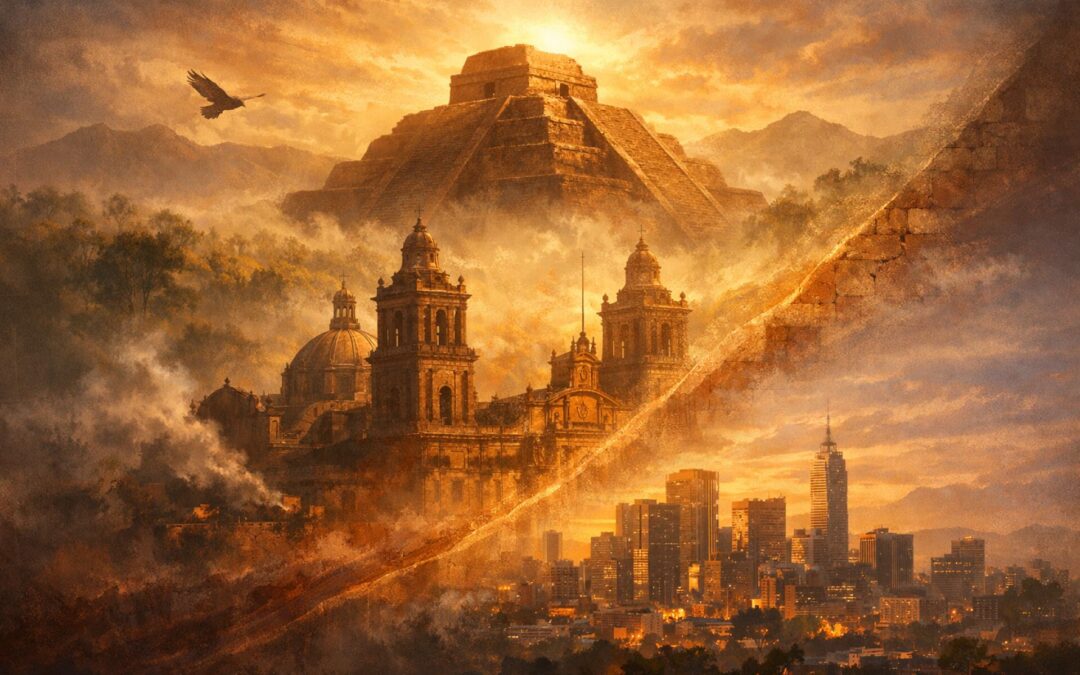
Few nations in the world possess a history as dramatic, layered, and transformative as Mexico. From the towering pyramids of ancient civilizations to the upheavals of revolution and the emergence of a modern global power, Mexico’s story is one of constant reinvention shaped by centuries of cultural exchange, political conflict, and social transformation.
Long before the arrival of Europeans, the region known today as Mexico was the heart of Mesoamerica, one of the great cradles of civilization in the ancient world. Here, complex societies developed monumental architecture, sophisticated calendars, advanced mathematics, and thriving cities that rivaled those of the Old World. Civilizations such as the Olmec, Maya, Toltec, and Aztec left behind enduring legacies that still influence Mexican identity today.
Yet the course of this history changed dramatically in the early 16th century when Spanish conquistadors arrived on the shores of the New World. Their conquest of the Aztec Empire initiated one of the most profound transformations in human history: the merging of Indigenous American societies with European institutions, religion, and economic systems. The colonial era that followed reshaped Mexico’s political structures, population, and culture, laying the foundations of the modern nation.
Over the centuries that followed, Mexico would experience dramatic upheavals. The struggle for independence from Spain, the turbulent political experiments of the 19th century, territorial conflicts with the United States, foreign intervention, dictatorship, and one of the most significant revolutions of the modern era all played defining roles in shaping the country.
Despite these challenges, Mexico emerged as a resilient nation that forged a unique cultural identity out of its diverse influences. Indigenous traditions blended with Spanish heritage to create distinctive customs, cuisine, art, and religious practices that continue to define Mexican culture today. By the 20th century, political consolidation and economic development began to transform the country into a modern state, even as it continued to grapple with new social and political challenges.
Today, Mexico stands as one of the most culturally influential nations in the world—renowned for its vibrant traditions, historical depth, and dynamic society. To understand how this remarkable nation came to be, we must journey back thousands of years to the earliest peoples who first settled the lands of Mesoamerica and laid the foundations of Mexican civilization.
The First Peoples of Mesoamerica
The story of Mexico begins thousands of years before the rise of cities, empires, and written history. The earliest humans to inhabit the region arrived during the final stages of the last Ice Age, when much of the world looked dramatically different from today.
Between roughly 26,000 and 19,000 years ago, small groups of hunter-gatherers migrated from Asia into North America by crossing a vast land bridge known as Beringia, which once connected Siberia to Alaska. At the time, lower global sea levels exposed this natural passage, allowing humans and animals to move between the continents. Over generations, these early migrants gradually spread southward across the Americas, exploring and settling new landscapes.
By around 11,000 years ago, rising sea levels submerged the Bering land bridge, permanently separating the continents. But by that point, human populations had already dispersed widely across the Western Hemisphere. Some groups eventually reached the fertile and environmentally diverse region that would later be known as Mesoamerica, which includes much of present-day Mexico and parts of Central America.
This region offered a remarkable combination of natural advantages. Its varied geography included fertile valleys, tropical forests, highland plateaus, and coastal plains. Rivers and seasonal rainfall supported plant life, while forests and grasslands sustained abundant wildlife. These environmental conditions made it possible for early human communities to gradually shift from nomadic hunting and gathering toward more stable forms of settlement.
Over time, the inhabitants of Mesoamerica began to experiment with agriculture, one of the most important turning points in human history. By approximately 2000 BC, many communities had adopted intensive farming techniques that allowed them to cultivate crops such as maize (corn), beans, squash, and chili peppers. Maize in particular would become the cornerstone of Mesoamerican civilization, shaping diet, culture, and mythology for thousands of years.
The development of agriculture enabled people to establish permanent settlements, which gradually grew into villages and eventually into complex societies. As populations expanded, communities developed specialized roles such as artisans, traders, farmers, and religious leaders. Trade networks began to form, linking distant regions and spreading ideas, goods, and technologies.
These early developments laid the foundations for the great civilizations that would later emerge in the region. Over the following centuries, societies in Mesoamerica began to develop monumental architecture, organized religion, social hierarchies, and political institutions. The region would soon give rise to some of the most sophisticated cultures of the ancient world.
The first of these civilizations would appear along the humid Gulf Coast of Mexico, where a mysterious culture known as the Olmec began to flourish. Their achievements would mark the true beginning of Mesoamerican civilization and set the stage for everything that followed.
The Rise of the First Mesoamerican Civilizations
By the second millennium BC, the agricultural communities of Mesoamerica had grown increasingly complex. Permanent settlements expanded into organized towns, social hierarchies began to emerge, and religious life became more structured. These developments laid the groundwork for the first true civilizations of the region—societies capable of building monumental architecture, sustaining large populations, and exerting influence far beyond their immediate territories.
Over the centuries, several powerful cultures rose to prominence across Mesoamerica. Each contributed important innovations in governance, religion, architecture, science, and art, creating a civilizational tradition that would shape the region for thousands of years.
The Olmec Civilization
The earliest known major civilization in Mesoamerica was the Olmec, who flourished along the humid tropical lowlands of the Gulf Coast in what are now the Mexican states of Veracruz and Tabasco. Emerging around 1200 BC, the Olmec are often referred to as the “mother culture” of Mesoamerica because many of the cultural and religious traditions that defined later civilizations can be traced back to them.
Olmec society developed large ceremonial centers such as San Lorenzo, La Venta, and Tres Zapotes, which served as political and religious hubs. These settlements featured complex urban planning, including plazas, pyramidal platforms, and ceremonial structures.
Perhaps the most iconic symbols of the Olmec are the enormous colossal stone heads carved from basalt. Some of these sculptures weigh several tons and depict rulers wearing elaborate helmets, suggesting a society with powerful leaders and a highly organized labor force capable of transporting massive stones across great distances.
The Olmec also introduced important cultural elements that later civilizations would adopt and expand upon. These included early forms of writing, a sophisticated religious worldview centered on powerful deities, and symbolic artistic motifs that spread widely across Mesoamerica through trade and cultural exchange.
By around 400 BC, however, the Olmec civilization had begun to decline for reasons that remain uncertain. Environmental changes, political instability, or internal conflict may have contributed to their disappearance. Yet their cultural legacy endured, influencing the societies that followed.
Teotihuacan: The First Great Metropolis
Several centuries after the decline of the Olmec, a new center of power emerged in the Valley of Mexico. Known today as Teotihuacan, this city would become one of the largest and most influential urban centers in the ancient Americas.
Founded sometime before the first century AD, Teotihuacan grew rapidly into a vast metropolis. At its peak during the early centuries of the first millennium, the city may have housed over 100,000 inhabitants, making it one of the largest cities in the world at the time.
Teotihuacan was renowned for its monumental architecture. The city was carefully planned along a central axis known as the Avenue of the Dead, which connected several massive ceremonial structures. Among these were the enormous Pyramid of the Sun and Pyramid of the Moon, two of the largest pyramids ever built in the Americas.
The city was not only a religious center but also a hub of trade and cultural influence. Goods such as obsidian tools, pottery, textiles, and precious materials circulated widely through Mesoamerican trade networks, spreading the city’s influence far beyond the Valley of Mexico.
Although historians still debate the precise nature of its political system, Teotihuacan clearly exercised immense cultural and economic power. Its architectural style, artistic motifs, and religious imagery appeared across distant regions, demonstrating the city’s widespread prestige.
The Maya and Their Intellectual Achievements
While Teotihuacan dominated central Mexico, another remarkable civilization flourished further to the southeast. The Maya inhabited a vast region that included the Yucatán Peninsula, parts of southern Mexico, Belize, Guatemala, and Honduras.
Unlike Teotihuacan’s centralized urban structure, the Maya world consisted of numerous independent city-states, each ruled by its own king. Powerful cities such as Tikal, Calakmul, and Palenque competed for political influence and control over trade routes.
What distinguished the Maya above all was their intellectual and scientific achievements. They developed one of the most sophisticated writing systems in the pre-Columbian Americas, allowing them to record dynastic histories, religious events, and astronomical observations in detailed hieroglyphic inscriptions.
Mayan scholars also made remarkable advances in mathematics and astronomy. They used a vigesimal (base-20) number system and were among the first civilizations in the world to independently develop the concept of zero. Their complex calendars accurately tracked solar and lunar cycles and played a central role in religious ceremonies and political life.
Like other Mesoamerican civilizations, the Maya built impressive ceremonial architecture, including stepped pyramids, temples, palaces, and ball courts. These structures served as both religious centers and symbols of political authority.
However, by the 9th century, many major Maya cities in the southern lowlands were abandoned. Scholars continue to debate the reasons for this collapse, with possible explanations including warfare between rival city-states, environmental stress, overpopulation, or prolonged drought.
The disappearance of these cities did not mean the end of the Maya people, who continued to inhabit the region and maintain many of their cultural traditions. But the decline of these once-powerful urban centers marked the end of one of the most remarkable chapters in the history of ancient Mesoamerica.
Collapse and Transformation in the Mesoamerican World
The rise of the great Mesoamerican civilizations brought centuries of prosperity, monumental architecture, and intellectual achievements. Yet like many complex societies throughout history, these civilizations eventually faced periods of decline and upheaval. Between the 6th and 10th centuries AD, much of Mesoamerica experienced dramatic transformations that reshaped the political and cultural landscape of the region.
Several of the great urban centers that had once dominated the region either collapsed or declined significantly. Cities were abandoned, trade networks weakened, and power shifted toward new societies that would eventually rise to prominence.
The Decline of Teotihuacan
One of the most significant events in early Mesoamerican history was the decline of Teotihuacan, the immense metropolis that had dominated central Mexico for centuries. At its height, the city had been one of the largest urban centers in the world, exerting economic and cultural influence across vast distances.
However, by the 6th century AD, signs of instability began to appear. Archaeological evidence suggests that many of the city’s elite buildings were burned or destroyed, indicating the possibility of internal rebellion or political conflict. The precise causes of Teotihuacan’s downfall remain uncertain, but historians have proposed several explanations.
Some scholars believe that growing social inequality may have triggered unrest among the population. Others suggest that external pressures, including conflict with neighboring societies, may have weakened the city’s authority. Environmental factors such as drought or resource depletion may also have contributed to the city’s gradual decline.
Whatever the cause, Teotihuacan’s collapse marked the end of one of the most powerful civilizations in the Americas. Yet its influence endured long after the city itself fell. Later cultures would continue to revere its monumental ruins and adopt many of its architectural and religious traditions.
The Fragmentation of the Maya
Around the same period, the Maya world was also undergoing profound upheaval. During the Classic Maya period, powerful city-states across the southern lowlands had constructed vast ceremonial complexes and maintained sophisticated political systems.
By the 9th century, however, many of these great cities began to decline rapidly. Once-thriving urban centers such as Tikal, Copán, and Palenque were gradually abandoned, leaving behind towering pyramids and overgrown temples that still stand today.
The reasons behind the Maya collapse have long been debated by historians and archaeologists. Unlike a single catastrophic event, the decline appears to have been the result of multiple interconnected problems.
One major factor was likely prolonged warfare between rival city-states. Political competition had intensified over time, leading to increasingly destructive conflicts that destabilized the region. At the same time, growing populations placed pressure on agricultural systems, possibly leading to soil exhaustion and food shortages.
Environmental challenges may have further exacerbated the crisis. Evidence suggests that the region experienced periods of severe drought during the late Classic period, which would have placed enormous strain on water supplies and agricultural production.
As these pressures mounted, many cities were gradually abandoned. However, like the earlier collapse of Teotihuacan, the disappearance of these political centers did not mean the end of the Maya civilization itself. Maya communities continued to survive and adapt, especially in the northern Yucatán Peninsula, where new centers of power emerged.
The Rise of the Toltecs
Out of this era of upheaval emerged new political forces that reshaped the balance of power in Mesoamerica. Among the most influential of these were the Toltecs, who rose to prominence around the 10th century.
The Toltecs established their capital at Tula, located north of the Valley of Mexico. From this strategic location, they built a powerful society that came to dominate much of central Mexico for several centuries.
Toltec culture was heavily influenced by the earlier traditions of Teotihuacan, but it also introduced new military and political elements that would shape later Mesoamerican societies. Their art and architecture often depicted warriors and symbols of conquest, suggesting that military power played a major role in maintaining their authority.
Toltec religious traditions also spread widely across Mesoamerica. One of the most important figures associated with their culture was the deity Quetzalcoatl, the feathered serpent god who would later become central to Aztec religion and mythology.
Although the Toltec state eventually declined by the 12th century, its cultural influence endured. Later civilizations, especially the Aztecs, would look back on the Toltecs as legendary ancestors and models of civilization.
As the Toltec world faded, new groups began to migrate into the Valley of Mexico. Among them were a people who would eventually establish one of the most powerful empires in the history of Mesoamerica—the Aztecs.
The Aztec Empire and the Height of Indigenous Power
By the early 14th century, the political landscape of central Mexico had once again begun to shift. The decline of earlier civilizations such as the Toltecs left behind a fragmented region filled with competing city-states. Into this complex environment arrived a group of migrants known as the Mexica, who would later become famous as the Aztecs.
Though initially regarded as outsiders and often marginalized by established societies, the Mexica would eventually build one of the most powerful empires in the history of Mesoamerica. Within just a few generations, they transformed themselves from wandering migrants into the dominant political force of central Mexico.
The Founding of Tenochtitlan
According to Aztec tradition, the Mexica were guided by their patron god Huitzilopochtli, who instructed them to settle where they witnessed a prophetic sign: an eagle perched on a cactus devouring a snake. After years of migration through the Valley of Mexico, they claimed to have seen this omen on a small island in Lake Texcoco.
In 1325, the Mexica founded the city of Tenochtitlan at this location. At first, the settlement was modest and politically weak compared to its neighbors. However, the Mexica gradually expanded their influence through military alliances and strategic diplomacy.
The location of the city proved surprisingly advantageous. Surrounded by water, Tenochtitlan was connected to the mainland by large causeways and protected by natural defenses. The inhabitants also developed innovative agricultural techniques known as chinampas, or floating gardens, which allowed them to cultivate crops in the shallow waters of the lake and support a rapidly growing population.
Over time, Tenochtitlan developed into one of the largest cities in the world. By the early 16th century, the city may have had around 200,000 inhabitants, making it comparable in size to many major European capitals of the time.
The Structure of the Aztec Empire
The rise of Aztec power accelerated in the 15th century when Tenochtitlan formed a powerful alliance with two neighboring cities—Texcoco and Tlacopan. This coalition, known as the Triple Alliance, became the foundation of what historians now call the Aztec Empire.
Through a series of military campaigns, the alliance expanded its influence across much of central Mexico. Rather than directly controlling every territory they conquered, the Aztecs established a system in which defeated regions were required to pay tribute in the form of goods, labor, and resources.
These tribute payments included valuable commodities such as cotton textiles, cacao beans, feathers, precious stones, and agricultural produce. The enormous flow of wealth into Tenochtitlan helped transform the city into a prosperous political and economic center.
Despite its power, the Aztec Empire remained relatively fragile. Many of the territories it ruled were resentful of the tribute system and only remained under Aztec authority due to military intimidation. This widespread resentment would later play a crucial role during the Spanish conquest.
Religion, Ritual, and Human Sacrifice
Religion lay at the heart of Aztec society and shaped nearly every aspect of life. The Aztecs believed that the universe was sustained through the continuous nourishment of the gods, particularly through ritual offerings and sacrifices.
One of the most important religious sites in Tenochtitlan was the Templo Mayor, a massive pyramid that stood at the center of the city. This temple served as the focal point for religious ceremonies and state rituals.
Among the most controversial aspects of Aztec religion was the practice of human sacrifice. According to Aztec cosmology, the gods had sacrificed themselves to create the world and set the sun in motion. Human offerings were therefore seen as a necessary act of repayment to sustain the cosmic order.
Captives taken during warfare were often used in these rituals. Though shocking to European observers, these practices were deeply integrated into the Aztec worldview and religious traditions.
By the early 16th century, the Aztec Empire controlled a vast territory and ruled over millions of people. Its capital city stood as one of the most impressive urban centers in the world, filled with temples, markets, canals, and palaces.
Yet despite its strength and wealth, the empire faced internal tensions and external threats. Many neighboring peoples resented Aztec dominance, and this resentment would soon prove decisive when a small group of Spanish explorers arrived on the coast of Mexico in 1519.
The collision between these two worlds—Indigenous Mesoamerica and European colonial expansion—would bring about one of the most dramatic turning points in the history of the Americas.
The Spanish Conquest of Mexico
By the early 16th century, the Aztec Empire stood as the dominant political force in central Mexico. Its capital, Tenochtitlan, was a thriving metropolis of canals, temples, markets, and causeways, ruling over millions through a vast network of tribute-paying territories. Yet despite its power, the empire was internally fragile. Many of the peoples it had conquered resented Aztec rule and were eager for an opportunity to break free.
That opportunity arrived in 1519, when a small expedition of Spanish conquistadors landed on the Gulf Coast of Mexico. What followed would become one of the most consequential encounters in world history—the violent collision between European imperial ambition and the civilizations of the New World.
The Arrival of Hernán Cortés
The expedition that would ultimately bring down the Aztec Empire was led by Hernán Cortés, a Spanish conquistador operating under the authority of the Spanish crown. In February 1519, Cortés sailed from Cuba with a small force of around 500 soldiers, accompanied by a handful of horses, artillery pieces, and ships.
The Spanish landed along the Caribbean coast and soon established a settlement called Villa Rica de la Vera Cruz, the first permanent Spanish town in what would become Mexico. From this foothold, Cortés began gathering information about the powerful empire that dominated the interior of the region.
Reports from local peoples spoke of the immense wealth of the Aztec capital and the vast tribute system that supported it. But Cortés also learned something equally important: many Indigenous communities were deeply dissatisfied with Aztec domination.
Alliances with Indigenous Rivals
Rather than confronting the Aztecs alone, Cortés pursued a strategy that proved decisive—forming alliances with rival Indigenous groups. Several tribes had long been forced to pay tribute to the Aztec Empire and saw the arrival of the Spaniards as an opportunity to overthrow their overlords.
One of the most important of these allies was the Tlaxcalans, a powerful group that had resisted Aztec expansion for decades. After initial clashes with the Spaniards, the Tlaxcalans ultimately joined Cortés and provided thousands of warriors to support the expedition.
These alliances dramatically strengthened the Spanish position. Although the Spaniards themselves were relatively few in number, their Indigenous allies provided crucial manpower, local knowledge, and logistical support. The conquest of the Aztec Empire would ultimately be achieved not by Spaniards alone, but by a coalition of forces united against Aztec rule.
The Fall of Tenochtitlan
Cortés and his allies began their march toward the Aztec capital, arriving at Tenochtitlan in November 1519. The Aztec emperor Montezuma II initially welcomed the Spaniards into the city, though historians continue to debate his motives. Some believe he hoped to avoid immediate conflict, while others suggest he was uncertain about the intentions and capabilities of these strange newcomers.
Tensions quickly escalated. The Spaniards eventually seized Montezuma and attempted to rule through him as a puppet leader. However, unrest soon spread throughout the city, and the fragile peace collapsed into open rebellion.
In 1520, the Spaniards were forced to flee the city during a disastrous retreat known as La Noche Triste, or “The Night of Sorrows.” But Cortés regrouped with his allies and launched a full-scale assault on the capital the following year.
After months of brutal fighting, siege warfare, famine, and disease, Tenochtitlan fell in August 1521. The once-great city was devastated, and the Aztec Empire collapsed.
Several factors contributed to the Spanish victory. Superior weapons and military tactics gave the conquistadors an advantage, but perhaps the most decisive factor was the arrival of European diseases, particularly smallpox, which spread rapidly among Indigenous populations who had no immunity. Entire communities were devastated, weakening resistance across the region.
Following the conquest, the ruins of Tenochtitlan were rebuilt as Mexico City, which became the capital of a new Spanish colony known as New Spain.
The conquest of Mexico marked the beginning of a new era. Spanish rule would fundamentally reshape the region’s political structures, economy, religion, and population. Indigenous societies did not disappear, but they were forced to adapt to a new colonial order that would dominate Mexico for the next three centuries.
The Creation of New Spain
With the fall of Tenochtitlan in 1521, the Spanish conquest of central Mexico was effectively complete. In the ruins of the Aztec capital, the Spanish began constructing a new colonial city that would become the center of their authority in the Americas. This new settlement—Mexico City—was built directly atop the remains of Tenochtitlan and would serve as the capital of a vast colonial territory known as New Spain.
Over the following decades, Spanish authorities set about reorganizing the conquered lands according to European political, economic, and religious institutions. The transformation was profound. Indigenous political systems were dismantled, Spanish administrators took control of governance, and the region was integrated into the expanding global empire of Spain.
Colonial Governance and Society
The Spanish crown ruled its American territories through a highly centralized administrative system. New Spain was governed by a viceroy, a royal representative appointed by the king of Spain who exercised authority over the colony in the monarch’s name.
The viceroyalty of New Spain eventually became one of the largest and most important territories in the Spanish Empire. At its height, it extended far beyond modern-day Mexico. The colony’s northern frontier stretched into what are now parts of the southwestern United States, while its southern territories included much of Central America.
Spanish settlers established new towns and cities throughout the region, often built around a central plaza that contained key institutions such as churches, government buildings, and markets. Catholic missionaries accompanied these settlers, seeking to convert Indigenous populations to Christianity and integrate them into the colonial system.
Although Indigenous communities were often allowed to maintain certain local traditions and leadership structures, ultimate authority rested firmly with Spanish colonial officials and settlers.
The Encomienda System and Forced Labor
To support the rapid development of the colony, Spanish authorities implemented a system known as the encomienda. Under this arrangement, Spanish settlers were granted the right to collect tribute and labor from Indigenous communities in exchange for providing protection and religious instruction.
In practice, the system often resembled a form of forced labor. Indigenous populations were compelled to work in fields, mines, and construction projects under harsh conditions. Many communities were displaced or reorganized to serve the needs of colonial economic production.
At the same time, Catholic missionaries attempted to reshape Indigenous spiritual life by introducing Christianity. Churches and monasteries were built across the region, and missionaries sought to replace traditional belief systems with Catholic practices. Despite these efforts, many Indigenous religious traditions survived by blending with Christian rituals and symbols.
Silver Mining and the Colonial Economy
One of the most important foundations of New Spain’s economy was the discovery of vast silver deposits in northern Mexico. Mines such as those at Zacatecas and Guanajuato became major centers of wealth extraction, producing enormous quantities of precious metal.
Silver quickly became the backbone of the colonial economy. The mines attracted settlers, laborers, merchants, and administrators from across the Spanish Empire. Entire towns grew around these mining centers, creating networks of trade that connected Mexico to Europe and Asia.
The silver extracted from New Spain was transported across the Atlantic to Spain, enriching the Spanish crown and fueling the expansion of global commerce. In many ways, Mexico became one of the economic pillars of the Spanish Empire.
As the colonial economy expanded, Spanish landowners also established large plantations that produced crops such as sugar, tobacco, and other agricultural goods. These estates relied heavily on labor from Indigenous communities, and later also on enslaved Africans who were brought to the Americas through the transatlantic slave trade.
The result was the emergence of a complex colonial society marked by deep social divisions but also by significant cultural interaction. Over time, the blending of Indigenous, European, and African peoples would give rise to a distinctive cultural identity that would later become central to the nation of Mexico itself.
Cultural Fusion in Colonial Mexico
Although the Spanish conquest dramatically transformed the political and economic structures of Mesoamerica, it did not erase the cultures that had existed there for thousands of years. Instead, the colonial period produced a remarkable process of cultural blending, as Indigenous, Spanish, and African influences gradually fused together to create a new and distinct society.
Over time, this cultural interaction gave rise to many of the traditions, identities, and social structures that would eventually define Mexico. Language, religion, art, food, and social life were all reshaped by this long period of colonial transformation.
The Colonial Caste System
As the population of New Spain grew more diverse, Spanish authorities attempted to organize society through a strict racial hierarchy, commonly known as the casta system. This system categorized individuals according to their ancestry and determined their social status, economic opportunities, and legal privileges.
At the top of this hierarchy were the peninsulares, Spaniards who had been born in Spain and migrated to the colonies. They typically held the highest government and church positions and formed the ruling elite of colonial society.
Just below them were the criollos, people of Spanish descent who had been born in the Americas. Although many criollos were wealthy and influential, they were often excluded from the most powerful political offices, which created resentment toward the peninsular elite.
Beneath these groups were people of mixed ancestry, commonly referred to as mestizos, who had both Spanish and Indigenous heritage. Mestizos gradually became one of the largest groups within colonial society and played an important role in shaping the emerging cultural identity of Mexico.
At the bottom of the hierarchy were Indigenous peoples and enslaved Africans, who were often subjected to the harshest forms of exploitation and discrimination. Despite these social divisions, everyday life in the colonies often blurred the rigid boundaries that Spanish authorities tried to impose.
Religion and Cultural Syncretism
Religion became one of the most important arenas in which cultural blending occurred. The Spanish crown and Catholic Church invested enormous resources into converting Indigenous populations to Catholicism, building churches, monasteries, and missions throughout New Spain.
Missionaries taught Christian doctrines and encouraged Indigenous communities to adopt Catholic rituals. However, rather than completely abandoning their traditional beliefs, many Indigenous peoples integrated elements of their earlier religious traditions into Christian practices.
This process of religious syncretism produced new cultural expressions that combined European and Indigenous influences. One famous example is the veneration of the Virgin of Guadalupe, who became one of the most important religious symbols in Mexico. For many believers, the Virgin represented both Catholic devotion and deeper Indigenous spiritual traditions.
Another example is the celebration of Día de los Muertos (Day of the Dead), a festival that blends Catholic observances with ancient Indigenous rituals honoring deceased ancestors. Today, it remains one of the most iconic cultural traditions associated with Mexico.
The Emergence of Mexican Identity
Over the centuries, the interaction between Spanish, Indigenous, and African communities produced a distinctive culture that was neither purely European nor purely Indigenous. Instead, a unique Mexican identity gradually emerged.
This identity was expressed in language, music, food, and artistic traditions. Spanish became the dominant language of administration and public life, but many Indigenous languages continued to be spoken across the region. Mexican cuisine blended Indigenous staples such as maize, beans, and chili peppers with European ingredients and cooking techniques.
Music and dance also reflected this cultural fusion, giving rise to traditions such as mariachi, while agricultural practices produced beverages like tequila, which would later become internationally recognized symbols of Mexican culture.
Despite the rigid social hierarchy imposed by colonial rule, these cultural exchanges created a vibrant and complex society. By the late colonial period, many inhabitants of New Spain—particularly the criollos and mestizos—had begun to see themselves not simply as subjects of Spain but as members of a distinct community.
This growing sense of identity would eventually play a critical role in the events that unfolded at the beginning of the 19th century, when revolutionary ideas began to spread across the Atlantic world and inspire movements for independence throughout the Americas.
The Road to Mexican Independence
By the late 18th and early 19th centuries, the colonial system that had governed New Spain for nearly three hundred years was beginning to show signs of strain. Economic inequality, social divisions, and political exclusion had created growing resentment among large segments of the population. At the same time, revolutionary ideas spreading across the Atlantic world began to challenge the legitimacy of imperial rule.
These developments gradually set the stage for a movement that would ultimately bring an end to Spanish colonial authority in Mexico.
The Impact of Global Revolutions
The late 18th century was an era of dramatic political change. The American Revolution (1776) and the French Revolution (1789) demonstrated that established monarchies could be challenged and replaced by new systems of governance based on popular sovereignty and national identity.
These ideas spread throughout the Spanish Empire, particularly among the criollos—people of Spanish descent who had been born in the Americas. Although many criollos were wealthy and influential, they were often excluded from the highest positions in government and the church, which were reserved for Spaniards born in Europe.
As Enlightenment ideas circulated through books, pamphlets, and conversations, many members of the colonial elite began to question the legitimacy of Spanish rule. Meanwhile, social tensions among peasants, Indigenous communities, and the urban poor continued to intensify.
Yet the immediate catalyst for revolution came not from Mexico itself but from events in Europe.
In 1808, Napoleon Bonaparte invaded Spain and forced the Spanish king to abdicate. Napoleon then installed his own brother, Joseph Bonaparte, as the new ruler of Spain. This unexpected development created a political crisis across the Spanish Empire, as colonial territories suddenly faced uncertainty about who held legitimate authority.
In New Spain, different factions proposed competing solutions. Some believed loyalty should remain with the Spanish monarchy, while others argued that the colonies should govern themselves. These tensions soon escalated into open rebellion.
Miguel Hidalgo and the First Uprising
The Mexican War of Independence began in 1810, when a Catholic priest named Miguel Hidalgo y Costilla issued a call to arms against Spanish colonial rule. According to tradition, Hidalgo rang the bells of his church in the town of Dolores and delivered a passionate speech urging the population to rise up against oppression.
This event, known as the Grito de Dolores, is widely regarded as the symbolic beginning of the Mexican struggle for independence.
Hidalgo’s movement quickly gained momentum among the lower classes, including peasants, Indigenous communities, and mestizos who were dissatisfied with the colonial system. Thousands of followers joined the insurgent forces as they marched through central Mexico.
Despite their enthusiasm, the rebels lacked organization and military discipline. Spanish royalist forces eventually defeated Hidalgo’s army, and he was captured and executed in 1811. However, the rebellion he had ignited continued under other revolutionary leaders.
The Plan of Iguala and Independence
Over the next decade, the struggle for independence continued through a series of uprisings and guerrilla campaigns led by figures such as José María Morelos and Vicente Guerrero. Although these insurgent movements achieved some successes, the conflict remained largely unresolved for many years.
The turning point came in 1821, when a surprising alliance formed between two former enemies. Agustín de Iturbide, a royalist military commander, joined forces with insurgent leader Vicente Guerrero. Together they issued the Plan of Iguala, a political agreement that outlined the principles of a new independent Mexican state.
The plan proposed three central guarantees: the preservation of Catholicism, the establishment of independence from Spain, and the creation of a society in which both Spaniards and Mexicans would enjoy equal rights.
This alliance quickly gained widespread support, and the Spanish colonial government collapsed soon afterward. In September 1821, Mexico formally declared its independence from Spain, ending three centuries of colonial rule.
Yet the creation of an independent nation did not immediately bring stability. The newly independent Mexico soon faced enormous challenges as it struggled to define its political institutions, manage its vast territory, and reconcile competing visions for the country’s future.
Empire, Republic, and Early Political Instability
When Mexico finally achieved independence from Spain in 1821, the new nation inherited enormous challenges. After three centuries of colonial rule, the country had little experience with self-government. Its economy had been disrupted by years of war, its political institutions were fragile, and deep divisions existed between competing political factions.
In the years that followed independence, Mexico struggled to define what kind of nation it would become. Monarchists, republicans, liberals, and conservatives all proposed different visions for the country’s future. The result was decades of political instability marked by coups, short-lived governments, and shifting alliances.
The First Mexican Empire
Immediately after independence, Mexico briefly adopted a monarchical system. The revolutionary coalition that had overthrown Spanish rule believed that a monarchy might provide stability during the fragile early years of the new nation.
In 1822, the military leader Agustín de Iturbide, who had played a central role in securing independence, was crowned Emperor Agustín I. The newly formed Mexican Empire was vast, encompassing not only modern-day Mexico but also territories stretching from California in the north to parts of Central America in the south.
However, the empire soon encountered serious problems. The government faced a severe financial crisis, political divisions deepened between supporters of the emperor and those who favored republican government, and Iturbide struggled to maintain legitimacy.
Within just two years, opposition to the emperor grew so strong that Iturbide was forced to abdicate in 1823. The brief experiment with monarchy ended, and Mexico moved toward establishing a republican system.
The Birth of the Mexican Republic
Following the collapse of the empire, Mexico adopted a federal republic modeled partly on the political system of the United States. The new constitution, adopted in 1824, created a government divided into executive, legislative, and judicial branches.
Despite these reforms, political stability remained elusive. Rival factions competed for power, and governments frequently rose and fell through military coups rather than orderly elections. Economic problems and regional tensions further complicated the country’s efforts to build a functioning state.
At the same time, Mexico faced the challenge of governing its enormous territory, much of which remained sparsely populated and difficult to control. The northern regions, in particular, were distant from the political center in Mexico City and vulnerable to outside pressures.
The Rise of Santa Anna
One of the most influential—and controversial—figures of this turbulent period was Antonio López de Santa Anna, a military leader who would dominate Mexican politics for decades.
Santa Anna first rose to prominence as a general during the early years of the republic. Over time, he became a central figure in numerous political upheavals and would serve as president of Mexico multiple times, sometimes as a defender of the republic and at other times as an authoritarian ruler.
Santa Anna’s shifting political alliances reflected the instability of the era. Governments frequently changed direction, swinging between federalist and centralist policies as different factions gained influence.
During this period, Mexico also adopted a policy intended to strengthen control over its northern territories. To encourage settlement and economic development in the remote region of Texas, the Mexican government offered land grants to settlers—many of whom came from the United States.
This policy would soon have unintended consequences. As the population of American settlers in Texas grew, tensions between them and the Mexican government began to intensify.
These tensions would soon erupt into open conflict, triggering events that would dramatically reshape the borders of Mexico and alter the balance of power in North America.
Territorial Loss and National Crisis
By the mid-19th century, the young Mexican nation faced one of the most difficult periods in its history. Political instability, weak institutions, and regional tensions left the country vulnerable to internal rebellions and external pressure. Nowhere were these tensions more apparent than in Mexico’s vast northern territories.
The struggle to maintain control over these regions would soon lead to war, territorial loss, and a profound national crisis that reshaped the geography of North America.
The Texas Revolution
During the early decades after independence, the Mexican government encouraged settlement in the sparsely populated region of Texas. Authorities hoped that new settlers would strengthen the frontier, stimulate economic development, and help protect the territory from foreign encroachment.
Many of the settlers who moved to Texas came from the United States. In exchange for land grants, these settlers were expected to adopt Mexican citizenship, convert to Catholicism, and follow Mexican laws. However, these expectations were often ignored, and tensions gradually increased between the settlers and the Mexican government.
One particularly contentious issue was slavery. Mexico had abolished slavery, but many American settlers in Texas continued to rely on enslaved labor. As disputes over governance and cultural differences deepened, calls for autonomy—and eventually independence—began to grow among the settlers.
In 1835, open rebellion erupted, beginning the Texas Revolution. Several dramatic battles defined the conflict, including the famous Battle of the Alamo, where a small group of Texan defenders was overwhelmed by Mexican forces led by General Santa Anna.
Despite early victories by Mexico, the conflict ended in disaster for the Mexican government. In 1836, Texan forces defeated Santa Anna’s army at the Battle of San Jacinto, capturing the general and forcing him to recognize the independence of the Republic of Texas.
Although Mexico refused to formally accept Texas as an independent nation, the new republic existed for nearly a decade before being annexed by the United States in 1845.
The Mexican–American War
The annexation of Texas dramatically escalated tensions between Mexico and the United States. Disputes over the exact boundary between Texas and Mexico soon led to open conflict.
In 1846, the Mexican–American War broke out. The conflict proved devastating for Mexico. The United States possessed a larger economy, more stable political institutions, and a more organized military.
American forces launched multiple campaigns against Mexico, advancing deep into the country’s territory. In one of the most humiliating moments of the war, U.S. troops marched into Mexico City and occupied the capital.
After two years of fighting, Mexico was forced to accept defeat.
The Loss of Northern Territories
The war ended in 1848 with the signing of the Treaty of Guadalupe Hidalgo, which imposed severe territorial concessions on Mexico. Under the treaty, Mexico ceded nearly half of its national territory to the United States.
This vast region included present-day California, Nevada, Utah, Arizona, New Mexico, and parts of Colorado and Wyoming. The loss represented one of the most dramatic territorial transfers in modern history.
Mexico’s territorial losses did not end there. In 1853, under the pressure of political turmoil and financial difficulties, the Mexican government sold an additional strip of land to the United States in what became known as the Gadsden Purchase.
These events left Mexico with greatly reduced borders and deeply wounded national pride. The territorial losses intensified political divisions within the country and fueled debates about the future direction of the Mexican state.
The humiliation of defeat and the ongoing struggle between competing political ideologies soon pushed Mexico into another period of intense internal conflict—one that would pit liberals against conservatives in a battle over the country’s political and social foundations.
Civil War and Foreign Intervention
In the aftermath of the devastating territorial losses to the United States, Mexico entered yet another turbulent period. The defeat had intensified political divisions within the country, sharpening the ideological struggle between liberals and conservatives. These factions disagreed deeply over the role of the church, the structure of government, and the direction Mexico should take as a modern nation.
The conflict between these competing visions soon erupted into a civil war that would plunge the country into further instability—and ultimately invite foreign intervention.
The Reform War
By the mid-19th century, liberals and conservatives were locked in a bitter struggle for control of the Mexican state. The liberals sought to modernize the country by reducing the influence of the Catholic Church and the military, promoting individual rights, and strengthening a secular republican government.
The conservatives, on the other hand, favored preserving traditional institutions and maintaining the strong role of the church in public life. They believed rapid liberal reforms threatened social stability and the cultural foundations of Mexican society.
Tensions reached a breaking point in 1857 when the liberal government introduced a new constitution. The Constitution of 1857 included sweeping reforms that limited the privileges of the Catholic Church and the military while promoting civil liberties and secular governance.
Conservatives strongly opposed these changes, and the country soon descended into a violent conflict known as the Reform War (1857–1861). For four years, liberal and conservative forces fought for control of the nation.
The liberals ultimately emerged victorious under the leadership of Benito Juárez, one of Mexico’s most important political figures. Juárez, a Zapotec Indigenous leader who had risen through the political ranks, became president and symbolized the triumph of liberal reform.
However, the victory came at a steep cost. Years of war had devastated the economy, and the government faced enormous financial debts owed to European creditors.
The French Intervention
Facing severe economic difficulties, President Juárez announced that Mexico would temporarily suspend payments on its foreign debts. This decision angered several European powers, including France, Britain, and Spain, which demanded repayment.
While Britain and Spain eventually withdrew their involvement, France, under the rule of Emperor Napoleon III, saw an opportunity to expand its influence in the Americas. With the support of Mexican conservatives who opposed Juárez’s government, France launched a military intervention in 1862.
French forces invaded Mexico and gradually pushed inland. Although Mexican troops achieved an early symbolic victory at the Battle of Puebla in 1862—a victory commemorated today as Cinco de Mayo—the French army ultimately captured Mexico City.
The Second Mexican Empire
With French support, the conservatives sought to restore a monarchy in Mexico. They offered the throne to Archduke Maximilian of Austria, a member of the European royal family.
In 1864, Maximilian arrived in Mexico and was crowned Emperor Maximilian I, establishing what became known as the Second Mexican Empire. Despite the backing of French troops, however, Maximilian struggled to secure widespread support within Mexico.
Ironically, Maximilian adopted several moderate policies that alienated the conservative factions who had originally supported him. Meanwhile, Benito Juárez continued to lead a republican resistance movement against the imperial government.
The international situation soon turned against the empire as well. After the American Civil War ended in 1865, the United States began pressuring France to withdraw its forces from Mexico, citing the Monroe Doctrine, which opposed European interference in the Americas.
Without French military support, Maximilian’s regime quickly collapsed. In 1867, republican forces captured the emperor in the city of Querétaro. Shortly afterward, Maximilian was executed, and the Mexican Republic was restored under President Juárez.
Although the republic had survived, decades of war and political upheaval had left the country exhausted. Yet stability remained elusive. Within less than a decade, another powerful figure would seize control of Mexico and usher in a new era—one defined by authoritarian rule, economic modernization, and growing social inequality.
The Porfiriato: Stability Under Dictatorship
After decades of war, political instability, and foreign intervention, Mexico entered a new phase in its history during the late 19th century. This era would be dominated by the rule of Porfirio Díaz, a military leader who came to power promising order, modernization, and national progress.
The period of Díaz’s rule, known as the Porfiriato (1876–1911), brought relative stability and significant economic development to Mexico. Railways expanded across the country, industries grew, and foreign investment poured into the economy. Yet this apparent progress came at a cost, as political repression and social inequality deepened beneath the surface.
Porfirio Díaz and Authoritarian Rule
Porfirio Díaz first rose to prominence as a military officer during the struggle against the French intervention. In 1876, he led a successful rebellion against the sitting government and assumed control of the country.
Although Díaz initially presented himself as a defender of democratic principles, he gradually consolidated power and established an authoritarian regime. Elections continued to take place, but they were largely controlled to ensure Díaz’s continued rule.
Political opposition was suppressed, and critics of the regime were frequently silenced through imprisonment, exile, or intimidation. Díaz justified his strong-handed rule by arguing that Mexico required stability and centralized authority in order to modernize after decades of chaos.
Economic Modernization
Despite its authoritarian nature, the Porfiriato oversaw major economic transformations. Díaz actively encouraged foreign investment, particularly from the United States and Europe, believing that external capital and expertise could accelerate Mexico’s development.
The government invested heavily in infrastructure, most notably railways. Thousands of miles of track were constructed across the country, linking remote regions to major cities and ports. This expansion helped integrate Mexico’s national economy and facilitated the movement of goods and people.
Industrial production also expanded during this period. Factories, mines, and large agricultural estates increased output, while urban centers such as Mexico City, Monterrey, and Guadalajara experienced rapid growth.
Mining remained a cornerstone of the economy, with large deposits of silver and other minerals attracting investors from abroad. Agricultural exports also grew as commercial farming expanded across the countryside.
Growing Social Inequality
While economic development brought prosperity to certain sectors of society, the benefits were distributed unevenly. Wealth and land ownership became increasingly concentrated in the hands of a small elite.
Large landowners and foreign companies acquired vast estates, often displacing rural communities and Indigenous farmers. Many peasants were forced into systems of debt peonage, tying them to large haciendas where they worked under harsh conditions.
Urban workers also faced difficult circumstances. Industrial laborers often endured long hours, low wages, and dangerous working environments with few legal protections.
At the same time, political participation remained tightly restricted. Díaz’s government maintained control through a combination of patronage networks, military force, and alliances with regional elites.
By the early 20th century, resentment toward the regime had begun to grow. Intellectuals, reformers, peasants, and workers increasingly demanded political reform and social justice.
In 1910, Díaz announced that he would allow a fair election and step aside from power. However, when he later reversed his position and sought re-election, opposition erupted across the country.
The tensions that had accumulated during the Porfiriato would soon explode into one of the most dramatic and transformative events in Mexican history—the Mexican Revolution.
The Mexican Revolution
By the beginning of the 20th century, the long rule of Porfirio Díaz had created a paradox in Mexican society. On the one hand, the country had experienced decades of relative stability and economic modernization. On the other hand, political repression, land inequality, and widespread poverty had generated deep dissatisfaction among large segments of the population.
When Díaz attempted to extend his rule once again in 1910, these tensions erupted into a massive uprising that would transform Mexico’s political and social landscape. The Mexican Revolution became one of the most significant revolutionary movements of the 20th century, reshaping the nation through years of violent conflict and reform.
The Fall of Díaz
The revolution began with a political challenge from Francisco I. Madero, a wealthy reformer who called for democratic elections and an end to Díaz’s authoritarian rule. Madero gained widespread support from various groups that were dissatisfied with the existing regime.
Díaz initially responded by imprisoning Madero and securing victory in a highly controlled election. After escaping from prison, however, Madero issued a call for armed rebellion. Revolutionary uprisings soon spread across different regions of the country.
Within months, Díaz’s government began to collapse. Rebel forces captured key cities, and the regime’s authority rapidly eroded. Facing mounting pressure, Porfirio Díaz resigned in 1911 and fled into exile, bringing an end to more than three decades of rule.
Civil War and Revolutionary Leaders
Although Díaz had fallen, the revolution was far from over. The various factions that had united against the dictatorship soon began competing with one another for control of the country.
Madero became president in 1911, but his moderate reforms disappointed many of the revolutionaries who had fought for deeper social change. In 1913, Madero was overthrown and assassinated during a coup led by General Victoriano Huerta, plunging the nation into further chaos.
Opposition to Huerta’s dictatorship quickly formed under the banner of the Constitutionalist Army, led by Venustiano Carranza. Several other revolutionary leaders also emerged during this period, each representing different regional and social interests.
Among the most famous were Pancho Villa, who commanded powerful forces in northern Mexico, and Emiliano Zapata, who led a peasant movement in the south demanding land reform under the slogan “Tierra y Libertad”—“Land and Liberty.”
The conflict became a complex civil war involving shifting alliances, regional struggles, and competing visions for Mexico’s future. After Huerta’s regime collapsed in 1914, the revolutionary factions continued fighting among themselves, prolonging the violence for several more years.
The Constitution of 1917
Amid the turmoil, Carranza’s faction gradually gained the upper hand. Seeking to establish a new political framework for the country, the revolutionary leadership drafted a new constitution.
The Constitution of 1917 became one of the most progressive political documents of its time. It introduced sweeping reforms designed to address many of the grievances that had fueled the revolution.
The constitution included provisions for land redistribution, limits on foreign ownership of natural resources, protections for labor rights, and restrictions on the political power of the Catholic Church. These measures aimed to create a more equitable society and strengthen the authority of the Mexican state.
Although sporadic fighting continued for several years, by 1920 the major phase of the revolution had largely come to an end. The conflict had claimed hundreds of thousands of lives and left the country deeply scarred.
Yet the revolution also fundamentally reshaped Mexico’s political system. In the years that followed, new institutions were created to stabilize the nation and prevent the kind of prolonged chaos that had characterized the early decades of independence.
These reforms would eventually give rise to a new political order—one dominated by a single party that would shape Mexican politics for much of the 20th century.
The Rise of the PRI and Modern State Building
In the years following the Mexican Revolution, the country faced the enormous challenge of rebuilding its political institutions and stabilizing a society that had been torn apart by a decade of violence. Although the revolution had produced a new constitution and promises of reform, Mexico still struggled with factional rivalries, assassinations, and regional power struggles.
The revolutionary leaders who emerged victorious recognized that long-term stability would require a new political framework—one capable of preventing future civil wars while maintaining the ideals of the revolution.
Post-Revolution Stabilization
During the early 1920s, Mexico began the slow process of reconstruction. Political leaders focused on restoring order, rebuilding the economy, and strengthening the authority of the national government.
One of the most important figures of this period was Plutarco Elías Calles, who became president in 1924. Calles worked to modernize the Mexican state and expand its capacity to govern. His administration promoted economic development, improved infrastructure, and strengthened government institutions.
At the same time, the government sought to implement some of the reforms promised by the revolution, particularly those related to land redistribution and social justice. However, balancing reform with political stability proved difficult.
The Institutional Revolutionary Party
In 1929, Calles took a crucial step toward stabilizing Mexico’s political system by creating the Institutional Revolutionary Party (PRI). The party was designed to bring together the various revolutionary factions into a single political organization that could manage competition for power without returning to armed conflict.
The PRI effectively became the dominant force in Mexican politics for the next several decades. Rather than relying on military coups or violent struggles, political disputes were increasingly settled within the structures of the party itself.
Presidential succession became carefully managed through internal agreements, allowing power to transfer from one leader to another without destabilizing the country. While elections continued to be held, the PRI maintained overwhelming influence over the political system.
This arrangement created a form of one-party dominance, sometimes described as a “perfect dictatorship,” in which political stability was achieved but genuine democratic competition was limited.
Church–State Conflict and the Cristero War
Despite the government’s efforts to stabilize the nation, tensions persisted—particularly between the revolutionary state and the Catholic Church.
The Constitution of 1917 had imposed strict limitations on the political role of the church, reflecting the revolutionary leadership’s commitment to secular governance. In the 1920s, the government attempted to enforce these restrictions more aggressively.
These policies triggered a major uprising known as the Cristero War (1926–1929). Armed Catholic groups rebelled against the government’s anti-clerical measures, leading to a violent conflict across several regions of the country.
After several years of fighting, a compromise was reached that allowed religious practices to continue while maintaining the secular nature of the Mexican state.
Despite these challenges, Mexico gradually began to move away from the cycles of revolution and instability that had defined much of its earlier history. By the 1930s, the foundations of a more stable political system had been established.
This new stability allowed the country to enter a period of rapid economic growth and industrial development that would later be remembered as one of the most prosperous eras in modern Mexican history.
The Mexican Miracle and Economic Transformation
By the late 1930s and early 1940s, Mexico had begun to emerge from the long shadow of revolution and political instability. The consolidation of power under the Institutional Revolutionary Party and the strengthening of national institutions created the conditions for sustained economic development. Over the following decades, Mexico entered a period of rapid growth that historians often refer to as the Mexican Miracle.
Between the 1940s and the early 1970s, the country experienced remarkable economic expansion, industrialization, and rising living standards. This era transformed Mexico from a predominantly rural society into a more modern, urban, and industrialized nation.
The government played a central role in this transformation. Through a strategy known as import substitution industrialization, Mexican policymakers sought to reduce dependence on foreign manufactured goods by promoting domestic industry. Tariffs and protective policies were introduced to encourage the development of local factories, while the state invested heavily in infrastructure and economic modernization.
Large public works projects expanded transportation networks, including highways, ports, and railways. New factories were established in major urban centers, producing everything from textiles to automobiles. Industrial production surged, and Mexico’s economy grew steadily for several decades.
Urbanization accelerated as millions of people migrated from rural areas to cities in search of employment. Cities such as Mexico City, Monterrey, and Guadalajara expanded rapidly, becoming important economic and cultural hubs.
Mexico’s participation in World War II, though limited militarily, also contributed to economic growth. The country supplied raw materials, manufactured goods, and agricultural products to the Allied war effort, strengthening economic ties with the United States and stimulating domestic industry.
The postwar period brought further prosperity. Rising wages, expanding educational opportunities, and government investment in social programs improved the living standards of many Mexicans. A growing middle class emerged, and Mexico began to develop a stronger presence in global trade.
However, the Mexican Miracle was not without its limitations. Economic growth was unevenly distributed, and many rural communities remained impoverished. Rapid urbanization created new social challenges, including housing shortages and growing inequality between different regions of the country.
By the 1970s, the conditions that had sustained decades of growth began to weaken. Economic imbalances, rising government spending, and external financial pressures started to undermine the stability of the system.
The end of the Mexican Miracle marked the beginning of a new period of economic uncertainty and political change—one that would gradually challenge the long-standing dominance of the Institutional Revolutionary Party and reshape Mexico’s political landscape.
Crisis, Reform, and Political Change
By the 1970s, the long period of prosperity associated with the Mexican Miracle began to unravel. Structural weaknesses in the economy, rising government debt, and global economic shocks created a series of financial crises that deeply affected the country. At the same time, growing dissatisfaction with the political system began to challenge the long-standing dominance of the Institutional Revolutionary Party.
Over the next several decades, Mexico underwent a gradual process of economic reform and political transformation that reshaped the country’s institutions and opened the door to a more competitive political environment.
Economic Turmoil of the 1970s and 1980s
The economic model that had sustained Mexico’s rapid growth began to show serious strains in the 1970s. Government spending increased dramatically, and large public projects were often financed through foreign borrowing. For a time, the discovery of new oil reserves gave the impression that Mexico’s economic problems could be solved through petroleum exports.
However, when global oil prices collapsed in the early 1980s, Mexico suddenly found itself facing a severe debt crisis. The government struggled to meet its financial obligations, and in 1982 it was forced to declare that it could no longer service its foreign debt.
The crisis triggered widespread economic instability. Inflation surged, the national currency was devalued, and banks were temporarily nationalized in an effort to stabilize the financial system. For many Mexicans, living standards declined sharply during this period.
The government responded by adopting a series of economic reforms aimed at stabilizing the economy and integrating Mexico more closely into the global market. Trade barriers were reduced, state-owned enterprises were privatized, and new policies were introduced to encourage foreign investment.
Decline of PRI Dominance
Economic difficulties also weakened public confidence in the long-ruling PRI. For decades, the party had maintained political control through a combination of patronage networks, institutional authority, and electoral dominance.
But as economic problems mounted, criticism of the government became more widespread. Political reform movements began to demand greater transparency, fairer elections, and genuine democratic competition.
By the late 20th century, opposition parties were gaining strength. Electoral reforms gradually opened the political system, allowing for more competitive elections and reducing the PRI’s ability to dominate the political landscape.
The turning point came in 2000, when the opposition candidate Vicente Fox won the presidential election. His victory marked the first time in more than 70 years that a party other than the PRI held the presidency.
New Political Movements
The transition toward a more pluralistic political system continued in the years that followed. Multiple political parties began competing for power, reflecting a more diverse range of political viewpoints within Mexican society.
This shift did not immediately solve all of Mexico’s challenges. Economic inequality, corruption, and security concerns remained major issues. Yet the emergence of a more competitive political environment represented a major milestone in Mexico’s democratic development.
As Mexico entered the 21st century, it faced a new set of opportunities and challenges. Economic integration with North America, demographic changes, and evolving global dynamics would all play a role in shaping the country’s future.
Despite the difficulties it continued to face, Mexico had come a long way from the cycles of revolution and instability that had once defined its past.
Modern Mexico in the 21st Century
At the beginning of the 21st century, Mexico entered a new phase in its national development. After decades of political transformation and economic reform, the country had moved beyond the era of one-party dominance and was increasingly integrated into the global economy. At the same time, Mexico faced a number of complex challenges that continue to shape its political and social landscape today.
Modern Mexico represents a nation balancing economic opportunity, political change, and ongoing struggles with security and inequality.
Economic Integration with North America
One of the most important developments in recent decades has been Mexico’s deepening economic relationship with its northern neighbors. In 1994, Mexico joined the North American Free Trade Agreement (NAFTA) alongside the United States and Canada. The agreement dramatically expanded trade across the continent and helped integrate Mexico into North American manufacturing and supply chains.
Under NAFTA, Mexican industries—particularly automobiles, electronics, and agriculture—became closely connected with production networks in the United States and Canada. Factories known as maquiladoras expanded along the northern border, assembling goods for export and generating employment in industrial regions.
In 2020, NAFTA was replaced by a revised agreement known as the United States–Mexico–Canada Agreement (USMCA), which continues to regulate trade among the three countries.
These economic partnerships have helped transform Mexico into one of the largest economies in Latin America and an important player in global manufacturing.
The Drug War and Security Challenges
Despite its economic progress, Mexico has also faced significant security challenges. One of the most serious has been the rise of powerful drug cartels involved in trafficking narcotics to international markets.
Beginning in the early 2000s, the Mexican government intensified efforts to combat organized crime. In 2006, the government launched a major campaign against drug cartels, deploying military forces to confront criminal organizations across the country.
The conflict has been extremely violent, with rival cartels competing for control of smuggling routes and territory. In many regions, these criminal groups have developed extensive networks that include corruption, extortion, and other forms of organized crime.
The ongoing struggle against cartel violence remains one of the most pressing issues facing modern Mexico.
Mexico’s Cultural and Global Influence
Despite these challenges, Mexico continues to be one of the most culturally influential nations in the world. Its traditions, cuisine, music, art, and festivals have become globally recognized symbols of cultural richness.
Mexican culture reflects the long historical process of blending Indigenous and Spanish traditions. Celebrations such as Día de los Muertos, vibrant artistic movements, and internationally celebrated cuisine all demonstrate the depth of this cultural heritage.
Mexico is also one of the most visited countries in the world, attracting millions of tourists each year to destinations such as Cancún, Mexico City, Oaxaca, and the ancient ruins of Teotihuacan and Chichén Itzá.
Today, Mexico stands as a country defined by both its deep historical roots and its dynamic modern society. Its people continue to navigate the challenges of the present while carrying forward the rich cultural traditions shaped by centuries of change.
From ancient civilizations and colonial conquest to revolution, reform, and modernization, the long and complex history of Mexico has produced a nation whose identity is as resilient as it is vibrant.
Conclusion
The history of Mexico is a story shaped by cycles of creation, conquest, upheaval, and renewal. Across thousands of years, the region has witnessed the rise of powerful civilizations, the collapse of empires, the arrival of foreign conquerors, and the struggles of a nation seeking to define its identity and future.
Long before the arrival of Europeans, the lands of Mesoamerica were home to sophisticated societies such as the Olmec, Maya, Toltec, and Aztec, whose achievements in architecture, science, and culture formed the earliest foundations of Mexican civilization. These cultures created complex cities, developed systems of writing and mathematics, and established traditions that still echo in Mexican life today.
The arrival of the Spanish in the 16th century initiated one of the most transformative moments in world history. The conquest of the Aztec Empire brought Mexico into the orbit of the Spanish Empire and set in motion centuries of colonial rule. Yet this period also produced a unique blending of Indigenous, European, and African influences that gradually gave rise to a distinctive cultural identity.
The struggle for independence in the early 19th century marked the beginning of Mexico’s journey as a sovereign nation. However, the road toward stability proved difficult. Political instability, territorial losses, foreign interventions, and ideological conflicts repeatedly challenged the young republic.
The Mexican Revolution of the early 20th century ultimately reshaped the country’s political and social structures, leading to reforms that influenced Mexico for generations. In the decades that followed, the country experienced both periods of economic growth and episodes of crisis as it navigated the complex path toward modernization.
Today, Mexico stands as a nation deeply rooted in its history yet continually evolving. Its culture, traditions, and identity reflect the layers of civilizations and experiences that have shaped it over centuries.
From the great pyramids of ancient Mesoamerica to the bustling cities of the modern era, Mexico’s past reveals a people who have repeatedly adapted to change, endured hardship, and transformed challenges into new beginnings.
Understanding this long and turbulent history helps explain not only how Mexico became the nation it is today, but also why its culture, resilience, and spirit continue to captivate the world.