
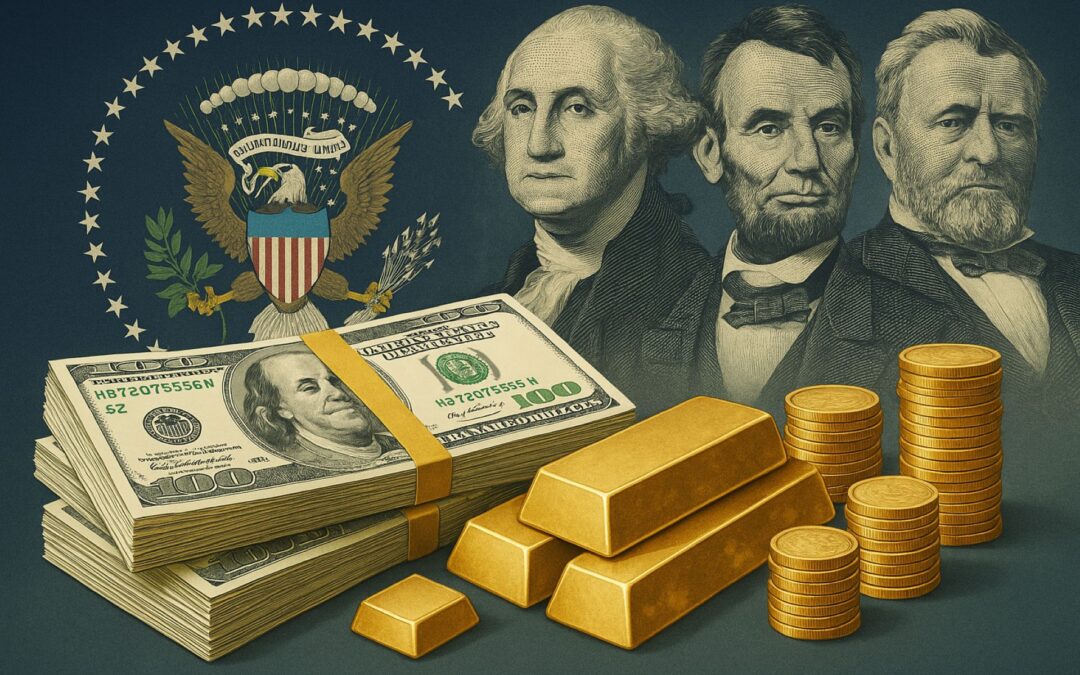
From log cabins to marble estates, from scraping by on modest salaries to commanding billion-dollar empires—the financial stories of America’s presidents read like a parallel history of the nation itself. Wealth, or the absence of it, has shaped not only how presidents lived but also how they led, influenced, and were remembered. Some left office with barely enough to cover debts, their widows surviving on congressional pensions. Others lived like aristocrats, anchored by sprawling plantations, trust funds, and inherited dynasties.
In modern times, the presidency has become less a career of service and more a springboard into lucrative book deals, speeches, and even media empires. To trace every president’s fortune is to trace the shifting tides of America: from land to industry, from dynasties to celebrity, from poverty to billions.
The Broke Boy Club
The presidency, especially in its early years, did not come with the promise of untold riches. In fact, many of America’s leaders barely scraped by, their financial realities a far cry from the golden trappings of office that modern eyes often imagine. For these men, wealth was either fleeting, nonexistent, or destroyed by misfortune.
James Buchanan serves as a prime example. Born in a Pennsylvania log cabin, the son of a merchant with a sprawling family, Buchanan grew up with the basics—enough to survive, but never the comforts of luxury. His entire professional life was tethered to government paychecks, which, in the mid-1800s, hardly provided stability, let alone wealth. As a congressman, senator, and later secretary of state, he lived within modest means, dependent on salaries that paled compared to the fortunes of industrialists and landowners of the time. Buchanan’s reputation as one of the poorest U.S. presidents was no exaggeration.
Abraham Lincoln, revered as one of America’s greatest leaders, had an equally austere beginning. Raised in poverty on the Kentucky frontier, Lincoln split rails, worked odd jobs, and taught himself law by candlelight. He clawed his way into the legal profession, building a practice that earned him respect but little fortune. It wasn’t until his presidency that Lincoln earned real money—$25,000 annually, equivalent to about $750,000 today. Yet destiny had other plans. His assassination in 1865 abruptly cut off any chance to build lasting wealth. Mary Todd Lincoln, his widow, endured a life marked by financial strain. She pawned clothing and jewelry to survive and frequently appealed to Congress for financial assistance, an almost unimaginable fate for the First Lady of a fallen president.
Lincoln’s successor, Andrew Johnson, climbed out of poverty in his own way. Apprenticed as a tailor in Tennessee, Johnson was a self-taught man who spent his youth mending clothes before mending political rifts. His ascent through public service—from alderman and mayor to governor, senator, and finally vice president—was remarkable. But his finances remained stagnant. Johnson never saw wealth accumulate, and when he left the White House, he carried with him little more than personal pride and political scars. He died without riches, his legacy marked more by impeachment battles than by estates or investments.
Ulysses S. Grant, unlike his predecessors, briefly tasted affluence. A Civil War hero and adored national figure, Grant was showered with gifts, property, and even cash donations from a grateful public. For a time, he lived like a wealthy man, his reputation opening doors to prosperity. But fate proved cruel. Grant entrusted his money to a firm run by his son and a scheming partner, Ferdinand Ward, who masterminded one of the era’s most notorious Ponzi schemes. In a single stroke, Grant’s wealth evaporated. Reduced to just $80 in his pocket and dying of throat cancer, he turned to the only resource left—his pen. With astonishing speed and determination, Grant wrote his memoirs, pouring his final strength into ensuring his family’s financial future. The book became a national bestseller, generating the equivalent of millions today and restoring dignity to his name.
Woodrow Wilson belonged to the same modest camp. Before entering the White House, Wilson lived as an academic. He was the president of Princeton University and later the governor of New Jersey, positions steeped in prestige but not in wealth. His income was steady but unremarkable, enough to support his family comfortably without lifting him into affluence. Wilson never cultivated businesses or estates, and when his presidency ended, he left without financial grandeur, only the imprint of his political ideals.
Chester A. Arthur, though not born into money, lived as if he had endless reserves. He embraced the lavish Gilded Age lifestyle, purchasing a grand New York townhouse, adorning it with fine furnishings, and draping himself in fashionable attire. Unlike the thrifty Coolidge or the scholarly Wilson, Arthur lived for appearances. Every dollar that passed through his hands seemed to leave just as quickly, spent on silks, décor, and reputation. His wealth never built into a legacy—it was consumed in the pursuit of image.
James Garfield’s story was one of brilliance without wealth. A boy genius who rose from dire poverty, Garfield paid his way through college as a janitor and teacher, eventually serving nearly two decades in Congress. He embodied the American dream of self-made success, but his presidency was tragically short. Just months into office, he was assassinated at 49, never given the opportunity to build financial stability. His modest estate reflected his short life, but his legacy was in his intellect, his commitment to education, and his vision for a better country.
Calvin Coolidge closed this chapter of modest presidencies with quiet consistency. Raised in a frugal New England household, he internalized thrift as a lifelong virtue. Coolidge earned a decent living as a lawyer and politician, but he never chased wealth through business or speculation. His fortune remained small, mirroring his reputation as “Silent Cal,” a man who valued restraint over indulgence. For Coolidge, prosperity was measured not in net worth but in simplicity and discipline.
Together, these men embodied the reality that the presidency did not always bring financial gain. Their stories reveal a pattern of humble beginnings, modest salaries, and, at times, tragic endings. They served for duty, not for dollars, leaving behind legacies of resilience, service, and sacrifice rather than dynastic fortunes.
The Million-Dollar Men
Beyond the presidents who lived and died with little, there emerged a class who managed to accumulate fortunes in the range of one to ten million dollars in today’s money. Their wealth was not extravagant by modern standards, but it represented a comfortable cushion built on careers in law, politics, business, or the quiet advantages of marriage.
William McKinley’s finances reveal the fragile line between solvency and ruin. During the Panic of 1893, he was buried under debt after co-signing loans for friends and allies while serving as Ohio’s governor. Bankruptcy loomed over him like a dark cloud. Yet McKinley was a man admired by his community, and supporters rallied to his side, raising funds to wipe his debts clean. By the time he ascended to the presidency, he had regained modest stability, anchored by his home in Canton, Ohio. McKinley’s story is a testament to reputation and goodwill serving as financial safety nets.
Warren G. Harding, on the other hand, owed his prosperity not to his own hands but to the sharp instincts of his wife, Florence. Harding himself was a mediocre businessman; his small-town newspaper, the Marion Star, limped along under his leadership. Florence, however, came from wealth and possessed an acumen for operations. She transformed the paper into a profitable venture that provided the bulk of Harding’s fortune. The irony is clear: Harding’s legacy as a president may be tainted by scandal, but his financial legacy rested on his wife’s business genius.
Franklin Pierce enjoyed stability that came from both law and lineage. The son of New Hampshire’s governor, he was no stranger to privilege, but it was his marriage to Jane Appleton that secured his financial standing. Her family, steeped in academic prestige and connected to Bowdoin College, provided Pierce with a wealthy social circle. Though never ostentatious, Pierce lived comfortably, enjoying the fruits of professional respectability and family ties.
Rutherford B. Hayes followed a similar path. A successful Ohio lawyer, Hayes’s career in politics provided steady income, but it was his marriage to Lucy Webb, whose family was well-to-do, that enhanced his finances. After his presidency, Hayes retired to Spiegel Grove, his sprawling 25-acre estate in Fremont, Ohio, complete with a 10,000-square-foot mansion. The estate symbolized not only his modest fortune but also the enduring value of property in establishing legacy.
William Howard Taft’s résumé was one of the most impressive in American history. From lawyer and judge to secretary of war, president, professor at Yale, and finally chief justice of the Supreme Court, Taft embodied public service. Yet for all his titles and honors, his wealth remained modest by comparison. He lived comfortably in Cincinnati, his fortune reflecting steady government salaries rather than entrepreneurial ventures. Taft’s life proved that prestige does not always translate to riches.
Millard Fillmore, like many in this tier, relied heavily on his marital ties. A self-taught lawyer, he climbed into politics but never amassed significant personal wealth. It was the fortune of his second wife, Caroline McIntosh, that buoyed his finances later in life. He also made modest investments, but his financial security was less the product of his own accumulation and more the result of prudent partnerships.
William Henry Harrison exemplified the paradox of being land-rich but cash-poor. Born into a prominent Virginia family and married into even more wealth, he acquired 160 acres in Ohio, supplemented by government land grants for military service. Yet when he died just one month into his presidency, his family was left destitute, with no liquid assets to survive. Congress intervened, granting his widow a special pension. Land titles had not saved Harrison’s heirs from financial ruin.
His grandson, Benjamin Harrison, fared far better. A distinguished lawyer, Benjamin built his own fortune independent of inheritance. His legal prowess was such that he once represented Venezuela in an international arbitration case against Britain—a role that brought him prestige and substantial income. His Indianapolis Victorian mansion became both home and a monument to his financial success.
Harry Truman’s story remains one of the most intriguing in this bracket. Truman projected the image of the humble, near-broke farmer and politician, a man whose modest background never translated into personal riches. He refused corporate offers after leaving office, even claiming poverty to preserve the image of a man of the people. His portrayal of financial need helped spark Congress to create the presidential pension. Yet modern investigations revealed that Truman was far wealthier than he admitted, secretly maintaining accounts that put his net worth in the millions. Truman’s legacy as the struggling common man was partly myth, carefully constructed to fit a political narrative.
Zachary Taylor’s wealth carried darker origins. Born into a prominent Virginia family, Taylor expanded his holdings during his military career, acquiring plantations across Kentucky, Mississippi, and Louisiana. His net worth, estimated at $7 million today, was built squarely on the backs of over 100 enslaved people. Taylor’s brief presidency—cut short after just 16 months—meant he never collected much from his salary, but his fortune remained entrenched in the South’s plantation economy.
Gerald Ford’s rise was different. A career congressman, Ford lived on a modest income until fate placed him in the Oval Office after Nixon’s resignation. His presidency itself did little for his finances, but once he left office, he cashed in. Ford commanded enormous fees for speeches and joined the boards of corporations like American Express. Within a year of leaving office, he had earned over a million dollars—a fortune at the time—and he continued to accumulate wealth steadily afterward.
Jimmy Carter provides perhaps the most admirable example in this group. Before the presidency, Carter was a peanut farmer and naval officer with modest means. After his single term ended, however, he reinvented himself as an author, speaker, and humanitarian. Dozens of books and lectures poured money into his accounts, while his 2002 Nobel Peace Prize brought a million-dollar prize in recognition of his global peace efforts. Carter’s financial story was not one of inheritance or speculation but of sustained productivity well into his later years.
Dwight D. Eisenhower followed a hybrid path. His decades of military service never made him rich—an army general’s pay was far from extravagant—but after purchasing a 250-acre farm in Gettysburg, Pennsylvania, he watched its value soar. Combined with royalties from his bestselling memoirs and cautious saving, Eisenhower left behind an estate worth around $10 million. His life was a lesson in patient accumulation and careful stewardship.
Joe Biden’s financial transformation was perhaps the most dramatic of all. For 36 years as a senator, Biden was consistently ranked among the poorest members of Congress, his wealth hampered by debt and modest government salaries. But after serving as vice president, his fortunes changed overnight. In 2017, Joe and Jill Biden earned $11 million in a single year from book deals and speaking engagements. By 2023, his net worth had risen to approximately $10 million. Biden’s trajectory was a modern rags-to-riches tale, fueled not by plantations or inheritances but by the publishing industry and the celebrity of high office.
Together, these presidents illustrate a transitional stage in America’s political-financial story. No longer scraping by like the broke boy club, they lived comfortably, even prosperously, though none reached the astronomical fortunes of dynasties. Their wealth came from law, land, marriage, reputation, and—especially in modern times—the power of the presidential brand.
The Multi-Millionaires
In the next tier, fortunes swelled beyond the modest million but stopped short of dynastic wealth. These presidents lived in the range of $10 to $50 million in modern value, a class of men who leveraged timing, connections, and reputation to elevate themselves into financial security. Their stories reflect a blend of inheritance, land ownership, political connections, and in more recent times, the art of post-presidential reinvention.
James K. Polk exemplified wealth drawn from land—and from the brutal realities of the slave economy. Born into a relatively comfortable family, Polk married into even greater privilege. His true fortune, however, came from nearly 900 acres of prime Mississippi cotton land, where enslaved laborers toiled under grueling conditions. Polk’s wealth, estimated in the tens of millions today, was secured at the expense of human suffering. His financial legacy stands as one of the starkest reminders that early American affluence was often inseparable from slavery.
Ronald Reagan’s story could not have been more different. Born the son of a shoe salesman in rural Illinois, Reagan grew up modestly before finding success in Hollywood. His acting career brought him into the public eye, while his stint as governor of California placed him at the intersection of politics and wealth. Reagan purchased a sprawling 688-acre ranch near Santa Barbara, which became a symbol of his personal brand: rugged individualism dressed in Western charm. Yet Reagan’s real fortune blossomed after he left the White House. A blockbuster $2 million speaking tour in Japan, at the time one of the most lucrative speaking deals in history, catapulted him into financial comfort. Book advances and steady royalties added millions more, making Reagan one of the first presidents to truly capitalize on the post-presidential speaking circuit.
Richard Nixon’s financial arc reads like a paradox. Forced to resign in disgrace over Watergate, Nixon’s political career seemed to have destroyed any chance at respectability, let alone wealth. Yet his notoriety became his most valuable asset. He signed a lucrative deal with British journalist David Frost for a series of televised interviews that brought him $600,000—a staggering $2.5 million in today’s terms. His memoirs and other writings sold briskly, and by the time of his death, Nixon had rebuilt his fortune into the tens of millions. He proved that scandal could be monetized just as effectively as celebrity.
The Adams family—John Adams and his son John Quincy Adams—secured their financial footing through dynastic privilege. John Adams, America’s second president, practiced law at a high level and married Abigail Quincy, whose family was among Massachusetts’s most prominent. Together, they lived at Peacefield, a grand estate that became a multi-generational family seat. John Quincy Adams, though a career politician and diplomat with limited opportunities for entrepreneurial ventures, inherited Peacefield and strengthened his position by marrying Louisa Johnson, the daughter of a wealthy merchant. Their combined fortunes placed them firmly in the multi-millionaire bracket, proof that for some families, wealth and politics were a generational inheritance.
George H.W. Bush, decades later, mirrored the dynastic thread but added his own twist. His father, Prescott Bush, was both a U.S. senator and a successful investment banker. George H.W. Bush built on that foundation, co-founding Zapata Petroleum, an offshore drilling company that made him a multimillionaire long before he entered the White House. Oil transformed him into one of the wealthiest modern presidents, and by the time he reached the Oval Office, his presidential salary was little more than pocket change.
Grover Cleveland’s fortune came through a different route. Born into a modest family, Cleveland worked tirelessly as a lawyer before entering politics. Twice elected president, he invested heavily in the stock market during his later years, watching his portfolio balloon. By the time he retired to his Westland mansion in Princeton, New Jersey, he had transformed himself into one of the wealthier men of his age. His wealth was earned not through inheritance but through calculated investments and patience.
Martin Van Buren’s life reflected the slow, steady climb of legal income transformed into lasting security. The son of a tavern keeper in Kinderhook, New York, Van Buren rose through the ranks as a lawyer, then as secretary of state, vice president, and eventually president. But unlike other politicians who squandered their earnings, Van Buren invested shrewdly. His estate, Lindenwald, sprawled across 225 acres in New York, providing him with both a home and a fortune that cemented his financial standing.
James Monroe’s tale stood in stark contrast to these success stories. Born into privilege and married into wealth, Monroe appeared destined for lasting prosperity. He owned plantations, enslaved workers, and enjoyed the income of a lawyer and public servant. Yet decades in politics proved financially disastrous. Monroe mismanaged his finances, living well beyond his means. By the time he retired, he was drowning in debt. Despite having at one point amassed a fortune worth the modern equivalent of $30 million, he died nearly broke, forced to sell his properties to stay afloat. His widow, Elizabeth, lived her final years in relative hardship—a cruel irony for a man who had once walked the halls of power.
George W. Bush, like his father before him, benefited from family pedigree. Yet his initial ventures in the oil industry faltered, leaving him far from wealthy. His breakthrough came in 1989 when he invested $600,000 in the Texas Rangers baseball team. When the franchise was later sold, Bush turned that stake into a $15 million payday. From there, his fortune grew rapidly. After leaving the presidency, Bush joined the lucrative post-office circuit, raking in millions through speeches and publishing. His net worth settled in the $40 million range, marking him as one of the most financially successful modern presidents.
Collectively, these multi-millionaire presidents illustrate the varied ways wealth could be acquired: through land and slavery, dynastic inheritance, shrewd investing, or modern celebrity and speaking fees. They lived lives far removed from the financial precariousness of the “broke boy club” but not yet in the stratosphere of dynastic billionaires. Their fortunes represent a transitional stage—secure, comfortable, and in some cases, tainted by the darker shadows of exploitation.
The Fifty-to-Hundred Millionaires
Now the story of presidential wealth begins to take on a grander scale. These were not men who merely lived comfortably—they lived expansively, in estates and dynasties that spoke to power and permanence. Their fortunes, ranging from $50 to $100 million in today’s terms, came from inheritance, land, strategic marriages, or the ability to cash in on fame long after leaving office.
John Tyler was one of the first to ascend into this elite circle. Born into Virginia’s landed gentry, he inherited wealth through plantations worked by enslaved people. His financial position was strengthened by his second marriage to Julia Gardiner, the daughter of a wealthy New York family with extensive Long Island property. Their union symbolized how marriage could serve as both a political alliance and a financial windfall. Tyler retired to Sherwood Forest, his vast plantation and mansion in Virginia, where his descendants still live today. It was a reminder that wealth in the 19th century often meant not liquid cash but sprawling estates, tied directly to land and labor.
Franklin Delano Roosevelt, a century later, represented the evolution of dynastic wealth into the modern age. The Roosevelt family had been wealthy for generations, part of the Dutch aristocracy of New York. Through careful marriages with the equally affluent Delano family, their fortune doubled across generations. Franklin inherited not only money but also power, prestige, and the family’s jewel—the Springwood estate in Hyde Park, New York. FDR’s wealth was generational, rooted in old money, the kind that was managed and multiplied through land holdings, investments, and influence. His presidency was less a stepping stone to wealth than a continuation of privilege already secured.
Barack Obama’s presence in this tier marked a new kind of story—one that reflected the 21st century’s transformation of politics into celebrity. Obama began his career as a community organizer and law professor, with modest means. Even during his time in the Senate, his net worth remained relatively low. But his election to the presidency catapulted him into global fame. After leaving office, he and Michelle Obama signed a joint book deal worth more than $60 million. His speeches commanded fees of hundreds of thousands of dollars each. The clincher, however, was the $50 million Netflix deal signed by the Obamas to produce films and series under their company Higher Ground Productions. With Michelle’s own bestselling memoir advance of $65 million, their combined fortune soared into the $70 to $100 million range. Unlike earlier presidents, whose wealth often came from land or inheritance, Obama’s was built on intellectual property and cultural influence—the commodities of a modern age.
Bill Clinton, too, turned political fame into fortune, but his path was paved with urgency. When he left the White House in 2001, the Clintons were drowning in legal debt from investigations tied to Whitewater and his impeachment. Bankruptcy loomed as a very real possibility. But Bill Clinton discovered that his voice—and his story—were worth millions. His memoir My Life earned him a $15 million advance, while Hillary Clinton’s Living History brought in $14 million. Together, they became a speaking powerhouse, commanding fees of $200,000 to $500,000 per appearance. Over two decades, the Clintons raked in over $100 million, transforming their finances from peril to prosperity. Their story illustrated how, in the modern era, political notoriety could be monetized just as effectively as political service.
Herbert Hoover, in contrast, entered the White House already fabulously wealthy. Orphaned as a child, Hoover’s brilliance and grit carried him to Stanford University, where he trained as a mining engineer. By his twenties, he was managing mining operations across the globe—in Australia, China, and Burma—and acquiring stakes in silver and gold mines. Hoover’s ventures made him one of the richest men in America before his presidency, with a net worth equivalent to $100 million in today’s dollars. Unlike the Clintons or Obama, Hoover never needed to monetize his time in office; the Oval Office was simply a capstone to a career already defined by extraordinary financial success.
This tier of presidents demonstrated that by the late 19th and 20th centuries, the game of wealth had shifted. Some, like Tyler and Roosevelt, lived off dynastic inheritance. Others, like Hoover, built fortunes through international enterprise. Still others, like Clinton and Obama, revealed the new reality of politics as a platform for fame and intellectual capital. For the first time, the presidency itself became not just an honor or a service but a brand—one that could be sold, spun, and transformed into a fortune that rivaled the aristocracies of old.
The Hundred Million Plus Club
Here lies the league of presidents whose fortunes eclipsed the comfortable millions and ventured into staggering territory. Their wealth—soaring beyond $100 million in today’s terms—was often rooted in dynastic inheritance, massive estates, or shrewd maneuvers that blurred the line between politics and business. Unlike the modest accumulators of earlier generations, these men left behind legacies of empire, scandal, and grandeur.
Lyndon B. Johnson’s story illustrates how political power and financial opportunity sometimes walked hand in hand. Born in rural poverty in the Texas Hill Country, Johnson understood deprivation intimately. But fortune turned when his wife, Lady Bird Johnson, purchased a failing Austin radio station in 1943. With Lyndon in Congress at the time, the Federal Communications Commission—an agency Johnson oversaw—approved licenses that transformed the station into a media juggernaut. KTBC became the crown jewel of a growing media empire, raking in millions. Added to this was the Johnsons’ sprawling 1,500-acre cattle ranch. By the time Johnson left office, his family had amassed a fortune well into the hundreds of millions. Critics have long suggested that his wealth was not merely luck but the product of political leverage, yet his empire remains one of the most substantial presidential fortunes in history.
James Madison, in contrast, was born into affluence. The Montpelier estate in Virginia, thousands of acres of fertile farmland worked by enslaved people, was the foundation of his wealth. At its height, Madison’s fortune equaled roughly $140 million today, cementing him among the wealthiest of the Founding Fathers. Yet wealth is only as enduring as the heirs who inherit it. Madison’s stepson, John Payne Todd, squandered vast sums on gambling, alcohol, and reckless living. Madison bailed him out repeatedly, bleeding his finances. By the time of Madison’s death, much of his fortune had dissolved into debt. His widow, Dolley Madison, was eventually forced to sell Montpelier, its possessions, and even enslaved people just to survive. Once the toast of Washington society, she died in near-poverty—a haunting reminder that even dynasties can collapse when fortune meets mismanagement.
Andrew Jackson’s climb into this tier is the quintessential American rags-to-riches tale, shadowed by the darker truths of slavery. Orphaned on the frontier, Jackson rose through grit, serving as a lawyer, soldier, and politician. His wealth multiplied through aggressive land speculation and slave labor. By 1804, he was wealthy enough to purchase The Hermitage, which he expanded into a thousand-acre plantation worked by more than 150 enslaved people. Cotton, the “white gold” of the South, flowed from his lands, enriching Jackson immensely. At the height of his life, his net worth equaled about $130 million in modern value. His story embodied the myth of the self-made man, though in truth, his fortune was built as much on oppression as on ambition.
Theodore Roosevelt was cut from a different cloth. Unlike Jackson, Roosevelt was born into wealth. The Roosevelt family of New York had accumulated vast fortunes through business and real estate, giving young Teddy a trust fund worth millions. At just 22 years old, he purchased Sagamore Hill, a grand 235-acre estate on Long Island. Yet Roosevelt’s fortune was not invincible. He sank much of his inheritance into a cattle ranching venture in the Dakotas. When a brutal winter decimated his herds, he lost the equivalent of millions in today’s terms. Still, Roosevelt rebuilt his finances with a mixture of determination and talent. He wrote more than 35 books on topics ranging from history to hunting, securing steady royalties. His presidential salary added respectability, but it was Sagamore Hill—his “White House of the North”—that became his enduring financial and symbolic asset. Roosevelt’s life revealed both the fragility and resilience of inherited wealth when paired with individual drive.
Thomas Jefferson’s fortunes towered even higher. He inherited 3,000 acres from his father, which he expanded into Monticello, a 5,000-acre plantation run by more than 600 enslaved people over his lifetime. Jefferson was not only a statesman and thinker but also a man of exquisite taste. He imported European wines, purchased rare books, and filled Monticello with fine furnishings and art. His wealth peaked at the equivalent of $250 million in today’s dollars, making him one of the richest Americans of his era. Yet Jefferson was also one of its most prodigal spenders. His appetite for luxury far exceeded his income. By the time of his death in 1826, Jefferson was drowning in debt, forcing his heirs to auction Monticello, his possessions, and enslaved people to pay creditors. His financial collapse mirrored the contradictions of his philosophy: a man who penned the words “all men are created equal” while sustaining his lifestyle through slavery and debt.
George Washington’s fortune dwarfed them all. Born into the Virginia planter class, Washington inherited Mount Vernon but expanded it into a vast estate of 8,000 acres. Through marriage to Martha Custis, a wealthy widow, he acquired even more land and enslaved laborers. Washington eventually owned over 50,000 acres across Virginia, Maryland, Pennsylvania, and Kentucky. He also operated one of the largest whiskey distilleries in America, diversifying his income. Though much of his wealth was tied to land and enslaved people rather than liquid cash, his net worth at its height was estimated at nearly $600 million today. His presidential salary of $25,000 a year—2% of the federal budget—was itself a fortune, equal to roughly $700,000 today. Washington was not only the father of his country; he was its original mega-millionaire. His empire, though land-rich rather than cash-heavy, set a standard of aristocratic wealth among America’s earliest leaders.
This tier of presidential wealth tells a story of two Americas. On one hand, it reflects the triumph of ambition, land ownership, and strategic marriages. On the other, it exposes the grim underbelly of slavery, exploitation, and debt that underpinned many of these fortunes. These presidents lived not just as leaders but as aristocrats, their names tied to estates, plantations, and dynasties that echoed long after their deaths. They were symbols of grandeur, but also of the precariousness of wealth—fortunes that could soar into the hundreds of millions, then vanish within a single generation.
The Billionaires’ Club
At the very summit of presidential wealth are the dynasts and moguls whose fortunes crossed into the billions in today’s value. Their names carry not only political weight but also the aura of financial empires—empires so vast that the presidency itself seemed less a source of riches than an accessory to preexisting dynastic power. In this league, family legacies, savvy deals, and larger-than-life personas converged to create the richest presidents in American history.
John F. Kennedy is the quintessential heir of an American dynasty. His father, Joseph P. Kennedy Sr., was a titan of early 20th-century finance, amassing hundreds of millions through stock market speculation, liquor distribution, real estate, and even a Hollywood studio. By the time JFK was born in 1917, the family fortune was already vast. The Kennedys were not just wealthy; they were aristocrats in everything but name, wielding influence in both Wall Street boardrooms and Washington politics. Kennedy himself never needed to worry about money—his annual trust fund payouts kept him in comfort long before he stepped into the White House.
Marriage further expanded this wealth. Jackie Bouvier Kennedy came from privilege herself, but her stepfather was heir to part of the Standard Oil fortune, ensuring that her marriage to JFK merged two substantial financial legacies. Together, the couple represented the American version of royalty, their summers spent at Hyannis Port or cruising Martha’s Vineyard on yachts, their lifestyles reflecting the privileges of generational affluence. Kennedy’s presidential salary was so negligible compared to his inheritance that he donated it entirely to charity, a gesture only possible for a man whose financial worries were already solved. Today, estimates put the Kennedy family fortune well over a billion dollars—wealth that has stretched across generations, maintained through trusts, properties, and investments.
Donald Trump, by contrast, was not merely an heir but also an empire-builder, though his fortune came with equal parts flair and controversy. Born into the wealth of Fred Trump’s New York real estate empire, Donald expanded the family business into Manhattan skyscrapers, luxury hotels, casinos, and golf resorts. His personal style of wealth accumulation was brash and highly visible: gilded apartments, branded towers, and Mar-a-Lago, a 126-room Palm Beach estate once owned by cereal heiress Marjorie Merriweather Post. Trump transformed the property into both a private residence and a business hub, its value today estimated in the hundreds of millions.
Trump’s wealth was not confined to real estate. His persona became a brand—plastered across everything from neckties to steaks, and most lucratively, television. The Apprentice, his long-running reality TV show, elevated him from developer to household name, earning him millions in salaries and licensing deals while turning “You’re fired” into a pop-culture catchphrase. When combined with speaking fees, golf course revenues, and global licensing, Trump’s fortune entered the multi-billion-dollar realm.
Yet Trump’s wealth, unlike Kennedy’s, has always been contested—its true value fluctuates depending on whether one looks at his balance sheet, his debts, or his brand valuations. Still, even the most conservative estimates place him as the richest U.S. president in history. His private jet, valued at $100 million, and sprawling real estate portfolio underscore a life lived not just in affluence but in opulence.
The contrast between Kennedy and Trump is striking. Kennedy’s fortune was the quiet, generational wealth of dynastic inheritance, refined through family trusts and marriages that bound fortunes together. Trump’s was loud, performative, and entrepreneurial, built on spectacle and risk, as much a performance as it was a balance sheet. But together they define the apex of presidential wealth: the billionaires’ club, where politics and power were less about financial survival and more about the privilege of commanding empires.
For Kennedy, the presidency was a duty carried on the shoulders of inherited riches. For Trump, it was another extension of his brand, an office transformed into a stage for a mogul’s personality. Both illustrate that by the time you reach the top of this tier, the presidency itself no longer creates wealth—it simply magnifies fortunes that were already there.
Conclusion
Presidential wealth is more than numbers on a ledger—it’s a mirror of America’s values across eras. In one century, wealth meant land and enslaved labor; in another, it was measured in stocks, oil, and estates. Today, it comes from publishing contracts, speaking tours, and streaming platforms. For some presidents, fortune was an accident of birth; for others, it was clawed out of hardship or stumbled upon in retirement.
But whether penniless like Buchanan or billionaire like Trump, each president’s financial journey reveals a truth: money shapes legacy as much as politics. Wealth can amplify influence, cushion reputations, or, in cases of mismanagement, destroy dynasties. In the end, the story of presidential riches is less about who had the most, and more about how each man’s relationship with money reflected the nation he governed.