
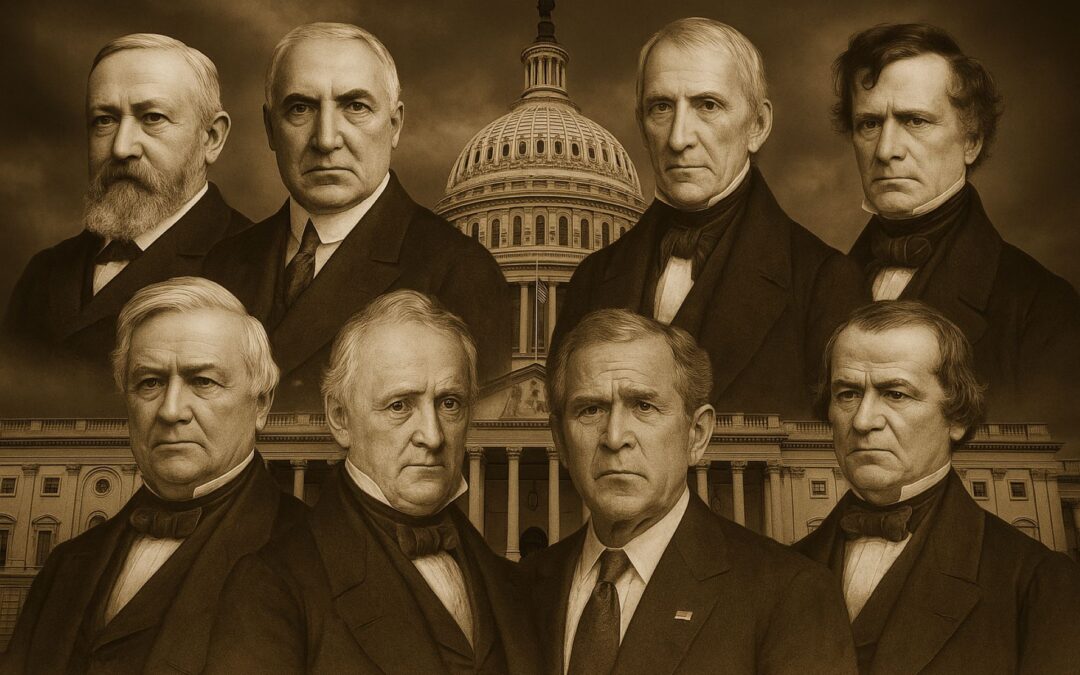
Leadership at the highest level doesn’t just influence history—it defines it. A president’s choices can stabilize a nation in crisis or accelerate its collapse. And while history often remembers great leaders for what they built, it is just as shaped by those who failed—and the damage they left behind.
The worst presidents in American history were not always the most incompetent or the least popular. Many were intelligent, experienced, even well-intentioned. But when faced with defining moments, they made decisions that deepened divisions, weakened institutions, or allowed crises to spiral out of control.
In some cases, they acted—and made things worse. In others, they failed to act when leadership was most needed. But the result was the same: long-term consequences that reshaped the nation in ways they could not control.
This article is not about judging personalities or political ideologies. It is about examining cause and effect—how specific decisions, made at critical moments, created ripple effects across decades of American history.
Because in the end, history does not judge presidents by what they meant to do. It judges them by what actually happened.
Millard Fillmore and the Dangerous Compromise
When Millard Fillmore took office in 1850, the United States was already under immense strain. The issue of slavery had begun to fracture the nation along deep moral and political lines. It was a moment that required careful, forward-looking leadership—someone who could reduce tensions without inflaming them further.
Instead, Fillmore chose a path that did the opposite.
At the center of his presidency was the Fugitive Slave Act, one of the most controversial laws in American history. As part of the Compromise of 1850, it required citizens in free states to assist in the capture and return of escaped enslaved people. This effectively extended the reach of slavery into places where it had previously been resisted or rejected.
The consequences were immediate and far-reaching. For many in the North, slavery was no longer a distant Southern institution—it had become a personal moral dilemma. Citizens were now forced to choose between obeying federal law and following their own conscience. This tension transformed passive discomfort into active resistance.
Abolitionist movements gained momentum almost overnight. Communities that had once been divided or indifferent began to unify in opposition. Rather than calming the nation, the law intensified outrage and hardened attitudes on both sides.
Fillmore believed he was preserving the Union through compromise. In reality, he was exposing the limits of compromise itself. By forcing a moral issue into the daily lives of ordinary Americans, he accelerated the very conflict he sought to contain.
His presidency stands as an early warning of what happens when leadership prioritizes short-term political balance over long-term stability. The peace he helped maintain was fragile—and it would not last.
Franklin Pierce and the Collapse of Political Stability
If Millard Fillmore exposed the limits of compromise, Franklin Pierce dismantled them entirely.
Pierce entered office in 1853 at a time when the nation was still holding together—barely. The fragile balance between free and slave states had been maintained through a series of uneasy agreements. What the country needed was stability. What it got instead was disruption on a national scale.
The turning point of his presidency was the Kansas–Nebraska Act. On paper, it appeared to offer a democratic solution: let settlers in new territories decide for themselves whether slavery would be allowed. But in doing so, it overturned a critical precedent—the Missouri Compromise—which had kept a delicate equilibrium between North and South for decades.
What followed was not democratic consensus, but violent breakdown.
Pro-slavery and anti-slavery groups rushed into Kansas, not to build communities, but to control the outcome. Elections were marred by fraud and intimidation. Armed militias formed on both sides. The territory descended into chaos in what became known as Bleeding Kansas—a period of sustained violence that foreshadowed the civil war to come.
Pierce’s response only deepened the crisis. Rather than acting as a neutral authority, he sided with pro-slavery factions, recognizing a government that had been established through coercion and illegitimate means. Federal power, instead of restoring order, was used to reinforce division.
In doing so, Pierce shattered confidence in the federal government’s ability to act as a fair arbiter. His presidency didn’t just fail to contain conflict—it legitimized it.
Where leadership might have slowed the nation’s descent into war, Pierce accelerated it. By removing the guardrails that had kept tensions in check and then backing one side in an increasingly violent struggle, he helped turn political disagreement into open hostility—bringing the country closer to collapse.
James Buchanan and Leadership Paralysis
By the time James Buchanan took office in 1857, the United States was no longer just divided—it was unraveling. The tensions that leaders like Millard Fillmore and Franklin Pierce had failed to contain were now reaching a breaking point.
Buchanan had a clear choice: confront the crisis directly or attempt to sidestep it. He chose neither. Instead, he deferred leadership at the very moment it was most needed.
One of the defining moments of his presidency was his handling of the Dred Scott decision. The ruling declared that Black Americans could not be citizens and that Congress had no authority to restrict slavery in the territories. Rather than treating this as a volatile and deeply divisive decision, Buchanan supported it—believing it would settle the slavery issue once and for all.
It did the opposite.
The ruling outraged the North, strengthened anti-slavery movements, and further delegitimized the idea that compromise could resolve the conflict. Instead of calming tensions, it intensified them.
But Buchanan’s most consequential failure came during the secession crisis that followed the election of Abraham Lincoln in 1860. As Southern states began to secede from the Union, Buchanan took a position that perfectly captured his presidency: he believed secession was illegal—but also claimed the federal government had no authority to stop it.
This contradiction resulted in paralysis.
As states left the Union, federal forts were seized, and the country edged closer to war, Buchanan did little to intervene. He neither enforced federal authority nor attempted a meaningful political solution. By the time he left office, seven states had already seceded, and the Union was on the brink of collapse.
Buchanan’s legacy is not defined by a single disastrous decision, but by the absence of decisive leadership. At a moment when the nation required clarity and action, he offered uncertainty and inaction.
In many ways, his presidency represents the most dangerous form of failure—not causing a crisis, but allowing one to spiral unchecked until it becomes inevitable.
Andrew Johnson and the Betrayal of Reconstruction
After the assassination of Abraham Lincoln in 1865, the United States stood at a fragile crossroads. The Civil War had ended, but the real challenge had just begun: rebuilding the nation and defining what freedom would mean for millions of formerly enslaved people.
Into this moment stepped Andrew Johnson—a man whose presidency would undermine much of what the war had been fought to achieve.
Johnson believed in preserving the Union, but not in transforming it. He opposed efforts to expand civil rights for freed slaves and clashed repeatedly with Congress over the direction of Reconstruction. His most defining act was his veto of the Civil Rights Act of 1866, legislation designed to grant basic legal protections and citizenship to formerly enslaved people.
Congress overrode his veto—an extraordinary move that highlighted just how deeply he was at odds with the government he was meant to lead.
But Johnson did not stop there. He issued mass pardons to former Confederates, restoring their political rights and allowing them to regain power in Southern states. Many of these individuals quickly re-established systems that closely resembled the old order, passing laws that restricted the freedoms of Black Americans and reinforced racial hierarchy.
The consequences were profound and long-lasting. Johnson’s policies helped lay the groundwork for the Jim Crow era, enabling decades of segregation, discrimination, and violence. Instead of using federal power to secure the results of the Civil War, he allowed much of its progress to be reversed.
His presidency brought the nation to another constitutional crisis. In 1868, Johnson became the first president in American history to be impeached, surviving removal from office by a single vote in the Senate. The impeachment reflected not just political conflict, but a fundamental disagreement over the future of the country.
Andrew Johnson’s failure was not one of inaction, but of direction. At a moment when the nation needed to move forward, he pulled it backward—weakening the promise of Reconstruction and shaping a legacy that would haunt the United States for generations.
Herbert Hoover and the Great Depression
When Herbert Hoover took office in 1929, the United States appeared to be at the height of its prosperity. The economy was booming, industry was thriving, and there was widespread belief that the good times would continue indefinitely.
Within months, that illusion collapsed.
The Wall Street Crash of 1929 triggered the beginning of the Great Depression, one of the most devastating economic crises in modern history. Banks failed, businesses shut down, and unemployment surged to unprecedented levels. It was a moment that demanded bold, decisive action from the federal government.
Hoover, however, believed that such intervention would do more harm than good.
A firm believer in limited government and self-reliance, he resisted large-scale federal involvement in the economy. Instead, he encouraged voluntary cooperation from businesses and relied on local governments and private charities to provide relief. But as the crisis deepened, these measures proved inadequate. The scale of the collapse far exceeded the capacity of voluntary solutions.
As conditions worsened, public confidence eroded. Millions of Americans found themselves unemployed, homeless, and desperate, while the federal response appeared slow and insufficient. Hoover’s reluctance to adapt his approach became one of the defining features of his presidency.
The breaking point came in 1932 with the Bonus Army. Thousands of World War I veterans marched on Washington, D.C., demanding early payment of bonuses they had been promised. Many were struggling to survive and saw the payment as a lifeline.
Hoover’s response was decisive—but in the worst possible way.
He ordered the U.S. Army to disperse the protesters. Led by General Douglas MacArthur, troops used tear gas and force to clear the encampments. Images of veterans being driven out by soldiers shocked the nation and crystallized Hoover’s image as out of touch and unsympathetic.
Herbert Hoover did not cause the Great Depression, but his presidency became defined by his inability to respond effectively to it. In a moment that required flexibility and bold leadership, he remained bound to ideology.
His failure illustrates a critical lesson: in times of crisis, inaction—or insufficient action—can be just as damaging as the crisis itself.
George W. Bush and the Post-9/11 World
When George W. Bush entered office in 2001, his presidency did not initially appear destined for crisis. That changed on September 11, 2001, when the September 11 attacks reshaped both the nation and the world.
In the immediate aftermath, Bush’s leadership brought a sense of unity. The country rallied, and there was broad support for decisive action against those responsible. But the decisions that followed would define his presidency—and their consequences would extend far beyond the moment.
The most significant of these was the invasion of Iraq in 2003. The administration justified the war on the basis that Iraqi leader Saddam Hussein possessed weapons of mass destruction. Those weapons were never found.
What followed was a prolonged and costly conflict. The war resulted in thousands of American casualties, destabilized Iraq, and contributed to long-term instability across the Middle East. The decision damaged U.S. credibility internationally and raised lasting questions about intelligence, strategy, and accountability.
At home, the response to 9/11 also reshaped the balance between security and civil liberties. The Patriot Act expanded the government’s surveillance powers, allowing federal agencies to monitor communications and activities with fewer restrictions. While many viewed these measures as necessary at the time, they sparked ongoing debates about privacy, government overreach, and the limits of state power.
Bush’s presidency was further tested in 2005 by Hurricane Katrina. When the storm devastated New Orleans, the federal response was widely seen as slow and ineffective. Images of stranded residents and overwhelmed infrastructure highlighted failures in disaster preparedness and coordination, reinforcing perceptions of governmental incompetence.
George W. Bush’s presidency was shaped by extraordinary circumstances. But it is remembered not only for the crises he faced, but for how those crises were handled. Decisions made in the name of security led to long-term geopolitical consequences, while failures in domestic response exposed weaknesses in governance.
His legacy reflects the complexity of leadership in crisis—where actions taken under pressure can define not just a presidency, but an entire era.
Benjamin Harrison and Economic Mismanagement
The presidency of Benjamin Harrison is often overlooked, but its consequences were anything but insignificant. While his time in office lacked the drama of war or national upheaval, his economic decisions quietly set the stage for a major financial crisis.
At the center of his administration’s economic policy was the McKinley Tariff, which raised import duties to nearly 50 percent—one of the highest rates in American history at the time. The goal was to protect domestic industries from foreign competition. In theory, this would strengthen American manufacturing.
In practice, it created a series of unintended consequences.
Higher tariffs led to increased prices for consumers, making everyday goods more expensive. At the same time, foreign nations responded by reducing their imports of American agricultural products, hurting farmers who relied on international markets. The policy strained both domestic consumption and global trade relationships.
Compounding the issue was Harrison’s approach to government spending. During his presidency, the federal government rapidly depleted its surplus through increased expenditures, leaving little financial cushion to absorb future shocks. The combination of reduced trade efficiency and fiscal imbalance created an unstable economic environment.
The full impact of these decisions did not materialize immediately. Instead, they contributed to conditions that culminated in the Panic of 1893, one of the most severe economic downturns of the 19th century. By the time the crisis unfolded, Harrison was no longer in office, and the consequences fell to his successor.
This delayed fallout highlights a different kind of presidential failure—one where the effects are not immediate, but deeply embedded. Harrison did not preside over collapse, but his policies helped make it more likely.
His presidency serves as a reminder that economic decisions at the national level often carry consequences that extend far beyond a single term. What appears stable in the short run can prove fragile over time, especially when policy choices disrupt the balance between growth, trade, and fiscal responsibility.
Woodrow Wilson and the Contradictions of Idealism
Few presidents embody the tension between vision and consequence more than Woodrow Wilson. He is often remembered as an idealist—a leader who sought to reshape the global order and make the world “safe for democracy.” But beneath that vision lay decisions that carried deeply troubling consequences, both at home and abroad.
During World War I, Wilson took unprecedented steps to control dissent within the United States. Through laws such as the Espionage Act and the Sedition Act, his administration made it a crime to criticize the government, the military, or even the war effort. These measures led to the prosecution of thousands of Americans, including journalists, activists, and ordinary citizens.
In effect, one of the core principles of American democracy—free speech—was significantly curtailed under his leadership. What was justified as a wartime necessity became one of the most sweeping restrictions on civil liberties in the nation’s history.
At the same time, Wilson was attempting to shape the postwar world. His role in negotiating the Treaty of Versailles reflected his ambition to create a lasting peace. However, the treaty imposed severe penalties on Germany, including heavy reparations and territorial losses. These conditions contributed to economic instability and political resentment, factors that would later play a role in the rise of extremism and the outbreak of World War II.
Wilson’s most ambitious project was the creation of the League of Nations, an international body intended to prevent future conflicts. Yet despite championing the idea, he failed to secure support at home. The United States Senate rejected membership, leaving the organization without the participation of the very nation that had driven its creation.
This contradiction defined his presidency. Wilson pushed for global cooperation while struggling to build domestic consensus. He promoted democratic ideals abroad while restricting freedoms at home. His vision was expansive, but his execution was often rigid.
Woodrow Wilson’s legacy is not one of simple failure, but of imbalance. His presidency demonstrates how even the most ambitious ideals can produce unintended consequences when they are pursued without flexibility or regard for their broader impact.
Warren G. Harding and Institutionalized Corruption
The presidency of Warren G. Harding stands as one of the clearest examples of how corruption at the highest level can erode public trust in government.
Harding entered office in 1921 promising a “return to normalcy” after the upheaval of World War I. The message resonated with a country exhausted by conflict and change. But instead of stability, his administration became synonymous with scandal.
A central issue was Harding’s reliance on a close circle of associates—often referred to as the “Ohio Gang.” These were not simply trusted advisors; many were individuals placed in positions of power without regard for competence or integrity. This system of patronage created an environment where influence could be exploited for personal gain.
The most infamous example was the Teapot Dome scandal. In this case, federal oil reserves were secretly leased to private companies in exchange for bribes. It was one of the most significant corruption scandals in American history, revealing how government resources had been effectively sold for private profit.
But Teapot Dome was not an isolated incident. Other members of Harding’s administration were implicated in schemes involving embezzlement, kickbacks, and misuse of public funds. In one case, money intended for wounded veterans was siphoned off through fraudulent operations, highlighting the depth of the corruption.
While there is limited evidence that Harding personally orchestrated these activities, his leadership created the conditions that allowed them to flourish. His failure lay in judgment—both in the people he trusted and in his oversight of their actions.
The damage extended beyond individual scandals. Public confidence in the federal government was shaken, reinforcing a growing skepticism about political leadership and accountability. The idea that those in power could exploit their positions for personal gain became harder to dismiss.
Harding’s presidency illustrates a different kind of failure—not driven by ideology or crisis mismanagement, but by a breakdown of integrity within the system itself. When leadership fails to enforce standards, institutions begin to decay from within.
William Henry Harrison and the Presidency That Never Was
The presidency of William Henry Harrison is often remembered less for what he did—and more for what he never had the chance to do.
Elected in 1840, Harrison was, at the time, one of the oldest individuals to assume the presidency. Determined to project strength and vitality, he delivered the longest inaugural address in American history, speaking for nearly two hours in cold weather without adequate protection. It was a symbolic gesture meant to demonstrate endurance and commitment.
Weeks later, he was dead.
Harrison’s death, just 31 days into his term, made his presidency the shortest in U.S. history. Whether caused by exposure during his inauguration or by other factors such as illness from unsanitary conditions, the result was the same: a presidency that effectively never began.
The consequences extended beyond personal tragedy. At the time, there was no clear constitutional precedent for what should happen when a sitting president died in office. The transition of power to Vice President John Tyler raised fundamental questions about whether he would serve as an acting president or assume the office fully.
Tyler asserted full presidential authority, establishing a precedent that would shape future successions. While this ultimately brought clarity, the situation exposed a significant gap in constitutional understanding at a critical moment.
Unlike other figures on this list, Harrison did not leave behind damaging policies or controversial decisions. His legacy is instead defined by absence—by the opportunities unrealized and the uncertainty created by an unprecedented situation.
His presidency serves as a reminder that leadership is not only about intention or symbolism. It is about the ability to act, to govern, and to navigate challenges over time. In Harrison’s case, that opportunity never materialized, leaving behind a presidency remembered not for impact, but for its abrupt end.
What Makes a “Bad President”?
Looking across these presidencies, a clear pattern begins to emerge. The worst leaders were not always the least intelligent or the least experienced. Many were capable individuals who simply failed at the moments that mattered most.
One common thread is the failure to act when action was necessary. Leaders like James Buchanan allowed crises to escalate unchecked, mistaking inaction for neutrality. In reality, refusing to act in a moment of national danger is itself a decision—one that can carry consequences just as severe as any deliberate policy.
On the other hand, some presidents acted decisively—but in ways that made things worse. Franklin Pierce and Andrew Johnson both used the power of their office to push the country in the wrong direction, accelerating division rather than resolving it. Their actions demonstrate that leadership is not just about decisiveness, but about judgment.
Another recurring pattern is the prioritization of ideology over reality. Herbert Hoover remained committed to limited government intervention even as the economy collapsed around him. His unwillingness to adapt turned a severe crisis into a prolonged catastrophe. Similarly, Woodrow Wilson pursued his vision with such rigidity that it created contradictions between his ideals and their outcomes.
There is also the issue of unintended consequences. Policies introduced with one goal often produced entirely different results. Whether it was the Kansas–Nebraska Act triggering violence, or economic decisions contributing to financial collapse, these presidencies highlight how short-term thinking can lead to long-term instability.
Finally, the most damaging failures often came from a misunderstanding of leadership itself. The presidency is not simply a position of authority—it is a responsibility to guide the nation through uncertainty. When that responsibility is neglected, misused, or misunderstood, the effects can ripple across generations.
Taken together, these patterns reveal that a “bad president” is not defined by a single mistake, but by a failure to meet the demands of the moment. Whether through action or inaction, rigidity or misjudgment, the result is the same: a legacy shaped not by what was achieved, but by what went wrong.
Conclusion
The worst presidents in American history were not always reckless or malicious. Many believed they were acting in the nation’s best interest. But leadership is not judged by intention—it is judged by outcome.
Again and again, these presidencies reveal the same truth: moments of crisis expose the limits of leadership. Some failed because they acted too aggressively, pushing policies that deepened division or triggered unintended consequences. Others failed because they hesitated, allowing problems to grow until they could no longer be contained.
In each case, the result was lasting damage. Laws that intensified conflict, decisions that destabilized regions, and inactions that allowed crises to spiral all left marks that extended far beyond a single term in office. The effects were not temporary—they reshaped the trajectory of the nation.
What makes these failures especially significant is their scale. A poor decision at the highest level does not remain isolated. It influences institutions, affects millions of lives, and can alter the course of history itself.
And that is the real lesson.
The presidency is not just a position of power—it is a test of judgment under pressure. Those who pass it leave behind stability and progress. Those who fail leave behind consequences that others must spend years, sometimes decades, trying to repair.