
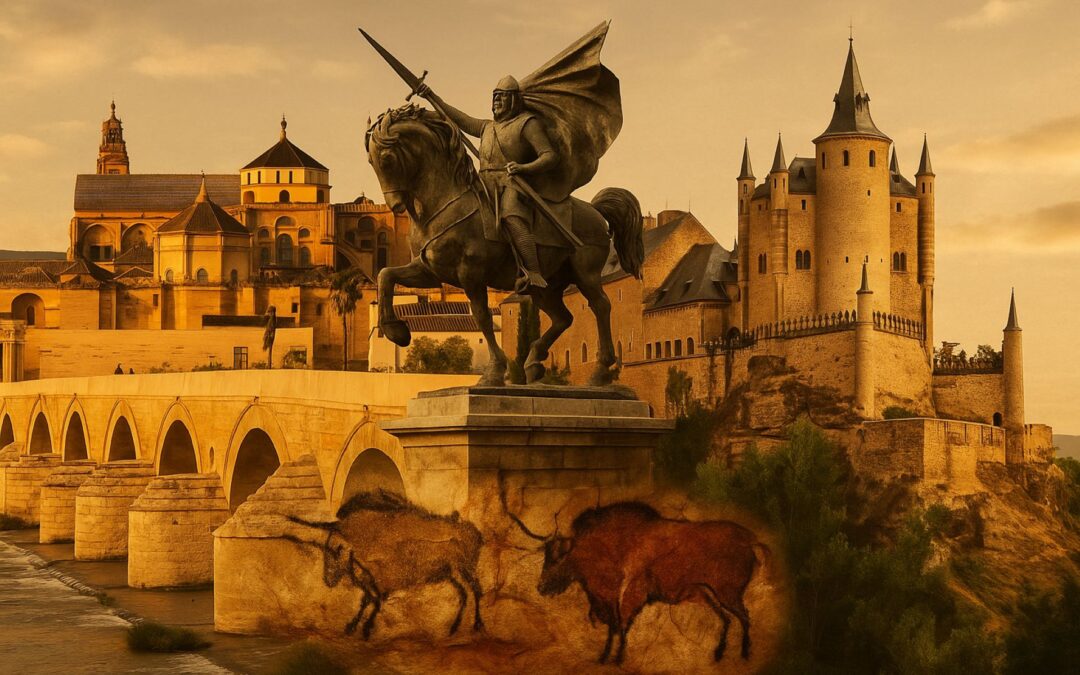
Spain’s history is a saga of contrasts—conquest and resistance, brilliance and brutality, collapse and renewal. Few nations have been shaped by such a relentless cycle of invasion, empire, decline, and rebirth. From prehistoric cave dwellers sketching animals in Altamira to the glittering courts of Córdoba, from the fire and steel of the Reconquista to the global reach of its empire, Spain has been both battlefield and beacon.
It is a land where Roman aqueducts still arch over city streets, Moorish palaces shimmer with intricate stonework, and Gothic cathedrals loom as monuments to ambition. To understand Spain is to trace a story of civilizations colliding, blending, and leaving indelible marks. What emerges is not simply a national history, but a portrait of resilience—an unbroken thread running through millennia of turmoil and transformation.
Prehistoric Beginnings and Ancient Tribes
The Iberian Peninsula has been home to human life for nearly a million years, making it one of Europe’s longest-inhabited landscapes. Archaeological finds in Atapuerca near Burgos reveal the presence of Homo antecessor, a potential ancestor to both Neanderthals and modern humans, dating back 800,000 years. Later, Neanderthal communities flourished in caves like Gibraltar’s Gorham’s Cave, leaving behind flint tools, symbolic carvings, and evidence of fire use. By the Upper Paleolithic, anatomically modern humans had arrived, painting vivid animal scenes in caves such as Altamira, which became known as the “Sistine Chapel of Paleolithic art.”
The Neolithic transition around 6000 BC was transformative. Farming communities began to appear along river valleys, practicing agriculture and animal husbandry. Permanent settlements grew, and monumental megaliths—dolmens and passage tombs—were erected as burial or ritual sites. By 2000 BC, Bronze Age cultures were shaping the peninsula. The El Argar civilization in southeastern Iberia developed complex urban centers, bronze weaponry, and long-distance trade networks. Distinct cultural zones emerged, each marked by unique ceramics, burial practices, and social hierarchies.
By the dawn of the Iron Age, the peninsula had become a patchwork of distinct peoples. The Iberians, concentrated along the Mediterranean, were urbanized and heavily influenced by contact with Mediterranean traders. Their cities had walls, standardized weights and measures, and an early form of script. The Celts in the northwest and interior remained tribal and pastoral, with warrior aristocracies and fortified hillforts (castros). The Lusitanians, occupying western Iberia, gained renown for their tenacity in battle, often using guerrilla tactics to repel invaders. The Tartessians in the southwest forged a wealthy, literate society linked to metal-rich mines, producing gold and silver that attracted Mediterranean interest. Iberia was already diverse and dynamic before outsiders arrived in force.
Rome and the Forging of Hispania
The 3rd century BC transformed Iberia into a stage for global rivalry. Carthage, already entrenched in the south, sought to consolidate its holdings. Its general Hamilcar Barca, father of Hannibal, expanded Carthaginian influence after the First Punic War. Hannibal himself famously marched from Spain with elephants across the Alps to attack Rome in 218 BC—a feat that shook the ancient world. Despite victories at battles like Cannae, Rome’s counterattacks proved decisive. By 206 BC, Scipio Africanus had expelled Carthage from the peninsula.
Rome’s conquest of Iberia was far from swift. The Celtiberians resisted fiercely, their capital Numantia becoming legendary for its doomed defense in 133 BC, when the entire population chose death over surrender. Guerrilla leaders like Viriathus of Lusitania waged relentless campaigns, outmaneuvering Roman legions until his assassination. The final act came with the Cantabrian Wars in the rugged north, where Augustus personally directed campaigns until the last tribes submitted in 19 BC.
Once subdued, Iberia became fully integrated as Hispania. The Romans carved the peninsula into provinces—Baetica, Lusitania, and Tarraconensis—each governed for administration and taxation. Infrastructure followed: aqueducts in Segovia and Tarragona, amphitheaters in Mérida, bridges like Alcántara, and a vast road system connecting cities to the empire. These roads enabled both commerce and Romanization.
Economically, Hispania became indispensable. Baetica’s olive oil fueled Roman diets, wines from Tarraconensis flowed to Gaul, and silver from Cartagena enriched imperial coffers. Roman villas spread across the countryside, showcasing mosaics and agricultural estates. Latin replaced local dialects, planting the roots of the Spanish language. Christianity, initially persecuted, spread across Hispania by the 3rd century, with martyrs such as Saint Eulalia of Mérida inspiring devotion.
The province produced intellectual and political giants. Seneca the Younger shaped Stoic philosophy, Lucan authored epic poetry, Martial pioneered satire, and emperors like Trajan and Hadrian exemplified Rome’s cosmopolitan rule. By the 4th century, Hispania was one of the empire’s most thoroughly Romanized regions, its population embracing Roman law, culture, and religion.
Visigoths and the Fall to Islam
The collapse of Rome opened Iberia to waves of Germanic migration. Around 409 AD, the Vandals swept across the Pyrenees, carving out territories in the south before moving into North Africa. The Suebi settled in Galicia, establishing one of the earliest post-Roman kingdoms in Western Europe. The Alans, a Sarmatian people, briefly held lands before being absorbed.
The Visigoths, initially allies of Rome, became the dominant force. After the sack of Rome in 410, they moved into Iberia, eventually consolidating control by the mid-5th century. From their capital in Toledo, they unified most of the peninsula, expelling rivals and quashing Byzantine enclaves that lingered in the south. They maintained Roman legal traditions through the Codex Euricianus and later the Liber Iudiciorum, blending Roman and Gothic law into a unified system.
Religiously, the Visigoths underwent a dramatic shift. Initially Arians, their kings and nobles eventually embraced Catholic Christianity at the Third Council of Toledo in 589, aligning themselves with the Hispano-Roman majority. This conversion helped fuse the Gothic elite with the broader population, though political instability remained endemic. Rival claimants to the throne clashed, and assassinations were common.
By the early 8th century, this fragility proved disastrous. A succession dispute divided the Visigothic nobility, weakening defenses just as Muslim forces advanced from North Africa. In 711, Tariq ibn Ziyad crossed the Strait of Gibraltar with a relatively small army of Arabs and Berbers. At the Battle of Guadalete, King Roderic fell, and within a few years, nearly the entire peninsula had succumbed. The Visigothic kingdom—once seen as a successor to Rome—collapsed almost overnight, giving way to the new Islamic state of Al-Andalus.
Al-Andalus and the Golden Age
The Muslim conquest of Iberia in 711 was swift, decisive, and world-altering. Within a decade of Tariq ibn Ziyad’s landing at Gibraltar, almost the entire peninsula was under Muslim control. Only a small enclave in the northern mountains of Asturias held out, planting the seeds of Christian resistance. The rest of Iberia became Al-Andalus, initially a province of the vast Umayyad Caliphate centered in Damascus.
When the Abbasid revolution toppled the Umayyads in 750, Abd al-Rahman I—an Umayyad prince who escaped massacre—fled across North Africa and established an independent emirate in Córdoba in 756. His successors consolidated power, creating a sophisticated state blending Arab, Berber, Visigothic, and Hispano-Roman traditions. In 929, Abd al-Rahman III elevated Al-Andalus to a caliphate, making Córdoba one of the greatest cities of the medieval world.
Córdoba in the 10th century was dazzling: paved and lamp-lit streets, aqueducts carrying fresh water, gardens blooming with exotic flora, and libraries boasting hundreds of thousands of volumes—while most European cities were muddy and illiterate. Scholars, philosophers, and physicians flourished. Averroes (Ibn Rushd) reintroduced Aristotle’s works to the West, influencing Aquinas and medieval scholasticism. Jewish thinker Maimonides produced writings that shaped philosophy and theology for centuries.
Tolerance, though not equality, marked this era. Jews and Christians lived as dhimmi, protected but taxed. This coexistence, often referred to as convivencia, created a vibrant exchange of ideas. Agriculture was revolutionized: irrigation canals spread, new crops such as rice, citrus, cotton, and pomegranates transformed diets, and economic prosperity followed. Al-Andalus became famed for luxury goods—Damascene steel, silk weaving, ceramics, and leatherwork from Córdoba.
The architectural achievements still astound: the Great Mosque of Córdoba, begun in the 8th century and expanded into a forest of columns and arches, remains an icon of Islamic art. Later, the Alhambra in Granada, with its intricate arabesques and flowing water features, epitomized Muslim aesthetic genius.
Yet beneath the brilliance lay political fractures. The Caliphate of Córdoba splintered in the early 11th century into smaller taifa kingdoms. These taifas, often brilliant in culture, were weak in defense, competing with one another and inviting northern Christian kingdoms to exploit their divisions. The golden age began to dim, though its cultural legacy endured long after.
The Reconquista and the Rise of Christian Spain
Resistance to Muslim rule began almost immediately after 711. In the mountainous redoubts of Asturias, a Visigothic noble named Pelayo won a modest victory at Covadonga in 722, mythologized as the birth of the Reconquista. For centuries, Christian kingdoms clung to the northern highlands, slowly pushing south as opportunities arose.
By the 9th century, Asturias expanded into León, while Navarre, Aragón, and Catalonia consolidated in the northeast. These realms were small and fragmented, but each generation pushed the frontier further. Castles, monasteries, and repopulated towns marked the shifting borderlands. The warrior-hero Rodrigo Díaz de Vivar—El Cid—embodied this era of shifting loyalties, serving Muslim rulers as a mercenary before carving out his own Christian principality around Valencia.
The decisive turning point came in 1212 at the Battle of Las Navas de Tolosa. A coalition of Christian kings from Castile, Aragon, and Navarre dealt a crushing blow to the Almohads, a North African dynasty that had crossed into Spain to defend Islam. The victory opened Andalusia to rapid Christian conquest. Córdoba fell in 1236, Seville in 1248, and by mid-century, only Granada remained Muslim.
Granada’s Nasrid dynasty survived for over two centuries through diplomatic maneuvering, tribute payments, and its formidable fortress—the Alhambra. Meanwhile, Christian kingdoms grew into formidable states. Portugal consolidated its Atlantic frontiers, Aragon extended into the Mediterranean, and Castile expanded across the heart of Iberia.
The union of Ferdinand of Aragon and Isabella of Castile in 1469 created a dynastic powerhouse. Their armies besieged Granada in a final campaign (1482–1492), culminating in the city’s surrender on January 2, 1492. The Reconquista was complete after nearly eight centuries. That same year, a series of dramatic events reshaped Spain: Jews were expelled unless they converted, the Inquisition enforced religious orthodoxy, and Columbus’ voyage opened the New World. Spain stood on the cusp of global dominance.
Empire and Global Supremacy
The year 1492 marked the beginning of Spain’s transformation from a fragmented peninsula to a global empire. Columbus’ voyage to the Caribbean inaugurated a tidal wave of exploration and conquest. Within decades, Spanish conquistadors overthrew the Aztec Empire in Mexico and the Inca Empire in Peru. Vast territories from California to Chile, from Cuba to Colombia, fell under Spanish rule.
The riches were staggering. Silver from Potosí in Bolivia and Zacatecas in Mexico flooded into Seville, enriching the monarchy. Galleons carried gold, sugar, tobacco, and exotic goods across the Atlantic, while Manila became Spain’s gateway to Asian trade. The Spanish crown established the first truly global empire, spanning the Americas, Asia, Africa, and Europe.
Charles I of Spain, who became Holy Roman Emperor Charles V, ruled not only Spain and its New World colonies but also the Habsburg domains in Central Europe. He presided over an empire so vast that it was said “the sun never set” on his domains. Yet managing such a realm proved nearly impossible. Wars against France, the Protestant Reformation, and the Ottoman Turks consumed resources.
Philip II, Charles’s son, moved the capital to Madrid in 1561 and sought to consolidate power. He crushed Protestant uprisings, clashed with Elizabethan England (sending the ill-fated Armada in 1588), and confronted the Ottoman fleet at Lepanto in 1571 in one of history’s largest naval battles. His reign marked the apogee of Spanish Catholic militancy, positioning Spain as Europe’s defender of faith.
The cultural flowering of this period became Spain’s Golden Age. Miguel de Cervantes wrote Don Quixote, redefining literature. Painters such as El Greco and later Diego Velázquez captured Spain’s spiritual intensity and courtly grandeur. The Escorial, Philip II’s monumental palace-monastery, symbolized both piety and imperial ambition.
Yet Spain’s supremacy came at a price. Endless wars drained the treasury, inflation soared as silver flooded markets, and social tensions grew. By the end of the 17th century, despite its immense empire, Spain was already slipping into decline.
Golden Age and Decline
The 16th and 17th centuries marked the height of Spain’s cultural and political prestige, but also the beginning of its long decline. On one hand, the era shone with dazzling artistic and literary brilliance. Miguel de Cervantes published Don Quixote in 1605 and 1615, a work widely hailed as the first modern novel. Diego Velázquez, court painter to Philip IV, produced masterpieces like Las Meninas, blending realism and illusion in ways no painter before had dared. El Greco’s spiritual intensity redefined Renaissance art, while dramatists such as Lope de Vega and Calderón de la Barca revolutionized European theater.
Architecture mirrored this grandeur. The Monastery of El Escorial, constructed under Philip II, stood as both royal palace and austere symbol of Catholic piety. Cathedrals across the empire blended Gothic, Renaissance, and Baroque elements into striking spiritual fortresses. Music, too, flourished, with composers like Tomás Luis de Victoria contributing to the golden canon of sacred choral works.
Yet behind the artistic radiance, Spain’s foundations were crumbling. The influx of silver from the Americas created rampant inflation, destabilizing the economy and hollowing out domestic industry. The empire’s vast wealth was quickly consumed by the cost of endless wars—against the Protestant Dutch in the Eighty Years’ War, against France in the Thirty Years’ War, and against England on the seas.
Spain suffered humiliations: the Armada’s disastrous defeat in 1588 signaled the waning of its naval dominance, while the independence of the Dutch Republic deprived it of its richest provinces. Portugal, united with Spain from 1580 to 1640, broke away after a successful revolt. Revolts within Spain itself—most notably in Catalonia—strained unity.
By the late 17th century, Spain’s once-mighty Habsburg dynasty was visibly exhausted. Charles II, the last Habsburg king, epitomized the dynasty’s decline. Sickly and infertile due to generations of inbreeding, he left no heir when he died in 1700. Spain, though still vast in territory, was politically fragile, militarily weakened, and economically stagnant. The question of succession plunged Europe into crisis.
Bourbon Reforms and the Age of Enlightenment
The death of Charles II without an heir sparked the War of the Spanish Succession (1701–1714). France and Austria both laid claim to the throne, and Europe descended into a continent-wide conflict. Battles raged not only in Spain but also across the Low Countries, Italy, and even North America. The war ended with the Treaty of Utrecht, which recognized Philip V, a Bourbon grandson of Louis XIV, as king of Spain. However, Spain was forced to cede important territories: the Spanish Netherlands, Naples, Milan, and Sardinia went to Austria, while Britain gained Gibraltar and Minorca.
The Bourbon dynasty brought a different style of rule. Philip V and his successors embraced French-inspired absolutism, centralizing administration and weakening regional privileges such as the historic fueros of Aragon and Catalonia. The monarchy aimed to modernize Spain’s stagnant economy and inefficient governance.
The reforms reached their zenith under Charles III (1759–1788), often called Spain’s “enlightened despot.” He promoted science and secular education, encouraged agricultural innovation, built roads and canals, and curbed the excessive influence of the Church. The Bourbon Reforms extended to the colonies, tightening royal control over trade and administration. New taxes and centralized governance sought to extract more wealth from the Americas.
These reforms revitalized Spain to some degree, creating an atmosphere of intellectual curiosity and modernization. The Botanical Gardens of Madrid, the Royal Academy of History, and scientific expeditions to the Americas reflected the Enlightenment’s spirit. Yet the reforms also bred resentment. Colonists resisted new taxes and tighter oversight, laying the foundations for independence movements that would erupt in the 19th century.
Despite its improvements, Spain never recovered its former dominance. Britain’s naval supremacy, cemented after victories in the Seven Years’ War, restricted Spain’s ability to project power overseas. By the late 18th century, Spain stood stronger than in the Habsburg twilight, but still lagged behind its European rivals. The French Revolution of 1789 soon unleashed a storm that would upend Spain once again.
Napoleonic Upheaval and the Loss of Empire
The French Revolution shook monarchies across Europe, and Spain, initially an ally of revolutionary France, soon found itself entangled in the ambitions of Napoleon Bonaparte. In 1808, Napoleon forced King Charles IV and his son Ferdinand VII to abdicate, installing his brother Joseph Bonaparte as king of Spain. What followed was one of the most brutal and defining conflicts in Spanish history: the Peninsular War (1808–1814).
The war began with the uprising of Madrid on May 2, 1808, immortalized by Francisco Goya in his painting The Third of May 1808. Spanish civilians, priests, and peasants rose in revolt, joined by regular troops and militias. The war became a ferocious struggle of guerrilla warfare—the very term “guerrilla” (little war) originates from this conflict. Ambushes, assassinations, and relentless harassment crippled French supply lines.
Britain, under the Duke of Wellington, allied with Spanish and Portuguese forces. Together, they wore down Napoleon’s armies in a grinding war of attrition. The conflict devastated Spain: cities were destroyed, civilians massacred, and famine stalked the land. Yet by 1814, Napoleon’s forces were expelled, and Ferdinand VII was restored to the throne.
But Spain had emerged broken. Its monarchy, economy, and military were in tatters. Worse still, the war had inspired revolutionary movements across the Atlantic. From Mexico to Argentina, independence leaders seized the moment. Simón Bolívar, José de San Martín, and others led successful campaigns against Spanish rule. By 1825, nearly all of Spain’s American colonies were gone, leaving only Cuba, Puerto Rico, and the Philippines.
The loss of empire dealt a psychological as well as economic blow. Once the most powerful state in Europe, Spain was reduced to a secondary power. Internally, the return of Ferdinand VII proved disastrous. He abolished the liberal Constitution of 1812, reimposed absolutism, and alienated much of his people. Spain lurched into civil wars—particularly the Carlist Wars over succession rights—while modernization stalled. The Napoleonic invasion had not only cost Spain its empire but had also left deep scars on its political and social fabric.
Civil War and Franco’s Dictatorship
The early 20th century in Spain was a cauldron of discontent. The Bourbon monarchy under Alfonso XIII presided over a nation riddled with inequality, corruption, and regional tension. Industrial unrest, the humiliating defeat at the hands of Moroccan Berbers in the Battle of Annual (1921), and a restless military eroded confidence in the crown. In 1923, General Miguel Primo de Rivera seized power in a coup, ruling as dictator with the king’s blessing. His regime initially stabilized the economy and quelled unrest but quickly lost legitimacy, collapsing in 1930 and dragging the monarchy down with it.
In April 1931, elections brought overwhelming support for republican candidates, prompting Alfonso XIII to flee into exile. The Second Republic was proclaimed, and for a brief moment, Spain seemed poised to modernize. Sweeping reforms followed: land redistribution to weaken aristocratic estates, secularization of schools, women’s suffrage, and greater autonomy for regions like Catalonia. But these progressive measures split the country. Landowners, the military, monarchists, and the Catholic Church opposed the Republic, while socialists, communists, and anarchists demanded even deeper change. Political polarization intensified, and street violence became common.
By July 1936, conservative generals led by Francisco Franco staged a coup. Instead of a quick takeover, Spain descended into a full-scale civil war that would become one of the defining conflicts of the 20th century. The Nationalists—monarchists, fascists, conservatives, and clerics—faced the Republicans, an uneasy coalition of liberals, communists, socialists, and anarchists. The war quickly became international. Hitler’s Germany and Mussolini’s Italy sent planes, tanks, and troops to aid Franco, testing weapons later used in World War II. The Soviet Union funneled aid to the Republic, while thousands of volunteers from across the world, including George Orwell and Ernest Hemingway, joined the International Brigades to fight fascism.
The conflict was merciless. Cities were bombed indiscriminately—the Basque town of Guernica annihilated in 1937, an atrocity immortalized in Picasso’s haunting mural. Both sides committed massacres and repression, but the Nationalists were better organized, with stronger foreign support. By 1939, Madrid fell, and Franco declared victory. The toll was catastrophic: an estimated 350,000 dead, countless wounded, and hundreds of thousands fleeing into exile.
Franco established a dictatorship that lasted until 1975. His regime was ultra-conservative, authoritarian, and fiercely Catholic. Political parties were banned; dissenters were imprisoned, executed, or silenced. The Falange became the only legal political movement, and censorship permeated daily life. Franco promoted a rigid Castilian identity, suppressing Basque, Catalan, and Galician languages and traditions. The Inquisition may have been centuries gone, but its spirit of conformity lingered under his watch.
During World War II, Franco remained officially neutral, though sympathetic to the Axis powers. This cautious stance spared Spain from the devastation that consumed Europe. After 1945, however, Franco’s Spain was diplomatically isolated, branded a fascist relic in a world embracing democracy. Yet the onset of the Cold War changed everything. The West, valuing Franco’s anti-communism, began to re-engage. In 1953, Spain signed agreements with the United States, allowing American military bases in exchange for financial aid.
The 1950s and 60s brought the so-called “Spanish Miracle.” Economic liberalization, foreign investment, and booming tourism transformed Spain from a largely agrarian society into an industrial power. Highways, skyscrapers, and modern industries emerged. Millions of Europeans vacationed on Spanish beaches, while Spaniards migrated from rural areas into cities. Living standards rose, but prosperity came unevenly, and repression persisted. Students, workers, and regional nationalists still faced harsh crackdowns.
By the 1970s, Franco’s health faltered. With no children, he named Prince Juan Carlos, grandson of Alfonso XIII, as heir, hoping to preserve Francoism beyond his death. But Franco underestimated the man he chose. When the dictator died in 1975, Spain braced for either continuity of authoritarianism or a leap into the unknown.
Democracy and Modern Spain
The transition after Franco’s death was one of the most remarkable in modern history. King Juan Carlos I, rather than cementing dictatorship, surprised the world by steering Spain toward democracy. He appointed Adolfo Suárez as prime minister, who guided the dismantling of Franco’s political system. Political parties were legalized, including the once-banned communists. In 1977, Spain held its first free elections in over forty years.
A new constitution, ratified in 1978, created a parliamentary monarchy, guaranteeing freedoms of speech, assembly, and religion. Crucially, it also recognized Spain’s regional diversity, granting autonomy to Catalonia, the Basque Country, Galicia, and other communities. This balance between unity and diversity became the bedrock of modern Spain.
The young democracy faced severe tests. In 1981, disaffected military officers staged a coup, storming parliament in an attempt to restore authoritarian rule. The image of Juan Carlos, dressed in military uniform and denouncing the coup on national television, became iconic. His intervention helped save democracy, cementing his reputation as the guarantor of Spain’s new political order.
Spain rapidly integrated into the Western world. It joined NATO in 1982, and in 1986 became part of the European Economic Community (later the EU). The 1980s and 90s saw rapid modernization, with infrastructure projects, economic reforms, and cultural revival. The 1992 Barcelona Olympics symbolized Spain’s transformation from dictatorship to modern European democracy, showcasing a confident, cosmopolitan nation.
Prosperity followed, but challenges persisted. The global financial crisis of 2008 hit Spain especially hard, with unemployment soaring above 25%. Harsh austerity measures followed, sparking mass protests and political realignments. Meanwhile, separatist movements gained momentum, particularly in Catalonia, where demands for independence brought Madrid into repeated confrontation with Barcelona.
The monarchy, once central to democratic stability, also faced declining popularity. Scandals, including corruption and Juan Carlos’s controversial hunting trip during a time of economic crisis, tarnished the crown. In 2014, Juan Carlos abdicated in favor of his son, Felipe VI, who has worked to restore its image.
Today, Spain stands as a parliamentary democracy, integrated deeply into Europe and the global economy. It remains culturally vibrant, economically resilient, and politically complex. Its past—prehistoric tribes, Roman legions, Visigothic kings, Moorish splendor, Christian crusades, imperial grandeur, civil war, dictatorship, and democratic rebirth—still echoes in its institutions, identity, and debates. A country forged in struggle, Spain continues to navigate the legacies of unity and division, tradition and modernity.
Conclusion
Spain today stands as a modern democracy, but its present cannot be separated from its past. Every stone in Toledo, every tower in Seville, every fortress in Granada whispers echoes of the empires, faiths, and revolutions that built the nation. It has endured invasions from Carthage and Rome, the splendor of Al-Andalus, the triumphs and tragedies of the Reconquista, the dizzying wealth and corrosive decline of empire, the fires of civil war, and the iron grip of dictatorship—only to emerge into freedom and stability.
Spain’s history is not a straight line but a mosaic, defined as much by its fractures as by its unities. And yet, through centuries of upheaval, the Spanish spirit has proven remarkably enduring—fiery, adaptive, and unafraid of reinvention. That is the enduring lesson of Spain: nations, like people, are never static. They are living stories, forever shaped by their past, yet always writing their next chapter.