
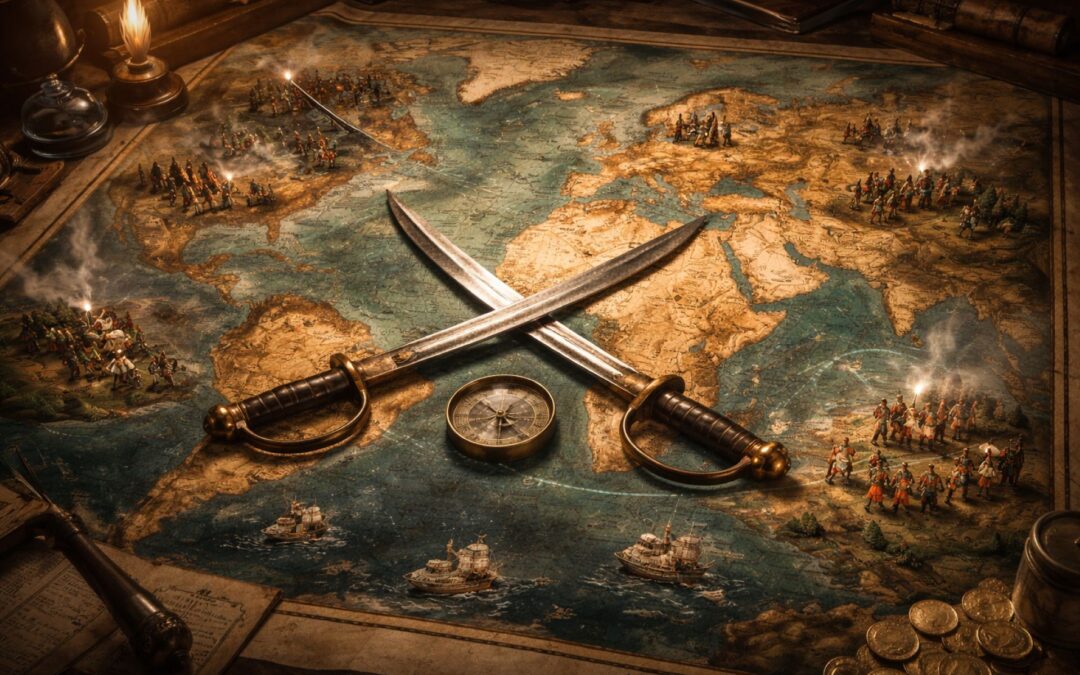
When most people think of a world war, they imagine the catastrophic conflicts of the twentieth century. The First and Second World Wars reshaped nations, redrew borders, and involved combat across multiple continents. Yet more than 150 years before those conflicts erupted, the world had already experienced a war of truly global proportions.
Between 1756 and 1763, the Seven Years’ War engulfed Europe, North America, the Caribbean, Africa, India, and even the Pacific. The great powers of the eighteenth century—Britain, France, Austria, Prussia, Russia, Spain, Sweden, and Portugal—fought alongside colonial forces, indigenous allies, and private trading companies in a sprawling struggle that stretched across the globe.
What began as a diplomatic crisis in Europe and a territorial dispute in North America quickly escalated into a conflict that reshaped the global balance of power. Empires clashed on land and sea, colonial possessions changed hands, and the political map of the world was dramatically altered.
The war ultimately elevated Britain to the position of the world’s leading colonial and naval power while weakening France and transforming the strategic landscape of Europe. It also set in motion events that would lead directly to the American Revolution and the reshaping of the modern world.
For these reasons, many historians regard the Seven Years’ War as the first true world war in human history—a conflict whose consequences were felt across continents and whose legacy continues to shape global history today.
The Fragile Balance of Power in 18th-Century Europe
To understand how the Seven Years’ War erupted into a global conflict, it is necessary to first examine the political landscape of Europe in the early eighteenth century. The continent was dominated by a handful of powerful dynasties whose rivalries shaped international politics. Above all, the struggle between the Bourbon dynasty of France and the Habsburg dynasty of Austria defined the balance of power.
For decades, European diplomacy had operated through a relatively stable alliance system. Britain and Austria had traditionally been allies, united primarily by their shared interest in containing the expansion of French power. France, meanwhile, often supported states that opposed Austrian influence within the fragmented territories of the Holy Roman Empire.
This delicate balance was repeatedly tested through a series of wars that characterized the eighteenth century. One of the most significant was the War of the Austrian Succession, fought between 1740 and 1748. The conflict erupted after the death of Emperor Charles VI of Austria, whose daughter Maria Theresa inherited the Habsburg lands. Several European powers challenged her claim, hoping to exploit the apparent weakness of the Austrian monarchy.
During this war, the traditional alliance structure largely held. Britain supported Austria in order to prevent France from expanding its influence across Europe. Prussia, however, emerged as a new and ambitious power. Under the leadership of King Frederick II—later known as Frederick the Great—Prussia invaded and seized the wealthy province of Silesia from Austria.
The conflict ended in 1748 with the Treaty of Aix-la-Chapelle, which confirmed Maria Theresa as ruler of Austria but allowed Prussia to retain control of Silesia. While the treaty formally ended the war, it resolved few of the deeper tensions that had fueled the conflict.
Austria never accepted the loss of Silesia and was determined to recover the province. Prussia, meanwhile, had gained a valuable territory and increased prestige, but its position remained precarious among larger and more powerful neighbors. France and Britain also remained locked in an increasingly intense struggle for colonial dominance across the globe.
Thus, by the middle of the eighteenth century, Europe stood on the edge of another major war. Old grievances remained unresolved, rival empires competed for influence both within Europe and overseas, and the fragile balance of power that had governed the continent for decades was beginning to break apart.
The Diplomatic Revolution of 1756
By the mid-eighteenth century, the traditional alliance system that had governed European politics for decades began to collapse. The tensions left unresolved by the War of the Austrian Succession had created deep mistrust among the major powers, and shifting strategic interests forced governments to reconsider their longstanding alliances.
At the center of this upheaval was Austria’s determination to recover the province of Silesia from Prussia. Empress Maria Theresa viewed the loss of this prosperous territory as both a humiliation and a strategic threat. Yet Austria’s traditional ally, Britain, was unwilling to support a war aimed at reclaiming Silesia. London was far more concerned with protecting its overseas empire and defending the German territory of Hanover, which was ruled in personal union with the British crown.
Frustrated by Britain’s lack of commitment, Austria took a dramatic and unexpected step. It began pursuing diplomatic ties with its long-time rival—France. For centuries, the Bourbon monarchy of France and the Habsburg dynasty of Austria had been bitter enemies, but their interests were now beginning to align. France saw an opportunity to weaken Britain’s position in Europe, while Austria hoped that French support would allow it to defeat Prussia and reclaim Silesia.
This sudden reversal of alliances became known as the Diplomatic Revolution of 1756. Austria and France, once adversaries, formed a powerful partnership that also included Russia, which feared the growing strength of Prussia under Frederick the Great. Sweden and several smaller German states later joined this coalition.
Meanwhile, Britain found itself searching for a new continental ally. Its primary concern was the defense of Hanover from potential French invasion. The solution came from an unlikely partner: Prussia. In 1756, Britain and Prussia signed the Convention of Westminster, establishing an alliance in which Britain would provide financial support while Prussia committed to defending Hanover and opposing Austria.
The result was a dramatic realignment of European politics. Instead of the traditional France–Prussia alliance against Austria and Britain, the continent now faced two entirely new blocs. On one side stood Britain and Prussia; on the other were France, Austria, Russia, Sweden, and eventually Spain.
This reshaping of alliances shattered the diplomatic balance that had previously kept Europe relatively stable. With rival coalitions now preparing for confrontation and tensions rising across the continent, the stage was set for a war that would soon spread far beyond Europe’s borders.
Colonial Rivalry Between Britain and France
While diplomatic tensions were escalating in Europe, an equally intense rivalry was unfolding across the expanding colonial empires of the eighteenth century. Britain and France had spent decades competing for influence in overseas territories, and by the mid-1700s their ambitions had begun to collide in multiple parts of the world.
Both powers had built vast trading networks and colonial settlements that generated enormous wealth. Sugar from the Caribbean, furs from North America, spices and textiles from India, and countless other commodities flowed into European markets, enriching merchants and strengthening national economies. Control over these resources had become essential to the prestige and power of European states.
In India, the rivalry between the two nations was largely conducted through their respective trading companies: the British East India Company and the French East India Company. Although these organizations were officially commercial enterprises, they increasingly acted as political and military agents of their governments. Both companies maintained private armies composed of European soldiers and locally recruited troops, and they frequently intervened in regional disputes to secure favorable trading arrangements.
These tensions erupted in a series of conflicts known as the Carnatic Wars, which saw British and French forces fighting for influence among the competing Indian rulers of the subcontinent. Although these struggles were often tied to wars in Europe, they also reflected the growing importance of India within the global contest between the two empires.
The rivalry was even more pronounced in North America. By the middle of the eighteenth century, Britain and France had established extensive colonial territories across the continent. Britain’s thirteen colonies stretched along the eastern seaboard from Georgia to New England, while France controlled a vast network of territories extending from the St. Lawrence River through the Great Lakes and down the Mississippi River toward the Gulf of Mexico.
This enormous French domain, known as New France, effectively surrounded the British colonies and limited their ability to expand westward. To strengthen their claims, the French constructed a chain of forts throughout the interior, particularly in the Ohio River Valley. These fortifications were intended to prevent British settlers from moving into the region and to secure vital trade routes with Native American allies.
For British colonists eager to expand westward, the French presence in the Ohio Valley represented a direct challenge. The boundaries between the two empires were poorly defined, and both sides believed they had legitimate claims to the territory. As settlers pushed further into contested lands and military patrols began confronting one another in the wilderness, tensions escalated rapidly.
It was in this remote frontier region of North America that the first shots of what would become the Seven Years’ War were fired—turning a colonial dispute into a conflict that would soon engulf the world.
The Spark in North America
The immediate spark that ignited the wider conflict occurred in the contested frontier lands of the Ohio River Valley in North America. During the early 1750s, both Britain and France sought to strengthen their claims over this strategically important region. The area served as a vital link between the French territories of Canada and Louisiana and was equally attractive to British colonists eager to expand westward beyond the Appalachian Mountains.
To secure their position, the French constructed a series of forts throughout the Ohio Valley. Among the most important of these was Fort Duquesne, built in 1754 at the confluence of the Allegheny and Monongahela rivers—an area that today forms the city of Pittsburgh. From the French perspective, the fort was necessary to protect their territorial claims and maintain control over trade routes with Native American tribes.
British officials and colonial settlers, however, saw the fortifications as a direct violation of British territorial rights. In response, the British government authorized a military expedition to challenge French control of the region. The task of leading this force fell to a young and relatively inexperienced officer in the Virginia militia: Lieutenant Colonel George Washington, who would later become the first president of the United States.
In May 1754, Washington led a small detachment of colonial troops and Native American allies into the wilderness near Fort Duquesne. There, they encountered a small French scouting party under the command of Joseph Coulon de Jumonville. Washington’s forces ambushed the French detachment in what became known as the Battle of Jumonville Glen.
The skirmish ended with several French soldiers killed and others captured. However, the circumstances of the encounter were controversial, with the French claiming that Jumonville had been on a diplomatic mission rather than conducting reconnaissance. The incident quickly inflamed tensions between the two powers.
Just weeks later, French forces retaliated. In July 1754, they attacked Washington’s hastily constructed defensive position known as Fort Necessity. Surrounded and outnumbered, Washington was forced to surrender after a brief battle.
Although these clashes were relatively small engagements fought deep in the American wilderness, they carried enormous consequences. The fighting in the Ohio Valley became known as the French and Indian War, the North American theater of what would soon evolve into the Seven Years’ War.
News of the conflict spread slowly across the Atlantic, but once it reached Europe, it became clear that Britain and France were on a path toward open war. What had begun as a local dispute over frontier territory had now set in motion a chain of events that would soon engulf multiple continents and draw the great powers of the world into a global struggle.
War Breaks Out Across the Globe
By the mid-1750s, Britain and France were effectively at war even before either nation had formally declared it. Fighting had already begun in North America, and both powers were preparing for a much larger conflict by sending reinforcements to their overseas territories.
The first major British move came in 1755 with an attack on the French colony of Acadia in present-day Nova Scotia. British forces captured the territory and expelled thousands of French settlers, an event that became known as the Great Expulsion of the Acadians. At the same time, British armies attempted to push deeper into the French-controlled interior of North America.
One of the most ambitious British operations was led by Major General Edward Braddock, who commanded a force of around 2,000 soldiers and colonial militia. His objective was to capture Fort Duquesne, the strategic French stronghold in the Ohio Valley. However, the expedition ended in disaster. In July 1755, Braddock’s army was ambushed by a smaller French force and its Native American allies. The British troops were routed, and Braddock himself was mortally wounded during the retreat.
Meanwhile, tensions were escalating at sea. Even though Britain and France had not yet officially declared war, the British Royal Navy began targeting French shipping. British warships captured several French vessels and seized hundreds of merchant ships, while blockading French ports in an effort to disrupt trade and weaken the French economy.
France responded in 1756 by launching an invasion of the British-held Mediterranean island of Minorca. The British fleet sent to relieve the island failed to defeat the French navy, and Minorca soon fell into French hands. The defeat sparked outrage in Britain and led to the execution of Admiral John Byng, who was court-martialed for failing to do everything possible to defend the island.
With hostilities escalating on multiple fronts, Britain formally declared war on France in May 1756. France followed with its own declaration of war shortly afterward.
While the colonial struggle between Britain and France had helped ignite the conflict, the war in Europe was triggered by another development entirely. In August 1756, Frederick the Great of Prussia launched a preemptive invasion of Saxony, a state allied with Austria.
This bold move was intended to prevent Austria and its allies from surrounding Prussia and to secure Frederick’s control over the valuable province of Silesia. Instead, it transformed the growing tensions between the European powers into a full-scale continental war.
Within months, armies were marching across central Europe, colonial forces were clashing in North America and India, and naval battles were spreading across the Atlantic and Mediterranean. What had begun as a series of regional disputes had now escalated into a truly global conflict.
Frederick the Great and the European Theater
While Britain and France battled for control of colonies and sea routes around the world, the central European theater became the stage for a dramatic struggle between Prussia and a powerful coalition of enemies. At the center of this conflict stood Frederick II of Prussia, later known as Frederick the Great, whose military leadership would become legendary.
Frederick’s decision to invade Saxony in 1756 was a bold attempt to seize the initiative before Prussia could be surrounded by hostile powers. Saxony was allied with Austria and served as a potential staging ground for an invasion of Prussia. By occupying the territory quickly, Frederick hoped to neutralize the threat and prepare for a decisive campaign against Austria.
His broader strategy was to deliver a rapid knockout blow to the Austrians by advancing through Saxony and striking deep into Bohemia. If successful, this maneuver might have forced Austria to accept peace before Russia or France could bring their full military strength against Prussia.
However, the campaign did not unfold as Frederick had planned. Early battles in Bohemia revealed the resilience of the Austrian army. Although Prussian forces initially made progress, they failed to secure a decisive breakthrough. In October 1756, an Austrian army under General Maximilian Ulysses Browne halted Frederick’s advance, forcing the Prussians into a prolonged struggle.
The situation soon grew even more dangerous for Prussia. France entered the war on Austria’s side and launched an invasion of Hanover, the German territory ruled by Britain’s King George II. French forces defeated the Hanoverian army in 1757 and forced the region to temporarily surrender.
At the same time, Russian armies began advancing into eastern Prussian territories, while Sweden joined the coalition and threatened Prussia from the north. By late 1757, Frederick faced the daunting prospect of fighting powerful enemies on multiple fronts.
Despite these overwhelming odds, Frederick demonstrated remarkable military skill. In November 1757, he achieved a stunning victory at the Battle of Rossbach, where a smaller Prussian army defeated a much larger combined French and German force through superior maneuvering and discipline.
Just weeks later, Frederick secured another dramatic triumph at the Battle of Leuthen, defeating a numerically superior Austrian army. These victories restored Prussian morale and cemented Frederick’s reputation as one of the greatest commanders of the eighteenth century.
Frederick’s successes prevented the immediate collapse of Prussia, but the war in Europe was far from over. Surrounded by powerful enemies and forced to fight on multiple fronts, the Prussian kingdom would spend the next several years struggling for survival in one of the most intense military contests of the century.
The War in India and the Rise of the British East India Company
While Europe remained locked in a brutal struggle between Prussia and its enemies, another crucial theater of the Seven Years’ War unfolded thousands of miles away on the Indian subcontinent. Here, the conflict between Britain and France was fought largely through the actions of their respective trading corporations—the British East India Company and the French East India Company.
Although these companies had originally been established to conduct trade, by the mid-eighteenth century they had evolved into powerful political and military organizations. Each maintained fortified settlements, commanded private armies, and sought alliances with local rulers in order to expand their influence. The competition between them had already produced several regional conflicts known collectively as the Carnatic Wars, which formed part of the larger rivalry between the two European powers.
India at the time was still dominated by powerful indigenous states. The once-mighty Mughal Empire continued to exert influence in the north, while regional powers such as the Maratha Confederacy, the Sultanate of Mysore, and numerous smaller kingdoms controlled other parts of the subcontinent. European companies often intervened in the disputes among these rulers, supporting one side or another in exchange for political and commercial advantages.
One of the most decisive moments of the war in India occurred in 1757 at the Battle of Plassey. A relatively small force belonging to the British East India Company, led by the ambitious officer Robert Clive, confronted the army of the Nawab of Bengal, Siraj-ud-Daulah. The Nawab commanded an army vastly larger than Clive’s, numbering tens of thousands of soldiers and supported by a small French contingent.
Despite this numerical disadvantage, Clive secured a decisive victory. Through a combination of battlefield tactics and political intrigue—including the defection of several key Bengali commanders—the British forces shattered the Nawab’s army. The victory at Plassey allowed the British East India Company to seize control of Bengal, one of the richest regions in India.
The consequences of this triumph were enormous. Bengal’s wealth provided the British with the financial resources needed to expand their military operations across the subcontinent. Over the following years, British forces steadily pushed back French influence and strengthened their control over strategic territories.
The conflict culminated in a decisive British victory at the Battle of Wandiwash in 1760, where British troops defeated the remaining French forces in southern India. The fall of the French stronghold at Pondicherry in 1761 effectively ended French ambitions of building a major empire in India.
Although the French were allowed to retain a small commercial presence after the war, the balance of power had shifted decisively. The British East India Company now stood as the dominant European power in India—a position that would eventually allow Britain to establish one of the largest colonial empires in history.
The Struggle for North America
While events in Europe and India shaped the wider war, North America remained one of the most decisive theaters of the conflict. Known locally as the French and Indian War, this struggle determined which European power would dominate the vast territories of the continent.
At the beginning of the war, the French enjoyed several early advantages. Their military forces were smaller than those of the British colonies, but they benefited from strong alliances with many Native American tribes and from a network of well-positioned frontier forts. French commanders used these advantages to conduct swift raids and coordinated attacks across the borderlands.
In 1756, French forces captured Fort Oswego, a key British stronghold on Lake Ontario, giving them greater control over the Great Lakes region. The following year they achieved another major success by capturing Fort William Henry, which commanded the southern end of Lake George. These victories temporarily secured the French position in the northern frontier.
Despite these successes, France faced a major demographic disadvantage. By the late 1750s, the British colonies along the eastern seaboard had a population of roughly two million people, while the French colony of New France contained only about one hundred thousand settlers. Once Britain mobilized the full resources of its colonies, this imbalance became increasingly difficult for France to overcome.
The turning point came after the British government adopted a new strategy under the leadership of William Pitt, who became secretary of state in London. Pitt recognized that Britain’s greatest strengths were its naval power and its economic resources. His plan was to finance Prussia’s war effort in Europe while directing British military operations toward France’s vulnerable overseas possessions.
With increased manpower and stronger coordination, British forces began to push back the French. In 1758 they captured Fort Duquesne, securing control of the Ohio Valley, and seized Fort Frontenac, a vital French supply base on Lake Ontario.
That same year, British forces achieved another major victory by capturing the powerful fortress of Louisbourg on Cape Breton Island. This fortified harbor controlled access to the St. Lawrence River and served as the gateway to the French heartland in Canada.
Although the French managed to win a costly defensive victory against a British advance at the Battle of Carillon (also known as Fort Ticonderoga), the strategic momentum had begun to shift. The growing manpower and resources of the British Empire were beginning to overwhelm French resistance.
By the end of the decade, British forces were poised to launch a decisive campaign against the French colonies in Canada—a campaign that would ultimately determine the fate of French power in North America.
Britain’s Annus Mirabilis: The Turning Point of 1759
By the late 1750s, the Seven Years’ War had reached a critical stage. Although the conflict had dragged on for several years with mixed results for both sides, the year 1759 proved to be a dramatic turning point—especially for Britain. A series of extraordinary victories across multiple theaters transformed the course of the war and secured Britain’s position as the dominant global power.
One of the greatest threats facing Britain during this period was the possibility of a French invasion of the British Isles. France planned an ambitious amphibious assault that would transport an army across the English Channel in flat-bottomed boats. If successful, such an invasion could have forced Britain out of the war entirely.
However, Britain’s powerful navy proved decisive. In August 1759, a British fleet under Admiral Edward Boscawen defeated the French Mediterranean fleet at the Battle of Lagos, disrupting France’s preparations for invasion. Later that year, the Royal Navy achieved an even more decisive victory.
On 20 November 1759, Admiral Edward Hawke intercepted the main French fleet near Quiberon Bay off the coast of France. In a fierce naval battle fought during rough weather, the British fleet destroyed or scattered the French ships, effectively eliminating any possibility of an invasion of Britain. The victory demonstrated the overwhelming superiority of the Royal Navy and secured British control of the seas.
Meanwhile, major developments were unfolding in North America. In September 1759, British forces launched a daring attack on the city of Quebec, the capital of New France. Under the command of Major General James Wolfe, around 4,000 British troops climbed steep cliffs overlooking the St. Lawrence River and confronted French forces outside the city on the Plains of Abraham.
The battle that followed was brief but decisive. The British army defeated the French defenders, led by General Louis-Joseph de Montcalm. Both commanders were mortally wounded during the fighting, but the British victory allowed them to capture Quebec. This triumph opened the way for the eventual conquest of the entire French colony of Canada.
The wave of British successes in 1759 earned the year the title Annus Mirabilis, meaning “year of miracles.” Victories at sea, in North America, and in other theaters of the war demonstrated the effectiveness of Britain’s global strategy and its growing dominance over its French rival.
Despite these successes, the war was not yet over. In Europe, Prussia continued to struggle against the combined forces of Austria and Russia, suffering several devastating defeats. Nevertheless, the events of 1759 had shifted the strategic balance of the war in Britain’s favor, making it increasingly difficult for France and its allies to recover.
The Global Expansion of the Conflict
As the Seven Years’ War continued, the fighting spread even further across the world. By the late 1750s, nearly every region touched by European colonial power had become part of the conflict. Battles were fought not only in Europe, North America, and India, but also in the Caribbean, Africa, and across the world’s oceans.
One of the most important areas of conflict was the Caribbean, where France possessed extremely valuable sugar-producing colonies such as Guadeloupe and Martinique. These islands were among the most profitable possessions in the French empire. The wealth generated from sugar plantations made them economically more valuable to France than its vast but sparsely populated territories in North America.
Recognizing this, Britain launched a major campaign to capture the French Caribbean colonies. In 1759, British naval forces sailed to the region and began operations against Guadeloupe. Despite suffering heavy losses from tropical diseases that devastated their troops, British forces eventually succeeded in capturing the island after a prolonged campaign.
The war also reached West Africa, where both Britain and France operated trading posts that were deeply involved in the Atlantic slave trade. In 1758, British forces captured several French trading stations in present-day Senegal, including the important stronghold of Fort Louis. Control of these trading posts disrupted French commercial networks and strengthened Britain’s position in the Atlantic economy.
Meanwhile in Europe, the struggle between Prussia and its enemies continued with enormous intensity. Russian forces occupied large parts of East Prussia, threatening Frederick the Great’s kingdom from the east, while Austrian and French armies pressed from other directions. Several major battles during this period inflicted heavy casualties on all sides, demonstrating the increasingly brutal nature of the war.
Despite Prussia’s remarkable resilience, the kingdom was pushed to the brink of collapse. In 1759, Frederick suffered a catastrophic defeat at the Battle of Kunersdorf, where combined Russian and Austrian forces nearly destroyed the Prussian army. The scale of the losses was enormous, and for a moment it appeared that Prussia might soon be defeated.
Yet Frederick managed to escape complete destruction, largely because coordination between his enemies broke down. The uneasy alliance between Austria and Russia prevented them from fully exploiting their victory. As a result, Prussia survived the crisis and continued fighting.
By the early 1760s, the Seven Years’ War had become one of the most widespread conflicts the world had ever seen. Fighting stretched across continents, trade networks were disrupted, and governments struggled to sustain the immense financial burden of maintaining armies and fleets for so many years.
Although neither side had yet secured a decisive victory, the strain of the war was beginning to push all of the major powers toward the search for peace.
The War Reaches Its Breaking Point
By the early 1760s, the Seven Years’ War had entered a stage of exhaustion. Nearly every nation involved in the conflict was under enormous financial and military strain. Years of fighting had drained treasuries, devastated armies, and placed immense pressure on governments struggling to sustain the war effort.
Across Europe, battles continued but rarely produced decisive breakthroughs. Armies maneuvered, fought, and suffered heavy casualties, yet neither side was able to secure a victory strong enough to force the other into surrender. The war had effectively reached a stalemate.
One major change came when Spain entered the war in 1762. The Spanish monarchy, ruled by the Bourbon dynasty like France, had remained neutral during most of the conflict. However, King Charles III feared that Britain’s growing dominance in North America and the Caribbean posed a direct threat to Spanish colonial possessions.
Spain therefore formed a closer alliance with France and entered the war against Britain. The decision quickly proved disastrous. British forces responded by launching a series of bold expeditions against Spanish colonies across the world.
One of the most significant operations targeted Havana, the capital of Spanish Cuba and one of the most important ports in the Caribbean. In 1762, a massive British expeditionary force of roughly 30,000 troops besieged the city. After a prolonged siege lasting several weeks, Havana fell to the British, delivering a major blow to Spain’s colonial defenses.
At nearly the same time, another British expedition sailed across the globe to the Philippines. In October 1762, British forces captured Manila, the capital of the Spanish colony. This remarkable operation demonstrated the truly global reach of the war and the power of the British navy to project force across vast distances.
Meanwhile in Europe, Prussia’s situation remained precarious. Frederick the Great had been fighting for survival against Austria and Russia for several years, and by 1761 his kingdom was close to collapse. Russian forces had captured the Baltic port of Kolberg, which allowed them to supply their armies more easily and increased the pressure on Prussia.
Then an unexpected event dramatically altered the course of the war. In January 1762, the Russian Empress Elizabeth died. Her successor, Peter III, admired Frederick the Great and immediately reversed Russia’s foreign policy. Instead of continuing the war against Prussia, he withdrew Russian forces and even formed an alliance with Frederick.
This sudden shift, sometimes called the “Miracle of the House of Brandenburg,” saved Prussia from destruction. Without Russian support, Austria could no longer defeat Frederick, and the European theater of the war began moving toward stalemate.
At the same time, France was suffering from economic exhaustion and the devastating effects of the British naval blockade. With its military fortunes declining and its resources nearly depleted, the French government gradually accepted that continuing the war offered little hope of success.
By late 1762, most of the major powers recognized that peace negotiations were unavoidable. The world had endured seven years of global warfare, and the time had come to bring the conflict to an end.
The Treaties That Ended the War
After seven years of exhausting warfare, the major powers of Europe and their colonial empires finally began negotiating peace in late 1762. The immense financial and military strain of the conflict had convinced nearly every government that continuing the war offered little chance of further gains.
The settlement that ended the conflict came in the form of two major treaties signed in early 1763, each addressing different parts of the war.
The first was the Treaty of Hubertusburg, signed on 15 February 1763 between Prussia, Austria, and Saxony. This treaty concluded the European theater of the war. Despite years of brutal fighting and enormous casualties, the agreement largely restored the territorial status quo. Prussia retained control of Silesia, the province whose seizure had originally sparked the conflict between Prussia and Austria. Frederick the Great had successfully defended his kingdom against a powerful coalition of enemies and emerged from the war with Prussia recognized as one of the great powers of Europe.
Five days earlier, on 10 February 1763, another treaty had been signed in Paris between Britain, France, and Spain. The Treaty of Paris addressed the global aspects of the war and dramatically reshaped the colonial world.
Britain emerged as the clear victor. France ceded all of its territory in North America east of the Mississippi River to Britain, effectively ending the French colonial empire in Canada. In compensation, France transferred the territory of Louisiana west of the Mississippi to Spain, while Spain ceded Florida to Britain.
France was allowed to retain several of its valuable Caribbean sugar islands, including Guadeloupe and Martinique. These colonies were so economically profitable that France considered them more valuable than its vast North American territories.
In India, the treaty allowed France to maintain a limited presence in several trading posts, but it effectively confirmed the dominance of the British East India Company on the subcontinent. The balance of power had decisively shifted in Britain’s favor.
Although Spain had suffered major losses during the war, Britain returned Havana and Manila to Spanish control in exchange for Florida. This arrangement helped stabilize relations between the two powers while reinforcing Britain’s growing influence across the Atlantic world.
Together, the Treaties of Paris and Hubertusburg formally ended the Seven Years’ War and marked the beginning of a new global order. Britain had emerged as the leading naval and colonial power, while Prussia had secured its position as a dominant force in European politics.
Yet the peace settlement also created new tensions and problems that would soon lead to further upheaval across the Atlantic world.
The Consequences: A New Global Order
Although the Seven Years’ War officially ended in 1763, its consequences reshaped the political and economic landscape of the world for decades to come. The conflict dramatically altered the balance of power among European nations and transformed the nature of global empires.
The greatest beneficiary of the war was Great Britain. Through its victories on land and sea, Britain had eliminated France as a major rival in North America and established itself as the dominant naval power in the world. The British Empire now controlled vast territories stretching from Canada to Florida, along with expanding influence in India and key positions across the Caribbean.
However, victory came at an enormous financial cost. The war had required massive military expenditures, leaving the British government deeply in debt. In an effort to recover these costs, Parliament introduced new taxes and regulations on the American colonies.
These measures included acts that imposed duties on trade and goods within the colonies. British officials argued that the colonies should help pay for the defense that had secured their territory from French threats. Many colonists, however, strongly disagreed. They resented being taxed by a parliament in which they had no direct representation.
The growing dispute over taxation and political authority gradually escalated into a major constitutional crisis. Within little more than a decade after the end of the Seven Years’ War, tensions between Britain and its American colonies erupted into open conflict, leading to the American Revolutionary War in 1775.
France also emerged from the war profoundly weakened. Although it retained its lucrative Caribbean colonies, the loss of its North American empire dealt a severe blow to French prestige and influence. French leaders became determined to restore the balance of power and sought opportunities to undermine Britain’s dominance.
This motivation would eventually lead France to support the American colonies during their rebellion against Britain, providing financial and military assistance that proved crucial to the success of the American Revolution.
In Europe, the war confirmed Prussia’s rise as a major continental power. Frederick the Great had successfully defended his kingdom against a powerful coalition of enemies, demonstrating the effectiveness of Prussia’s disciplined army and military leadership. The kingdom would remain a central force in European politics for generations.
The Seven Years’ War also marked an important turning point in global imperial competition. The conflict demonstrated that wars between European powers were no longer confined to the continent itself. Instead, they were increasingly fought across colonies, trade routes, and distant territories around the world.
For this reason, historians often view the Seven Years’ War as the first truly global conflict in modern history—a war whose consequences shaped the rise and fall of empires and set the stage for the revolutionary age that followed.
Conclusion
The Seven Years’ War stands as one of the most consequential conflicts of the eighteenth century and arguably the first true world war in history. Fought across Europe, North America, the Caribbean, Africa, India, and even the Pacific, it demonstrated how the ambitions of European empires had expanded beyond the continent into a truly global struggle for power.
What began as a diplomatic crisis in Europe and a territorial dispute in the forests of North America rapidly escalated into a war involving nearly every major power of the age. Through a combination of naval strength, financial resources, and strategic planning, Britain ultimately emerged as the dominant imperial power, while Prussia secured its position as a rising force in European politics.
The war also reshaped colonial empires. France lost its vast North American territories, Spain saw its possessions threatened, and the British East India Company began its transformation into the dominant power in India. These shifts marked the beginning of a new era in global imperial competition.
Yet the consequences of the conflict reached far beyond territorial changes. The enormous debts accumulated during the war forced governments to impose new taxes and reforms, creating political tensions that would soon erupt into revolution. In particular, Britain’s attempts to raise revenue from its American colonies set the stage for the American Revolution, which would dramatically alter the course of modern history.
In many ways, the Seven Years’ War laid the foundations for the geopolitical world that followed. It demonstrated that wars between great powers would increasingly be fought on a global scale, linking distant continents through conflict, commerce, and empire.
For this reason, the war of 1756–1763 deserves recognition not merely as another eighteenth-century conflict, but as the moment when warfare truly became global—the real first world war.