
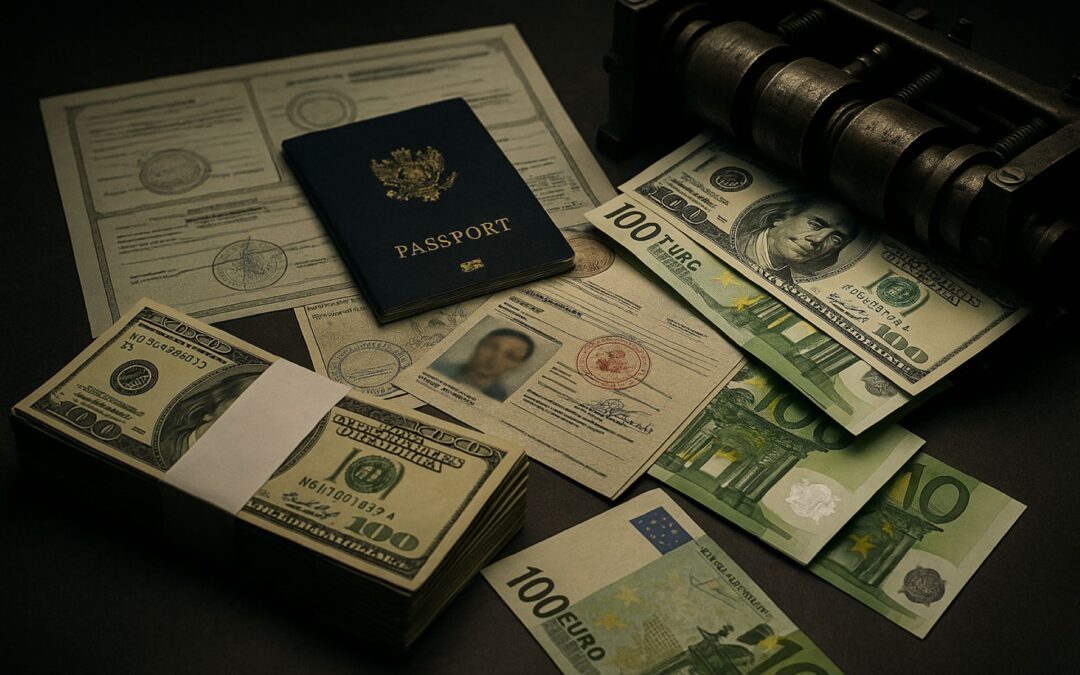
Every bill in your wallet, every designer logo stitched into your clothes, every passport stamp granting you passage across borders—each carries an unspoken promise of authenticity. Yet, somewhere in the world, there exists a version of it that isn’t real. Counterfeit money and forged documents aren’t just petty crimes or market nuisances; they are billion-dollar empires running parallel to the legitimate economy, complete with supply chains, logistics, and international networks.
From the meticulous forgers of Peru to North Korea’s state-backed “supernotes,” from Colombia’s high-volume presses to Lagos’ identity factories, entire cities have become capitals of counterfeiting. They don’t just copy value—they manufacture belief, exploiting the thin line between what we trust and what we see.
Fake Money, More Problems
The story of counterfeit currency is as old as money itself, and it reveals a fascinating paradox: the moment humanity invented a system of trust, someone tried to exploit it. When the Kingdom of Lydia introduced the world’s first standardized coins in the 7th century BCE, stamped with the image of a lion’s paw or head to signify royal authenticity, they had no idea they were also introducing the world’s first counterfeiters. Archaeologists have uncovered coins from this period that appear genuine on the surface but hide a core of base metal beneath a thin coating of electrum. It was the earliest bait-and-switch, proof that wherever value is concentrated, deception follows.
As civilizations expanded, so did the sophistication of fakes. In ancient Greece and Rome, counterfeiters clipped slivers of precious metal off genuine coins to collect scrap, then passed the lighter coins back into circulation. Others cast molds of authentic coins and struck copies with diluted alloys. The cat-and-mouse game between authority and forgery became endless: each time rulers introduced new markings or shapes, counterfeiters devised new tricks to replicate them. Money, at its core, is built on confidence—and counterfeiters have always thrived by undermining that confidence.
The leap to paper money in China’s Song Dynasty during the 11th century was supposed to solve practical problems. Coins were heavy, expensive to transport in bulk, and vulnerable to theft. Lightweight paper notes, backed by metal reserves, promised efficiency. But that efficiency also meant vulnerability. In Sichuan, a hub of commerce and paper-making, workshops sprouted that produced forged notes almost as quickly as the government could issue the real ones. The authorities, recognizing how dangerous counterfeits were to stability, resorted to brutal punishments—execution for anyone caught with forged currency. Even this draconian deterrent could not stamp out the practice.
By the time paper money became common in the West, the lesson was well established: wherever money flows, counterfeits shadow it. In the 19th century United States, the scale was staggering. The nation was young, fragmented, and lacked a standardized currency system—banks issued their own notes, and designs varied widely. This chaos created the perfect environment for counterfeiters. After the Civil War, it was estimated that between one-third and one-half of all money in circulation was fake. Imagine walking into a store, handing over a bill, and not knowing whether the shopkeeper would accept it, or whether the bank would laugh you out the door. That level of uncertainty wasn’t just inconvenient—it was corrosive to the entire economy.
The crisis forced the government to act. In 1865, the U.S. Secret Service was established, not to protect Abraham Lincoln or his successors, but to safeguard the financial system. Its original mandate was to track down counterfeiters, dismantle their operations, and restore confidence in the dollar. Over time, the agency evolved into what we know today, but its roots were planted in this war against fake money.
The deeper story here is that counterfeit money has always been more than crime. It is a mirror of society’s weaknesses—whether technological, institutional, or psychological. It thrives on gaps: gaps in enforcement, gaps in trust, and gaps in the public’s ability to tell real from fake. Every new evolution of money—from coins to notes to digital transactions—brings with it a new breed of counterfeiter eager to exploit those cracks.
Operation Bernhard: How Counterfeits Nearly Crippled Britain
If counterfeit money had historically been a nuisance, World War II transformed it into a weapon of mass disruption. In 1942, the Nazi regime launched Operation Bernhard, a covert project designed not merely to enrich Germany, but to destabilize the British economy and tilt the war through financial sabotage. It was one of the most audacious counterfeiting schemes ever attempted.
The SS gathered 140 prisoners in Sachsenhausen concentration camp, many of them master engravers, printers, and bankers. These were men whose expertise meant the difference between life and death—cooperate, and you live another day; resist, and the firing squad awaits. Their task was extraordinary: produce counterfeit British banknotes of such quality that even the Bank of England’s experts would struggle to tell them apart from the real thing.
The team dissected every detail of the pound sterling. They studied the cotton-based paper’s weight and texture, experimented with ink formulas, and replicated the intricate guilloche patterns that adorned the notes. Serial numbers were carefully sequenced, watermarks meticulously imitated, and the raised ridges of intaglio printing reproduced with alarming precision. Their craftsmanship was so convincing that some of the counterfeits actually passed tests inside the Bank of England itself.
By 1943, the operation was producing £500,000 worth of fake notes every single month—a torrent of forged currency that could, if unleashed, devastate Britain’s financial system. The Nazis considered several strategies: one plan involved dropping vast quantities of notes from planes over London, creating chaos as citizens scrambled for what they believed was free money. Ultimately, the scheme shifted to laundering the counterfeits through neutral countries like Switzerland and Turkey. The notes were used to purchase war supplies, fund German intelligence operations abroad, and bribe foreign officials.
The scale was astonishing. By the end of the war, the Nazis had produced an estimated £132 million in forged notes—a colossal sum at the time, equivalent to billions in today’s money. When Allied forces liberated the camp in 1945, they discovered the operation’s remains. To prevent the materials from falling into enemy hands, the Nazis had dumped printing plates, machinery, and unused notes into Austria’s Lake Toplitz.
The psychological impact was as severe as the economic one. The Bank of England, rattled by the fact that its trusted notes could be so thoroughly imitated, took drastic measures. In 1945, it withdrew all banknotes above £5 from circulation, refusing to issue larger denominations again until two decades later. Britain’s financial establishment, long seen as one of the world’s most secure, had been humbled by a prison workshop in Nazi Germany.
Operation Bernhard remains a chilling case study in how counterfeiting can transcend crime and become a tool of war. It revealed that money is not merely a medium of exchange but a cornerstone of national security. Undermine it, and you don’t just counterfeit cash—you counterfeit trust, stability, and the very credibility of a nation.
Modern Drivers and Enablers of Counterfeiting
Counterfeiting thrives because it feeds on two intertwined forces: human motivation and structural opportunity. On one side of the equation are the drivers—greed, desperation, and ingenuity. On the other are the enablers—systems and weaknesses that allow forgery to flourish. Together, they create the conditions for billion-dollar fake money empires.
The human drivers are as old as need itself. For a struggling worker, counterfeiting can seem like the fastest escape from poverty. For a criminal syndicate, it’s a way to diversify revenue streams beyond narcotics or smuggling. For a rogue state under sanctions, it becomes a lifeline for survival. The appeal is obvious: turning paper and ink into purchasing power. Unlike drugs or weapons, fake money doesn’t require cultivation, manufacturing plants, or complex supply chains—it simply requires skill and access to the right tools.
Yet motivation alone is not enough. What enables counterfeit operations is the infrastructure of global commerce itself. Weak institutions, endemic corruption, and porous borders open the gates. A customs officer who accepts a bribe, a port official who looks the other way, a printer who sells specialized paper under the table—each becomes a link in the counterfeit supply chain. Geography also matters: cities near major shipping hubs, international borders, or trade arteries become natural incubators.
Technology adds another layer. Where once only state mints possessed the machinery for intaglio printing or watermarking, modern digital tools have democratized deception. High-resolution scanners, advanced lithography, and chemical inks are increasingly accessible. Small, decentralized workshops can now produce bills that fool older detection machines, while large-scale state-backed operations can churn out “supernotes” nearly indistinguishable from the real thing.
It’s no surprise, then, that the world’s most counterfeited currencies are those with the highest global trust. The U.S. dollar leads the list—its role as the reserve currency means it circulates in every corner of the world, from New York boardrooms to African open-air markets. The euro follows, tied to the vast European economy and its cross-border trade. India’s 500-rupee note, vital in the subcontinent’s cash-heavy economy, rounds out the trio. These notes are not simply money; they are symbols of stability. And the greater the trust a currency commands, the greater the reward for those who can fake it.
Ultimately, counterfeiting is never just a crime of replication—it’s a crime of exploitation. It exploits trust, exploits weakness, and exploits the human desire for shortcuts. And when those factors align, counterfeit capitals emerge.
North Korea: The State-Backed Supernote
Few stories illustrate the fusion of state power and counterfeiting as dramatically as North Korea’s “supernote” program. It began quietly in the 1990s, when a bank teller in the Philippines flagged a $100 bill that felt slightly off. Nothing obvious betrayed it—the ink was sharp, the watermark visible, the security thread intact. But under closer inspection, forensic analysts discovered microscopic deviations. The bill wasn’t fake in the traditional sense—it was nearly perfect.
Investigators soon realized these were not the products of back-alley printers. The consistency of the serial numbers, the precision of the intaglio printing, and the quality of the paper could only come from a highly coordinated operation with access to state-level resources. Over time, evidence pointed squarely at Pyongyang—specifically Room 39, the shadowy department tasked with managing the regime’s illicit financial networks.
For North Korea, the motive was straightforward. Isolated by international sanctions, deprived of legitimate access to foreign currency, the regime turned to forgery as a means of survival. Supernotes became a secret export, funneled through casinos in Macau, trading companies in Asia, and even diplomatic pouches carried by North Korean officials. Some were laundered through banks unsuspecting of their origins; others were used directly to finance imports, intelligence operations, and the luxury lifestyles of the elite.
The sophistication of these bills astonished experts. Unlike most counterfeiters who relied on lithographic printing, North Korea appeared to have mastered the same intaglio process used by the U.S. Bureau of Engraving and Printing. This created a raised texture detectable to the fingertips—a hallmark of authenticity. The paper itself was a cotton-linen blend nearly identical to official U.S. stock, and the inks reacted correctly under ultraviolet light. To the untrained eye—and even to trained ones—the notes were indistinguishable from the real thing.
International seizures revealed just how widespread the operation had become. In Russia, East Asia, and even Europe, bundles of supernotes surfaced in banks and casinos. In Ireland, authorities intercepted shipments tied to laundering operations with suspected North Korean involvement. In one high-profile case, a North Korean trade attaché was caught attempting to pass $30,000 in counterfeit notes. The pattern was too consistent to ignore.
By the mid-2000s, the U.S. Treasury formally accused North Korea of producing the fakes, dubbing them “supernotes” for their unmatched quality. Sanctions followed, including the freezing of North Korean accounts in Macau’s Banco Delta Asia, where the regime allegedly funneled much of its counterfeit cash into the legitimate banking system.
The contrast with history is telling. Where Nazi Germany once weaponized counterfeiting to destabilize an enemy, North Korea weaponized it for endurance. It wasn’t about bringing down the dollar—it was about securing the hard currency needed to keep the regime afloat, bypass sanctions, and maintain its grip on power. For Pyongyang, counterfeiting wasn’t a sideline crime. It was statecraft.
Peru: The Workshop of Precision
Peru’s counterfeit economy stands as one of the most remarkable—and persistent—non-state operations in the world. Unlike North Korea’s centralized, government-backed machine, Lima’s counterfeit networks are a loose constellation of workshops scattered across the city. They operate quietly in residential apartments, hidden backrooms of legitimate printing shops, and even in garages. Each workshop is highly specialized, focusing on just one part of the process: engraving plates, printing sheets, cutting notes, or aging bills to make them look “lived in.” No single site holds the full operation, which makes it nearly impossible for authorities to dismantle the entire ecosystem.
The origins of Peru’s counterfeit dominance trace back to the late 1980s and early 1990s. The country was in the grip of hyperinflation—prices were soaring so fast that people’s salaries became worthless within weeks. As confidence in the national sol evaporated, everyday transactions shifted to the U.S. dollar. When a society runs on hard currency, counterfeiting becomes almost inevitable. The dollar was everywhere, circulating in wallets, businesses, and street markets. For forgers, this was the perfect template and a guaranteed market.
Adding fuel to the fire was the simultaneous boom of the cocaine trade. Traffickers moving narcotics northward to the U.S. had ready-made smuggling routes. Counterfeit bills could be slipped into the same pipelines, traveling alongside drugs, weapons, and laundered money. The infrastructure of one illicit economy became the delivery system for another.
What makes Peruvian counterfeits notorious is their craftsmanship. These aren’t crude imitations churned out in haste—they are labors of precision. Forgers often come from legitimate printing backgrounds, bringing with them technical expertise in lithography, ink chemistry, and paper handling. Instead of using cheap paper, they source cotton-linen blends that mimic the texture of genuine U.S. currency. Offset lithographic printing produces razor-sharp detail, while specialized inks replicate the subtle color-shifting hues found on real notes.
But the true genius lies in the aging process. Freshly printed notes raise suspicion—real currency rarely looks crisp unless it has just left the bank. So counterfeiters go to extraordinary lengths to replicate wear. Bills are crumpled, rubbed, and even tumbled in bags filled with coins or sand to create realistic folds and scuffs. Some are lightly stained with oils or dirt to mimic the patina of circulation. The result is a counterfeit note that doesn’t just look authentic—it feels authentic.
Authorities in the U.S. and abroad admit that Peruvian notes are among the hardest to detect. Older sorting machines often accept them without question, and even trained tellers can be fooled. Each time the U.S. redesigns its currency to introduce new anti-counterfeiting measures, Peruvian forgers adapt within months. This cat-and-mouse game has been running for decades, and Peru continues to outpace almost every other non-state operation in the world. Precision is their signature, and resilience is their secret.
Colombia: Volume Over Finesse
If Peru is the surgeon of counterfeiting, Colombia is the factory floor. Bogotá’s counterfeiters are not interested in meticulous artistry or perfect replicas—they play a different game altogether: overwhelming the market with sheer volume. Where Lima’s fakes aim to survive the scrutiny of trained eyes and machines, Bogotá’s aim to saturate economies where speed matters more than precision.
Colombia’s counterfeit trade took off as the country began to stabilize economically. During the years of high inflation, Colombians relied heavily on the U.S. dollar, but as the peso regained credibility, demand for local counterfeits dropped. Across the border, however, the story was very different. Venezuela, Ecuador, and Peru were struggling with collapsing currencies, and citizens in those countries turned to U.S. dollars as their safe haven. This created a lucrative external market for Colombian counterfeiters.
The operations are often massive in scale. Hidden print shops in Bogotá and the surrounding countryside churn out notes by the thousands. Unlike Peru’s compartmentalized networks, Colombian operations frequently manage several stages of production under one roof, enabling high-volume output. Once printed, the fake bills are bundled with other contraband: pirated electronics, stolen cigarettes, and knockoff designer goods. Trucks and couriers move the bundles along Colombia’s extensive highway system, funneling them across borders in less than a day.
The strategy is simple but effective: flood cash-heavy economies where counterfeit detection is minimal. In Venezuelan street markets, Ecuadorian shops, or Brazilian border towns, transactions happen quickly, often without the benefit of advanced scanners or trained staff. If a bill looks good enough at a glance, it passes. By the time suspicions arise, the money has already changed hands multiple times.
Law enforcement has waged an ongoing war against these networks. Raids have uncovered presses still warm from use, stacks of unfinished notes waiting to be cut, and warehouses stuffed with millions in fake cash. Yet shutting down one operation barely dents the flow. The demand for U.S. dollars in unstable economies is so relentless that every closure is met with a new opening elsewhere.
Bogotá’s counterfeiters don’t care about perfection. They don’t need to. Their strength lies in scale, speed, and logistics. Where Peru prides itself on artistry, Colombia bets on saturation. It is the blunt-force approach to counterfeiting: not a scalpel, but a hammer, swung again and again, until the market itself is bruised and battered.
Lagos: Forging Identities, Not Just Notes
In Lagos, Nigeria’s sprawling economic capital, the counterfeit trade takes on a different form. Unlike Peru or Colombia, where the target is paper currency, Lagos has built its underground reputation on something even more valuable: identity itself. Here, the most sought-after fakes are not banknotes, but documents—passports, visas, birth certificates, driver’s licenses, and work permits. In the right hands, these items unlock borders, bank accounts, and opportunities that would otherwise remain sealed.
The roots of this trade stretch back to the oil boom of the 1970s and 80s, when Nigeria became a magnet for foreign investment and migrant labor. International companies flocked to Lagos, and workers from across Africa poured in, carrying legitimate documents to gain employment. But when oil prices crashed in the 1980s, the boom turned bust. Unemployment skyrocketed, and Nigerians themselves began looking outward, seeking work in Europe, North America, and the Gulf states. The problem? Strict immigration requirements. Visas were scarce, passports closely monitored, and opportunities for legal migration slim. Out of this desperation, a new economy emerged—one where forgers provided the “papers” that governments refused to grant.
At first, the methods were crude. Stolen passports were altered with typewriters, new photos pasted over old ones, ink stamps forged by hand. Local stationers and print shops quietly sold laminates and embossing tools under the table. These early efforts worked just enough to encourage demand. As technology spread in the 1990s and 2000s, Lagos’ counterfeiters upgraded their craft. Desktop publishing, color printers, and digital scanners allowed them to replicate complex watermarks, holograms, and even the machine-readable codes at the bottom of passports—the gibberish-like numbers and letters designed to foil forgery.
Today, the industry operates like a professional service sector. Forgers run small but sophisticated operations out of internet cafés, apartments, and backrooms of legitimate print shops. A customer might walk in needing a Schengen visa, a U.S. green card, or a British passport. Within weeks, they walk out with documents so convincing that many pass through airports and checkpoints with little scrutiny. Interpol estimates that over 40 million passports reported lost or stolen since 2002 have found their way into these criminal networks—either sold as blanks or used as templates for new forgeries.
Ironically, the most secure passports in the world—the British, for instance—are also the most targeted. Their global reputation for legitimacy makes them less likely to be challenged, which in turn makes them more desirable to forge. Fraud detection firms have found that over half of the forgeries flagged in their systems are of British passports. Lagos’ document forgers have essentially created a parallel travel industry, one that serves migrants, smugglers, and criminals alike.
The genius of Lagos’ counterfeit trade lies not just in the production but in the demand it services. As long as borders exist, as long as people seek better lives across oceans, there will be markets for forged papers. In Lagos, counterfeiters don’t just fake documents—they sell access, opportunity, and the illusion of legitimacy.
The Counterfeit Economy: Built to Last
Counterfeiting, whether of money, goods, or identities, is not a short-term hustle. It is a parallel economy designed to endure, built on networks that adapt faster than governments can respond. At its heart lies a simple truth: the counterfeit exists only because the real thing is scarce, valuable, and trusted.
Fake money works because genuine money underpins trust in daily transactions. Forged documents work because governments tightly control access to mobility and opportunity. Knockoff goods sell because luxury brands restrict status to the few who can afford it. Counterfeits are, in essence, shadow reflections of human desire.
What makes this underground economy so resilient is its structure. Counterfeit operations are almost always decentralized and compartmentalized. In Peru, no single workshop controls the entire process—engravers, printers, and distributors work separately, so dismantling one unit leaves the system intact. In Colombia, volume-based producers scatter their operations across regions, ensuring that raids only scratch the surface. In Lagos, document forgers operate independently but share templates, techniques, and supply chains. There is no single target to eliminate—only a hydra, where each severed head spawns two more.
Another factor sustaining the trade is adaptability. Every time governments redesign currencies, counterfeiters evolve. Every time airports tighten security, forgers learn to mimic biometric data or acquire lost passports. Even luxury brands with holograms and RFID chips find their products replicated within months. The counterfeit economy is not static—it is a living organism that mutates in response to its environment.
The deeper reality is that counterfeits expose the fragility of our systems. Money is only valuable because we agree to trust it. Borders only hold because we believe documents are reliable. Brands only command power because we accept their symbols as authentic. Strip away that belief, and the line between real and fake blurs to near invisibility.
Counterfeiters understand this better than most. Their business isn’t just about deception—it’s about exploiting the gray space between perception and reality. And as long as people crave wealth, access, and status, the counterfeit economy will continue to thrive, not as a fringe activity but as a shadow twin to the legitimate one.
Conclusion
The counterfeit economy reveals an unsettling truth: our systems of money, trade, and identity rest on faith as much as on enforcement. A banknote is only valuable because we trust it. A passport only opens borders because we believe in its legitimacy. Luxury goods only hold status because we accept their symbolism. Counterfeiters expose those fragile assumptions, creating parallel markets that thrive wherever demand collides with scarcity and trust can be manipulated. Governments can redesign currencies, tighten borders, and raid workshops, but counterfeiting adapts faster. In many ways, these fake capitals remind us that authenticity itself is an illusion—maintained not by ink, paper, or holograms, but by the collective agreement to believe.