
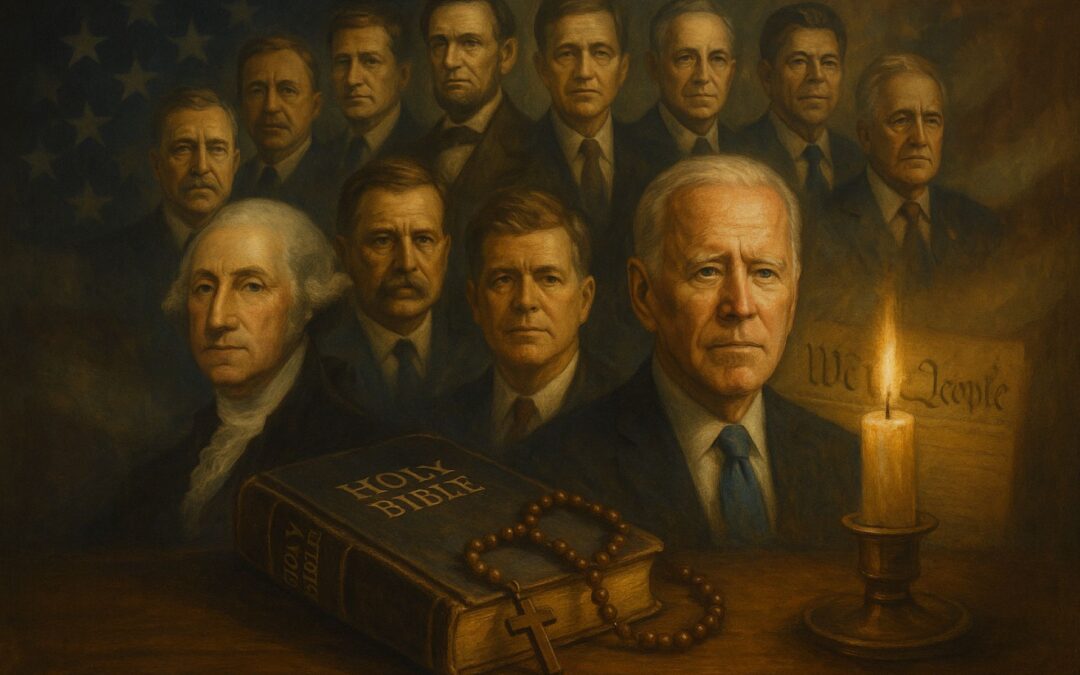
From rewriting the Bible with scissors to whispering hymns while bleeding out from an assassin’s bullet, the faith of America’s presidents has been anything but predictable. Behind every oath of office lies a quieter oath—one between man and the divine, between ambition and absolution. Some prayed for wisdom, others for forgiveness, a few for votes.
Together, they form a tapestry of belief as varied as the nation itself: deists and doubters, revivalists and rationalists, sinners and saints who all swore on something greater than themselves—sometimes the Bible, sometimes just hope.
If you think every commander-in-chief simply folded his hands and sang “Amazing Grace,” think again. This is the story of every U.S. president’s religion—how they worshipped, how they wavered, and how faith shaped, tested, and occasionally saved them.
Founding Faiths: Saints, Skeptics, and Scissors
George Washington, the first president and the reluctant father of a new nation, balanced faith with pragmatism like a man juggling fire. He was Anglican by baptism and Episcopalian by inheritance, yet his spiritual life was neither fiery nor fanatical. He believed in Providence—capital “P”—an invisible architect overseeing the fragile architecture of the republic. His letters brimmed with phrases like “the Almighty Disposer of events,” as if God were a constitutional officer sitting just outside the cabinet room. Yet, despite his reverence, Washington famously skipped communion. He would attend church, stand tall through hymns, and then quietly exit before the Eucharist, as though unwilling to cross that threshold from civic to sacred. No one ever knew why. Perhaps it was humility. Perhaps a sense of unworthiness. Or perhaps the first president simply believed faith was better lived than performed. He never spoke of visions or miracles—only duty, virtue, and the moral order required to sustain freedom. His religion, like his leadership, was one of restraint.
John Adams, meanwhile, treated religion as moral infrastructure. Raised in the Puritan soil of Massachusetts within the Congregational Church, he later identified with the emerging Unitarian movement, rejecting the mystical gymnastics of the Trinity. For Adams, faith wasn’t about submission—it was about structure. “Without religion,” he warned, “this world would be something not fit to be mentioned in polite company—I mean Hell.” He considered himself a “churchgoing animal,” not because he loved sermons, but because he believed church attendance was civic duty, the community’s weekly rehearsal for virtue. Adams’ theology was steeped in Enlightenment rationalism: reason over revelation, ethics over ecstasy. Yet he was no cold deist. He prayed, often and earnestly, not for miracles but for clarity. His God was a divine moralist, stern but fair—a cosmic magistrate presiding over human folly.
Thomas Jefferson took a scalpel to that magistrate. Born Anglican but baptized into skepticism, he approached religion like a philosopher editing an essay—careful, clinical, and unafraid of heresy. Jefferson’s correspondence dripped with disdain for dogma. He adored Jesus the man, the moral teacher, the radical humanist who preached love and forgiveness. But Jesus the Christ—the miracle worker who rose from the dead? Jefferson dismissed that as “priestcraft,” a corruption of pure philosophy. So he created The Life and Morals of Jesus of Nazareth, known to history as the Jefferson Bible. With scissors and glue, he literally sliced the Gospels apart, removing every miracle, every supernatural claim, and every hint of divinity. What remained was a distilled ethical manual, a gospel of reason. In it, Jefferson found what organized religion had lost: moral clarity without the mythology. He believed faith should illuminate, not intimidate—a religion of conscience, not control.
Then came James Madison, the quiet genius who believed so deeply in freedom of belief that he refused to speak of his own. Madison viewed religion as sacred precisely because it was private. He drafted the First Amendment to guarantee that every American, from the devout to the doubtful, could worship—or not—without interference. To him, the state had no right to dictate the soul. When asked about his personal faith, he politely ignored the question, even instructing his staff to disregard letters about religion. In this silence, Madison embodied his creed: that the government’s role was not to promote faith but to protect its freedom. His reverence was constitutional, his piety philosophical.
James Monroe carried that silence to new extremes. Born into Virginia’s Anglican tradition, he left behind few words on religion and even fewer deeds. His letters are nearly void of divine reference, and most that contained them he destroyed before death. To posterity, Monroe appears as a cipher—neither atheist nor zealot, merely indifferent. Historians speculate he leaned toward deism, the belief that God created the universe but left it to its own devices. His was the faith of the rational age: a distant deity, a self-regulating cosmos, and a quiet man too busy founding a nation to fret about metaphysics.
John Quincy Adams inherited his father’s intellect and his spiritual restlessness. He began in the Congregational Church but wandered across denominations like a pilgrim without a map—attending Unitarian, Presbyterian, and Episcopal services with equal enthusiasm and skepticism. In his diary, he poured out a confession as honest as it was conflicted: “I reference God. I venerate Jesus. But this belief is dark and dubious.” That sentence captures the soul of the early republic—devoted yet doubting, moral yet modern. Adams believed faith was essential for virtue but impossible without introspection. His God was both comfort and question mark.
The Founders’ faith, then, was less a choir and more a debate—an argument between head and heart. They prayed, reasoned, doubted, and legislated their way through theology. Some saw divine purpose in democracy; others saw democracy as liberation from divine rule. They did not agree on what God was, only that He—or It—must remain free, ungoverned, and ungoverning.
The Age of Reserved Devotion
If the Founding Fathers wrestled with belief in the open, the next generation preferred to close the curtains. The early 19th century was an age of decorum and distance, where presidents treated religion like fine china—respected, displayed, but rarely used.
Andrew Jackson exemplified this frontier stoicism. Born Presbyterian but converted late in life, he carried faith like he carried his pistol—with quiet conviction. Jackson was a man who believed God guided destiny but refused to weaponize prayer for politics. He prayed daily, read scripture, and saw Providence in the rise of the American nation, yet insisted that government had no place declaring holy days or enforcing moral codes. When he finally joined the church at age seventy, it wasn’t for appearances—it was an act of surrender. On his deathbed, “Old Hickory” took communion, professed faith in Christ, and asked forgiveness for his enemies. For a man who had dueled, conquered, and defied half of Washington, that last act may have been his most courageous.
Martin Van Buren, the smooth-talking Dutchman from Kinderhook, brought his Reformed Church upbringing to Washington along with his trademark charm. He was known to sing hymns with such enthusiasm that his voice reportedly rattled pews. But faith for Van Buren, ever the pragmatist, was about propriety rather than passion. In the capital, he joined St. John’s Episcopal Church—more for convenience than conversion. He wasn’t chasing doctrine; he was preserving decorum. Religion, to him, was a language of civility, the polite grammar of public life.
William Henry Harrison, scion of a devout Virginian family, treated faith as both inheritance and insurance. As an Anglican-turned-Episcopalian, he helped manage his local church as a vestryman and purchased a brand-new Bible the day after his inauguration. It would outlive him by a month. The ninth president’s entire tenure lasted only thirty-one days—long enough for one Bible reading, perhaps, but too brief to turn piety into policy.
John Tyler followed him into office with the composure of a man who knew where he stood. A lifelong Episcopalian, Tyler’s faith was steady but unshowy. He disliked denominational disputes and refused to turn religion into political theater. His friends said he practiced “unostentatious devotion”—a kind of dignified faith that neither preached nor postured.
James K. Polk’s spiritual life, by contrast, was a turbulent symphony. His father, a deist, refused to baptize him, earning the family a small-town scandal. As a young man, Polk attended a Methodist revival, where he was reportedly “swept by the Spirit” and converted. Yet old habits and social obligations complicated matters. His wife, Sarah, remained staunchly Presbyterian, so Polk alternated churches depending on whose company he kept. On some Sundays, he was Methodist; on others, Presbyterian. Religion for Polk became a kind of marital diplomacy—a balancing act between conviction and companionship.
Zachary Taylor represented the quiet end of the spectrum. Born into an Episcopalian household, married to an Episcopalian wife, he went through the motions but never formally joined a congregation. To Taylor, faith was private territory, not political spectacle. Even amid national crises, such as the cholera epidemic that killed thousands, he refused to declare a national day of prayer. “Religion,” he once remarked, “is a personal matter, not a proclamation.” It was an unusually modern stance for a man who preferred sabers to speeches.
Millard Fillmore, raised in hardship, saw faith through the lens of liberty. Initially drawn to the evangelical energy of revivalism, he later embraced Unitarianism—a creed of reason and tolerance. As a young lawyer, he tried to repeal a law requiring witnesses to affirm belief in God, calling it “an absurd relic of prejudice.” His was a lawyer’s religion: rational, fair, allergic to dogma. By the time he reached the presidency, Fillmore had distilled faith into its civic essence—freedom of conscience as the highest commandment.
This era of presidents did not pray for applause. Their religion was measured, restrained, and almost allergic to fervor. They believed deeply in God—but more deeply still in the right not to be told how to believe. In their hands, faith became a quiet instrument, played in private but woven into the melody of the republic. Each of them—Jackson’s repentance, Van Buren’s civility, Taylor’s reserve, Fillmore’s rationalism—represented a nation maturing in its belief that religion, like liberty, is strongest when left unforced.
Tragedy, Doubt, and Divine Reckoning
Franklin Pierce’s relationship with God was one long argument whispered through grief. Born into the rigid piety of New England’s Congregational Church, Pierce’s life unraveled in a trilogy of loss that would have tested a saint. His first son died in infancy, his second of typhus, and his third—eleven-year-old Benny—was killed in a train derailment right before Pierce’s inauguration. The image of his parents arriving at the presidency with their child’s body still warm in their memories is almost unbearable. His wife, Jane, withdrew into despair, convinced that Benny’s death was divine punishment for Pierce’s political ambition. Together, they leaned on scripture, but not in triumph—more like survivors clinging to wreckage. When Inauguration Day arrived, Pierce refused to swear on the Bible, opting instead to affirm his oath on a law book. Historians still debate the reason. Was it a gesture of secular defiance? Or was it a private act of penitence—a man too broken to invoke the God who had taken everything from him? Either way, his faith was shaped not by theology but by tragedy.
James Buchanan’s Presbyterian upbringing was steady but unshowy, the sort of faith that preferred quiet acts to loud declarations. He read the Bible, funded church charities, and spoke reverently of Providence, yet never evangelized or moralized. It was an inward, gentlemanly belief—the kind you carry in your pocket rather than wear on your sleeve. But his caution earned him scorn from revivalist preachers, who accused him of being “lukewarm” in his faith. Buchanan’s religion mirrored his presidency: well-intentioned, decorous, and ultimately paralyzed by moderation. He sought peace in every realm—political and spiritual—but found neither.
Then came Abraham Lincoln, a man who wrestled with belief as fiercely as he wrestled with war. As a young lawyer on the Illinois frontier, Lincoln read deist authors like Thomas Paine and Volney, their skepticism seeping into his bones. Locals whispered that he was an infidel. Yet the horrors of the Civil War transformed him. He began invoking God not as a comfort but as a mystery—an unfathomable force presiding over the blood and dust of human failure. His Second Inaugural Address reads less like policy and more like prophecy: “The Almighty has His own purposes.” Lincoln suggested that the war itself might be divine punishment for slavery, that both North and South had sinned, and that judgment was being carried out impartially by heaven. It was not the faith of a preacher but the anguish of a philosopher-poet standing in a storm. He never joined a church, never professed doctrinal loyalty, but his life and language became a sermon on humility. His God was vast, inscrutable, and silent—a deity who did not answer prayers but demanded endurance.
Andrew Johnson, who succeeded Lincoln, swung the pendulum in the opposite direction. His religion was the Constitution. Born poor and self-taught, Johnson distrusted organized faith as much as he distrusted elites. He never joined a church, never professed a creed, and rarely uttered the word “God.” His only scripture was civic duty. To him, salvation came through self-reliance, not divine grace. If Lincoln spoke with heaven in mind, Johnson spoke only of earthly laws, believing perhaps that man’s fate was not guided by Providence but by politics.
Ulysses S. Grant, the general who broke the Confederacy, lived most of his life with similar skepticism. Though raised Methodist, he avoided church entirely as an adult. To his wife Julia’s dismay, Grant saw religion as a private matter best left to others. Yet as his body decayed from throat cancer, the stoic soldier finally surrendered. On his deathbed, he was baptized, expressing hope that he would “meet Julia in a better world.” The warrior who had conquered empires of men now yielded to eternity. His last act was not victory but surrender—to faith, to mortality, to peace.
Rutherford B. Hayes was less dramatic but no less thoughtful. A moralist by temperament, he lived as though Christianity were a code of conduct rather than a creed. “I belong to no church,” he wrote, “but I try to be a Christian.” His religion was domestic and dutiful, grounded in the small decencies of everyday life. His wife, Lucy—nicknamed “Lemonade Lucy” for banning alcohol at the White House—embodied Methodist virtue, and together they modeled faith not as ritual but as restraint.
James A. Garfield blurred the line between politics and pulpit. Raised in the Disciples of Christ, he worked as a preacher before entering Congress. His sermons were fiery, frontier-style revivals filled with conviction and charisma. But destiny had a dark sense of irony. In 1881, he was shot by a delusional man named Charles Guiteau—who claimed that God had told him to do it. Garfield’s deathbed became a tragic echo of Old Testament irony: a preacher-president felled by a false prophet. Faith, it seemed, was both shield and sword, capable of saving or slaying with equal ease.
Chester A. Arthur, Garfield’s successor, grew up the son of a Baptist minister known for fiery oratory and stricter-than-scripture sermons. Yet Arthur himself preferred quiet piety. When his beloved wife, Ellen, died suddenly, he turned inward. To honor her memory, he commissioned a magnificent stained-glass window at St. John’s Episcopal Church, just across from the White House. There, in luminous color and sacred geometry, he found the wordless solace that sermons could not give.
This era of presidents carried religion like an heirloom passed down through generations—sometimes polished, sometimes neglected, occasionally broken. For them, faith was not about institution but introspection. It was the language they used to reason with loss, doubt, and guilt, to find meaning when history itself seemed cursed.
Piety, Politics, and Poker Nights
Grover Cleveland’s upbringing could have filled a Puritan manual. His father, a Presbyterian minister, preached discipline, duty, and divine wrath. But when Cleveland grew into power, he developed a taste for whiskey and poker—pastimes not listed in the catechism. His faith remained formal, even nostalgic, but not reformist. He attended services, invoked God in speeches, but his moral compass spun freely between pulpit and saloon. His God was one of forgiveness—a quality Cleveland required frequently.
Benjamin Harrison, grandson of William Henry Harrison, restored a sterner brand of belief to the presidency. A devout Presbyterian, he served for forty years as an elder in his church. During the Civil War, he led prayer meetings for his troops and saw no contradiction between waging war and worshipping peace. “I want to be a good soldier of Jesus Christ,” he told his wife—a promise he seemed determined to keep. As president, he even granted soldiers the right to rest on Sundays, turning spiritual mercy into military policy. Harrison’s faith was disciplined, organized, and unmistakably Victorian—respectable to the point of rigidity.
William McKinley, the next in line, was cut from similar cloth but with more sentimental thread. A devout Methodist who had once considered joining the ministry, McKinley saw divine purpose in every policy. During the Spanish-American War, he famously dropped to his knees to seek guidance on what to do with the Philippines. His conclusion—to “educate, uplift, and Christianize”—was pure 19th-century missionary zeal, noble in tone but colonial in consequence. Yet in his final moments, McKinley lived his faith without politics. After being shot in 1901, he forgave his assassin and murmured the hymn “Nearer, My God, to Thee” as he died. For once, politics stepped aside and piety took the podium.
Theodore Roosevelt, the rough-riding philosopher-king, believed religion was not about recitation but action. Raised in the Dutch Reformed Church, he later joined the Presbyterians but never sat comfortably in any pew. His Christianity was kinetic, muscular—a creed of service, courage, and moral vigor. “The true essence of Christianity,” he declared, “is not to be found in words but in the effort to do justice, to love mercy, and to walk humbly with our God.” Roosevelt’s faith was the gospel of effort—a call to righteousness through movement, not meditation. To him, a man’s faith was proven not by prayer but by how he fought for fairness.
William Howard Taft turned that creed inside out. A proud Unitarian, he prized intellect over inspiration. When offered the presidency of Yale, a Trinitarian institution, he declined, saying, “I don’t believe in the divinity of Christ.” It was a scandalous confession at the time, bordering on blasphemy. Yet Taft was not irreligious—he simply preferred reason to revelation. His was an ethical faith, grounded in moral clarity and human decency rather than supernatural mystery. “Less hallelujah, more homework,” one might say.
Woodrow Wilson was born into the pulpit—literally. His father, a Presbyterian minister, preached fire and reform from both church and dinner table. Religion, for Wilson, was not something to be practiced but something to be performed—an inheritance that shaped his vision of global politics. He saw World War I as a sacred crusade “to make the world safe for democracy” and viewed the League of Nations as an almost biblical mission for peace. Under Wilson, moral conviction fused with statecraft until foreign policy began to sound like scripture. He made faith not just personal but planetary.
Then came Warren G. Harding, the first Baptist president—and arguably the most paradoxical. He quoted the Bible in speeches, hosted hymn-sings in the White House, and praised the “social gospel” of service. Yet behind closed doors, he was a man of appetites: poker, whiskey, and extramarital scandal. His presidency embodied America’s enduring tension between public virtue and private vice. He could sermonize by day and gamble by night, as if convinced that God wouldn’t mind a friendly hand of cards.
Calvin Coolidge, the man of few words, carried the quiet dignity of a Puritan elder. A Congregationalist from Vermont, he spoke rarely of faith but lived it in conduct. His religion was not about rhetoric but restraint—about moral steadiness rather than showmanship. “Silent Cal” let his actions do the preaching.
Herbert Hoover, one of only two Quaker presidents, transformed simplicity into sanctity. As a young engineer, he organized massive humanitarian relief during World War I, feeding millions across Europe. His Quaker principles of peace, service, and modesty defined him more than his politics ever could. As president, he rarely mentioned faith—it was unnecessary. His belief was visible in the bread lines he tried to shorten, in the quiet labor he called duty.
In this era, faith became a mirror of the modern presidency—complex, performative, sometimes hypocritical, but always human. For every Harrison who prayed in uniform, there was a Harding who sinned in verse. For every Roosevelt who worked out his salvation in sweat, there was a Taft who reasoned it into ethics. Together they revealed a pattern that still defines American leadership: the attempt to reconcile power with piety, ambition with absolution, public office with private soul.
Faith in Times of Fire
Franklin Delano Roosevelt entered the White House with a prayer in his pocket and a nation in ruins. A lifelong Episcopalian, his faith was neither loud nor ornamental—it was service-oriented, steeped in the Social Gospel movement that believed true religion was expressed through compassion and reform. For Roosevelt, Christianity wasn’t a doctrine to defend; it was a mandate to act. When the Great Depression ravaged the country, he spoke of “neighborly concern” as though quoting from the Beatitudes. His New Deal policies—public works, relief programs, and financial reforms—were, in essence, sermons in economic form. To him, faith without social responsibility was just noise.
But Roosevelt’s belief shone brightest not in policy but in crisis. On D-Day, June 6, 1944, as Allied forces stormed the beaches of Normandy, Roosevelt went on national radio and led the country in prayer. There was no political polish in his voice, only the gravity of a man begging heaven for mercy. “Almighty God,” he began, “Our sons, pride of our nation, have set upon a mighty endeavor…” It was one of the rare moments in American history when a president prayed aloud not as leader, but as father, uniting a weary nation in sacred silence. Later, he famously remarked, “I am a Christian and a Democrat,” equating his faith and politics not as rivals but as twin instruments of moral progress. Roosevelt’s religion was not confined to church walls—it was stitched into the fabric of national renewal.
Harry S. Truman followed, a man less poetic but more consistent in devotion. A lifelong Baptist from Missouri, he read the Bible cover to cover multiple times and kept it near at hand in the Oval Office. Truman’s spirituality was pragmatic—an everyday kind of faith, plainspoken and sturdy as his accent. Before major decisions, he prayed privately, not for victory but for wisdom. When he authorized the use of the atomic bomb, he agonized over it and later admitted to having “no joy, only the burden of necessity.” For Truman, faith wasn’t consolation; it was conscience. He believed deeply that moral law existed beyond politics and that leaders were answerable to it. In 1952, he established the National Day of Prayer, institutionalizing his belief that a nation, like a man, must pause and bow its head from time to time.
Dwight D. Eisenhower, soldier and statesman, carried a faith shaped by paradox. His parents belonged to a religious sect that blended Mennonite simplicity with early Jehovah’s Witnesses theology—rigorous, ascetic, and suspicious of government. Yet Eisenhower himself avoided church membership for most of his life. Only after assuming the presidency did he formally join the Presbyterian Church, becoming the only U.S. president ever baptized in office. What followed was a spiritual transformation that reshaped America’s civic religion.
Eisenhower believed the country needed a moral center in the midst of Cold War anxiety. So he made faith part of the national vocabulary. He added “under God” to the Pledge of Allegiance, pressed “In God We Trust” onto every dollar, and began cabinet meetings with prayer. To some, it was patriotic piety; to others, political theater. But to Eisenhower, it was the antidote to a godless world divided by ideology. “Our form of government has no sense unless it is founded in a deeply felt religious faith,” he declared. His theology was vague, perhaps deliberately so—a unifying belief in belief itself. Under his tenure, religion became both shield and symbol, a civic ritual wrapped in the language of unity.
John F. Kennedy’s faith, by contrast, frightened the public before it inspired them. As the first Catholic president, he carried the burden of centuries of prejudice. Protestants feared the Pope would become the nation’s shadow commander, issuing orders from Rome. Kennedy faced it head-on. “I am not the Catholic candidate for president,” he told a skeptical audience of ministers. “I am the Democratic candidate who happens to be Catholic.” It was a masterstroke—a redefinition of faith as identity, not allegiance. Kennedy practiced his religion quietly, attending Mass regularly but keeping his spirituality separate from statecraft. In doing so, he broke a centuries-old barrier, proving that devotion to God and loyalty to the Constitution were not mutually exclusive. His calm composure during the Cuban Missile Crisis—the moment when the world held its breath—was perhaps his truest act of faith: belief in human reason as divine instrument.
Lyndon B. Johnson, Kennedy’s successor, approached religion with less flair but equal sincerity. When asked about his faith, he often replied simply, “I’m a Christian.” Yet, in times of national grief, he turned to scripture for solace and authority. After Martin Luther King Jr.’s assassination, Johnson called on Americans to pray “for the insight that we may see the way to unity and peace.” His words were pastoral, almost penitential. He saw faith not as escape from the world’s pain but as the courage to confront it.
Then came Richard Nixon—a Quaker who defied almost every Quaker virtue. Raised in a devout, pacifist household, he was taught simplicity, honesty, and restraint. His political career, of course, would unravel all three. Nixon’s religiosity was strategic, often invoked to reinforce his moral legitimacy. Yet when Watergate crushed his presidency, he turned sincerely—perhaps desperately—toward faith. He met often with Billy Graham, the nation’s unofficial pastor, seeking counsel, forgiveness, and a kind of spiritual rehabilitation. Whether or not it redeemed him, it revealed the paradox at Nixon’s core: a man who preached peace but waged war, who quoted scripture but fell to sin.
Gerald Ford, the accidental president who followed him, embodied the steadiness Nixon lacked. A lifelong Episcopalian, Ford agonized over whether to pardon Nixon. He prayed, he waited, he prayed again. Finally, he concluded that forgiveness, however unpopular, was the only moral path. “Our long national nightmare is over,” he said, invoking not triumph but release. It was one of the purest acts of faith in modern politics—trusting in grace over vengeance.
Modern Miracles and Mixed Motives
Jimmy Carter walked into the Oval Office carrying a Bible and a Southern drawl. A devout Baptist and self-described “born-again Christian,” he wore his faith with unembarrassed sincerity. Carter taught Sunday school for decades—even during his presidency—and often quoted scripture in speeches. His faith was active, compassionate, and unpretentious, guiding policies on human rights, peace negotiations, and social justice. He believed power was a test of humility, not privilege. Critics mocked his piety as naïve; history remembers it as authentic. Long after leaving office, he continued teaching Bible lessons in Plains, Georgia, reminding the world that real leadership, like faith, is service without applause.
Ronald Reagan followed, and though his approach was less ecclesiastical, it was no less profound. Raised in the Disciples of Christ and later joining the Presbyterians, Reagan’s spirituality radiated optimism. His speeches were laced with biblical cadence, framing America as a “shining city on a hill”—a phrase borrowed from Puritan preacher John Winthrop but reborn as Cold War prophecy. He rarely attended church, citing security risks, but saw divine providence in America’s destiny. To Reagan, freedom itself was sacred—a covenant between God and the republic. His belief was cinematic, moral, and deeply American, where good and evil still fought in black and white.
George H. W. Bush continued the Episcopalian legacy of his predecessors with understated conviction. He prayed before major decisions, sought counsel from Billy Graham, and viewed service as sacrament. When facing the Gulf War, he prayed privately for guidance and publicly for peace. His faith was steady, measured, and quietly paternal—the kind of belief that didn’t need broadcasting because it was simply assumed.
Bill Clinton, by contrast, was a preacher trapped in a politician’s body. Raised Southern Baptist, he could quote scripture like a revivalist and charm an audience like one too. His speeches dripped with biblical metaphor—justice, forgiveness, redemption—but his personal life often betrayed his public piety. The Monica Lewinsky scandal fractured his credibility, and while some pastors forgave him, others branded him a hypocrite. Yet Clinton’s redemption arc, marked by contrition and counseling, mirrored the very theology he preached: the sinner saved by grace. His faith was a seesaw between weakness and wisdom—a reminder that saints and scoundrels often share the same pew.
George W. Bush took that message and made it personal. The younger Bush was adrift in alcohol until a conversation with Billy Graham turned his life around. He later described the moment as his spiritual rebirth—the point when he “gave his life to Christ.” As president, he governed with that evangelical confidence, often framing policy decisions in moral language. To him, the axis of evil was not just geopolitical—it was spiritual. His faith inspired both loyalty and controversy, yet to Bush, it was not politics but identity. He embodied the conviction that faith, once found, must lead to purpose.
Barack Obama’s spiritual journey was more eclectic, more modern. Born to a secular mother and a Kenyan father who had abandoned Islam, Obama’s childhood exposed him to Catholic, Islamic, and agnostic influences alike. His real conversion came in Chicago’s Trinity United Church of Christ, under the mentorship of Reverend Jeremiah Wright. There, faith became more than belief—it became belonging, rooted in the social activism of black Protestant tradition. Obama’s Christianity was cerebral yet compassionate, shaped by moral complexity rather than certainty. He spoke less of miracles and more of meaning. “Faith doesn’t mean that you don’t have doubts,” he said once. “It means you trust despite them.” His religion, like his politics, was built on empathy—a theology of understanding in an age of division.
Donald Trump brought a different gospel to the presidency—the gospel of confidence. Raised Presbyterian in Queens, he was heavily influenced by Pastor Norman Vincent Peale, author of The Power of Positive Thinking. Peale’s message—that faith and success were reflections of divine favor—became the spiritual backbone of Trump’s worldview. His references to God were sparse but emphatic; when asked about the Bible, he called it “the best, greatest book of all time.” Critics called it superficial, but in Trump’s world, belief and branding were siblings. He saw religion as affirmation, not examination—a creed for winners, not worriers.
And then came Joe Biden, only the second Catholic to take the oath of office after Kennedy. His faith is both public and deeply personal, shaped by decades of grief—first his wife and daughter in a car crash, then his son Beau to cancer. Biden carries Beau’s rosary beads everywhere, attending Mass each Sunday not out of tradition but out of necessity. For him, Catholicism is not a banner but a lifeline—a faith of endurance, forgiveness, and compassion. He quotes Pope Francis often, invoking the dignity of work, the sanctity of empathy, and the moral duty of kindness. Biden’s religion is not about grandeur or spectacle; it’s about survival. His presidency, like his prayer life, is built on quiet persistence—the belief that hope, like grace, renews itself daily.
Amen, America
From Jefferson’s scissor-cut gospel to Eisenhower’s public prayer, from Roosevelt’s wartime invocation to Biden’s whispered rosary, the spiritual story of American presidents is as paradoxical as the nation they led. Faith in the Oval Office has never been uniform—it has been stoic, theatrical, intellectual, transactional, ecstatic, and exhausted. Some prayed for peace, others for power, many for forgiveness. Each turned to God in their own way—some to listen, some to justify, some to simply be heard.
And perhaps that’s the truest reflection of the American soul: not a chorus in harmony, but a symphony of contradictions. A republic that believes in liberty enough to question its own saints, and in faith enough to forgive its sinners. For all their flaws and fervor, these presidents shared one truth—leadership, like belief, is never pure. It is a pilgrimage through doubt, failure, and fleeting grace.
Because in America, the pulpit and the podium are never far apart—and every president, sooner or later, ends up preaching to both heaven and history.