
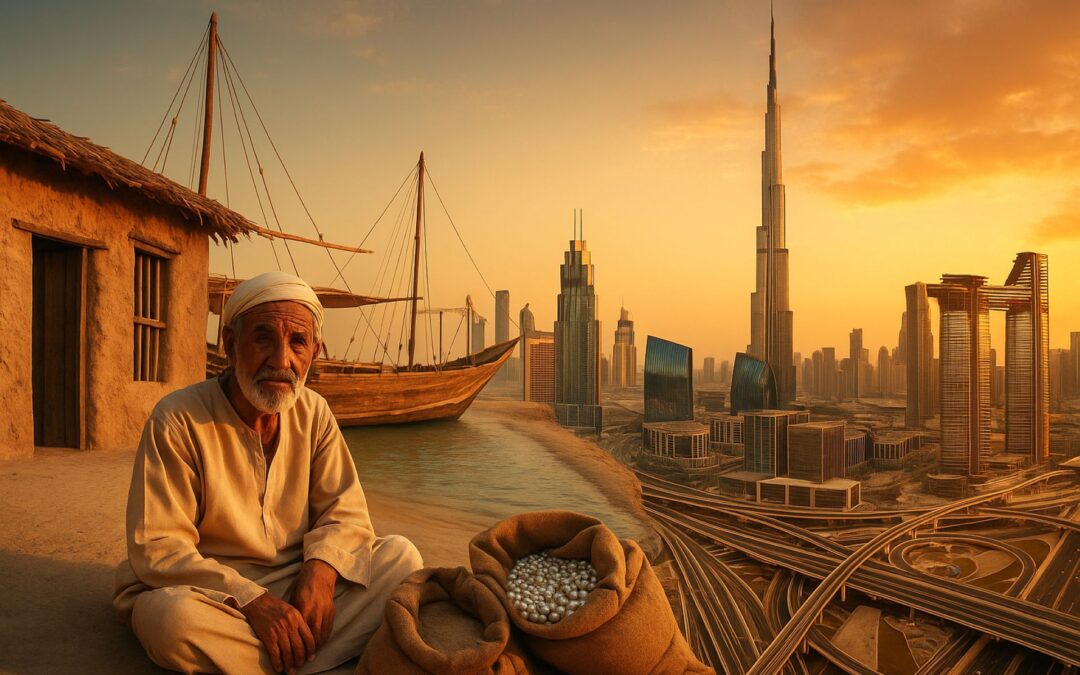
Dubai—a city that dazzles with its glittering skyscrapers, sprawling luxury, and seemingly boundless opportunity. It boasts rapid growth, a low crime rate, and an allure that draws millions every year. But this urban marvel was not always the sparkling metropolis it is today. Seventy years ago, Dubai had no electricity, no running water, and certainly no Lamborghinis cruising its streets. How did this small, unassuming pearling village buried in the harsh Arabian desert transform into one of the fastest-growing and most opulent cities on the planet in under a century? Is Dubai’s ascent a miracle, or just a mirage built on calculated gambles? Let’s unravel the extraordinary history of Dubai’s rise.
From Pearling Village to Economic Desperation
In the dawn of the 20th century, Dubai was a modest, unassuming fishing and pearling village nestled along the shores of the Persian Gulf. Its population hovered around 10,000 inhabitants, living in simple mud-brick houses and palm-thatched dwellings. The economy was almost entirely dependent on the pearling industry, a grueling and perilous trade that shaped the city’s culture and survival.
The pearling process was both primitive and dangerous. Divers, often enslaved men, would plunge into the depths of the gulf armed with only the bare essentials: a sack to collect oysters, a nose clip to hold their breath, and a stone tied to their leg to help them sink quickly. They swam down repeatedly, sometimes to depths of over 20 meters, risking drowning, shark attacks, and decompression sickness in a time long before modern diving equipment existed. Each dive could last over a minute, with only moments on the surface before plunging down again.
Pearls harvested from these treacherous expeditions became coveted luxury items. They shimmered on the necklaces of European aristocrats, Indian maharajas, and wealthy North Americans. Dubai’s pearling industry was, for a time, the beating heart of its economy—generating wealth, employment, and international trade ties. The city thrived on this singular commodity, and the trade’s rhythm dictated daily life.
But this dependence sowed a dangerous vulnerability. The global economy was volatile, and the luxury market especially fickle. The Great Depression of 1929 struck with merciless force. As financial markets crashed and personal fortunes evaporated, demand for luxury goods—including pearls—plummeted. The industry, already delicate, was devastated. Ships that once sailed for months in search of oysters returned empty.
Adding insult to injury, technological innovation from Japan dealt a fatal blow. Scientists developed cultured pearls—artificially grown but nearly indistinguishable from natural pearls—allowing for mass production at a fraction of the cost. These perfect imitations flooded the market worldwide, driving down prices and rendering the painstakingly harvested natural pearls nearly obsolete.
Dubai’s economy was crushed. The city that had depended so heavily on the sea’s bounty now faced stark economic desperation. Jobs vanished, income dried up, and the community grappled with an existential crisis. This catastrophic collapse embedded a profound lesson in Dubai’s collective memory: reliance on a single industry or resource was perilous. The city vowed never again to gamble its future on one economic pillar. This was the crucible from which Dubai’s later ambition and diversification emerged.
The Duty-Free Port: A Calculated Pivot
In the shadow of the pearling collapse, Dubai’s leadership recognized the imperative of reinvention. Visionary and pragmatic, the ruling Sheikh undertook a strategic pivot to transform Dubai into a commercial hub—an idea bold for its time.
In the early 1900s, Dubai was designated a duty-free port. This move was revolutionary in a region dominated by heavy tariffs and protectionist policies. By offering a tax-free haven for traders and merchants, Dubai positioned itself as an attractive alternative to neighboring ports, which were burdened with escalating taxes and bureaucratic barriers.
This shift came at a critical juncture. Persian ports such as Bandar Abbas and Bushehr had grown increasingly expensive for merchants due to rising duties. Persian traders, eager for a more favorable business climate, began migrating to Dubai, bringing with them capital, goods, and entrepreneurial spirit. The city’s natural harbor, though modest, was sufficient to welcome an influx of vessels and commerce.
Trade revitalized the city’s economy. Markets burgeoned with spices, textiles, pearls, and other commodities flowing through Dubai’s docks. The cosmopolitan mix of merchants fostered a lively, if still humble, economic ecosystem. However, the city’s infrastructure remained rudimentary: unpaved roads, limited fresh water, and scarce modern conveniences characterized life. Education was largely informal, with few opportunities for broader skill development.
Regionally, geopolitical tensions simmered. Dubai was entangled in a border dispute with Abu Dhabi, complicating prospects for regional collaboration. The outbreak of World War II further suppressed trade and slowed development. Western awareness of Dubai remained minimal—often dismissed as a backwater in the harsh Arabian desert.
Yet the duty-free policy laid the foundational bedrock for Dubai’s transformation. It nurtured a nascent trading culture, widened economic activity beyond pearling, and established Dubai’s identity as a mercantile crossroads. This strategy would prove pivotal when oil wealth eventually flowed into the city’s coffers, allowing Dubai to build on a diverse commercial base rather than solely on hydrocarbons.
The Search for Black Gold: Oil Exploration Begins
The mid-20th century ushered in a seismic shift in global geopolitics and economics. The devastation of World War II had galvanized industrialized nations to secure reliable energy sources. Oil, often dubbed “black gold,” became the lifeblood of modern industry, military power, and economic growth. The Persian Gulf, long a remote and overlooked desert region, suddenly attracted intense international interest for its potential petroleum reserves.
In 1950, British geologists and drilling engineers arrived on Dubai’s southern outskirts, tasked with a mission that would determine the city’s fate. Equipped with rudimentary technology by today’s standards, their work was grueling—surveying, drilling, and analyzing core samples under punishing desert heat and logistical challenges.
For thirteen years, despite relentless efforts, the oil rigs yielded nothing. Dubai’s terrain was stubbornly barren. Neighboring Abu Dhabi had struck massive oil reserves in 1959, igniting economic transformation there, but Dubai appeared destined to remain a dusty backwater. The British exploration company, disillusioned and convinced of Dubai’s barrenness, packed up and prepared to leave.
Yet Sheikh Rashid bin Saeed Al Maktoum, Dubai’s visionary leader, refused to accept defeat. His indefatigable optimism drove him to press on with exploration. Understanding that the city’s survival depended on diversification and new wealth, he doubled drilling efforts, extended leases, and even committed public funds to support the search.
This persistence was not just stubbornness—it was a calculated gamble rooted in strategic foresight. Sheikh Rashid recognized that oil could be the key to breaking Dubai out of its economic obscurity. The years of dry wells were a test of resilience and belief in the city’s potential.
Striking Oil and Entering the Modern Age
In 1966, after years of uncertainty and skepticism, hope blossomed. Offshore drilling approximately 15 meters into the Persian Gulf uncovered Dubai’s first significant oil reserve. While the find was relatively modest compared to the vast wealth discovered in Abu Dhabi, it represented a turning point—an entry ticket to the modern economic arena.
The discovery unleashed a cascade of change. Within three years, Dubai began exporting crude oil, injecting vital revenue into the city’s nascent government coffers. This financial influx allowed the emirate to invest in infrastructure, education, and public services at a scale previously unimaginable.
This period coincided with a monumental geopolitical shift. In 1971, Britain withdrew fully from the Persian Gulf, ending centuries of colonial influence and leaving the Gulf States to navigate independence and self-governance. To ensure security and political stability, Dubai, Abu Dhabi, and five other emirates united to form the United Arab Emirates (UAE).
Though Abu Dhabi was the wealthiest and politically dominant emirate within the federation, Dubai negotiated significant autonomy over its own affairs, including economic policy and development strategy. This arrangement allowed Dubai to pursue an aggressive modernization agenda tailored to its unique vision.
The newfound oil wealth catalyzed Dubai’s leap into the modern age. Concrete roads replaced dusty tracks, schools and hospitals were established, and urban planning took root. The city began to shed its sleepy village image, embracing the possibilities that energy wealth afforded.
Rapid Growth Fueled by Oil Wealth
Between 1960 and 1980, Dubai underwent a transformation of staggering proportions. Its population ballooned from around 60,000 to nearly 276,000—a nearly fivefold increase within two decades. The city itself expanded exponentially, sprawling over desert sands that were once considered inhospitable.
Dubai’s oil reserves, though comprising only about 4% of the UAE’s total, were a substantial asset. By 1975, oil revenues constituted roughly 57% of Dubai’s Gross Domestic Product (GDP), injecting around $9 billion into the economy. This revenue stream funded rapid development across sectors—from public utilities and transportation to education and healthcare.
Yet Sheikh Rashid’s leadership was marked by caution and pragmatism. Having witnessed the collapse of the pearling economy decades earlier, he was acutely aware that oil was a finite resource—both a blessing and a potential curse. His famous aphorism echoed this wisdom: “My grandfather rode a camel, my father rode a camel, I drive a Mercedes, my son drives a Land Rover, his son will drive a Land Rover, but his son will ride a camel.”
This prescient statement underscored his recognition that oil wealth could not be Dubai’s permanent foundation. It could fuel growth for a time, but sustainability required building an economy that could thrive beyond hydrocarbons.
Guided by this philosophy, Dubai began preparing to leverage its oil wealth as a springboard, not a crutch—setting the stage for bold diversification efforts that would redefine its future.
The Infrastructure Gamble: Betting on a Post-Oil Future
With oil revenues flowing but the clock ticking on its finite reserves, Sheikh Rashid bin Saeed Al Maktoum made a decision that would define Dubai’s destiny—a monumental bet on infrastructure and economic diversification. Starting in the late 1970s and accelerating through the 1980s, Dubai undertook an ambitious construction and development spree that many contemporaries considered audacious, even reckless.
At the time, Dubai was still a relatively small city of roughly 236,000 people. Yet Sheikh Rashid envisioned a metropolis that could stand shoulder to shoulder with the world’s great cities. His approach was not incremental but exponential: build for the future fifty years ahead, anticipating growth rather than reacting to it.
The Dubai World Trade Center was among the first symbols of this vision. Rising from the desert floor, it was the city’s first major skyscraper and a deliberate statement of intent—to be a regional hub for business and commerce. This building was not merely architecture; it was a strategic tool to attract multinational corporations and global trade.
Complementing the World Trade Center was the development of Jebel Ali Port, an engineering marvel and the largest man-made harbor in the world at the time. This deep-water port was constructed to accommodate vast cargo ships and serve as a logistical nexus for trade flowing between Asia, Europe, and Africa. It dramatically reduced Dubai’s dependence on oil revenues by anchoring its economy in global commerce and shipping.
Beyond ports and skyscrapers, Sheikh Rashid invested in industrial infrastructure: the Dubai Aluminium smelter and Dubai Dry Docks were developed to establish manufacturing and repair capabilities, diversifying the city’s economic base even further.
Dubai also began crafting its luxury tourism sector. The iconic Burj Al Arab hotel, with its distinctive sail-shaped silhouette, was commissioned to attract high-end travelers and put Dubai on the map as a destination synonymous with opulence and exclusivity.
Perhaps most crucially, the launch of Emirates Airlines in 1983 expanded Dubai’s connectivity exponentially. The airline not only connected Dubai to the world’s major cities but also reinforced the emirate’s position as a transit hub, facilitating business, tourism, and trade.
These massive infrastructure projects were more than construction—they were calculated investments. Sheikh Rashid’s willingness to “overbuild” in a city still modest in size was a strategic gamble on future growth, positioning Dubai as a beacon of progress and opportunity. In hindsight, this leap of faith set Dubai apart from its oil-rich neighbors and laid the foundation for its meteoric rise on the global stage.
The Palm and the Sky: Masterpieces of Ambition
The early 2000s saw Dubai’s ambitions transcend traditional development, morphing into visionary architectural feats and urban planning marvels that captured global imagination.
One of the most iconic projects was the creation of the Palm Jumeirah, initiated in 2001. This massive artificial island, shaped like a palm tree and sprawling into the Persian Gulf, was a feat of engineering ingenuity and audacity. It expanded Dubai’s limited coastline and offered vast new residential, hospitality, and entertainment opportunities. The Palm was not just land reclamation—it was a bold declaration of Dubai’s capacity to reshape nature itself to fit its vision.
Simultaneously, Dubai set its sights skyward with the conception of the Burj Khalifa. Construction began in 2004 on what would become the tallest building on Earth, soaring over 828 meters. The Burj Khalifa became a symbol of Dubai’s futuristic ambitions, a vertical city that housed offices, residences, hotels, and observation decks, attracting tourists and global attention alike. Its record-breaking stature served both practical economic purposes and intangible branding, signaling Dubai as a city of superlatives.
Complementing these architectural wonders was the Dubai Mall, opened in 2008. As the second largest shopping complex by total land area worldwide, it redefined retail experiences with over 1,200 shops, an indoor aquarium, and vast entertainment options. This mall was not just a shopping center—it was a lifestyle destination, enticing tourists and residents with a blend of luxury, convenience, and spectacle.
Together, these projects exemplified Dubai’s determination to build a diversified economy driven by tourism, real estate, and commerce rather than oil. They underscored a narrative of endless possibility, where innovation and scale were the currencies of success.
These ventures transformed Dubai’s skyline and economic profile, marking it as a city unafraid to dream big and execute even bigger.
A Magnet for Talent and Tourism
Dubai’s meteoric rise isn’t solely the product of architectural marvels and oil wealth; it’s also rooted in its deliberate cultivation of an open, cosmopolitan environment that attracts global talent, investors, and tourists. Unlike many of its Middle Eastern neighbors, where strict social norms and religious regulations dominate daily life, Dubai has carved out a unique niche by embracing a degree of social and cultural tolerance that appeals to a wide spectrum of people.
Key to this openness is Dubai’s pragmatic approach to religion and lifestyle. Alcohol consumption, while prohibited in most of the region, is legally available in designated areas. The city permits the sale and consumption of pork products, and maintains a general policy of religious tolerance, allowing expatriates to worship freely. This flexibility makes Dubai particularly attractive to Westerners, Asians, and other expatriates who seek opportunities without abandoning aspects of their lifestyle.
The city’s tax policies are another potent lure. With no personal income tax and minimal corporate taxes in many sectors, Dubai presents an alluring proposition for entrepreneurs, executives, and investors looking to maximize wealth retention. Coupled with streamlined business regulations and a government keen on fostering innovation, the emirate has become a hub for startups, multinational corporations, and financial institutions.
As a result, Dubai’s demographic landscape is extraordinary. Over 88% of its population comprises foreigners hailing from all corners of the globe. This multicultural milieu creates a dynamic, multilingual, and multifaceted society where ideas and cultures intermingle freely. The influx of expatriates fuels the demand for diverse goods, services, and cultural offerings, enriching the city’s social fabric.
Dubai’s geographic positioning amplifies its appeal. Situated at the crossroads of Europe, Asia, and Africa, it lies within a seven-hour flight of half the world’s population. This strategic location has turned Dubai into a pivotal aviation and trade hub. Dubai International Airport, now the busiest international airport worldwide, handled over 85 million passengers in recent years, acting as a gateway for business travelers, tourists, and cargo.
Emirates Airlines, the city’s flagship carrier, has been instrumental in this connectivity, offering extensive global routes and fostering economic integration. The airline’s premium service and strategic partnerships reinforce Dubai’s reputation as a world-class travel and commerce nexus.
Tourism, powered by these infrastructural and social factors, has flourished. Dubai attracts over 17 million visitors annually, drawn by its luxury resorts, shopping extravaganzas, cultural festivals, and events. From the thrill-seeker exploring desert safaris to the luxury traveler indulging in five-star experiences, Dubai’s appeal is broad and growing.
The Hidden Costs: Labor and Demographic Challenges
Beneath Dubai’s gleaming skyscrapers and luxury lifestyles lies a sobering and complex reality—one marked by profound labor issues and demographic imbalances that challenge the city’s sustainability and ethical standing.
The emirate’s rapid development has relied heavily on migrant workers, predominantly from South Asia and parts of Africa. These workers form the backbone of Dubai’s construction, hospitality, and service industries, undertaking physically demanding and often dangerous jobs. Many live in labor camps with overcrowded and inadequate living conditions, far removed from the opulence that defines Dubai’s image.
While slavery was officially abolished in the UAE only in 1963, the legacy of exploitative labor practices persists in more subtle but equally troubling forms. Workers frequently face long hours, low wages, and limited legal protections. The Kafala system, a sponsorship framework tying workers’ legal status to their employers, often restricts freedom of movement and leaves workers vulnerable to abuse.
Tragically, the human cost is stark. Thousands of migrant workers die each year, with causes often listed as “cardiac arrest” or “natural causes,” obscuring preventable workplace fatalities related to extreme heat, exhaustion, and unsafe conditions. Human rights organizations have consistently criticized Dubai and the UAE for insufficient labor protections and transparency.
Demographically, the city’s reliance on a foreign population poses long-term challenges. With foreigners constituting approximately 88% of residents, and virtually no pathway to citizenship or political participation for expatriates, Dubai’s population is transient and disenfranchised. This demographic skew raises questions about social cohesion, political stability, and the sustainability of an economy heavily dependent on a non-citizen workforce.
Moreover, the stark divide between wealthy expatriates and low-paid laborers highlights systemic inequality. While Dubai markets itself as a cosmopolitan paradise, the lived experiences of many workers starkly contrast with the city’s opulent image.
These labor and demographic issues represent critical challenges that Dubai must address as it charts its future—balancing continued growth with human rights, social equity, and political inclusivity.
Facing the Future: The Post-Oil Economy and Its Uncertainties
Dubai today stands as the Middle East’s pioneering post-oil economy—a remarkable feat in a region long synonymous with hydrocarbon wealth. Oil now accounts for less than 5% of Dubai’s GDP, a dramatic decline from over half five decades ago. The city’s relentless investment in infrastructure, free trade zones, tourism, finance, and real estate has paid dividends, carving a diversified economic base.
Dubai’s strategic gamble on economic diversification has yielded an enviable position as a global trading hub, financial center, and tourist magnet. The emirate continues to attract multinational corporations, startups, and capital inflows, leveraging its liberal policies, strategic location, and cutting-edge infrastructure.
However, this remarkable success story is not without looming uncertainties.
Environmental risks, particularly those posed by climate change, threaten Dubai’s coastal infrastructure and freshwater resources. Rising temperatures, sea-level rise, and water scarcity demand forward-thinking adaptation strategies to safeguard the city’s long-term viability.
Labor and social challenges remain pressing. The heavy dependence on a foreign workforce with no citizenship prospects risks social fragmentation and potential unrest. Addressing these demographic imbalances while enhancing labor protections will be critical for sustainable growth.
Economic volatility, from global market fluctuations to regional geopolitical tensions, also poses risks. Dubai’s rapid expansion has created vulnerabilities to speculative bubbles, particularly in real estate. The city must balance growth with prudent regulatory oversight to avoid destabilizing crises.
Looking ahead, Dubai’s ability to sustain its extraordinary rise hinges on its capacity for innovation—not just technological, but social and political. Governance reforms, investment in human capital, and environmental stewardship will be crucial.
The question remains: can Dubai transcend the so-called “resource curse” that has ensnared many oil-rich states and build a resilient, inclusive, and sustainable society that thrives a century from now? Its history suggests boldness and adaptability, but the future will test these traits like never before.
Conclusion
Dubai’s story is one of grit, vision, and relentless optimism. From humble pearling roots to soaring skyscrapers, it rewrote the script for what a desert city could become. Its rise defies convention and challenges skeptics who see it as merely a mirage in the sands.
If you found Dubai’s ascent captivating, explore Switzerland’s equally surprising journey from a vulnerable landlocked nation to a global powerhouse. The story of Swiss innovation and resilience is a masterclass in defying odds and shaping destiny.