
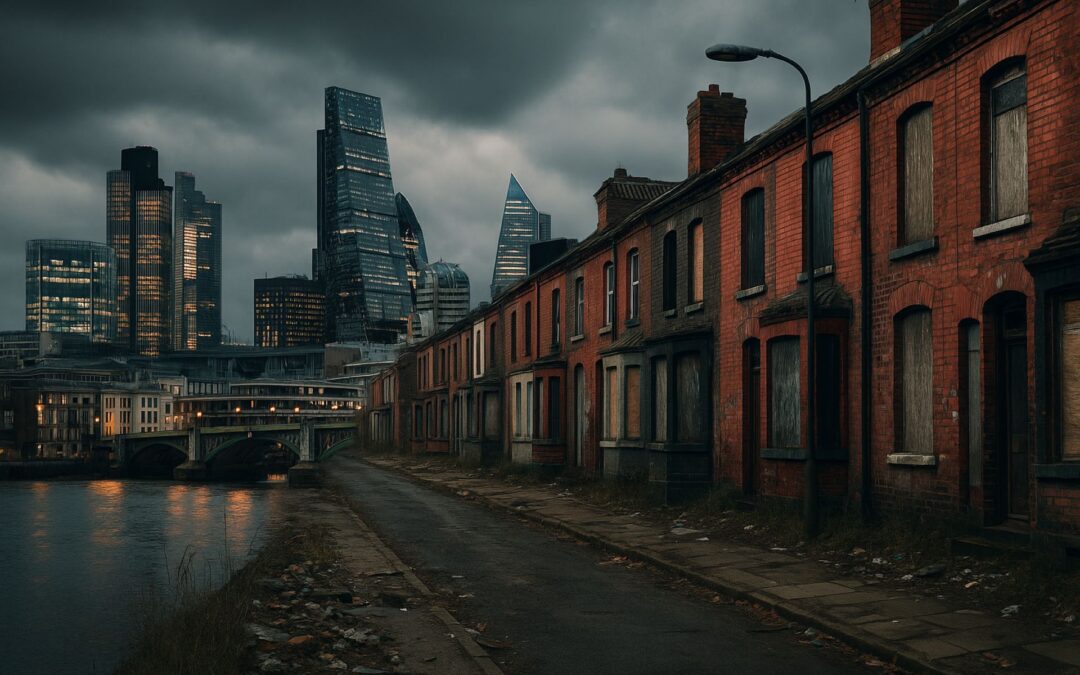
What happens when a nation’s prosperity is siphoned into a single city? Britain, once the workshop of the world and the greatest empire on earth, now teeters as a fractured state: London shines like a jewel, while the rest of the country crumbles. The capital counts hundreds of thousands of millionaires and a skyline built on global finance, yet towns in the North and Midlands rank among the poorest in Western Europe.
Blackpool’s life expectancy has fallen below Rwanda’s, and wages outside the Southeast lag far behind even the poorest American states. This is not misfortune—it is the result of deliberate choices, decades of policies that elevated London while hollowing out everything else.
To understand how the United Kingdom became the “Divided Kingdom,” we must trace the story of inflation, industry, housing, and investment, and how one city ultimately came to dominate the nation’s future.
A Tale of Two Economies
London today is less a city than a gravitational force. It concentrates within its borders a staggering 215,700 millionaires, 516 centi-millionaires, and 45 billionaires. Its skyline, studded with steel and glass, mirrors the magnitude of its wealth. For those who inhabit the financial district, prosperity is not just visible—it is tangible, expressed in private equity offices, Michelin-starred dining, and high-end real estate that trades hands like fine art. London has, in many ways, become the beating heart of global finance, a place where money doesn’t just circulate but multiplies.
But step outside the boundaries of the capital, and a very different Britain unfolds. The removal of London and the Southeast from the national accounts slices 14% off GDP per capita, revealing a country that is startlingly poorer than its façade suggests. Disposable incomes across the UK are lower than those of the poorest five U.S. states, and even trail the average among OECD nations—a sobering reality for a nation that once prided itself as the world’s economic vanguard.
The inequality isn’t abstract; it’s written in lives. In Blackpool, life expectancy is lower than in Rwanda, a haunting indicator that prosperity has not only stalled but regressed. Once-bustling industrial cities like Sheffield, Sunderland, and Stoke-on-Trent—engines of Britain’s imperial rise—now sit among the poorest in Western Europe. Their factories are silent, their main streets hollowed out by unemployment, their youth drawn elsewhere or left behind. The “United” Kingdom looks more like a patchwork: a wealthy enclave orbiting the Thames, surrounded by regions left to wither. London thrives as a gilded citadel, while the rest of Britain struggles in its shadow.
The Great Inflation Crisis
The seeds of this divide were sown in the turbulent 1970s. Britain was rattled by two colossal oil shocks that reshaped the global economy. OPEC, flexing its power, doubled and then tripled oil prices. For ordinary Britons, the effects were immediate and merciless. The cost of petrol surged, heating bills skyrocketed, and food prices climbed sharply. Inflation crept into every corner of life, gnawing away at purchasing power like an invisible tax. By the decade’s end, £100 from 1970 could buy little more than £33 worth of goods. Families who once lived comfortably found themselves stretched to the breaking point.
But inflation was not just imported—it was amplified at home. Britain’s powerful trade unions, defending workers’ living standards, pressed relentlessly for wage increases. Employers caved, but each wage rise only added more fuel to the inflationary fire. It was the textbook case of a wage-price spiral: prices rose, unions demanded higher wages, wages rose, and prices rose again, an endless cycle with no escape. Meanwhile, government policy compounded the problem. Successive administrations, reluctant to rein in spending or tighten monetary supply, let money flood into the economy. The currency weakened, borrowing ballooned, and inflation became entrenched.
The atmosphere of the late 1970s was one of chaos. Strikes brought cities to a halt, rubbish piled on streets, power cuts plunged homes into darkness. Britain, once the workshop of the world, was mocked as the “sick man of Europe.” For ordinary citizens, the crisis wasn’t a matter of statistics—it was a daily grind of higher prices, wage disputes, and crumbling public confidence. Into this storm walked Margaret Thatcher, promising to restore stability, even if it meant dismantling the very fabric of British economic life.
Thatcher’s War on Inflation
When Margaret Thatcher took office in 1979, she did so with the conviction that Britain’s runaway inflation was the central cancer corroding its economy. Her solution was bold, uncompromising, and, to many, brutal. Guided by her Chancellor Geoffrey Howe and ideological allies like Alan Walters and Keith Joseph, she embraced monetarism—an economic doctrine that treated inflation as a disease to be cured by restricting the money supply.
The first weapon was monetary tightening. Growth in sterling M3, the broad measure of money supply, had been racing at 12% annually. Thatcher’s government forced it down to 6%. This meant reining in lending, squeezing credit, and curbing liquidity—deliberately starving the economy of cash.
The second weapon was interest rates. Within months of her election, rates jumped from 12% to 14%, and by November 1979, they hit 17%—a record high in Britain’s history. Mortgages became crippling, small businesses couldn’t afford to borrow, and investment all but froze. To homeowners and entrepreneurs, the medicine felt worse than the illness.
The third weapon was austerity. Thatcher targeted the public sector borrowing requirement, cutting it from 4.7% of GDP to 1.5% by 1983. And she didn’t shy away from raising taxes, even in the depths of recession. For millions of Britons, this meant higher costs, shrinking services, and job losses all at once.
The backlash was ferocious. By 1981, unemployment had surged past 2 million, climbing by nearly 100,000 people each month. Entire families were thrown out of work, their futures dismantled overnight. A collective of 364 economists signed a letter to The Times condemning her approach, arguing it had “no basis in economic theory.” Yet Thatcher remained unyielding. By 1983, inflation had indeed dropped from 13% to 5%. To her, this vindicated the strategy. But for countless communities, the price of victory was devastation—factories shuttered, mortgages foreclosed, and livelihoods erased in the name of stability.
The Industrial Base is Gutted
The war on inflation didn’t just cool the economy—it hollowed it out. Manufacturing, once the bedrock of Britain’s power, became collateral damage. High interest rates strangled investment, while a strengthened pound made exports uncompetitive abroad. Factories that had supplied the world with steel, textiles, and machinery suddenly found themselves priced out of global markets.
In 1979, manufacturing still accounted for nearly 30% of GDP, employing millions across the North, the Midlands, Scotland, and Wales. By 1990, it had collapsed to just 16% of GDP. Between 1979 and 1993, nearly 40% of manufacturing jobs vanished. Whole industries—coal mining in South Wales, shipbuilding in Newcastle, steel in Sheffield—crumbled in less than a generation. Towns that had lived for centuries on the dignity of labor fell into unemployment, poverty, and despair.
The devastation extended beyond the factories themselves. Manufacturing had a powerful multiplier effect: for every 100 workers on the floor, another 900 jobs were sustained in supply chains, distribution, utilities, and local services. This 1-to-9 ratio meant that when a factory closed, entire ecosystems collapsed with it. By comparison, finance—the sector that would replace industry as Britain’s new darling—offered a ratio closer to 1-to-2. Fewer indirect jobs, fewer opportunities, and far less stability.
The loss was not only economic but cultural. Manufacturing jobs had come with stable contracts, pensions, sick leave, and a sense of security. They were the backbone of working-class prosperity. The service jobs that replaced them—often casual, low-paid, and insecure—offered no such dignity. Inequality began to take root, not as an abstract statistic but as a lived reality.
London, with its service-heavy economy, weathered the storm. But for much of the country, Thatcher’s war on inflation felt like a war on them. Empty factories and abandoned mines stood as monuments to a new divide—one where the capital thrived while the rest of Britain slipped into irreversible decline.
The Big Bang and the London Renaissance
If Thatcher’s early years were defined by austerity and industrial collapse, her mid-1980s legacy was marked by a gamble that reshaped London forever. In 1986, she unleashed the “Big Bang” deregulation package—a sweeping overhaul of financial rules designed to catapult London into the ranks of the world’s dominant financial capitals.
The reforms were seismic. Fixed commissions that had governed stockbrokers for decades were abolished, cutting out the old clubby culture of gentlemen’s agreements. The single-capacity rule, which had separated jobbers and brokers, was scrapped, allowing firms to both advise and trade. Foreign banks, once restricted, were welcomed with open arms. Most transformative of all, electronic trading systems replaced paper and handshakes, creating a faster, more efficient, and infinitely more scalable market.
The response was electric. Within months, international banks poured £450 million into the City, eager to seize a piece of the newly deregulated pie. Towering glass offices rose over the Square Mile, signaling not just prosperity but a reorientation of Britain’s economy. The City minted 1,500 new millionaires in record time, and by the end of the decade, London stood as the undisputed capital of global finance—second to none in scale, sophistication, and swagger.
On paper, the UK seemed to roar back to life. GDP rose from £1 trillion in 1979 to £1.4 trillion by 1990. GDP per capita increased by nearly 30%. Politicians touted this as proof that Britain had been revitalized, that Thatcher’s painful medicine had paved the way for a renaissance. But beneath the glowing figures lay an uncomfortable truth: the wealth was highly concentrated. The Gini coefficient, a global measure of inequality, jumped from 25 to 35—a 40% rise in inequality during Thatcher’s reign. London glittered, but the glow never spread beyond its boundaries. The Big Bang had lifted one city into the stratosphere while the rest of the nation remained grounded in decline.
The Housing Catastrophe
While finance flourished, Thatcher turned her attention to housing, championing a policy that would prove both wildly popular and devastatingly shortsighted: the 1980 Right to Buy scheme. The idea seemed simple, even noble. Tenants living in council housing could buy their homes at massive discounts—33% for houses, 50% for flats, and eventually up to 70%. It was pitched as a pathway to ownership, a way for working families to join the property-owning democracy.
The reality was catastrophic. Local authorities were compelled to sell their best properties, but there was no requirement to replace the stock. By the early 1980s, London had roughly 715,000 council homes, accounting for nearly a third of its housing supply. Today, fewer than 390,000 remain. Social housing has shriveled to just 10% of the capital’s total, a 61% decline. What was framed as empowerment for tenants quickly became a generational theft: homes were stripped from public use and never replaced.
The scheme’s design all but guaranteed speculation. Buyers were offered 0% deposit mortgages, often purchasing properties at steep discounts and flipping them at full market value just a few years later—profits that went untaxed. By 2024, an estimated 40% of Right to Buy homes had slipped into the hands of private landlords, rented out at full market rates to the very people council housing was meant to protect.
Compounding this was London’s openness to global capital. Unlike New York or Paris, the UK imposed no restrictions on foreign ownership. By 2024, foreign buyers accounted for 27% of London property transactions, compared to just 0.3% in New York. Entire swathes of prime real estate became financial assets for overseas investors, many of whom rarely set foot in the properties they owned.
The effect on prices was brutal. London homes became less a place to live and more a vault for global wealth. Local families were priced out, forced into precarious rentals or pushed out of the city altogether. Homelessness surged, with London now recording one of the highest rates in the developed world. What began as a promise to extend ownership to ordinary Britons ended up distorting the housing market beyond recognition, enriching a generation of lucky buyers while locking their children—and grandchildren—out of affordable housing forever.
The Migration Paradox
In theory, cities that prosper draw people in like magnets. Economists expected London, flush with wealth and jobs, to attract a steady stream of internal migrants from Britain’s struggling towns. But London defies this rule. More people move out of the city than into it. The capital’s wealth is real, but its costs cancel out the benefits for most.
On paper, Londoners earn 14% more than the average Briton. But reality intrudes once living costs are considered. Housing, in particular, consumes the bulk of incomes, leaving little behind. Adjusted for these costs, London’s apparent wage advantage shrinks to just 1%. For anyone outside the top quartile of earners, the arithmetic doesn’t add up: why pay double the rent or mortgage only to live no better than before?
This creates a paradoxical situation. London grows wealthier as a city, but its growth doesn’t translate into meaningful gains for ordinary citizens. For many, staying in smaller towns with lower wages but cheaper living costs is more rational than plunging into London’s financial black hole. Families weigh opportunity against affordability and often decide that moving to the capital is not worth the sacrifice. The city becomes a place reserved for elites, global investors, and high earners, while the rest of Britain looks on from the sidelines.
London’s negative internal migration also reveals the brittleness of its prosperity. A city that people cannot afford to inhabit, no matter how rich it becomes, isn’t a magnet—it’s a fortress. The glitter of the Thames is inaccessible to those who cannot pay the toll, and the dream of mobility within Britain is reduced to a cruel illusion.
Homelessness in a Global City
If high costs push many away, those who remain at the margins face an even harsher reality: homelessness. In 2024, London counted more than 13,000 rough sleepers, a figure that represents a 63% increase in just ten years. Overall, 2% of the city’s residents are considered homeless. For comparison, New York’s rate sits at 0.8%, Toronto’s at 0.5%, Berlin’s at 0.3%, and Amsterdam’s at 0.2%. London’s crisis is not just severe—it is exceptional, outpacing all other wealthy capitals in scale.
This explosion in homelessness is the byproduct of decades of policy decisions. The Right to Buy scheme gutted social housing stock. Foreign investment transformed homes into safety deposit boxes rather than places to live. Wages stagnated even as rents soared. The end result is a city where luxury apartments stand empty while thousands sleep on pavements and in shelters.
The problem is not confined to rough sleeping. Hidden homelessness—families crammed into temporary accommodations, young adults couch-surfing, children growing up in hostels—has become endemic. For many Londoners, insecurity is a permanent condition, and the dream of stable housing remains out of reach.
The contrast could not be sharper. On one end of the city, Michelin-starred restaurants and glass towers of finance define the landscape. On the other, encampments, overcrowded hostels, and endless waiting lists for affordable housing show the cost of such lopsided prosperity. London’s homelessness crisis is not an accident. It is the inevitable outcome of policies that privileged short-term profit, speculation, and foreign capital over the long-term needs of its own people. It is the shadow cast by the capital’s brilliance.
Investment: A Lopsided Ledger
Nowhere is Britain’s imbalance more visible than in the way public money is allocated. Infrastructure, the skeleton of any economy, has been built with London in mind. Transport funding per capita tells the story starkly: Londoners receive nearly £1,200 each, while Northerners scrape by with £430, and those in the East Midlands just £350. To put it in perspective, if the North had been given London’s share, it would have gained £140 billion extra—enough to build seven Elizabeth Lines, each capable of transforming connectivity, productivity, and opportunity. Instead, trains are overcrowded, roads crumbling, and bus networks unreliable in much of the country outside the capital.
This is not just about convenience; it is about economic vitality. In modern economies, connectivity determines productivity. Workers must be able to commute efficiently, goods must move seamlessly, and businesses must reach customers and partners with ease. London’s constant inflows of transport investment allow its ecosystem to thrive—commuters reach jobs faster, firms access larger labor markets, and productivity compounds. In the North and Midlands, by contrast, weak infrastructure creates bottlenecks that suppress growth. The effective size of these cities shrinks; fewer jobs are connected, fewer firms can scale, and fewer opportunities exist for residents.
The imbalance is mirrored in research and development. In 2016, the government spent £60 per person on R&D in London, while the North received just £21 and the Midlands £14. This matters deeply because R&D is the seedbed of future prosperity. More government funding attracts more private capital, which drives innovation, which in turn attracts more government support. London benefits from a self-reinforcing loop, while the rest of the UK is trapped in a cycle of neglect.
In Germany, the logic is inverted: poorer regions receive additional support to level the playing field. In Britain, the richest region gets the lion’s share, while struggling ones are left with scraps. Even within London, much of the investment is funneled into sectors—finance, legal, professional services—that reinforce existing inequality. The outcome is not accidental. It is a structural choice, one that has entrenched London as the country’s favored child, while the rest of Britain plays the part of forgotten sibling.
The Shrinking Kingdom
The cumulative effect of decades of lopsided policies is a nation hollowed out. Every region north of London falls below the UK’s national GDP per capita average. This is not the natural ebb and flow of economic geography—it is a sign of systemic imbalance. The North, once the forge of the Industrial Revolution, now languishes with stagnant wages and poor infrastructure. Wales and Scotland, long reliant on heavy industry and public investment, face similar decline. Even cities that should be engines of growth—Manchester, Birmingham, Newcastle—struggle to match their European peers, shackled by underinvestment and disconnection.
Britain has become an anomaly in Western Europe. In France, Germany, Italy, and Spain, larger cities beyond the capital still carry significant economic weight. But in the UK, London towers above everything else. It is the financial, political, cultural, and infrastructural hub all at once, leaving little space for balanced growth. The result is fragility. A nation’s prosperity cannot rest securely on a single city.
The social consequences are equally stark. Communities stripped of industry have been left with generational scars—high unemployment, low educational attainment, poor health outcomes, and dwindling opportunities. Young people leave for London or abroad, hollowing out towns even further. Those who stay face insecure work, underfunded services, and collapsing infrastructure. What remains of Britain’s promise is concentrated along the Thames.
The image of a kingdom united by prosperity is long gone. London dines in Michelin-starred restaurants, its residents driving luxury cars and trading million-pound flats. The rest of the UK rummages for opportunity like stray cats in alleyways. The empire’s wealth has not vanished—it has been hoarded. Britain still has money, prestige, and power, but they are locked within a few square miles of glass towers. For the majority, the empire is not just over—it has been stolen from them. The future shrinks each year the imbalance persists.
Conclusion
Britain’s tragedy is not that it lacks wealth, but that its wealth has been captured by one place. London thrives as a global financial citadel, brimming with capital, talent, and prestige. Yet beyond its borders lie hollowed-out towns, crumbling infrastructure, and generations locked into stagnation. The factories are gone, the mines are gone, and the promise of shared prosperity has evaporated.
Instead of spreading opportunity, Britain has allowed it to pool in a few square miles along the Thames. Unless the nation confronts this imbalance—investing in regions starved of growth, rebuilding industries beyond finance, and restoring housing and infrastructure—it will remain a kingdom in name only. London will continue to feast, while the rest of Britain is left scavenging in the shadows of its own lost future.