
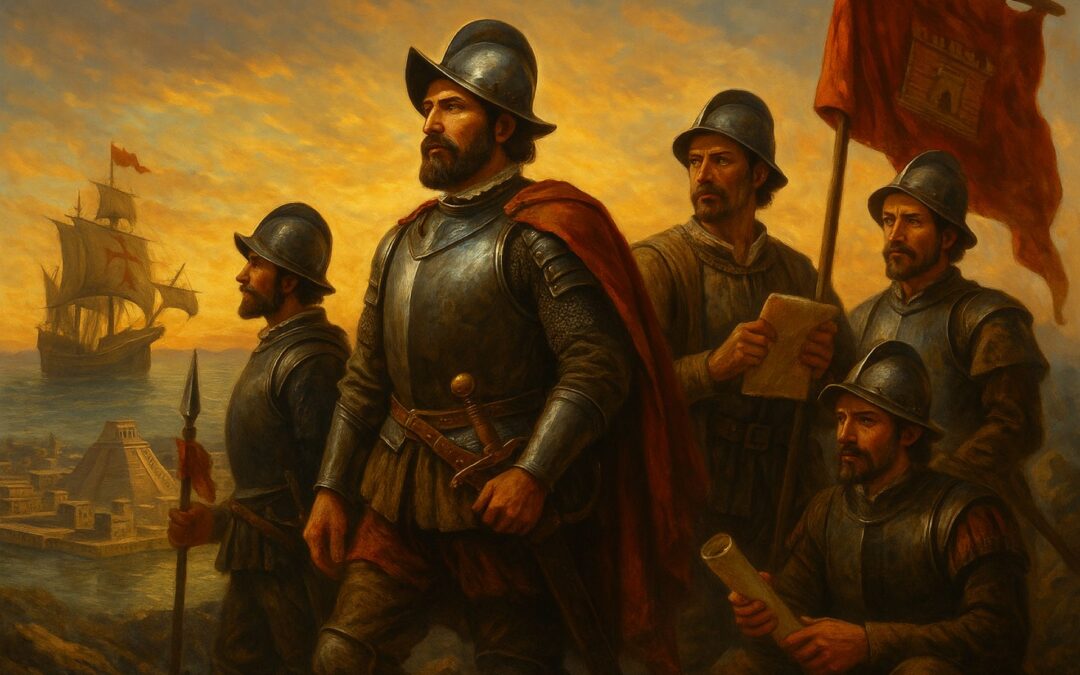
When Spain’s conquistadors first set sail across the Atlantic, they carried with them more than swords and banners—they carried a hunger for glory, wealth, and immortality. They stepped into a continent filled with civilizations older and more complex than they imagined, yet their eyes were fixed on shimmering mirages of gold and fabled kingdoms. For some, like Cortés and Pizarro, fortune came swiftly with the fall of empires.
But for others, the journey was far less triumphant. Álvar Núñez Cabeza de Vaca, Hernando de Soto, Francisco de Orellana, and Francisco Vázquez de Coronado did not carve empires of treasure. Instead, they wandered, endured, discovered, and failed—yet in doing so, they left behind stories as compelling as any conquest. Their legacies are not measured in plunder but in survival, exploration, and the haunting glimpses they preserved of a world on the brink of transformation.
A New World and the Birth of Legends
The European conquest of the Americas unfolded like a cataclysm that reshaped the very structure of the world. Until the dawn of the 16th century, the Atlantic Ocean had acted as a formidable barrier. What lay beyond its waters was largely confined to rumor, sailors’ yarns, and speculative maps filled with sea monsters. When Spanish and Portuguese caravels pierced that frontier, they did not merely add new lands to old maps—they redrew the mental geography of humanity itself.
The Americas, to European eyes, appeared as a boundless canvas of opportunity. To the Spanish Crown, these lands represented imperial expansion and an inexhaustible treasury. To the conquistadors, they were fields of personal ambition, where a man’s fortune, reputation, and very destiny could be forged in steel and blood. To the Catholic Church, they were battlegrounds for souls, a mission field where conversion would sanctify conquest. And to the indigenous peoples who had inhabited these lands for millennia, they were home—lands tied to ancestry, ritual, and meaning, now suddenly threatened by forces beyond imagining.
This was not a meeting of equals. Spanish ships carried gunpowder, steel blades, armored horses, and devastating microbes—diseases that would decimate populations before swords could reach them. Yet what Europeans encountered in return astonished them. The Aztec capital of Tenochtitlán, with its causeways, floating gardens, and gleaming temples, rivaled or surpassed any city in Europe. The Inca Empire stretched along the spine of the Andes with roads, bridges, and a bureaucracy so advanced it could mobilize armies and resources across thousands of miles without wheels or writing.
Still, conquest was never straightforward. Behind every triumph lay years of attrition, mutinies, starvation, and desperate gambles. The myth of El Dorado—the golden man who covered himself in dust each morning before bathing—embodied this fevered hunger. Entire expeditions set out chasing whispers, only to vanish in jungles or deserts. The lure of inexhaustible wealth blinded men to the reality of the lands they entered.
It was within this crucible of hope and horror that the conquistadors emerged as paradoxical figures. They were ruthless marauders and accidental chroniclers, destroyers and yet, unintentionally, preservers of history. Hernán Cortés and Francisco Pizarro loom largest in the tale, remembered for toppling empires. Yet scattered among the chronicles are the sagas of others—less celebrated but no less extraordinary. Álvar Núñez Cabeza de Vaca, who survived not by conquest but assimilation. Hernando de Soto, who died on the banks of a river he could never claim. Francisco de Orellana, swept by fate into discovering the Amazon. And Francisco Vázquez de Coronado, who squandered his fortune chasing mirages across the plains.
Together, these figures reveal that the story of the conquest was not a simple arc of victory. It was a tangle of desperation, endurance, and disillusionment. The New World was not conquered overnight—it was wrestled into history through blunders, betrayals, and sheer human will. And in those struggles, the legends of the conquistadors were born.
Álvar Núñez Cabeza de Vaca: The Survivor
The story of Álvar Núñez Cabeza de Vaca is one of the most improbable sagas of survival and transformation in the age of conquest. Unlike many of his contemporaries, his legacy was not built on slaughtered empires or mountains of treasure but on endurance, adaptability, and the strange alchemy of suffering.
Born around 1490 in Jerez de la Frontera, Spain, Cabeza de Vaca came from a lineage of minor nobility. Though not wealthy, his family carried prestige, and from a young age he was trained in arms, horsemanship, and the discipline of warfare. He saw combat in the Italian Wars, earning scars at the Battle of Ravenna in 1512, before returning to Spain. By the time he was appointed treasurer of the ambitious Narváez expedition to Florida in 1527, he was a seasoned soldier, hardened but still searching for fortune.
The expedition, however, was cursed almost from the moment it began. Five ships left Spain with 600 men, but attrition quickly gnawed away at their numbers. Storms battered the fleet, desertions thinned their ranks, and logistical failures haunted every decision. By the time they reached Florida, only a fraction of their force remained intact.
Cabeza de Vaca advised caution, urging against splitting the force between ships and an overland march. His protests fell on deaf ears. Narváez, hungry for glory, branded him a coward and pressed forward. What followed was a cascade of misfortune: fruitless marches through swamps, hostile encounters with native tribes, and starvation that reduced soldiers to gnawing raw corn or boiling leather. Eventually, with no ships in sight and no hope of rescue, the desperate men fashioned five crude boats. They melted down their weapons to forge nails, used horsehide for water bags, and stitched together their shirts to make sails.
The sea, however, was no kinder than the land. In September 1528, storms ripped apart their makeshift fleet. One barge after another sank beneath the waves, leaving only Cabeza de Vaca and a handful of survivors stranded on the shores of present-day Texas. Of the 600 who had set out from Spain, fewer than 80 remained alive.
From there began an odyssey unlike any in the annals of conquest. For nearly eight years, Cabeza de Vaca wandered the Gulf Coast, enslaved at times, living as a trader at others. Stripped of armor, weapon, and title, he survived by embracing the world around him. He learned the languages of tribes, ate roots, berries, and fish, and adopted the customs of those who had once feared or despised him. In time, he acquired a reputation as a healer. Performing rituals of blowing, praying, and making the sign of the cross, he came to be regarded as a man touched by the divine. For the natives, he was no longer an invader but a strange emissary of the sun, capable of both curing sickness and invoking awe.
His transformation was not only physical but spiritual. While many conquistadors viewed the natives as obstacles to wealth, Cabeza de Vaca came to see them as fellow human beings, with their own dignity and suffering. His ordeal had forced him into humility, and his survival depended on reciprocity rather than dominance.
In 1536, after years of wandering, he and three companions—two Spaniards and an enslaved African named Estebanico—finally stumbled upon Spanish settlements in present-day Sinaloa, Mexico. Their appearance shocked the colonists: gaunt, barefoot, and dressed in animal skins, they seemed more native than European. Cabeza de Vaca soon returned to Spain, where he published his memoir La Relación.
Unlike most conquistador accounts, his narrative did not revel in conquest. Instead, it painted a vivid portrait of native societies—describing their foods, rituals, family structures, and hardships. He emphasized the cruelty of Spanish greed and advocated for more humane treatment of indigenous peoples, a position rare for his time.
Later appointed governor of Río de la Plata in South America, he returned to the Americas with new responsibilities, but his tenure was marked by mismanagement and opposition. Arrested and sent back to Spain, he eventually faded into obscurity, dying sometime between 1557 and 1560.
Yet his legacy endures. Cabeza de Vaca’s survival was not a tale of victory but of transformation. He crossed a cultural frontier as vast as any ocean, living not as conqueror but as captive, healer, and wanderer. In doing so, he left behind one of the most remarkable records of early encounters in North America—a chronicle not of gold and glory but of resilience, humility, and the fragile threads that connect strangers in the wilderness.
Hernando de Soto: Death on the Mississippi
Hernando de Soto’s life was the embodiment of conquistador ambition—ruthless, daring, and insatiable. Born around 1500 in Extremadura, Spain, to a family of impoverished nobility, he grew up in a land where honor was inherited but fortune had to be seized. Like many of his generation, the New World beckoned as the one stage vast enough to transform a minor nobleman into a man of legendary stature.
He cut his teeth on conquest in Central America, riding with the brutal campaigns that subdued Nicaragua and Panama. His prowess as a cavalryman and tactician earned him both wealth and reputation. Later, he joined Francisco Pizarro’s audacious expedition to Peru. De Soto played a central role in the capture of the Inca emperor Atahualpa at Cajamarca in 1532, even conversing with him and teaching him chess during his captivity. When Atahualpa was executed, de Soto shared in the immense ransom of gold and silver that poured into Spanish coffers. By his mid-thirties, he had amassed riches beyond imagination.
But conquest bred appetite. Unlike Cabeza de Vaca, who returned humbled by his trials, de Soto hungered for more. In 1537, King Charles V granted him the right to conquer La Florida, a vague and little-understood territory that stretched across much of what is now the southeastern United States. The appointment came with a title, land, and the promise of glory. It was the culmination of every conquistador’s dream.
De Soto spared no expense. He invested much of his personal fortune to outfit the largest expedition yet sent to North America: nine ships, 620 men, 220 horses, herds of swine for food, priests for conversion, artisans for building, and chains for enslaving. When he landed on the Gulf Coast in May 1539, the expedition had the look of an army destined to carve out an empire.
The land, however, resisted them. Florida’s dense swamps and forests made cavalry nearly useless. Supplies ran short, and every native settlement seemed empty of gold. The Spaniards demanded food and interpreters, and when refused, they resorted to violence—raiding villages, taking hostages, and leaving destruction in their wake. They spent their first winter in present-day Tallahassee, hounded by hunger and disease.
Rumors of gold further north lured them onward. The march became an ordeal of attrition. They crossed Georgia, South Carolina, and Tennessee, often encountering tribes who alternated between cautious hospitality and outright hostility.
The pivotal moment came in October 1540, when the Spaniards entered the fortified town of Mabila in present-day Alabama. At first welcomed, they soon realized it was a trap: thousands of native warriors ambushed them. What followed was one of the bloodiest battles of early American history.
For nine hours, Mabila became a furnace of fire and steel. The Spaniards eventually prevailed, setting the town ablaze, slaughtering more than 2,000 warriors. Yet it was a pyrrhic victory. Over 200 Spaniards lay dead, nearly all their horses were wounded or killed, and most of their precious supplies went up in flames. The expedition, once brimming with confidence, was now crippled.
Still, de Soto pressed forward. In May 1541, after nearly two years of wandering, the expedition reached the Mississippi River. To the Spaniards, it was a marvel—an artery of such vastness that crossing it required constructing flat-bottomed boats. They became the first Europeans to record and traverse the mighty river. Yet this achievement did not bring salvation. Instead, it underscored the scale of the wilderness they faced.
De Soto’s resolve began to unravel. Exhaustion weighed on his men, food grew scarcer, and hostile tribes closed in. In May 1542, De Soto himself fell ill with fever. Wasting away, the man who had once ridden as a lord of conquest died in a foreign land, far from the treasures he had envisioned.
His companions, fearing the natives might defile his body as that of a fallen enemy, concealed his death. They wrapped his corpse in blankets, weighted it with sand, and consigned him to the depths of the Mississippi under the cover of night.
Leadership passed to Luis de Moscoso, who struggled to hold the expedition together. After de Soto’s death, the men abandoned all hope of finding gold. They built makeshift boats, fought their way down the Mississippi amid attacks from war canoes, and eventually staggered to Spanish territory in Mexico. Of the 700 who had set out with de Soto, barely 300 survived.
De Soto’s grand venture achieved no conquest, uncovered no riches, and established no permanent settlement. By the standards of empire, it was a failure. Yet in death, he left an unintended legacy.
His expedition produced some of the earliest European descriptions of the peoples and landscapes of the American Southeast, including the river valleys, sprawling plains, buffalo herds, and the complex societies of the Mississippian tribes.
His story became a cautionary tale of ambition turned to ruin—a conquistador who sought to rival Cortés and Pizarro but found only a grave beneath the waters of the Mississippi.
Francisco de Orellana: The River of Destiny
Few expeditions in the Age of Discovery began with such promise and ended in such ruin, yet along the way stumbled into a feat so monumental it secured eternal remembrance. Francisco de Orellana’s journey into the Amazon was born out of greed for El Dorado but became an odyssey of endurance, betrayal, and discovery.
Orellana was born around 1511 in Trujillo, Spain, a relative of the powerful Pizarro brothers, who had already established dominions in Peru. He first joined them in the Andean campaigns, gaining land and favor in Ecuador. But conquest always demanded more. By 1541, rumors had reached Quito of a mythical land east of the Andes—a realm of abundance where the “Golden Man” (El Dorado) supposedly bathed each morning, his body shimmering in dusted gold. Gonzalo Pizarro, brother of Francisco, resolved to lead an expedition in search of this kingdom. Orellana, loyal to kin, agreed to accompany him.
The venture was massive by conquistador standards: 220 Spaniards and over 4,000 native porters and auxiliaries set out. The Andes were crossed at terrible cost. Freezing passes, suffocating rainforests, and thin mountain air drained strength from both men and animals. Horses collapsed on the trail, and porters—burdened with supplies and treated as expendable—perished by the thousands.
Hunger sharpened tempers. Gonzalo Pizarro vented his rage on guides, torturing and burning them alive, or unleashing mastiff hounds upon them. The Spaniards soon devoured their remaining horses and gnawed bark from trees.
When the remnants of the expedition reached the Coca River, desperation reigned. A brigantine was built, and Orellana was entrusted with 57 men to take it downstream in search of food. The current was so powerful that return was impossible. Orellana and his men were swept into the unknown, carried deeper into a world no European had seen.
The river alternated between salvation and menace. In some villages, natives fled in fear, leaving behind food that kept the Spaniards alive. In others, hospitality turned into cautious friendship, with tribes offering shelter, roasted manioc, and fish. But not all encounters were peaceful. Carvajal, a Dominican friar who chronicled the journey, recorded ambushes from river canoes, arrows hissing through the air, and battles fought at dusk when shadows concealed the assailants.
It was in one of these clashes, on June 24, 1542, that Carvajal noted a detail that astonished Europe: women fought alongside men with ferocity equal to their counterparts. Tall, fierce, and unflinching, they became etched in the Spaniards’ minds as the Amazons of classical legend. From this moment, the river they sailed would forever bear the name—the Amazon.
As they drifted further, Orellana began to realize the scale of their passage. The river widened into a continent-spanning artery. Along its banks stretched vast settlements, some larger than any they had seen before. Carvajal described palisaded towns with thousands of inhabitants, fields of crops stretching into the distance, and complex political federations.
To Europeans conditioned to think of the Americas as sparsely populated wilderness, these accounts seemed implausible. Yet Orellana and his men were seeing societies later devastated by disease, their very existence erased within decades.
Eight months after setting out, battered but alive, Orellana and his dwindling force finally reached the Atlantic. They had traveled over 2,500 miles, completing the first recorded navigation of the Amazon River. It was a feat of geography as astounding as Magellan’s circumnavigation, though born of desperation rather than design.
Their return to Spanish territory was triumphant yet shadowed by suspicion. Gonzalo Pizarro, whose own expedition had collapsed with only 80 survivors limping back to Quito, accused Orellana of treachery, claiming he had abandoned his men to seize glory for himself.
But Orellana defended his actions with notarized testimonies from his companions, explaining that the river’s current made return impossible. The accusations faded, and the enormity of his achievement spoke louder than his cousin’s bitterness.
Back in Spain, Orellana was celebrated. He married Ana de Ayala, a noblewoman who would later accompany him on his ill-fated return to the Amazon. In 1545, the Crown granted him authority to govern the new territory he had discovered—New Andalusia. Yet his second expedition was a disaster from the start.
Poorly financed and poorly manned, it was plagued by desertion, shipwrecks, and disease. When Orellana reached the Amazon Delta in 1546, he could not even locate the river he had once navigated. Fever and grief consumed him; he died that same year, leaving his wife to carry word of his end back to Spain.
Though his life closed in failure, Orellana’s name was immortalized by the river he revealed. His voyage expanded Europe’s map and imagination, proving the continent’s heart was no barren wilderness but a vast corridor of civilizations. Even centuries later, explorers and scholars would debate Carvajal’s descriptions of populous towns—dismissed for generations, only now supported by archaeological evidence of pre-Columbian urban centers hidden in the jungle.
Orellana set out in search of a fabled king bathed in gold. He found instead the greatest river on Earth, a discovery born of chance but destined to alter the world’s understanding of the Americas forever.
Francisco Vázquez de Coronado: The Quest for Cíbola
Francisco Vázquez de Coronado’s name is forever tied to one of the grandest yet most ill-fated expeditions of the 16th century. Unlike Cortés or Pizarro, who struck down mighty empires and returned with plunder, Coronado returned empty-handed—ruined financially, scarred by scandal, and remembered less for conquest than for the scale of his failure. Yet, in that failure, he opened a window onto lands and peoples that Europe had never before imagined.
Born in Salamanca in 1510, Coronado came from a noble family but, as a younger son, was denied the inheritance that sustained status in Spain. Like so many of his generation, he turned his eyes westward. In 1535, he sailed to New Spain (Mexico), serving under Viceroy Antonio de Mendoza.
There, fortune smiled. He married Beatriz de Estrada, daughter of the royal treasurer, acquiring an enormous dowry that made him one of the wealthiest men in the colony. Appointed governor of Nueva Galicia in 1538, he seemed destined for high office and prosperity. Yet wealth alone did not satisfy the conquistador spirit. He craved glory.
That opportunity seemed to arrive in 1539. Word spread of a Franciscan friar, Marcos de Niza, who claimed to have glimpsed a city to the north—Cíbola—perched on a hill, gleaming as large and as wealthy as Mexico City itself. The tale electrified Spanish imaginations.
If true, it might be one of the fabled Seven Cities of Gold, a legend that had haunted Europe since the Reconquista. Coronado persuaded Mendoza to authorize an expedition, promising to finance much of it himself. In February 1540, with 400 Spaniards, 1,500 Mexican allies, dozens of priests, servants, and slaves, Coronado set out to claim this new empire.
The march northward was arduous but filled with anticipation. They followed the Gulf of California’s coast before striking inland across deserts and mountains, guided by Marcos de Niza himself. By July, they reached the supposed city of Cíbola. The sight broke hearts. Instead of golden palaces, they found a cluster of adobe pueblos—stone and mud dwellings belonging to the Zuni people. The “city” was neither large nor wealthy, and Marcos de Niza’s florid descriptions proved wildly exaggerated. The conquistadors, furious at being deceived, sent the friar back in disgrace.
Coronado, however, refused to abandon the venture. Establishing a base among the pueblos, he dispatched scouting parties in all directions. One of his captains, García López de Cárdenas, stumbled upon a sight no European had ever seen: the Grand Canyon, a chasm so immense that the river below looked like a silver thread. Yet it yielded no riches.
Elsewhere, Coronado clashed violently with the Tiwa people along the Rio Grande, seizing pueblos for food and shelter. When supplies dwindled, he resorted to force, sparking the brutal Tiguex War in the winter of 1540–41. Dozens of pueblos were besieged or destroyed, hundreds of natives slaughtered. It was the first recorded war between Europeans and indigenous peoples in what is now the United States.
Rumors of wealth continued to taunt them. In 1541, Coronado heard of another land called Quivira, far to the east, where gold supposedly abounded. Guided by a Pawnee captive whom they nicknamed “the Turk,” Coronado led a smaller detachment across the vast Great Plains.
For weeks they marched through grasslands so endless that the horizon seemed to swallow them. They encountered immense herds of buffalo, a sight that astonished Europeans accustomed to domesticated cattle. Yet their spirits waned as the Turk led them deeper into the wilderness.
At last, they reached Quivira in present-day Kansas. Again, the dream dissolved into disappointment. Instead of golden palaces, Coronado found a community of grass-thatched huts and a people who wore little clothing. The Turk confessed under torture that he had deliberately misled the Spaniards to save his people from their violence. In retaliation, Coronado had him executed. With no gold, no empire, and no hope, Coronado turned back.
The return to New Spain in 1542 was humiliating. Coronado had spent his fortune outfitting the expedition, and the riches he promised never materialized. Worse still, reports of his cruelty during the Tiguex War reached authorities. He faced charges of war crimes, though he was eventually acquitted. Financially ruined and politically disgraced, he resigned his governorship in 1544 and retired to Mexico City, where he lived out his remaining years quietly until his death in 1554.
Though Coronado failed by the standards of conquest, his journey was monumental in scope. His men traversed more land than any other Spanish expedition in North America. They were the first Europeans to describe the Grand Canyon, the Great Plains, and the buffalo herds that sustained indigenous peoples. Chroniclers recorded invaluable observations of native cultures—the Pueblo, the Wichita, the Tiwa—before centuries of colonialism transformed them.
Coronado set out to find cities of gold but instead unveiled the landscapes of the American Southwest. His failure was bitter, yet his expedition etched into history one of the most sweeping explorations of the continent—a journey not of treasure, but of discovery and disillusionment.
The Legacy of the Lesser-Known Conquistadors
The tales of Álvar Núñez Cabeza de Vaca, Hernando de Soto, Francisco de Orellana, and Francisco Vázquez de Coronado differ from the familiar stories of Cortés and Pizarro. They did not topple mighty empires or return to Spain laden with treasure. Instead, their legacies rest in something subtler yet no less enduring: survival, exploration, and the preservation of fleeting glimpses of worlds that would soon be altered forever.
Cabeza de Vaca’s survival across eight years in the wilds of North America reshaped the narrative of conquest. Unlike most of his peers, who measured success in gold and captives, he measured it in endurance and adaptation. Stripped of armor and authority, he crossed cultural boundaries and lived as the people around him lived. His account, La Relación, remains one of the earliest and most intimate portraits of indigenous life before European domination, offering details of foodways, healing rituals, and kinship structures that might otherwise have vanished unrecorded. His insistence later in life on treating native peoples with dignity was born not of ideology but of necessity—his very survival depended on their mercy.
Hernando de Soto, by contrast, left a darker imprint. His three-year expedition through the American Southeast was a brutal march of violence, hunger, and futility. Yet even in failure, it mattered. His men produced the first European descriptions of the Mississippi River and the societies of the Mississippian cultures that thrived in the region. Within a century, those same societies would be scattered or extinguished by disease and colonization. De Soto’s story is thus both a cautionary tale of hubris and a tragic prelude to the devastation that would follow European arrival.
Francisco de Orellana’s accidental voyage down the Amazon demonstrated how chance could shape history as much as design. Swept downstream, he revealed to Europe the existence of the largest river system in the world and described civilizations along its banks that archaeology has only recently confirmed. Though derided in later centuries as exaggeration, Carvajal’s chronicles of vast towns and warrior women—Amazons—have regained credibility as evidence emerges of pre-Columbian cities hidden beneath the rainforest canopy. Orellana died in failure on his second expedition, yet his name lives on in the very river that defines South America.
Francisco Vázquez de Coronado’s search for Cíbola ended in disappointment, but his march across deserts, canyons, and plains mapped vast stretches of the American Southwest and Great Plains for the first time. His soldiers described buffalo herds numbering in the thousands, pueblos with intricate architecture, and the yawning chasm of the Grand Canyon. Though he returned bankrupt and disgraced, the knowledge gleaned from his expedition expanded Europe’s understanding of a continent whose scale and diversity they had barely grasped.
Together, these four conquistadors form a counterpoint to the triumphant narratives of empire. They remind us that history is not only written in victories but also in the stumbles, the accidents, and the failures that inadvertently preserve fragments of a world otherwise lost. None of them found El Dorado, yet each left behind something more enduring than gold: testimonies of resilience, records of civilizations on the cusp of destruction, and a reminder that conquest was as much about survival and folly as it was about triumph.
Their stories complicate the image of the conquistador. They were not merely marauders but also chroniclers, wanderers, and, in rare cases, reluctant advocates for the very peoples they once sought to dominate. In their struggles, they preserved traces of cultures, landscapes, and encounters that shaped the destiny of two hemispheres. Theirs is a legacy built not on the spoils of conquest but on the haunting resonance of survival against impossible odds.
Conclusion
The legends of conquest are often told in the language of triumph—gold seized, kings dethroned, lands claimed. Yet the lives of Cabeza de Vaca, de Soto, Orellana, and Coronado remind us that history is just as often shaped by failure, miscalculation, and endurance. They did not find El Dorado, nor did they return with overflowing galleons.
But they mapped unknown rivers, described vast plains, and bore witness to peoples whose voices might otherwise have been silenced. Their stories blur the line between conqueror and castaway, between adventurer and survivor.
In chasing illusions, they uncovered truths—about the scale of the Americas, the resilience of its peoples, and the fragility of human ambition. And in their footsteps, the myths of the New World gave way to the harsh, extraordinary reality of discovery.