
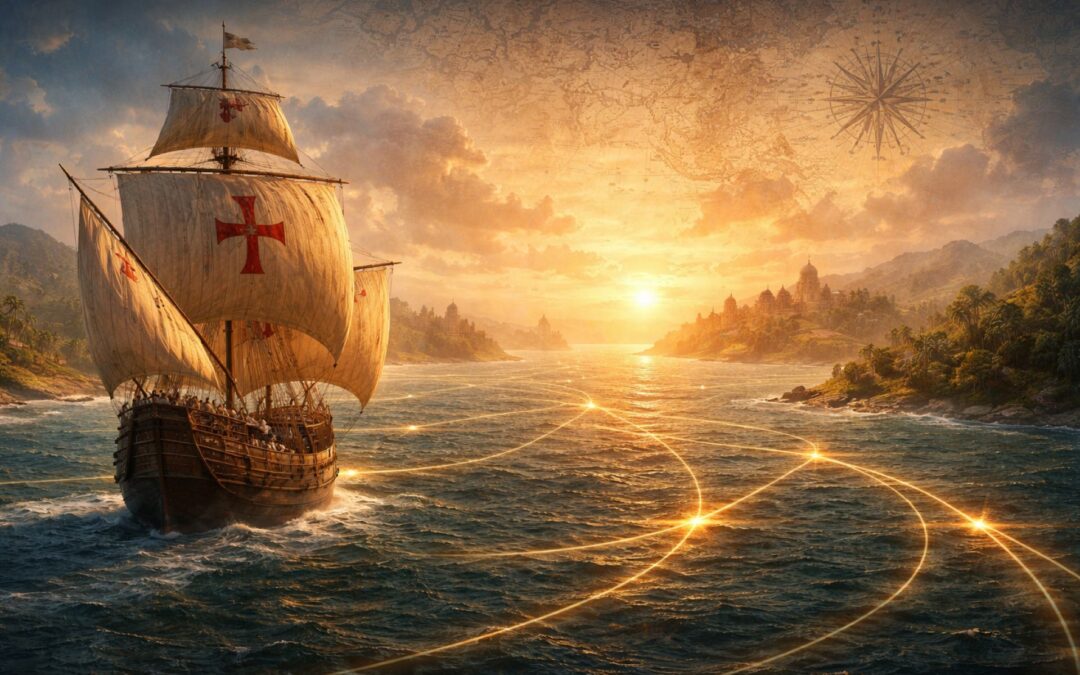
Introduction: How A Small Kingdom Built A Global Maritime Empire
If you were to look at a modern map of global shipping routes, you would see a dense web of lines stretching across oceans—connecting continents, economies, and civilizations. These routes form the backbone of globalization. They carry oil from the Middle East, electronics from Asia, grain from the Americas, and manufactured goods across the world. They are so fundamental to modern life that it is easy to assume they have always existed.
But just over 500 years ago, this interconnected system did not exist.
The oceans were not highways—they were barriers. Navigation was uncertain, maps were incomplete, and vast stretches of the globe remained unknown to European powers. Trade between distant regions depended on long, fragmented overland routes controlled by intermediaries. Asia’s spices, Africa’s gold, and Europe’s markets were connected—but only indirectly, inefficiently, and at great cost.
It was into this world that a small, relatively obscure kingdom on the western edge of Europe made a decision that would change history.
Portugal, constrained by geography and surrounded by more powerful neighbors, turned its gaze outward—toward the Atlantic Ocean. What followed was one of the most extraordinary transformations in human history. Within a few decades, Portuguese sailors pushed beyond the known world, charting unknown waters, establishing new trade routes, and connecting continents that had never been directly linked before.
In doing so, they did not merely build an empire. They created the first truly global system of trade.
From the coasts of West Africa to the spice markets of India, from the islands of Southeast Asia to the vast lands of Brazil, the Portuguese Empire stretched across oceans rather than continents. It was not a traditional land empire built through territorial conquest alone. Instead, it was a maritime network—held together by ships, fortified ports, and control over key choke points of global commerce.
This model of empire—focused on trade, naval power, and strategic positioning—would become the blueprint for the European powers that followed.
Yet, for all its early success, the Portuguese Empire also contained the seeds of its own decline. Its reliance on long-distance trade made it vulnerable to competition. Its scattered holdings were difficult to defend. And as other European nations learned from its methods, Portugal’s early advantage began to erode.
Over time, its dominance faded. Its territories were lost. Its empire shrank.
But its legacy endured.
The global trade networks it pioneered continue to shape the modern world. The Portuguese language is spoken by hundreds of millions. And the patterns of exchange—economic, cultural, and political—that began with its voyages still define the structure of globalization today.
This is the story of how a small kingdom became the architect of a connected world—and how its empire rose, expanded, struggled, and ultimately came to an end.
The Origins of Portugal and the Turn to the Sea
The story of the Portuguese Empire does not begin on the ocean—it begins on land, in the long and violent struggle that shaped medieval Iberia.
For centuries, the Iberian Peninsula had been divided between Christian kingdoms in the north and Muslim-ruled territories in the south. This conflict, known as the Reconquista, was not a single war but a gradual process of conquest, alliance, and consolidation that unfolded over hundreds of years. It was within this shifting frontier that Portugal first emerged.
Originally a small county under the Kingdom of León, Portugal began to assert its independence in the 12th century under the leadership of Afonso Henriques. Through a combination of military success and political maneuvering, he established Portugal as a sovereign kingdom, recognized in 1143. Over the following century, Portuguese forces continued pushing southward, capturing territory from Muslim rulers and expanding their domain.
This expansion reached its conclusion in 1249 with the conquest of the Algarve, the southernmost region of modern Portugal. With this victory, Portugal achieved something unusual for a medieval European kingdom: it fixed its borders early. Unlike many of its neighbors, whose frontiers would shift repeatedly over the centuries, Portugal’s territorial boundaries on the Iberian Peninsula remained remarkably stable from this point forward.
This stability, however, came with a limitation.
To the east lay Castile, a powerful Christian kingdom with which Portugal maintained relatively stable relations. Further expansion on the peninsula was not only difficult but politically undesirable. Unlike other European powers that could continue to grow through land-based conquest, Portugal found itself effectively boxed in.
It had reached the limits of what it could achieve on land.
This geographic constraint would prove to be one of the most important turning points in its history.
With no viable path for expansion within Iberia, Portugal began to look outward. The Atlantic Ocean, once seen as a dangerous and uncertain frontier, increasingly appeared as an opportunity. Across the narrow Strait of Gibraltar lay North Africa—rich in trade, strategically important, and still under Muslim control. Beyond that lay the vast, largely unknown coastline of West Africa, and further still, the possibility—however distant—of reaching Asia by sea.
This shift in perspective was not immediate, but it was decisive.
The pivotal moment came in 1415, when the Portuguese launched an expedition across the Mediterranean and captured the North African city of Ceuta. On the surface, this appeared to be a continuation of the Reconquista—a Christian kingdom seizing territory from a Muslim power. But in reality, it marked something far more significant.
Ceuta was not just a military target; it was a gateway to trade.
The city sat at a crucial junction of trans-Saharan trade routes, through which gold, spices, and other valuable goods flowed into the Mediterranean world. By capturing it, the Portuguese gained direct exposure to these networks and, perhaps more importantly, insight into how they might bypass them.
Although their attempts to expand further into North Africa were met with resistance and ultimately failed, the strategic value of Ceuta lay elsewhere. It became a base—a launching point for exploration along the Atlantic coast of Africa.
From this moment onward, Portugal’s ambitions began to shift fundamentally.
No longer focused solely on territorial conquest within Europe, the kingdom began to experiment with something entirely new: maritime expansion. Instead of armies marching across land, ships would venture into unknown waters. Instead of castles and fortresses deep inland, there would be coastal outposts and trading hubs.
Portugal was no longer just a kingdom at the edge of Europe.
It was becoming a nation oriented toward the sea—and in time, that orientation would transform it into the first global maritime empire in history.
Prince Henry and the Age Of Exploration
If the capture of Ceuta marked the beginning of Portugal’s outward expansion, it was the vision and persistence of one man that transformed that ambition into a sustained, systematic project.
That man was Prince Henry of Portugal—later known to history as Henry the Navigator.
Despite the title, Henry was not a great seafarer himself. He rarely sailed on the long voyages that would define the age. His importance lay elsewhere. He was an organizer, a patron, and above all, a driving force behind Portugal’s early exploration efforts. At a time when most European kingdoms were still focused on land-based power, Henry recognized that the ocean represented both opportunity and uncertainty—and he set out to systematically reduce that uncertainty.
From his base in southern Portugal, often associated with the region of Sagres, Henry sponsored a series of expeditions along the west coast of Africa. These voyages were not isolated adventures but part of a broader, coordinated effort to push further into unknown waters year after year. Each journey built upon the knowledge of the last, gradually extending the limits of the known world.
The motivations behind this push were complex and intertwined.
There was, of course, the economic incentive. Portugal was searching for direct access to valuable commodities—gold, spices, and other luxury goods—that were otherwise obtained through long and expensive overland routes dominated by Muslim and Venetian merchants. By finding a sea route, Portugal could bypass these intermediaries entirely.
There was also a religious dimension. The Reconquista had instilled a deep sense of Christian mission within the Portuguese elite. Exploration was seen not only as a means of wealth but also as an opportunity to spread Christianity and potentially find allies against Muslim powers—particularly the legendary Christian king Prester John, whom many believed ruled somewhere in Africa or Asia.
And finally, there was simple curiosity—an intellectual drive to understand what lay beyond the known world.
But ambition alone was not enough. The Atlantic Ocean posed real and immediate dangers. Early explorers faced unpredictable winds, strong currents, and a lack of reliable navigational tools. Maps were incomplete, and myths about sea monsters and boiling waters persisted. One of the most formidable obstacles was Cape Bojador, located along the coast of present-day Western Sahara.
For years, it was considered an impassable boundary.
The waters around the cape were treacherous, and sailors believed that crossing it meant entering a region from which no ship could return. It became a psychological barrier as much as a physical one—symbolizing the edge of the known world.
That changed in 1434.
A Portuguese captain named Gil Eanes successfully navigated around Cape Bojador and returned safely. This achievement, though modest in distance, was monumental in significance. It shattered long-held fears and proved that the Atlantic could be explored further. With that barrier broken, exploration accelerated rapidly.
In the decades that followed, Portuguese ships pushed steadily southward along the African coastline. They discovered and settled the Atlantic islands of Madeira and the Azores, which became important bases for navigation and agriculture. These islands also served as early laboratories for colonial practices, including plantation agriculture and the use of enslaved labor.
At the same time, improvements in ship design and navigation made longer voyages possible. The development of the caravel—a small, highly maneuverable ship capable of sailing against the wind—allowed Portuguese sailors to explore previously inaccessible regions. Advances in cartography, along with the use of instruments like the astrolabe, gradually made navigation more reliable.
What emerged during this period was something unprecedented: a structured, state-supported system of exploration.
Portugal was no longer sending out occasional expeditions. It was building a process—one that combined technology, knowledge accumulation, and economic incentive to continuously expand its reach. Each voyage extended trade networks, mapped new territories, and brought back valuable information that would be used to plan the next.
By the time of Henry’s death in 1460, the Portuguese had explored much of the West African coast and established the foundations of what would soon become a vast maritime empire.
The age of exploration was no longer a distant possibility.
It was already underway—and Portugal was leading it.
Trade, Gold, and the Beginnings of Empire in Africa
Once the Portuguese had broken past the psychological and navigational barrier of Cape Bojador, exploration along the African coast began to shift from curiosity-driven discovery to something much more concrete: profit. What had started as an experiment in maritime expansion was becoming an imperial system rooted in commerce, extraction, and control.
The first major reward was access to West Africa’s trade networks. As Portuguese ships moved farther south during the 15th century, they encountered regions linked to the trans-Saharan exchange of gold, ivory, pepper, and other valuable goods. For merchants in Lisbon, this was transformative. Until then, much of this wealth had reached Europe through long chains of intermediaries, passing through North Africa and the Mediterranean before finally arriving in European markets. Portugal now had the chance to tap into these flows more directly.
Gold was especially important. In late medieval Europe, access to gold mattered not only for luxury but for coinage, finance, and state power. The Portuguese crown quickly realized that maritime exploration could become an economic weapon. By reaching the sources of African gold through the Atlantic coast, Portugal could weaken older commercial networks while enriching itself.
This commercial motive gave exploration a new urgency. Ships were no longer sailing south merely to map coastlines or test the limits of navigation. They were searching for points of exchange, river mouths, anchorages, and coastal communities with whom trade could be established. In time, this produced one of the defining features of the early Portuguese Empire: the fortified trading post.
Rather than conquering vast inland territories, the Portuguese concentrated on controlling strategic points along the coast. They built forts, warehouses, and feitorias—trading factories that served as protected commercial bases. From these outposts, they could buy goods, store cargo, repair ships, and regulate exchange. This was a model of empire very different from the territorial empires that would dominate later centuries. It was maritime, selective, and focused on choke points rather than continuous land control.
As they explored, the Portuguese also marked their claims symbolically. They erected padrões, stone pillars engraved with the royal coat of arms, along parts of the African coastline. These markers announced possession, projected royal authority, and signaled that Portuguese voyages were not merely exploratory but imperial in intent. They were physical statements that discovery, trade, and sovereignty were becoming intertwined.
By the middle decades of the 15th century, Portuguese ships had reached the Cape Verde Islands and the Gulf of Guinea. These regions brought the crown and its merchants into profitable contact with the gold-rich zones of West Africa. The trading post of Elmina, established later on the Gold Coast, would become one of the most important centers of Portuguese commerce, especially in gold. For a time, Portugal enjoyed a powerful advantage in these networks and came close to monopolizing Atlantic access to several key African commodities.
But alongside gold and ivory came something darker and more consequential: the expansion of the slave trade.
The Portuguese did not invent slavery, which already existed in many forms across Africa, Europe, and the Islamic world. What they did help create, however, was a new oceanic system of slave trading that would become one of the most devastating institutions in modern history. Enslaved Africans were initially transported to Portugal itself and to Atlantic islands under Portuguese control. Over time, these patterns would expand dramatically, especially once plantation economies in places like Brazil began to demand enormous amounts of labor.
In these early decades, the slave trade was still developing, but the logic behind it was already visible. Maritime power allowed the Portuguese to link African supply zones to overseas labor markets. Ships could move not just goods but human beings across long distances, converting violence and captivity into imperial profit. This would become one of the central economic foundations of the empire.
The Atlantic islands offered an early testing ground for these new colonial systems.
The Race to Asia and the Discovery of Sea Routes
By the late 15th century, Portuguese expansion along the African coast had achieved something remarkable—but incomplete. The crown and its merchants had access to gold, slaves, and coastal trade networks, yet the ultimate objective still lay beyond their reach.
Asia.
For European markets, Asia represented the greatest prize. Spices such as pepper, cinnamon, cloves, and nutmeg were not luxuries in the modern sense—they were essential commodities. They preserved food, enhanced flavor, and carried high value relative to their weight. Yet the trade in these goods was controlled by a complex chain of intermediaries. Arab merchants dominated routes across the Indian Ocean and Middle East, while Venetian traders controlled distribution into Europe.
This system made spices extraordinarily expensive.
Portugal’s ambition was simple in theory but revolutionary in execution: find a direct sea route to Asia and eliminate the middlemen. If successful, it would allow Portugal to access the spice markets at their source and reshape global trade in its favor.
The breakthrough came in 1488.
A Portuguese expedition led by Bartolomeu Dias reached the southern tip of Africa and successfully rounded it, entering the waters of the Indian Ocean. The cape he encountered—later named the Cape of Good Hope—was more than a geographic landmark. It was proof that the Atlantic and Indian Oceans were connected, and that a maritime route to Asia was not just possible but within reach.
For Portugal, this was a strategic revelation.
But before they could act fully on it, a new complication emerged from an unexpected direction.
In 1492, Christopher Columbus, sailing under the Spanish crown, crossed the Atlantic Ocean in search of a westward route to Asia. Instead, he encountered lands previously unknown to Europeans—the Americas. Although Columbus believed he had reached the outskirts of Asia, his voyage triggered immediate geopolitical tension between Spain and Portugal.
Both kingdoms now claimed rights to newly discovered territories, but neither had a clear understanding of the geography involved. Where did Asia end? Where did these new lands begin? Without clarity, conflict seemed inevitable.
The solution was diplomatic—but sweeping.
In 1494, Portugal and Spain signed the Treaty of Tordesillas, an agreement that effectively divided the non-European world into two spheres of influence. An imaginary north–south line was drawn across the Atlantic. Lands to the east would belong to Portugal; lands to the west would belong to Spain.
At the time, neither side fully grasped the long-term consequences of this division.
For Portugal, however, the treaty provided something crucial: security. With its claims to the eastern routes recognized, it could now pursue its long-standing objective of reaching Asia without fear of direct Spanish interference.
And so, in 1497, Portugal made its decisive move.
Vasco da Gama set sail from Lisbon with a small fleet, following the route pioneered by Dias. After months at sea, navigating the treacherous waters around southern Africa and crossing the vast expanse of the Indian Ocean, his expedition reached the Malabar Coast of India in 1498.
For the first time in history, a direct maritime link between Europe and India had been established.
The achievement was monumental. It connected two major regions of the world in a way that bypassed centuries-old trade systems. It proved that Portugal’s strategy—incremental exploration, technological innovation, and persistence—had succeeded.
Yet success was not immediate in economic terms.
When da Gama arrived in Calicut, he encountered a sophisticated and well-established trading environment. Local merchants, accustomed to high-quality goods from across Asia, found little value in the relatively modest items the Portuguese had brought for exchange. The Portuguese had reached the right destination, but they had not yet learned how to compete within its commercial ecosystem.
The return journey was even more brutal. Monsoon winds, disease, and exhaustion took a heavy toll on the crew. Many did not survive the voyage back to Portugal.
And yet, despite these challenges, the expedition was hailed as a triumph.
Because it had proven the most important point of all: the route existed.
From that moment onward, everything changed.
Subsequent expeditions would refine the journey, establish stronger trading positions, and begin the process of transforming this fragile connection into a durable system. What had begun as an ambitious gamble was now a strategic reality.
Portugal had found its way to Asia—and in doing so, it had opened the door to a new kind of empire, one built not on land, but on the control of oceans and trade.
The Birth of a Global Trading Empire
Once the sea route to India had been proven, Portugal moved with remarkable speed to convert discovery into dominance. The early voyages had demonstrated possibility; what followed was a deliberate effort to turn that possibility into a structured, profitable, and defensible system of global trade.
The first step was repetition and reinforcement.
Within just a few years of Vasco da Gama’s return, multiple expeditions were dispatched to India, each better equipped and more strategically prepared than the last. These voyages carried not only merchants but also soldiers, administrators, and envoys tasked with securing long-term commercial relationships. The objective was no longer simply to reach Asia—it was to establish a permanent presence there.
In 1500, one such expedition under Pedro Álvares Cabral took an unexpected detour. Blown westward while crossing the Atlantic, his fleet made landfall on the coast of South America, in what would later be known as Brazil. Although initially seen as a secondary discovery, this event would eventually prove to be one of the most consequential developments in the history of the Portuguese Empire.
For the moment, however, Portugal’s primary focus remained firmly on Asia.
As Portuguese fleets returned year after year, they began to build a network of fortified bases along key points of the Indian Ocean. These were not large territorial colonies in the traditional sense. Instead, they were strategic nodes—ports, islands, and coastal strongholds that allowed Portugal to insert itself directly into existing trade routes.
Goa, captured in 1510, became the administrative and commercial center of Portuguese India. From there, Portuguese influence extended outward across the Indian Ocean world. They established footholds in places such as Malacca, a critical gateway between the Indian Ocean and the South China Sea, and secured access to valuable spice-producing regions in Southeast Asia.
Further east, Portuguese traders reached China and Japan, integrating themselves into local trade systems. In Japan, they played a role in opening new ports such as Nagasaki to international commerce. What emerged was not a single, unified territory, but a vast and loosely connected network stretching across thousands of miles.
At the heart of this system was control over trade flows.
Portugal did not need to conquer entire regions. Instead, it sought to dominate key choke points—narrow passages and strategic ports through which valuable goods had to pass. By controlling these locations, the Portuguese could regulate trade, impose taxes, and ensure that goods moved through their network rather than bypassing it.
This strategy was reinforced through both diplomacy and force.
In some regions, the Portuguese negotiated agreements with local rulers, securing permission to trade and establish settlements. In others, they used military power to seize control of important ports and enforce their presence. Their ships, equipped with advanced artillery, gave them a significant advantage in naval engagements, allowing them to project power across vast distances.
One of the most influential figures in shaping this system was Afonso de Albuquerque, often regarded as the architect of the Portuguese Empire in Asia. As governor of Portuguese India, he pursued an aggressive strategy aimed at securing the most critical points in the Indian Ocean trade network. His campaigns were not random acts of expansion; they were carefully targeted efforts to control the flow of commerce.
Under his leadership, Portugal established a chain of fortified positions that linked Lisbon to the East Indies. This maritime corridor—spanning Africa, the Middle East, India, and Southeast Asia—became the backbone of the empire. Goods could now travel along a route that was, to a significant extent, under Portuguese supervision.
The impact on European markets was immediate and profound.
Spices that had once been rare and prohibitively expensive began to flow more directly into Lisbon. The city transformed into one of the most important commercial centers in Europe, drawing merchants, wealth, and influence. Portugal, once a peripheral kingdom, had become a central player in global trade.
Yet this system also had its limitations.
It depended heavily on long supply lines, vulnerable outposts, and the ability to maintain naval superiority across vast distances. It required constant coordination, protection, and enforcement. And it operated within regions that already had established political and economic structures, meaning that Portuguese dominance was never absolute.
Even so, by the early 16th century, the transformation was undeniable.
Portugal had succeeded in building something entirely new—a global trading empire connected not by contiguous land, but by the sea. Its strength lay in mobility, strategy, and the ability to link distant parts of the world into a single, functioning network.
This was not just expansion.
It was the creation of the first truly global economic system.
Empire Through Trade, War, and Religion
The Portuguese Empire was not held together by vast armies or continuous stretches of land. It was sustained through a more flexible—and often more volatile—combination of trade, naval force, and religious ambition. This hybrid model allowed Portugal to build influence across enormous distances, but it also meant that its power had to be constantly asserted and defended.
At its core, the Portuguese strategy was simple: control the sea, and you control the trade.
Rather than attempting to conquer large inland territories, the Portuguese focused on dominating key maritime routes and strategic ports. Their ships patrolled the Indian Ocean, escorting friendly vessels, intercepting rivals, and enforcing a system of licensed trade. Merchants operating in these waters were often required to carry official permits, and those who did not could face confiscation or attack.
This approach turned the ocean itself into a regulated space.
But such control did not go uncontested.
The Indian Ocean world was already home to powerful states and well-established trading networks. Arab, Persian, Indian, and Southeast Asian merchants had been conducting maritime commerce for centuries before the Portuguese arrived. These traders did not simply step aside. Instead, they viewed the Portuguese as disruptive outsiders attempting to impose a new and coercive system.
Tensions escalated quickly.
Throughout the 16th century, the Portuguese found themselves engaged in a series of conflicts across the Indian Ocean. They fought against regional powers, coastal sultanates, and established trading cities that resisted their presence. In many of these encounters, the Portuguese held an advantage due to their heavily armed ships and experience in naval warfare. Cannon-equipped vessels allowed them to project force in ways that many local fleets were not initially prepared to counter.
This technological edge enabled them to capture or secure several key positions.
However, Portuguese dominance was never absolute. In many areas, their control was limited to fortified enclaves along the coast, surrounded by larger and more powerful inland states. Their influence depended on maintaining pressure, forming alliances, and responding quickly to threats. It was a constant balancing act between cooperation and coercion.
Alongside trade and warfare, religion formed the third pillar of Portuguese expansion.
From the earliest voyages, the Portuguese crown saw itself as carrying a Christian mission beyond Europe. This was partly a continuation of the mindset shaped during the Reconquista, where conflict with Muslim powers had been framed in religious terms. Now, that same outlook extended into Africa and Asia.
Missionaries—particularly from the Jesuit order—accompanied traders, soldiers, and officials on Portuguese expeditions. Their goal was to spread Catholic Christianity among the populations the Portuguese encountered. In some regions, this effort was met with openness, especially where conversion could bring political or economic advantages.
In other places, it led to tension and violence.
The most striking example of this was in Goa, the administrative center of Portuguese India. There, the Portuguese established the Goa Inquisition, an institution designed to enforce religious conformity. Local populations, particularly Hindus and Muslims, were subjected to persecution, coercion, and forced conversion. What had begun as a missionary effort often became an instrument of control.
This combination of trade, force, and religion gave the Portuguese Empire a distinctive character.
It was not purely commercial, nor purely military, nor purely ideological. It was all three at once. Trade generated wealth, which funded naval power. Naval power enforced trade dominance. Religion provided both justification and an additional means of influence.
For a time, this system worked.
Portugal was able to maintain a far-reaching presence across the Indian Ocean and beyond, linking together regions that had never before been directly connected under a single European power. But the very nature of this system—its reliance on scattered outposts, constant enforcement, and limited manpower—also made it fragile.
As long as Portugal remained technologically and strategically ahead of its rivals, it could sustain this balance.
But that advantage would not last forever.
The Rise of Brazil and the Atlantic Economy
For much of the early 16th century, Brazil occupied a surprisingly minor place in the Portuguese imperial system. Compared to the lucrative spice trade of Asia, the vast lands of South America appeared distant, underdeveloped, and lacking in immediate wealth. Portugal’s attention—and resources—remained focused on the Indian Ocean, where profits were faster and more substantial.
But this relative neglect would not last.
The first shift came not from Portugal’s own priorities, but from external pressure. Other European powers, particularly the French, began to show interest in the Brazilian coastline. They established trading contacts and attempted to gain a foothold in the region. For Portugal, this posed a direct threat. Under the terms of earlier agreements, Brazil fell within its sphere of influence—but without active occupation, that claim meant little.
The response was decisive.
In the 1530s, the Portuguese crown initiated a structured colonization program. Brazil was divided into large administrative units known as captaincies, each granted to a private individual responsible for developing the land, establishing settlements, and maintaining order. This system was designed to reduce the financial burden on the crown while accelerating the process of colonization.
In practice, however, the results were uneven.
Many captaincies struggled to survive. The challenges were immense: unfamiliar terrain, resistance from indigenous populations, lack of resources, and the sheer distance from Portugal. Only a few regions achieved lasting success, and they did so largely because they focused on a single, highly profitable crop—sugar.
Sugar would transform Brazil.
The tropical climate and fertile land made it ideal for sugarcane cultivation, and European demand for sugar was growing rapidly. What had once been a luxury became an increasingly widespread commodity, and Brazil emerged as one of the world’s leading producers. This marked the beginning of a new economic model within the Portuguese Empire—one based not on trade alone, but on large-scale agricultural production for export.
But sugar production required labor—on a massive scale.
Initially, the Portuguese attempted to use indigenous populations for this purpose, but disease, resistance, and demographic collapse made this system unsustainable. The solution they turned to was already developing within their African trade networks: the large-scale importation of enslaved Africans.
Over time, Brazil became one of the central destinations of the transatlantic slave trade.
Millions of Africans were forcibly transported across the Atlantic to work on plantations under brutal conditions. The scale of this system was immense, and its consequences were profound. It reshaped the demographic, social, and cultural landscape of Brazil, while also embedding slavery as a foundational element of its economy.
By some estimates, a significant proportion of all enslaved Africans sent to the Americas were brought to Brazil.
As the plantation system expanded, so too did the infrastructure of colonial society. Cities such as Salvador (Bahia), São Paulo, and Rio de Janeiro began to emerge as important urban centers. These settlements functioned as administrative hubs, ports, and points of connection between the interior and the wider Atlantic world.
Gradually, Brazil began to shift from a peripheral possession to a central pillar of the Portuguese Empire.
This transformation was not immediate, but it was decisive. While the Asian trade network remained important, it was increasingly challenged by competition and conflict. Brazil, by contrast, offered something different: a vast territory that could be directly controlled, settled, and economically developed.
It also marked a broader transition in the nature of the empire itself.
In its early phase, Portuguese power had been defined by mobility—ships moving across oceans, linking distant markets. In Brazil, that model evolved into something more rooted and territorial. Land, labor, and production became as important as trade routes and naval dominance.
By the late 16th century, this shift was already underway.
Portugal was no longer just a maritime trading power operating at the edges of global commerce. It was becoming a colonial power with deep investments in the Atlantic world.
And as Brazil grew in importance, it would reshape not only the empire’s economy, but its entire strategic focus.
The Iberian Union and the Beginning of Decline
By the late 16th century, the Portuguese Empire had reached an extraordinary geographic scale—but beneath that expansion lay growing vulnerabilities. Its network of distant outposts required constant protection. Its trade routes stretched across vast oceans. And its dominance depended on a fragile advantage in navigation and naval power.
It was at this moment of both strength and strain that a political crisis at home triggered one of the most consequential turning points in its history.
In 1578, King Sebastian of Portugal led a military campaign into North Africa that ended in disaster. He was killed in battle, leaving no direct heir to the throne. What followed was a succession crisis that destabilized the Portuguese monarchy and opened the door for foreign intervention.
In 1580, Philip II of Spain seized the opportunity.
With military backing and a claim to the Portuguese crown, he took control of the kingdom, initiating what became known as the Iberian Union. For the next sixty years, Portugal and Spain would be ruled by the same monarch, though they remained administratively separate.
On paper, Portugal retained its identity, laws, and imperial structure.
In practice, however, the consequences were profound.
Spain was deeply entangled in conflicts across Europe, fighting wars against England, France, and the Dutch Republic. By becoming part of the Iberian Union, Portugal was effectively drawn into these conflicts—whether it wanted to be or not. Its empire, once focused on trade and maritime expansion, now became a target in a much larger geopolitical struggle.
This shift exposed Portugal to new and powerful enemies.
The Dutch, in particular, posed a serious challenge. Having recently gained independence from Spanish rule, they were determined to break into the lucrative trade networks that Portugal had established in Asia. They were skilled sailors, aggressive merchants, and well-organized competitors. The English, too, began to expand their own overseas ambitions, following the routes that the Portuguese had pioneered.
What had once been a Portuguese advantage—exclusive knowledge of global sea routes—was no longer secure.
By the early 17th century, Dutch and English traders had established themselves in key Asian ports. They entered markets in India, Southeast Asia, and beyond, directly competing with Portuguese merchants. But competition did not remain purely commercial.
It turned into conflict.
The Dutch-Portuguese War, which lasted from 1598 to 1663, was fought across multiple continents—from Brazil to Africa to Asia. Wherever Portuguese trading posts and colonies existed, they became potential targets. The Dutch launched coordinated attacks on these outposts, aiming to dismantle Portugal’s trading network and replace it with their own.
In many cases, they succeeded.
Portugal lost several of its most valuable territories in Asia, including parts of modern-day Indonesia, Sri Lanka, and key positions along the African coast. These losses were not just territorial—they were structural. Each lost port weakened the integrity of the broader network, making it harder to control trade routes and maintain influence.
Even in regions where Portugal managed to hold on, its dominance was no longer uncontested.
The cumulative effect of these challenges was a gradual erosion of power.
Portugal’s resources were stretched thin, and its interests were often overshadowed by Spain’s priorities within the union. The empire, once built on strategic precision and controlled expansion, was now reacting defensively to external pressures.
By the mid-17th century, it had become clear that the Iberian Union was doing more harm than good to Portuguese interests.
In 1640, a revolt in Portugal led to the restoration of independence and the establishment of a new ruling dynasty under John IV. This marked the end of the Iberian Union and the beginning of an effort to rebuild and stabilize the empire.
But the damage had already been done.
Portugal no longer held the same commanding position in global trade. The Dutch and English had established themselves as powerful competitors, and the balance of maritime power had shifted. The early advantage that had allowed Portugal to dominate the seas was fading.
The empire would continue—but it would never again be what it once was.
Shifting Power and the Golden Age of Brazil
After regaining independence in 1640, Portugal faced a stark reality: the empire it had built over the previous two centuries could not be restored to its former shape. Too many strategic positions in Asia had been lost, and new European powers—especially the Dutch and the English—had firmly established themselves in the very trade networks Portugal had once dominated.
The center of gravity of the empire was shifting.
Where Asia had once been the primary source of wealth and prestige, Brazil now began to take on a far more central role. What had earlier been a secondary possession, valued mainly for sugar production, was becoming the economic foundation of the Portuguese Empire.
This transformation accelerated dramatically at the end of the 17th century.
In 1693, significant deposits of gold were discovered in the interior region of Minas Gerais. This discovery triggered a gold rush on a scale that Portugal had never experienced before. Thousands of migrants from Portugal crossed the Atlantic in search of opportunity, while enslaved Africans were brought in large numbers to work in the mines under harsh and dangerous conditions.
The demographic and economic impact was immediate.
Settlements expanded rapidly, and previously remote regions became centers of activity. Within a few decades, the population of Minas Gerais surged, and the extraction of gold became one of the most important economic activities in the empire. For the Portuguese crown, this was a financial lifeline.
Gold exports from Brazil surged, and by the mid-18th century, they accounted for a substantial portion of the empire’s wealth. This influx of precious metal strengthened royal finances, supported state expenditures, and temporarily restored a sense of economic vitality that had been fading since the loss of Asian dominance.
At the same time, the sugar economy remained highly significant.
Brazil continued to be one of the world’s leading producers of sugar, and plantation agriculture remained deeply tied to enslaved labor. Together, gold mining and sugar production created a dual economic system that sustained the empire through this period.
But this prosperity came with structural consequences.
Unlike the earlier maritime model, which had been based on flexible networks and strategic mobility, the Brazilian-centered empire was far more dependent on land, labor, and extraction. Wealth now came from what could be produced and mined within a specific territory, rather than from controlling the flow of goods across oceans.
This made the empire both more stable in some ways and more vulnerable in others.
Brazil’s importance also reshaped Portugal’s political and administrative priorities. Greater attention was directed toward governing the colony, managing its resources, and maintaining control over its population. Cities such as Rio de Janeiro grew in prominence, eventually overtaking older colonial centers as the focal points of imperial activity.
By the 18th century, it was clear that Brazil was no longer just a colony.
It was the empire’s core.
Yet even as Portugal experienced this renewed period of wealth, deeper problems remained unresolved. The empire was still overstretched. Its global influence had diminished. And its economic model—reliant on resource extraction and coerced labor—carried inherent limits.
These underlying weaknesses would soon be exposed.
In 1755, a catastrophic earthquake struck Lisbon, the heart of the Portuguese state. The destruction was immense, both in terms of human life and economic impact. The disaster placed enormous strain on the kingdom’s resources at a time when stability was already fragile.
And beyond Portugal, a new force was beginning to reshape the world.
Across the Atlantic, ideas of revolution, independence, and self-determination were spreading. What had begun as political upheaval in North America and France would soon echo across empires—including Portugal’s.
Brazil, now the most important part of that empire, would not remain untouched.
Crisis, Earthquake, and the Age of Revolutions
By the mid-18th century, the Portuguese Empire appeared, at least on the surface, to have stabilized. Wealth from Brazilian gold and sugar was flowing into Lisbon, supporting the crown and restoring a measure of prestige. But beneath this recovery lay a fragile foundation—one that would soon be shaken both literally and politically.
The first shock came in 1755.
On the morning of November 1, a massive earthquake struck Lisbon, followed by fires and a devastating tsunami. The destruction was catastrophic. Much of the city—one of Europe’s major commercial and administrative centers—was reduced to ruins. Tens of thousands of people were killed, and critical infrastructure was wiped out in a matter of hours.
The consequences went far beyond immediate loss.
Lisbon was not just a capital; it was the nerve center of the empire. It coordinated trade, governance, and communication across multiple continents. Its destruction disrupted administration, strained financial resources, and forced the state to redirect attention inward at a moment when external pressures were already building.
Reconstruction would take years, and while the Portuguese government eventually rebuilt the city with remarkable speed and organization, the long-term impact of the disaster weakened the empire’s ability to project power abroad.
At the same time, the broader Atlantic world was entering a period of profound transformation.
In 1775, Britain’s thirteen colonies in North America began a rebellion that would lead to the creation of the United States. This event demonstrated that European colonies could successfully break away from imperial control. It was not just a political shift—it was an ideological one.
The idea of independence had become real.
This was followed by the French Revolution in 1789, which further amplified concepts such as liberty, equality, and popular sovereignty. These ideas spread across borders, influencing political thought far beyond Europe. They challenged the legitimacy of monarchies and colonial rule, and they provided a framework for resistance.
Portugal’s empire was not isolated from these developments.
In Brazil, the effects were gradual but unmistakable. The colony had grown in wealth, population, and importance. Its elites—many of whom were educated and increasingly aware of global political currents—began to question the nature of their relationship with Portugal. Why should such a vast and economically vital territory remain subordinate to a distant European monarchy?
At first, this dissatisfaction expressed itself in limited and localized ways.
There were uprisings, including slave revolts and conspiracies among colonial elites, but these were typically contained and suppressed by authorities. Even so, they revealed an underlying tension that was becoming harder to ignore.
Brazil was no longer just a passive colony.
It had developed its own internal dynamics, its own economic power, and increasingly, its own political consciousness. The empire that Portugal had built was beginning to change from within.
These pressures were not yet enough to break the imperial structure.
But they were building momentum.
And when combined with external shocks—military, political, and economic—they would soon push the Portuguese Empire into a new and irreversible phase of transformation.
The Napoleonic Wars and Brazilian Independence
At the beginning of the 19th century, the Portuguese Empire faced a crisis unlike any it had encountered before—one that would fundamentally alter its structure and accelerate its decline as a global power.
The source of this crisis was not in the colonies, but in Europe.
In 1807, Napoleon Bonaparte ordered the invasion of Portugal as part of his broader campaign to enforce the Continental System against Britain. Portugal, long allied with the British, refused to comply with French demands. As French forces advanced toward Lisbon, the Portuguese monarchy was confronted with a stark choice: submit, resist, or flee.
It chose to flee.
In a move that was unprecedented in European history, the Portuguese royal family, along with much of the court and administrative apparatus, relocated across the Atlantic to Brazil. Under the leadership of Prince Regent João (later King João VI), the center of the empire was effectively transferred from Lisbon to Rio de Janeiro.
This was not a symbolic gesture.
For the first time, a European empire was being governed from one of its colonies.
The consequences were immediate and far-reaching. Brazil, which had long been subordinate within the imperial system, was suddenly elevated in status. In 1815, it was formally recognized as a kingdom, equal to Portugal itself, within the newly created United Kingdom of Portugal, Brazil, and the Algarves.
Rio de Janeiro became the capital of the empire.
This shift transformed Brazil politically, economically, and psychologically. The presence of the royal court brought administrative institutions, investment, and new opportunities. Trade restrictions were loosened, ports were opened, and Brazil began to function less like a colony and more like a central component of the state.
At the same time, this new arrangement altered the balance of power.
Brazilian elites gained greater influence, and a sense of political identity began to take shape. The idea that Brazil could exist as an autonomous or even independent entity was no longer abstract—it had become a practical possibility.
When the Napoleonic Wars came to an end, pressure grew for the royal family to return to Portugal.
In 1821, King João VI left Brazil and went back to Lisbon, attempting to restore the traditional hierarchy of the empire. But the situation had already changed too much. Brazil had experienced over a decade as the center of imperial power, and its political class was no longer willing to accept a return to colonial status.
João VI left his son, Dom Pedro, in Brazil as regent.
What followed was a decisive moment.
Faced with growing demands from Portugal to reassert control over Brazil, Dom Pedro chose a different path. In 1822, he declared Brazil’s independence and proclaimed himself Emperor of Brazil. This act did not lead to a prolonged war, but it marked a clear and irreversible break.
Portugal had lost its most important colony.
The consequences for the Portuguese Empire were profound. Brazil had been its economic backbone—its primary source of wealth, population, and strategic importance. Without it, the empire was reduced to a scattered collection of smaller territories, primarily in Africa and a few remaining outposts in Asia.
More importantly, the loss of Brazil represented a shift in the nature of global empires.
What had once been a system built on expansion and integration was now facing fragmentation. The forces of nationalism and self-determination, which had been growing for decades, were beginning to dismantle colonial structures.
For Portugal, this marked the beginning of its final phase as an imperial power.
It would continue to hold onto its remaining territories for more than a century.
But the era of Portugal as a dominant global empire was over.
The Scramble for Africa and Final Imperial Efforts
After the loss of Brazil in 1822, the Portuguese Empire entered a markedly diminished phase. What had once been a vast and interconnected global system was now reduced to a handful of territories, most notably in Africa—Angola on the west coast and Mozambique on the east.
If the empire was to survive, it would have to be rebuilt around these remaining possessions.
During the 19th century, European powers turned their attention increasingly toward Africa, driven by a combination of economic ambition, strategic competition, and imperial ideology. This period, later known as the Scramble for Africa, saw major powers such as Britain, France, and Germany rapidly expanding their control over the continent.
Portugal, despite its weakened position, sought to reassert itself within this new imperial race.
Its strategy was ambitious.
Rather than simply holding its coastal enclaves, Portugal envisioned a continuous band of territory stretching across southern Africa—from Angola in the west to Mozambique in the east. This plan, often referred to as the Pink Map, aimed to connect its two major colonies through expansion into the interior.
If successful, it would have reestablished Portugal as a significant territorial power.
But this vision ran directly into the interests of a far more dominant empire: Britain.
The British had their own strategic objective—to establish a north-to-south axis of control across Africa, linking Cairo to Cape Town. Portugal’s proposed expansion cut across this plan, creating an inevitable conflict of interests.
Unlike earlier centuries, Portugal no longer had the strength to assert its ambitions independently.
In 1890, the British government issued an ultimatum demanding that Portugal abandon its plans for territorial expansion in central Africa. Faced with overwhelming pressure and lacking the military capacity to resist, Portugal complied.
The impact of this humiliation was severe.
Domestically, it exposed the weakness of the Portuguese monarchy and government. Public confidence eroded, and dissatisfaction grew among political factions that had long criticized the state’s inability to maintain its former imperial stature. The idea that Portugal could still compete with the great European powers was increasingly difficult to sustain.
This moment marked the effective end of any serious attempt to revive Portuguese imperial ambition.
From this point forward, Portugal’s role in Africa was no longer defined by expansion, but by preservation. Its efforts shifted toward maintaining control over Angola and Mozambique, managing colonial administration, and extracting resources where possible.
At the same time, internal instability within Portugal itself was intensifying.
The late 19th and early 20th centuries saw rising tensions between monarchists and republicans. The monarchy, already weakened by external setbacks, faced growing opposition from groups that viewed it as incapable of reform or effective governance.
These tensions would soon erupt into violence.
In 1908, King Carlos I and his heir were assassinated in Lisbon, an event that shocked the nation and further destabilized the political system. Just two years later, in 1910, the monarchy was overthrown entirely, and Portugal was declared a republic.
This political transformation did not immediately resolve the country’s deeper problems.
Instead, it marked the beginning of a new phase of uncertainty—both at home and across what remained of the empire.
Portugal still possessed overseas territories, but it no longer possessed the strength, unity, or global influence that had once made it a dominant imperial power.
The final chapter of the Portuguese Empire was approaching.
From Empire to Republic and Global Decline
The fall of the Portuguese monarchy in 1910 marked a dramatic political transformation—but it did not restore strength to the empire. Instead, it ushered in a period of instability that further weakened Portugal’s ability to manage its remaining overseas territories.
The newly established republic struggled from the outset.
Frequent changes in government, economic difficulties, and internal divisions made consistent policy nearly impossible. While other European powers were consolidating and expanding their influence, Portugal was increasingly preoccupied with its own domestic challenges. This lack of stability translated directly into diminished imperial capacity.
These weaknesses became more apparent with the outbreak of World War I in 1914.
Portugal initially remained on the sidelines, but the global nature of the conflict soon drew it in. Its African colonies—particularly Angola and Mozambique—bordered German territories, making them strategically vulnerable. Skirmishes broke out in these regions even before Portugal formally entered the war in 1916.
Once involved, Portugal committed resources to support the Allied war effort, including sending troops to fight in Europe.
This created a difficult balancing act.
On one hand, participation in the war was meant to reinforce Portugal’s standing among the Allied powers and protect its colonial possessions. On the other hand, it placed additional strain on an already fragile state. Resources that might have been used to strengthen control over overseas territories were diverted elsewhere.
Despite these challenges, Portugal managed to retain its colonies after the war, confirmed by the postwar settlement.
But survival did not mean recovery.
The interwar years saw continued political instability, culminating in another major shift in 1933 with the establishment of the Estado Novo regime under António de Oliveira Salazar. This new government replaced the unstable republican system with an authoritarian state that emphasized order, nationalism, and centralized control.
Under Salazar, Portugal adopted a different approach to its empire.
Rather than preparing for gradual change, the regime doubled down on imperial identity. The colonies were not seen as territories that might one day become independent, but as integral parts of a unified Portuguese state. This position increasingly put Portugal at odds with global trends.
After World War II, the international environment changed dramatically.
Across Asia and Africa, European empires began to unravel. Britain and France, despite initial resistance, started granting independence to many of their colonies. The principle of self-determination gained legitimacy, and anti-colonial movements grew stronger.
Portugal, however, refused to follow this path.
The Estado Novo regime remained committed to maintaining control over its overseas territories, particularly in Africa. This refusal created mounting tension, both internationally and within the colonies themselves.
A key flashpoint came in 1961.
In India, the former Portuguese enclaves of Goa, Daman, and Diu had remained under Portuguese control even after Indian independence in 1947. Diplomatic efforts to resolve the issue failed, and in 1961, Indian forces moved in and took control of the territories. Portugal refused to recognize this loss, but in practical terms, its presence in India had come to an end.
At the same time, a far more serious challenge was emerging in Africa.
Independence movements began to organize in Angola, Mozambique, and other territories. These movements, often supported by external powers in the context of the Cold War, initiated armed conflict against Portuguese rule. What followed was a prolonged and costly conflict known as the Portuguese Colonial War.
Fought from 1961 to 1974, this war placed enormous strain on Portugal.
It required sustained military engagement across multiple fronts, drained economic resources, and became increasingly unpopular at home. Young soldiers were sent to fight distant wars with no clear end, while the broader society bore the cost of maintaining an empire that was becoming harder to justify.
By the early 1970s, the situation had become unsustainable.
Portugal was no longer capable of maintaining its empire through force alone, yet its government remained unwilling to change course. The contradiction between reality and policy was reaching a breaking point.
That breaking point would come not from the colonies—but from within Portugal itself.
Decolonization and the End of Empire
By the early 1970s, the Portuguese Empire had been reduced to its final, fragile form. What remained was held together not by strength or strategic advantage, but by inertia and force. The colonial wars in Africa were draining resources, public support was collapsing, and the gap between government policy and reality had become impossible to ignore.
The end, when it came, was sudden.
On April 25, 1974, a group of military officers in Portugal launched a coup against the Estado Novo regime. Known as the Carnation Revolution, it was remarkably swift and largely peaceful. Civilians took to the streets, soldiers refused to resist, and within hours, the authoritarian government that had ruled for decades collapsed.
At the heart of this revolution was exhaustion.
The colonial wars in Angola, Mozambique, and Guinea-Bissau had become deeply unpopular. They were costly, prolonged, and increasingly seen as unwinnable. Many within the military itself had come to believe that continuing the fight served no meaningful purpose.
The new government moved quickly.
One of its first priorities was to end the wars and dismantle the empire that had sustained them. Negotiations were opened with independence movements across Africa, and within a short period, Portugal began withdrawing its forces and transferring power.
In 1975, Angola and Mozambique achieved independence, followed by other territories soon after. The process was rapid—far more rapid than in many other European empires—and often chaotic. Decades of colonial rule had left deep divisions, and the sudden transition created instability in several newly independent states.
For Portugal, however, the decision was definitive.
The empire that had once stretched across continents was effectively gone.
There remained a few final remnants.
East Timor declared independence in 1975, though it was soon occupied by Indonesia, delaying its full sovereignty for decades. Meanwhile, Macau—a small but historically significant Portuguese enclave on the southern coast of China—continued under Portuguese administration.
Macau represented the last surviving piece of Portugal’s overseas empire.
That final chapter closed on December 20, 1999, when sovereignty over Macau was formally transferred to the People’s Republic of China. With that handover, the Portuguese Empire—one of the longest-lasting maritime empires in history—officially came to an end.
Its lifespan had stretched for nearly five centuries.
What began with the capture of Ceuta in 1415 and the voyages along the African coast had evolved into a global system of trade, colonization, and cultural exchange. It had risen rapidly, dominated key routes of commerce, and connected distant parts of the world in ways that had never been done before.
And then, slowly but inevitably, it had unraveled.
Yet the end of the empire did not mean the end of its influence.
Its legacy remained embedded in the modern world—visible in language, culture, economic patterns, and the very structure of global trade. The routes first navigated by Portuguese sailors continue to carry ships across the oceans. The connections they established still shape the movement of goods, people, and ideas.
The empire was gone.
But the world it helped create remained.
Conclusion: The Legacy of the Portuguese Empire
The Portuguese Empire was never the largest in terms of land, nor the most powerful in terms of military dominance at its peak. Yet, in many ways, it was the most transformative.
What Portugal built was not just an empire—it was a system.
At a time when the world was divided into disconnected regional economies, Portugal created the first sustained links between Europe, Africa, Asia, and the Americas. It turned oceans from barriers into highways. It established patterns of long-distance trade that bypassed traditional intermediaries and reoriented global commerce around maritime routes.
This was a structural shift in how the world functioned.
Before the Portuguese, trade between distant regions depended on fragmented chains of exchange. After them, goods could move across entire oceans in a single, continuous system. Spices from Southeast Asia, gold from Africa, sugar from Brazil—all could be integrated into a single network centered on maritime movement.
In this sense, Portugal did not just participate in globalization.
It helped create it.
But this transformation came at a cost.
The empire was built not only on innovation and exploration, but also on coercion, violence, and exploitation. The expansion of the slave trade, the use of forced labor in plantations and mines, and the imposition of foreign control over distant societies left deep and lasting scars. These were not side effects—they were integral to how the system functioned.
The legacy of the Portuguese Empire, therefore, is not a simple story of progress.
It is a complex inheritance.
On one hand, it gave rise to enduring cultural and linguistic connections. Today, Portuguese is spoken by hundreds of millions of people across multiple continents, linking countries as distant as Brazil, Angola, Mozambique, and Portugal itself. These shared histories have shaped identities, cultures, and global relationships in ways that continue to evolve.
On the other hand, it contributed to patterns of inequality and exploitation that persist in various forms.
Economies built on extraction, societies shaped by forced labor, and borders influenced by colonial decisions all trace part of their origins to this period. The impact of empire did not end with independence—it continued to shape the trajectories of nations long after formal control had been relinquished.
And yet, despite its eventual decline, the Portuguese Empire occupies a unique place in history.
It was the first to demonstrate that a small, resource-limited state could project power globally through strategy, technology, and control of trade routes. It pioneered a model of empire based not on continuous territory, but on connectivity—on linking distant regions into a functioning whole.
That model would be adopted, expanded, and refined by the empires that followed.
In the end, Portugal’s greatest achievement was not the territory it controlled, but the world it helped connect.
The ships are different now. The technologies have changed. The scale has expanded beyond anything imaginable in the 16th century.
But the underlying system—the idea of a world tied together through maritime exchange—remains.
And it began with Portugal.