
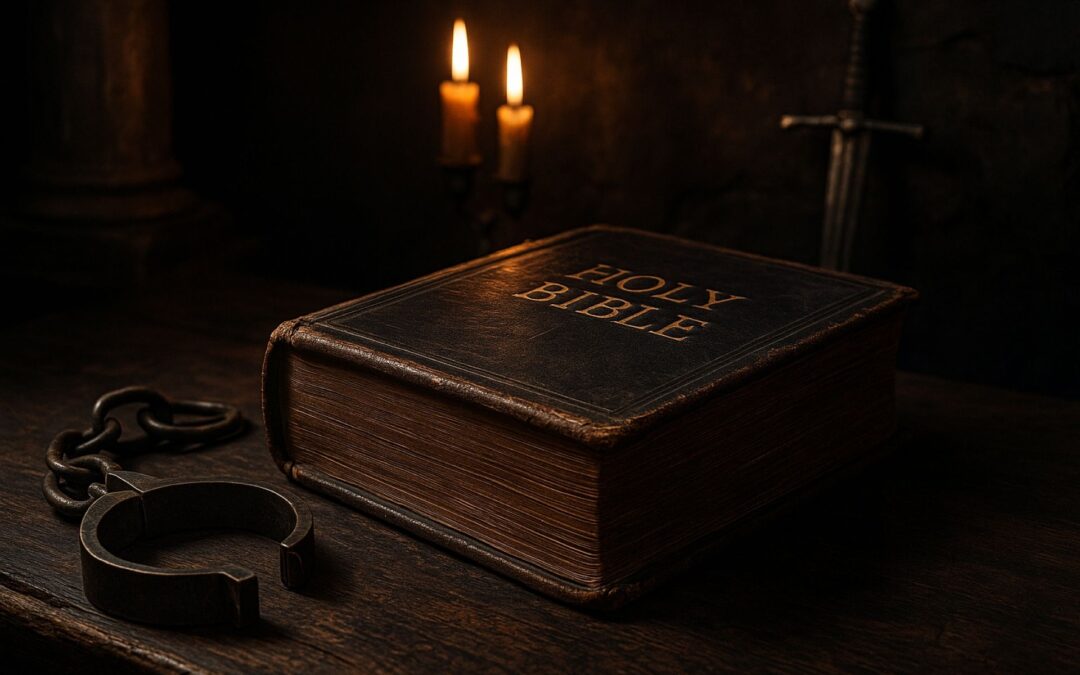
The King James Bible, a cornerstone of Western literature and religious thought, was born in an era rife with tension, danger, and political intrigue. Far from being a simple sacred text, it was a highly charged political instrument, its creation steeped in the power struggles of early 17th-century England. To fully grasp its significance, we must look beyond the poetic verses and into the shadowy backdrop of its origin.
Up until the 1600s, translating the Bible into English was not only frowned upon—it was a perilous act, often punishable by death. The Bible was kept under tight lock and key, preserved in Latin to safeguard clerical authority and restrict laypeople’s access to its contents. In 1604, King James I authorized a new English translation of the Bible, ostensibly to settle religious disputes and unify his kingdom. Yet, this royal decree was as much about consolidating his sovereignty as it was about faith.
By commissioning this translation, King James unwittingly democratized a text that had long been the exclusive province of the clergy and scholars. The King James Version (KJV) became the “people’s Bible,” accessible, resonant, and enormously influential. Since its first publication in 1611, it has sold between five and seven billion copies, making it the most widely distributed book in history. With 66 books, 1,189 chapters, and over 800,000 words, it offers a vast and varied narrative that has shaped language, culture, and thought for centuries.
Regardless of personal belief, the KJV stands as a masterpiece of poetic power. Its cadences and rhythms have permeated the English language, embedding themselves in everyday speech and literary expression. Writers as diverse as John Milton, Herman Melville, J.R.R. Tolkien, Jane Austen, William Blake, Emily Dickinson, Henry Miller, Chinua Achebe, Seamus Heaney, and Toni Morrison have drawn from its rich linguistic well. Even prominent atheists like Richard Dawkins have acknowledged its linguistic prowess. Across the Atlantic, the King James Bible’s influence seeped into the rhetoric of America’s founding fathers, Abraham Lincoln, Martin Luther King Jr., and countless others, leaving an indelible mark on political and cultural discourse.
The Political Climate Behind the Bible’s Translation
The early 17th century was a period defined by deep religious fissures and political power struggles, and the question of Bible translation was at the very heart of these conflicts. When King James I ascended the English throne in 1603, he inherited not only a divided kingdom but a contentious debate over who should control access to Scripture. The Bible was not merely a religious text—it was a political weapon, a symbol of authority, and a tool for shaping public belief and loyalty.
For centuries, the Bible was locked away in Latin, the sacred language of the Catholic Church. This linguistic exclusivity wasn’t accidental; it was a deliberate means of maintaining clerical dominance. The clergy’s monopoly over the Bible ensured they controlled theological interpretation, which in turn reinforced their spiritual and social power. Allowing the common people to read the Bible in their own tongue risked upending this hierarchy. What might happen if laypeople could interpret Scripture independently, unmediated by church officials? Could they challenge existing doctrines? Could the Bible fuel dissent or rebellion?
These fears were real and intense. Translating or even possessing an English Bible was considered a dangerous act bordering on treason. Those caught faced brutal punishments, including death. The church and state operated in tandem to suppress unauthorized translations, effectively controlling religious knowledge as a form of political control.
On the other side of this fierce gatekeeping were scholars, reformers, and the rising Protestant movement, which championed personal faith and direct access to God. They argued that everyone should be able to engage with Scripture in their mother tongue, an idea that undermined centuries of clerical authority. This movement was not just theological but revolutionary, threatening to democratize religion and, by extension, challenge the established social order.
King James I’s decision to authorize a new English translation of the Bible was a masterstroke of political calculation. By commissioning an authoritative Bible, he aimed to quell religious disputes that were fracturing the kingdom. It was intended to standardize worship, consolidate his divine right to rule, and marginalize radical groups like the Puritans and Calvinists who openly questioned his authority. The new translation was a tool to assert both spiritual and temporal supremacy.
Yet, James’s plan carried unintended consequences. By sanctioning an English Bible, he paved the way for the Scriptures to reach a mass audience in a way that had never before been possible. The Bible became accessible not only in churches but in homes, taverns, and marketplaces. It empowered individuals to read, interpret, and debate Scripture for themselves. This democratization of knowledge planted the seeds of intellectual freedom and political change, setting the stage for centuries of religious and cultural transformation.
The Five-Act Drama of the Bible’s Narrative
The King James Bible is far more than a collection of ancient texts; it is a grand narrative woven with intricate themes and diverse literary styles, unfolding like a majestic five-act play that chronicles the relationship between God, humanity, and the world.
Act One: Creation. The story begins with Genesis, which offers a mythic and poetic account of the universe’s birth. Unlike modern scientific explanations, this narrative communicates profound truths about existence through symbolism and metaphor. God speaks the cosmos into being, crafting light, sky, land, sea, and living creatures in a deliberate sequence that reflects divine order and purpose. Humanity is introduced as the pinnacle of creation—beings made uniquely in God’s image, endowed with creativity, rationality, and moral capacity. Yet, this act also sets the stage for humanity’s tragic flaw: separation from God. The idyllic harmony of Eden is fragile, a backdrop for the tension between divine intention and human free will.
Act Two: Israel’s Story. The narrative zooms in on a particular people—Israel—who are called to embody God’s covenantal relationship with the world. From Abraham’s covenant through the Exodus and into the Babylonian exile, this act traces Israel’s journey of faith, obedience, and survival. The stories, initially oral histories, were later codified during exile, a time of profound reflection and theological development. Israel’s role is to be a “light to the nations,” exemplifying justice, mercy, and the knowledge of God. Their history is marked by suffering and perseverance, illustrating how divine presence is most keenly felt amid adversity. The Old Testament’s mosaic of laws, poetry, prophecy, and wisdom literature springs from this crucible, offering ethical frameworks and visionary hope.
Act Three: Jesus Christ. This pivotal act centers on the life and mission of Jesus as portrayed in the four Gospels. Jesus fulfills Israel’s ancient vocation by becoming the living revelation of God—God incarnate walking among humanity. His teachings overturn conventional power structures, emphasizing love, forgiveness, and radical inclusion. The Crucifixion and Resurrection are theological fulcrums, representing atonement and victory over death. Through these events, Jesus inaugurates the “kingdom of God,” a spiritual reign characterized by justice, peace, and reconciliation. This act represents the ultimate divine-human encounter and redefines salvation history.
Act Four: The Early Church. After Jesus’s Ascension, his followers receive the Holy Spirit, transforming them from a small group into a global movement. The church becomes the embodiment of Christ’s presence, tasked with continuing his mission. This act depicts the nascent Christian community navigating challenges, spreading the gospel, and living as a countercultural sign of God’s kingdom. The imagery of the church as the “body of Christ” conveys unity, diversity, and interdependence. The community’s efforts to embody love and justice serve as a visible testimony to the hope inaugurated by Jesus.
Act Five: The Future. The Bible concludes with prophetic visions of the end times, when the current world order will be transformed. Heaven and earth will merge, death and suffering will be no more, and creation will be restored to its original harmony. This eschatological hope is both a promise and a call to faithfulness amid present trials. The vision echoes Eden’s innocence but in a perfected, eternal form. It offers believers assurance that their struggles are part of a divine drama culminating in ultimate restoration and communion with God.
Together, these five acts present a sweeping, multifaceted story that explores existence’s deepest questions—origin, purpose, identity, redemption, community, and destiny. The King James Bible’s narrative power lies in its ability to weave these themes into a coherent, resonant drama that continues to captivate hearts and minds across centuries.
The Long and Tumultuous History of Bible Translation in England
The journey toward an English Bible was long, fraught with danger, and emblematic of the broader struggle for religious and intellectual freedom. Centuries before the King James Bible, early efforts at translation emerged from the shadows, reflecting a desire to bring Scripture closer to the English-speaking populace despite overwhelming opposition.
Around the 13th and 14th centuries, fragments of Scripture began to appear in Anglo-Saxon vernacular. These early translations of the gospels and psalms, though limited in scope, represented a subtle challenge to Latin’s monopoly on sacred texts. But it was in the late 14th century that the movement took a defining leap with John Wycliffe and his followers, often called the Lollards.
Wycliffe’s translation project was groundbreaking. Working from the Latin Vulgate, he sought to produce a complete Bible in English—a radical act in an era when Scripture was almost exclusively the domain of the clergy and scholars. His Bible was painstakingly copied by hand, each manuscript requiring nearly a year of skilled labor. Despite the monumental effort, Wycliffe’s work found eager audiences among the lay population, planting seeds of religious reform and dissent.
However, the ruling church and state saw Wycliffe’s vernacular Bible as an existential threat. Laws were enacted making it a capital offense to translate, possess, or read the Bible in English. The brutal suppression that followed included the execution of many Lollard followers. Wycliffe himself was posthumously condemned; his corpse was exhumed, put on trial, and burned—an extraordinary display of the lengths to which authorities would go to maintain control.
The invention of the printing press in the 15th century changed everything. Gutenberg’s press enabled books to be produced en masse, drastically lowering costs and expanding access. The Bible was among the first texts printed, marking the dawn of a new era.
By 1517, Martin Luther’s Reformation unleashed a theological and cultural earthquake across Europe. Luther championed the idea that Scripture should be accessible to all in their native language, challenging centuries of ecclesiastical control. His Ninety-five Theses, nailed to a church door in Wittenberg, not only criticized church practices but also ignited a movement for religious and intellectual emancipation.
In this ferment, William Tyndale emerged as a seminal figure for English Bible translation. A gifted linguist, Tyndale was fluent in the original biblical languages—Greek, Hebrew, Latin, and Syriac—and combined this erudition with a poetic sensibility rooted in Anglo-Saxon literary traditions. He embarked on the monumental task of translating the Bible into English, aiming to make it accessible “to princes and ploughboys alike.”
Tyndale’s translation was revolutionary—not only linguistically but theologically. He advanced the doctrine of personal faith, arguing that individuals could approach God directly without the mediation of the established church. This was a radical departure from the prevailing ecclesiastical order and was deemed heretical.
Forced to flee England to avoid persecution, Tyndale published his New Testament in English in 1526 on the Continent. His work disseminated Reformation ideas back into England, challenging church authority and igniting popular religious engagement.
Tyndale paid the ultimate price for his conviction. In 1536, he was captured, tried for heresy, and burned at the stake. Yet his legacy was profound. The King James Bible, produced nearly a century later, borrowed extensively from Tyndale’s translations—about 84% of the New Testament and 76% of the Old Testament derive directly from his work. His lyrical phrasing and vocabulary indelibly shaped English religious language, arguably more than any other single figure before or since.
King James I and the Struggle Over Religious Texts
The religious landscape King James I inherited was a battleground not just of doctrines but of competing Bible versions and their political implications. His reign followed a turbulent period during which religion and monarchy were inseparably entangled.
The execution of Mary Queen of Scots by Queen Elizabeth I was a stark reminder of the lethal stakes involved. Mary’s Catholic claim to the English throne posed a serious threat to Elizabeth’s Protestant rule. James himself was Mary’s son, making his accession a delicate balancing act between Protestant and Catholic factions.
Even within Protestantism, tensions simmered. The Church of England, with its episcopal structure, was confronted by Puritans and Calvinists who sought further reforms and challenged the authority of bishops and the crown. These dissenting voices questioned the absolute power of the monarch and the established church hierarchy.
Central to these conflicts were competing Bible versions. The Bishops’ Bible, authorized by the Church of England, was used in official services but was criticized for poor translation quality and lack of accessibility. More popular among ordinary people was the Geneva Bible, produced by Calvinist exiles in Switzerland. This Bible was notable not just for its clarity but for its extensive marginal notes—commentaries that directly challenged royal and episcopal authority by labeling monarchs as tyrants over 400 times. Such politically charged annotations were deeply threatening to James, who sought to maintain strict control over religious and political discourse.
To address these challenges, King James I commissioned a new Bible translation. This was a strategic endeavor aimed at creating a unified, authoritative text that would suppress dissenting versions and reinforce the divine right of kings. The new Bible was designed to be the sole authorized Scripture for use across his realm, effectively eradicating the influence of competing translations and their subversive commentaries.
This commission was both a religious and political project. It symbolized James’s determination to control not only the church but the spiritual lives of his subjects. By dictating the language of faith, James sought to legitimize his rule and silence factions that questioned his sovereignty.
The struggle over Bible translations thus epitomized broader power dynamics. Controlling Scripture meant controlling the narrative of divine authority, governance, and social order. James’s new Bible would become an instrument not only of faith but of political consolidation—though, as history would reveal, its impact extended far beyond his original intentions.
The Monumental Task of Translation
Translating the Bible into English under King James I was a gargantuan scholarly undertaking marked by meticulous collaboration, theological precision, and political sensitivity. Recognizing the immense significance of this project—not just spiritually but as a tool for national unity and royal authority—James assembled an elite team of 54 scholars and clergymen. These men were not only highly educated linguists but also devout theologians, well-versed in Greek, Hebrew, Latin, and Syriac—the original biblical languages.
The translators were organized into six separate committees, stationed at three prestigious centers of learning: Oxford, Cambridge, and Westminster. Each location hosted two groups responsible for different portions of Scripture. This division of labor ensured that no single group could dominate the translation’s direction, promoting checks and balances through scholarly debate.
The process was exhaustive and iterative. Each translator initially produced his own version of assigned passages. These drafts were then rigorously debated within their respective committees, with members challenging word choices, interpretative nuances, and theological implications. Once the committee reached consensus, the agreed-upon text was circulated to the other groups for further scrutiny and comparison, fostering a collaborative dynamic across the scholarly community.
This painstaking back-and-forth spanned several years, reflecting the translators’ commitment to both fidelity and elegance. The goal was not merely a literal word-for-word translation but a majestic and accessible text that balanced doctrinal orthodoxy with poetic beauty. This is why the KJV reads with such rhythm and grandeur—it was designed to be read aloud in churches, where its cadences could inspire awe and reverence.
The first editions were massive folio Bibles intended for church pulpits, signaling their official and authoritative status. However, recognizing the growing demand for personal devotion, smaller, portable editions soon followed, making Scripture more accessible than ever before.
A critical political dimension shaped this translation. The King’s instructions emphasized the defense of monarchy and the suppression of rebellious rhetoric. Notably, the word “tyrant” was excluded from the entire text—a direct response to the politically charged annotations in the popular Geneva Bible that James despised. This censorship underscored how language was wielded to bolster royal authority and quash dissent.
Despite the care taken, the early printings were not without errors. Some notorious misprints entered the public eye, like the “Wicked Bible,” where the Seventh Commandment was mistakenly rendered as “Thou shalt commit adultery,” and the “Murderer’s Bible,” which instructed to “kill” rather than “fill” children. These blunders, while scandalous, did not overshadow the translation’s overall influence and poetic power.
While many readers initially preferred other Bibles—especially the Geneva Bible with its accessible commentary—King James’s mandate that the KJV be the sole authorized version in churches gradually shifted public usage. Over time, the KJV’s stately prose and theological gravitas won widespread acclaim, securing its place as the English Bible for generations.
From Tool of Monarchy to Catalyst of Revolution
The King James Bible’s history took an unexpected and ironic twist: a text commissioned to cement absolute monarchy became a foundational weapon for those advocating republicanism and democracy.
King James’s son, Charles I, inherited his father’s throne but faced mounting opposition from Parliament and radical religious factions. The struggle culminated in the English Civil War (1642–1651), where both Royalists and Parliamentarians wielded biblical language and concepts to justify their causes. The KJV became the scriptural backbone of these fierce ideological battles.
The execution of Charles I in 1649, a dramatic and unprecedented event, was accompanied by biblical rhetoric drawn directly from the KJV. Oliver Cromwell and his supporters invoked Scripture to legitimize their actions, emphasizing themes of divine justice, covenant, and judgment. The monarchy was abolished, and England entered a brief republican phase under Cromwell’s Protectorate.
This upheaval was fueled by rising literacy rates and the Bible’s growing accessibility. Ordinary citizens were no longer passive recipients of royal or clerical interpretation—they engaged with Scripture themselves, interpreting and debating its meanings. The KJV’s availability empowered a wider populace to participate in political discourse, fostering a culture where ideas about governance, rights, and justice flourished.
The revolution in England reverberated across the Atlantic. The Puritan settlers aboard the Mayflower in 1620 carried the King James Bible with them, embedding its linguistic and theological legacy in the fabric of early American society. The Bible became central to the emerging American identity, shaping legal frameworks, social norms, and political rhetoric.
Figures like George Washington took oaths on the KJV, underscoring its symbolic authority. The Great Awakening of the 18th century further amplified the Bible’s role in inspiring calls for liberty, equality, and social reform. Methodist preacher George Whitefield proclaimed that all men are equal before God and that liberty of conscience is a natural right—ideas deeply rooted in Scripture.
The Bible also became a battleground in the contest over slavery. Both abolitionists and defenders of slavery wielded biblical texts to support their claims, leading to fierce debates over interpretation. For enslaved African Americans, the KJV provided spiritual sustenance and hope. Spirituals born from biblical themes expressed their longing for freedom and justice, evolving into the foundation for gospel, soul, jazz, and eventually rock and roll—the cultural voice of America.
Even Abraham Lincoln’s Gettysburg Address, though devoid of direct biblical quotations, echoes the KJV’s cadences and themes, illustrating how deeply its language permeated American political and cultural life.
The Enduring Linguistic Legacy
The King James Bible’s influence on the English language is nothing short of monumental. Its cadences, idioms, and rhythms have seeped into everyday speech so thoroughly that many expressions are now taken for granted, their biblical origins forgotten.
Phrases like “the powers that be,” “by the skin of your teeth,” “the powers of darkness,” “a thorn in the flesh,” and “a law unto themselves” all trace their roots to the KJV’s text. These idioms have enriched English with vivid metaphors and enduring images that continue to shape communication, literature, and thought.
Literary giants have recognized the Bible’s formative role. Alfred Tennyson famously regarded Bible-reading as a fundamental part of education, while Charles Dickens praised the New Testament as a masterpiece of literature, regardless of theological belief.
A striking example of the Bible’s linguistic creativity comes from William Tyndale, whose pioneering work prefigured the KJV. Struggling to find an English equivalent for a Hebrew word meaning “lovely to look at,” Tyndale crafted the word “beautiful” by combining the French “beau” with the Germanic suffix “-ful.” Such inventive coinages illustrate the Bible’s role as a crucible for linguistic innovation.
King James’s political ambition inadvertently gifted the English-speaking world a text that transcended its original purpose. The “people’s Bible” not only democratized religious knowledge but also shaped intellectual freedom and cultural identity.
Its language continues to resonate in sermons, speeches, literature, and everyday conversation, a testament to the enduring power of well-crafted words and ideas. The King James Bible remains a monument to the paradox of power—created to control but ultimately inspiring liberation and creativity across centuries.