
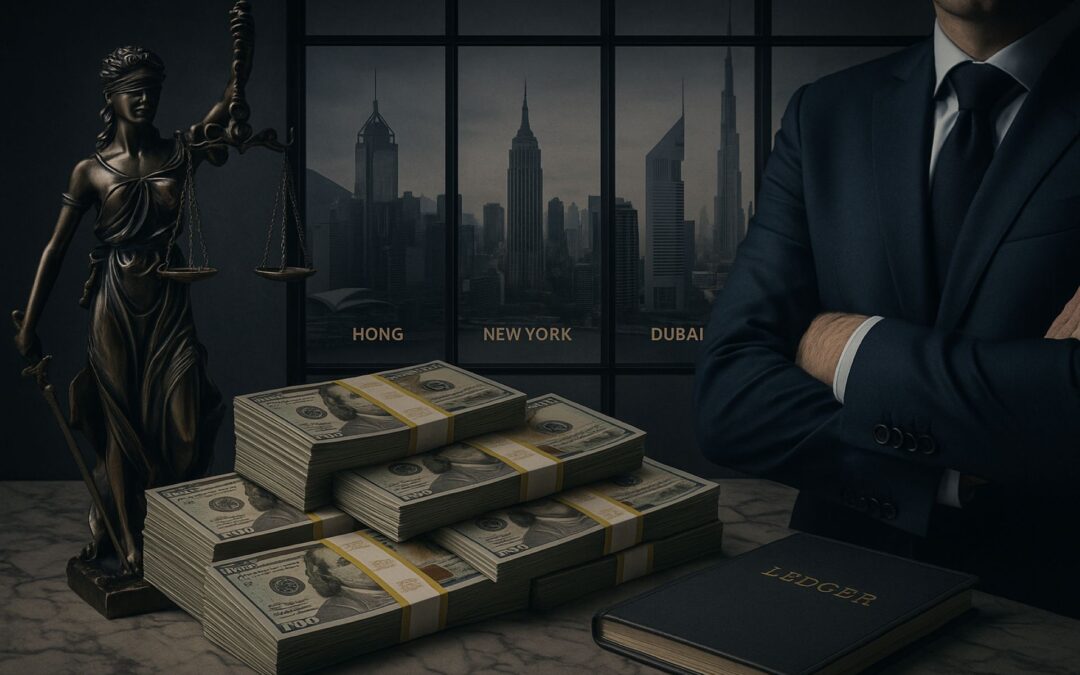
Dirty money doesn’t hide in the shadows anymore—it lounges in penthouses, hangs in art galleries, and sits quietly in trust funds managed by the world’s most prestigious institutions. The modern laundering industry has shed its old clichés of suitcases full of cash and backroom deals, replacing them with legal contracts, corporate structures, and international transfers so complex that even trained investigators struggle to follow the trail.
Behind the glossy facades of global finance, trillions move undetected, aided by jurisdictions that sell secrecy as a premium service. From corporate boardrooms to criminal cartels, every tier of illicit capital has a preferred path and a chosen destination. And the capitals of dirty money are no longer obscure tropical enclaves—they are the beating hearts of the global economy.
The New Face of Laundering
Money laundering today is not a backroom gamble—it’s a boardroom strategy. The imagery of masked men slipping envelopes across café tables has given way to something far more refined and far more dangerous: a meticulously constructed, globally integrated system that launders illicit wealth in plain sight.
The core players are not gangsters in leather jackets but attorneys in tailored suits, bankers with immaculate LinkedIn profiles, and policymakers who shape legislation under the banner of economic growth. Law firms act as architects, constructing intricate networks of shell companies, trusts, and layered ownership structures that stretch across multiple jurisdictions. Each layer adds a new level of opacity, making the money’s true origin nearly impossible to trace without years of forensic investigation.
Banks, meanwhile, act as the circulatory system of this global network. They facilitate rapid-fire transfers through a web of correspondent accounts, shifting millions—or billions—across borders in seconds. Transactions hop from one jurisdiction to another, exploiting differences in financial regulation. By the time the funds arrive at their final destination, their trail has cooled to the point of invisibility.
Cities themselves, often hailed as bastions of law and order, are active participants. They draft corporate registration laws that require little to no public disclosure, they offer tax incentives to attract “investment,” and they guard their legal frameworks with pride. The legitimacy of these cities is their most valuable asset—it reassures the world that the wealth they shelter is clean, even when much of it is not.
What makes this new face of laundering so insidious is the convergence of interests. Lawyers profit from building ever-more complex financial vehicles. Banks profit from transaction fees and asset management contracts. Governments profit from incorporation fees, property taxes, and the secondary economic benefits of high-net-worth inflows. Every layer of the system extracts value from the very process of concealment, making transparency not just undesirable but actively against their financial interests.
The transformation has been so complete that laundering no longer looks like a criminal enterprise. It looks like wealth management. It takes place in skyscrapers with glass facades, at champagne receptions, during private banking consultations in the marble lobbies of five-star hotels. The mechanics of the operation have merged seamlessly with the machinery of legitimate global finance—so much so that for the casual observer, the difference between laundering and investing is almost impossible to spot.
The irony is chilling: the safest place for dirty money today is not an offshore island in the middle of nowhere—it’s the very heart of the world’s most respected economies. In these capitals of commerce, secrecy is not a breach of the system. It is the system.
Four Tiers of Tainted Capital
Dirty money is not a single, monolithic entity. It exists on a spectrum, from meticulously planned corporate deception to the raw, volatile profits of organized crime. Each tier operates with its own methods, its own risks, and its own preferred laundering channels. Understanding this hierarchy is critical to grasping how illicit wealth moves and why certain jurisdictions attract specific kinds of capital.
Level Four: White-Collar Dirty Money
This is the most polished form of financial wrongdoing—committed in conference rooms, not back alleys. It is sophisticated, strategic, and often perfectly legal on paper, despite its corrosive effect on economies. White-collar dirty money is the realm of insider trading, embezzlement, bribery, market manipulation, and the artful dodge of taxes through profit-shifting schemes.
The architects of this tier are corporate executives, financial advisors, and politicians who understand the machinery of global finance down to its smallest cog. They rarely “steal” in a way that would be recognised as theft in criminal court; instead, they manipulate legal frameworks to ensure maximum private gain and minimal tax liability.
A favourite manoeuvre here is intellectual property migration. A multinational might develop software in a high-tax country but transfer ownership of the IP to a subsidiary in a low-tax jurisdiction. When the software is sold, the profits are recorded in the low-tax country, shrinking the original nation’s tax take. This is not a loophole—it’s a highway, paved by decades of deliberate policy-making.
The danger of this tier lies in its legitimacy. White-collar dirty money doesn’t look dirty—it looks like genius-level financial planning. Its operators sit on advisory boards, receive awards for innovation, and fund think tanks that shape public policy in their favour.
Level Three: Commercial Dirty Money
At this level, we see businesses that present themselves as conventional enterprises but whose revenues are significantly boosted—or entirely sourced—from illicit activity. This is the space of overbilled government contracts, fraudulent invoicing, illegal labour exploitation, and illicit resource extraction.
The shell company is a common weapon here. It acts as a phantom supplier or buyer, allowing for inflated invoices or the insertion of fictitious transactions into the books. On paper, it all balances—goods “shipped,” payments “received.” In reality, the transactions are vehicles for moving dirty money into the legitimate economy.
Industries like construction, mining, and fishing are particularly vulnerable. Construction projects are ideal for inflating costs under the guise of “unexpected delays” or “material shortages.” Mining operations in resource-rich countries may extract beyond their licensed quota, laundering the proceeds through legitimate commodity traders.
This tier thrives on the complicity of middlemen—consultants, contractors, and local officials—who benefit from the flow of funds and have no incentive to stop it. For every fraudulent invoice or padded contract, there’s a web of people taking their cut, ensuring silence and continuity.
Level Two: State-Level Corruption
Here, the perpetrators are not evading the state—they are the state. This is kleptocracy in action: heads of government, senior ministers, military leaders, and political elites using their positions to extract wealth from national budgets, public projects, and natural resources.
The sums involved can dwarf those of any other tier. Entire infrastructure budgets vanish into private accounts. Oil revenues are diverted offshore. Sovereign wealth funds, meant to serve generations, are stripped to finance private jets, mega-yachts, and art collections.
Malaysia’s 1MDB scandal exemplifies this level. Over $4.5 billion was allegedly stolen, routed through a network of shell companies, and deployed to buy luxury property, jewellery, and even bankroll Hollywood films. In Russia, oligarchs with Kremlin ties move billions out of the country under the tacit approval of the state, often into London or Swiss banking systems. Nigeria’s oil industry has seen billions siphoned away through inflated contracts and bribes, leaving infrastructure starved despite the country’s resource wealth.
The protective shield here is immense. Legal systems are often controlled or influenced by the same individuals committing the crimes. International efforts to recover stolen assets are met with stonewalling, diplomatic immunity claims, or protracted legal battles designed to exhaust investigators.
Level One: Organized Crime
This is the most visceral and hazardous form of dirty money. It originates directly from illegal activities: narcotics trafficking, arms smuggling, human trafficking, illegal gambling, extortion. The capital is often physical cash—bulky, risky, and in urgent need of integration into the formal economy.
Laundering at this level is a race against time. Criminal syndicates use front businesses, cash-intensive operations, and trade-based laundering to disguise the source. A shipment of goods may be deliberately mispriced to move value across borders. Cash might be broken into smaller deposits to avoid reporting thresholds—a method known as “smurfing.”
Organised crime’s global reach allows for complex multi-country laundering chains. A drug cartel in Mexico may smuggle cash into the US, convert it into gold or luxury vehicles, export those assets to a third country, and sell them for clean currency. Chinese triads might launder wildlife smuggling profits through Macau casinos, then route them into real estate in Vancouver.
Unlike the higher tiers, which often seek long-term wealth preservation, organised crime’s priority is rapid conversion. Liquidity trumps legacy. The faster the dirty cash becomes spendable, the better.
The Modern Havens for Hidden Wealth
The popular imagination still clings to the cliché of shadowy Caribbean islands as the end point for illicit fortunes. Sun-bleached beaches, discreet banking laws, and numbered accounts—these are the postcard images of a tax haven. But in today’s world, the true capitals of financial secrecy are not fringe outposts; they are the economic heavyweights of the global stage.
According to the 2025 Financial Secrecy Index, the United States now holds the crown as the most secretive jurisdiction in the world. This is not an accident—it’s the result of decades of regulatory choices that favour corporate anonymity and asset protection over transparency. While US politicians often rail against offshore secrecy in foreign jurisdictions, their own legal systems offer one of the most efficient and opaque frameworks for hiding ownership and shielding wealth from scrutiny.
Close on its heels are Singapore and Hong Kong. Both are celebrated as global business hubs, ranked highly for their efficiency, stability, and rule of law. Their airports hum with the flow of international trade, their skylines are symbols of modern prosperity, and their financial systems are among the most advanced in the world. Yet beneath this legitimacy lies the machinery of concealment: corporate registries with minimal disclosure requirements, trusts that obscure beneficial ownership, and legal protections that make it extraordinarily difficult for foreign authorities to pierce the veil.
What sets these modern havens apart is their ability to launder not only illicit funds but also reputations. A company or individual can operate in a jurisdiction renowned for compliance and stability, creating the appearance of propriety while enjoying the same secrecy benefits once associated with obscure island nations. The jurisdictions’ prestige acts as a shield; few people suspect wrongdoing when the address on the letterhead is Manhattan, Marina Bay, or Central.
They cater to multiple levels of dirty money. White-collar capital finds in them a sophisticated tax planning ecosystem. Commercial-level funds enjoy the ability to integrate into legitimate supply chains. State-level corruption thrives under the protection of strong property rights and diplomatic tact. Together, these havens have turned secrecy into a premium product—sold not as a shady workaround, but as a hallmark of “financial sophistication.”
From Paradise to Metropolis
The 2016 Panama Papers leak was a watershed moment in the global understanding of hidden wealth. The leak of 11.5 million documents from Mossack Fonseca, a Panamanian law firm, revealed a sprawling web of shell companies, trusts, and nominee directors used by the global elite to shield assets from taxation, creditors, and public scrutiny. But the most striking revelation was not the breadth of the offshore network—it was the location of the money’s final resting place.
Panama, as it turned out, was merely the first stop. The real parking lots for hidden wealth were in the beating hearts of the global financial system: London, New York, Zurich, Geneva. The offshore entities acted as feeder channels, directing funds into high-value assets in these metropolitan hubs—luxury real estate, blue-chip stocks, private equity, and art collections.
The mechanism is deceptively simple. A shell company is incorporated in a jurisdiction like the British Virgin Islands. That company opens a bank account or purchases property in a major financial centre. Because the legal owner is the shell company, the true beneficiary remains hidden. The asset itself—be it a penthouse in Manhattan or a townhouse in Kensington—now wears a veneer of legitimacy, even if its purchase was funded by embezzled state resources or profits from illicit trade.
Multinational corporations use a similar playbook, though their methods are couched in the language of tax efficiency. Profit-shifting strategies allow them to record revenue in jurisdictions with minimal tax obligations, regardless of where the actual economic activity occurs. Before its 2020 restructuring, Facebook channelled most of its international advertising revenue through Ireland, benefiting from a corporate tax rate of just 12.5%. Apple, Alphabet, and Microsoft have all employed variations of this tactic, using complex corporate structures to minimise their global tax liabilities.
The scale is staggering. The OECD estimates that as much as $11.3 trillion is hidden in offshore arrangements, spread across over 80 million trusts, shell companies, and nominee structures. This is not idle wealth—it is capital that actively seeks returns, often reinvested into legitimate markets that welcome the inflow without questioning the source.
What makes metropolitan havens so powerful is the paradox they embody. No one blinks at billions flowing through Wall Street or the City of London. The presence of regulation, prestigious institutions, and public oversight creates an illusion of cleanliness. Yet the very systems that make these cities global economic powerhouses also make them the ultimate laundromats—capable of absorbing, legitimising, and protecting dirty money with unparalleled efficiency.
The American Conduits: Delaware, Wyoming, Nevada
These states are not just administrative conveniences—they are industrial-grade anonymity factories, engineered to process corporate registrations at speed and in silence. In Delaware alone, over 2.2 million business entities are registered in a state with fewer than one million residents. This is not a statistical quirk; it is the result of a deliberate business model. Incorporation fees and franchise taxes from these entities contribute roughly a third of Delaware’s entire state budget, making secrecy itself a key export.
Wyoming, once better known for cattle and national parks, has quietly outpaced Delaware in LLCs per capita. Its pitch is simple: the same veil of anonymity, but with lower fees and minimal bureaucratic friction. In Nevada, the offering is similar—rapid company formation, few questions asked, and a business-friendly court system that is loath to pierce corporate structures.
The toolkit these states provide is almost custom-built for laundering. First, incorporation can be completed online in less than 24 hours, often through agents who act as nominee directors or managers. This allows the true owner to remain invisible not only to the public but often to the state itself. Second, there is no public registry of beneficial owners. Even law enforcement agencies from other states or countries face hurdles in accessing ownership information without lengthy court proceedings.
Third, the legal systems in these states are fiercely protective of corporate privacy. Foreign subpoenas are met with resistance, and judges are often sympathetic to arguments about protecting “legitimate business interests” against intrusive investigations. Fourth, the jurisdictions offer easy pathways to convert liquid funds into prestige assets—prime real estate, luxury yachts, fine art—without the buyer’s identity ever becoming public record. Finally, the professional ecosystem in these states—lawyers, accountants, corporate service providers—specialises in creating layered, multi-jurisdictional structures that frustrate even the most determined investigators.
These states are what industry researchers call “conduit jurisdictions.” They rarely act as the long-term storage vaults for illicit wealth. Instead, they are the processing plants—entities are formed here, funds are routed through them, and then the money moves on to its final resting place in a more prestigious, asset-rich location. In this role, they are indispensable to the modern laundering chain.
London: The Crown Jewel of Concealment
London’s role in the global dirty money economy is not accidental—it is a legacy of empire, financial dominance, and a deliberately cultivated reputation as a safe, prestigious place to park capital. The city is the beating heart of a network of secrecy jurisdictions that includes the British Virgin Islands, Cayman Islands, Jersey, and Guernsey. These territories provide the anonymous shell companies; London provides the legitimacy and the assets.
In practical terms, this means a company registered in the British Virgin Islands can purchase a penthouse in Knightsbridge, bid for government contracts, or acquire a stake in a British business without ever revealing the identity of the ultimate owner. On paper, the buyer is simply “XYZ Holdings Ltd.” In reality, the money might trace back to a kleptocrat, an oligarch, or a corporate fraudster.
The scale is extraordinary. Since 2016, over £11 billion in suspicious funds have flowed into UK real estate, with more than half channelled through companies in British overseas territories. The British Virgin Islands alone accounted for roughly 90% of these transactions.
The UK government introduced the Register of Overseas Entities in 2022 to address this, requiring foreign companies owning UK property to disclose their beneficial owners. But the reform has been largely toothless. A review by the London School of Economics found that over 70% of properties held through offshore structures still list no public beneficial owner. In more than a third of those cases, even law enforcement cannot access the true ownership data.
Neighbourhoods like Mayfair, Knightsbridge, and Belgravia bear visible signs of this capital influx—rows of multi-million-pound properties sitting dark, unoccupied for most of the year. These are not homes; they are vaults. Their value lies not in rental income or appreciation alone, but in their ability to store wealth behind an impenetrable wall of corporate anonymity.
London’s power as a laundering hub is amplified by its financial services sector. Major banks, law firms, and property agents have long catered to international clients with “complex needs,” a euphemism for structures designed to obscure origins. While regulators occasionally levy fines, the profits from these arrangements far outweigh the penalties, ensuring the cycle continues.
In London, secrecy is not an aberration—it is a service offering, embedded in the city’s financial DNA. Its prestige makes it the perfect camouflage, transforming even the most suspicious funds into assets that appear unassailably legitimate.
Dubai: The Desert Laundromat
Dubai has mastered the art of turning opacity into a selling point. In a matter of decades, it has transformed from a modest Gulf trading port into one of the most efficient, discreet, and luxurious money-cleaning hubs on earth. Its skyline of futuristic towers is more than an architectural statement—it’s a catalogue of wealth storage units, each capable of absorbing millions in capital without drawing the faintest whiff of suspicion.
The city’s free zones are its secret weapon. These designated areas allow businesses to be established within days, often without requiring the owner to be physically present. The registration process is streamlined to an extreme—minimal paperwork, no public beneficial ownership registry, and negligible due diligence. The result is a conveyor belt of shell companies that can transact internationally while revealing virtually nothing about who controls them.
Gold, in particular, plays a starring role in Dubai’s laundering economy. The emirate is one of the world’s largest hubs for physical gold trading, much of it arriving from regions where mining is linked to conflict, smuggling, or environmental destruction. Once in Dubai, the gold is melted down, recast, and stamped with new documentation. This rebranding instantly transforms suspect bullion into a legitimate commodity, ready for sale anywhere in the world.
The United Arab Emirates’ Golden Visa programme, launched in 2020, has turbocharged these dynamics. It offers long-term residency to high-net-worth individuals who invest significant sums—often in real estate. Since its inception, more than 80,000 wealthy foreigners have secured residency, bringing vast portable fortunes into Dubai’s property market. In Q1 2024 alone, 105 property transactions exceeded $10 million, outpacing even New York and Palm Beach combined.
The property boom has been staggering. Prime villa prices have surged by 147% in just five years, fuelled by a mix of legitimate investment, speculative buying, and laundering capital. Developers, brokers, law firms, and banks all take their slice of the pie, creating a local economy that thrives on the constant influx of opaque wealth.
Even international scrutiny has failed to slow the tide. In 2025, the Financial Action Task Force removed the UAE from its “grey list” of jurisdictions with strategic deficiencies in countering money laundering. The European Union disagreed, keeping the UAE flagged as high-risk due to transparency gaps. Yet the capital kept coming, the cranes kept building, and Dubai’s reputation as the Middle East’s premier financial laundromat only deepened.
State-Level Laundering: Prestige as Camouflage
When the money in question is siphoned directly from public coffers or natural resource revenues, its laundering requires more than just secrecy—it demands prestige. The perpetrators at this level are heads of state, cabinet ministers, military chiefs, and their inner circles. For them, it is not enough to hide the money; they must also rehabilitate it in the eyes of the world.
London, New York, and Zurich are the vaults of choice for this echelon. Their reputations as global financial centres act as a disinfectant, stripping away the taint of corruption simply through association. Real estate, fine art, and luxury goods become not just investments but social camouflage.
The 1MDB scandal in Malaysia illustrates the playbook. Billions diverted from a sovereign development fund were channelled into luxury apartments in New York, contemporary art in Switzerland, and even the production of The Wolf of Wall Street. This was laundering with a PR strategy—turning stolen national wealth into cultural capital and social access.
The extravagance was almost theatrical. Malaysian financier Jho Low, one of the scandal’s central figures, gifted a $1.3 million diamond necklace to model Miranda Kerr, $8 million in jewellery to Kim Kardashian, and a $3.2 million Picasso to Leonardo DiCaprio. Each purchase was both a personal indulgence and a laundering step—transforming liquid cash of questionable origin into tangible, prestigious, and ostensibly legitimate assets.
Russian oligarchs have perfected similar tactics. Many hold multimillion-pound homes in London’s Mayfair and Kensington—never in their own names, but through layers of shell companies registered in British Overseas Territories. The ownership trail dead-ends in jurisdictions with no public registry, making it all but impossible for investigators to connect the asset to the individual.
Nigeria’s oil sector has provided another steady stream of state-level dirty money. Revenues meant for public development have been siphoned into private accounts, with proceeds funnelled into global property markets. Major British banks—including HSBC, Standard Chartered, and NatWest—have been implicated in processing vast sums linked to these transactions, often without performing adequate due diligence.
The crucial feature of state-level laundering is that the perpetrators operate with a shield few others possess: political immunity, diplomatic influence, and control over domestic enforcement agencies. Even when international investigators get close, extradition battles, jurisdictional disputes, and procedural delays can drag on for years. In the meantime, the assets sit comfortably in some of the most admired cities in the world, appreciating in value while their origins fade from public memory.
Organized Crime’s Quick Cleaners
For organised crime networks, time is the enemy and liquidity is survival. Unlike white-collar fraudsters or corrupt heads of state—who can afford to let money sit, season, and grow—drug cartels, smuggling rings, and trafficking syndicates operate in an environment where holding onto large amounts of physical cash is both risky and logistically cumbersome. Cash piles not only invite theft and betrayal from within, but they also draw the attention of law enforcement, rival gangs, and even the very politicians who may be on the payroll.
The laundering process at this tier is designed for speed. The objective is to move currency from high-risk, high-visibility environments into legitimate-looking systems within days, sometimes hours. The methods are aggressive and pragmatic.
One common tool is trade-based money laundering, particularly through misinvoicing. A shipment of goods might be deliberately undervalued or overvalued on its paperwork to move equivalent amounts of cash covertly across borders. For example, a container full of cheap scrap metal could be invoiced as high-grade copper, with the “overpayment” representing laundered funds.
Gold remains another favourite—compact, easily transported, and universally valuable. Smuggled gold can be melted down, recast, and sold into legitimate markets with falsified certificates of origin. Dubai, the Cayman Islands, and the British Virgin Islands are prime entry points for this transformation process, offering minimal scrutiny for incoming commodities.
Front businesses play an equally important role. Bars, casinos, strip clubs, and small retail outlets act as cash-intensive covers where illicit funds can be mixed with legitimate earnings. “Smurfing”—the practice of breaking large sums into smaller deposits below reporting thresholds—is still widely used, especially in countries with less advanced banking oversight.
The jurisdictions that dominate this tier—Panama, the Caymans, the BVIs, and increasingly Dubai—are specialists in rapid integration. They don’t necessarily store the funds long term. Instead, they act like international transit hubs, washing the money just enough to send it onward to a more secure, more prestigious final destination. The guiding principle here is simple: get the money out of immediate danger and into circulation before anyone has the chance to freeze or seize it.
Secrecy as Strategy
Hiding money is not just about evading law enforcement—it’s about shaping the battlefield in one’s favour. For the ultra-wealthy, secrecy is an offensive tactic as much as a defensive one. By cloaking their true resources, they gain an asymmetric advantage in negotiations, acquisitions, and political influence.
Consider a private equity firm preparing to acquire a distressed company. If competitors know the firm has $500 million in liquid reserves, the price of the target will inevitably inflate. But if those funds are concealed inside a Liechtenstein foundation or a web of anonymous trusts, the firm appears cash-light and can make a lower bid. Only after securing the asset is the true scale of their war chest revealed. This is not merely secrecy—it’s deliberate misdirection to gain leverage.
Secrecy also allows wealthy individuals and corporations to operate across political fault lines without consequence. Assets can be held in neutral jurisdictions under anonymous structures, ensuring that even if geopolitical tensions flare, opponents cannot easily target their holdings. For oligarchs, political elites, and major corporations, this invisibility acts as both a shield and a sword: untouchable in times of conflict, yet able to strike with capital when opportunities arise.
When a city becomes a laundering hub, the benefits for the wealthy multiply. The capital they bring in doesn’t just sit in private accounts—it gets reinvested into local infrastructure, public debt instruments, and luxury developments. In return, governments develop a quiet dependency on these flows. The arrangement is symbiotic: the city gains economic activity and inflated asset markets, while the wealthy gain a jurisdiction with no incentive to pry into their affairs.
For ordinary citizens, the effects are corrosive. Housing markets become distorted as property is treated less like shelter and more like a vault. Public budgets shrink under the weight of tax avoidance, even as infrastructure demands grow. Legitimate businesses find themselves unable to compete with rivals backed by invisible, unregulated capital.
The ultimate truth is that the people being kept in the dark are not regulators or political insiders—they are the public. Journalists, watchdogs, and ordinary citizens are the ones denied the knowledge of who owns what, who controls which assets, and where national wealth is really flowing. This engineered ignorance is not an accident; it is the very foundation of the system. By keeping half the chessboard hidden, the players at the top ensure they will always be one move ahead.
Conclusion
The capitals of dirty money are not accidents of geography—they are products of design. Laws are written to invite anonymous ownership, financial services are tailored to protect it, and political will to change the system is deliberately anaesthetised by the profits it generates.
For those who use them, secrecy is more than a shield against justice—it is a tool for power, a lever to tilt markets, win deals, and outmanoeuvre rivals. For everyone else, the costs are steep: unaffordable housing, shrinking public budgets, and a playing field tilted beyond recognition.
These cities and states have become the world’s most sophisticated laundromats, hiding illicit wealth in plain sight while the public is told nothing at all. The question is not whether the system can be dismantled—it’s whether anyone in power is willing to lose by shutting it down