
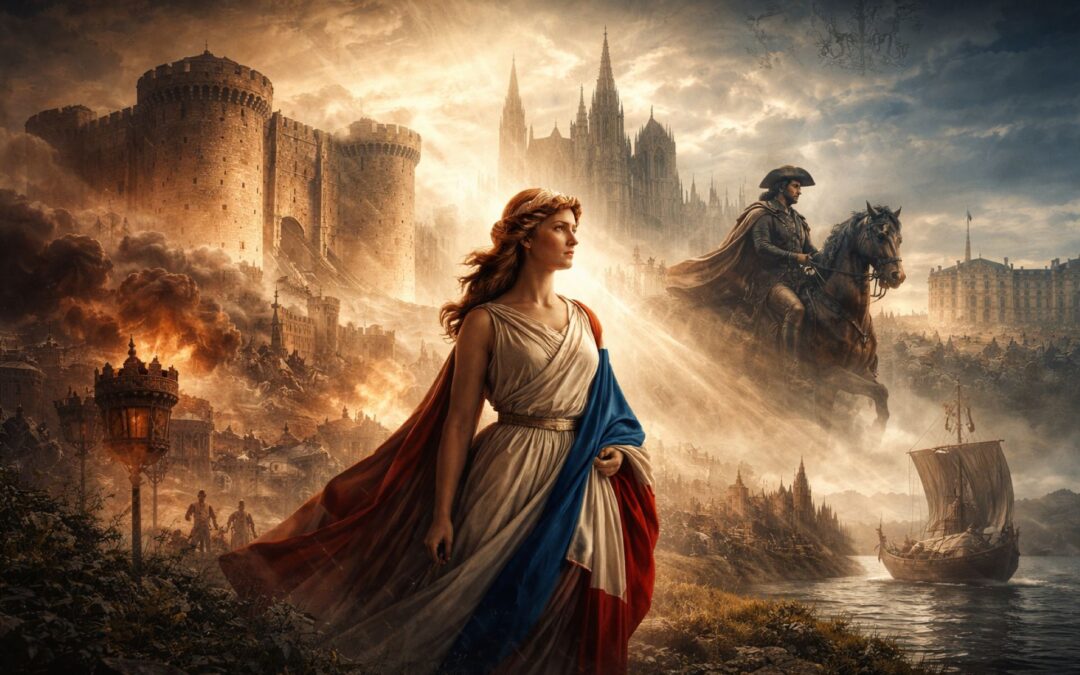
Introduction: A Nation Forged By War, Faith, And Revolution
For tens of thousands of years, humans have lived in the lands that would one day become France. From prehistoric cave painters to medieval kings, from revolutionaries storming prisons to presidents shaping European unity, France’s story is one of constant reinvention. Few nations have been so repeatedly dismantled and rebuilt—politically, socially, and culturally—while maintaining such a powerful and continuous identity.
The history of France is not simply a sequence of rulers and wars. It is the story of how a patchwork of tribes became a Roman province, how a Germanic kingdom forged a medieval monarchy, how that monarchy evolved into the most powerful state in Europe, and how it ultimately collapsed under the weight of its own contradictions. Out of revolution came republic. Out of empire came democracy. Out of defeat came renewal.
Across two millennia, certain themes appear again and again: centralization of power, struggles between faiths, rivalry with neighboring powers, expansion abroad, and moments of explosive internal transformation. France has been a kingdom, an empire, and a republic—sometimes all within a single century.
To understand modern France—its politics, culture, and global influence—we must trace this long arc of upheaval and consolidation. It is a story that begins long before the word “France” existed at all.
Before France: Prehistoric And Celtic Foundations
Long before there was a kingdom, a language, or even a concept of France, the land was already inhabited by human communities. Some of the earliest evidence of human presence in Western Europe comes from this region. Most striking are the Paleolithic cave paintings at Lascaux, created between roughly 15,000 and 20,000 BC. These vivid depictions of animals—horses, deer, bulls—reveal not only artistic sophistication but also complex symbolic thought. The story of France begins not with kings, but with artists.
By around 1200 BC, during the Iron Age, much of the territory was inhabited by Celtic peoples associated with the Hallstatt and later La Tène cultures. These communities were not a unified nation but a mosaic of tribes sharing related languages, religious beliefs, and social structures. They built fortified settlements, engaged in metalworking, and developed long-distance trade networks that stretched across Western Europe.
In the southwest lived the Aquitanians, whose language was related to modern Basque and distinct from the Celtic tongues spoken elsewhere. Together, these diverse groups laid the foundations for some of the region’s earliest urban centers, including Lutetia (modern Paris), Burdigala (Bordeaux), and Tolosa (Toulouse).
Contact with the wider Mediterranean world accelerated change. Around 600 BC, Greek settlers founded the colony of Massalia—modern Marseille—on the southern coast. Through trade with Greek and later Roman merchants, the peoples of Gaul became increasingly connected to broader economic and cultural networks. Wine, pottery, metal goods, and ideas flowed inland.
By the 2nd and 1st centuries BC, the region known to the Romans as Gaul was prosperous, interconnected, and strategically significant. It was no longer an isolated frontier. It was a land poised for conquest—and transformation.
Rome And The Making Of Gaul
In the 1st century BC, the expanding Roman Republic turned its attention northward. What the Romans called Gallia was a vast territory of tribes and shifting alliances—but to Rome, it represented both opportunity and threat. The decisive transformation began in 58 BC, when Julius Caesar launched a series of campaigns later known as the Gallic Wars.
Over eight brutal years, Caesar systematically defeated the Gallic tribes. The turning point came in 52 BC at the Battle of Alesia, where the Gallic chieftain Vercingetorix was captured after a desperate siege. With his surrender, organized resistance collapsed. Gaul was annexed into the Roman state.
Roman rule reshaped the region profoundly. New cities such as Lugdunum (Lyon) and Narbo (Narbonne) were constructed with forums, amphitheaters, baths, and aqueducts. Roads stitched Gaul into the imperial network, linking it to Italy, Spain, and beyond. Trade flourished. Urban life expanded. Latin replaced Celtic languages in administration and gradually in daily speech.
Over time, a distinctive Gallo-Roman society emerged. Local elites adopted Roman customs and governance while retaining aspects of indigenous culture. Most transformative of all was the spread of Christianity, which began to take root in the later centuries of Roman rule and would outlast the empire itself.
Yet Roman authority was not eternal. By the 4th and 5th centuries AD, the Western Roman Empire was weakening under internal instability and external pressures. Germanic tribes crossed the Rhine, some raiding, others settling permanently. Visigoths, Burgundians, and other groups carved out kingdoms within former Roman territory.
When imperial control finally disintegrated in the early 5th century, Gaul did not descend into total chaos—but it did enter a new era. Roman political unity had collapsed. In its place, new powers were rising. Among them, one group would shape the future more decisively than any other: the Franks.
The Franks And The Birth Of A Kingdom
As Roman authority faded in the 5th century, Gaul became a patchwork of competing kingdoms. Among the various Germanic groups that settled in the region, the Franks—originating from across the Rhine—would prove the most consequential.
Their rise began under the leadership of Clovis I, who came to power in the late 5th century. Through a combination of military conquest and political calculation, Clovis defeated rival Frankish leaders and subdued neighboring territories, uniting much of northern Gaul under his rule. His most significant decision, however, was religious rather than military. Around 496 AD, Clovis converted to Christianity.
Unlike many other Germanic rulers who had adopted Arian Christianity, Clovis embraced Roman Catholicism. This aligned him with the powerful Gallo-Roman clergy and the majority of the local population. His conversion strengthened his legitimacy and helped fuse Frankish rule with Roman traditions, laying the cultural and religious foundations of what would eventually become France.
Clovis established the Merovingian dynasty, which ruled for nearly two centuries. Yet after his death in 511, his kingdom was divided among his sons, following Frankish custom. This pattern of fragmentation repeated itself across generations. While the Merovingian kings retained symbolic authority, real power increasingly shifted to high-ranking officials known as the Mayors of the Palace.
These administrators managed finances, military affairs, and governance. Over time, they became the true power brokers of the realm. One such figure, Charles Martel, would elevate his family from behind-the-scenes managers to rulers in their own right.
The era of the Merovingians was one of consolidation but also instability. Political unity was fragile, and regional identities remained strong. Yet beneath the fragmentation, something enduring was taking shape: a Christian kingdom rooted in both Roman heritage and Frankish strength. From this fusion would emerge a new imperial ambition—one that sought not merely to rule Gaul, but to revive Rome itself.
The Carolingian Empire And The Medieval Order
The shift from Merovingian figureheads to true centralized authority culminated in the rise of the Carolingian family. The transformation began with Charles Martel, the powerful Mayor of the Palace who secured his legacy in 732 by defeating an invading Muslim force from Iberia at the Battle of Tours. Though the scale and long-term significance of the battle are debated, it strengthened his family’s prestige and reinforced their dominance within the Frankish realm.
His son, Pepin the Short, took the decisive step. In 751, with papal approval, he deposed the last Merovingian king and crowned himself ruler, inaugurating the Carolingian dynasty. This alliance between Frankish monarchy and the papacy would define medieval European politics for centuries.
The dynasty reached its height under Pepin’s son, Charlemagne. Crowned King of the Franks in 768, Charlemagne embarked on an ambitious campaign of expansion, conquering territories across modern-day Germany, Italy, and beyond. On Christmas Day in the year 800, he was crowned Emperor of the Romans by Pope Leo III in Rome—symbolically reviving the Western Roman Empire.
Charlemagne’s empire was vast and culturally transformative. He promoted administrative reform, standardized laws, encouraged learning, and fostered what is often called the Carolingian Renaissance. Monasteries and scriptoria preserved classical texts, while education and governance became more systematized.
Yet the empire’s unity was fragile. After Charlemagne’s death in 814, internal divisions resurfaced. In 843, the Treaty of Verdun split the empire among his grandsons. The western portion—West Francia—would evolve into the core of modern France.
From this fragmentation emerged the political landscape of medieval France: a kingdom where royal authority existed, but power was often dispersed among powerful local lords. The medieval order—defined by feudal bonds, land-based wealth, and layered loyalties—had taken shape.
And new external pressures were already testing its resilience.
Vikings, Capetians, And The Rise Of Royal Power
During the 9th century, West Francia faced a new and formidable threat: Viking raiders from Scandinavia. Sailing along rivers such as the Seine and Loire, they attacked monasteries, towns, and even Paris itself. The sack of Paris in 845 exposed the kingdom’s vulnerability and the limits of royal power.
Rather than fight endless battles, the Frankish crown adopted a pragmatic solution. In 911, King Charles the Simple granted land along the lower Seine to the Viking leader Rollo in exchange for loyalty and defense against further raids. This territory became known as Normandy—“the land of the Northmen.” Over time, its Norse settlers adopted the French language, Christianity, and local customs, integrating into the political fabric of the kingdom.
Meanwhile, internal political transformation was underway. The Carolingian line gradually weakened, and by 987 it had died out. In its place, the leading nobles elected Hugh Capet, Count of Paris, as king. His accession marked the beginning of the Capetian dynasty, which would rule in various forms for centuries.
At first, Capetian authority was modest. The king directly controlled only a small region around Paris—the Île-de-France—while powerful dukes and counts governed vast territories almost independently. Yet unlike previous dynasties, the Capetians maintained an unbroken line of succession by carefully ensuring their heirs were crowned during their lifetimes. Stability gradually replaced fragmentation.
Over the following centuries, Capetian rulers expanded royal authority step by step. Through strategic marriages, legal reforms, military campaigns, and the assertion of feudal rights, they steadily brought rebellious nobles and semi-independent regions under tighter control. Royal justice expanded. Administrative systems strengthened. The monarchy began its long transformation into a centralized state.
By the dawn of the High Middle Ages, France was no longer merely a successor to the Frankish kingdoms—it was becoming a more unified and self-conscious realm. Yet external entanglements, particularly with England, would soon test that unity in dramatic fashion.
England, Empire, And The Hundred Years’ War
In 1066, the political relationship between France and England changed permanently. William the Conqueror, Duke of Normandy and a vassal of the French king, invaded England and claimed its throne. The result was a cross-Channel aristocracy: English kings who held vast territories in France while technically owing loyalty to the French crown.
Over the next two centuries, this arrangement created constant tension. The English Plantagenet dynasty controlled enormous swathes of western France, including Normandy and Aquitaine. Although legally subordinate to the French king, these lands were effectively independent. For the Capetian monarchy, consolidating power meant reclaiming these territories.
By the early 13th century, French kings had successfully seized much of the English-held land. Yet rivalry persisted, and in 1337 a dynastic dispute triggered what would become known as the Hundred Years’ War. When the last direct Capetian king died without a male heir, competing claims emerged from the French House of Valois and the English Plantagenet line.
The early phase of the conflict was disastrous for France. English forces won decisive victories at Crécy (1346) and Poitiers (1356), where the French king John II was captured. The kingdom was further devastated by the Black Death in 1348, which may have killed nearly half the population. War, famine, and plague combined to bring France to the brink of collapse.
The crisis deepened in 1415 when Henry V defeated a French army at the Battle of Agincourt. A treaty in 1420 recognized him as heir to the French throne. It appeared that France might be absorbed into an Anglo-French monarchy.
Then, in 1429, an unexpected figure altered the course of history. Joan of Arc, a young peasant claiming divine guidance, inspired French forces to lift the siege of Orléans and escort the Dauphin to Reims for his coronation as Charles VII. Though she was later captured and executed in 1431, her actions galvanized national resistance.
By 1453, the war ended with the expulsion of English forces from nearly all French territory. The long struggle had been catastrophic—but transformative. The French monarchy emerged stronger and more centralized than before. A sense of national identity, forged in resistance to foreign rule, began to take deeper root.
Out of devastation came consolidation. The medieval kingdom had survived its greatest trial. In the centuries ahead, it would seek not only to defend its borders—but to project its power far beyond them.
Renaissance, Religion, And Civil War
The end of the Hundred Years’ War ushered France into a period of renewal. By the early 16th century, it had become one of Europe’s most populous and powerful kingdoms. French kings turned their attention outward, particularly toward Italy, where a series of conflicts known as the Italian Wars (1494–1559) drew France into prolonged rivalry with the Habsburgs of Spain and the Holy Roman Empire.
Though these wars brought limited territorial gains, they exposed France to the flourishing culture of the Italian Renaissance. Under Francis I of France, the monarchy became a patron of the arts and learning. He invited artists such as Leonardo da Vinci to his court and transformed royal residences like Fontainebleau into centers of artistic innovation. Humanism, architecture, and new intellectual currents reshaped elite culture.
At the same time, French explorers such as Jacques Cartier ventured across the Atlantic, laying early foundations for what would become a French colonial presence in North America. France was emerging as both a cultural and global power.
Yet beneath this outward expansion, internal tensions were mounting. The Protestant Reformation, which began in Germany in 1517, soon spread into France. Inspired in part by the teachings of John Calvin, a significant minority of French Protestants—known as Huguenots—challenged the religious unity of the Catholic kingdom.
What followed was a series of brutal conflicts known as the French Wars of Religion (1562–1598). Political rivalry between noble factions merged with sectarian hatred, plunging the country into intermittent civil war. One of the most infamous episodes was the St. Bartholomew’s Day Massacre in 1572, when thousands of Huguenots were killed in Paris and across the provinces.
Stability was finally restored under Henry IV of France. Originally a Protestant leader, Henry converted to Catholicism—famously declaring that “Paris is worth a Mass”—to secure the throne. In 1598, he issued the Edict of Nantes, granting limited religious toleration to Protestants and ending decades of bloodshed.
Henry IV’s reign marked a turning point. He repaired finances, encouraged agriculture and trade, and restored order to a fractured kingdom. France had survived civil war—but the experience left a lasting imprint. The monarchy would increasingly seek not just authority, but absolute control, to prevent such chaos from recurring.
That drive toward centralized power would define the next great chapter of French history.
Absolute Monarchy And The Age Of Louis XIV
The push toward centralized authority intensified in the 17th century. Under Louis XIII, real power was exercised by his chief minister, Cardinal Richelieu. Richelieu systematically weakened the political independence of the nobility, curtailed Protestant military power, and strengthened the administrative machinery of the state. His reforms laid the groundwork for an increasingly centralized monarchy.
This concentration of authority provoked resistance. During the minority of Louis XIV, a series of noble uprisings known as the Fronde (1648–1653) challenged royal control. Though ultimately unsuccessful, the rebellion deeply influenced the young king. He resolved never again to allow aristocratic factions to threaten his power.
When Louis XIV assumed personal rule in 1661, he embarked on one of the most striking demonstrations of absolute monarchy in European history. He transformed the modest hunting lodge at Versailles into a vast and opulent palace. More than a residence, Versailles became a political instrument. By requiring nobles to spend time at court, Louis kept them under surveillance and dependent on royal favor.
Under his reign, France became the cultural center of Europe. French emerged as the language of diplomacy. Writers, artists, and architects flourished under royal patronage. The monarchy projected an image of grandeur and divine authority, with Louis styling himself the “Sun King” around whom all revolved.
Abroad, Louis pursued territorial expansion, seeking to secure and enlarge France’s borders. His ambitions led to major conflicts, including the Nine Years’ War and the War of the Spanish Succession. Although France remained powerful, these wars drained the treasury and exhausted the population.
Domestically, Louis made a consequential decision in 1685: he revoked the Edict of Nantes. Protestantism was outlawed, and hundreds of thousands of Huguenots fled the country. Many were skilled artisans and merchants, and their departure weakened the economy while fostering resentment against the crown.
By the time Louis XIV died in 1715, France was still the preeminent power in Europe. Yet beneath the splendor lay deep structural weaknesses—mounting debt, social inequality, and growing discontent. The monarchy appeared magnificent and invincible, but the foundations were beginning to crack.
The forces that would soon challenge absolute rule were already gathering strength.
Enlightenment, Crisis, And Revolution
When Louis XV inherited the throne, he ruled over a kingdom still powerful but increasingly strained. Costly wars, including the disastrous Seven Years’ War (1756–1763), ended in humiliating defeat by Britain and the loss of most of France’s North American and Indian colonies. These military failures compounded an already severe financial crisis. The monarchy relied on heavy taxation, yet the nobility and clergy remained largely exempt, deepening resentment among the broader population.
At the same time, a powerful intellectual movement was reshaping European thought. The Enlightenment challenged traditional authority, religious orthodoxy, and the foundations of absolute monarchy. Thinkers such as Voltaire, Montesquieu, and Jean-Jacques Rousseau advanced ideas about reason, individual rights, constitutional government, and the social contract. Their works circulated widely, influencing both elites and the educated middle classes.
When Louis XVI ascended the throne in 1774, France was effectively bankrupt. Attempts at reform repeatedly failed, blocked by privileged estates unwilling to surrender their exemptions. In 1789, facing financial collapse, Louis summoned the Estates-General for the first time since 1614. What was intended as a fiscal solution instead ignited political revolution.
Representatives of the Third Estate—commoners—broke away to form the National Assembly, vowing to draft a constitution. On July 14, 1789, Parisians stormed the Bastille, a symbol of royal authority. Across the countryside, peasants attacked feudal estates and destroyed records of obligation. Feudal privileges were abolished. The Declaration of the Rights of Man and of the Citizen proclaimed liberty, equality, and popular sovereignty.
Initially, revolutionaries sought a constitutional monarchy. But when Louis XVI attempted to flee the country in 1791, trust collapsed. In 1792, the monarchy was abolished, and France was declared a republic. The king was tried and executed in January 1793.
What followed was radicalization. Surrounded by hostile monarchies abroad and unrest at home, the revolutionary government established the Committee of Public Safety under Maximilien Robespierre. During the Reign of Terror (1793–1794), thousands were executed as enemies of the revolution.
The revolution shattered centuries of monarchy and feudal hierarchy. Yet it also unleashed instability, violence, and factional struggle. Out of this turmoil, a new figure would rise—one who promised order, glory, and the export of revolutionary ideals across Europe.
France was about to exchange revolution for empire.
Napoleon And The Remaking Of Europe
Amid the instability that followed the Reign of Terror, a young artillery officer rose rapidly through the ranks of the revolutionary army: Napoleon Bonaparte. His military successes in Italy during the late 1790s made him a national hero. In 1799, he returned to Paris and orchestrated a coup that overthrew the fragile revolutionary government. In its place, he established the Consulate and installed himself as First Consul.
Napoleon brought stability to a country exhausted by years of upheaval. He reformed administration, centralized authority, stabilized finances, and introduced the Napoleonic Code—a comprehensive legal framework that enshrined equality before the law, property rights, and secular governance. Many of these reforms endured long after his fall.
In 1804, Napoleon crowned himself Emperor of the French inside Notre-Dame Cathedral, signaling the transformation of the republic into a new imperial regime. Yet unlike the old monarchy, his legitimacy rested not on divine right but on military glory and revolutionary accomplishment.
Over the next decade, Napoleon’s armies redrew the map of Europe. Through a series of decisive victories against Austria, Prussia, and other powers, he established French dominance across much of the continent. Kingdoms were reorganized, rulers replaced, and revolutionary principles exported under French supervision.
However, empire brought overreach. In 1812, Napoleon launched a massive invasion of Russia. The campaign ended in catastrophe as harsh winter, logistical failures, and relentless resistance decimated the Grand Army. Sensing weakness, Britain, Russia, Prussia, and Austria formed a new coalition. By 1814, allied forces had entered Paris, and Napoleon abdicated.
Exiled to the island of Elba, he returned briefly in 1815 during the period known as the Hundred Days. His final defeat came at the Battle of Waterloo. Thereafter, he was exiled permanently to Saint Helena, where he died in 1821.
Napoleon’s fall did not erase his impact. He had spread revolutionary ideals, reshaped political boundaries, and demonstrated the power of a centralized modern state. But his defeat restored the Bourbon monarchy and ushered France into a new era of uncertainty.
The age of empire had ended—but political instability was far from over.
Revolution And Republic In The 19th Century
After Napoleon’s defeat, the Bourbon monarchy was restored under Louis XVIII. Though he accepted a constitutional framework that preserved some revolutionary gains, tensions simmered between conservative royalists and liberal reformers. When his successor, Charles X, attempted to revive aristocratic privilege and restrict press freedoms, opposition intensified.
In July 1830, Paris erupted in revolt. Charles X abdicated and fled, replaced by Louis-Philippe I, who styled himself “King of the French” rather than “King of France,” signaling a more constitutional approach. Initially popular, his regime gradually became associated with corruption and the interests of the wealthy bourgeoisie. Economic hardship and demands for electoral reform culminated in another revolution in 1848.
The February Revolution overthrew Louis-Philippe and established the Second Republic, introducing universal male suffrage and promising social reform. Yet divisions quickly emerged between conservatives, republicans, and socialists. In December 1848, voters elected Napoleon III—the nephew of Napoleon Bonaparte—as president.
Barred from reelection, he seized power in a coup in 1851 and declared himself Emperor in 1852, inaugurating the Second Empire. Though authoritarian, Napoleon III oversaw significant economic modernization. Railways expanded, industry grew, and Paris was dramatically redesigned under Baron Haussmann, with broad boulevards and modern infrastructure transforming the capital.
Abroad, he sought to restore French prestige, participating in the Crimean War and expanding colonial holdings in Africa and Asia. But his ambitions ultimately led to disaster. In 1870, he declared war on Prussia, misjudging its strength. The Franco-Prussian War ended swiftly in defeat. Napoleon III was captured at the Battle of Sedan, and the empire collapsed.
Republicans proclaimed the Third Republic in 1870. Though born in defeat and followed by turmoil—including the radical Paris Commune—the republic endured. By 1875, a constitutional framework was established, ushering in a prolonged period of parliamentary democracy.
The 19th century had seen France cycle repeatedly between monarchy, empire, and republic. Yet by its end, republicanism had taken firm root. France entered the 20th century as a republic—proud, industrializing, and still seeking its place among Europe’s great powers.
Empire, Culture, And World War
In the late 19th century, the Third Republic gradually stabilized. Republican ideals—secularism, citizenship, and parliamentary governance—became embedded in public life. Despite periodic political scandals, France experienced a period of cultural dynamism and economic expansion known as the Belle Époque. Paris became a global center of art, literature, music, and scientific innovation.
At the same time, France expanded its colonial empire aggressively. By 1914, it possessed vast territories in North and West Africa, Indochina, and the Pacific, making it the world’s second-largest colonial power after Britain. Overseas expansion was seen as both a mark of prestige and a means of compensating for the loss of Alsace and Lorraine to Germany after the Franco-Prussian War.
To counter the growing power of Germany, France forged alliances with Britain and Russia, creating a diplomatic framework intended to preserve the European balance of power. Yet these alliances also locked the continent into rival blocs. When war erupted in 1914 following the assassination of Archduke Franz Ferdinand, France was drawn immediately into what became the First World War.
German forces invaded through Belgium and advanced toward Paris. The French and British armies halted the offensive at the Battle of the Marne, but the conflict soon descended into trench warfare. From the North Sea to the Swiss border, soldiers endured years of brutal stalemate, artillery bombardment, and catastrophic casualties in battles such as Verdun and the Somme.
By 1918, with American forces reinforcing the Allies, Germany sought an armistice. France emerged on the winning side—but victory came at enormous cost. More than a million French soldiers had been killed, millions more wounded, and large swathes of northeastern France lay devastated.
The interwar years were marked by reconstruction and anxiety. France built the Maginot Line, a vast system of fortifications along its eastern frontier, hoping to prevent another invasion. The 1920s saw cultural revival, but the Great Depression of the 1930s brought economic hardship and political polarization. Extremist movements gained traction, and the republic entered the Second World War divided and uncertain.
The trauma of one global conflict had not secured lasting peace. An even greater test lay ahead.
Occupation, Resistance, And Liberation
When the Second World War began in 1939, France initially prepared for a long defensive struggle against Nazi Germany. But in May 1940, German forces bypassed the heavily fortified Maginot Line by advancing through Belgium and the Ardennes. Within weeks, the French army collapsed. Paris fell in June, and the government sought an armistice.
The country was divided. Northern and western France came under direct German occupation, while the southern region was governed by the collaborationist Vichy regime under Marshal Philippe Pétain. The Vichy government cooperated with Nazi authorities, including in the persecution and deportation of thousands of Jews from French territory.
Yet occupation did not go unchallenged. From exile in London, General Charles de Gaulle called on French citizens to continue resistance. His appeal laid the foundation for the Free French movement, which coordinated with resistance networks inside France. Underground groups conducted sabotage, gathered intelligence, and aided Allied operations.
In June 1944, Allied forces landed in Normandy. The invasion marked the beginning of France’s liberation. As Allied armies advanced and resistance groups rose up, German forces were gradually pushed back. Paris was liberated in August 1944, and de Gaulle entered the capital to reestablish French authority.
By 1945, France stood among the victorious Allied powers. Yet the war had left deep scars—material destruction, political trauma, and moral reckoning over collaboration. The Fourth Republic was established in 1946, aiming to restore democratic governance and rebuild the nation.
However, postwar France faced new challenges. Colonial conflicts in Indochina and Algeria exposed the limits of French imperial power and generated political instability at home. The Fourth Republic struggled with frequent government changes and internal divisions.
By 1958, amid crisis over the Algerian War, Charles de Gaulle returned to power and founded the Fifth Republic. With a stronger executive presidency and constitutional reforms, France entered a new political era—one that would endure into the present.
The trauma of occupation and liberation reshaped French identity. The republic that emerged was determined to balance national sovereignty with international cooperation, setting the stage for France’s modern role in Europe and the world.
The Fifth Republic And Modern France
The collapse of the Fourth Republic in 1958 marked a decisive turning point. Amid the escalating Algerian War and fears of military revolt, Charles de Gaulle returned to power and drafted a new constitution. The Fifth Republic strengthened the presidency, granting it significant executive authority and providing the political stability that had long eluded postwar France.
De Gaulle moved swiftly to resolve the Algerian conflict, granting independence in 1962 and effectively dismantling much of France’s colonial empire. At the same time, he pursued an independent foreign policy, withdrawing from NATO’s integrated military command and asserting France’s position as a sovereign power distinct from both the American and Soviet blocs during the Cold War.
Domestically, France experienced rapid economic growth during the postwar decades—an era often referred to as the “Trente Glorieuses.” Industrial expansion, modernization, and rising living standards transformed society. Yet prosperity did not eliminate social tensions. In May 1968, massive student protests and nationwide strikes challenged traditional authority and exposed generational divides, though the political system ultimately endured.
In the decades that followed, France increasingly tied its future to European integration. It was a founding member of the European project and played a central role in its development. In 1992, France ratified the Maastricht Treaty, helping establish the European Union, and in 1999 it adopted the euro as its currency, replacing the franc.
Today, France stands as a major European power, a permanent member of the United Nations Security Council, and a leading voice within the European Union. It continues to grapple with questions of identity, immigration, secularism, and political fragmentation. Yet its modern institutions reflect centuries of state-building, revolution, reform, and adaptation.
From prehistoric communities to Roman province, from medieval kingdom to absolute monarchy, from revolutionary republic to imperial power and back again, France’s history is defined by transformation. Its long arc reveals a nation repeatedly reshaped by crisis—yet consistently influential in shaping the course of Europe and the wider world.
Conclusion: The Arc Of Reinvention
Across more than two millennia, the lands that became France have undergone repeated cycles of fragmentation and consolidation, collapse and renewal. From Celtic tribes to Roman province, from Frankish kingdom to medieval monarchy, from absolute rule to revolutionary republic, each era dismantled elements of the old order while preserving fragments that would shape the next.
France’s monarchy centralized power more effectively than almost any other in Europe—only to be overthrown in one of the most consequential revolutions in world history. The revolution promised liberty and equality, descended into terror, and ultimately gave rise to empire. Napoleon’s fall restored monarchy, yet republican ideals persisted. Throughout the 19th century, France oscillated between regimes until republicanism finally took root.
The 20th century tested the nation again through world wars, occupation, decolonization, and ideological conflict. Yet from these crises emerged a stable constitutional system under the Fifth Republic and a renewed commitment to European cooperation.
What defines France’s history is not continuity of government but continuity of influence. Its language became the medium of diplomacy. Its philosophers reshaped political thought. Its revolutions redefined sovereignty. Its culture set standards for art, architecture, and literature across continents.
The country that stands today—democratic, secular, and deeply integrated into European institutions—is the product of centuries of conflict, negotiation, and reinvention. France’s past is neither linear nor tranquil. It is turbulent, transformative, and foundational to the modern world.
In that sense, the history of France is not only the story of one nation—it is one of the defining arcs of European civilization itself.