
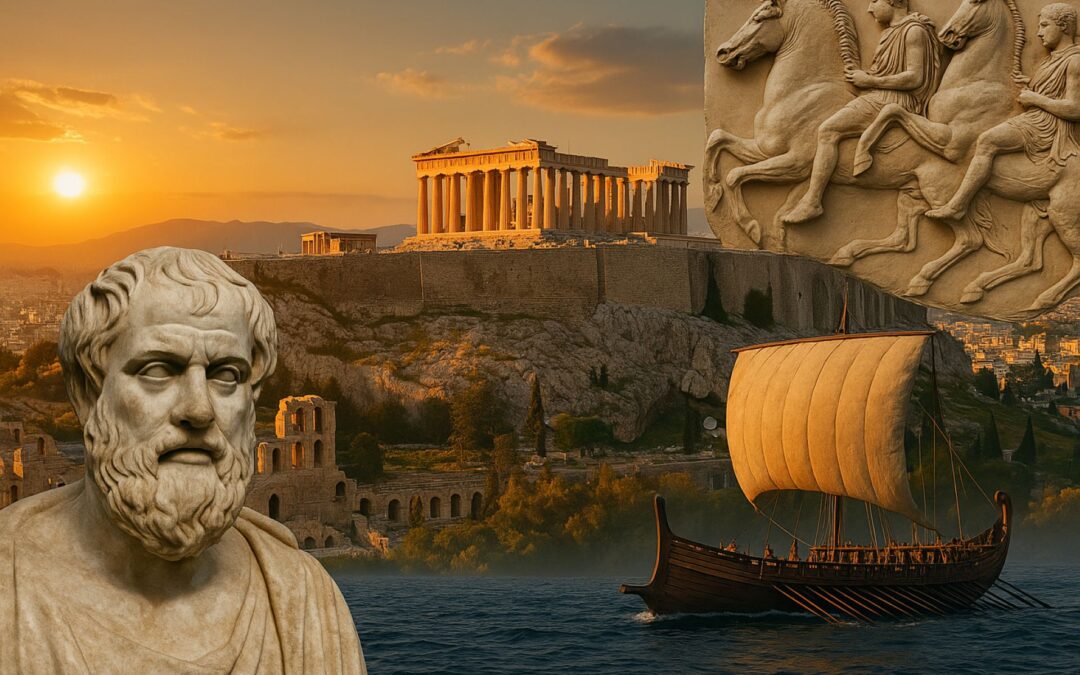
Athens is a city like no other—a place where myth and history converge, where ruins whisper of glories past, and where ideas once spoken in dusty marketplaces still echo across the world. Known as the cradle of Western civilization, it gave humanity democracy, philosophy, and drama, shaping principles that continue to guide modern nations.
Yet the story of Athens is not one of uninterrupted triumph. It is a tale of rise and fall, of fires that consumed it and revolutions that rebuilt it, of resilience that has carried it through millennia of conquest, decline, and rebirth. To follow the history of Athens is to witness humanity’s enduring struggle between fragility and endurance, ambition and humility, ruin and renewal.
The Birth of a Civilization
The story of Athens begins not with marble temples or great philosophers, but with small clusters of humans eking out survival in the Neolithic age, around 7,000 BC. These early settlers lived off the land, cultivating cereals, domesticating animals, and shaping rudimentary tools from stone and bone. Life was harsh, but gradually, stability came. Farming meant permanence. Families no longer had to follow herds across the plains—they could stay rooted in one place, build homes, and form communities.
Among the rocky outcrops of Attica, one site proved exceptional—the Acropolis. This massive limestone plateau rose above the surrounding land like a natural fortress, protecting those who dwelled at its base while providing a vantage point over fertile valleys and the sea beyond. For millennia, the Acropolis was more than geography—it was destiny. Its sheer presence guided Athens’ evolution, transforming it from a cluster of huts into the nucleus of one of history’s greatest civilizations.
By the second millennium BC, Athens was drawn into the orbit of the Mycenaean civilization, the first great power of mainland Greece. Palaces crowned with megarons—the grand halls of kings—sprang up across the land. Athens did not match the scale of Mycenae or Pylos, but it flourished as a secondary hub of trade and administration. Its people cultivated olives and grapes, exported pottery and textiles, and absorbed the influences of Minoan Crete and other cultures across the Aegean. The city’s mythology also crystallized during this period: the tale of Athena’s gift of the olive tree, triumphing over Poseidon’s salt spring, established her as the eternal patroness of the city. In that myth, wisdom and resourcefulness triumphed over brute force—an omen of the values Athens would come to embody.
Athens’ early significance was thus both practical and symbolic. It was a crossroads of trade, a center of ritual, and a site where myth and reality fused. Though modest compared to other Mycenaean strongholds, it carried within it the seeds of endurance and transformation that would later allow it to outlast many greater powers.
Collapse and Survival in the Dark Ages
Around 1100 BC, the Aegean world was convulsed by catastrophe. The mighty palatial states of the Mycenaean civilization collapsed in rapid succession. Archaeological evidence speaks of fire-blackened ruins, abandoned citadels, and widespread depopulation. What caused this upheaval remains a mystery—historians speak of invading Sea Peoples, crippling drought, systemic political breakdown, or all of these combined. What is certain is that a once-flourishing civilization fell into silence.
The disappearance of Linear B, the script used to record Mycenaean administration, marked the end of written history for centuries. Economies regressed to subsistence farming, long-distance trade dried up, and artistry became crude compared to earlier achievements. It was an age of scarcity, uncertainty, and isolation. This period has been aptly named the Greek Dark Ages.
And yet, unlike so many of its contemporaries, Athens survived. The city avoided wholesale destruction, maintaining a thread of continuity when others vanished altogether. Though its population shrank, a community endured at the Acropolis and its environs. This resilience preserved cultural memory, even as much else was lost. Oral traditions became the lifeline of identity. Tales of gods, heroes, and battles were passed from generation to generation, keeping alive the echoes of the Mycenaean past. Out of these oral recitations, the great epics—the Iliad and the Odyssey—emerged, epic poetry that carried forward not only stories but values: bravery, honor, fate, and the tension between hubris and humility.
Politically, Athens in the Dark Ages was not the powerful city-state it would become, but rather a patchwork of clans and kinship groups. Authority rested in local chieftains, and society was organized in small, semi-autonomous communities. While fragmented, this decentralization planted the roots of something profoundly new: the idea of the polis, the self-governing city-state. The devastation of the collapse paradoxically gave rise to innovation. Out of the ashes of Mycenaean centralization, Athens and other Greek settlements began to experiment with new political and social forms.
Thus, while much of Greece faded into obscurity during these centuries, Athens remained a flickering flame in the darkness. Its survival was not only physical but cultural—safeguarding memory, myth, and identity until the dawn of a new age brought resurgence. It was this continuity, this refusal to vanish, that gave Athens a foundation on which to build its future greatness.
From Oligarchy to Reform
By the 8th century BC, Athens was reawakening from centuries of obscurity. Trade routes stitched it back into the fabric of the wider Mediterranean world, carrying not only goods but ideas. Egyptian statuary, Near Eastern metallurgy, and Phoenician scripts filtered into the city, enriching its culture and reshaping its identity. The most transformative of these imports was the Phoenician alphabet, adapted into Greek and becoming the first widely accessible writing system in Europe. With it came a rebirth of literacy: laws, poetry, and religious hymns could now be recorded, preserving traditions that had once survived only on the tongues of bards.
Athens itself, however, remained in the grip of an entrenched aristocracy. Kings, who once embodied political authority, were replaced by archons—powerful magistrates drawn exclusively from elite families. These aristocrats monopolized power, land, and privilege, while the majority of Athenians—farmers, laborers, craftsmen—remained politically voiceless. Beneath the surface, resentment simmered. The city’s growth meant heavier burdens on ordinary citizens: taxation, military service, and debts that often ended in bondage. Social fractures widened until they could no longer be ignored.
The first attempt to impose order came from Draco in 621 BC. His code was Athens’ first written system of laws, carved in stone for all to see. But justice, under Draco, was merciless. Theft, debt, and even trivial offenses were punishable by death. The severity of his legislation gave birth to a word still in use today—draconian. Far from easing tensions, Draco’s code entrenched the privileges of the wealthy and exposed the vulnerability of the poor.
Real reform would come with Solon in 594 BC. A statesman of unusual foresight, Solon was tasked with resolving Athens’ crises before they tore the city apart. He abolished debt slavery, freeing countless Athenians who had been shackled for failing to repay loans. He then reorganized society not by birth but by wealth, dividing citizens into four property-based classes. While the wealthiest could still hold the highest offices, even the poorest were granted the right to vote in the assembly, the Ecclesia. For the first time, Athens took a step toward broader participation in governance. Solon also restructured economic life, encouraging trade, standardizing weights and measures, and promoting olive cultivation, which became a cornerstone of Athenian wealth.
Yet Solon’s reforms were not a panacea. They loosened the aristocracy’s grip but did not eliminate factionalism. Old rivalries endured, and political power still leaned heavily toward the wealthy. The seeds of change had been sown, but the soil remained volatile. Into this turbulence entered Peisistratus, a shrewd opportunist who seized power as tyrant in 561 BC. Unlike later despots, Peisistratus ruled with surprising moderation. He maintained many of Solon’s reforms, patronized artists and craftsmen, and invested in infrastructure that stimulated the economy. Temples and public works adorned Athens, while festivals such as the Panathenaic Games were expanded to celebrate civic pride. His rule demonstrated that tyranny, when pragmatic, could stabilize Athens.
But dynasties rarely last. After Peisistratus’ death, his sons Hippias and Hipparchus struggled to maintain control. When Hipparchus was assassinated, Hippias responded with repression, alienating the people. In 510 BC, he was overthrown, paving the way for the most radical transformation Athens had yet seen—the birth of democracy.
The Birth of Democracy
The fall of the Peisistratid tyranny left Athens at a crossroads. Power vacuums are dangerous, often leading to chaos, but in 508 BC, an aristocrat named Cleisthenes engineered a political revolution that would alter the course of history. His vision was audacious: dismantle the old power structures based on bloodlines and replace them with a system grounded in geography and shared civic identity.
Cleisthenes divided Attica into demes—local units that disregarded aristocratic lineage. These were grouped into ten new tribes, each mixing people from the coast, the countryside, and the city, ensuring that no single noble family could dominate. This bold restructuring fractured the aristocracy’s influence and created a more balanced distribution of political power.
At the heart of his reforms was the Council of 500 (Boule), chosen by lot from the ten tribes. This body prepared legislation for the assembly, where thousands of citizens gathered to debate and decide on matters of war, law, and policy. The assembly (Ecclesia) became the voice of the people—ordinary men, not just aristocrats, now had a direct say in governance. While women, slaves, and foreigners remained excluded, for free male citizens the shift was revolutionary.
Cleisthenes also introduced ostracism, a strikingly original mechanism designed to prevent tyranny’s return. Each year, citizens could vote to exile any individual deemed too ambitious or dangerous. For ten years, the ostracized man would live in banishment, stripped of influence but not property or citizenship. It was a safeguard born of bitter memory, ensuring no one man could dominate Athens again.
These reforms did more than redistribute power; they created a new identity. Athenians were no longer defined primarily by family or wealth but by their participation in the civic body. Citizenship became both a privilege and a responsibility, requiring active engagement in collective decision-making. For the first time in history, a society had institutionalized the idea that the governed should govern themselves.
This was not democracy as we know it today. It was limited, exclusionary, and often chaotic. But it was a beginning—a radical departure from the monarchies and oligarchies that dominated the ancient world. Athens had set in motion an experiment that would not only define its own destiny but echo across millennia, inspiring republics, revolutions, and democratic ideals that endure to this day.
The Persian Wars and Athenian Ascendancy
The dawn of the 5th century BC hurled Athens into the crucible of war, a test that would shape its destiny. Across the Aegean, the Persian Empire loomed as the most powerful force the world had yet seen, stretching from Egypt to India. When the Ionian Greeks of Asia Minor, under Persian rule, revolted in 499 BC, Athens made a fateful choice: it sent ships and men to aid the rebels. Though the revolt failed, this act of defiance drew the wrath of King Darius I, setting the stage for a confrontation that would reverberate through history.
In 490 BC, Persian forces landed on the plains of Marathon, confident of victory. Facing them was a smaller Athenian army bolstered by a handful of allies from Plataea. The Athenians, heavily armored hoplites fighting in disciplined phalanxes, launched a daring charge across the plain. The clash ended in a stunning upset: the Persians were routed, their ships driven back to sea. Marathon was more than a battle—it was a declaration that free citizens could stand against the might of an empire. From it sprang the legend of Pheidippides, the messenger who ran 26 miles to Athens with news of victory, collapsing dead upon arrival—a tale that later inspired the modern marathon.
But Persia would not forget. A decade later, Xerxes, son of Darius, assembled an army so vast that ancient writers claimed it drank rivers dry. In 480 BC, this juggernaut marched into Greece, supported by a colossal fleet. At Thermopylae, King Leonidas and 300 Spartans, alongside thousands of other Greeks, staged a heroic last stand, buying precious time. Yet Athens itself could not be saved—the citizens evacuated, and Xerxes’ soldiers torched the city, leaving the Acropolis in ruins.
It was on the waters, however, that Athens’ fate was decided. At the straits of Salamis, the Athenian navy, led by Themistocles, lured the Persian fleet into narrow channels where its numerical advantage was nullified. Triremes—sleek, three-banked Athenian warships—rammed and splintered the enemy, turning the tide. The victory at Salamis crippled Persian naval power, and the following year, at Plataea, the Persians suffered final defeat.
Athens emerged from the Persian Wars not only as a survivor but as a leader. Its navy, its courage, and its strategic brilliance had saved Greece. To safeguard against future invasions, Athens spearheaded the Delian League, an alliance of city-states united against Persia. But what began as mutual defense soon transformed into empire. Tribute from allies poured into Athens, funding monumental projects and swelling its power. The city that had once clung to survival now stood as the unrivaled naval and cultural powerhouse of the Aegean.
Under Pericles’ leadership (461–429 BC), Athens entered its Golden Age. The Parthenon, with its gleaming marble columns and intricate sculptures, rose above the Acropolis as both temple and treasury, symbol of divine favor and civic pride. The arts flourished—Sophocles, Euripides, and Aeschylus staged tragedies probing the depths of human nature; Aristophanes wielded comedy as social critique. Public festivals, particularly the Dionysia, drew crowds to theaters where drama became both entertainment and civic reflection.
Intellectual life thrived as well. Socrates roamed the agora, questioning assumptions and probing the meaning of virtue. His student Plato would later found the Academy, the first institution of higher learning in the Western world, where knowledge was dissected in disciplines from mathematics to metaphysics. Athens had become not just a city-state but a beacon, radiating ideas, art, and architecture that would define civilization itself.
Peloponnesian War and Decline
Yet Athens’ brilliance cast a long shadow. Its empire, forged under the guise of collective defense, became an instrument of domination. Member states of the Delian League, once allies, found themselves paying tribute enforced by Athenian garrisons. Resentment brewed, and Sparta, long Athens’ rival, bristled at its growing influence. By 431 BC, tensions boiled over into the Peloponnesian War, a conflict that would stretch across nearly three decades and engulf the entire Greek world.
Athens, a naval power, relied on its fleet and its Long Walls—fortifications linking the city to its port at Piraeus—to ensure survival. Supplies could flow by sea even as Spartan armies ravaged the countryside. But the strategy faltered when plague swept through the crowded city in 430 BC, killing thousands, including Pericles himself. Athens lost not only its leader but its guiding vision, leaving it vulnerable to internal strife.
Despite setbacks, Athens fought on, leveraging its navy to project power across the Aegean. Yet ambition led to overreach. In 415 BC, Athens launched the Sicilian Expedition, a massive campaign to conquer Syracuse. What followed was disaster: the Athenian fleet was annihilated, its soldiers slaughtered or enslaved. The loss drained resources, morale, and prestige, marking the beginning of the city’s downward spiral.
Sparta, with financial backing from Persia, built a fleet to rival Athens’. In 405 BC, at the Battle of Aegospotami, the Spartan navy struck a decisive blow, capturing or destroying nearly the entire Athenian fleet. Starved of supplies, Athens was besieged and forced to surrender the following year. Its walls were torn down, its empire dissolved, and its democracy briefly replaced by the oligarchic “Thirty Tyrants,” a regime imposed by Sparta.
Although democracy was restored within a year, the damage was irreversible. Athens’ glory had dimmed. No longer the master of the seas or the arbiter of Greece, it became a city haunted by its own hubris. The Peloponnesian War revealed the fragility of power, showing how quickly triumph could turn to ruin. Athens still had brilliance to offer—in philosophy, in drama, in architecture—but never again would it wield the unchallenged dominance of its Golden Age.
Macedonian and Roman Rule
The Peloponnesian War left Athens scarred, weakened, and increasingly vulnerable to the rise of new powers. In the 4th century BC, Macedonia—once dismissed by Greeks as a backwater kingdom—emerged as a formidable force under King Philip II. Philip’s military reforms, particularly the creation of the Macedonian phalanx with its long sarissas (pikes), gave his armies unmatched discipline and power. When the Greek city-states attempted to check his advance, Athens found itself at the center of resistance. The climactic moment came in 338 BC at the Battle of Chaeronea, where Athens and its allies were decisively defeated. From that day, Athens’ independence was gone; it now lived under Macedonian hegemony.
Yet conquest did not extinguish Athens’ cultural radiance. Philip’s son, Alexander the Great, inherited the mantle of leadership and carried Greek influence eastward into Asia, conquering an empire stretching to India. Athens, though politically diminished, continued to shine as an intellectual lighthouse. Philosophers, orators, and playwrights still made the city a magnet for those who sought wisdom. Plato’s Academy and Aristotle’s Lyceum flourished, advancing philosophy, science, and logic. Speeches by orators like Demosthenes thundered against Macedonian rule, even as his words could not alter the reality of subjugation.
The death of Alexander in 323 BC briefly reignited Athenian hopes of freedom. Athens and other Greek states rose in rebellion during the Lamian War, but the effort was crushed within a year. From then on, Athens’ political autonomy was reduced to a shadow of its former self. For two centuries it drifted amid the struggles of Alexander’s successors—the Antigonids, Seleucids, and Ptolemies—its fate decided by forces far beyond its control.
When Rome entered the Greek world in the 2nd century BC, Athens became yet another stage for imperial ambition. The Macedonian Wars brought Greece under Roman dominion, culminating in 146 BC when the Roman Republic decisively subdued the region. Unlike other cities, Athens was not razed; instead, its prestige as a cultural capital ensured preservation. The Romans, far from suppressing Athens’ heritage, venerated it. Statesmen, generals, and emperors sent their sons to Athens to learn rhetoric, philosophy, and the arts. Cicero, for instance, was deeply influenced by his time among Athenian teachers.
Roman emperors left their mark on the city. Augustus restored monuments; Hadrian, enamored with Athens, adorned it with new splendor. His library, aqueduct, and completion of the long-delayed Temple of Olympian Zeus testified to the enduring reverence Romans held for the city. Under Roman patronage, Athens became cosmopolitan once again, attracting scholars and travelers from across the empire. Though it no longer commanded armies or ruled an empire, Athens thrived as the intellectual and spiritual heart of the Mediterranean. It was no longer a city of political might—it was a city of the mind.
Byzantines, Crusaders, and Ottomans
The transformation of the Roman Empire into its eastern half—the Byzantine Empire—shifted the balance of power decisively to Constantinople. Athens, once revered, now faded into provincial obscurity. Pagan temples were converted into Christian churches, the Academy and Lyceum closed, and centuries of philosophical inquiry dimmed under the weight of new religious orthodoxy. By the 6th century AD, Athens was no longer a center of political or intellectual life, but a provincial town clinging to the shadows of its glorious past.
The Middle Ages were a time of upheaval. In 1204, the Fourth Crusade shattered the Byzantine Empire. Crusaders, meant to reclaim Jerusalem, instead sacked Constantinople and carved the empire into smaller states. Athens fell into the hands of Western feudal lords, becoming the Duchy of Athens. Under Frankish rule, the Acropolis was fortified, its temples repurposed into strongholds, while the Greek population lived under foreign dominion. Catalan mercenaries later seized the duchy, and Venetians asserted control in the 15th century, each wave of rulers layering their customs atop the ancient stones.
But it was the Ottoman Turks who would leave the deepest mark. In 1458, Sultan Mehmed II, fresh from conquering Constantinople, marched into Athens and absorbed it into the Ottoman Empire. The Parthenon, once a temple and then a church, was converted into a mosque, symbolizing the transformation of the city’s cultural and religious identity. Ottoman governors ruled from the Acropolis, while the Orthodox Church remained the primary guardian of Greek identity beneath the shadow of Islamic authority.
The Ottomans fortified the Acropolis, turning Athens into a strategic outpost. Yet the city suffered a devastating blow in 1687, during a Venetian siege. A mortar struck the Parthenon, which the Ottomans had been using as a gunpowder store. The resulting explosion obliterated much of the building, leaving the skeletal ruins that still define it today. This catastrophe seared Athens’ heritage, transforming one of antiquity’s most exquisite structures into a haunting ruin.
By the 18th century, Athens was a modest provincial town of artisans, merchants, and peasants, far removed from its classical grandeur. Yet it captivated European travelers of the Enlightenment. Scholars and antiquarians wandered its ruins, sketching, documenting, and, at times, plundering. The most infamous of these was Lord Elgin, who in the early 1800s removed large sections of the Parthenon’s sculptural treasures and transported them to Britain, where they remain in the British Museum.
Athens, once the heart of a great civilization, had become a pawn in the struggles of empires. But its ruins whispered of an immortal past, inspiring poets, painters, and philosophers across Europe. These whispers would soon help ignite the Greek War of Independence—a rebirth that would restore Athens, not as an empire, but as the symbolic capital of a modern nation.
Revolution and Modern Athens
By the dawn of the 19th century, the Ottoman Empire was showing unmistakable signs of decline. Across its vast territories, uprisings and revolts simmered, and in Greece the desire for freedom burned with particular intensity. The spirit of Hellenism, fueled by centuries of myth, philosophy, and cultural pride, had never truly died, even under centuries of subjugation. Intellectuals and nationalists, inspired by the Enlightenment and the ideals of the French Revolution, began to speak of independence. Athens, though reduced to a modest provincial town, became swept into this rising tide.
The Greek War of Independence erupted in 1821, beginning in the Peloponnese and spreading across the country. Athens soon became a battleground. Its Acropolis was besieged more than once, its streets filled with violence as Greek insurgents clashed with Ottoman garrisons. For years, the war dragged on with moments of triumph and disaster. Massacres and retaliations scarred the land, but the determination of the Greeks never faltered.
International attention soon turned toward Greece. Poets and artists in Europe—most famously Lord Byron, who died fighting for the cause—romanticized the struggle as a rebirth of the ancient civilization that had given the world democracy and philosophy. This growing philhellenism stirred public opinion in Britain, France, and Russia, and eventually their governments intervened militarily. In 1827, the combined fleets of the three powers destroyed the Ottoman navy at Navarino, a decisive blow that forced the empire to negotiate.
By 1830, Greece had won recognition as an independent state. In 1833, the young Bavarian prince Otto was installed as King Otto I of Greece, and Athens was declared the capital. At that time, Athens was little more than a dusty town of roughly 10,000 inhabitants, its skyline dominated not by modern boulevards but by the ruins of antiquity. Yet the choice of Athens was symbolic—it embodied the rebirth of a nation anchored in its glorious past.
King Otto initiated an ambitious program of modernization. Neoclassical buildings inspired by the grandeur of ancient Greece rose across the city, designed by Bavarian architects who sought to connect modern Athens with its heritage. The city was given wide boulevards, public squares, and government buildings that echoed the symmetry and elegance of classical forms. Institutions such as the National Archaeological Museum and the University of Athens were established, reviving the city’s role as a center of knowledge. The Panathenaic Stadium, originally built in antiquity, was reconstructed and would later host the revival of the Olympic Games in 1896, signaling Athens’ re-emergence on the global stage.
By the close of the 19th century, Athens had transformed. From a forgotten outpost under Ottoman rule, it had become the proud capital of a modern European kingdom. Its population expanded, its infrastructure grew, and its streets buzzed with political and cultural life. Though poverty and political instability still plagued the young nation, Athens had reclaimed its symbolic crown as the beating heart of Greece.
Athens Today
The 20th century would test Athens’ resilience in ways as brutal as any ancient war. During World War II, Nazi Germany occupied the city, unleashing years of famine, repression, and terror. The winter of 1941–42 was particularly devastating, with tens of thousands of Athenians starving to death in the streets. Liberation in 1944 brought no peace: a bitter civil war between communist partisans and nationalist forces soon followed, plunging Athens into fratricidal conflict that scarred the nation for decades.
When stability finally returned in the 1950s, Athens entered a period of rapid transformation. Industrialization and urbanization swelled the city’s population. Migrants from rural Greece poured into Athens in search of work, and by the 1970s the city had ballooned into a sprawling metropolis. Apartment blocks rose hastily to accommodate the influx, reshaping the city’s skyline into the dense, chaotic urban fabric that characterizes it today. Political turbulence, including the oppressive rule of the military junta from 1967 to 1974, tested democratic ideals, but the eventual restoration of democracy marked a new beginning.
Athens continued to modernize in the late 20th century, with highways, public transportation systems, and expanded infrastructure. Its crowning moment came in 2004, when it hosted the Olympic Games for the second time. The event was a celebration of Athens’ dual identity: ancient and modern, rooted in history yet striving toward the future. New stadiums, the expansion of the metro system, and urban beautification projects gave the city a global spotlight.
Yet challenges soon followed. The global financial crisis of 2008 and Greece’s ensuing debt crisis plunged Athens into austerity. Unemployment soared, protests filled the streets, and the city once again became a stage for political turmoil. Poverty and hardship were widespread, but amid the unrest, Athens’ resilience shone. Street art blossomed, neighborhoods reinvented themselves, and a new generation of Athenians embraced creativity as a form of defiance.
Today, Athens remains a paradox—both ancient ruin and modern sprawl, scarred by crises yet full of energy. The Acropolis still towers over the city, its weathered stones glowing gold in the evening light, a reminder of a civilization that once changed the world. Below, a vibrant, noisy city pulses with cafes, markets, music, and protest marches. Tourists walk the narrow lanes of Plaka, while scholars study millennia-old inscriptions just a short distance away.
Athens endures because Athens adapts. It has been burned, conquered, rebuilt, and reborn countless times. From the cradle of democracy to the battleground of empires, from obscurity under the Ottomans to the turbulence of the modern era, it remains a city of resilience. More than ruins or monuments, Athens represents the human spirit’s capacity to rise again, carrying forward the eternal dialogue between past and future.
Conclusion
Athens has lived many lives. It has been a Mycenaean outpost, a democratic beacon, an imperial capital, a Roman schoolroom, a Byzantine backwater, a Crusader duchy, an Ottoman garrison, and, finally, the heart of a modern nation. Each age has left its scars and its gifts, layering the city with meaning that transcends time.
Though it has been conquered, plundered, and scarred by war, Athens has never truly been silenced. Its ruins still command awe, its streets still hum with restless energy, and its legacy continues to shape the way we think, govern, and imagine freedom. Athens is not merely the past—it is the embodiment of humanity’s capacity for reinvention, a reminder that even when empires fall, ideas endure.