
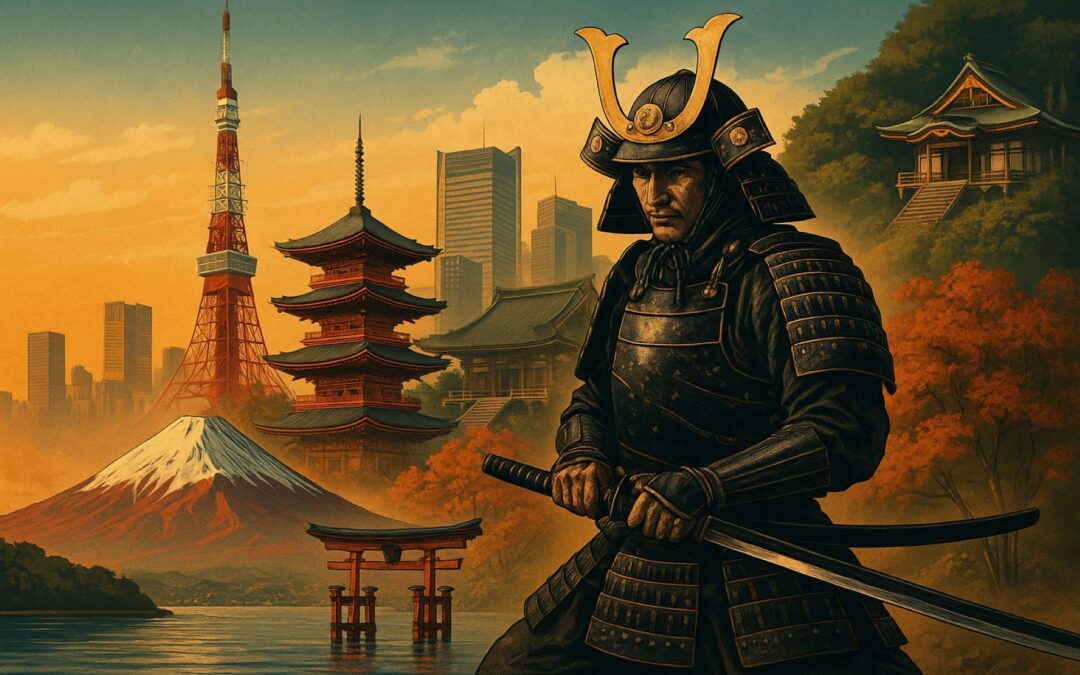
Japan’s story is unlike any other. From its prehistoric settlers shaping pottery out of clay to the neon towers of modern Tokyo, the nation has continually reinvented itself in the face of upheaval. Empires rose and fell, swords gave way to rifles, and centuries of isolation gave way to explosive modernization.
Few countries have endured so many cycles of collapse and renewal, and fewer still have emerged stronger from each trial. The tale of Japan is one of paradox—at once fiercely protective of tradition and endlessly adaptive to change. To trace its history is to witness the birth of a culture that has shaped not only Asia but the modern world.
The Land of the Rising Sun
Japan’s identity has always been cloaked in paradox. To many, it is a realm of cutting-edge robotics, bullet trains that blur across the landscape, and neon-lit towers that give the impression of a nation living in the future. Yet only a few steps away, one may stumble upon a centuries-old temple, where monks chant prayers in incense-thick air and ancient wooden beams echo with the weight of history. Tourists marvel at this duality: the hyper-modernity of Tokyo paired with the serene mystique of Kyoto, the silence of snowy mountain shrines mirrored against the roar of Shibuya’s crossings.
But this openness—the willingness to invite the world in—was not always Japan’s posture. For centuries, the nation was guarded and self-contained, wary of foreign entanglements. Its long isolation under the Tokugawa shogunate sealed its culture into a unique vessel, one that brewed poetry, theater, calligraphy, and martial disciplines untouched by outside disruption. The result was a civilization both insular and dazzlingly original, a society that crafted beauty from limitation and order from strict codes of loyalty. This deep rhythm of oscillating between openness and seclusion, destruction and rebirth, has shaped Japan’s destiny. To walk through its history is to walk through a series of thresholds—moments where collapse gave way to renewal, where external pressure forced internal reinvention, and where the Japanese spirit revealed its extraordinary capacity to adapt and endure.
From Prehistoric Settlers to the Yamato State
The Japanese islands were not always as they are now. Shaped by volcanic fire and seismic shifts, the archipelago lies at the meeting point of tectonic forces that both nurture and threaten. Into this landscape came humanity, first arriving from the Asian mainland around 40,000 years ago. These early inhabitants lived as hunter-gatherers, carving tools from stone, fishing the rich coastal waters, and adapting to the forests and mountains that defined their world. Over millennia, their descendants formed the Jōmon culture, renowned for its pottery—the oldest yet discovered anywhere. Coiled and flame-patterned, these clay vessels were both functional and artistic, foreshadowing Japan’s enduring devotion to beauty even in utility.
By the Yayoi period, beginning around 300 BC, new waves of migrants introduced rice cultivation, bronze tools, and ironworking. Wet-rice agriculture transformed the land, giving rise to permanent villages, structured societies, and increasing stratification. Communities fortified themselves, rival chiefs fought for dominance, and slowly a larger political order began to emerge. By the 3rd century AD, the Yamato clan, based in the fertile Nara plain, had consolidated power. Their rulers claimed descent from the sun goddess Amaterasu, weaving divine legitimacy into their authority—a mythic bond between heaven and earth that still underpins the imperial institution today.
From the mainland, influences continued to flow. Korea acted as a bridge, bringing Buddhism in 552, a faith that would transform Japanese spirituality and art. Not long after, the Taika Reforms of 645 attempted to reshape governance along Chinese imperial lines, emphasizing centralized rule and bureaucratic efficiency. Yet the new state was still young, fragile, and searching for permanence. The imperial court shifted its seat with each ruler until Emperor Kammu anchored it at Heian (modern Kyoto) in 794. There, a thousand years of aristocratic refinement would flourish—poetry, ritual, and the quiet elegance of a courtly life. Still, the seeds of decentralization were already sown, as distant provinces often answered more to local lords than to the emperor himself.
Rise of the Samurai and the Shogunate
As the Heian aristocracy sank deeper into its own rituals of poetry, aesthetics, and courtly intrigue, the practical work of governing slipped through its fingers. Beyond the capital’s polished palaces, provincial lands were plagued by disputes over resources, harvests, and territory. Local strongmen emerged—armed, ambitious, and more concerned with loyalty and protection than with the delicate politics of Kyoto. From this crucible arose the samurai, warriors who embodied discipline, martial skill, and a code of loyalty that bound them to their lords.
These warriors were not simply soldiers; they were symbols of an emerging order where power was measured by the sword rather than by lineage. By the 12th century, two clans rose above the rest: the Taira and the Minamoto. Both had roots in the imperial family, but both drew their real strength from the warriors who swore allegiance to them. Their rivalry erupted into violence during the Hōgen and Heiji disturbances, preludes to the far greater conflict of the Genpei War (1180–1185).
The Genpei War became a defining struggle in Japanese history. Samurai clashed on land and sea, their banners fluttering against the backdrop of burning temples and fractured loyalties. The climactic Battle of Dan-no-ura in 1185 sealed the fate of the Taira, who were annihilated, their child-emperor plunging into the sea with his attendants. Victory fell to Minamoto no Yoritomo, a figure both ruthless and pragmatic. Establishing his base far from Kyoto in the coastal city of Kamakura, Yoritomo accepted the emperor’s nominal authority but wielded true power himself. In 1192, he was granted the title of shogun—“supreme general.”
This was no mere military appointment. It created a dual system of governance that would define Japan for centuries: emperors remained symbols of divine order, while shoguns ruled in fact. The Kamakura shogunate laid the foundations of a military-led Japan, codifying samurai as the dominant class and entrenching feudal ties between lord and vassal. For the first time, the sword, not the scepter, determined Japan’s destiny.
The Mongol Threat and Fractured Power
The new shogunate, however, faced challenges that would test its resilience. In the late 13th century, the Mongol Empire—then the most formidable power on earth—turned its gaze toward Japan. Kublai Khan, grandson of Genghis, demanded Japan’s submission as a vassal. His demand was ignored, and so he launched an invasion in 1274. Thousands of Mongol, Chinese, and Korean troops landed on Kyūshū’s shores. The samurai, trained for individual duels of honor, found themselves stunned by the Mongols’ coordinated tactics, volleys of arrows, and thundering cavalry. Defeat seemed imminent.
But nature intervened. A sudden typhoon tore through the Mongol fleet, scattering ships and drowning invaders. Japan survived, but the danger was not over. In 1281, an even larger armada—some 140,000 men—set sail. Once again, fierce battles raged, and once again, storms smashed the invaders. The Japanese called these winds kamikaze, or divine winds, believing their gods had intervened to save the land. These events seared themselves into national memory, later revived in 20th-century wartime rhetoric.
Yet victory came at a cost. The Mongol threat had drained the shogunate’s coffers. Unlike conquests abroad, defending against invasions yielded no plunder or land to reward loyal samurai. Many warriors were left unpaid, their sacrifices unrewarded. Resentment simmered. The authority of the Kamakura shogunate began to falter. In 1333, Emperor Go-Daigo attempted to restore imperial rule, briefly succeeding before being overthrown by Ashikaga Takauji, a former ally who established a new shogunate in Kyoto.
The Ashikaga shogunate restored a semblance of order, but true power was fragmenting. Regional daimyōs—lords who controlled provinces with private armies of samurai—grew increasingly independent. They shifted alliances as it suited them, balancing loyalty against ambition. Japan was no longer a unified state but a quilt of competing warlords, each carving their own dominion. This decentralization, born from financial strain and political betrayal, would set the stage for one of the most turbulent eras in Japanese history: the age of the Warring States.
The Warring States and the Arrival of Europeans
The collapse of centralized power under the Ashikaga shogunate plunged Japan into one of the most violent and transformative chapters of its history—the Sengoku Jidai, or Warring States period, lasting from the mid-15th to the late 16th century. It began with the Ōnin War (1467–1477), ostensibly a dispute over succession to the shogunate but in truth a descent into chaos. Kyoto was reduced to ashes, its temples looted and its aristocratic households scattered. What emerged afterward was not unity, but fragmentation: Japan splintered into dozens of domains ruled by ambitious daimyō, each commanding their own samurai armies, fortified castles, and swelling ambitions.
These warlords were locked in perpetual conflict. Alliances were forged and shattered with dizzying speed; brothers turned on brothers, vassals betrayed masters, and entire provinces shifted loyalties overnight. To survive in this climate, daimyō innovated. Military strategies grew more sophisticated, fortifications more elaborate. It was also in this era that the covert arts of the ninja flourished—stealthy operatives who specialized in espionage, sabotage, and assassination, offering shadowy alternatives to the open valor of the samurai. Meanwhile, militant Buddhist sects organized armies of warrior monks, marching to war with prayer beads in one hand and polearms in the other, complicating an already unstable landscape.
Then came an event that altered the balance of power irreversibly. In 1543, a Portuguese vessel was blown off course and landed on Tanegashima, an island off Kyūshū. The sailors brought with them an object that would revolutionize Japanese warfare: the arquebus, a matchlock firearm. Unlike the bow, it required less training to master and could pierce armor at a distance. Within a decade, Japanese blacksmiths were producing firearms by the tens of thousands. Battles that had once been contests of archery and swordsmanship transformed into volleys of coordinated gunfire. Daimyō rushed to acquire this new technology, and war became bloodier, deadlier, and increasingly tactical.
The Portuguese also brought Christianity. Jesuit missionaries, most notably Francis Xavier in 1549, spread the faith across southern Japan. Many daimyō converted, partly out of genuine conviction, partly as a pragmatic strategy to secure favorable trade with European merchants. Converts received guns, military aid, and access to global trade networks. Christianity thus became intertwined with politics and war.
In this maelstrom rose three extraordinary figures, remembered as the unifiers of Japan. Oda Nobunaga, a ruthless strategist, embraced firearms with unmatched zeal, deploying them in disciplined volleys to obliterate traditional samurai cavalry charges. He crushed rival clans and even razed powerful Buddhist monasteries that opposed him, shocking contemporaries with his brutality but leaving no doubt of his determination to unify Japan. Yet Nobunaga was betrayed in 1582, forced to commit seppuku by one of his generals.
His mantle fell to Toyotomi Hideyoshi, a man of peasant birth who rose through sheer brilliance and charisma. Hideyoshi completed the work of unification, instituting land surveys, rigid social classes, and disarmament edicts that forbade peasants from bearing arms. Although he ruled as regent rather than shogun, his control was absolute. But upon his death in 1598, the fragile peace unraveled once more, as rival factions vied for dominance over his young heir.
The decisive moment came in 1600 at the Battle of Sekigahara, where Tokugawa Ieyasu crushed his rivals and claimed supremacy. From that battlefield, a new age dawned.
The Tokugawa Era and Isolation
With his victory at Sekigahara, Tokugawa Ieyasu secured his place as the most powerful man in Japan. In 1603, the emperor formally granted him the title of shogun, inaugurating the Tokugawa shogunate. Unlike previous regimes, the Tokugawa dynasty endured for over 250 years, presiding over an era of relative peace, stability, and cultural flourishing. The new government established its seat at Edo—modern Tokyo—a fishing village that would grow into one of the world’s largest cities.
To maintain order, the Tokugawa implemented a rigid social hierarchy. At the top stood the samurai, loyal retainers of their daimyō. Below them were peasants, who produced the rice that fueled the economy; then artisans, who created tools, crafts, and artworks; and finally merchants, considered lowest despite their growing wealth. Mobility between classes was prohibited, ensuring stability but also ossification. The daimyō themselves were kept on a tight leash through the sankin-kōtai system, which required them to spend alternating years in Edo under the shogun’s watchful eye, leaving their families behind as hostages of loyalty.
Economically, the Tokugawa era saw prosperity. Roads and waterways connected the provinces, facilitating trade and communication. Markets flourished, and with them a vibrant urban culture. The arts blossomed: kabuki theater drew raucous crowds, ukiyo-e woodblock prints captured scenes of pleasure districts and landscapes, and haiku poetry distilled the essence of fleeting beauty into just a few lines. A new urban middle class emerged, enjoying leisure and entertainment in ways unthinkable in earlier centuries.
Yet prosperity was coupled with paranoia. The shogunate, wary of destabilizing influences, viewed Christianity with suspicion. After violent uprisings by Christian peasants in Kyūshū, the faith was banned, missionaries expelled, and converts persecuted. In 1639, the policy of sakoku—“closed country”—was formalized. Japan sealed itself off from most foreign contact. Japanese were forbidden to travel abroad, shipbuilding of ocean-going vessels was outlawed, and trade was restricted to a few tightly controlled partners: China, Korea, and the Netherlands, whose merchants were confined to a small artificial island at Nagasaki called Dejima.
For over two centuries, Japan turned inward. The absence of foreign wars allowed society to focus on agriculture, infrastructure, and culture. The population doubled, education spread widely—even among commoners—and literacy rates soared. But cracks eventually formed. By the late 18th century, population pressures strained resources, famines devastated communities, and rigid structures stifled innovation. Meanwhile, Dutch merchants trickled in Western knowledge—medicine, astronomy, science—through translations known as rangaku. These sparks of curiosity hinted at the winds of change.
When Commodore Matthew Perry’s black ships arrived in 1853, demanding the opening of Japanese ports, they found a nation sophisticated yet stagnant, prosperous yet vulnerable. The long Tokugawa peace was nearing its end.
The Opening of Japan
For more than two centuries, the Tokugawa shogunate had preserved Japan’s isolation with remarkable success. But by the 19th century, the walls of sakoku were being battered by external forces. The Industrial Revolution had transformed Western powers into maritime empires hungry for trade and resources. Russia pressed from the north, Britain and France loomed in the Pacific, and the United States—newly confident after its own expansion across North America—turned its attention to Asia.
In July 1853, Commodore Matthew Perry arrived in Edo Bay with four imposing steamships, their black smoke and iron hulls unlike anything the Japanese had ever seen. The ships bristled with cannons, a show of force impossible to ignore. Perry presented a letter from U.S. President Millard Fillmore demanding that Japan open its ports to American trade. The shogunate stalled, but Perry returned the following year with an even larger fleet. Faced with overwhelming firepower and the knowledge that China had been humiliated in the Opium Wars, the Tokugawa shogunate signed the Convention of Kanagawa in 1854.
This treaty opened two ports to American ships and granted limited rights of resupply and diplomacy. Soon, other Western nations—Britain, France, Russia, the Netherlands—demanded similar concessions. These so-called “unequal treaties” stripped Japan of tariff autonomy and granted foreigners extraterritorial rights, creating resentment and a sense of national humiliation. To many Japanese, it seemed as though their rulers had surrendered sovereignty without a fight.
The crisis fractured Japan’s political order. Reformist domains in the south, especially Chōshū and Satsuma, denounced the shogunate as weak. Samurai rallied under the slogan sonnō jōi—“Revere the Emperor, Expel the Barbarians.” Anti-foreign uprisings broke out, but Western gunboats quickly crushed them, demonstrating the futility of isolation. Amid this turbulence, reformists realized that to resist foreign domination, Japan would need to modernize, not retreat. Their solution was radical: restore power to the emperor, dismantle the shogunate, and centralize authority to rebuild the nation.
In 1868, imperial loyalists marched on Edo in what became known as the Boshin War. The Tokugawa shogunate collapsed, and power was restored to the young Emperor Meiji. Edo was renamed Tokyo, “Eastern Capital,” and the Meiji Restoration began. It was less a return to old imperial rule than a revolutionary project to reinvent Japan as a modern nation-state capable of standing alongside the Western powers.
Modernization and Empire
The Meiji leaders, many of them samurai from Chōshū and Satsuma, recognized the urgency of transformation. They had witnessed Western imperialism carve up Asia and understood Japan’s survival depended on rapid modernization. With remarkable pragmatism, they launched sweeping reforms across every sector of society.
The political order was centralized. Feudal domains were abolished, replaced by prefectures under direct imperial control. The samurai class, once the backbone of Japanese society, was dismantled. Stipends were converted into bonds, swords were banned from public life, and the warrior elite lost their privileges. Predictably, discontent erupted, culminating in the Satsuma Rebellion of 1877, where the last great samurai army, led by Saigō Takamori, was crushed by the imperial conscript army. The era of the sword had given way to the age of the rifle.
Industrialization advanced at breakneck speed. Railways linked distant provinces, telegraph lines stitched the islands together, and modern factories turned out textiles, steel, and armaments. A universal education system was established, promoting literacy and fostering a shared national identity. Western experts—engineers, bankers, doctors, legal scholars—were invited to Japan, while Japanese students were sent abroad to absorb knowledge firsthand. Even the military was overhauled: Prussian models shaped the army, while the British navy inspired Japan’s fleet.
By the 1890s, these reforms bore fruit. Japan’s modernized army and navy were battle-tested in the First Sino-Japanese War (1894–1895), where they delivered a stunning defeat to Qing China. Taiwan was annexed, and Japan began to emerge as a regional power. The victory shocked the world: an Asian nation had humbled a great empire.
But Japan’s ambitions did not stop there. In 1902, it signed an alliance with Britain, the first such agreement between an Asian and a Western power. When conflict with Russia erupted over Manchuria and Korea, Japan struck decisively. The Russo-Japanese War (1904–1905) ended with a spectacular Japanese victory at the Battle of Tsushima, where Admiral Tōgō annihilated the Russian fleet. For the first time in modern history, a non-Western nation had defeated a European empire in open war. The world took notice.
By annexing Korea in 1910, Japan cemented its status as an imperial power. No longer a nation under Western threat, it had joined the ranks of the colonizers. Yet this triumph also marked the beginning of a more aggressive and expansionist Japan, one whose ambitions would soon entangle it in conflicts far beyond its shores.
War and Devastation
At the dawn of the 20th century, Japan stood transformed—from an isolated archipelago into a modern empire whose influence stretched across Asia. Victories over China and Russia had imbued the nation with confidence, even a sense of destiny. Japan’s annexation of Korea in 1910 solidified its imperial ambitions, while World War I provided opportunities to seize German colonies in the Pacific. At Versailles in 1919, Japan sat alongside the victors, a testament to its newfound status. Yet beneath this triumph lay currents of nationalism, militarism, and expansionist hunger that would soon propel the nation into catastrophe.
During the 1920s, Japan experienced a brief experiment with liberal politics and international cooperation. It joined the League of Nations, participated in naval disarmament treaties, and saw its cities flourish with art, literature, and modern culture. But the Great Depression of 1929 struck hard. Economic collapse bred discontent, and voices within the military gained strength, arguing that only expansion could secure Japan’s survival. By 1931, Japanese troops staged the Mukden Incident as a pretext to invade Manchuria, establishing the puppet state of Manchukuo. The civilian government faltered; the military effectively seized control of policy.
In 1937, full-scale war erupted with China. Japanese forces swept through coastal cities, but their advance was marked by atrocities. The Nanjing Massacre shocked the world, staining Japan’s reputation with images of mass killings and brutalities. Still, expansion continued, and Japan’s ambitions turned southward toward the rich resources of Southeast Asia. Western powers, alarmed, imposed sanctions. The United States, in particular, cut off oil and steel, lifeblood for Japan’s military machine.
The response from Tokyo was audacious and fatal. On December 7, 1941, Japanese planes roared over Pearl Harbor, striking the American Pacific Fleet. The attack was devastating but not decisive—it awoke a sleeping giant. Within days, the United States declared war, and the Pacific Theater became the crucible in which Japan’s fate would be decided.
Initially, Japan surged forward. Its armies seized the Philippines, Malaya, Singapore, and the Dutch East Indies. At its zenith, the empire stretched across vast swathes of Asia and the Pacific. Yet holding such territory proved impossible. The United States adopted a strategy of “island hopping,” capturing strategic positions and bringing the fight ever closer to Japan’s home islands. Battles like Midway, Iwo Jima, and Okinawa showcased Japanese tenacity but also their desperation—kamikaze pilots hurled themselves at Allied ships in suicide attacks, echoing the ancient legend of divine winds.
By 1945, Japan was battered, its cities reduced to rubble under relentless firebombing. Still, its leaders refused unconditional surrender. Then came the ultimate horror: on August 6, 1945, Hiroshima was obliterated by the first atomic bomb. Three days later, Nagasaki met the same fate. Over 100,000 lives were incinerated in an instant, and countless others would suffer radiation’s slow agony. On August 15, Emperor Hirohito’s voice, trembling yet resolute, crackled across the airwaves, announcing Japan’s surrender. For the first time, his subjects heard their divine sovereign speak, not of victory but of defeat. The empire lay in ruins.
Reconstruction and the Economic Miracle
Defeat might have broken another nation, but for Japan, it became the crucible of reinvention. Under Allied occupation, led by General Douglas MacArthur, sweeping reforms remade the nation from the ground up. The once-sacrosanct emperor was forced to renounce his divine status, becoming a constitutional monarch. Land reforms dismantled feudal estates, redistributing farmland to peasants. Women were granted the right to vote, unions legalized, and a new constitution enshrined democracy, civil liberties, and the renunciation of war itself in Article 9.
The Allied authorities dismantled Japan’s military machine, but they also laid the foundation for recovery. American aid, coupled with favorable international conditions, gave Japan access to markets and resources. The Korean War (1950–1953) provided an unexpected boon: Japan became a vital supply hub for U.S. forces, jump-starting industrial production. Factories that once produced weapons now turned out textiles, steel, and machinery.
By the mid-1950s, the so-called “Japanese Economic Miracle” was underway. A combination of cultural discipline, government planning, and corporate innovation fueled unprecedented growth. Lifetime employment systems tied workers to companies, encouraging loyalty and stability. Technological innovation became a hallmark: Toyota refined lean manufacturing into an art, Sony and Panasonic revolutionized consumer electronics, and Honda motorcycles conquered global roads. By 1964, Tokyo hosted the Summer Olympics, a dazzling showcase of Japan’s rebirth. High-speed bullet trains ferried visitors across the archipelago, symbols of modernity hurtling into the future.
In less than two decades, Japan had risen from devastation to become the world’s second-largest economy, trailing only the United States. Prosperity surged, life expectancy soared, and Japanese products flooded global markets. Cars, cameras, and televisions stamped with Made in Japan became synonymous with reliability and innovation. The nation’s soft power—its cuisine, arts, and culture—spread alongside its economic influence, reshaping global tastes.
Yet the miracle carried burdens. The relentless pace of work fostered social strains, with long hours and rigid hierarchies breeding exhaustion. By the 1990s, the bubble economy burst, ushering in a period of stagnation. Still, the achievements of postwar Japan remain staggering: a nation that endured nuclear annihilation emerged not as a pariah but as a pacifist democracy and an economic titan.
Japan Today
Modern Japan stands as a nation of contradictions—both deeply traditional and dazzlingly futuristic. Its cities, especially Tokyo, are marvels of urban dynamism: neon skyscrapers blaze against the night sky, bullet trains glide at astonishing speeds, and robotics integrate seamlessly into daily life. Yet just beyond these cityscapes lie ancient shrines where priests conduct ceremonies unchanged for centuries, and rural villages where rice paddies shimmer under the same sun that once illuminated samurai battlefields. This delicate coexistence of old and new is not accidental; it is the result of centuries of oscillation between isolation and openness, collapse and rebirth, destruction and reconstruction.
Culturally, Japan radiates influence far beyond its shores. Its cuisine—sushi, ramen, matcha—has become global staples, while its pop culture, from anime and manga to video games and J-pop, commands vast international audiences. The country’s artistry remains rooted in an appreciation for impermanence and refinement: the fleeting beauty of cherry blossoms, the stillness of a tea ceremony, the minimalist aesthetics of Zen gardens. These traditions coexist with cutting-edge contributions to design, architecture, and technology, making Japan a cultural and creative superpower.
Economically, Japan remains one of the world’s largest economies, a hub of advanced manufacturing, electronics, and innovation. Despite demographic challenges such as an aging population and declining birthrate, the nation continues to adapt, pioneering robotics, automation, and sustainable technologies to meet its future needs. Japan’s companies remain household names—Toyota, Sony, Nintendo—and its innovations continue to shape industries across the globe.
Politically, Japan has maintained a pacifist constitution since World War II, renouncing the right to wage war while maintaining a Self-Defense Force. Its foreign policy balances alliance with the United States and a cautious but assertive presence in regional affairs, particularly in the face of rising tensions in East Asia. This pacifist stance, born of wartime devastation, is both a constraint and a point of pride—Japan projects power not through armies but through diplomacy, economy, and culture.
Socially, Japan is marked by resilience and discipline. Natural disasters, from earthquakes to tsunamis, are met with stoicism and community solidarity. Urban life can appear overwhelming, yet beneath the surface lies a society deeply committed to harmony, order, and respect. Challenges persist—overwork, rural depopulation, and gender inequality—but Japan continually grapples with these issues through reinvention, as it has throughout its history.
Ultimately, Japan today is more than a country—it is a living testament to endurance. It has absorbed invasions, civil wars, isolation, Western domination, nuclear annihilation, and economic collapse, only to rise each time with renewed vitality. Its story is not linear but cyclical, defined by moments of crisis that give birth to transformation. The Land of the Rising Sun remains true to its name: no matter how often darkness falls, it rises again, offering the world a vision of resilience, refinement, and reinvention.
Conclusion
Across millennia, Japan has walked a path defined by resilience. It has stood firm against Mongol invasions, endured centuries of civil war, embraced and then resisted foreign influence, suffered the devastation of nuclear attack, and risen to become an economic powerhouse and cultural beacon.
Each turning point in its history—whether the divine winds, the Meiji Restoration, or the postwar economic miracle—reveals a nation that bends but does not break. Today, Japan embodies the art of balance: where temples stand in the shadow of skyscrapers, where timeless rituals coexist with technological frontiers. Its journey is a reminder that strength is not found in permanence, but in the ability to rebuild, refine, and rise anew.