
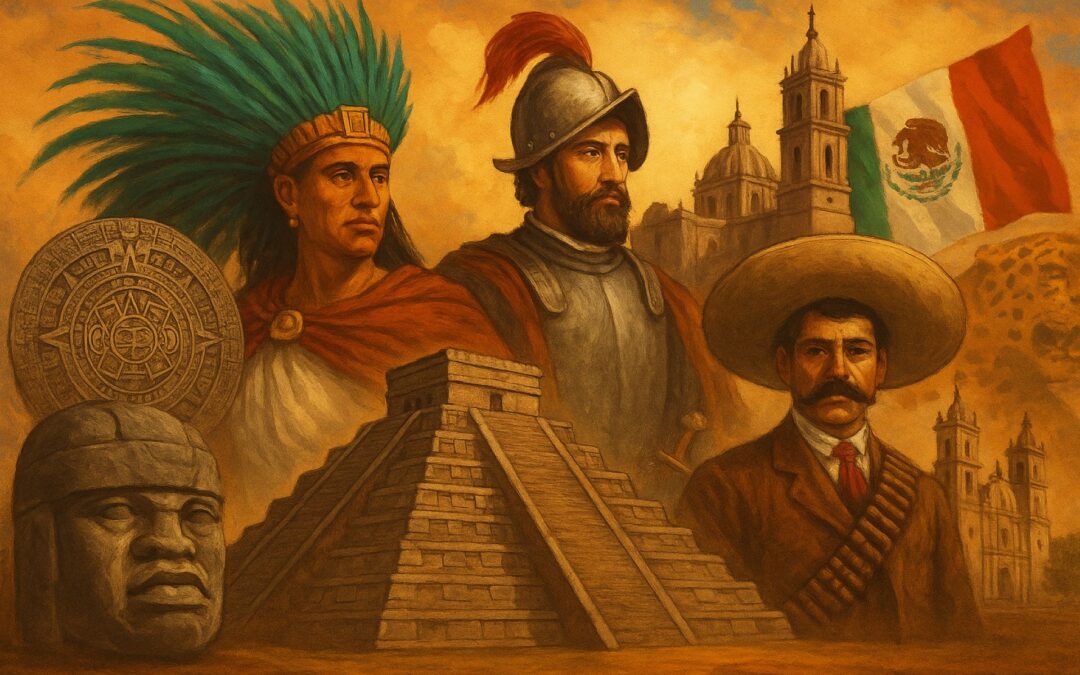
Mexico’s history is not a straight line but a mosaic—layer upon layer of civilizations, conquests, revolutions, and rebirths. It is a land where colossal stone heads gaze across millennia, where pyramids rise from jungle clearings, and where colonial cathedrals stand atop indigenous temples. Few nations have experienced such turbulence, yet few have emerged with such vibrancy.
The Mexico of today—renowned for its cuisine, art, music, and warmth—was forged through centuries of struggle, resilience, and cultural fusion. To understand the soul of modern Mexico is to journey through its past, tracing the footsteps of the Olmecs, Aztecs, conquistadors, revolutionaries, and everyday people who shaped its destiny.
The First Peoples and the Dawn of Civilization
The origins of Mexico’s story stretch back tens of thousands of years, long before temples and empires, to the time when the Americas were an untouched frontier. The first humans to arrive did so between 26,000 and 19,000 years ago, crossing the vast, frozen land bridge of Beringia that once linked Siberia to Alaska. These were not explorers in the modern sense but survivalists, chasing migrating herds across icy plains, armed with little more than stone-tipped spears and endurance. As they trickled southward, they encountered landscapes ranging from deserts to lush valleys, each shaping the way they hunted, gathered, and eventually settled.
By 11,000 years ago, rising seas severed this connection to Asia forever, sealing the Americas into isolation. Yet isolation proved fertile ground for innovation. In Mexico, the varied geography—from the volcanic highlands of the Valley of Mexico to the coastal plains of Veracruz—offered abundance. Early communities experimented with domesticating maize, beans, squash, and chili peppers. These “three sisters,” grown together, not only sustained diets but also symbolized an early understanding of ecology: maize stalks supported bean vines, while squash leaves shaded the soil.
The ability to produce surplus food freed people from the ceaseless demands of hunting. Villages took root. Pottery appeared, crafted not merely for function but also for ornament, bearing patterns that spoke of emerging ritual life. Religion became interwoven with the cycles of planting and harvest, the heavens and earth. Shamans and priests arose to interpret the mysteries of sun and rain.
Out of these early experiments in settled life came the Olmecs—widely regarded as the “mother culture” of Mesoamerica. Flourishing from 1200 to 400 BC in the fertile lowlands of Tabasco and Veracruz, they engineered ceremonial centers at San Lorenzo and La Venta. Their legacy was monumental, quite literally: colossal basalt heads, each weighing up to 40 tons, their features carved with astonishing detail. These heads, believed to represent rulers or warriors, remain among the most iconic artifacts of the ancient Americas.
The Olmecs also pioneered elements that would echo through later civilizations: blood rituals, jaguar symbolism, perhaps even a rudimentary writing system. Their decline around 300 BC was abrupt, but their imprint endured. Every civilization that followed—from the Maya to the Aztecs—drew upon their innovations, either consciously or through the cultural currents that flowed across Mesoamerica.
Teotihuacan and the Maya
In the centuries that followed the Olmec collapse, the Valley of Mexico became the stage for an urban experiment of unprecedented scale. Around 100 BC, settlers began laying out a city that would eventually awe all who came after: Teotihuacan, “the place where the gods were born.” Unlike earlier ceremonial centers, Teotihuacan was not just a site of ritual but a true metropolis. Its urban planning was meticulous—wide avenues aligned with celestial bodies, apartment compounds housing artisans and traders, and sprawling markets humming with activity.
By 500 AD, it was home to as many as 125,000 people, making it one of the largest cities in the world at the time, rivaling Rome or Chang’an. Its pyramids—most famously the Pyramid of the Sun and the Pyramid of the Moon—dominated the skyline. These were not mere monuments but living temples where priests conducted rituals to ensure cosmic balance. Murals painted on walls depicted gods, animals, and abstract symbols, offering glimpses into a worldview where religion and politics were inseparable.
Teotihuacan’s reach extended far beyond its valley. Obsidian, the volcanic glass prized for weaponry and ritual objects, was exported across Mesoamerica. Diplomats and merchants spread its influence to the Maya lowlands, Oaxaca, and even as far as Honduras. Its architecture and religious imagery became templates for other societies.
To the southeast, the Maya flourished in parallel. Their civilization spread across the Yucatán Peninsula, Belize, Guatemala, and Honduras. Unlike Teotihuacan, the Maya world was not a single empire but a constellation of city-states—Tikal, Calakmul, Palenque, Copán—each ruled by dynasties that claimed divine sanction. Their rivalry produced an arms race in architecture, ritual, and warfare.
The Maya achievements were profound. They developed the most sophisticated writing system in the Americas, carving stelae that recorded dynasties, wars, and cosmic events. They advanced mathematics, inventing the concept of zero independently, and created calendars that tracked not only solar years but also sacred cycles. Their astronomers observed Venus and eclipses with staggering accuracy, building observatories that rivaled those of later civilizations.
Yet beneath the brilliance lay fragility. By the 9th century, constant warfare between city-states drained resources. Deforestation and drought strained agriculture. Famine and unrest followed. One by one, great centers were abandoned—stone temples left to the encroaching jungle, glyphs silenced mid-story. Teotihuacan, too, had collapsed earlier, likely due to internal strife or environmental pressures.
The simultaneous unraveling of these civilizations remains one of history’s enduring mysteries. But from their ashes, cultural threads remained, to be woven into the fabric of future powers like the Toltecs and Aztecs.
The Toltecs and the Aztec Ascendancy
When Teotihuacan fell, it left behind not just ruins but a cultural template. From its shadow rose the Toltecs, who established their capital at Tula around the 10th century. Though smaller than Teotihuacan, Tula projected enormous symbolic and military influence. Its pyramid-topped temples were adorned with stone warrior columns, known as Atlantean figures, which stood like sentinels overlooking the city. These colossal statues represented Toltec ideals of militarism and discipline, underscoring their identity as both conquerors and cultural torchbearers.
Toltec power extended far into Mesoamerica. Their artisans spread innovations in metallurgy, pottery, and urban planning. They maintained religious traditions steeped in blood offerings but also elevated Quetzalcoatl—the feathered serpent deity—into a figure of profound importance. According to later Aztec accounts, the Toltec ruler Ce Acatl Topiltzin Quetzalcoatl was said to have been a wise king who renounced human sacrifice and was eventually exiled, vowing to return. Whether myth or history, this legend would later haunt the Aztecs when Hernán Cortés arrived centuries afterward.
By the 12th century, Tula itself had fallen into decline, undone by invasions and internal divisions. Yet the Toltec mystique endured. Later civilizations, especially the Aztecs, claimed Toltec ancestry to legitimize their own rule, treating them as paragons of wisdom and authority.
The Aztecs themselves began as wanderers—Chichimec nomads who migrated into the Valley of Mexico. For generations, they served as mercenaries for more established city-states until, in 1325, they founded their own settlement on a swampy island in Lake Texcoco. Legend tells of their god Huitzilopochtli directing them to settle where an eagle devoured a serpent atop a cactus, an omen still immortalized on the Mexican flag.
Tenochtitlan, their city, was a feat of engineering genius. They constructed chinampas, floating gardens that turned lakebeds into fertile farmland, feeding a growing population. Causeways linked the island to the mainland, aqueducts supplied fresh water, and markets bustled with goods from every corner of the empire. By the early 16th century, with a population nearing 200,000, Tenochtitlan rivaled or surpassed European capitals in scale and sophistication.
The Aztec Empire was forged through war and tribute. Their Triple Alliance—Tenochtitlan, Texcoco, and Tlacopan—expanded across central Mexico, demanding goods, labor, and captives from subject peoples. Gold, cacao, turquoise, feathers, and obsidian poured into the capital, enriching its rulers and dazzling outsiders. But wealth came at a price: resentment simmered among subjugated tribes forced to provide victims for human sacrifice, rituals the Aztecs believed were necessary to keep the sun moving across the sky.
Their empire, glittering and formidable, seemed unassailable. Yet beneath its grandeur lay vulnerabilities that would be exposed when Europeans set foot on their shores.
Conquest and Colonization
The year 1519 marked a turning point in Mexico’s destiny. Hernán Cortés landed on the Gulf Coast with just 500 men, 16 horses, and ironclad ambition. Outnumbered thousands to one, his success depended on audacity and cunning. He quickly grasped the fractures within the Aztec system—resentment among tributary states, rivalries between cities, and the fearsome reputation of Aztec sacrifice.
Cortés exploited these divides masterfully. He forged alliances with groups like the Tlaxcalans, long oppressed by Aztec tribute demands, turning them into indispensable partners. With their support, his expedition swelled into a formidable force. As they advanced inland, they were both astonished and appalled by Tenochtitlan—a city of canals and temples that rivaled Venice or Constantinople in splendor.
Initially, Emperor Moctezuma II received Cortés with caution, perhaps hoping diplomacy could avert disaster, or perhaps misled by omens and the old legend of Quetzalcoatl’s return. But tensions quickly erupted into violence. By 1521, after months of siege, famine, and disease, the once-great city lay in ruins. The Spaniards destroyed temples, leveled palaces, and drained the sacred lake. Moctezuma was dead, betrayed or killed in the chaos, and the empire that had ruled millions crumbled in less than two years.
Yet it was not steel or gunpowder alone that toppled the Aztecs. Smallpox, carried unknowingly by Europeans, tore through indigenous populations with horrifying speed. With no immunity, whole communities perished within weeks. It is estimated that within a century of conquest, up to 90% of Mexico’s native population had died from disease. The demographic collapse was as decisive as any battle.
On the ruins of Tenochtitlan, the Spaniards built Mexico City, the jewel of New Spain. The encomienda system forced indigenous people into labor on farms and mines, while vast silver deposits in Zacatecas and Guanajuato became lifelines of Spain’s global empire. Silver coins from Mexico circulated as far as China, fueling the first truly global economy.
Spanish rule imposed hierarchy: peninsulares (Spaniards born in Europe) at the top, creoles (Spanish-born in the Americas) just below, mestizos in the middle, and indigenous peoples and enslaved Africans at the bottom. Yet even amid oppression, cultures merged. Catholicism absorbed native rituals, saints blended with pre-Columbian deities, and celebrations like Día de los Muertos emerged from this fusion. Mariachi music, tequila distilled from agave, and vibrant artistic traditions embodied a new, syncretic identity.
Conquest had shattered the old world, but in its place, something distinctively Mexican began to take form—a hybrid culture that would outlast both Aztec empire and Spanish crown.
Independence and the First Republic
By the dawn of the 19th century, the wealth of New Spain glittered, but beneath its surface lay discontent. Spanish-born elites, or peninsulares, monopolized high offices, while criollos—Spaniards born in the Americas—chafed under their exclusion from power. Indigenous peoples bore the heaviest burdens: land dispossession, forced labor, and crushing tribute. The rigid caste hierarchy reinforced inequality, even as a uniquely Mexican identity—neither wholly Spanish nor wholly indigenous—began to emerge.
When Napoleon invaded Spain in 1808 and placed his brother Joseph Bonaparte on the throne, the entire empire was thrown into crisis. Questions of loyalty arose: should colonies obey a foreign king, or govern themselves? Into this uncertainty stepped Father Miguel Hidalgo y Costilla, a parish priest with radical ideas. On the night of September 15, 1810, in the small town of Dolores, Hidalgo rang the church bell and delivered the Grito de Dolores. He called on his parishioners—indigenous peasants and mestizos—to rise against Spanish oppression. The rebellion spread like wildfire.
Though Hidalgo was captured and executed in 1811, others carried the struggle forward. José María Morelos, another priest, organized armies and drafted documents envisioning independence, equality, and the abolition of slavery. His campaigns kept the dream alive until his execution in 1815. The insurgency then smoldered, led by guerilla leaders like Vicente Guerrero.
Ironically, it was a royalist officer, Agustín de Iturbide, who delivered the final blow to Spanish rule. Recognizing shifting tides, he allied with Guerrero in 1821 under the Plan of Iguala. Their tricolor flag proclaimed “Religion, Independence, and Unity.” The Spanish crown, exhausted and weakened by turmoil in Europe, could not hold Mexico. Independence was declared, and New Spain ceased to exist.
Yet independence did not mean stability. Iturbide crowned himself emperor of Mexico in 1822, attempting to fashion a monarchy. But suspicion, economic ruin, and opposition in Congress led to his abdication within a year. By 1823, the First Mexican Republic was born. Central America soon seceded, pursuing its own independence. The republic, plagued by bankrupt finances, weak institutions, and political factionalism, struggled to define itself. Presidents rose and fell with dizzying frequency. Rather than ushering in a golden age, independence opened a new chapter of uncertainty.
Loss, Reform, and Empire
The republic’s fragility became glaring in the decades that followed. Internal divisions—liberals versus conservatives, federalists versus centralists—prevented unity. At the same time, external pressures gnawed away at Mexico’s vast territory.
In the north, Mexico had invited American settlers into Texas, offering land grants in exchange for loyalty, Catholic conversion, and obedience to Mexican laws. Instead, settlers imported enslaved people, resisted authority, and clashed with the Mexican government. By 1836, they declared independence, sparking the Texas Revolution. The battles of the Alamo and San Jacinto became legendary, but for Mexico, they were bitter defeats. Texas remained a breakaway republic until its annexation by the United States in 1845.
The annexation ignited war. From 1846 to 1848, the Mexican-American War devastated the young nation. U.S. troops marched all the way to Mexico City, and in the Treaty of Guadalupe Hidalgo, Mexico lost nearly half its territory—lands that today encompass California, Arizona, New Mexico, Nevada, Utah, and parts of Colorado. For Mexico, it was a national catastrophe, a humiliation that deepened political instability and scarred its collective memory.
The aftermath was no kinder. Santa Anna, the dominant figure of the era, returned repeatedly to power, often selling territory—such as the Gadsden Purchase of 1854—in desperate bids to keep Mexico afloat. But each concession fueled outrage.
Then came the Reform era. Liberals pushed through the Constitution of 1857, enshrining secular education, dismantling church privileges, and promising land reform. Conservatives resisted fiercely, plunging Mexico into the bloody War of Reform (1857–1861). Benito Juárez, a Zapotec lawyer who rose from poverty to become president, embodied the liberal cause. By 1861, the liberals triumphed, but their victory came at immense financial cost.
Bankrupt, Mexico suspended foreign debt payments, provoking intervention by France, Britain, and Spain. While Britain and Spain withdrew, Napoleon III pressed forward, seeking to carve out a French empire in the Americas. In 1864, Archduke Maximilian of Austria was installed as Emperor of Mexico with conservative support. For a moment, Mexico once again had a monarch.
But Maximilian’s reign was doomed. Though benevolent in some policies—supporting land reforms and offering amnesty—he alienated conservatives while failing to win broad support from liberals. Juárez never recognized his rule, and Mexican republicans waged a relentless guerrilla campaign. When French troops withdrew in 1867, Maximilian was abandoned. Captured, he was executed by firing squad—a grim symbol of foreign overreach.
The republic was restored under Juárez, but the cycle of upheaval was far from over. Mexico had survived conquest, secession, and foreign empire, yet the price was steep: economic exhaustion, political scars, and a society still struggling to reconcile liberty with stability.
The Porfiriato and Revolution
The restoration of the republic after Maximilian’s fall did not guarantee peace. Mexico continued to stagger under coups, assassinations, and bitter rivalries until 1876, when a charismatic general named Porfirio Díaz seized power. With his rallying cry of “No re-election,” Díaz promised to end instability. Ironically, he would remain in power—either directly or through puppets—for over three decades. This era became known as the Porfiriato.
Díaz transformed Mexico into a modernizing powerhouse. Railroads snaked across the country, binding distant regions into a single market. Telegraph lines buzzed with instant communication. Factories and mines flourished with heavy foreign investment, particularly from the United States and Britain. Cities like Mexico City, Guadalajara, and Monterrey began to echo European capitals, with boulevards, opera houses, and electric lighting. The economy surged; exports of silver, copper, henequen, and oil made Mexico a rising player in global trade.
Yet this prosperity came at an enormous social cost. Land was concentrated in the hands of a tiny elite and foreign corporations, while millions of peasants were stripped of communal holdings and forced into debt peonage on vast haciendas. Indigenous communities, long marginalized, now faced even deeper dispossession. Political freedoms shrank as Díaz suppressed opposition, censored dissent, and ruled through a careful balance of patronage and intimidation. His motto, “Order and Progress,” brought stability, but it was stability built on repression.
By 1910, discontent had reached a boiling point. Díaz, in his 80s, declared Mexico ready for democracy and promised not to run again. But when reformist candidate Francisco Madero challenged him, Díaz reversed course and rigged the election. The betrayal ignited fury. Madero called for revolt, and across Mexico, uprisings erupted.
The Mexican Revolution had begun. It was not a single movement but a storm of overlapping struggles: peasants demanding land, workers demanding rights, and revolutionaries demanding democracy. Pancho Villa, the charismatic bandit-general of the north, rallied armies of cowboys and laborers. Emiliano Zapata, in the south, mobilized peasants under the banner of “Tierra y Libertad”—land and liberty. Together, they embodied the voice of the dispossessed.
Díaz fled into exile in 1911, but stability remained elusive. Madero assumed the presidency, yet his moderate reforms angered radicals and conservatives alike. In 1913, he was overthrown and murdered in a coup led by General Victoriano Huerta. Civil war intensified. The country fractured into warring factions—Huerta’s dictatorship, Carranza’s constitutionalists, Villa’s northern cavalry, and Zapata’s peasant militias. Alliances shifted constantly, assassinations claimed leaders one after another, and entire regions descended into chaos.
By 1920, after a decade of bloodshed, millions were dead, cities lay in ruins, and fields were scorched. Yet out of this upheaval came new foundations: land redistribution, labor rights, and a search for a distinctly Mexican identity rooted in its revolutionary struggle.
Modern Mexico: From Miracle to Crisis
The revolution’s legacy was institutionalized under the Partido Revolucionario Institucional (PRI), founded in 1929. For the rest of the 20th century, this party would dominate Mexican politics, presenting itself as the guardian of revolutionary ideals while exercising near-absolute control. Presidents rotated every six years in a carefully managed system, ensuring continuity while preventing the rise of dictatorships.
The early decades under the PRI witnessed steady consolidation. In the 1930s, President Lázaro Cárdenas carried out sweeping land reforms and nationalized the oil industry, creating PEMEX, a cornerstone of Mexican sovereignty. His populist policies cemented the revolution’s promises in concrete form.
By the 1940s and 1950s, Mexico entered a period of remarkable growth known as the Mexican Miracle. Industrialization accelerated; highways, dams, and factories transformed the landscape. Cities swelled as millions left the countryside in search of jobs. Middle-class life expanded, complete with education, housing, and consumer goods that mirrored those of the developed world. Internationally, Mexico’s role as a U.S. ally during World War II and a reliable trading partner elevated its standing.
But prosperity masked fragility. Growth was uneven—urban elites thrived while rural communities stagnated. By the 1960s and 70s, cracks widened. Rapid urbanization strained infrastructure, corruption hollowed institutions, and oil wealth led to reckless borrowing. When oil prices collapsed in the early 1980s, Mexico spiraled into debt crises. The peso plummeted, banks were nationalized, and inflation devastated savings.
Political legitimacy also faltered. The PRI’s one-party rule grew increasingly hollow, marked by electoral fraud and authoritarian crackdowns. The 1968 Tlatelolco massacre, where government forces opened fire on student protesters just before the Mexico City Olympics, left deep scars on public trust.
Then came disaster in 1985. A devastating earthquake leveled parts of Mexico City, killing thousands. The government’s slow and incompetent response shocked citizens into recognizing the hollowness of PRI governance. Civil society groups, neighborhood brigades, and volunteers stepped in where the state failed, marking a new era of grassroots political awakening.
By the end of the century, the PRI’s grip weakened. In 2000, Vicente Fox of the PAN party won the presidency, ending 71 years of single-party dominance. Yet democracy brought new challenges. The drug trade, already entrenched, erupted into cartel wars, claiming tens of thousands of lives. Economic inequality persisted, corruption remained endemic, and political polarization deepened.
Still, Mexico endured. Its culture—art, music, film, and cuisine—flourished globally. From Frida Kahlo’s self-portraits to Alfonso Cuarón’s films, Mexico projected creativity onto the world stage. Festivals like Día de los Muertos and the vibrancy of mariachi music became global symbols of joy and resilience.
Modern Mexico stands at a crossroads: a nation of immense cultural capital and economic potential, yet still shadowed by violence and inequality. Its history of survival, however, suggests a pattern—every crisis is met with reinvention, every collapse with resurgence. It is this resilience, etched into the Mexican spirit, that continues to define the country today.
Mexico Today
Mexico in the 21st century is a nation of contrasts—an intricate tapestry woven from its ancient past, colonial encounters, revolutionary upheavals, and modern aspirations. Its global image is often defined by vibrancy: mariachi bands filling plazas with song, the aroma of street tacos drifting through city streets, and the kaleidoscope of colors at Día de los Muertos altars. Yet beneath the celebration lies a country still grappling with enduring challenges.
Culturally, Mexico is a powerhouse. Its cuisine, from humble corn tortillas to complex mole poblano, has been recognized by UNESCO as intangible cultural heritage. Its visual arts, shaped by titans such as Diego Rivera and Frida Kahlo, remain symbols of defiance and identity. Its literature, embodied in the works of Octavio Paz or contemporary voices like Valeria Luiselli, reflects a profound engagement with history, politics, and human longing. Mexican cinema has won global acclaim, producing Academy Award–winning directors like Alejandro González Iñárritu, Alfonso Cuarón, and Guillermo del Toro. Few nations fuse history and modernity into cultural production as seamlessly as Mexico does.
Economically, the nation is deeply integrated into North America. The 1994 North American Free Trade Agreement (NAFTA), and its successor the United States–Mexico–Canada Agreement (USMCA), tethered Mexico’s economy to its northern neighbors. Factories along the border churn out automobiles, electronics, and textiles for global markets. Tourism, too, is a lifeline: from the turquoise beaches of Cancún to the ancient ruins of Chichén Itzá, millions of visitors fuel local economies each year. Remittances sent by Mexicans abroad, particularly from the United States, remain one of the country’s largest sources of income, underscoring both opportunity and dependency.
Yet challenges loom large. Inequality remains one of the starkest in the OECD. While neighborhoods of Mexico City boast skyscrapers and luxury boutiques, rural Oaxaca or Chiapas struggle with poverty and underdevelopment. Corruption corrodes public trust, and government institutions often falter under the weight of inefficiency or political interference. Most acutely, cartel violence continues to exact a heavy toll. The so-called “war on drugs,” launched in the mid-2000s, has spiraled into a complex conflict involving rival cartels, fragmented criminal groups, and state forces. Entire regions live under the shadow of extortion, kidnapping, and bloodshed, even as ordinary citizens carry on with resilience.
Politically, Mexico is no longer the one-party state of the PRI era, but its democracy is still fragile. Power alternates between major parties, yet accusations of corruption, electoral manipulation, and populist rhetoric often cloud governance. Leaders promise reform, but deep structural issues resist easy solutions. Still, the democratic transition has empowered civil society: journalists, activists, and grassroots movements now play a critical role in holding power accountable, despite facing immense risks.
Socially, Mexicans display a remarkable capacity for joy and endurance. In the aftermath of earthquakes, pandemics, or violence, neighbors form brigades, artists respond with murals, and communities find ways to celebrate life even amid adversity. The ethos of convivencia—living together, sharing life—remains strong. Festivals like Independence Day and Día de los Muertos are not just rituals but affirmations of survival and identity.
Mexico today is thus neither simply a story of crisis nor solely one of triumph. It is a nation in motion, negotiating its contradictions while celebrating its essence. From the colossal Olmec heads to the neon skyline of Monterrey, from the sacred pyramids of Teotihuacan to the bustling markets of Oaxaca, the country embodies resilience through reinvention. Its people, carrying the legacies of every era, continue to find ways not only to endure but to thrive—transforming hardship into culture, memory into art, and history into a living rhythm that beats at the heart of modern Mexico.
Conclusion
From the earliest hunter-gatherers who crossed into the Americas to the sprawling metropolis of Mexico City, Mexico’s story is one of survival and reinvention. Ancient civilizations rose and fell, European conquest reshaped the land, revolutions redrew its identity, and modern challenges continue to test its resolve.
Yet through every upheaval, the Mexican spirit has endured—celebratory, resilient, and unyielding. Its people have learned not merely to survive history’s storms but to transform them into art, ritual, and community. Today, Mexico stands as a nation defined not just by its past but by its ability to keep reimagining its future—always with color, rhythm, and an undying zest for life.