
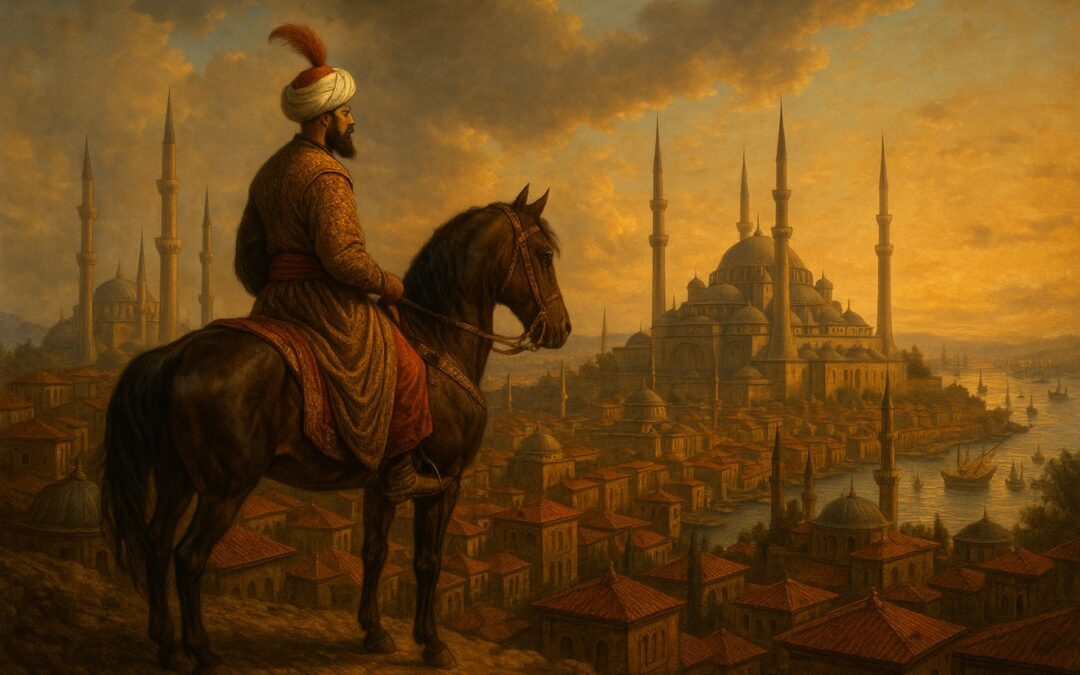
The Ottoman Empire was not born mighty—it grew from the ambitions of a frontier warlord in Anatolia into one of the most formidable empires in history. For over six centuries, it shaped the destinies of Europe, the Middle East, and North Africa. Its armies stood at the gates of Vienna, its fleets ruled the Mediterranean, and its cities became crossroads of culture, commerce, and faith.
Yet, like all empires, it too faced decline, fractures, and eventual collapse. To follow its history is to witness the drama of rise and fall: conquest and tolerance, grandeur and stagnation, reform and revolution. The Ottoman story is more than a tale of power—it is a mirror of how civilizations endure, adapt, and ultimately transform.
The Origins: Turkic Migrations and the Seljuk Legacy
The story of the Ottoman Empire begins not in Anatolia, but thousands of miles eastward on the boundless grasslands of Central Asia. These vast steppes were home to Turkic tribes—nomadic peoples whose lives revolved around the rhythm of horses, herds, and warfare. They were masters of mobility, able to cover enormous distances in days, armed with the composite bow that could rain arrows with deadly precision even at full gallop.
By the 7th century, Turkic groups were established near the Altai Mountains, straddling the frontiers of present-day Mongolia, Kazakhstan, and Russia. Their way of life was dictated by survival: moving with the seasons, clashing with rival tribes, and forging loose confederations when necessity demanded. As centuries passed, the push westward continued. Some tribes halted around the Caspian and Aral Seas, adapting to a semi-nomadic lifestyle where fertile pastures met caravan routes.
Among these groups, the Oghuz Turks gained prominence. In the late 10th century, a leader named Seljuk broke from the Oghuz confederation and carved out his own dominion. His rise was no mere tribal skirmish; it marked the birth of a dynasty. The Seljuks moved into Persia, absorbing not only land but culture. Persian became the language of their court, their bureaucracy, and their literature. Islam, already spreading through the region, became their binding faith. This synthesis of nomadic vigor and Persian sophistication produced a formidable new power.
By the mid-11th century, the Seljuks had advanced into Anatolia, culminating in their decisive victory over the Byzantines at the Battle of Manzikert in 1071. This moment opened the gates of Asia Minor to Turkic settlement. Waves of tribes poured into the region, establishing footholds in territories once thought invincible.
Yet like many empires, the Seljuks’ brilliance burned brightly but briefly. Internal rivalries, external pressures, and the ceaseless centrifugal pull of nomadic politics led to fragmentation. By the 13th century, Anatolia was no longer dominated by one strong hand but instead dotted with smaller states—beyliks—ruled by Turkish warlords. These petty principalities warred, allied, and schemed in the ruins of Seljuk authority. Out of this mosaic of fractured power, one clan—led by an obscure chieftain named Osman—would rise to reshape history.
Osman and the Rise of a Dynasty
Osman I was not born into greatness. His principality was modest, perched in northwestern Anatolia near the Byzantine frontier, an area of constant skirmishes and shifting borders. Yet geography proved both a challenge and an opportunity. To the east lay rival Turkish beyliks, each vying for dominance. To the west, the once-mighty Byzantine Empire lingered in decline, reduced to little more than its capital, Constantinople, and scattered holdings in the Balkans and Greece.
Osman understood that survival meant expansion. He launched raids into Byzantine territories, striking weakly defended outposts and towns. These ghazi warriors, fueled by both faith and ambition, carved a reputation as fierce fighters. Success bred momentum. Villages joined willingly, lured by promises of protection, plunder, and the rising prestige of Osman’s banner.
By 1331, under Osman’s successors, the Ottomans captured Nicaea, a city of symbolic and strategic weight. Just a few decades later, in 1369, Adrianople (modern Edirne) fell and was made their capital. Situated at the crossroads of the Balkans and Anatolia, it gave the Ottomans a springboard into southeastern Europe.
The Byzantines, once the titans of the eastern Mediterranean, could only watch as their empire shrank around Constantinople’s walls. Ottoman armies pressed further into the Balkans, subduing Serbia, Bulgaria, and Albania. In just over a century from Osman’s time, the dynasty had transformed from a minor frontier principality into a power poised to rival kingdoms and empires.
Though Osman’s life is cloaked in legend—half remembered through oral tradition, half mythologized by later chroniclers—his legacy is beyond dispute. He gave the dynasty its name, its first conquests, and its enduring ethos: relentless expansion, shrewd pragmatism, and an unyielding vision of dominion.
The Fall of Constantinople
For centuries, Constantinople had loomed as the jewel of the eastern Mediterranean—a city of colossal walls, glittering churches, and unmatched strategic value. Founded by Constantine the Great in the 4th century, it had withstood countless sieges by Persians, Arabs, Rus, and even Crusaders. By the mid-15th century, however, it was a ghost of its former glory. The Byzantine Empire had shrunk to little more than the city itself and a few scattered enclaves. Its once-proud walls still stood strong, but the empire behind them was hollow.
When Mehmed II ascended the Ottoman throne in 1451, he was just 19 years old. But he possessed both the ambition and the resources to achieve what his predecessors had long dreamed: the capture of Constantinople. He prepared meticulously. Fortresses such as Rumeli Hisarı were built along the Bosphorus to choke off supplies and reinforcements from the Black Sea. Artillery, an emerging force in medieval warfare, was commissioned from master cannon-makers. Among them was the Hungarian engineer Orban, who cast the massive bombard that could hurl stone balls weighing half a ton against the city’s walls.
On April 6, 1453, the siege began. For nearly seven weeks, thunderous cannon fire shook Constantinople day and night. Inside, Emperor Constantine XI marshaled a small garrison—fewer than 10,000 men against perhaps 80,000 Ottomans. The defenders patched breaches with earthworks, hurled Greek fire, and prayed for aid that never arrived. The Venetian and Genoese fleets could not break the Ottoman naval blockade.
On May 29, the final assault came. Waves of Ottoman troops hurled themselves at the walls, first irregulars, then the disciplined Janissaries. Exhausted, outnumbered, and surrounded, the Byzantine defenders crumbled. Constantine XI himself is said to have cast off his imperial regalia and died sword in hand amidst his soldiers.
The fall of Constantinople sent shockwaves across Europe. To many, it marked the end of the Middle Ages. The city, rechristened Istanbul, became the capital of a new Islamic empire, straddling both Europe and Asia. The Hagia Sophia, crown jewel of Byzantine Christendom, was converted into a mosque, its domes now framed by soaring minarets. Trade routes shifted, scholars fled westward bringing classical knowledge with them, and the balance of power in the Mediterranean tipped irrevocably toward the Ottomans. Mehmed II had achieved immortality—he was remembered thereafter as “Mehmed the Conqueror.”
Expansion Across Continents
The conquest of Constantinople was not the end but the ignition of a century of Ottoman triumphs. Mehmed II pushed his armies into Greece, taking the Peloponnese, and then turned north into the Balkans. Bosnia, Serbia, and Albania were absorbed into the empire. He even sent expeditions into the Crimea, establishing Ottoman influence on the northern shores of the Black Sea. When Mehmed died in 1481, his empire stretched across two continents, and his successors were determined to extend it further.
Bayezid II consolidated these gains and confronted Venice, the maritime republic that dominated trade in the eastern Mediterranean. The conflict, fought between 1499 and 1503, saw the Ottomans seize key ports and assert control over vital shipping lanes. With this victory, the Aegean became an Ottoman sea.
Selim I, ruling from 1512 to 1520, shifted the empire’s focus southward. Known for his ruthlessness, he turned against the Mamluk Sultanate of Egypt. In 1517, after decisive victories at Marj Dabiq and Ridaniya, he annexed Syria, Egypt, and the holy cities of Mecca and Medina. With this, the Ottomans became not just an empire but the spiritual guardians of Islam. North Africa followed, as local rulers in Algeria and Tunisia became Ottoman vassals, bringing the empire to the edge of the Atlantic.
The 16th century reached its climax under Suleiman the Magnificent. For nearly half a century (1520–1566), he embodied Ottoman grandeur. In Europe, his armies crushed the Hungarians at Mohács in 1526, carving a path toward Vienna. Twice his forces laid siege to the Austrian capital, pressing deep into Central Europe. In the Mediterranean, his navy, led by the legendary admiral Barbarossa, clashed with Christian fleets, capturing Rhodes, Tripoli, and Tunis. His reach extended eastward into Mesopotamia, where Ottoman banners flew over Baghdad and Basra, securing dominance over the Persian Gulf.
By the time of Suleiman’s death, the empire spanned three continents. From Hungary’s plains to the deserts of Arabia, from the mountains of Algeria to the shores of the Caspian, it was one of the most formidable states in history. Its wealth flowed through Istanbul, now a thriving capital of trade, culture, and religion.
The Janissaries: An Engine of Power
No institution better embodied the Ottoman war machine than the Janissary corps. They were unlike any other military force of their age—a blend of discipline, loyalty, and innovation that made them the envy and terror of Europe. Their origins lay in the devshirme system, a levy imposed on Christian populations in the Balkans and Anatolia. Boys, often between the ages of 8 and 14, were taken from their families, converted to Islam, and subjected to rigorous training that forged them into soldiers wholly devoted to the Sultan.
Though the practice was harsh, the opportunities it created were undeniable. A boy of peasant birth could rise to become not just a Janissary officer but a vizier, a provincial governor, or even grand vizier, the Sultan’s right hand. In this way, the Janissary corps also became a ladder of social mobility, binding the conquered to the empire with both fear and aspiration.
Unlike feudal levies in Europe, Janissaries were professional soldiers. They were salaried, housed in barracks, and drilled relentlessly. They mastered firearms earlier than most European armies, giving the Ottomans a decisive edge on the battlefield. Their formations combined arquebusiers with pikemen, creating a deadly balance of ranged firepower and close-quarters defense. Behind them thundered Ottoman cannons—some of the most advanced artillery in the world.
The Janissaries’ loyalty was legendary. They were forbidden from marrying or engaging in trade during their service, ensuring that their lives remained tethered to military duty. They marched under the white banner of the Sultan, carrying their kettledrums and standards into battle with a ritualistic solemnity that made them both soldiers and symbols. To enemies, they were a nightmare—unflinching, disciplined, and seemingly endless in number. To the Ottomans themselves, they were the steel backbone of imperial expansion.
Over time, however, their immense influence became a double-edged sword. As the centuries passed, Janissaries grew entrenched in politics, resistant to reform, and more concerned with privileges than discipline. But in their prime—particularly during the 15th and 16th centuries—they were the cutting edge of Ottoman power, the unstoppable spear that drove the empire across three continents.
Wars with Christendom
From the mid-16th century onward, the Ottoman Empire was locked in a titanic struggle with Christian Europe. The battlegrounds were as varied as they were vast: the Mediterranean Sea, the Balkans, and the plains of Central Europe. Each clash was more than a contest of arms—it was a struggle for supremacy between civilizations.
The Mediterranean was the first great theater. For the Ottomans, dominance of the sea lanes meant control over trade and the ability to project power westward. Suleiman’s navy, commanded by the brilliant corsair-turned-admiral Hayreddin Barbarossa, became a formidable force. Under his leadership, the Ottomans humbled the fleets of Spain and Venice, seizing strongholds such as Tunis and Tripoli. Yet the Christian powers rallied.
The Siege of Malta in 1565 epitomized this struggle. The island, ruled by the Knights of St. John, blocked Ottoman access to the western Mediterranean. Suleiman dispatched an armada and tens of thousands of troops to capture it. The siege was brutal—fortresses shattered by cannon fire, defenders fighting to the last—but ultimately, the Ottomans were repelled. The failure marked one of the first serious checks to Ottoman naval ambitions.
Six years later, in 1571, the contest reached its bloody climax at the Battle of Lepanto. Off the coast of Greece, over 400 ships and 130,000 men clashed in one of history’s greatest naval battles. The Holy League—a coalition of Spain, Venice, and the Papal States—destroyed much of the Ottoman fleet. Though the empire rebuilt quickly, Lepanto shattered the myth of Ottoman naval invincibility. It was a symbolic turning point, proof that Christian Europe could resist and even defeat the empire at sea.
On land, the Balkans and Central Europe bore the brunt of Ottoman ambitions. After their decisive victory at Mohács in 1526, Hungary was split, with much of it absorbed into the empire. Vienna became the next prize. In 1529, Suleiman marched his armies to its gates, but weather, logistics, and stubborn defenders forced him to retreat. Over a century later, in 1683, the Ottomans returned under Grand Vizier Kara Mustafa Pasha with an army of 150,000. For weeks, Vienna seemed doomed. Then, on September 12, a relief force led by Polish King John III Sobieski arrived. In what became the largest cavalry charge in history—18,000 horsemen thundering downhill—the Christian coalition broke the Ottoman lines and sent their army fleeing.
That defeat was more than a failed siege; it was a pivot in history. From Vienna in 1683 onward, Ottoman expansion into Europe halted forever. The wars with Christendom had once promised domination of the continent. Instead, they marked the beginning of Ottoman contraction, as Europe’s military and technological ascendancy began to eclipse that of the once-mighty empire.
The Slow Decline
By the late 17th century, the Ottoman Empire had shifted from relentless expansion to an uneasy stagnation. The sultans who once led their armies across continents were now more often secluded within the gilded walls of Topkapı Palace, surrounded by concubines, courtiers, and intrigue. The empire that had once been propelled by the personal energy of warrior-rulers began to drift, its helm increasingly steered by viziers, bureaucrats, and palace factions.
The machinery of government remained formidable on paper. Taxes flowed from the provinces into the capital, sustaining a large standing army and a sprawling bureaucracy. But the system had grown complacent, and corruption seeped into its gears. Governors in far-flung provinces exercised increasing autonomy, sometimes ruling as semi-independent princes under the veneer of Ottoman authority. What had once been a centralized, expansionist machine began to fray into a looser collection of territories held together by inertia and tradition.
Economically, the empire’s fortunes dimmed as the world’s trade arteries shifted. For centuries, the Silk Road had funneled goods from Asia through Ottoman lands, enriching cities like Aleppo, Damascus, and Constantinople. But the rise of Atlantic trade routes changed everything. Portuguese caravels and Spanish galleons bypassed the empire entirely, carrying silver from the Americas and spices from the Indian Ocean directly to Western Europe. The Ottomans, once gatekeepers of East–West commerce, found themselves sidelined. Their coffers dwindled, their currency depreciated, and smuggling undercut state revenues.
Despite these weaknesses, the empire retained its cosmopolitan character. The millet system granted autonomy to religious communities, allowing Christians, Jews, and other minorities to govern their own affairs under the overarching authority of the Sultan. Far from being a monolithic Islamic state, the empire became a haven for diversity. Jews expelled from Spain found refuge in Ottoman cities like Thessaloniki, which by the early 16th century had a Jewish majority. Armenian merchants, Greek shipowners, and Arab scholars all flourished within the Ottoman fold.
But tolerance could not mask decline. By the early 18th century, the Ottoman military—once the terror of Europe—had fallen behind. Janissaries resisted modernization, clinging to outdated privileges and tactics. European rivals surged ahead, embracing the scientific revolution, firearms innovations, and naval supremacy. While European monarchs restructured their states for efficiency, the Ottoman system remained trapped in ritual and conservatism. The empire, once feared, was now increasingly seen as vulnerable—a giant weakened by age and hesitation.
The 19th Century: The Empire Fractures
If the 18th century was a time of stagnation, the 19th was an era of unraveling. The empire earned a grim epithet: “the sick man of Europe.” Nationalist movements, foreign invasions, and internal decay gnawed at its body until only fragments remained.
The first shock came in the Balkans. In 1804, the Serbs rose in revolt, challenging centuries of Ottoman domination. Though brutally suppressed at first, the uprising ignited a chain reaction. The Greek War of Independence, beginning in 1821, galvanized European support. Britain, France, and Russia intervened on Greece’s behalf, seeing both a Christian cause and an opportunity to weaken the Ottomans. The decisive naval Battle of Navarino in 1827 shattered Ottoman–Egyptian fleets, paving the way for Greek independence in 1829.
As Greece emerged, so too did Romania, Serbia, and Bulgaria, gradually winning autonomy or outright independence over the following decades. Each loss chipped away at the empire’s European heartland, territories that had once been the jewel of Ottoman conquest.
Meanwhile, European colonial powers seized Ottoman provinces abroad. France invaded Algeria in 1830, planting the seeds of its North African empire. Italy followed decades later, wresting Libya from Ottoman hands. Even Egypt, though nominally under Ottoman sovereignty, slipped into de facto independence under the rule of Muhammad Ali and his dynasty, who modernized the region and played European powers against each other.
Russia loomed as the most dangerous predator. Determined to expand southward, it fought a series of wars with the Ottomans, clawing away territories in the Caucasus, Crimea, and the Balkans. By the mid-19th century, Russia seemed poised to carve up the empire entirely. Alarmed, Britain and France intervened—not out of love for the Ottomans, but to preserve the balance of power in Europe. The Crimean War (1853–1856) pitted Western powers and the Ottomans against Russia, ending in a temporary reprieve for the empire. Yet the war revealed the Ottomans’ dependence on foreign support, a stark contrast to the days when they had stood as an independent colossus.
Even with these external blows, internal weakness compounded the crisis. Reform movements known as the Tanzimat sought to modernize the state—introducing new legal codes, modern schools, and reorganized armies modeled after Europe. Yet these reforms were uneven, resisted by conservative elites and undermined by corruption. While they slowed the empire’s collapse, they could not reverse it.
By the late 19th century, Ottoman losses had become routine. Bosnia slipped into Austro-Hungarian control, Tunisia fell to France, and waves of Balkan nationalism stripped the empire of nearly all its European territories. Each retreat was not just a territorial loss but a psychological wound, feeding the perception that the once-mighty empire was now little more than a relic waiting to be dismantled.
The Young Turks and Reform
By the dawn of the 20th century, the Ottoman Empire stood at a crossroads. Its dominions had shrunk, its economy lagged far behind Europe’s industrial powers, and its prestige as a great empire had long since faded. The phrase “sick man of Europe” was now a familiar refrain in the chancelleries of London, Paris, and Vienna. Within the empire itself, younger generations of intellectuals, officers, and bureaucrats looked at the crumbling edifice around them and demanded change.
Out of this ferment emerged the Young Turks, a coalition of reformist groups united less by a shared ideology than by a shared frustration with imperial decay. Many of them were educated in European-style schools or military academies, exposed to new currents of nationalism, constitutionalism, and liberalism. They envisioned an Ottoman state reborn through modernization: a constitutional monarchy, a representative parliament, and a streamlined civil service that could stand alongside Western powers as an equal.
In 1908, their movement reached its crescendo. Discontent within the military and mounting pressure in the provinces created the perfect storm for revolution. Young Turk officers marched on Istanbul, forcing Sultan Abdulhamid II to restore the suspended constitution of 1876 and reconvene parliament. For a brief moment, it seemed as though the Ottoman Empire might yet rejuvenate itself. Cities buzzed with political debate, newspapers flourished, and reformers spoke with the fervor of revival.
Yet unity soon unraveled. The Young Turks were not a monolith but a patchwork of factions—liberal intellectuals, secular bureaucrats, Islamic conservatives, and ambitious military men. Some sought to preserve the empire’s multiethnic character, while others pushed for Turkish nationalism as the glue to hold the state together. Tensions erupted into coups, countercoups, and political assassinations. Far from stabilizing the empire, the Young Turks’ revolution exposed its fractures.
Nevertheless, the reforms of this period reshaped Ottoman politics. Modern schools and railways were expanded, legal codes updated, and the army restructured. The Committee of Union and Progress (CUP), the dominant Young Turk faction, gradually seized power, ruling with an authoritarian hand in the years leading up to the First World War. Their promise of revival remained only half-fulfilled, but their rise marked the empire’s final attempt to modernize itself before collapse.
The First World War and Final Collapse
When war erupted in the summer of 1914, the Ottoman Empire stood on the edge of survival. Its leaders faced a stark choice: remain neutral and risk encirclement, or gamble on an alliance that might restore its fortunes. Tempted by promises of lost territories and wary of Russian expansion, the Ottomans cast their lot with Germany and Austria-Hungary, joining the Central Powers.
At first, the gamble seemed to pay off. In 1915, Ottoman troops under Mustafa Kemal dealt Britain and its allies a stunning defeat at Gallipoli, turning the Dardanelles into a graveyard for invading forces. The victory electrified the empire and offered a fleeting glimpse of its old martial glory. Yet elsewhere, calamity struck. In the deserts of Arabia, the British orchestrated the Arab Revolt, led in part by the enigmatic T.E. Lawrence. Arab tribes rose against Ottoman rule, capturing key cities and severing the empire’s hold over the Levant.
Worse still was the shadow of atrocity. In 1915, Ottoman authorities unleashed mass deportations and massacres of Armenians, whom they accused of collaborating with Russia. What followed was systematic extermination: forced marches, starvation, and slaughter that claimed over a million lives. The Armenian genocide left an indelible scar on history and stained the empire’s final years with blood.
On the battlefields, Ottoman fortunes collapsed. Russian armies pressed into eastern Anatolia. British troops advanced from Egypt, seizing Palestine, Syria, and Mesopotamia. By 1918, Ottoman forces were shattered on multiple fronts, their supply lines exhausted, their soldiers demoralized. When Germany sued for peace that autumn, the Ottomans followed, signing the Armistice of Mudros.
The aftermath was catastrophic. Allied forces occupied Istanbul, and the empire’s Arab provinces were carved up between Britain and France under the guise of League of Nations mandates. Greece advanced into western Anatolia, Italy seized southern territories, and the empire’s last vestiges seemed poised for dismemberment. The once-great state, which for centuries had dominated three continents, was reduced to a shadow of Anatolia itself.
Yet from this ruin would rise something new. Turkish nationalists, led by Mustafa Kemal Atatürk, rejected partition and waged a fierce war of independence. Their eventual victory in 1923 abolished the Ottoman Sultanate and birthed the Republic of Turkey, bringing six centuries of imperial history to a dramatic close.
The Turkish War of Independence
The empire’s defeat in the First World War left its heartland exposed to foreign occupation and its people humiliated. Istanbul, the once-proud capital of the Ottomans, was occupied by Allied troops. Greece landed forces in İzmir in May 1919, advancing deep into Anatolia with dreams of reclaiming lands that had been Byzantine centuries earlier. Italy sought influence along the southern coast, and France pressed its claims in Cilicia. It seemed that the Ottomans—already stripped of their Arab provinces—were to be carved apart entirely.
In this atmosphere of despair, resistance coalesced. At its center was Mustafa Kemal, a former Ottoman general celebrated for his defense of Gallipoli. Kemal saw that the sultan’s government in Istanbul was powerless, even complicit, in submitting to Allied dictates. He rallied nationalist officers, intellectuals, and villagers to a new cause: not defending the Ottoman throne, but establishing an independent Turkish republic.
The struggle that followed was fierce and multifront. In the west, Turkish forces fought bitter campaigns against the Greeks, who had advanced far inland by 1921. In the east, clashes erupted with Armenian forces seeking independence. In the south, nationalists battled French troops and local militias. The movement was not merely military but political: in Ankara, far from occupied Istanbul, Kemal and his allies convened a Grand National Assembly, declaring themselves the legitimate government of Turkey.
By 1922, the tide had turned. The nationalists launched a series of offensives that drove the Greeks back toward the Aegean, culminating in the recapture of İzmir. French and Italian forces withdrew, unwilling to continue a costly war. The Sultan, increasingly irrelevant, fled into exile. What remained was a nation united under Kemal’s leadership, hardened by struggle and animated by a vision of sovereignty.
The final settlement came with the Treaty of Lausanne in 1923. It recognized the borders of the new Republic of Turkey and secured international legitimacy for the nationalist government. Ankara, not Istanbul, was chosen as the new capital, symbolizing a break from imperial tradition and a turn toward modernity. With the abolition of the Sultanate, six centuries of Ottoman rule ended in law as well as fact. The Turkish War of Independence was not only a military victory but a rebirth, turning the ruins of empire into the foundations of a nation-state.
Legacy of the Empire
The fall of the Ottoman Empire in 1923 marked the end of one of history’s longest-lived dynasties, but its legacy continues to echo across continents. For over six centuries, the empire had shaped the political, cultural, and religious landscapes of Europe, Asia, and Africa. Its impact cannot be confined to Turkey alone—it reverberates from the Balkans to North Africa, from the Middle East to Central Europe.
Culturally, the Ottomans left behind a mosaic. Their architectural marvels—the domes and minarets of Istanbul, the palaces of Edirne, the mosques of Damascus and Cairo—still dominate skylines. The Hagia Sophia, Topkapı Palace, and the Blue Mosque remain testaments to an aesthetic that fused Byzantine grandeur with Islamic artistry. Ottoman cuisine, music, textiles, and calligraphy influenced societies far beyond the sultan’s reach, weaving together traditions from Arabs, Persians, Greeks, Armenians, and Turks into something distinctly imperial.
Politically, the empire’s system of governance was both innovative and flawed. The millet system, which allowed religious communities autonomy under Ottoman oversight, created a precedent for managing diversity in multiethnic states. At its best, it provided a model of coexistence; at its worst, it entrenched divisions that later fed nationalist conflicts. Borders drawn on Ottoman ruins still shape disputes in the Balkans and the Middle East, where old fault lines of ethnicity and faith endure.
Economically, the Ottomans were once the linchpin of East–West trade, controlling caravan routes and sea lanes that connected continents. Their decline mirrored the shift of global commerce toward the Atlantic, but their cities remained hubs of exchange, where merchants from Venice, Cairo, Aleppo, and beyond mingled.
Perhaps the greatest legacy lies in the birth of modern Turkey. The republic, forged from the ashes of empire, sought to redefine itself: secular, nationalist, and modern, yet carrying the weight of centuries of imperial memory. The Ottoman story serves as both inspiration and caution—an empire that rose from obscurity, reached the height of power, and fell into decline under the pressures of modernity.
For the world, the Ottoman Empire remains a reminder of history’s cycles: how power can endure across ages, how cultures can intermingle to create brilliance, and how even the mightiest states must eventually yield. Though its banners no longer fly, its influence still lingers in the languages spoken, the foods eaten, the faiths practiced, and the cities built across three continents.
Conclusion
From Osman’s small principality on the Byzantine frontier to an empire that spanned three continents, the Ottomans carved a legacy that still shapes the modern world. They built a state that thrived on diversity, produced enduring art and architecture, and for centuries dictated the balance of power between East and West.
Yet their decline, accelerated by internal complacency and external pressures, reminds us that no empire is invincible. Out of their ruins emerged the Republic of Turkey—a nation determined to reinvent itself, yet still carrying the echoes of its imperial past. The Ottoman Empire may have fallen, but its imprint remains etched across landscapes, cultures, and histories, a testament to the enduring force of one of humanity’s greatest empires.