
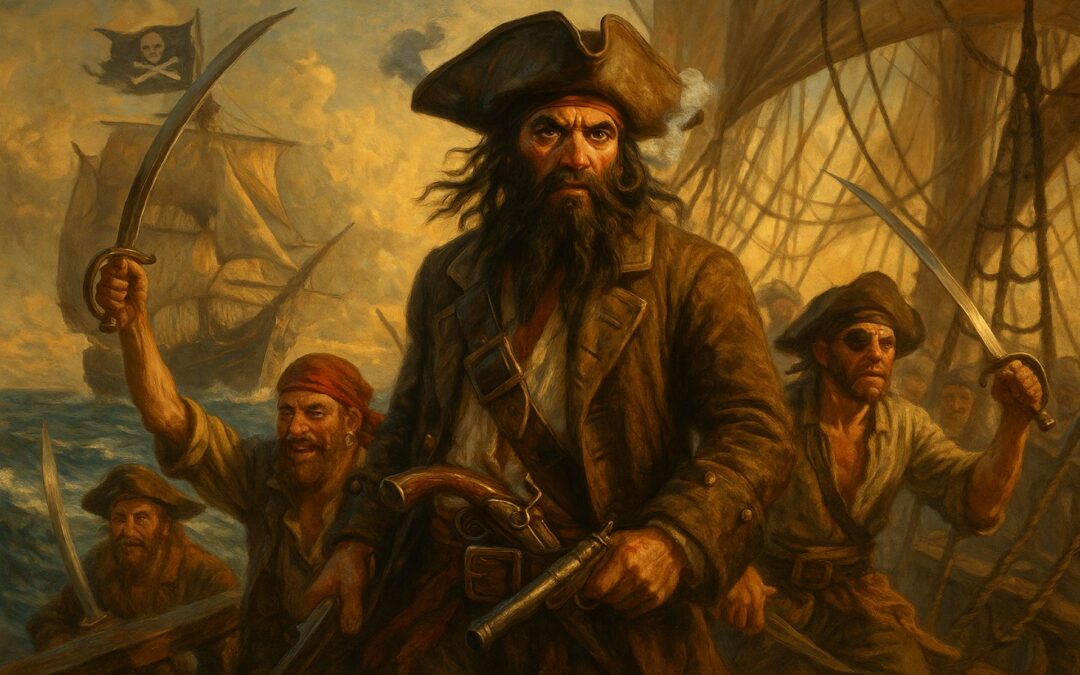
When we hear the phrase “Pirates of the Caribbean,” it conjures images of swashbucklers in feathered hats, ships draped with skull-and-crossbones flags, and treasure maps leading to buried chests of gold. It’s a vision crafted by novels, Hollywood, and theme parks. But the truth is both harsher and more fascinating.
The real pirates of the Caribbean were outcasts, rebels, and opportunists born out of empire, war, and desperation. They didn’t just plunder for fortune—they built makeshift societies, experimented with equality, and shook the very foundations of colonial power. To trace their story is to peel away layers of myth and uncover a history that is bloodier, bolder, and far more human than the tales we’ve been told.
The Making of Myth and Reality
The pirate of imagination is a theatrical figure. He strides across the deck in billowing silks, gold hoops glinting in his ears, and a cutlass drawn at the ready. His flag—a grinning skull—flutters in the salt wind while a chorus of “Arrr!” punctuates the air. This image is stitched together from novels, stage plays, and Hollywood blockbusters, not from logbooks or eyewitness accounts. The true men (and sometimes women) who sailed under black flags were far rougher, far grittier, and infinitely more complex.
Most were ordinary seamen before they turned to piracy, hardened by years of hauling ropes, scrubbing decks, and enduring the lash of unforgiving captains. Life aboard merchant or naval vessels was cruel: rations were meager, pay was often withheld, and punishments brutal. By contrast, pirate crews—though violent and unpredictable—offered an enticing kind of liberty. They elected their captains, shared plunder by agreed rules, and lived with a degree of equality unheard of elsewhere in the 17th century.
Their ships were not always sleek war galleons but converted merchantmen or captured prizes outfitted with as many cannon as they could mount. Flags were not uniform Jolly Rogers, either. Some bore skeletons spearing hearts, others showed hourglasses warning that time was short. The imagery was meant not to entertain but to terrify: a merchant captain faced with such a banner knew surrender was often safer than resistance.
Even their speech—the infamous growl of “pirate talk”—was a much later invention. Pirates came from every corner of Europe and Africa; their accents were diverse, their languages mixed into a salty pidgin. What bound them together was not a dialect, but a common disdain for authority and a hunger for survival. The myth of the pirate is a fantasy of freedom and swagger; the reality was a life of risk, disease, and the constant gamble of death versus plunder. Yet it was precisely that gamble, lived openly and defiantly, that made their legend endure.
Spain’s Monopoly and the Seeds of Piracy
The age of piracy cannot be understood without first grasping Spain’s grip on the Americas. From the late 15th century onward, the Spanish crown carved a vast dominion stretching from Mexico to the Andes. Silver poured out of Potosí in the high mountains of Bolivia, carried on llama trains down to Lima and shipped to Panama. From there, mule caravans crossed the isthmus to load treasure onto galleons bound for Havana, and finally across the Atlantic to Seville. These convoys were known as the “flotas,” treasure fleets that moved like floating fortresses. To Europe’s envious rivals, they were glittering targets moving along predictable routes.
Spain’s wealth made it the titan of Europe, but also its lightning rod. France, England, and the Dutch Republic lacked the same sprawling colonies, but they had ships, sailors, and ambition. The Protestant Reformation deepened the divide: Protestant states loathed Catholic Spain and sought to wound it wherever they could. Wars in Europe were draining, fought by mercenary armies and funded by fragile treasuries. But across the ocean lay another strategy—hit Spain where it was weakest: its lifelines of gold and silver.
The Spanish Main—the sweep of coastline from present-day Mexico through Central America and down into northern South America—was dotted with ports like Cartagena, Portobello, and Havana. These were Spain’s vaults in stone, but they were vulnerable to fast-moving raiders. Unlike Europe’s fortified battlefields, the Caribbean was an open chessboard of islands, reefs, and sea lanes. Small, determined crews in swift ships could evade lumbering galleons, strike at isolated ports, and vanish into the blue expanse before reinforcements arrived.
Thus, piracy in the Caribbean was never merely random thievery. It was born out of geopolitics—out of resentment toward Spain’s monopoly, out of religious strife, and out of Europe’s hunger for wealth. Every pirate raid was both a criminal act and a blow in a shadow war between empires. It was not treasure maps and buried chests that lured men to the trade, but the gleam of Spain’s silver bars, the smell of tobacco bales, and the promise of cutting a slice from the richest empire the world had ever seen.
Privateers: Piracy with Permission
In the crucible of empire-building, privateering emerged as a convenient loophole—a way for ambitious seafarers to enrich themselves while giving monarchs plausible deniability. A letter of marque, embossed with royal authority, transformed a pirate into a “gentleman of fortune.” The document permitted them to seize enemy vessels, cargoes, and even ports, provided that a share of the booty was sent back to the crown. In practice, it blurred the line between patriotism and piracy so completely that often the only difference was the ink on the paper.
The French were first to unleash these state-sanctioned raiders. Jean Fleury, operating in the 1520s, intercepted treasure bound from Mexico and captured part of Hernán Cortés’s plunder—gold, jewels, and even Aztec manuscripts. François Leclerc, nicknamed “Jambe de Bois” for his wooden leg, terrorized Caribbean settlements with daring raids that left Spain reeling. These men became symbols of French defiance, their exploits celebrated at home even as Spain branded them criminals.
The English soon followed. Francis Drake, a name still steeped in legend, began his career under Elizabeth I as a privateer targeting Spanish shipping. His raids on Nombre de Dios and Cartagena not only filled his coffers but also dealt humiliating blows to Spain’s pride. To the English, Drake was a national hero—knighted for his circumnavigation and victories against the Armada. To the Spanish, he was nothing less than a pirate king, a thorn in the side of their empire. Raleigh, Hawkins, and others carved similar reputations, turning maritime theft into statecraft.
But the system had its limitations. Privateers lacked permanent strongholds in the Caribbean. Their expeditions were episodic, lasting until their ships groaned under the weight of plunder, after which they sailed home to Europe. Spain adapted quickly, introducing heavily armed escort galleons and constructing massive stone fortresses around key ports. These defenses raised the cost of raids and limited their effectiveness.
Still, the precedent had been set: piracy could serve as an unofficial arm of empire. Monarchs who disdained open war found it useful to unleash wolves on Spain’s shipping lanes while keeping their own hands technically clean. For the men who wielded these letters of marque, however, the taste of easy plunder would prove addictive. Even when peace treaties rendered their commissions void, many simply ignored the paperwork and continued their assaults, sliding quietly from privateering into outright piracy.
Buccaneers: Hunters Turned Raiders
The buccaneers began not as marauders but as outcasts. In the 1620s, small bands of French settlers scraped out a living on the wild northern shores of Hispaniola. The land was unforgiving, and with little to trade or cultivate, they turned to hunting the feral cattle and pigs that roamed the island’s interior. To preserve the meat, they used a technique borrowed from the native Taíno—slow-smoking strips of flesh over wooden frames called boucans. From this practice came the term boucanier, later anglicized to buccaneer.
Their existence was precarious, and the Spanish regarded them with hostility. Spanish governors launched raids to eradicate these squatters, seeing them as both trespassers and potential rivals. Driven from Hispaniola, many buccaneers relocated to the rocky island of Tortuga, which became their refuge and eventually their fortress. Isolated, short on resources, and surrounded by hostility, they shifted from hunting to raiding.
It was in Tortuga that the buccaneers transformed into something larger than scattered hunters. By the 1630s, they had begun organizing themselves as the “Brethren of the Coast”—a loose confederation of French, English, and Dutch adventurers united by their hatred of Spain and their hunger for survival. Their society was radical for its time. Captains were not hereditary leaders but elected by vote. If a commander proved cowardly, tyrannical, or unlucky, the crew could depose him. Loot was divided by carefully agreed formulas: the captain received the largest share, skilled craftsmen like carpenters or surgeons earned more than common sailors, and even those injured in battle were compensated with fixed amounts of gold or silver.
This proto-democracy set the buccaneers apart from the rigid hierarchies of Europe’s navies, where common sailors endured beatings, starvation, and meager pay. In the brotherhood of piracy, men who had once been whipped on merchant decks could rise to positions of authority, their fortunes dictated not by birth but by bravery and skill. To many disillusioned seafarers, this promise of liberty was as alluring as the treasure itself.
As their numbers grew, so too did their audacity. Raiding Spanish treasure fleets became routine, and Spanish governors fumed at the insult of their former hunters now plundering under their noses. Though the Spanish launched counterattacks—burning settlements, tearing down fortifications—the buccaneers always returned, stronger and more numerous. By mid-century, they had evolved from ragged hunters into a force Spain could no longer ignore: professional pirates with a code, a cause, and the will to challenge an empire.
Tortuga and Port Royal: Pirate Utopias
Tortuga was the cradle of the buccaneers’ transformation from ragged hunters into organized raiders. By the 1640s, its rocky coves and hidden inlets offered a natural fortress against Spanish retaliation. When Jean Le Vasseur, a French engineer, took control of the island in 1640, he recognized its potential as a stronghold. He built Fort de Rocher, a bastion perched above the harbor, bristling with cannon. From that moment, Tortuga was no longer just a hideout—it was the first true pirate port, a sanctuary for men who lived outside the law.
Ships of every flag could sail into its harbor, provided their captains paid a cut of their loot to the governor. Inside, the island became a melting pot of nationalities. French, English, and Dutch buccaneers mingled, forming the infamous Brethren of the Coast. Here, codes of conduct were drafted before raids: articles that set out how loot would be divided, how discipline would be enforced, and even how compensation for injuries would be paid. Tortuga embodied a peculiar paradox—it was at once a lawless outpost and a society governed by rules the men themselves had written.
But Tortuga was only the beginning. When the English seized Jamaica in 1655, they turned the small settlement of Port Royal into something even more audacious: a thriving pirate metropolis. The governor invited privateers to use its harbor as a base of operations, seeing them as useful allies against Spain. Word spread quickly, and within a generation Port Royal had become the most notorious city in the New World.
By the 1660s, its taverns and brothels overflowed with gold and silver brought in by returning raiders. Tavern keepers, merchants, and prostitutes flocked there, eager to profit from the reckless spending of pirates who thought nothing of burning through thousands of pieces of eight in a single night. Accounts from the time describe a city drowning in excess: pirates pouring barrels of wine into the streets and forcing passersby to drink, men tossing coins to see naked women, and drunken brawls that spilled from taverns into alleys.
Yet Port Royal was not just debauchery—it was also a hub of trade. Legitimate merchants rubbed shoulders with outlaws, exchanging stolen Spanish goods for European luxuries. Artisans, shipbuilders, and traders all found employment in its economy, which thrived on plunder. At its peak, Port Royal was one of the wealthiest ports in the Caribbean, rivaling the great Spanish cities it preyed upon.
Then, in 1692, came catastrophe. On June 7, a massive earthquake tore through the city, collapsing buildings and dragging entire streets into the sea. Half of Port Royal sank beneath the waves, its sinful reputation leading some to call it divine punishment. Survivors tried to rebuild, but the city never regained its former glory. The earthquake symbolized the fragility of the pirate world—a society of fortune and vice that could vanish in a single stroke of fate.
The Rise of Legendary Buccaneers
If Tortuga and Port Royal were the stages, then the buccaneers who sailed from them were the actors who wrote themselves into history. Chief among them was Sir Henry Morgan, a man who epitomized both the audacity and ruthlessness of his age. Morgan began as a privateer under English sanction but quickly pushed beyond his mandate. In 1668, ignoring orders to target ships only, he launched an attack on the fortified Spanish city of Portobello. His men scaled walls, used prisoners as human shields, and sacked the city with merciless efficiency. The raid sent shockwaves through the Spanish Empire and made Morgan a legend.
He was far from finished. In 1671, Morgan led one of the most audacious expeditions in pirate history—the overland march to Panama City. With hundreds of men, he hacked through jungles, starved across the isthmus, and emerged to storm one of Spain’s wealthiest outposts. The sack of Panama yielded a fortune in gold, silver, and slaves. For this, Morgan was briefly arrested in England when Spain protested, but public opinion hailed him as a hero. Instead of punishment, he received a knighthood and later became Lieutenant Governor of Jamaica—a pirate elevated into the ranks of empire.
Other buccaneers followed paths just as daring. John Coxon, Bartholomew Sharp, and John Sawkins undertook the famous “Pacific Adventure” in 1680. Marching across the perilous Darien Gap with the help of native allies, they struck Spanish settlements on both coasts, seized ships in the Pacific, and ransomed towns before sailing back around Cape Horn to the Caribbean. Their exploits proved that no Spanish frontier was safe.
These figures embodied the contradictions of piracy. They were outlaws, yet sometimes celebrated as patriots. They plundered ruthlessly, yet operated under codes of conduct that bound them together. For men like Morgan, the line between pirate and empire-builder blurred entirely. Their actions were not just thefts at sea—they were blows struck in a shadow war for supremacy in the Americas.
By the late 17th century, the buccaneers had left an indelible mark. They had turned small islands into centers of power, forced Spain to divert resources into costly defenses, and shown Europe that the Spanish monopoly could be broken. Their raids laid the groundwork for the next great act of the story—the Golden Age of Piracy—when their successors would take the buccaneering tradition and turn it into legend.
The Pirate Republic of Nassau
By the early 18th century, the buccaneering era was waning, but the Caribbean was far from rid of its rogues. When the War of the Spanish Succession ended in 1714, thousands of English privateers suddenly found themselves unemployed. They were skilled sailors, hardened fighters, and accustomed to living off plunder. With peace treaties signed, their letters of marque were worthless scraps of parchment. For men with no trade but violence at sea, the choice was stark: return to grinding poverty as naval sailors or merchants—or continue to plunder without permission. Most chose the latter.
At this moment, Nassau in the Bahamas became the epicenter of piracy’s rebirth. The town had been little more than a neglected colonial outpost, with barely a hundred settlers clinging to its sandy shores. But it offered everything pirates desired: a deep, defensible harbor, proximity to the main shipping lanes, and scant interference from imperial authorities. Into this vacuum poured hundreds of unemployed privateers, mutinous sailors, and runaway slaves. Together they transformed Nassau into what would later be called the “Pirate Republic.”
Here, pirates forged a community unlike anything seen in the rigid societies of Europe. Captains were elected by majority vote, and deposed just as easily if they lost the crew’s confidence. Plunder was divided fairly, with rules ensuring even the lowest deckhand received a share. Injured men were compensated with payments from collective loot, a crude but revolutionary form of insurance. Nationality mattered little—English, French, Dutch, Africans, and creoles fought and feasted side by side, bound by their rejection of authority.
For enslaved Africans who escaped their masters, Nassau offered freedom that no plantation could. Historians estimate that nearly one-third of the Caribbean’s pirates during this period were of African descent, either free sailors or liberated captives. Within the republic, they could hold equal shares, vote in decisions, and rise to positions of authority. This egalitarianism—radical for its time—was one of the republic’s strongest draws.
At its height, Nassau sheltered perhaps 5,000 pirates, their numbers dwarfing the island’s lawful inhabitants. Merchant vessels and colonial governors alike viewed it with dread. For nearly a decade, this outlaw republic stood as a direct affront to imperial control. It was not just a base of operations; it was a living experiment in liberty, created by men and women who had chosen a life outside the law.
The Flying Gang and the Golden Age
From Nassau’s republic emerged a constellation of figures who would etch their names into legend. Known collectively as the “Flying Gang,” these captains commanded fear and fascination across the Caribbean. Benjamin Hornigold and Henry Jennings laid the foundations, but it was the next generation that became immortal: Charles Vane, “Calico” Jack Rackham, Blackbeard, Mary Read, and Anne Bonny.
Blackbeard—Edward Teach—was the most fearsome of them all. He was a master of psychological warfare. Before battle, he tied slow-burning fuses into his thick black beard, so that sparks and smoke wreathed his face like a demon. Accounts describe his massive frame towering over foes, pistols strapped across his chest, cutlass in hand, eyes glowing from the haze of gunpowder. He rarely had to fight—his appearance alone often persuaded captains to surrender without resistance. His flagship, the Queen Anne’s Revenge, became synonymous with terror from the Carolinas to the West Indies.
Charles Vane, by contrast, was reckless and uncompromising, known for his violent temper and refusal to accept royal pardons when offered. His contemporary, Calico Jack Rackham, was remembered less for his plunder and more for his companions—two women who defied every convention of the age. Mary Read and Anne Bonny disguised themselves as men, fought ferociously in battle, and matched their comrades in courage and ferocity. Their presence shattered the stereotype of piracy as a man’s world, proving that the life of liberty and defiance appealed across gender as well as class.
Together, these figures ushered in the Golden Age of Piracy (roughly 1715–1725). During this decade, pirates targeted ships of every flag. No longer limited to attacking Spanish treasure fleets, they preyed on French, Dutch, and even British merchants. The trade routes of the Caribbean and Atlantic became perilous, with insurance rates soaring and colonial governors begging for naval protection.
What made this age “golden” was not just the wealth pirates seized but the audacity with which they defied empire. They carved out autonomous spaces—ships and harbors where democracy ruled, spoils were shared, and freedom outweighed law. To the rulers of Europe, they were criminals to be eradicated. To their crews, they were pioneers of an alternative way of life—harsh, violent, and fleeting, yet intoxicating in its promise of liberty.
The Flying Gang’s reign of terror was brief but unforgettable. In a single decade, they transformed Nassau from a sleepy colonial backwater into the capital of piracy, and they inscribed their names in history’s ledger with fire, blood, and bravado. Their exploits remain the most vivid chapter of piracy’s long saga—an age when outlaws ruled the waves and made empires tremble.
The War Against Piracy
The Golden Age of Piracy could not last forever. For a time, European crowns had tolerated or even encouraged piracy when it weakened Spain, their mutual rival. But by the early 18th century, circumstances had changed. The War of the Spanish Succession had ended, and with peace came a demand for stability. Trade, not plunder, was now the lifeblood of empire. Britain in particular had little patience left for freebooters: its colonies depended on sugar, tobacco, and above all the transatlantic slave trade. Merchant shipping could no longer be at the mercy of outlaw captains who recognized no flag.
In 1717, King George I issued a royal proclamation offering clemency to pirates who voluntarily surrendered. Known as the “King’s Pardon,” it promised forgiveness for past crimes provided the men renounced piracy forever. The offer was generous, but uptake was lukewarm. Many pirates scoffed at the idea of surrendering their liberty for the harsh life of a naval sailor or plantation worker. A few captains—Benjamin Hornigold among them—accepted and even turned hunter, chasing down their former comrades for bounty. Yet others, like Charles Vane, mocked the pardon and doubled down on defiance.
To enforce the law, Britain appointed Woods Rogers as royal governor of the Bahamas in 1718. Rogers was a hardened privateer himself, but his task was daunting: reassert imperial control over Nassau and stamp out the republic of pirates that had flourished there. He arrived with warships, blockaded the harbor, and trapped pirates inside. Some accepted his terms, but others slipped through the net. Rogers rebuilt Nassau’s fortifications, conscripted locals into service, and unleashed waves of pirate hunters.
From that moment, the tide turned. Blackbeard was cornered off the coast of North Carolina later that year, killed in a furious battle with Royal Navy forces. His head, severed from his body, was hung from a bowsprit as a grim warning. Calico Jack Rackham was captured in 1720, hanged in Jamaica, and displayed in chains. Charles Vane was betrayed by former allies, taken prisoner, and executed in 1721. Even those who had once been celebrated—like Stede Bonnet, the so-called “Gentleman Pirate”—met the gallows.
Executions became a theater of deterrence. In Port Royal and Charleston, bodies of captured pirates were gibbeted—hung in chains along harbors or at crossroads where sailors could see them. The message was unmistakable: piracy was no longer a tolerated nuisance but a capital crime. In just a decade, more than 500 pirates were executed across the Caribbean. By the mid-1720s, the organized piracy that had once ruled the seas was a memory, its survivors scattered into obscurity or pressed into naval service. The war against piracy was brutal, but it was decisive. The empires of Europe had reasserted control.
Legacy of the Real Pirates
Although their reign was short, the pirates of the Caribbean left behind an outsized legacy. Much of what we think we know about them—the parrots on shoulders, the wooden legs and eyepatches, the “Arrr!”—belongs more to fiction than fact. There is no evidence pirates ever forced victims to “walk the plank.” Their accents varied with their origins: Welsh, Irish, Dutch, African, French, or Spanish. Yet the myths persist, woven into novels like Treasure Island, romanticized by theater, and burnished by Hollywood.
Behind the myths, however, lay truths that still resonate. Pirates lived in ways radically different from the societies they opposed. They created codes of conduct that ensured fairness in dividing loot and offered compensation for injury. They elected their captains and could depose them if they proved unfit. They welcomed men of every nationality and even women into their ranks, at a time when mainstream society rigidly excluded both. For enslaved Africans who escaped, pirate crews offered something closer to equality than they could find on any plantation.
This spirit of rough democracy, however short-lived, has become one of the most enduring aspects of their story. To many modern eyes, the pirates of the Caribbean foreshadow ideals of liberty and fraternity—values that would only formally take root decades later in revolutions on both sides of the Atlantic. Their ships were violent workplaces, but they were also experiments in self-rule, created by men who had nothing to lose but their chains.
The empires eventually crushed them, but they could not erase the fascination they inspired. Centuries later, the real pirates of the Caribbean remain symbols of defiance—men and women who lived by their own codes, rejecting a world of poverty and oppression for a life of danger, fleeting wealth, and a kind of freedom that still captures the imagination. Their treasure may be long gone, but their legend endures, richer than gold.
Conclusion
The age of Caribbean piracy burned bright but brief. In less than a century, hunters on Hispaniola became buccaneers of Tortuga, Port Royal blossomed into a pirate metropolis, and Nassau crowned itself as the republic of outlaws. Figures like Henry Morgan, Blackbeard, and Anne Bonny embodied both the brutality and the strange allure of this world—men and women who carved their names into history with cannon fire and cutlasses.
By the 1720s, the empires struck back, and the gallows silenced the golden age. Yet the spirit of these outlaws never died. Their codes of fairness, their defiance of authority, and their reckless pursuit of freedom left a legacy that outshines even their most treasured possessions. The real pirates of the Caribbean remind us that history’s outlaws can sometimes teach us as much about liberty as its kings.