
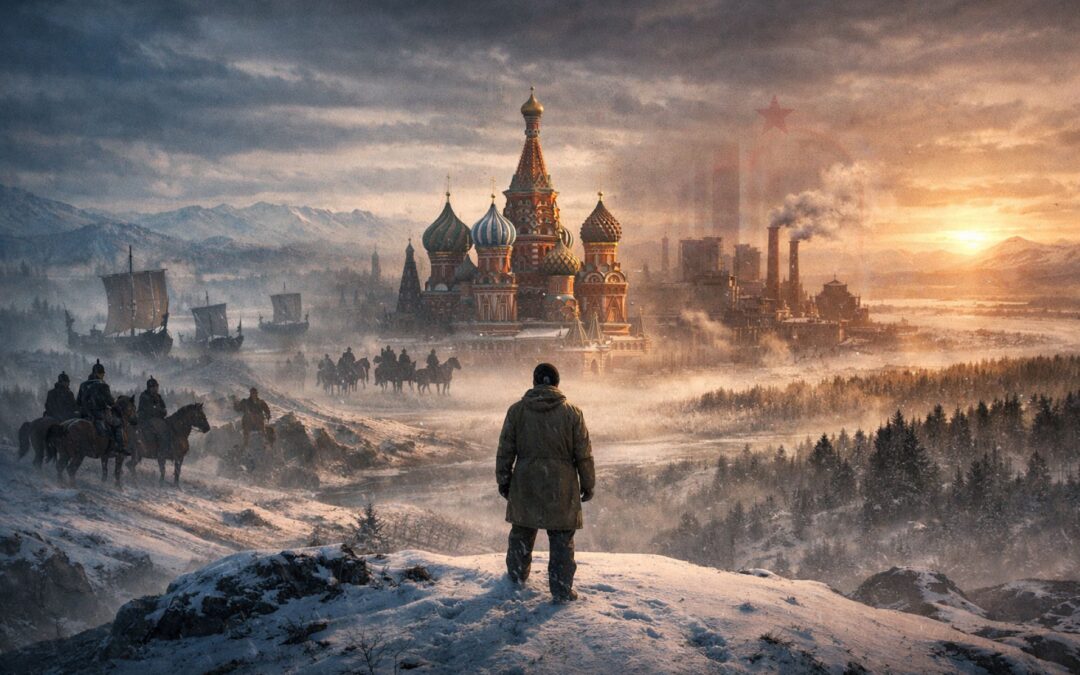
Russia is not just another country on the map—it is a geographical phenomenon. Stretching across eleven time zones and spanning from Eastern Europe to the Pacific Ocean, it is the largest nation on Earth by an enormous margin. At its peak in the 19th century, its empire extended from Poland in the west to Alaska in the east, making it one of the most expansive political entities in human history.
But this vast, unified state did not always exist.
Just a thousand years ago, the lands that now make up Russia were a fragmented mosaic of forests, rivers, steppe grasslands, and scattered principalities. There was no single Russian identity, no centralized authority, and no cohesive state. Instead, the region was shaped by migration, trade, and invasion—constantly influenced by forces arriving from both Europe and Asia.
What makes the story of Russia unique is not just its size, but how that size came to be. Unlike many nations that formed through gradual internal consolidation, Russia expanded relentlessly outward—absorbing territories, cultures, and peoples across one of the most challenging landscapes on Earth. Geography, more than anything else, shaped its destiny: open plains invited invasion, vast distances demanded control, and harsh climates forged resilience.
This is a story of transformation across multiple identities. Medieval river kingdoms gave way to Mongol domination. A rising principality in Moscow unified surrounding lands into a tsardom. That tsardom became a sprawling empire under powerful rulers like Peter the Great and Catherine the Great. The empire then collapsed into revolution, only to re-emerge as the Soviet Union—a global superpower locked in ideological conflict with the West. And finally, in the late 20th century, that superpower dissolved, leaving behind the modern Russian Federation.
To understand Russia today is to understand these layers of history—each one leaving its imprint on the next. This is the story of how a land of scattered tribes and river settlements became the largest country in the world.
The Geographic Foundations of a Giant
Russia did not begin as a nation. It began as a landscape—vast, exposed, and unforgiving. Long before any centralized authority emerged, the physical geography of the region dictated how people lived, moved, traded, and fought. To understand the rise of Russia, one must begin not with rulers or wars, but with terrain.
The Vastness of European Russia
While modern Russia stretches far into Asia, its historical core lies west of the Ural Mountains in what is known as European Russia. This region, though only a fraction of the country’s total landmass, served as the cradle of Russian civilization. It is here that the earliest cities developed, where trade routes converged, and where political power first began to take shape.
What defines European Russia is not mountains or natural barriers—but their absence. Much of the region consists of broad, flat plains that extend uninterrupted for thousands of kilometers. Unlike Western Europe, which is broken up by mountain ranges, rivers, and coastlines that naturally divide territories, the Russian plain is open and continuous. This openness made it easier for early communities to expand and interact—but it also made them extraordinarily vulnerable.
Throughout history, these plains acted as a corridor for invasion. From nomadic tribes of the Eurasian steppe to later organized armies like the Mongols, invaders could move swiftly and with little resistance from the landscape itself. There were no natural defenses to slow them down, no mountain passes to guard. Survival in such an environment would eventually demand a different kind of strength: not just military resistance, but territorial depth.
Rivers, Steppe, and Strategic Exposure
If the plains defined Russia’s vulnerability, its rivers defined its connectivity.
The great river systems of European Russia—most notably the Volga, Dnieper, and Don—served as the lifelines of early settlement. In a world where dense forests and vast distances made overland travel difficult, rivers became the primary highways of movement and trade. They linked distant regions, enabled cultural exchange, and allowed early communities to grow into prosperous centers of commerce.
These waterways also connected northern Europe to the Black Sea and the Caspian Sea, placing the region at the crossroads of major trade networks between Scandinavia, Byzantium, and the Islamic world. It was along these rivers that early political structures would begin to form, as settlements grew into fortified towns and eventually into organized states.
But beyond the rivers lay the steppe—a vast expanse of open grassland stretching across Eurasia. This region was home to nomadic peoples who were highly mobile, skilled in warfare, and difficult to contain. For centuries, the steppe served both as a bridge and a threat: a route for trade and cultural exchange, but also a launching ground for invasions.
The combination of open plains, vital rivers, and exposed steppe created a paradox that would define Russian history. The land offered immense opportunity for expansion and connection, yet it also demanded constant vigilance and control. Over time, this would shape a political culture that valued strong central authority, territorial expansion as a form of defense, and the relentless push outward to secure vulnerable borders.
In many ways, Russia’s future was written into its geography long before its first state ever emerged.
The Earliest Peoples and the Steppe Legacy
Before the emergence of anything resembling a Russian state, the lands of Eastern Europe and the Eurasian steppe were inhabited by a constantly shifting mosaic of peoples. There were no fixed borders, no lasting political institutions, and no unified identity. Instead, this region functioned as one of the great crossroads of human migration—where tribes arrived, settled briefly, and were often displaced by the next wave.
To understand early Russia is to understand this deep and restless prehistory.
Indo-European and Nomadic Cultures
Among the earliest known inhabitants of the region were Indo-European groups who settled across the vast plains thousands of years ago. Over time, these populations gave rise to a variety of tribes, each with their own customs, languages, and ways of life. Some practiced agriculture along riverbanks, while others adopted a more mobile, pastoral lifestyle suited to the open grasslands.
But stability was rare.
The region’s geography—flat, expansive, and difficult to defend—made it particularly vulnerable to incursions from the east. Waves of nomadic peoples moved across the Eurasian steppe, often displacing those who came before them. Among these were groups such as the Scythians and Sarmatians, who dominated the steppe in antiquity, followed later by more aggressive and expansionist forces.
By the early centuries of the Common Era, this pattern intensified. Tribes like the Huns surged westward, unleashing a chain reaction of migration that rippled across Europe. Germanic groups, including the Goths, were pushed into Roman territories, contributing to the eventual destabilization and fall of the Western Roman Empire.
In this way, the lands that would one day become Russia were never isolated. They were deeply embedded in the wider currents of Eurasian history—both influencing and being influenced by events far beyond their immediate borders.
A Crossroads of Migration and Invasion
What distinguished this region was not just who lived there, but how often those populations changed.
Unlike more geographically protected areas, where civilizations could develop in relative isolation, the Russian plains were exposed on nearly all sides. The steppe to the south and east acted as a vast highway for movement, allowing entire peoples to traverse enormous distances with relative ease. Forests in the north provided some cover, but they were not enough to prevent the steady flow of migration.
This constant turnover had lasting consequences. It prevented the early formation of stable, centralized states and instead fostered a landscape of loosely connected tribes and settlements. Political authority was often local and temporary, rarely extending far beyond immediate surroundings.
At the same time, this fluid environment encouraged adaptability. Cultures absorbed influences from one another, blending traditions and technologies. Trade networks began to emerge, linking distant regions through the exchange of goods, ideas, and practices.
Yet, the absence of unity also meant vulnerability. Without strong political structures, the region remained susceptible to more organized forces that would eventually arrive—groups capable not just of migrating, but of conquering and ruling.
It was within this dynamic and unstable world that the first recognizable foundations of Russian statehood would begin to appear—not from within, but from an unexpected direction: the north.
The Viking Origins of the Rus
The first recognizable foundations of a Russian state did not emerge from the steppe or the scattered Slavic tribes alone—but from the arrival of outsiders. From the north came a group better known in Western Europe for raiding monasteries and coastal towns: the Vikings.
In Eastern Europe, however, their role would be very different. Here, they were not just raiders—they were traders, settlers, and ultimately, state-builders.
Norse Expansion into Eastern Europe
Beginning in the 9th century, Norse seafarers from Scandinavia began moving eastward across the Baltic Sea. Unlike their counterparts who sailed west toward Britain and France, these groups turned inland, navigating the vast river systems of Eastern Europe.
Using rivers like the Volga, Dnieper, and Don as natural highways, they penetrated deep into the continent. Their journeys connected the Baltic Sea to the Black Sea and the Caspian Sea, linking northern Europe with the wealthy markets of the Byzantine Empire and the Islamic world.
These Norse adventurers were known in the region as the Rus. Initially, they operated as mobile traders and warriors, establishing strategic outposts along key river routes. Over time, many of these outposts evolved into permanent settlements.
What began as a network of trading stations gradually took on a more political character.
Formation of Early City-States
As Norse groups settled along the rivers, they established control over local trade and began to exert authority over surrounding populations. Important centers such as Novgorod in the north and Kiev in the south emerged as key hubs of commerce and governance.
These settlements functioned as early city-states—independent, fortified, and economically vibrant. Their power rested not only on military strength but also on their position within lucrative trade networks. Goods such as furs, slaves, wax, and honey moved southward, while luxury items and silver flowed north.
Crucially, the Norse rulers did not remain culturally separate for long. Over generations, they began to assimilate with the local Slavic population. Their language, customs, and identity gradually blended with those of the people they governed.
This fusion laid the groundwork for something new—not purely Norse, not purely Slavic, but a hybrid political and cultural entity.
The Rise of Kievan Rus
By the late 9th and early 10th centuries, these scattered settlements coalesced into a more unified political structure known as Kievan Rus. Centered around the city of Kiev, this state became the first large-scale polity in the region that resembled a precursor to later Russian, Ukrainian, and Belarusian identities.
Kievan Rus was not a tightly centralized state by modern standards, but it represented a significant step forward. It controlled key trade routes, maintained diplomatic relations with powerful neighbors like the Byzantine Empire, and developed a ruling structure that extended across multiple cities and regions.
One of its most important transformations came with the adoption of Eastern Orthodox Christianity in the late 10th century. This decision would have profound and lasting consequences, shaping the cultural and religious identity of the region for centuries to come.
At its height, Kievan Rus stood as a prosperous and influential state—bridging north and south, Europe and Asia, trade and governance.
But this early unity was fragile.
Internal rivalries, shifting trade dynamics, and external pressures would eventually fracture this emerging state, leaving it vulnerable to forces far more destructive than anything it had faced before.
Fragmentation and the Mongol Invasion
The rise of Kievan Rus marked the first moment of unity in the region’s history—but it did not last. What followed was a period of fragmentation that would leave the lands of the Rus divided, weakened, and ultimately exposed to one of the most devastating invasions in history.
The Decline of Kievan Unity
Kievan Rus was never a fully centralized state. It functioned more as a loose federation of principalities, each ruled by members of the same ruling dynasty. Power was shared, contested, and frequently redistributed among rival princes.
Over time, this system became increasingly unstable.
Succession disputes, regional rivalries, and shifting economic centers began to erode Kiev’s dominance. Trade routes that once fueled its prosperity gradually declined, particularly as new connections emerged elsewhere. Meanwhile, other cities—such as Novgorod in the north and Vladimir-Suzdal in the northeast—grew in influence and began to assert their independence.
By the early 13th century, the once-unified Rus had splintered into a patchwork of competing principalities. Each pursued its own interests, often fighting against its neighbors rather than cooperating with them.
This disunity would prove catastrophic.
The Mongol Conquest and the Golden Horde
In 1223, the fractured principalities of the Rus encountered a new and terrifying force: the Mongols.
Originating from the vast steppes of Central Asia, the Mongols had already built one of the most formidable military machines the world had ever seen under the leadership of Genghis Khan and his successors. Highly mobile, disciplined, and ruthlessly efficient, they swept across Eurasia with astonishing speed.
Their first clash with the Rus came at the Battle of the Kalka River, where a coalition of Rus princes was decisively defeated. Although the Mongols withdrew shortly afterward, the encounter was merely a prelude.
In 1237, they returned—this time with the full intent of conquest.
Over the next few years, Mongol armies devastated the region. City after city fell. Entire populations were massacred or enslaved. Kiev, once the proud center of the Rus world, was sacked in 1240 and reduced to ruins.
In the aftermath, the lands of the Rus were incorporated into a vast Mongol domain known as the Golden Horde. While some northern principalities escaped direct destruction by submitting early, they were not free. Instead, they became tributary states, forced to pay heavy taxes and acknowledge Mongol supremacy.
Life Under Mongol Domination
Mongol rule over the Rus lasted for more than two centuries, leaving a deep and lasting imprint on the region.
Contrary to popular perception, the Mongols did not directly administer every aspect of daily life. Local princes were often allowed to retain their positions, provided they remained loyal and continued to deliver tribute. However, this system reinforced fragmentation, as rulers competed for favor from the Mongol khans.
At the same time, the constant extraction of wealth and resources placed a heavy burden on the population. Economic development slowed, cities struggled to recover, and the political landscape remained divided.
Yet, Mongol domination also had unintended consequences.
It created a power vacuum in which certain principalities could rise above others. Among them was a relatively obscure settlement that would soon change the course of Russian history: Moscow.
As the influence of the Golden Horde began to wane in the 14th and 15th centuries, this rising power would seize its moment—laying the foundations for a new, more centralized Russian state.
The Rise of Moscow and the Birth of a Russian State
Out of the devastation of the Mongol invasion and the long shadow of the Golden Horde, a new center of power began to emerge—one that would fundamentally reshape the future of the region. This was Moscow, a once modest settlement that would rise to become the nucleus of a unified Russian state.
Moscow’s Strategic Advantage
In the centuries following the Mongol conquest, the Rus lands remained divided into competing principalities, all operating under the authority of the Golden Horde. Among them, Moscow held no immediate advantage in terms of size or prestige. It was neither the richest nor the most historically significant city.
Yet it possessed something more subtle—and ultimately more powerful.
Moscow’s location was deeply strategic. Situated within dense forests and connected to important river networks, it was relatively protected from steppe invasions while still maintaining access to key trade routes. This combination of security and connectivity allowed it to grow steadily, even as other regions struggled.
Equally important was Moscow’s political strategy.
Rather than openly resisting Mongol authority in its early rise, Moscow’s princes chose cooperation. They positioned themselves as reliable intermediaries, collecting tribute on behalf of the Mongols and, in return, gaining their trust and favor. This role allowed Moscow to accumulate wealth and authority without provoking direct destruction.
Over time, this quiet consolidation of power began to tilt the balance in its favor.
Ivan III and the Consolidation of Power
The true transformation of Moscow into a dominant power came under the rule of Ivan III, who reigned from 1462 to 1505. Often regarded as one of the founders of the Russian state, Ivan III pursued a deliberate strategy of expansion and centralization.
He systematically absorbed neighboring territories, including powerful rivals like Novgorod and Tver. These acquisitions were not merely territorial—they represented the unification of previously independent centers of power under a single authority.
Just as significant was Ivan’s challenge to Mongol dominance.
By the late 15th century, the Golden Horde had begun to fragment and decline. Sensing an opportunity, Ivan III gradually asserted independence. This culminated in the symbolic “Great Stand on the Ugra River” in 1480, where Mongol forces ultimately withdrew without battle—effectively ending their control over Moscow.
For the first time in over two centuries, a Russian principality stood free from Mongol rule.
The End of Mongol Influence
With independence secured, Moscow moved quickly to redefine its identity and authority.
Ivan III adopted the title of “Grand Prince of All Rus,” signaling a claim not just over his own territory, but over all the lands that had once belonged to the Rus world. He also embraced symbols and traditions that reinforced this growing sense of legitimacy and unity.
Moscow began to position itself as the heir to both the legacy of Kievan Rus and the spiritual authority of the Orthodox Christian world. As Constantinople—the center of Eastern Orthodoxy—fell to the Ottomans in 1453, Moscow increasingly saw itself as the “Third Rome,” the new guardian of the Orthodox faith.
This combination of political consolidation, religious identity, and independence from foreign domination marked a turning point.
By the beginning of the 16th century, what had once been a fragmented collection of principalities had been transformed into a centralized state centered on Moscow. It was still far from the vast empire it would become—but the foundations had been laid.
From this point forward, Russia would no longer be defined by fragmentation and subjugation, but by expansion and ambition.
Ivan the Terrible and the Tsardom of Russia
With the foundations of a centralized state established under Moscow, the next phase of Russian history would be defined by consolidation, authority, and expansion. It was under Ivan IV—better known as Ivan the Terrible—that Russia formally transformed from a loose collection of lands into a unified tsardom.
His reign marked both a decisive strengthening of the state and the beginning of a darker, more oppressive political culture that would echo through Russian history.
The First Tsar
In 1547, Ivan IV took a step that symbolized a new era: he crowned himself “Tsar of All Russia.” The title, derived from “Caesar,” was meant to elevate his status beyond that of a mere prince or king. It asserted that Russia was not just another European kingdom, but an empire in its own right.
This act was more than symbolic. It reflected a growing sense of centralized authority and a desire to project power both internally and externally.
Ivan’s early reign showed promise. He introduced legal reforms, reorganized aspects of governance, and sought to strengthen the state’s administrative structure. For a time, it appeared that Russia was entering a period of stability and modernization.
But this stability would not last.
Expansion Toward the Caspian
One of Ivan’s most significant achievements was territorial expansion to the south and east. He launched a series of campaigns against the successor states of the former Mongol dominion—particularly the khanates that controlled key regions along the Volga River.
The conquest of Kazan in 1552 and Astrakhan in 1556 brought vast new territories under Russian control. These victories were crucial, not only for their symbolic value in overcoming former Mongol powers, but also for their strategic importance.
By securing the Volga River, Russia gained control over a major trade route and established a direct connection to the Caspian Sea. This opened new economic opportunities and extended Russian influence deeper into Asia.
These conquests also marked the beginning of a long-term pattern: Russia’s expansion was not limited to nearby lands, but increasingly pushed outward into diverse and distant regions.
Centralization and Fear
Despite these successes, Ivan’s reign became increasingly defined by paranoia and brutality.
Fearing betrayal from the nobility, he initiated a campaign known as the Oprichnina—a policy that divided the country into separate territories under his direct control and unleashed a reign of terror against perceived enemies. Lands were confiscated, entire communities were devastated, and thousands were executed or exiled.
The most infamous example of this violence was the sack of Novgorod, once a powerful and independent city, which Ivan suspected of disloyalty. The destruction of Novgorod symbolized the end of any remaining regional autonomy and the complete dominance of centralized authority.
While these actions strengthened the power of the tsar, they came at a tremendous cost. Economic disruption, depopulation, and widespread fear weakened the state internally, even as it expanded externally.
Ivan IV’s legacy is therefore deeply contradictory.
He transformed Russia into a true tsardom, expanded its borders, and solidified centralized rule. At the same time, he entrenched a political culture rooted in absolute authority and repression—one that would continue to shape Russian governance for centuries to come.
With the Volga secured and the authority of the tsar firmly established, Russia now stood on the edge of something even more ambitious: a vast and largely unexplored frontier to the east.
The Great Eastward Expansion into Siberia
With the Volga secured and the power of the tsar firmly established, Russia turned its attention to a new frontier—one that would ultimately define its identity as the largest country on Earth. Beyond the Ural Mountains lay Siberia, an immense and largely unknown expanse of forests, rivers, and tundra stretching all the way to the Pacific Ocean.
What followed was one of the most extraordinary episodes of territorial expansion in history.
The Role of the Cossacks
Unlike the organized state campaigns that had characterized earlier conquests, the initial push into Siberia was driven by small, mobile groups rather than large imperial armies. Chief among these were the Cossacks—semi-nomadic warriors from the steppe, known for their independence, adaptability, and exceptional skill in horseback combat.
Operating on the fringes of Russian society, the Cossacks were both frontier settlers and instruments of expansion. They were often sponsored or encouraged by Russian authorities but retained a degree of autonomy in their expeditions.
One of the most pivotal figures in this movement was Yermak Timofeyevich, a Cossack leader who, in the late 16th century, led an expedition eastward across the Urals. His campaign resulted in the defeat of the Siberian Khanate, a successor state of the Mongol world, opening the door for further Russian incursions into the region.
Yermak’s expedition did not immediately bring Siberia under full Russian control, but it set a powerful precedent. It demonstrated that the vast lands beyond the Urals were not beyond reach.
Conquest of the Khanates
Following these early successes, waves of explorers, traders, and settlers began moving eastward. Rather than conquering vast territories in a single coordinated effort, Russian expansion into Siberia unfolded gradually—through a network of forts, settlements, and tribute systems.
Local populations were often incorporated into the expanding Russian sphere by being required to pay yasak, a form of tribute usually collected in furs. These furs, highly valued in European markets, became a major economic driver of Siberian expansion.
The Russian state extended its influence step by step, establishing control over rivers, securing trade routes, and subduing or integrating indigenous groups. Unlike earlier conquests in Europe, this expansion encountered relatively less organized resistance, though it was not without conflict.
Over time, the scattered efforts of traders and Cossacks coalesced into a broader imperial project.
Reaching the Pacific Ocean
The speed of this expansion was remarkable.
Within roughly a century of Yermak’s initial campaign, Russian explorers had crossed the entirety of Siberia. By the mid-17th century, they had reached the Pacific Ocean, establishing outposts along its coastline and effectively spanning the Eurasian continent from west to east.
This achievement transformed Russia into a transcontinental empire.
From the frozen forests of Siberia to the shores of the Pacific, new settlements began to take root. Though many of these outposts were small and isolated, they extended the reach of Russian authority across an unprecedented distance.
Exploration did not stop at the continent’s edge. In the 18th century, expeditions led by figures such as Vitus Bering pushed further eastward, leading to the discovery of Alaska and the eventual establishment of Russian claims in North America.
By this point, Russia had become something unique in world history—not just a large country, but a continuous land empire spanning two continents.
Yet, for all its success in the east, Russia’s ambitions were not limited to expansion into empty spaces. Increasingly, its rulers looked westward, toward Europe—not just to expand, but to transform the very nature of the state itself.
Russia and the West: Peter the Great’s Transformation
By the end of the 17th century, Russia had achieved something extraordinary in terms of territorial expansion. It stretched across Siberia to the Pacific, commanding vast resources and land. Yet, despite its size, it remained in many ways a backward state—economically underdeveloped, technologically behind, and politically isolated from the rapidly advancing powers of Western Europe.
It was under the rule of Peter the Great that Russia would undergo one of the most dramatic transformations in its history.
The Great Northern War
One of Peter’s primary ambitions was to secure access to the Baltic Sea—a crucial gateway to European trade and influence. At the time, much of this region was controlled by Sweden, one of the dominant military powers in Northern Europe.
To challenge this dominance, Russia entered into the Great Northern War in 1700.
The conflict would last over two decades and test the limits of Russia’s military and political capacity. Early defeats exposed the weaknesses of the Russian army, but Peter responded with sweeping reforms. He reorganized the military along modern European lines, introduced new training methods, and invested heavily in weapons and infrastructure.
Gradually, these efforts began to pay off.
By 1721, Sweden had been decisively defeated, and Russia emerged victorious. As a result, it gained control over key territories along the Baltic coast, including parts of modern-day Estonia and Latvia. For the first time, Russia had secured a stable and strategically vital foothold in Europe.
Founding of St. Petersburg
With access to the Baltic secured, Peter set out to create a new capital that would symbolize Russia’s transformation.
In 1703, he began constructing the city of St. Petersburg on marshland near the Gulf of Finland. Built at enormous human and financial cost, the city was intended to be Russia’s “window to the West”—a place where European ideas, culture, and commerce could flow into the country.
St. Petersburg was unlike anything Russia had seen before. Designed in a European architectural style and oriented toward the sea, it represented a deliberate break from the traditional, inward-looking structures of the past.
In 1712, it officially replaced Moscow as the capital of Russia.
This shift was deeply symbolic. It signaled not just a change in geography, but a change in direction—a reorientation of Russia toward Europe and the wider world.
Modernization and Westernization
Peter’s ambitions extended far beyond military victories and urban development. He sought to fundamentally reshape Russian society.
Having traveled extensively in Western Europe, he was deeply influenced by what he saw—particularly in terms of science, technology, and governance. Upon his return, he launched a series of reforms aimed at modernizing Russia along European lines.
These reforms touched nearly every aspect of life. The military was reorganized and strengthened. New industries were established. Administrative systems were overhauled to improve efficiency and central control. Even social customs were targeted—Peter famously encouraged or forced members of the nobility to adopt Western dress and grooming standards.
While these changes brought Russia closer to Europe in terms of power and capability, they were often imposed from above and met with resistance.
Nevertheless, by the time of Peter’s death in 1725, the transformation was undeniable.
Russia had emerged as a major European power—no longer isolated or backward, but active and influential on the continental stage. It had gained access to critical trade routes, modernized its institutions, and redefined its identity.
Yet, this newfound strength would soon be tested and expanded even further under the rule of another formidable leader—one who would push Russian influence deeper into Europe and beyond.
Imperial Expansion Under Catherine the Great
If Peter the Great transformed Russia into a European power, it was under Catherine the Great that Russia fully asserted itself as one of the dominant empires on the continent. Her reign in the latter half of the 18th century marked a period of aggressive expansion, strategic ambition, and consolidation of Russia’s position as a major force in European geopolitics.
Where Peter had opened the door to Europe, Catherine pushed Russia firmly into its center.
Expansion into the Black Sea Region
One of Catherine’s primary objectives was to extend Russian influence southward toward the Black Sea. This region was of immense strategic importance—not only for trade but also for access to warmer waters, which Russia had long sought due to the limitations of its northern ports.
At the time, much of the territory surrounding the Black Sea was controlled by the Ottoman Empire.
In 1768, war broke out between Russia and the Ottomans. The conflict lasted several years and ultimately ended in a decisive Russian victory by 1774. As a result, Russia gained control over key territories along the northern coast of the Black Sea, including important access points that significantly enhanced its strategic position.
From this foothold, Russia continued to expand its influence. The annexation of Crimea in 1783 was a major milestone, marking the permanent establishment of Russian power in the region. This not only weakened Ottoman dominance but also secured Russia’s long-sought access to a warm-water coastline.
The southern frontier, once vulnerable and contested, was now becoming a stable and expanding boundary of the empire.
Partitions of Poland
While Russia pushed southward, it also expanded westward—this time not through direct conquest alone, but through political maneuvering.
The Polish-Lithuanian Commonwealth, once a powerful state in Eastern Europe, had fallen into decline by the 18th century. Its weakened political system made it vulnerable to intervention by its more powerful neighbors.
Russia, alongside Prussia and Austria, took advantage of this situation through a series of territorial divisions known as the Partitions of Poland.
Between 1772 and 1795, Poland was effectively carved up and erased from the map. Russia gained vast territories as a result, including most of present-day Ukraine, Belarus, and Lithuania, as well as portions of eastern Poland.
These acquisitions dramatically expanded Russia’s western borders and brought millions of new subjects under its rule. More importantly, they cemented Russia’s presence deep within European affairs, positioning it as a central player in continental politics.
Russia as a European Great Power
By the end of Catherine’s reign, Russia had reached a new level of power and influence.
Its territory had expanded significantly in multiple directions. Its military had proven capable of defeating major rivals like the Ottoman Empire. Its political reach extended across Eastern Europe. And its rulers were now deeply involved in shaping the balance of power on the continent.
At the same time, this expansion reinforced a pattern that had become increasingly clear: Russia’s strength lay in its ability to grow—territorially, militarily, and politically.
Yet, this growth also came with challenges.
Managing such a vast and diverse empire required constant effort. Different regions had different cultures, languages, and loyalties. Maintaining control demanded a strong central authority and a capable military—both of which would remain defining features of the Russian state.
As the 18th century gave way to the 19th, Russia stood at the height of its imperial confidence. But soon, it would face one of the greatest tests in its history—a challenge that would push its resources, geography, and resilience to their limits.
Russia in the Age of Napoleon and European Dominance
By the early 19th century, Russia had firmly established itself as one of Europe’s great powers. Its vast territory, large population, and growing military strength made it a formidable presence on the continent. But this status would soon be tested by one of the most ambitious figures in European history: Napoleon Bonaparte.
The confrontation between Russia and Napoleonic France would become one of the defining moments of the era—and a powerful demonstration of how geography itself could shape the outcome of war.
The French Invasion of 1812
In 1812, Napoleon launched a massive invasion of Russia, leading one of the largest armies Europe had ever seen deep into Russian territory. His goal was clear: to force Russia into submission and solidify French dominance across the continent.
At first, the advance seemed unstoppable.
Napoleon’s forces pushed steadily eastward, capturing territory and moving closer to the heart of Russia. However, the Russian response was unconventional. Rather than engaging in decisive battles early on, Russian forces adopted a strategy of retreat—drawing the French deeper into the vast interior.
As they withdrew, they employed a scorched-earth policy, destroying crops, supplies, and infrastructure that could be used by the invading army. What appeared to be weakness was, in reality, a calculated strategy.
By the time Napoleon reached Moscow, his army was already strained, undersupplied, and far from its base of operations.
Russia’s Strategic Depth and Survival
The capture of Moscow did not bring the decisive victory Napoleon had hoped for. Instead, it marked the beginning of the end.
The city was largely abandoned and soon engulfed in flames, depriving the French army of shelter and resources. With winter approaching and no clear path to victory, Napoleon was forced to retreat.
It was during this retreat that the true power of Russia’s geography became evident.
The immense distances, harsh climate, and lack of supplies devastated the French army. Freezing temperatures, starvation, and constant harassment by Russian forces reduced what had once been a massive invasion force to a fraction of its original size.
By the time the remnants of Napoleon’s army escaped Russia, the campaign had turned into one of the greatest military disasters in history.
Russia had survived—not through superior tactics alone, but through its ability to absorb and outlast the invasion.
Post-Napoleonic Expansion
Following Napoleon’s defeat, Russia emerged stronger than ever.
At the Congress of Vienna in 1815, which reshaped the political map of Europe after the Napoleonic Wars, Russia played a central role. It gained additional territories, including control over much of Poland, further extending its influence westward.
Russia also maintained control over Finland, which it had taken from Sweden earlier in the century, administering it as a semi-autonomous region under the Russian crown.
Beyond Europe, Russia continued to expand its reach. Conflicts with the Ottoman Empire and Persia led to further territorial gains in the Caucasus, strengthening its position in a strategically important region between Europe and Asia.
By the mid-19th century, Russia stood at the height of its territorial and political power.
Yet, beneath this outward strength, deeper problems remained. Despite its size and influence, Russia lagged behind Western Europe in terms of economic development, industrialization, and political reform. These internal weaknesses would soon begin to surface, challenging the stability of the empire from within—even as it continued to project power abroad.
The Height of Imperial Russia and the Great Game
By the mid-19th century, the Russian Empire had reached the peak of its territorial expansion. It stretched across Europe and Asia, commanded immense resources, and stood as one of the most powerful states in the world. To many observers—especially rival powers—Russia appeared unstoppable.
Yet this very expansion brought it into direct competition with other empires, most notably Britain. Nowhere was this rivalry more intense than in Central Asia, in a geopolitical struggle that came to be known as the Great Game.
Expansion into Central Asia
Following its consolidation of power in Europe and the Caucasus, Russia turned its attention toward Central Asia. This region, comprising vast deserts, steppe lands, and ancient cities, was strategically significant as a buffer zone between empires.
Throughout the 19th century, Russian forces gradually advanced into this area, subduing a series of khanates and emirates. Territories that today include Kazakhstan, Uzbekistan, Turkmenistan, and parts of Tajikistan were brought under Russian control.
Unlike the earlier expansion into sparsely populated Siberia, this region was home to established societies with their own political structures and traditions. As a result, Russian expansion here was more complex, involving military campaigns, diplomatic maneuvering, and systems of indirect rule.
By the latter half of the century, Russia had secured a dominant presence across much of Central Asia, extending its influence deep into the heart of the continent.
Rivalry with the British Empire
Russia’s advance into Central Asia alarmed the British Empire, which controlled India—the most valuable part of its global holdings. British strategists feared that continued Russian expansion could eventually threaten the northern frontiers of India.
This concern set the stage for a prolonged and often indirect confrontation between the two powers.
Rather than engaging in direct warfare, Britain and Russia competed through diplomacy, espionage, and influence over smaller states. Each sought to expand its reach without provoking a full-scale conflict.
This rivalry became known as the Great Game—a shadow struggle for dominance in Central Asia.
Both empires sent explorers, agents, and military advisors into the region, mapping territories, forming alliances, and attempting to outmaneuver one another. It was a contest not just of armies, but of intelligence and strategy.
Limits of Expansion in Afghanistan
At the center of this geopolitical contest lay Afghanistan—a rugged and fiercely independent region that served as a buffer between Russian and British spheres of influence.
Both powers sought to bring Afghanistan under their control or influence, recognizing its strategic importance. However, the terrain, local resistance, and complex political dynamics made this goal extremely difficult.
Despite repeated efforts, neither Russia nor Britain succeeded in fully dominating Afghanistan. Instead, it remained a contested space—one that neither side could control outright, but both sought to influence.
This stalemate effectively marked the limits of Russian expansion in Central Asia.
By the late 19th century, Russia had reached the height of its imperial reach. Its borders extended across vast and diverse territories, and its influence was felt far beyond them.
But this outward success masked growing internal problems.
Beneath the surface of imperial strength lay economic stagnation, political rigidity, and rising social unrest. The same centralized authority that had enabled expansion was now becoming a source of tension—setting the stage for profound upheaval in the years to come.
Internal Weakness Behind Imperial Strength
By the late 19th century, the Russian Empire stood as one of the largest and most powerful states in the world. Its armies had expanded its borders across continents, and its rulers commanded immense authority over millions of people.
But beneath this imposing exterior lay deep structural weaknesses.
Russia’s strength had always been tied to its size and centralized power—but these same qualities now began to expose its limitations. While Western Europe was undergoing rapid industrialization, political reform, and economic growth, Russia struggled to keep pace.
The gap between power and progress was widening.
Economic Backwardness
Despite its vast resources, Russia remained economically underdeveloped compared to its Western counterparts. Much of its population was still engaged in agriculture, often under inefficient and outdated systems.
Serfdom—the system that bound peasants to the land—had only been abolished in 1861, far later than similar systems in Western Europe. Even after its abolition, millions of peasants continued to live in poverty, burdened by debts and limited access to land.
Industrialization did begin to take hold in the late 19th century, particularly in cities like St. Petersburg and Moscow. However, it was uneven and often dependent on foreign investment. While factories and railways expanded, they did not transform the broader economy at the same pace seen in countries like Britain or Germany.
As a result, Russia entered the modern industrial age without the same economic foundation as its rivals.
Political Repression and Social Tensions
Russia’s political system also contributed to its instability.
The tsar ruled with near-absolute authority, supported by a rigid and hierarchical system that left little room for political participation or reform. Unlike many European states that were gradually introducing constitutional governance, Russia remained firmly autocratic.
This lack of political flexibility created growing frustration among different segments of society.
The nobility, while privileged, often found themselves constrained by the central authority of the tsar. The emerging middle class—small but increasingly influential—sought greater representation and reform. Meanwhile, workers in the growing industrial centers faced harsh conditions, low wages, and limited rights.
These tensions gave rise to a range of political movements, from moderate reformists to more radical groups advocating revolutionary change. Ideas such as socialism, anarchism, and eventually communism began to spread, particularly among intellectuals and urban workers.
The state responded with repression—censorship, surveillance, and force—but these measures often deepened the sense of unrest rather than resolving it.
The Seeds of Revolution
By the turn of the 20th century, Russia was a country under strain.
Its vast empire was difficult to manage. Its economy lagged behind its rivals. Its political system resisted change. And its population was increasingly dissatisfied.
These pressures were not isolated—they reinforced one another.
Economic hardship fueled social unrest. Political repression intensified opposition. Military setbacks, such as those experienced in conflicts like the Russo-Japanese War, exposed the weaknesses of the state and undermined confidence in the regime.
All of this created a volatile environment.
What Russia needed was reform—but what it would soon experience instead was revolution.
The forces that had been building for decades would finally erupt in the early 20th century, bringing an end to centuries of tsarist rule and ushering in a radically new political order.
Revolution and the Birth of the Soviet Union
By the early 20th century, the pressures within the Russian Empire had reached a breaking point. Decades of economic hardship, political repression, and social unrest had created a deeply unstable system—one that could no longer sustain itself under the strain of modern warfare and internal dissent.
The result was revolution—sudden, violent, and transformative.
The Collapse of Tsarist Rule
The immediate catalyst for revolution came during World War I.
Russia entered the war in 1914 as part of the Allied powers, but it was ill-prepared for the scale and intensity of the conflict. The Russian army suffered massive losses, equipment shortages were widespread, and the economy struggled to support the war effort.
As the war dragged on, conditions at home deteriorated rapidly. Food shortages, inflation, and widespread discontent gripped the population. Strikes and protests became increasingly common, particularly in major cities like Petrograd (formerly St. Petersburg).
In 1917, these tensions erupted.
The February Revolution forced Tsar Nicholas II to abdicate, bringing an end to over three centuries of Romanov rule. A provisional government was established, but it faced immense challenges. It struggled to maintain authority, failed to address key issues such as land reform, and—critically—chose to continue Russia’s involvement in the war.
This decision proved disastrous.
The Bolshevik Revolution
Amid the growing chaos, a more radical political force began to gain traction: the Bolsheviks.
Led by Vladimir Lenin, the Bolsheviks called for an immediate end to the war, the redistribution of land, and the transfer of power to workers’ councils, known as soviets. Their message resonated with a population exhausted by conflict and disillusioned with the provisional government.
In October 1917, the Bolsheviks seized power in Petrograd in a relatively swift and decisive coup.
This event, known as the October Revolution, marked the beginning of a new political order. The Bolsheviks moved quickly to consolidate control, withdrawing Russia from World War I and attempting to reshape society along socialist lines.
But their rise to power was not uncontested.
The Russian Civil War
Following the Bolshevik takeover, Russia descended into a brutal civil war.
On one side were the Reds—the Bolsheviks and their supporters. On the other were the Whites—a loose coalition of anti-Bolshevik forces that included monarchists, liberals, and foreign-backed factions.
The conflict, which lasted from 1918 to 1923, was marked by widespread violence, economic collapse, and immense human suffering. Both sides employed harsh measures to maintain control, and large parts of the country were devastated.
Despite these challenges, the Bolsheviks ultimately emerged victorious.
Their success was due in part to better organization, control over key urban centers, and the ability to mobilize resources more effectively than their opponents. By the end of the war, they had secured control over the vast majority of the former Russian Empire.
In 1922, this victory was formalized with the creation of the Union of Soviet Socialist Republics (USSR).
The Soviet Union represented a radical break from the past. It replaced the centuries-old system of tsarist rule with a communist state, based on entirely different political and economic principles.
Yet, in many ways, it also inherited the legacy of the empire it replaced—its vast territory, its centralized authority, and its enduring ambition to project power on a global scale.
The Soviet Union as a Superpower
With the formation of the Soviet Union in 1922, Russia entered a new phase of its history—one defined not just by territorial scale, but by ideology, industrial power, and global influence. What had once been an empire ruled by tsars was now a communist state that sought to reshape both its own society and the wider world.
Over the following decades, the Soviet Union would rise to become one of the two dominant superpowers of the 20th century.
World War II and Eastern Europe
The Soviet Union’s greatest test came during World War II.
In 1941, Nazi Germany launched a massive invasion of Soviet territory, opening what would become the Eastern Front—the largest and most brutal theater of the war. The initial advance was devastating, with German forces pushing deep into Soviet lands and inflicting enormous casualties.
But as in previous invasions, Russia’s geography and resilience played a decisive role.
The vast distances stretched German supply lines, while the harsh winter conditions took a severe toll on the invading army. Soviet forces, despite early setbacks, regrouped and began to push back. Key battles, such as those at Stalingrad and Kursk, marked turning points in the conflict.
By 1945, Soviet troops had not only repelled the German invasion but had advanced all the way into Eastern Europe and ultimately to Berlin.
The victory came at an immense cost—tens of millions of Soviet lives were lost—but it established the USSR as a dominant military power.
In the aftermath of the war, the Soviet Union extended its influence across Eastern Europe. Countries such as Poland, East Germany, Czechoslovakia, and Hungary came under Soviet control, either directly or through communist governments aligned with Moscow.
The Cold War and Global Influence
The end of World War II did not bring lasting peace. Instead, it marked the beginning of a new kind of conflict—the Cold War.
The Soviet Union and the United States emerged as rival superpowers, representing opposing political and economic systems: communism and capitalism. While they did not engage in direct large-scale warfare, their rivalry shaped global politics for decades.
The USSR sought to expand its influence by supporting communist movements and governments around the world. It provided military, economic, and ideological backing to regimes in countries such as North Korea, Vietnam, Cuba, and Afghanistan.
This global reach transformed the Soviet Union from a regional power into a central player in international affairs.
At the same time, the Cold War drove rapid advancements in science and technology. The space race, nuclear arms development, and military innovation became defining features of the era.
Yet, beneath this outward display of strength, deeper problems persisted.
Economic Stagnation and Decline
Despite its superpower status, the Soviet Union struggled with fundamental economic challenges.
Its centrally planned economy, while capable of mobilizing resources for large-scale projects, proved inefficient in the long term. Innovation lagged, consumer goods were scarce, and living standards often fell short of those in Western countries.
By the 1970s and 1980s, these issues had become increasingly apparent.
Efforts to reform the system under leaders like Mikhail Gorbachev—through policies such as perestroika (restructuring) and glasnost (openness)—aimed to address these weaknesses. However, instead of stabilizing the system, these reforms exposed its fragility.
Political control began to loosen, economic problems intensified, and dissatisfaction grew across the Soviet republics.
The same centralized system that had enabled the Soviet Union to rise to power was now becoming unsustainable.
As pressures mounted from within and without, the foundations of the Soviet state began to erode—leading to one of the most dramatic geopolitical transformations of the 20th century.
The Fall of the Soviet Union and Modern Russia
By the late 20th century, the Soviet Union remained vast, powerful, and globally influential—but it was no longer stable. Decades of economic inefficiency, political rigidity, and mounting internal pressures had weakened the system from within. What followed was not a sudden collapse, but a rapid unraveling of a state that had once seemed unshakable.
The Collapse of Communism
The final phase of the Soviet Union was shaped by attempts at reform.
Under the leadership of Mikhail Gorbachev, the government introduced policies aimed at revitalizing the system. Perestroika sought to restructure the economy, while glasnost encouraged greater openness and transparency in political and public life.
These reforms were intended to strengthen the Soviet system—but they had unintended consequences.
By loosening political control, they allowed long-suppressed frustrations to surface. Criticism of the government became more open. Nationalist movements began to re-emerge across the various Soviet republics. At the same time, economic problems deepened, with shortages, inefficiencies, and declining productivity becoming more visible.
The authority of the central government began to erode.
In 1989, communist regimes across Eastern Europe began to collapse, breaking free from Soviet influence. This was followed by increasing demands for independence within the Soviet Union itself.
By 1991, the situation had reached a tipping point.
The Emergence of New Nation-States
In December 1991, the Soviet Union was formally dissolved.
What had once been a single superpower fragmented into multiple independent nations. Republics such as Ukraine, Belarus, Lithuania, Latvia, Estonia, Kazakhstan, Uzbekistan, Turkmenistan, Tajikistan, Kyrgyzstan, Georgia, Armenia, Azerbaijan, and Moldova all emerged as sovereign states.
This marked the end of an era.
For the first time in centuries, the lands once unified under a single Russian-led political structure were divided into separate countries. The territorial reach that had defined Russia for generations was dramatically reduced.
At the center of this transformation was the Russian Federation—the largest successor state, inheriting much of the Soviet Union’s territory, population, and international responsibilities.
The Russian Federation Today
Modern Russia emerged from this collapse in a state of transition.
The 1990s were marked by economic turmoil, political instability, and significant social change. The shift from a centrally planned economy to a market-based system was uneven and often painful, leading to widespread hardship for many citizens.
Over time, however, the Russian Federation began to stabilize.
It retained its position as one of the largest countries in the world, spanning Europe and Asia, and continued to play a significant role in global affairs. Its history—as a medieval collection of principalities, a vast tsarist empire, and a Soviet superpower—remains deeply embedded in its identity.
Modern Russia is, in many ways, the culmination of all these historical layers.
It carries the legacy of expansion across immense territories, the tradition of strong centralized authority, and the enduring influence of its geopolitical position between Europe and Asia.
The Soviet Union may have collapsed, but the story of Russia did not end—it simply entered a new chapter, shaped as much by its past as by its present.
Conclusion
The story of Russia is, above all, a story of scale—of land, power, ambition, and transformation across centuries.
From its earliest beginnings as a scattered landscape of tribes and river settlements, Russia evolved through layers of identity that few nations can match. The Viking-founded networks of the Rus gave way to fragmentation and Mongol domination. Out of that fragmentation, Moscow rose—first as a regional power, then as the center of a unified state. Under the tsars, that state expanded relentlessly, becoming one of the largest empires in history.
Yet Russia’s growth was never purely a story of strength. At every stage, expansion was accompanied by internal strain. The same geography that enabled its rise also exposed it to invasion. The same centralized authority that held it together often suppressed reform. The same ambition that drove it outward frequently masked weaknesses within.
These contradictions reached their breaking point in the 20th century. The fall of the tsarist system led to the rise of the Soviet Union—an entirely new political experiment that transformed Russia into a global superpower. But even that system, built on ideology and control, ultimately proved unsustainable.
When the Soviet Union collapsed in 1991, it marked not just the end of a regime, but the end of a centuries-long imperial continuity. For the first time in generations, Russia existed in a reduced and redefined form.
And yet, despite these dramatic shifts, certain patterns remain.
Russia is still vast. It is still shaped by its geography. It still carries the legacy of strong centralized power. And it still occupies a unique position between Europe and Asia—both connected to and distinct from each.
To understand Russia today is to recognize that it is not the product of a single era, but of many overlapping histories. It is medieval and modern, European and Asian, imperial and post-imperial—all at once.
That complexity is what makes Russia not just one of the largest countries in the world, but one of the most historically layered.