
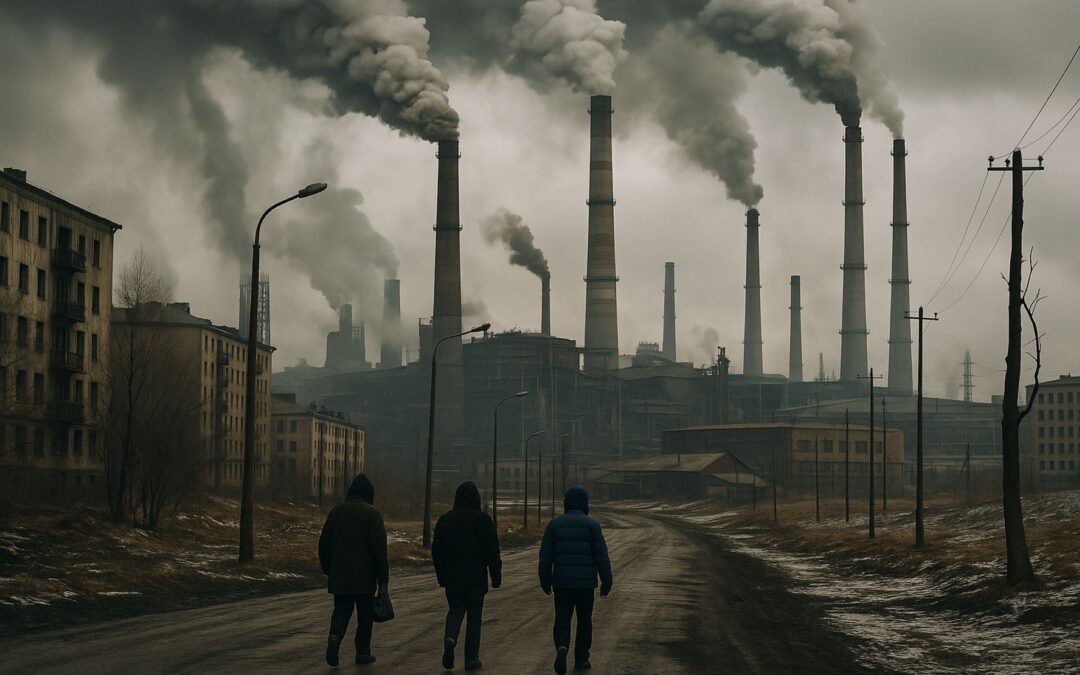
The Soviet Union was not built on dreams — it was built on dust, iron, and the bones of its people. In its relentless pursuit to industrialize, to outpace the capitalist world and reshape humanity itself, the USSR created cities that were less like homes and more like instruments — machines of production disguised as metropolises.
From the smog-choked streets of Magnitogorsk to the frozen wastelands of Norilsk and the dying coal veins of Vorkuta, these cities stand today as haunting testaments to what happens when ideology overpowers empathy.
They were born from ambition, fed by suffering, and preserved by inertia. To walk their streets is to see the ghosts of a century that tried to build paradise from steel — and ended up forging hell instead.
Magnitogorsk: The Iron Heart of Despair
To understand the tragedy of Magnitogorsk, you have to start with its promise.
It was meant to be the Soviet Union’s industrial masterpiece — a city that would transform a peasant nation into a mechanized superpower. A city of steel, sweat, and socialist glory. When Stalin announced the First Five-Year Plan in 1928, he declared that the Soviet Union was “fifty to a hundred years behind the advanced countries” and that they must make up the distance “in ten years — or be crushed.” Magnitogorsk was to be the anvil upon which the new Soviet man would be forged.
The location was chosen not for beauty, but for what lay beneath it — an enormous iron ore deposit buried under the Ural Mountains. So vast was this natural reservoir of metal that early explorers reported their compasses spinning wildly, the magnetic field distorting their sense of direction. To the planners in Moscow, this was a gift from nature itself, proof that the revolution had geological destiny on its side. The site would become the Soviet Pittsburgh, a living emblem of progress.
But progress, in Stalin’s Russia, meant pain. The city was founded in 1929, and construction began almost immediately — without infrastructure, without housing, without even proper roads. Trains crawled across the frozen steppe bringing workers and materials, but few supplies ever made it on time. The workers were mostly peasants, torn from their villages under the collectivization campaign, or prisoners condemned to forced labor. Their arrival at the site was often the beginning of a slow death sentence.
There were no homes, only makeshift huts and abandoned railway cars converted into shelters. In the first winters, temperatures dropped below -30°C, and food was scarce. The men and women who built the city lived off watery cabbage soup and bread crusts. They burned wooden beams from construction scaffolding to stay warm. Many died before the factories they were building ever produced a single ounce of steel.
Even the engineers and bureaucrats — those who had once walked the marble corridors of Leningrad or Moscow — found themselves swallowed by the desolation. A Soviet functionary later described his relocation as “a personal tragedy.” They had been promised purpose and prestige; what they got was isolation and mud. The wind howled across the steppe like a living thing, carrying soot and despair.
Yet the Party called it heroism. Posters declared Magnitogorsk “The City of the Future.” Films glorified its laborers as the vanguard of progress. But behind the propaganda, the place was chaos. There were no paved roads, no sanitation, no hospitals. People relieved themselves in open trenches. Epidemics swept through the camps — typhus, dysentery, malaria — diseases of poverty flourishing in the shadow of smokestacks.
Crime was rampant. The city had a prison colony attached to its main labor complex, and escapees frequently roamed the streets. Murders, stabbings, and robberies were so common that women refused to leave their railcars at night. Local newspapers reported violent incidents daily with chilling normalcy. One account mentioned that “women found it impossible to go out without escort after sundown.” Another described ax murders as routine.
The city’s design only deepened the misery. Soviet planners had initially intended to keep industry and housing separate — factories on one side of the Ural River, residences on the other. But cost overruns and bureaucratic impatience led to a disastrous shortcut: both were built on the same side. Worse, the housing ended up downwind from the steelworks. Residents woke up each morning to smog so thick it blotted out the sun, a rain of soot settling on windowsills, food, and children’s faces.
To the ideologues in Moscow, this was not failure — it was innovation. They wanted to dissolve the bourgeois separation between life and labor, between factory and home. The capitalist city, they argued, was built around markets and money. The socialist city would be built around production and the collective. Magnitogorsk, therefore, was designed not merely as a workplace, but as a living monument to Soviet ideology — a place where workers would breathe industry, eat industry, and sleep beside the hum of machinery.
The result was inhuman. By 1937, eight years after its founding, Magnitogorsk had no functioning sewage system, no proper hospital, and no clean water. Children died of preventable diseases. The river, once a natural boundary, became an open sewer. The air was laced with arsenic and carbon monoxide. The urgency to meet production quotas left no room for public health or urban planning. The Soviet Union was chasing numbers — tons of steel, units of labor — not lives.
As the decades passed, the dream of a model socialist city calcified into a nightmare of smog and sorrow. The very earth beneath Magnitogorsk became toxic. By the 1990s, arsenic levels in the soil were twenty-one times higher than what is safe for humans. Physicians began reporting that fewer than one percent of newborns were perfectly healthy. Lung disease, cancer, and birth defects became endemic. Even the trees turned gray from pollution, their bark ashen and lifeless.
Yet the factory never stopped. Its furnaces still glowed through the night, red as open wounds, feeding the Soviet machine. To stop production was unthinkable — it would mean betraying the revolution. As one factory representative admitted in 1989, “With the existing equipment, either you stop production or you destroy the air.” They chose to destroy the air.
Magnitogorsk remains a grim metaphor for the Soviet experiment — an attempt to industrialize the human spirit as ruthlessly as steel. It was a city built to prove that man could command nature, that ideology could outmuscle geography. But what it proved instead was that when ambition is divorced from humanity, progress becomes poison.
Today, Magnitogorsk still produces steel. The smoke still rises over the Urals. But if you walk its streets, you’ll find a silence beneath the noise — a stillness born of exhaustion. The city that once symbolized strength now stands as a monument to what happens when dreams of glory corrode into fumes. It is not just a place on the map — it is a warning carved into the iron heart of history.
Norilsk: The Gulag that Became a City
If Magnitogorsk was forged in fire, Norilsk was sculpted from ice — a city born not of ambition, but coercion. Perched more than 300 kilometers above the Arctic Circle, Norilsk is a place where winter lasts nine months, where the sun vanishes for six weeks straight, and where the ground itself — frozen solid for millennia — is both foundation and prison. Here, temperatures plunge below –40°C. Winds roar across the tundra at hurricane speeds. Nothing grows. Nothing heals. Yet this, somehow, was where the Soviet Union decided to build one of its greatest industrial hubs.
The origins of Norilsk lie in Stalin’s drive for self-sufficiency. Beneath the desolate permafrost of the Taymyr Peninsula lay a treasure trove of minerals — nickel, cobalt, copper, and platinum — all vital for military production and technological supremacy. The deposits were so vast that Soviet geologists nicknamed the region “the Arctic treasure chest.” But to extract those riches required something more valuable than machinery: human bodies willing to suffer.
Those bodies came in shackles.
In 1935, construction began on Norillag, one of Stalin’s largest gulags. Tens of thousands of prisoners — intellectuals, farmers, former soldiers, “enemies of the people” — were transported north in cattle cars, across thousands of miles of frozen wasteland. Many never even reached the camp. Those who did found a world of perpetual twilight, where they were forced to work twelve- to sixteen-hour days in subzero temperatures, mining ore from beneath the earth with little more than picks, dynamite, and desperation.
Frostbite was inevitable. So was starvation. Men collapsed in the snow and were left where they fell. Inmates burned benches, floorboards, even their own shoes to stay warm at night. The ground was too frozen to dig graves, so corpses were stacked in snowbanks like forgotten cargo. A survivor later recalled, “There was no need for executioners. The cold did their work.”
And yet, Norilsk produced. By 1953, the mines were supplying over a third of the Soviet Union’s nickel, nearly all of its platinum, and large shares of cobalt and copper — metals essential for tanks, aircraft, and nuclear reactors. The city’s output became so strategic that even the CIA tracked it during the Cold War. Stalin’s frozen labor camp had become the beating heart of Soviet industry.
When the gulag system collapsed after Stalin’s death in 1953, Norilsk did not vanish. It simply changed uniforms. The barbed wire was taken down, but the prisoners stayed — many too traumatized or impoverished to leave. The Soviet government, unwilling to abandon such a valuable industrial asset, transformed the camp into a city. Barracks became apartments. Watchtowers were replaced by smokestacks. The same hands that once built under guard now built for wages.
But freedom didn’t thaw the cold. The Soviet planners designed Norilsk as a “monotown” — a settlement built entirely around a single industry. Everything revolved around extraction. Schools, hospitals, and housing blocks were constructed from reinforced concrete to survive the permafrost, but the architecture was uniform, grey, and soul-crushing. Endless rows of identical apartment towers stretched into the white void, their windows frosted from within. During the polar night, the city glowed an eerie orange — the light of factories reflecting off clouds of chemical smog.
The environmental toll was catastrophic. The same nickel smelters that fueled Soviet prosperity also released millions of tons of sulfur dioxide and heavy metals into the air each year. Trees died for hundreds of kilometers around the city, their trunks blackened, their leaves dissolved by acid rain. The ground, permanently frozen beneath, trapped toxins in the soil like time capsules of decay. In the 1970s, a visiting Canadian delegation described Norilsk as “a city where the air itself bites back.”
By the 21st century, the damage had reached apocalyptic proportions. Scientists estimated that over 1.5 million tons of pollutants were being released annually. Residents described how the snow fell black or red, depending on which smelter was upwind. Children drew pictures of smokestacks and gray skies — not out of imagination, but memory. Doctors reported chronic lung diseases, cancer rates far above the national average, and neurological disorders from constant exposure to heavy metals.
Then came the disaster of May 2020. The permafrost — the frozen soil that had been the city’s only stable foundation — began to thaw due to rising global temperatures. One of Nornickel’s massive fuel storage tanks collapsed, releasing 21,000 tons of diesel into nearby rivers. The spill turned waterways crimson, killed fish and wildlife for miles, and became the largest Arctic oil disaster in history. Officials blamed “climate change” and “inadequate maintenance,” but the truth was more human: Norilsk had been built on denial — denial of nature, denial of limits, denial of consequence.
Yet, the city persists. It must. The world still craves the metals buried beneath its frozen earth. Nornickel remains one of Russia’s largest corporations, supplying over 20% of global nickel demand — the same nickel used in electric cars, smartphones, and aerospace engineering. Progress elsewhere is literally built on Norilsk’s suffering.
For those who live there, existence is a grim trade. High salaries lure workers from across Russia, but few stay long. Those who do describe life as a cycle of endurance — of long nights, toxic air, and the quiet resignation that this is the price of survival. The Arctic night closes in early and releases late. When the sun finally rises, it reveals a city scarred by smoke, surrounded by lifeless tundra.
Norilsk is a paradox frozen in place — a triumph of Soviet willpower and a monument to its cruelty. It was born as a prison, raised as a factory, and still functions as both. Its people live where no one should live, doing work that no one should have to do, to sustain a civilization that long ago forgot their names.
In Norilsk, history hasn’t ended. It’s simply congealed — suspended like ice around a buried flame, burning slowly, endlessly, in the dark.
Vorkuta: The City Time Forgot
Vorkuta is not merely a place — it’s a wound that never healed. It lies in the upper reaches of the Komi Republic, deep within the Arctic Circle, where the tundra stretches endlessly and the horizon feels like the edge of existence. The ground here is frozen nine months of the year, the wind cuts like a blade, and the nearest sign of civilization lies hundreds of kilometers away. For most of its history, Vorkuta was not meant for the living — it was a graveyard disguised as a city.
Its origins trace back to the early 1930s, when Stalin’s government discovered immense coal deposits in the region. The Soviet Union’s rapid industrialization demanded energy, and coal was its black gold. The problem was that no sane person would willingly live or work in a place like Vorkuta. The solution? Force them to.
In 1931, the Soviet secret police — then known as the OGPU — established one of the northernmost labor camps of the Gulag system, known as Vorkutlag. It was part of a vast chain of forced-labor colonies stretching across the Soviet Arctic. Prisoners arrived in cattle cars after journeys that lasted weeks. Many didn’t survive the trip. Those who did were met by an unforgiving wasteland. There were no permanent shelters, no tools fit for the permafrost, no medicine. They were told to dig coal from a land that refused to yield.
Temperatures often plunged to -40°C. The ground was so hard that dynamite was required to loosen it. Prisoners wore rags, slept in unheated barracks, and worked sixteen-hour shifts with minimal food. Guards carried rifles, not to prevent escape — there was nowhere to go — but to enforce quotas. If a worker didn’t meet his daily coal output, his food ration was cut. Hunger, exhaustion, and frostbite did the rest. It was, in every sense, a slow-motion execution by labor.
During the Great Purge of the late 1930s, the camp system expanded dramatically. Intellectuals, soldiers, peasants, even entire ethnic groups were shipped north to feed the empire’s appetite for coal. At its peak, Vorkutlag held over 70,000 prisoners. In 1953, the year of Stalin’s death, the inmates staged one of the largest uprisings in Gulag history — the Vorkuta Rebellion. Thousands of prisoners refused to work, demanding better treatment and release. Soviet troops surrounded the camp and opened fire. The rebellion was crushed within days. Hundreds were killed. The tundra swallowed their bodies, preserving them in ice.
After the Gulag system was dismantled in the mid-1950s, the state repurposed the camp infrastructure into a functioning industrial town. Barracks became homes, watchtowers became utility poles, and the mines continued to operate — now with “free” workers, many of whom were former inmates with nowhere else to go. The Soviet government poured money into Vorkuta, promoting it as a model Arctic settlement. Apartments were built, schools established, and cultural centers opened. For a time, the city thrived. Its miners were hailed as heroes of socialist labor, their faces featured on propaganda posters as symbols of endurance and loyalty to the Motherland.
But beneath the surface, the foundations of Vorkuta were already cracking. Its existence depended entirely on coal — a single, brittle pillar of survival. When the Soviet Union collapsed in 1991, that pillar shattered.
The newly capitalist Russia inherited a decaying infrastructure, outdated mines, and a collapsing market for coal. The state coal monopoly, Rosugol, began shutting down unprofitable operations across the country. In Vorkuta, the closures came like a death sentence. By 2009, more than half of the mines had been sealed. The once-bustling town fell silent. Thousands lost their jobs overnight.
The people who could afford to leave did so immediately. But most couldn’t. The cost of relocating a family by train to the nearest major city was astronomical. The ruble’s collapse and runaway inflation wiped out personal savings. For many, Vorkuta was both home and prison — too expensive to escape, too harsh to survive in.
With the economy gutted, law and order disintegrated. Gangs rose from the ashes of the old state system, seizing control of trade routes and fuel supplies. Violence became endemic. The city’s few remaining businesses paid protection money to stay open. Drugs flooded the streets, brought in through the same smuggling routes that once ferried coal. By 2007, nearly a third of Vorkuta’s residents admitted to using narcotics — a staggering figure for such an isolated region. Addiction became the anesthesia for despair.
The population collapse was staggering. Between 1989 and 2002, the city lost nearly 27% of its residents — over 30,000 people. Entire neighborhoods were abandoned. Schools shut their doors, playgrounds filled with snowdrifts, and once-proud apartment blocks became skeletal ruins. The empty windows stared blankly into the tundra, as if mourning the lives that had vanished. Those who stayed did so out of habit, or because there was simply nowhere else to go.
The Russian government, realizing that the city was dying, sought international help. In 2003, it requested an $80 million loan from the World Bank to assist residents in relocating to other regions — including, ironically, to Norilsk. When the prospect of moving to one of the world’s most polluted and inhospitable cities counts as an upgrade, you know the depths of your despair.
By the 2010s, Vorkuta had become a ghost city. Its skyline, once dotted with smokestacks, was now marked by crumbling towers and darkened windows. The few functioning mines operated with heavy automation, employing only a fraction of the workforce they once did. Unemployment soared, and with it, apathy. The younger generation grew up with no memory of the Soviet idealism that built the city. For them, Vorkuta was not a triumph of labor — it was a trap of history.
And yet, there is something haunting about its persistence. In the depths of winter, when temperatures plummet and the streets are buried in snow, the city still breathes — faintly. Smoke rises from a few chimneys. Lights flicker in isolated apartment blocks. The sound of a passing freight train echoes through the empty streets, a ghostly reminder of a time when the world still cared.
Vorkuta today is a study in entropy — the slow unraveling of human effort against the indifference of nature. Its decay is not sudden or dramatic; it’s steady, almost peaceful, like the fading heartbeat of a dying star. Coal, the element that once gave it life, is now hastening its death. As the world turns toward renewable energy, the city’s reason for being dissolves. The miners’ lamps are dimming, one by one.
Perhaps someday soon, Vorkuta will disappear entirely — reclaimed by the tundra that once imprisoned it. The snow will bury the ruins, the wind will erase the roads, and all that will remain are whispers: of the prisoners who dug in the dark, of the workers who dreamed of escape, of the families who stayed behind because they had nowhere else to go.
In Vorkuta, history doesn’t just linger — it freezes in place. It is the Soviet ghost that refuses to die, a monument to a civilization that mistook endurance for glory, and suffering for strength.
The Legacy of Industrial Ambition
When you trace the arc of the Soviet Union’s industrial story — from Magnitogorsk’s choking furnaces to Norilsk’s frozen smokestacks and Vorkuta’s collapsing mines — a single thread connects them all: a blind, relentless faith in progress. These cities were monuments to a belief system, not just a government program. They were built to prove that the will of man — or more precisely, the will of the state — could bend nature, geography, and even human endurance into submission.
But the Soviet experiment did not simply seek to modernize a nation; it sought to reengineer humanity itself. These were not towns designed for comfort, culture, or joy. They were blueprints of ideology, places where people were meant to dissolve into the machinery of collective purpose. The worker was not an individual but a cog in a historical mechanism — a living instrument of production.
In Magnitogorsk, the dream was to turn peasants into proletarians — to forge a new species of man from sweat and steel. In Norilsk, the Soviet state proved it could extract not just ore from the Earth but obedience from the human spirit, even in the most hostile climate imaginable. And in Vorkuta, it demonstrated how quickly a city built on forced labor could be abandoned once that labor was no longer needed. Each was a different expression of the same delusion: that suffering was a form of virtue, that misery could be justified in the name of progress.
The Cost of Catching Up
In the early 20th century, Russia’s sense of backwardness was both real and psychological. The West was modernizing at lightning speed — factories, railways, cities rising overnight — while Russia still plowed fields with oxen. Stalin understood that power in the modern world came not from ideology or even territory, but from steel, fuel, and machinery. The Five-Year Plans were his answer — brutal, uncompromising, and absolute.
Yet, in trying to catch up, the Soviet Union didn’t just imitate the industrial West; it amplified its worst instincts. Where capitalist industrialization was driven by profit, Soviet industrialization was driven by paranoia — a race against humiliation. Failure was not just economic; it was treasonous. So, cities were built faster than they could be planned, factories operated beyond their safe limits, and millions were sacrificed in the name of keeping pace with an imaginary enemy.
The Human Toll
The consequences were catastrophic. Entire populations were uprooted, deported, or coerced into service. Families vanished into the gulags, their names erased, their labor transformed into smokestacks and slag heaps. In Magnitogorsk, newborns gasped for air. In Norilsk, prisoners froze in unmarked graves. In Vorkuta, miners inhaled coal dust while the state broadcast their heroism over the radio.
But what makes these stories truly tragic is not just the suffering — it’s the silence that followed. When the Soviet Union collapsed in 1991, these cities didn’t vanish with it. They lingered, haunted by the ghosts of their creation. Factories kept running. Mines kept digging. Pollution kept spreading. The ideology that built them died, but the inertia of industry survived — grinding on without purpose, like a machine that no one remembered how to turn off.
Cities Without Futures
Today, Magnitogorsk still manufactures steel for global markets, its air thick with the same poison that once symbolized progress. Norilsk continues to mine nickel for the technologies of the 21st century — electric cars, batteries, smartphones — ironically fueling the world’s so-called “green revolution.” And Vorkuta, stripped of economic purpose, stands as a necropolis of Soviet dreams — a city slowly returning to the snow.
These places are not just historical relics; they are living testaments to what happens when production becomes religion. When the metric of success is tonnage, not wellbeing. When people become statistics, and suffering is measured only in efficiency.
The Lesson Beneath the Ruins
There is a certain grim poetry to their survival. Against all odds — against pollution, poverty, and perpetual night — people still live in these cities. They raise families. They celebrate New Year’s under black snow. They laugh, they love, they endure. It’s a testament to human resilience — but also a reminder that endurance, without purpose, is merely another form of captivity.
The legacy of the Soviet industrial experiment is not progress, nor even failure. It’s the revelation that progress divorced from humanity is indistinguishable from ruin. Magnitogorsk, Norilsk, and Vorkuta stand as monuments not to what was built, but to what was lost — empathy, beauty, and the simple dignity of life.
In their silence, they whisper the same truth: You can conquer nature, command the elements, and build cities in the snow — but if you forget the human heart, even your greatest achievements will crumble into ash.
Conclusion
Magnitogorsk, Norilsk, and Vorkuta remain as monuments to the arrogance of human design — proof that progress without compassion is just another form of decay. What began as Stalin’s promise of industrial glory became a theater of suffering, where the human spirit was melted down for the sake of production.
Decades after the fall of the Soviet Union, these cities still breathe — slowly, painfully — kept alive by the same industries that poisoned them. Their skies are dark, their rivers are heavy with metal, and their people quietly endure what history has long forgotten.
That may be their greatest lesson. These cities remind us that civilization cannot be measured in steel or coal or nickel — but in the lives that endure within it. Progress is meaningless when it crushes the very souls it was meant to uplift. The Soviet dream of mastering nature and man may have perished, but its ruins still whisper a truth older than any ideology: you can build factories from iron, but you cannot build a future without humanity.