
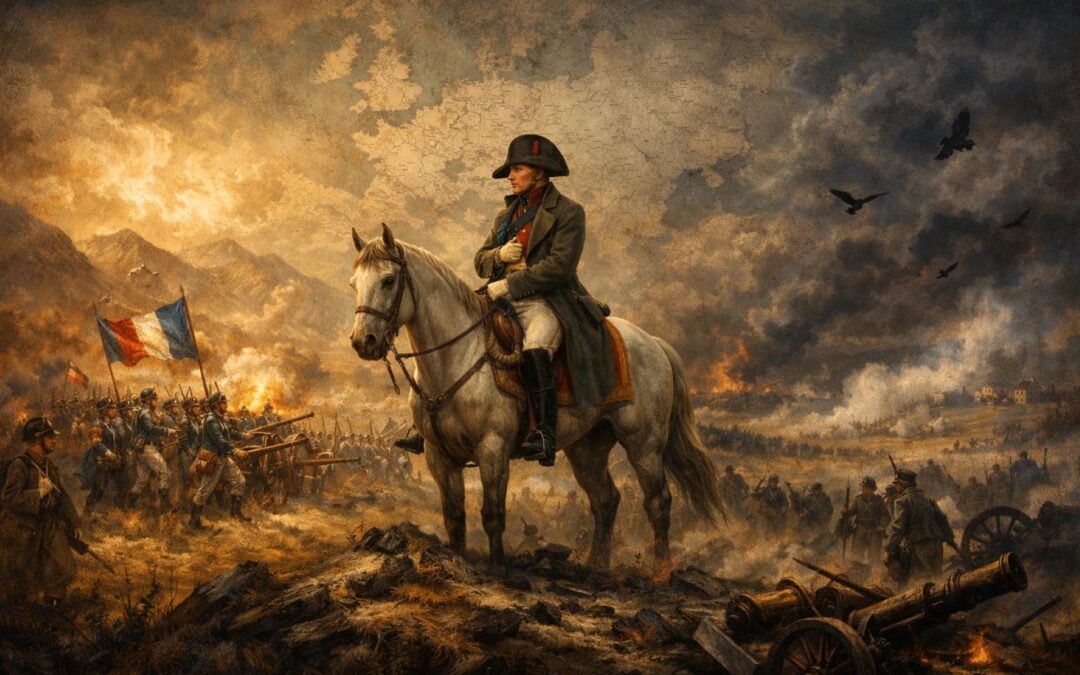
Few figures in history have reshaped Europe as dramatically as Napoleon Bonaparte. Rising from relatively modest beginnings on the island of Corsica, Napoleon became one of the most powerful rulers the continent had ever seen. Within a single generation, his ambitions and military genius would redraw the map of Europe, topple ancient institutions, and ignite wars that involved nearly every major power of the time.
The Napoleonic Wars, fought between roughly 1799 and 1815, were the culmination of the turmoil unleashed by the French Revolution. When revolution erupted in France in 1789, it did more than overthrow a king. It challenged the foundations of European political order. Ideas about citizenship, equality before the law, and the dismantling of aristocratic privilege spread rapidly across the continent, alarming the monarchies that had ruled Europe for centuries.
In response, a series of coalitions formed among the great powers—Austria, Prussia, Russia, and Britain—to contain revolutionary France and restore the old balance of power. Out of this conflict emerged Napoleon, a brilliant young artillery officer whose extraordinary military talent quickly propelled him to prominence. Through a combination of daring strategy, relentless ambition, and political opportunism, he rose from general to First Consul and ultimately crowned himself Emperor of the French.
Over the next decade, Napoleon dominated Europe through a remarkable series of victories. His armies defeated coalition after coalition, dismantled the thousand-year-old Holy Roman Empire, and established a vast network of allied and satellite states across the continent. At its height, the Napoleonic Empire stretched from Spain to Poland and reshaped the political landscape of Europe.
Yet Napoleon’s rise also set the stage for his eventual downfall. His efforts to isolate Britain economically, his brutal war in Spain, and his disastrous invasion of Russia in 1812 gradually eroded the strength of his empire. As former allies turned against him and Europe united in opposition, the tide of war shifted.
The Napoleonic Wars were therefore more than a series of military campaigns. They marked a profound turning point in European history. The conflicts accelerated the spread of revolutionary ideas, transformed the nature of warfare, weakened traditional monarchies, and helped ignite powerful new forces such as nationalism that would shape the modern world.
At the center of it all stood Napoleon himself—a military genius, political reformer, ambitious conqueror, and controversial figure whose legacy continues to provoke debate more than two centuries later.
The Making of Napoleon Bonaparte
Corsican Origins and Early Ambition
Napoleon Bonaparte was born on August 15, 1769, in the city of Ajaccio on the Mediterranean island of Corsica. His birth came at a pivotal moment in the island’s history. For centuries Corsica had been controlled by the Republic of Genoa, but in 1768 Genoa sold the island to France after struggling to maintain authority there. When Napoleon was born the following year, Corsica had only recently become French territory.
Napoleon’s family belonged to the minor Corsican nobility, but they were far from wealthy. His father, Carlo Buonaparte, was a lawyer who initially supported Corsican resistance against French rule before eventually aligning himself with the new French authorities. This pragmatic shift allowed the family to secure certain privileges, including educational opportunities for their children.
Napoleon’s mother, Letizia Ramolino, was known for her strict discipline and strong character—qualities that Napoleon later credited with shaping his personality. Life in Corsica during Napoleon’s childhood was rugged and politically turbulent, and the young boy grew up surrounded by stories of struggle, resistance, and ambition.
Despite being born into a modest family, Napoleon developed a powerful sense of destiny early in life. He admired the great conquerors of antiquity—figures such as Alexander the Great and Julius Caesar—and began to imagine that he might one day achieve similar greatness. Yet the path ahead was far from obvious. As a Corsican living within the French system, Napoleon was an outsider both culturally and socially.
Military Education and the Search for Advancement
Napoleon’s father secured him a scholarship to attend military school in mainland France, a rare opportunity that would profoundly shape his future. At the age of nine, Napoleon left Corsica to study at the military academy of Brienne in northeastern France.
The experience was difficult. Napoleon spoke French with a strong Corsican accent and came from a relatively poor family compared to many of his classmates, who were often from wealthy aristocratic backgrounds. He was frequently mocked and isolated. These experiences reinforced his outsider identity and fueled a fierce determination to prove himself.
Rather than focusing on social life, Napoleon immersed himself in study. He demonstrated particular talent in mathematics and geography—skills that were especially valuable for artillery officers. Artillery required precision, calculation, and technical knowledge, making it one of the most intellectually demanding branches of the army.
Napoleon graduated from the prestigious École Militaire in Paris in 1785 at the age of sixteen and was commissioned as a second lieutenant in an artillery regiment. For a young man of modest means, this was already a respectable achievement. Yet Napoleon was deeply ambitious and quickly grew frustrated with the rigid hierarchy of the old French military system.
Before the French Revolution, advancement in the army depended heavily on noble birth rather than merit. Many senior positions were reserved for aristocrats regardless of their competence. For a talented but relatively unknown officer like Napoleon, meaningful promotion seemed unlikely.
Everything changed with the outbreak of revolution.
The French Revolution as Napoleon’s Opportunity
The French Revolution, beginning in 1789, shattered the traditional structures that had long governed French society. Aristocratic privileges were dismantled, and new opportunities opened for individuals who possessed talent, energy, and ambition.
For Napoleon, the revolution transformed what had once been a closed system into a landscape full of possibility. As France descended into internal conflict and war with foreign powers, the army expanded rapidly and promotions came quickly to those who demonstrated ability.
Napoleon first gained significant attention during the Siege of Toulon in 1793. Royalist forces in the southern port city had handed control of the harbor to the British fleet, creating a major threat to revolutionary France. As a young artillery officer, Napoleon proposed a bold plan to seize key positions overlooking the harbor. Once these heights were captured, French artillery could drive the British fleet from the port.
The plan worked brilliantly. The British were forced to withdraw, and the city fell back under revolutionary control. Napoleon’s role in the victory earned him promotion to brigadier general at the astonishing age of twenty-four.
His reputation continued to grow in the turbulent years that followed. In 1795, when a royalist uprising threatened the revolutionary government in Paris, Napoleon famously suppressed the rebellion with decisive artillery fire. The swift and ruthless action demonstrated his willingness to use force to maintain order—and it brought him to the attention of powerful political leaders.
Within a few years, Napoleon would be given command of a French army and the opportunity to demonstrate the full scope of his military talent. What followed would transform him from a promising young officer into one of the most celebrated commanders in European history.
Napoleon’s Early Rise During the Revolutionary Wars
Toulon, Paris, and the Path to Command
Napoleon’s rise during the French Revolutionary Wars was extraordinarily rapid. The political chaos unleashed by the revolution created a situation in which talent, decisiveness, and loyalty to the new regime were rewarded far more quickly than under the old monarchy. For an ambitious officer like Napoleon, the turmoil of the 1790s proved to be the perfect environment in which to advance.
His first major breakthrough came during the Siege of Toulon in 1793, when royalist rebels handed the port city over to British forces. Toulon was one of France’s most important naval bases, and its loss represented a severe strategic threat to the revolutionary government.
Napoleon, then a young artillery officer, proposed a bold but effective plan. Instead of attacking the city directly, French forces would seize key high ground overlooking the harbor. Once these positions were secured, artillery batteries could dominate the port and force the British fleet to withdraw.
The plan succeeded. French artillery bombardment made the British position untenable, and the fleet was forced to evacuate the harbor. The victory restored French control of Toulon and brought Napoleon national attention. At just twenty-four years old, he was promoted to brigadier general.
His reputation grew further in 1795, when royalist supporters attempted to overthrow the revolutionary government in Paris. The government turned to Napoleon to suppress the uprising. Acting quickly, he deployed artillery against the insurgents in the streets of the capital. The uprising was crushed in what became known as the famous “whiff of grapeshot”—a moment that demonstrated Napoleon’s readiness to use decisive force to maintain political stability.
The young general had now proven himself both militarily capable and politically reliable. Within a year, he would receive a command that would transform his career and elevate him into the ranks of Europe’s most formidable military leaders.
Marriage, Social Ascent, and Personal Contradictions
Around the same time that his military career was accelerating, Napoleon also sought to improve his social standing through marriage. In 1796 he married Joséphine de Beauharnais, a widowed aristocrat who was older than him and already well connected within Parisian political society.
The marriage was complicated from the beginning. Napoleon quickly became deeply attached to Joséphine, writing her passionate letters during his campaigns. Joséphine, however, was far less devoted and maintained relationships with other men during their marriage. Their relationship would remain turbulent for many years.
Despite its personal difficulties, the marriage was politically advantageous. Joséphine’s connections helped integrate Napoleon into influential social circles in Paris, further strengthening his position within the revolutionary government.
Yet even as Napoleon sought social advancement, his primary focus remained on military glory. In 1796 he was appointed commander of the Army of Italy, a force tasked with fighting Austrian and allied troops in northern Italy. At the time, the army was poorly supplied, demoralized, and largely viewed by the French government as a secondary theater of war.
Napoleon would soon change that perception entirely.
The First Italian Campaign and the Birth of a Legend
When Napoleon arrived to take command of the Army of Italy, he inherited a force that was underpaid, poorly equipped, and suffering from low morale. Instead of seeing these disadvantages as insurmountable obstacles, Napoleon transformed them into motivation.
He delivered stirring speeches to his soldiers, promising them victory, glory, and the riches of Italy if they followed him into battle. His energy and confidence inspired the army, and within weeks he began launching a series of rapid and aggressive offensives against Austrian and Piedmontese forces.
Napoleon’s campaign in Italy demonstrated the qualities that would define his military genius. Rather than fighting slow, conventional battles, he relied on speed, surprise, and the concentration of force at decisive points. He repeatedly maneuvered his army between enemy forces, defeating them individually before they could unite.
Within a single campaign season, Napoleon won a stunning sequence of victories—at Montenotte, Lodi, Arcole, and Rivoli—that forced Austria to retreat and eventually seek peace negotiations. His success transformed what had been intended as a diversionary campaign into the central theater of the war.
The campaign also introduced another important aspect of Napoleon’s leadership: his ability to cultivate a powerful public image. He issued dramatic proclamations to his soldiers, wrote reports that highlighted his achievements, and ensured that news of his victories spread quickly throughout France.
By the end of the campaign, Napoleon had not only defeated major European armies but had also reshaped the political landscape of northern Italy. Several territories were reorganized into French-aligned republics, spreading revolutionary influence across the region.
Perhaps most importantly, Napoleon emerged from the Italian campaign as a national hero. At only twenty-eight years old, he had demonstrated military brilliance, political ambition, and a remarkable ability to inspire loyalty among his soldiers.
The young Corsican officer who had once been mocked as an outsider had now become one of the most famous generals in Europe—and his ambitions were only beginning to grow.
Egypt, Propaganda, and the Seizure of Power
The Egyptian Expedition and Its Limits
By the late 1790s, Napoleon Bonaparte had become one of the most celebrated figures in France. His victories in Italy had not only humbled Austria but had also elevated him to near-legendary status among the French public. For the government in Paris—known as the Directory—this popularity was both an asset and a potential threat. Napoleon was a hero, but he was also an ambitious general with enormous influence over the army.
Seeking both to weaken Britain and to keep Napoleon far from the political center of France, the Directory approved a bold plan: an expedition to Egypt in 1798. The goal was strategic. By seizing Egypt, France could potentially disrupt Britain’s trade routes to India, striking at the heart of British imperial power.
Napoleon embraced the idea enthusiastically. In addition to soldiers, he brought with him an unusual group of scholars, scientists, and engineers—known as the savants—who were tasked with studying the history, culture, and geography of Egypt. Their work would later lead to important discoveries, including the famous Rosetta Stone, which would eventually help scholars decipher ancient Egyptian hieroglyphs.
Initially, the campaign appeared successful. Napoleon captured Alexandria and defeated the Mamluk forces that controlled Egypt at the Battle of the Pyramids in July 1798. The victory demonstrated once again Napoleon’s ability to defeat larger forces through disciplined formations and effective use of artillery.
Yet the campaign soon ran into serious difficulties. In August 1798, the British navy under Admiral Horatio Nelson located the French fleet anchored in Aboukir Bay and destroyed it during the Battle of the Nile. With the fleet destroyed, Napoleon’s army was effectively stranded in Egypt, cut off from France and vulnerable to counterattack.
Further attempts to expand the campaign into the eastern Mediterranean met with mixed success. Napoleon marched into Ottoman territory in Syria, hoping to weaken Ottoman resistance, but his army failed to capture the heavily fortified city of Acre. Disease, supply shortages, and mounting casualties began to take their toll.
Realizing that the situation was deteriorating, Napoleon made a controversial decision. In 1799, he quietly left Egypt, abandoning his army and returning to France. While the remaining French forces in Egypt would eventually surrender, Napoleon himself arrived back in France before news of the campaign’s failures had fully spread.
Napoleon’s Mastery of Image and Reputation
One of Napoleon’s greatest talents extended beyond the battlefield: he understood the power of public perception.
Throughout his career, he carefully managed his image. During the Italian campaigns he had already demonstrated a knack for shaping the narrative of his victories through official reports, proclamations, and correspondence. In Egypt he continued this strategy by publishing newspapers and dispatches that portrayed the campaign in heroic terms, often downplaying setbacks or presenting events in a more favorable light.
He also recognized the importance of symbolism and visual representation. Artists were commissioned to paint dramatic scenes of his achievements—images that portrayed Napoleon as a heroic and almost mythic figure. One famous example depicted him dramatically crossing the Alps on a rearing horse, though in reality he had made the journey on a mule.
By the time Napoleon returned to France in late 1799, the public largely viewed the Egyptian expedition not as a failure but as another chapter in the legend of a brilliant commander. His reputation remained largely intact, and the political situation in France was rapidly deteriorating.
This instability would soon provide Napoleon with the opportunity he had been waiting for.
The Coup of 1799 and the Birth of the Consulate
When Napoleon returned to France, the revolutionary government was struggling. The Directory, which had ruled since 1795, faced widespread criticism for corruption, economic instability, and military setbacks. Public confidence in the government had eroded, and many political figures believed that a strong new leadership was needed to stabilize the nation.
Among those seeking change was the influential politician Emmanuel-Joseph Sieyès, who began plotting a coup to replace the Directory with a new system of government. However, he needed a figure with military prestige and public support to ensure the success of the plan.
Napoleon was the perfect candidate.
In November 1799, the conspirators initiated what became known as the Coup of 18 Brumaire (named after the revolutionary calendar date). The plan involved persuading members of the French legislature that a radical Jacobin conspiracy threatened the government, prompting them to relocate their meeting to a palace outside Paris for safety.
Once the legislature had been isolated, Napoleon and his troops moved to assert control. The situation quickly became chaotic. Members of the legislature resisted the attempt to dissolve the government, and Napoleon himself struggled to maintain order during tense confrontations inside the assembly halls.
Ultimately, the coup succeeded largely due to the intervention of Napoleon’s brother Lucien Bonaparte, who was serving as president of the Council of Five Hundred. With the support of the army, the existing government was dissolved and replaced with a new political structure known as the Consulate.
Although the Consulate technically consisted of three consuls, real power quickly concentrated in Napoleon’s hands. As First Consul, he effectively became the ruler of France.
At just thirty years old, Napoleon had moved from celebrated general to the dominant political leader of one of Europe’s most powerful nations. The French Revolution had opened the door to extraordinary opportunity, but it was Napoleon’s ambition, strategic intelligence, and willingness to seize the moment that allowed him to step through it.
His next challenge would be even greater: transforming revolutionary chaos into a stable and powerful state while continuing to defend France against the hostile monarchies of Europe.
Rebuilding France Under the Consulate
Administrative and Financial Stabilization
When Napoleon assumed power as First Consul in 1799, France was exhausted by a decade of revolution, political instability, and continuous war. Governments had risen and fallen in rapid succession, public finances were in disarray, and corruption had weakened confidence in state institutions. Napoleon understood that military victories alone would not secure his position; the country needed stability, order, and functioning institutions.
One of his first priorities was to restore financial stability. The revolutionary government had struggled with inflation, unreliable currency, and inefficient tax collection. Napoleon introduced reforms aimed at centralizing financial administration and improving the efficiency of taxation. In 1800 he established the Bank of France, which helped stabilize the currency and restore confidence in the French financial system. A more disciplined taxation structure allowed the state to collect revenue more effectively, ensuring that the government could fund both its administration and its armies.
Napoleon also reorganized local government. France had been divided into administrative regions known as departments during the revolution, but these regions lacked consistent leadership and oversight. Napoleon introduced a system of centrally appointed officials called prefects, who represented the authority of the national government in each department. Prefects were responsible for enforcing laws, supervising local administration, and ensuring that the policies of the central government were implemented uniformly across the country.
This highly centralized administrative structure greatly strengthened the power of the French state. While it limited local autonomy, it also created a more efficient and disciplined government capable of enforcing laws and maintaining order throughout the nation.
The Napoleonic Code and Legal Centralization
One of Napoleon’s most lasting contributions was the creation of a unified legal system. Prior to the revolution, France had been governed by a confusing patchwork of regional laws, feudal customs, and royal decrees. Even after the revolution, legal inconsistencies remained widespread.
To address this problem, Napoleon commissioned a group of legal scholars to compile a comprehensive civil code that would apply uniformly throughout France. The result was the Napoleonic Code, formally introduced in 1804.
The code established several key principles that reflected the ideals of the revolution. It affirmed equality before the law, protected private property rights, and eliminated many remaining feudal privileges. It also created a standardized framework for contracts, inheritance, and civil procedures, making the legal system more predictable and accessible.
However, the Napoleonic Code also reflected the conservative aspects of Napoleon’s rule. While it preserved many revolutionary principles, it reinforced traditional authority within the family. Women were placed under the legal authority of their husbands, and fathers maintained strong control over their households. In this sense, the code combined revolutionary legal equality with a more traditional social hierarchy.
Despite these limitations, the Napoleonic Code became one of the most influential legal frameworks in modern history. Versions of it were adopted across much of Europe and later influenced legal systems around the world.
Education, Religion, and the Reordering of Society
Napoleon believed that a strong state required a well-trained administrative and military elite. To achieve this, he reformed the education system and created institutions designed to train future government officials and officers.
One of the most important reforms was the creation of lycées, state-run secondary schools that focused on rigorous academic instruction, particularly in mathematics, science, and classical studies. Admission to these schools was based largely on merit, reflecting Napoleon’s belief that talent and ability should determine advancement within the state.
Religion was another area where Napoleon sought stability after the radical upheavals of the revolution. During the revolutionary period, the Catholic Church had been stripped of much of its power and influence, creating deep divisions within French society.
In 1801 Napoleon negotiated the Concordat with the Pope, an agreement that restored the Catholic Church’s presence in France while ensuring that it remained subordinate to the state. Catholicism was recognized as the religion of the majority of French citizens, but the government retained the authority to appoint bishops and supervise church activities.
At the same time, Napoleon maintained a policy of religious tolerance. Protestant and Jewish communities were granted legal recognition and protections, reflecting the broader revolutionary principle of religious freedom.
Through these reforms, Napoleon aimed to reconcile revolutionary ideals with social stability, creating a society that was both orderly and modern.
Reform, Control, and the Contradictions of Napoleonic Rule
While Napoleon’s domestic reforms brought stability and administrative efficiency, they also concentrated power in his own hands. Political opposition was limited, the press was tightly controlled, and critics of the regime were often suppressed.
Napoleon justified these measures as necessary to maintain order after years of revolutionary chaos. In his view, France needed strong leadership to preserve the achievements of the revolution while preventing the return of instability and violence.
Many French citizens accepted this trade-off. Napoleon’s government restored economic stability, improved infrastructure, and brought a sense of national pride through military success. For many people, the benefits of order and prosperity outweighed the loss of certain political freedoms.
By the early 1800s, Napoleon had transformed France from a revolutionary state struggling to survive into a powerful and centralized nation. Yet his ambitions continued to grow. In 1804 he would take a step that symbolized the full transformation of revolutionary France into a new imperial order: he crowned himself Emperor of the French.
Europe’s monarchs watched these developments with increasing alarm, and soon they would unite once again in an effort to contain the expanding power of Napoleon’s France.
The War of the Second Coalition and Napoleon’s Consolidation of Power
Marengo, Hohenlinden, and the Defeat of Austria
Even as Napoleon was reorganizing France internally, the country remained locked in conflict with the monarchies of Europe. While Napoleon had been campaigning in Egypt, the European powers had formed the Second Coalition, hoping to roll back French influence across the continent. Austria, Russia, Britain, and several smaller states joined together to challenge France’s expanding revolutionary republic.
By the time Napoleon seized power in 1799, France’s military position had deteriorated significantly. Coalition forces had pushed French armies out of much of Italy and threatened French gains in Central Europe. The young First Consul immediately recognized that military success was essential not only for France’s security but also for strengthening his own political authority.
In 1800, Napoleon launched a daring campaign to reclaim northern Italy from Austrian control. Instead of advancing directly through conventional routes, he executed a bold strategic maneuver that would become one of the most famous episodes of his career. Moving his army across the Alps through the Great St. Bernard Pass, Napoleon descended unexpectedly into northern Italy, threatening Austrian supply lines and forcing the enemy to confront him.
The resulting Battle of Marengo, fought in June 1800, nearly ended in disaster for the French. Austrian forces initially overwhelmed Napoleon’s army and seemed on the verge of victory. However, the arrival of French reinforcements late in the day allowed Napoleon to counterattack. The Austrians were driven back, turning what had seemed like a defeat into a dramatic French victory.
At roughly the same time, another French army under General Jean Moreau achieved a decisive victory against Austrian forces at the Battle of Hohenlinden in December 1800. This defeat exposed the road to Vienna and forced Austria to negotiate peace.
The resulting Treaty of Lunéville in 1801 confirmed French dominance in much of Western Europe. Austria recognized French control over territories west of the Rhine and accepted the reorganization of several Italian states under French influence.
For Napoleon, the campaign was more than a military success. It reinforced his image as France’s indispensable leader and strengthened his political legitimacy at home.
The Peace of Amiens and a Brief European Respite
Despite France’s victories on land, one major enemy remained undefeated: Great Britain. Britain’s powerful navy continued to dominate the seas, disrupt French trade, and finance continental coalitions against France.
However, by 1802 both France and Britain were weary of war. Britain’s economy had suffered from prolonged conflict, and Napoleon wished to focus on consolidating his power within France. Negotiations between the two powers produced the Peace of Amiens, which temporarily ended hostilities between Britain and France.
For the first time in nearly a decade, Europe experienced a brief period of peace. The treaty recognized many of France’s territorial gains, while Britain returned several colonial possessions that it had captured during the war.
Napoleon used this period to strengthen his domestic position. Economic reforms continued, administrative structures were reinforced, and public works projects were expanded. France appeared to be entering a period of stability after years of revolution and warfare.
Yet the peace was fragile. Mutual suspicion remained strong. Britain viewed Napoleon’s expanding influence across Europe with growing concern, while Napoleon believed Britain was determined to undermine France’s position.
Within little more than a year, tensions between the two powers would escalate once again.
From First Consul to Emperor
During this brief peace, Napoleon moved steadily to consolidate his authority. Although France technically remained a republic under the Consulate, power increasingly centered on Napoleon himself.
In 1802, a national referendum—carefully managed by the government—granted Napoleon the title of First Consul for Life, effectively giving him permanent control of the state. This marked a major step away from the republican ideals of the early revolution and toward a more centralized and personal form of rule.
Meanwhile, several assassination attempts against Napoleon heightened fears of political instability. Supporters of the regime argued that France needed a stronger and more permanent form of leadership to ensure stability and prevent the return of chaos.
In 1804, Napoleon made a dramatic decision that symbolized the transformation of revolutionary France. He declared the establishment of the French Empire and assumed the title Emperor of the French.
The coronation ceremony, held at Notre-Dame Cathedral in Paris, was carefully staged to emphasize Napoleon’s independence from traditional monarchies. Although the Pope was present to lend religious legitimacy, Napoleon famously placed the crown on his own head rather than allowing the Pope to crown him. The gesture signaled that his authority came not from the Church or hereditary tradition, but from his own achievements and the will of the French nation.
Napoleon’s elevation to emperor shocked many European monarchs. To them, the rise of a self-made emperor born outside the traditional royal families represented a dangerous challenge to the established order of Europe.
Within a year, a new alliance of powers would form to confront Napoleon’s expanding empire—and the wars that followed would produce some of the most famous battles in military history.
Why Napoleon Was So Effective in War
Speed, Corps Organization, and Operational Flexibility
One of the most important reasons for Napoleon’s extraordinary success on the battlefield was the way he reorganized the structure of the army. Traditional European armies of the eighteenth century tended to move slowly in large, rigid formations, dependent on long supply trains and centralized command structures. These armies often struggled to respond quickly to changing battlefield conditions.
Napoleon introduced a system that transformed how armies operated. He divided his forces into independent corps, each functioning as a miniature army. A corps typically contained its own infantry, cavalry, artillery, and support units, allowing it to fight independently if necessary.
This structure gave Napoleon enormous operational flexibility. Corps could march separately across wide areas, reducing congestion on roads and allowing the army to move faster. Yet they could also quickly concentrate for battle when needed. By spreading out his forces and then rapidly bringing them together at the decisive moment, Napoleon repeatedly achieved local superiority against larger enemy armies.
This ability to move quickly across large distances became a hallmark of Napoleonic warfare. His armies often appeared unexpectedly, striking enemy forces before they could coordinate with their allies.
Surprise, Concentration, and Divide-and-Destroy Tactics
Napoleon also excelled at identifying and exploiting weaknesses in enemy formations. Rather than attacking entire enemy armies at once, he often focused on separating opposing forces and defeating them individually.
This method—sometimes described as divide and destroy—allowed Napoleon to defeat enemies who might otherwise outnumber him if they combined their strength.
His strategy frequently followed a similar pattern. First, he maneuvered his army into a position where enemy forces were divided. Then he concentrated his troops against one isolated enemy formation, overwhelming it before reinforcements could arrive. Once that force was defeated, he quickly turned his attention to the next.
Surprise played a crucial role in these operations. Rapid marches, unexpected changes of direction, and deceptive positioning often allowed Napoleon to catch his opponents off guard. Commanders who expected him in one location might suddenly find his army appearing somewhere entirely different.
This combination of speed, concentration, and surprise repeatedly gave Napoleon the initiative in battle.
Leadership, Morale, and the Political Army
Napoleon’s leadership style also had a powerful effect on his soldiers. Unlike many traditional monarchs and generals, he frequently placed himself close to the front lines. He observed battlefield conditions directly and often made rapid decisions in response to unfolding events.
More importantly, he cultivated a deep connection with his troops. Napoleon understood the psychological dimension of warfare and made great efforts to inspire loyalty and confidence among his soldiers.
He delivered speeches that appealed to their pride and ambition, reminding them that they were fighting not just for France but for glory, honor, and opportunity. Revolutionary France had created armies composed largely of citizens rather than professional soldiers, and Napoleon skillfully harnessed this sense of national identity.
Victorious troops were rewarded with recognition, promotion, and sometimes the spoils of war. Soldiers who distinguished themselves could rise through the ranks regardless of social background. This meritocratic environment helped attract talented officers and encouraged soldiers to fight with exceptional determination.
Napoleon also relied heavily on a group of highly capable commanders known as his marshals—trusted generals who executed his plans across the battlefield. Though their abilities varied, many of them were experienced veterans who had risen through the revolutionary armies.
Artillery, Logistics, and Battlefield Decision-Making
Napoleon’s early career as an artillery officer profoundly influenced his approach to warfare. He understood the decisive power of artillery and used it more aggressively and effectively than many of his contemporaries.
Rather than dispersing artillery evenly across the battlefield, Napoleon often concentrated large numbers of cannons at critical points. These massed batteries could deliver devastating firepower against enemy formations, weakening defenses before infantry assaults.
Logistics also played an important role in his success. Napoleon’s armies frequently lived off the land rather than relying entirely on supply convoys. By requisitioning food and supplies from the territories they marched through, French forces could move faster and operate with greater independence.
Perhaps most importantly, Napoleon possessed an extraordinary ability to read the battlefield and adapt quickly. He often waited for the decisive moment before committing his reserves, launching powerful counterattacks when enemy forces were exhausted or disorganized.
This blend of organizational innovation, tactical flexibility, personal leadership, and strategic vision allowed Napoleon to dominate European battlefields for over a decade. However, his methods were not infallible. As other European powers studied and adapted to his tactics, they gradually learned how to counter them.
The next major conflict would showcase Napoleon’s brilliance at its peak—during a campaign that many historians still regard as his greatest military achievement.
The Third Coalition and the High Point of Napoleon’s Generalship
The Collapse of the Invasion of Britain
After becoming Emperor in 1804, Napoleon turned his attention toward his most persistent enemy: Great Britain. While French armies had repeatedly defeated continental powers, Britain remained largely beyond his reach. Protected by the English Channel and its powerful navy, Britain could finance coalitions against France while remaining relatively safe from invasion.
Napoleon initially hoped to change this balance. He assembled a massive army along the French coast near Boulogne, preparing for a potential invasion of Britain. The plan depended on briefly gaining control of the English Channel, allowing French troops to cross before the Royal Navy could intervene.
However, this strategy faced enormous challenges. The British navy dominated the seas, and coordinating French and allied fleets proved extremely difficult. As Napoleon prepared his invasion army, Britain was already working diplomatically to assemble a new coalition against him.
Ulm and the Destruction of the Austrian Army
In 1805, Britain succeeded in forming the Third Coalition, bringing together Austria, Russia, and several smaller states against France. Their strategy was to mobilize large armies and converge on French positions before Napoleon could respond.
Napoleon reacted with remarkable speed.
Instead of continuing preparations for the invasion of Britain, he quickly redirected his army from the Channel coast toward Central Europe. His forces marched hundreds of miles in a matter of weeks, demonstrating the mobility that had become a defining feature of Napoleonic warfare.
The Austrian army under General Karl Mack had advanced into southern Germany, expecting to link up with Russian forces. Napoleon moved swiftly to surround Mack near the city of Ulm. Through a series of rapid maneuvers, French corps encircled the Austrian army, cutting off its escape routes and isolating it from potential reinforcements.
Realizing that his position was hopeless, Mack surrendered in October 1805 along with tens of thousands of soldiers. The destruction of the Austrian army at Ulm was achieved with minimal fighting, a striking example of Napoleon’s ability to win campaigns through strategic maneuver rather than prolonged battles.
The road to Vienna now lay open.
Austerlitz and the Masterpiece of Deception
Although Napoleon captured Vienna, the war was far from over. Russian forces under Tsar Alexander I had joined the remaining Austrian troops, forming a combined army determined to confront Napoleon.
The two sides met on December 2, 1805, near the town of Austerlitz in what is now the Czech Republic. The resulting engagement, known as the Battle of Austerlitz, is often considered Napoleon’s greatest battlefield achievement.
Napoleon deliberately weakened his right flank and abandoned the strategically important Pratzen Heights, creating the impression that his army was vulnerable. The allied commanders believed they had an opportunity to outflank the French and launched a major assault against what appeared to be Napoleon’s weak position.
This was exactly what Napoleon had anticipated.
As the allied forces descended from the heights to attack the French flank, they left their center exposed. Napoleon then launched a powerful counterattack directly against the weakened center of the allied army. French troops surged up the Pratzen Heights, splitting the enemy forces in two.
The allied army quickly fell into disarray. Some units attempted to retreat across frozen lakes, while others were driven back by concentrated French attacks. By the end of the day, the combined Austrian and Russian forces had suffered a devastating defeat.
The victory at Austerlitz was decisive. Napoleon had defeated two emperors on the battlefield and demonstrated once again his mastery of strategy, deception, and timing.
The End of the Holy Roman Empire
The consequences of Austerlitz extended far beyond the battlefield. Austria was forced to sign the Treaty of Pressburg, which imposed heavy territorial losses and further expanded French influence in Europe.
Napoleon also reorganized the political structure of Central Europe. In 1806 he established the Confederation of the Rhine, a collection of German states that were effectively allied with and protected by France. This reorganization greatly weakened Austrian influence in the German-speaking world.
Faced with this new reality, Emperor Francis II made a momentous decision. Rather than remain the symbolic ruler of an institution that had lost much of its power, he dissolved the Holy Roman Empire, an entity that had existed in various forms for nearly a thousand years.
With a single campaign, Napoleon had reshaped the political landscape of Central Europe. His dominance on the continent now seemed nearly complete.
Yet even at the height of his power, one major obstacle remained: Britain’s continued control of the seas and its determination to resist French expansion.
Trafalgar and the Limits of French Power
Nelson’s Victory and British Naval Supremacy
While Napoleon’s armies were achieving spectacular victories on land, events at sea revealed a critical weakness in French power. Control of the oceans belonged overwhelmingly to Great Britain, whose navy had become the most powerful maritime force in the world.
Napoleon understood that defeating Britain directly would require challenging this naval supremacy. His earlier plan to invade the British Isles depended on temporarily gaining control of the English Channel. If French fleets could draw the Royal Navy away from the Channel even briefly, Napoleon’s invasion army waiting along the coast might cross before the British could respond.
To accomplish this, France coordinated its naval strategy with Spain, which had become an ally after joining France in 1804. The combined Franco-Spanish fleet was meant to lure British ships across the Atlantic before returning to Europe and securing control of the Channel.
The plan never worked as intended. British fleets relentlessly pursued their opponents, preventing the kind of coordination Napoleon needed. The decisive moment came on October 21, 1805, when the combined French and Spanish fleets encountered a British fleet under Admiral Horatio Nelson near Cape Trafalgar, off the southern coast of Spain.
Naval battles of the era traditionally involved fleets forming parallel lines of ships that exchanged cannon fire while sailing alongside each other. Nelson adopted a far more aggressive approach. Instead of engaging in a traditional line battle, he divided his fleet into two columns and sailed directly into the enemy formation, breaking the Franco-Spanish line.
This maneuver allowed British ships to engage enemy vessels at close range while disrupting the coordination of the opposing fleet. The resulting battle was chaotic but overwhelmingly successful for the British. By the end of the engagement, much of the Franco-Spanish fleet had been destroyed or captured.
Although Nelson himself was killed during the battle, the victory at Trafalgar secured Britain’s command of the seas for the remainder of the Napoleonic Wars.
Why Napoleon Could Not Defeat Britain at Sea
Trafalgar highlighted the fundamental strategic imbalance between France and Britain. Napoleon was arguably the greatest land commander of his era, but France could not match Britain’s naval power.
Several factors contributed to Britain’s maritime dominance. The Royal Navy had decades of experience from earlier conflicts and maintained a large, highly trained officer corps. British sailors were seasoned professionals, accustomed to long voyages and complex naval maneuvers.
France, by contrast, struggled to rebuild its naval forces after the disruptions of the French Revolution. Many experienced officers had fled or been removed during the political turmoil of the 1790s. French ships often remained blockaded in port by British fleets, limiting their opportunities for training and coordination.
Even when French fleets did put to sea, they frequently found themselves outmaneuvered by British commanders who were willing to take bold risks in battle.
As a result, Napoleon gradually abandoned the idea of directly invading Britain. Without control of the seas, transporting a massive invasion army across the Channel was simply too dangerous.
The Strategic Consequences of Maritime Inferiority
Although Trafalgar did not immediately threaten Napoleon’s dominance on the European continent, it had profound long-term consequences for the war.
First, Britain’s naval superiority allowed it to maintain global trade networks and protect its overseas empire. While French armies dominated continental battlefields, British commerce continued to flow across the oceans, strengthening the British economy.
Second, Britain used its wealth to finance coalition after coalition against Napoleon. British subsidies provided crucial financial support to European powers such as Austria, Russia, and Prussia, enabling them to rebuild armies and challenge French dominance.
Finally, Britain’s navy enabled it to strike at French allies and colonies across the world. From the Mediterranean to the Atlantic and beyond, British forces could disrupt French trade and seize strategic positions.
Unable to challenge Britain at sea, Napoleon turned instead to economic warfare. If he could not defeat Britain militarily, he hoped to cripple its economy by cutting it off from European markets.
This strategy would soon take shape in a sweeping system of economic restrictions known as the Continental System—a policy that would profoundly affect both Napoleon’s empire and the wider European economy.
The Fourth Coalition and the Defeat of Prussia and Russia
Jena-Auerstedt and the Collapse of Prussia
Napoleon’s victory over Austria and Russia in 1805 left France dominant across much of continental Europe. However, the rapid expansion of French influence—particularly the creation of the Confederation of the Rhine—deeply alarmed Prussia, a major German power that had previously remained neutral during the war.
Prussian leaders feared that Napoleon’s growing influence in Germany threatened their own position in Central Europe. Encouraged by Britain and Russia, Prussia decided to challenge France and joined the conflict in 1806, initiating what became known as the War of the Fourth Coalition.
Prussia’s military reputation had been formidable in the eighteenth century, especially under Frederick the Great. However, by the early nineteenth century, the Prussian army had become rigid and outdated. Its command structure was slow, its tactics were conservative, and its officers often relied on methods that had not evolved with modern warfare.
Napoleon moved swiftly to exploit these weaknesses. His army advanced into Prussian territory with remarkable speed, forcing the Prussians to confront him before their allies could arrive.
The decisive moment came on October 14, 1806, when two major battles took place simultaneously at Jena and Auerstedt.
At Jena, Napoleon personally commanded the main French force against a large portion of the Prussian army. Meanwhile, at Auerstedt, a smaller French corps under Marshal Louis-Nicolas Davout unexpectedly encountered another major Prussian force that actually outnumbered his troops.
Despite the odds, Davout’s disciplined corps defeated the larger Prussian army in a remarkable display of tactical skill and determination. At the same time, Napoleon’s forces overwhelmed the Prussian troops at Jena.
The twin defeats shattered the Prussian military. French forces pursued the retreating enemy relentlessly, capturing key cities including Berlin. Within weeks, the once-powerful Prussian army had effectively ceased to exist as an organized force.
Eylau, Friedland, and the Hard Road to Victory
Although Prussia had been crushed, the war was not yet over. Russia, Prussia’s ally, continued to fight and moved its armies into eastern Europe to confront Napoleon.
The winter campaign of 1806–1807 proved far more difficult than earlier campaigns. Harsh weather, poor roads, and exhausted soldiers created extremely difficult conditions for both sides.
One of the most brutal engagements of the war occurred at the Battle of Eylau in February 1807. Fought in the midst of a snowstorm, the battle descended into chaotic and bloody fighting. Artillery fire tore through dense infantry formations while cavalry charges clashed across frozen ground.
The battle produced enormous casualties on both sides and ended without a clear victory. At one point, Napoleon himself was nearly captured during the fighting. Only a massive cavalry charge led by Marshal Joachim Murat helped stabilize the French lines and prevent disaster.
Despite the inconclusive outcome at Eylau, the war continued. Napoleon reorganized his forces and sought another opportunity to deliver a decisive blow.
That opportunity arrived in June 1807 at the Battle of Friedland. Russian forces under General Bennigsen found themselves trapped with the Alle River behind them, limiting their ability to retreat. Napoleon recognized the vulnerability and launched a powerful assault.
French artillery concentrated devastating fire on the Russian lines, while infantry attacks pushed the enemy back toward the river. As the battle intensified, Russian forces collapsed under the pressure. Many soldiers drowned while attempting to escape across the river.
The victory at Friedland decisively broke Russian resistance and forced Tsar Alexander I to negotiate peace.
Tilsit and the Reordering of Europe
The war concluded with the Treaties of Tilsit in July 1807, negotiated in a dramatic meeting between Napoleon and Tsar Alexander I on a raft in the middle of the Niemen River.
The two rulers quickly developed a surprising rapport. Both were young and ambitious leaders who admired one another’s power and vision. Their negotiations reshaped the political landscape of Europe.
Russia agreed to join Napoleon’s economic blockade against Britain and became, at least temporarily, an ally of France. Prussia, by contrast, suffered severe punishment. It lost nearly half of its territory, much of which was reorganized into new French-aligned states such as the Duchy of Warsaw.
At this moment, Napoleon stood at the height of his power. Most of continental Europe had either been defeated, allied with France, or reorganized under French influence. Only Britain remained a determined and undefeated opponent.
Yet maintaining such a vast empire posed enormous challenges. Napoleon had created a system of allied kingdoms and client states governed by his relatives, loyal generals, or local rulers dependent on French support.
Managing this expanding empire—and enforcing the economic blockade against Britain—would soon create new tensions that would test the stability of Napoleon’s dominance over Europe.
Napoleon’s Empire at Its Greatest Extent
Client States, Family Monarchies, and Continental Hegemony
By the time of the Treaties of Tilsit in 1807, Napoleon had reached the height of his power. His armies had defeated Austria, Prussia, and Russia in successive campaigns, leaving France the dominant force on the European continent. For the moment, Russia had become an uneasy ally, Prussia had been humbled, and Austria had been pushed into submission. Only Britain remained in open opposition.
Napoleon now turned to organizing Europe according to his own vision. Rather than annexing every conquered territory directly into France, he constructed a vast network of client states and satellite kingdoms that were politically aligned with the French Empire.
Many of these states were ruled by members of Napoleon’s own family. His brother Joseph Bonaparte was first made king of Naples and later king of Spain. Another brother, Louis Bonaparte, became king of the Kingdom of Holland. His brother Jérôme Bonaparte was installed as ruler of the newly created Kingdom of Westphalia in Germany.
Napoleon also placed trusted military commanders and allies in positions of authority. These rulers were expected to govern according to Napoleonic principles and support French interests in European affairs.
This system allowed Napoleon to control a vast territory without administering every region directly. However, it also created tensions. Local populations often viewed these rulers as foreign impositions, and loyalty to Napoleon was sometimes fragile.
The Confederation of the Rhine and the New German Order
One of the most significant changes Napoleon introduced in Europe occurred in the German-speaking lands. After his victory at Austerlitz, Napoleon reorganized dozens of small German states into a new political entity called the Confederation of the Rhine.
The confederation consisted of a group of German states that were allied with France and placed under Napoleon’s protection. In practice, this meant that these states were expected to support French policies and provide troops for Napoleon’s armies.
The creation of the Confederation of the Rhine dramatically reduced Austrian influence in Central Europe and marked the end of the Holy Roman Empire, which had existed in various forms for nearly a thousand years. Emperor Francis II dissolved the empire in 1806 rather than rule over a structure that had effectively lost its power.
Napoleon’s reorganization simplified the political map of Germany by consolidating many smaller states into larger entities. While this strengthened French influence, it also had unintended consequences. By reshaping the German territories, Napoleon helped lay the groundwork for future movements advocating German unity and nationalism.
Glory, Overreach, and the Burden of Empire
At its greatest extent, Napoleon’s empire dominated much of Europe. France itself controlled large territories directly, while allied states and satellite kingdoms extended French influence across the continent.
Napoleon’s military victories had made him the most powerful ruler in Europe. Yet maintaining such an empire required enormous resources. French armies were stationed across vast regions, and many of Napoleon’s allies were compelled to supply soldiers and financial support.
This system placed increasing pressure on both France and the territories under its control. Conscription—mandatory military service—became widespread, and the demands of continuous warfare strained economies and societies across Europe.
Furthermore, many of the rulers Napoleon installed lacked strong local support. In places like Spain and parts of Germany, resentment toward French rule gradually grew. What had once been seen by some as the spread of revolutionary reform increasingly appeared to others as foreign domination.
Napoleon’s empire was therefore both impressive and fragile. It rested heavily on his military power and personal authority. As long as French armies remained victorious, the system functioned. But if Napoleon were ever to suffer a major defeat, the entire structure could begin to unravel.
Even at the height of his dominance, new challenges were already emerging. Britain remained unconquered and continued to resist Napoleon’s influence through economic warfare and global trade.
In response, Napoleon developed a bold strategy designed to weaken Britain without invading it—a sweeping economic blockade that would attempt to cut Britain off from the European continent entirely.
The Continental System and the Economic War Against Britain
The Logic Behind the Blockade
After the Battle of Trafalgar had confirmed British dominance at sea, Napoleon recognized that defeating Britain through traditional military means would be extremely difficult. Britain’s powerful navy made an invasion nearly impossible, and its global trade networks ensured that the country remained economically resilient despite continental wars.
If Napoleon could not defeat Britain on the battlefield, he decided he would try to defeat it economically.
In 1806, Napoleon announced the Continental System, a sweeping economic blockade designed to isolate Britain from European markets. The system began with the Berlin Decree, which declared the British Isles under blockade and prohibited trade between Britain and territories under French control or influence.
The logic behind the policy was straightforward. Britain’s economy depended heavily on international trade, particularly exports of manufactured goods. By shutting Britain out of continental markets, Napoleon hoped to cripple British industry, cause widespread economic hardship, and ultimately force Britain to negotiate peace.
The Continental System was therefore an attempt to wage economic warfare on an unprecedented scale. Napoleon sought to turn the entire European continent into a closed market that excluded British goods.
Why the Continental System Struggled
In theory, the blockade was a powerful strategy. In practice, it proved extremely difficult to enforce.
Britain possessed the world’s most powerful navy, allowing it to maintain trade routes with markets outside Europe. British merchants expanded their commercial networks in the Americas, Asia, and other parts of the world, compensating for the loss of some European trade.
Meanwhile, enforcing the blockade across the continent required strict cooperation from dozens of states and territories. Many European economies had long depended on trade with Britain, and the sudden disruption created serious economic problems.
Merchants, traders, and local officials often found ways to circumvent the restrictions. Smuggling became widespread, particularly along coastlines and border regions. British goods continued to enter European markets through illegal trade networks or through neutral intermediaries.
Even some of Napoleon’s allies quietly ignored or only partially enforced the blockade because doing so harmed their own economies.
The result was a system that was difficult to control and increasingly unpopular across Europe.
Smuggling, Resistance, and Economic Backlash
As the Continental System expanded, it began to create resentment among both allies and occupied territories. Industries that relied on British imports struggled, while consumers faced shortages of certain goods.
Napoleon attempted to strengthen the system with additional decrees and stricter enforcement measures. French authorities confiscated smuggled goods and imposed penalties on those caught trading with Britain. In some regions, French customs officials and soldiers were tasked with policing coastlines and borders.
However, these efforts often made the system even more unpopular. Merchants who had previously supported Napoleon’s rule now found themselves facing economic hardship. Local populations resented the presence of French officials enforcing trade restrictions that damaged their livelihoods.
The blockade also placed pressure on neutral nations caught between the two great powers. Countries attempting to trade with both sides were often harassed by British naval patrols or French enforcement efforts, creating tensions across the Atlantic and beyond.
Perhaps most importantly, the Continental System forced Napoleon to intervene more aggressively in the affairs of other European states in order to maintain compliance. When certain countries resisted or attempted to evade the blockade, Napoleon increasingly turned to military action.
This dynamic would soon lead him into one of the most difficult and destructive conflicts of his career—the war in the Iberian Peninsula, a conflict that would drain French resources and begin to undermine the stability of his empire.
The Peninsular War and the Beginning of Imperial Erosion
The Intervention in Portugal and Spain
One of the first major cracks in Napoleon’s continental system appeared in the Iberian Peninsula. Portugal, a long-standing ally of Britain, refused to comply fully with the blockade against British trade. Because Portugal depended heavily on commerce with Britain, cutting off those economic ties would have been extremely damaging.
Napoleon therefore decided to enforce the blockade by force. In 1807, French troops marched into Portugal with the aim of compelling the Portuguese government to close its ports to British ships. Facing the invasion, the Portuguese royal family fled to Brazil under the protection of the British navy, allowing Napoleon’s forces to occupy Lisbon.
However, the situation soon expanded far beyond Portugal. Napoleon had grown increasingly suspicious of Spain, which had technically been a French ally but whose monarchy was widely viewed as weak and politically unstable. The Spanish royal court was deeply divided, and internal rivalries created an opportunity that Napoleon chose to exploit.
French troops, many of whom had already entered Spain on the pretext of invading Portugal, gradually occupied key Spanish fortresses. Napoleon then summoned members of the Spanish royal family to France, where he pressured them into surrendering their claims to the throne. In their place, he installed his brother Joseph Bonaparte as king of Spain.
From Napoleon’s perspective, replacing the Spanish monarchy with a loyal ruler would strengthen French influence and ensure compliance with the Continental System. Instead, the move triggered one of the most dangerous and destructive conflicts of the entire Napoleonic era.
The Spanish Uprising and Guerrilla Warfare
Napoleon had assumed that removing the unpopular Spanish royal family would be welcomed by the population. Instead, the Spanish people reacted with fury.
In May 1808, uprisings broke out across Spain. Local communities, militias, and irregular fighters began attacking French troops. The conflict quickly escalated into a widespread popular resistance against French occupation.
Unlike traditional European warfare, which typically involved organized armies fighting set-piece battles, the fighting in Spain often took the form of guerrilla warfare. Small bands of Spanish fighters ambushed French patrols, attacked supply lines, and disappeared into the countryside before large French forces could respond.
The word “guerrilla,” meaning “little war,” entered the international vocabulary during this conflict. It described the persistent, decentralized resistance that made it extremely difficult for the French army to control the territory.
French forces responded with harsh reprisals, which only intensified Spanish resistance. The war became increasingly brutal, with atrocities committed on both sides. What Napoleon had expected to be a quick political reorganization instead turned into a prolonged and costly struggle.
British Intervention Under Wellington
The chaos in Spain presented an opportunity for Britain to intervene directly on the European continent. British forces landed in Portugal and began supporting Portuguese and Spanish resistance against the French.
The British army was commanded by Sir Arthur Wellesley, later known as the Duke of Wellington. Wellesley proved to be one of the most capable commanders Napoleon would face during the wars.
Using strong defensive positions and careful coordination with local forces, Wellington gradually pushed French armies back across parts of Portugal and Spain. The rugged terrain of the Iberian Peninsula made it difficult for large French armies to maneuver effectively, further complicating Napoleon’s efforts to suppress the resistance.
Although Napoleon himself briefly entered Spain in 1808 and temporarily restored French control, he could not remain there indefinitely. Other conflicts across Europe required his attention, and the war in Spain continued to drain French manpower and resources.
Why Spain Became Napoleon’s Bleeding Wound
The Peninsular War became one of the most damaging conflicts of Napoleon’s reign. At its peak, hundreds of thousands of French soldiers were tied down in Spain and Portugal, fighting not only British armies but also constant local resistance.
This prolonged conflict weakened Napoleon’s ability to respond quickly to threats elsewhere in Europe. It also demonstrated that his armies were not invincible and encouraged other powers to challenge French dominance.
Napoleon himself later referred to the Spanish campaign as “the Spanish ulcer,” acknowledging how deeply it had weakened his empire. The war exposed the limits of French power and showed that controlling large populations against their will could be far more difficult than winning battlefield victories.
As the fighting dragged on in the Iberian Peninsula, new tensions were emerging elsewhere in Europe. Another coalition would soon form, and Napoleon would once again be forced to defend his empire against powerful enemies.
But the challenges facing him were beginning to multiply, and even his extraordinary military abilities would soon be tested as never before.
The Fifth Coalition and the Cost of Continued Victory
Austria’s Return to War
Despite repeated defeats at Napoleon’s hands, Austria had not abandoned its desire to restore its influence in Europe. The Austrian leadership had carefully studied Napoleon’s military methods and began implementing reforms to modernize their army. Officers improved training, reorganized command structures, and sought to adopt some of the operational flexibility that had made French forces so effective.
At the same time, Austria recognized that Napoleon’s empire was under increasing strain. The ongoing conflict in Spain was consuming large numbers of French troops and resources. Britain continued to provide financial support to any European power willing to challenge France. Austrian leaders hoped that if they struck at the right moment, Napoleon might finally be vulnerable.
In 1809, Austria launched a new war against France, initiating the War of the Fifth Coalition. Austrian forces moved into Bavaria, which was one of Napoleon’s German allies. Their strategy was to ignite a broader uprising across German territories and weaken French dominance in Central Europe.
Napoleon reacted quickly. Even though many of his most experienced troops were still fighting in Spain, he rapidly assembled forces from across his empire and marched into Germany to confront the Austrian advance.
Aspern-Essling, Wagram, and the Rising Price of Empire
The early stages of the campaign revealed that Austria’s military reforms had made a real difference. The war produced some of the fiercest fighting of the Napoleonic era and demonstrated that Napoleon’s enemies were learning from previous defeats.
One of the most significant battles occurred in May 1809 at Aspern-Essling, near Vienna. Napoleon attempted to cross the Danube River and attack Austrian forces positioned on the opposite bank. However, rising water levels and Austrian attacks repeatedly destroyed the temporary bridges connecting French forces to their supply lines.
The resulting battle marked Napoleon’s first major battlefield defeat. Although neither side achieved a decisive breakthrough, French forces were forced to withdraw across the river after suffering heavy losses. The battle shocked Europe, as it proved that Napoleon could be stopped.
Napoleon responded by regrouping and preparing for another confrontation. A few weeks later, in July 1809, the two armies met again at the Battle of Wagram. This time Napoleon commanded a much larger force and launched a massive offensive supported by concentrated artillery fire.
The fighting at Wagram was brutal and costly. Both sides suffered enormous casualties, but the French ultimately forced the Austrians to retreat. Although Napoleon secured victory, the battle demonstrated that defeating his enemies was becoming increasingly expensive in terms of manpower and resources.
Austria was once again compelled to negotiate peace. The resulting Treaty of Schönbrunn forced Austria to surrender additional territory and pay significant compensation to France.
Marriage to Marie Louise and Dynastic Ambition
Following the war, Napoleon sought to stabilize relations with Austria through diplomacy rather than continued conflict. One of the most important developments was a political marriage designed to strengthen ties between the two powers.
Napoleon had previously been married to Joséphine, but their marriage had produced no children. As an emperor seeking to establish a lasting dynasty, Napoleon needed a male heir. Reluctantly, he divorced Joséphine in 1809 despite the emotional bond that had developed between them.
In 1810, Napoleon married Marie Louise, the daughter of the Austrian emperor Francis I. The marriage symbolized a remarkable shift in European politics. The same monarchy that Napoleon had repeatedly defeated on the battlefield was now linked to him through dynastic alliance.
The union also strengthened Napoleon’s legitimacy in the eyes of Europe’s traditional ruling families. A year later, Marie Louise gave birth to a son, Napoleon II, who was proclaimed the King of Rome and heir to the French Empire.
At first glance, Napoleon’s empire still appeared powerful and secure. France remained dominant across most of Europe, and Napoleon had finally achieved what many monarchs considered essential: a legitimate imperial dynasty.
Yet beneath this appearance of stability, serious problems were developing. The Continental System continued to strain relations with allies, the war in Spain remained unresolved, and tensions with Russia—once Napoleon’s ally—were steadily growing.
These tensions would soon lead to one of the most dramatic and disastrous military campaigns in history: Napoleon’s invasion of Russia in 1812.
The Invasion of Russia
The Breakdown of the Franco-Russian Alliance
After the Treaties of Tilsit in 1807, France and Russia had appeared to be partners in shaping the future of Europe. Napoleon and Tsar Alexander I had reached a personal understanding, and Russia had agreed to join Napoleon’s Continental System against Britain. For a brief period, the alliance between the two largest powers on the continent seemed to promise stability.
However, beneath the surface, tensions were steadily growing.
One of the central problems was the Continental System. Russia’s economy depended heavily on trade, particularly exports of grain, timber, and other raw materials. By cutting off trade with Britain, the blockade severely damaged Russian commerce. Russian merchants and landowners increasingly pressured the government to reopen trade routes.
Another source of tension was Napoleon’s creation of the Duchy of Warsaw, a French-aligned state carved out of former Polish territories taken by Prussia. Russia viewed the restoration of a Polish state near its borders as a potential threat, fearing that Napoleon might eventually support the re-establishment of a fully independent Poland.
Diplomatic disagreements multiplied, and by 1810 Russia began quietly relaxing its enforcement of the Continental System. Russian ports reopened to British trade, undermining the blockade that Napoleon considered essential to defeating Britain.
For Napoleon, this was more than an economic issue—it was a challenge to his authority and to the entire structure of his European empire. By 1812 he had decided that the only solution was to force Russia back into compliance through military action.
The Grand Army and the Scale of the Campaign
Napoleon prepared for the campaign with unprecedented ambition. He assembled what became known as the Grande Armée, the largest army Europe had ever seen up to that time.
The force that gathered along the borders of Russia in 1812 included more than 600,000 soldiers drawn from across Napoleon’s empire. In addition to French troops, the army included soldiers from Italy, Germany, Poland, the Netherlands, and several other allied states.
Napoleon hoped that the sheer scale of this force would overwhelm Russia quickly. His strategy relied on the same principles that had brought him victory in earlier campaigns: rapid movement, decisive battles, and the destruction of the enemy’s main army.
If he could defeat the Russian forces in a single decisive engagement, he believed the Tsar would be forced to negotiate peace.
However, the Russian leadership had learned from previous wars with Napoleon and adopted a very different strategy.
Scorched Earth, Distance, and the Failure of a Quick Victory
Rather than confronting Napoleon directly in a decisive battle, Russian commanders chose to retreat deeper into their own territory. As they withdrew, they adopted a scorched-earth strategy, destroying crops, supplies, and infrastructure that might be useful to the advancing French army.
This strategy undermined one of Napoleon’s greatest advantages. His armies often moved quickly by living off the land, requisitioning supplies from local regions rather than relying entirely on long supply lines. In Russia, however, the land was deliberately stripped of resources.
As the French army advanced, supply shortages began to appear. The enormous size of the Grande Armée made logistics extremely difficult. Soldiers suffered from heat, exhaustion, disease, and hunger as they marched deeper into Russia during the hot summer months.
Despite these challenges, Napoleon continued advancing, hoping that the Russians would eventually turn and fight.
Borodino and the Road to Moscow
That moment finally arrived in September 1812 at the Battle of Borodino, fought about seventy miles west of Moscow. The battle became one of the bloodiest single-day engagements of the entire Napoleonic Wars.
Russian forces constructed defensive fortifications and prepared to make a stand. Napoleon launched repeated assaults against these positions, committing wave after wave of infantry and artillery in an effort to break the Russian lines.
The fighting was brutal and chaotic. Casualties mounted rapidly on both sides as troops struggled for control of key positions across the battlefield. Although the French eventually forced the Russians to withdraw, the victory came at an enormous cost.
Both armies suffered tens of thousands of casualties in a single day. The Russian army was not destroyed, and Napoleon had failed to achieve the decisive victory he had hoped for.
Nevertheless, the road to Moscow now lay open.
Fire, Waiting, and the Fatal Delay
Napoleon entered Moscow in mid-September expecting that the capture of Russia’s historic capital would force Tsar Alexander to negotiate peace. Instead, the situation quickly took an unexpected turn.
Soon after the French army occupied the city, large fires broke out across Moscow. Whether deliberately set by Russian authorities or ignited by prisoners and looters remains debated, but the result was devastating. Much of the city was destroyed by flames.
The destruction meant that Moscow could not provide shelter or supplies for Napoleon’s army. Instead of serving as a base for winter operations, the city became an increasingly untenable position.
Napoleon waited for weeks, hoping that Alexander would agree to peace negotiations. But the Tsar refused to respond. Winter was approaching, supplies were dwindling, and Napoleon realized that his army could not remain in Moscow.
In October 1812, he made the difficult decision to retreat.
The Retreat From Moscow and the Destruction of the Grand Army
The retreat from Moscow quickly turned into one of the most catastrophic military disasters in history.
As the French army began its withdrawal, temperatures dropped sharply. The brutal Russian winter set in earlier than expected, and soldiers who were already exhausted and poorly supplied struggled to survive.
Food shortages became severe. Horses died from starvation and cold, reducing the army’s mobility. Thousands of soldiers froze to death or collapsed from exhaustion during the long march westward.
Meanwhile, Russian forces harassed the retreating army continuously. Cossack cavalry launched sudden attacks on stragglers and supply columns, while Russian armies moved to block escape routes.
One of the most desperate moments occurred at the Berezina River, where French forces managed to construct temporary bridges and escape encirclement by Russian troops. Even so, the crossing resulted in massive losses as thousands of soldiers drowned or were captured.
By the time the remnants of the Grande Armée staggered back across the borders of the French Empire, the once-mighty invasion force had been nearly annihilated. Of the more than 600,000 soldiers who had begun the campaign, fewer than 100,000 returned.
The Russian campaign shattered the aura of Napoleon’s invincibility. News of the disaster spread quickly across Europe, encouraging former enemies and reluctant allies to prepare for another coalition against France.
The stage was now set for a massive continental uprising that would challenge Napoleon’s empire on every front.
The Sixth Coalition and the Collapse of Napoleonic Europe
Europe Turns Against Napoleon
The catastrophic losses suffered during the Russian campaign in 1812 fundamentally changed the balance of power in Europe. For years Napoleon had dominated the continent through a combination of military brilliance, political maneuvering, and sheer force of will. The destruction of the Grande Armée, however, revealed that his empire was far more vulnerable than many had previously believed.
Sensing an opportunity, several European powers began to reconsider their alliances. Prussia, which had been forced into cooperation with Napoleon after earlier defeats, became one of the first states to turn openly against France. Nationalist sentiment within Prussia had been growing for years, and the disaster in Russia convinced many leaders that Napoleon could finally be challenged.
Soon after, Russia continued advancing westward, determined not only to defend its territory but also to push Napoleon’s influence out of Central Europe entirely. Britain, which had remained Napoleon’s most consistent opponent, increased its financial support to continental allies, helping to fund the rebuilding of their armies.
Even Sweden, which was ruled by one of Napoleon’s former marshals, Jean-Baptiste Bernadotte, eventually joined the coalition. Meanwhile Austria, long Napoleon’s rival but recently connected through dynastic marriage, initially tried to act as a mediator before ultimately deciding to side with the coalition as well.
By 1813 a powerful alliance known as the Sixth Coalition had formed, bringing together Russia, Prussia, Britain, Austria, Sweden, and several smaller states. Their goal was clear: to break Napoleon’s dominance in Europe once and for all.
Rebuilding an Army After Catastrophe
Despite the scale of the disaster in Russia, Napoleon refused to concede defeat. Returning to France in late 1812, he immediately began rebuilding his military forces.
Through aggressive conscription, Napoleon assembled a new army composed largely of young and inexperienced soldiers. Factories worked at full capacity to produce weapons and equipment, and new artillery units were formed to replenish the army’s firepower.
However, rebuilding the army presented serious challenges. One of the most critical shortages was cavalry, since many of the horses used by the French army had died during the Russian campaign. Without sufficient cavalry, Napoleon struggled to conduct effective reconnaissance and pursue defeated enemy forces.
Nevertheless, Napoleon managed to assemble a formidable new army and marched east to confront the advancing coalition forces in Germany.
The Trachenberg Strategy and the Allied Learning Curve
By this stage of the wars, Napoleon’s enemies had spent years studying his tactics. They recognized that confronting Napoleon directly in battle often resulted in defeat. Instead, the coalition adopted a new strategy designed specifically to neutralize his strengths.
Known as the Trachenberg Plan, this strategy instructed coalition armies to avoid fighting Napoleon himself whenever possible. Instead, they would focus on defeating the separate French forces commanded by his marshals.
Whenever Napoleon personally appeared on the battlefield, coalition armies were instructed to retreat. When he moved elsewhere, they would regroup and attack weaker French formations. This strategy aimed to gradually weaken Napoleon’s forces without giving him the opportunity to win a decisive victory.
The plan proved remarkably effective. While Napoleon still managed to win several battles during the 1813 campaign, his marshals suffered repeated defeats when they faced coalition forces without him.
Leipzig and the Battle of the Nations
The struggle reached its climax in October 1813 at the Battle of Leipzig, one of the largest battles ever fought in Europe before the twentieth century.
Sometimes called the Battle of the Nations, the conflict involved nearly half a million soldiers from across Europe. French forces faced a massive coalition army composed of Russians, Prussians, Austrians, and Swedes.
For four days intense fighting raged around the city of Leipzig. Napoleon attempted to hold off the converging coalition armies, but he was heavily outnumbered and faced enemies who had become increasingly coordinated and determined.
During the battle, some of Napoleon’s German allies began to lose confidence in his cause. In one dramatic moment, Saxon troops who had been fighting alongside the French suddenly switched sides and joined the coalition forces.
Eventually Napoleon realized that his position had become untenable. He ordered a retreat, hoping to withdraw his army across a nearby river. However, a crucial bridge was destroyed too early during the withdrawal, trapping thousands of French soldiers inside the city.
The result was a devastating defeat. Tens of thousands of French troops were killed or captured, and Napoleon’s remaining forces were forced to retreat westward.
The Fall of the Confederation and the Invasion of France
After Leipzig, the political structure Napoleon had built across Europe began to collapse rapidly.
The Confederation of the Rhine, which had served as the foundation of French influence in Germany, disintegrated as German states switched sides and joined the coalition. French control over much of Central Europe evaporated almost overnight.
Meanwhile, in the Iberian Peninsula, British and allied forces under the Duke of Wellington had steadily pushed French troops out of Spain and were now advancing toward southern France.
By early 1814, coalition armies crossed the Rhine and invaded French territory itself. Napoleon attempted to resist with a series of rapid defensive maneuvers, demonstrating that his military genius had not disappeared. However, the odds against him were overwhelming.
With multiple enemy armies advancing toward Paris and many of his own allies abandoning him, the once-dominant emperor now faced the collapse of the empire he had spent years building.
The final phase of Napoleon’s reign would soon unfold on French soil itself, leading to his first abdication and exile.
The 1814 Campaign, Abdication, and Exile to Elba
Napoleon’s Defensive Genius in France
By early 1814, coalition armies had crossed the Rhine and begun their invasion of France. Russian, Prussian, Austrian, and other allied forces were advancing from multiple directions, determined to end Napoleon’s rule permanently. For the first time since the rise of his empire, the war was now being fought on French soil.
Despite the overwhelming odds, Napoleon launched one of the most remarkable defensive campaigns of his career. With a relatively small army, he relied on the same principles that had brought him success in earlier wars—speed, maneuverability, and the concentration of force against isolated enemy units.
The coalition armies were spread across large areas of northeastern France. Napoleon exploited this dispersion by striking quickly at separated forces before they could unite. During what became known as the Six Days’ Campaign in February 1814, Napoleon achieved a series of stunning victories against elements of the Prussian army under Field Marshal Blücher.
In rapid succession, Napoleon defeated coalition forces at Champaubert, Montmirail, Château-Thierry, and Vauchamps, inflicting heavy losses while suffering comparatively smaller casualties himself. These victories demonstrated that even with limited resources, Napoleon remained one of the most formidable commanders in Europe.
Yet tactical brilliance could not compensate for strategic reality. Napoleon’s forces were simply too small to stop the multiple allied armies advancing across France. Whenever he defeated one force, others continued pushing forward elsewhere.
The Fall of Paris
While Napoleon attempted to defend France through rapid counterattacks, coalition forces continued moving toward the capital. The allied leaders understood that capturing Paris would likely force Napoleon’s government to collapse.
In March 1814, coalition armies approached the city. Although French forces and local defenders attempted to resist, the defense was poorly coordinated and insufficient to repel the massive coalition army.
On March 31, 1814, Paris surrendered to the allied forces. For many Parisians, the arrival of the coalition armies represented an end to years of exhausting war and economic hardship. Rather than resisting fiercely, many citizens greeted the incoming troops as bringers of peace.
The political situation in Paris quickly shifted. Influential political figures, including the diplomat Charles-Maurice de Talleyrand, began negotiating with the coalition leaders and working to establish a new government.
Abdication and the Bourbon Restoration
When Napoleon learned that Paris had fallen, he initially hoped to continue fighting and reclaim the capital. However, his senior commanders and marshals had reached a different conclusion.
Many of Napoleon’s generals believed that continued resistance would only bring further destruction to France. The army was exhausted, and political support for the emperor had begun to fade.
Facing pressure from his own commanders and recognizing that his position had become untenable, Napoleon agreed to abdicate the throne in April 1814.
Napoleon initially hoped that his young son, Napoleon II, might inherit the throne. The coalition powers, however, rejected this idea. Instead, they decided to restore the Bourbon monarchy, bringing Louis XVIII, the brother of the executed King Louis XVI, to the French throne.
The restoration of the Bourbons symbolized a return to the traditional dynastic order that the French Revolution had overthrown decades earlier.
Life on Elba
Although Napoleon had been defeated, the coalition powers decided not to imprison or execute him. Instead, they arranged for him to be exiled to the Mediterranean island of Elba, located off the coast of Italy.
The terms of exile were surprisingly generous. Napoleon was allowed to retain the title “Emperor” and was granted authority to rule Elba as a small independent principality. He was also promised a state pension from France, and members of his family were given titles and positions.
Napoleon arrived on Elba in May 1814 and quickly began reorganizing the island’s administration. He improved infrastructure, reformed local laws, and attempted to modernize the island’s economy. Visitors from across Europe traveled to Elba to meet the once-powerful emperor.
Yet life on the small island was a dramatic contrast to the vast empire Napoleon had once ruled. News from Europe reached him regularly, and he watched with growing frustration as the Bourbon monarchy struggled to govern France effectively.
At the same time, rumors began circulating that the coalition powers might relocate him to a more distant and isolated location. Napoleon also faced financial difficulties when the French government failed to deliver the pension promised to him.
For a man who had once commanded the greatest armies in Europe, the quiet life of a minor island ruler proved deeply unsatisfying.
Before long, Napoleon would make a decision that shocked the entire continent: he would leave Elba and attempt to reclaim his throne.
The Hundred Days and Waterloo
Escape From Elba and the Return to Power
Napoleon’s exile on Elba lasted less than a year. Although the island’s ruler in name, he remained closely connected to political developments in Europe. Reports from France suggested that the restored Bourbon monarchy under King Louis XVIII was struggling to maintain support. Many soldiers of the French army were unhappy with the new regime, and the return of aristocratic privileges reminded some citizens of the inequalities that had existed before the revolution.
At the same time, Napoleon heard troubling rumors that the allied powers might eventually relocate him to a much more remote island, where escape would be nearly impossible. Faced with the prospect of permanent isolation and convinced that he still had supporters in France, Napoleon made a bold decision.
In February 1815, he secretly left Elba with a small force of around 1,000 soldiers and sailed for the French coast. When he landed in southern France, he began marching north toward Paris.
The Bourbon government ordered troops to intercept and arrest him. However, many of these soldiers had once served under Napoleon and were reluctant to oppose their former commander. In several famous encounters, Napoleon approached government troops directly and appealed to their loyalty. Rather than arresting him, many soldiers joined his side.
As Napoleon advanced toward Paris, support for the Bourbon monarchy rapidly collapsed. King Louis XVIII fled the capital, and on March 20, 1815, Napoleon re-entered Paris and reclaimed power without a major battle.
This dramatic return began the period known as the Hundred Days, during which Napoleon briefly ruled France once again.
France Between Napoleon and the Bourbons
Although Napoleon had regained control of France, his position was far from secure. The European powers gathered at the Congress of Vienna, which had been reorganizing Europe after his earlier defeat, reacted immediately to his return.
The allied leaders declared Napoleon an outlaw and announced that they would once again unite their armies to remove him from power. This time, they made it clear that they were not declaring war on France itself but specifically on Napoleon.
Meanwhile, Napoleon attempted to stabilize his political position within France. He promised constitutional reforms and sought to present himself as a more moderate ruler than during his earlier reign. Nevertheless, many citizens remained wary of returning to another long period of war.
Napoleon knew that he had little time before coalition armies converged on France. His best chance was to strike quickly and defeat his enemies before they could unite.
The Final Campaign in Belgium
Two major coalition armies were assembling in the Low Countries (modern-day Belgium). One was led by the British commander Arthur Wellesley, the Duke of Wellington, while the other was commanded by the Prussian general Gebhard Leberecht von Blücher.
Napoleon devised a strategy that had brought him success many times before: he would move rapidly between the two armies, defeat them separately, and prevent them from joining forces.
In June 1815, Napoleon marched north with approximately 125,000 troops. Early engagements seemed promising. French forces defeated Prussian troops at the Battle of Ligny, temporarily forcing them to retreat.
However, Napoleon’s plan required precise coordination among his commanders. Miscommunication and hesitation among French marshals prevented the complete destruction of the Prussian army. Instead of retreating far from the battlefield, the Prussians regrouped and remained within supporting distance of Wellington’s forces.
Napoleon then turned his attention toward Wellington’s army, which had taken up a defensive position near the village of Waterloo.
Waterloo and the End of the Empire
The Battle of Waterloo, fought on June 18, 1815, would become one of the most famous battles in world history.
Wellington positioned his troops on elevated terrain and placed key defensive units inside fortified farmhouses and buildings across the battlefield. The muddy conditions caused by heavy rain slowed French movements and delayed Napoleon’s initial attack.
The battle unfolded through a series of intense assaults. French forces attacked the fortified farm of Hougoumont, while other units attempted to break through Wellington’s defensive lines. At several moments during the fighting, it appeared that the British army might collapse under the pressure.
French marshal Michel Ney launched massive cavalry charges against the British infantry. However, the British troops formed defensive square formations, which proved highly effective against cavalry attacks.
Later in the battle, Napoleon committed his elite Imperial Guard, hoping to deliver the decisive blow that would break the allied line. Instead, the guard was repelled by Wellington’s forces.
At the same time, the Prussian army, which Napoleon had hoped to keep separated from Wellington, began arriving on the battlefield. Their arrival placed enormous pressure on the French flank.
As coalition forces advanced from multiple directions, French lines began to collapse. Panic spread through the army, and the French retreat quickly turned into a rout.
The defeat at Waterloo ended Napoleon’s final attempt to regain power. Within days he returned to Paris and realized that further resistance was impossible.
Napoleon abdicated for the second time. This time, the allied powers were determined that he would never again return to influence European affairs.
Saint Helena and the Construction of the Napoleonic Legend
Exile, Isolation, and Final Years
After the defeat at Waterloo, Napoleon briefly hoped to escape to the United States. However, British naval patrols controlled the Atlantic routes, making such an escape extremely difficult. With no realistic options remaining, Napoleon surrendered to the British in July 1815, hoping that they might allow him to live in exile in Britain itself.
Instead, the British government chose a far more secure destination.
Napoleon was sent to Saint Helena, a small and extremely remote island in the South Atlantic Ocean, located roughly halfway between Africa and South America. The island’s isolation made it one of the most secure places in the world to imprison a former emperor whose return had already shaken Europe once before.
Napoleon arrived on Saint Helena in October 1815. His residence, Longwood House, was modest compared to the palaces he had once inhabited. British authorities imposed strict security measures. The island was guarded by thousands of soldiers, naval ships patrolled its waters, and Napoleon’s movements were closely monitored to prevent any possibility of escape.
Life on the island was deeply frustrating for the former emperor. Napoleon had once commanded vast armies and governed much of Europe; now he found himself confined to a small island under constant supervision. Relations between Napoleon and the British governor of the island, Sir Hudson Lowe, were often tense and hostile.
Cut off from political life and unable to influence events in Europe, Napoleon spent much of his time reading, dictating memoirs, and discussing his past campaigns with loyal companions who had accompanied him into exile.
Memoir, Myth, and the Battle for Reputation
Although Napoleon could no longer shape Europe through war or politics, he remained determined to shape how history would remember him.
During his years on Saint Helena, Napoleon dictated extensive memoirs and reflections on his life and career. These writings portrayed him as a champion of the French Revolution who had defended France against hostile monarchies determined to destroy its new political order.
In his telling, many of his wars were not acts of aggression but necessary responses to the repeated coalitions formed against France. He emphasized his administrative reforms, the spread of legal equality through the Napoleonic Code, and his role in modernizing Europe.
Napoleon also sought to reinforce the image of himself as a misunderstood hero brought down by overwhelming odds. Through conversations with his companions and through written accounts that would later be published, he carefully crafted the story of his life.
These narratives played a powerful role in shaping the Napoleonic legend. Across Europe—and particularly in France—many people began to view Napoleon not merely as a defeated emperor but as a romantic figure whose extraordinary rise and dramatic fall symbolized ambition, glory, and tragedy.
Napoleon died on May 5, 1821, at the age of fifty-one. The official cause of death was stomach cancer, though speculation about possible poisoning has continued for many years.
The British buried him on Saint Helena, encasing his body within multiple coffins to ensure that it would remain secure. Nearly two decades later, in 1840, the French government arranged for his remains to be returned to Paris. Today Napoleon rests beneath the grand dome of Les Invalides, where his tomb remains one of the most visited historical sites in France.
Even in death, Napoleon’s influence continued to resonate. His military campaigns had reshaped the map of Europe, his legal reforms had transformed political systems, and the legend he helped create ensured that his name would remain permanently embedded in world history.
The Legacy of the Napoleonic Wars
The Transformation of Warfare
The Napoleonic Wars fundamentally transformed the nature of warfare in Europe. Prior to the French Revolution, most wars had been fought by relatively small professional armies serving monarchs. Military campaigns were often limited in scope, and rulers typically sought negotiated settlements rather than total destruction of their enemies.
The revolutionary period—and Napoleon’s leadership in particular—introduced a new model of warfare. France mobilized vast numbers of citizens through mass conscription, creating armies far larger than those previously fielded in European conflicts. These armies were driven not only by loyalty to a monarch but also by national identity and revolutionary ideals.
Napoleon combined this mass mobilization with innovative military organization and operational flexibility. His use of the corps system, rapid maneuver, and concentrated attacks reshaped battlefield tactics and strategic planning. Future military leaders studied his campaigns closely, and many of his principles would continue to influence warfare well into the nineteenth and twentieth centuries.
The scale and intensity of the Napoleonic Wars also foreshadowed the larger national conflicts that would later characterize modern warfare. Entire societies became increasingly involved in supporting military efforts through taxation, industry, and political mobilization.
Law, Administration, and the Modern State
Napoleon’s impact was not limited to military matters. His reforms within France—and in territories under French control—helped shape the development of the modern state.
The Napoleonic Code standardized civil law and established principles such as equality before the law, the protection of property rights, and the elimination of many feudal privileges. Although it also reinforced traditional family hierarchies, the code became one of the most influential legal frameworks in the modern world.
Versions of the Napoleonic legal system spread across Europe during the wars and remained in place even after Napoleon’s defeat. Many countries continued to use legal structures inspired by the code, and its principles later influenced legal systems in parts of Latin America, the Middle East, and beyond.
Napoleon also strengthened administrative centralization. Systems of professional bureaucracy, standardized taxation, and state-controlled education helped create more efficient and organized governments. These reforms laid the foundations for the administrative structures used by many modern states.
Nationalism, Revolution, and the Reshaping of Europe
Ironically, Napoleon’s empire both suppressed and stimulated powerful new political movements. While he often presented himself as the defender of revolutionary ideals, many people in the territories under French control began to see French rule as foreign domination.
This tension helped encourage the growth of nationalism in several parts of Europe. In regions such as Germany, Italy, and Spain, resistance to French occupation strengthened a sense of shared identity and collective political purpose.
These nationalist sentiments did not disappear after Napoleon’s defeat. Instead, they became powerful forces in European politics throughout the nineteenth century, eventually contributing to the unification of Germany and Italy and influencing political movements across the continent.
The wars also accelerated the spread of revolutionary ideas about citizenship, political rights, and national sovereignty. Even though many European monarchies were restored after Napoleon’s defeat, the political landscape had been permanently altered.
Napoleon as Liberator, Tyrant, and Historical Enigma
Napoleon himself remains one of the most debated figures in history.
To some, he was a liberator who carried the principles of the French Revolution across Europe, abolishing feudal privileges and introducing modern legal and administrative reforms. His achievements as a military commander and political organizer are widely acknowledged as extraordinary.
To others, Napoleon was an ambitious conqueror whose wars caused immense suffering and whose rule ultimately replaced one form of authoritarian power with another. His creation of a vast empire and his willingness to impose French authority on other nations made him appear more like a traditional imperial ruler than a revolutionary reformer.
The truth likely lies somewhere between these interpretations. Napoleon was both a product of the revolution and a figure who reshaped it according to his own ambitions. His career reflected the tensions between revolutionary ideals and personal power that characterized the era.
Regardless of how one judges his legacy, Napoleon Bonaparte left an unmistakable mark on world history. His rise from obscurity to imperial power, his dramatic victories and catastrophic defeats, and the sweeping changes he introduced across Europe ensured that his story would continue to captivate historians and the public alike for generations.
Conclusion
The Napoleonic Wars were among the most consequential conflicts in European history. Emerging from the chaos of the French Revolution, they reshaped the political landscape of the continent and transformed the nature of warfare, governance, and international relations. What began as a struggle between revolutionary France and the monarchies of Europe evolved into a vast continental conflict that drew in nearly every major power of the era.
At the center of these events stood Napoleon Bonaparte, a figure whose rise and fall remain one of history’s most remarkable stories. From his humble beginnings in Corsica to his position as Emperor of the French and master of much of Europe, Napoleon’s career demonstrated the extraordinary impact that individual ambition and talent can have on the course of history. His victories on the battlefield and his reforms within France reshaped the institutions of the state and left a legacy that extended far beyond his lifetime.
Yet Napoleon’s empire ultimately proved unsustainable. The relentless pace of warfare, the strain of maintaining control over vast territories, and a series of strategic miscalculations gradually eroded his power. The disastrous invasion of Russia and the growing resistance among European nations exposed the limits of his dominance. One by one, his allies turned against him, and the coalition of European powers eventually succeeded in ending his rule.
Even in defeat, however, the effects of the Napoleonic era continued to shape the modern world. The wars accelerated the spread of revolutionary ideas, strengthened the development of modern nationalism, and left behind legal and administrative reforms that still influence many societies today. The political map of Europe was permanently altered, and the balance of power that emerged after Napoleon’s fall would shape international politics for decades.
Napoleon himself remains a complex and often controversial historical figure. To some he was a brilliant military genius and a reformer who modernized Europe. To others he was an ambitious ruler whose wars brought immense destruction and suffering. Both perspectives capture part of the truth.
What cannot be disputed is the scale of his impact. Few individuals have altered the course of history so dramatically or so quickly. The memory Napoleon spoke of—the immortality found in the minds of those who remember—has endured for more than two centuries. His story continues to be studied, debated, and retold, ensuring that the legacy of the Napoleonic Wars remains an essential chapter in the history of the modern world.