
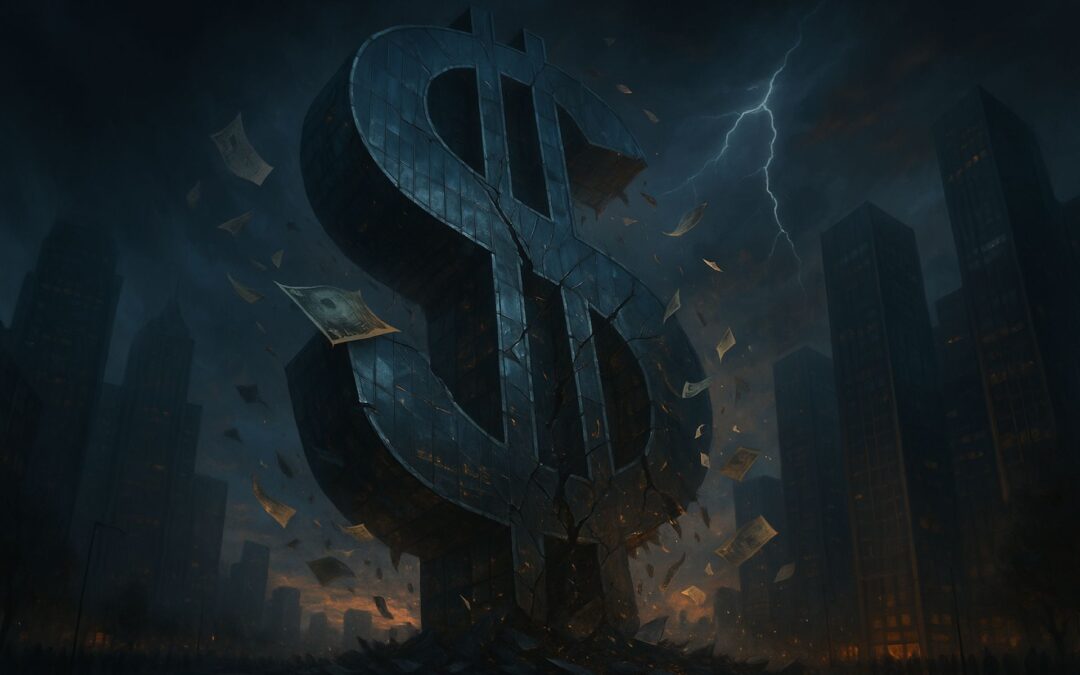
In the fall of 2008, the global financial system came perilously close to ceasing altogether. Markets convulsed, banks vanished overnight, and the world’s wealth seemed to evaporate in real time. Millions lost their homes, their savings, and their faith in a system they had been told was unshakable.
Yet what makes this story so haunting is not just the scale of the collapse, but its origin. It wasn’t born of a single catastrophic event, but of thousands of small, reasonable choices—each step logical, each motive defensible, until the sum of them became madness. The 2008 financial crash was not a thunderbolt from the blue; it was a slow erosion of prudence disguised as progress, a cautionary tale written in balance sheets and broken trust.
The Calm Before the Storm
The seeds of the 2008 financial crisis were sown long before the first bank collapsed. To understand it, one must return to the early 2000s, when optimism was policy and risk was invisible. The dot-com bubble had just burst, wiping out trillions in market value and leaving investors shaken. In an attempt to revive the economy, the Federal Reserve, under Chairman Alan Greenspan, embarked on an aggressive campaign to lower interest rates—eleven cuts in rapid succession that brought the federal funds rate down to historic lows.
Money suddenly became cheap. Borrowing was effortless, lending was profitable, and the promise of endless growth seduced policymakers and financiers alike. Low interest rates encouraged businesses to expand, consumers to borrow, and investors to seek higher returns wherever they could find them. Real estate became the favored outlet for this flood of easy money. Homes, once seen as personal sanctuaries, began to look like foolproof investments.
At the same time, the U.S. government was chasing another dream: universal homeownership. Presidents from both parties had long touted it as the cornerstone of national prosperity. Policies were passed to make mortgages accessible to low-income families, and government-sponsored entities like Fannie Mae and Freddie Mac were encouraged to support that mission. Lenders responded by loosening their standards. Suddenly, families that had been denied loans in the past found themselves courted by eager mortgage brokers promising the keys to a better life.
The cultural narrative reinforced the frenzy. Financial television channels glorified real estate as the safest bet in America. Dinner-table conversations turned to house flipping and home equity lines. Americans believed they had discovered a perpetual wealth machine: buy property, watch its value rise, refinance, and spend the gains. The economy appeared to be thriving—construction boomed, jobs multiplied, and Wall Street basked in record profits.
Yet beneath this glow of prosperity, cracks had begun to form. The expansion wasn’t built on productivity or innovation but on credit—cheap, abundant, and dangerously misunderstood. The same low interest rates that kept the economy humming also encouraged recklessness. Borrowers took on debts they couldn’t afford. Banks issued loans without concern for repayment. Everyone assumed that home prices would keep climbing forever. Few stopped to ask what would happen if they didn’t.
The conditions for catastrophe were in place: an overvalued housing market, mountains of debt, and a financial system growing addicted to leverage. The storm hadn’t arrived yet—but the air was already electric with its approach.
The Illusion of Infinite Growth
Then came the decision that would supercharge the entire machine. In April 2004, the U.S. Securities and Exchange Commission voted to relax a key regulation that had long limited how much debt investment banks could assume. Before this change, financial institutions were capped at a leverage ratio of 12-to-1—meaning they could borrow twelve dollars for every dollar of their own capital. It was a guardrail designed to prevent excessive risk-taking. When the rule was lifted, those guardrails disappeared.
The reasoning behind this deregulation seemed logical at the time. Banking executives and lobbyists argued that markets were sophisticated enough to regulate themselves. They claimed that government oversight stifled innovation and that modern risk-management models—powered by complex algorithms—could safely determine how much leverage a bank could handle. Policymakers, under pressure to sustain economic growth, accepted that logic. In an era of booming globalization and technological confidence, restraint was out of fashion.
Investment banks like Lehman Brothers, Goldman Sachs, and Merrill Lynch quickly took advantage. They multiplied their leverage ratios to 30-to-1 and beyond, meaning a mere 3% decline in asset values could wipe them out entirely. But that didn’t deter them. On paper, higher leverage amplified profits; in reality, it turned the financial system into a tower of glass—impressive from a distance but fatally fragile.
The philosophy of infinite growth took root. Analysts assured investors that housing prices had never fallen nationwide and therefore never would. Economists coined new terms like “the Great Moderation” to describe what they believed was a permanently stable economy. Regulators congratulated themselves for having created an era of self-balancing capitalism. In truth, the balance they admired was an illusion—a delicate equilibrium maintained by nothing more than borrowed confidence.
Every level of the system—borrowers, lenders, and investors—fed this illusion. Families believed they could stretch their finances endlessly because banks would always lend. Banks believed they could lend endlessly because investors would always buy their mortgage bundles. And investors believed they were safe because rating agencies would always bless those bundles with AAA stamps. Each player’s faith in the next created a daisy chain of complacency that wrapped around the global economy like silk—soft to the touch, deadly when it tightened.
By the mid-2000s, Wall Street had become addicted to leverage. The higher the risk, the higher the reward, and the less anyone wanted to stop. Growth seemed eternal because nobody wanted to imagine its limits. The system wasn’t simply expanding—it was inflating. And like any balloon stretched too far, all it needed was a pin.
The Invention of Financial Alchemy
By the mid-2000s, a quiet revolution was unfolding inside the glass towers of Wall Street. Traditional banking—where a lender issued a mortgage and patiently collected payments for decades—was becoming obsolete. The new era was ruled by investment banks, who saw mortgages not as long-term obligations but as raw materials for an elaborate and lucrative manufacturing process.
The process began simply: a bank would approve thousands of home loans and then bundle them together into a financial product known as a mortgage-backed security (MBS). These bundles were then sliced into smaller tranches, each with varying levels of risk and return, and sold to investors around the world. The cash flow from homeowners’ mortgage payments became the income stream that made the product profitable. The bank, meanwhile, collected its fees upfront and passed the risk to someone else.
To investors, these securities looked like gold. They offered higher yields than government bonds and were “backed” by tangible assets—American homes. Rating agencies reinforced the illusion by stamping these products with high safety grades. Pension funds, insurance companies, and foreign governments eagerly bought in. Everyone seemed to win: borrowers got homes, banks got profits, and investors got steady returns.
But innovation rarely stops where profit begins. Once bankers realized they could apply this structure to almost any form of debt, the floodgates opened. They started pooling not just mortgages but car loans, student loans, credit card debt, and corporate bonds. These conglomerations of debts were reborn as collateralized debt obligations (CDOs)—a new species of financial creation so complex that even those who built them often didn’t fully understand them.
And then came the recursion. Some CDOs began containing pieces of other CDOs, layering complexity upon complexity in a dizzying spiral. It was “Inception” in financial form: a dream within a dream within a dream, each layer promising stability by distributing risk across thousands of assets. In theory, diversification made the system safer. In reality, it made the danger impossible to see.
The deeper the layers went, the further the connection between the product and reality weakened. A mortgage issued in a small town in Ohio could end up inside a CDO owned by a hedge fund in Singapore, its risk masked by distance and mathematics. Bankers no longer cared whether borrowers could repay their loans—because by the time defaults happened, those loans had already been sold multiple times over. The incentives had shifted completely: profit came from creation, not from prudence.
Finance had become alchemy, turning bundles of debt into instruments of wealth. But unlike real alchemists, these modern magicians succeeded only in transforming risk into something invisible—until it reappeared all at once.
When Risk Became a Product
With every new mortgage packaged and sold, the machine demanded more fuel. Banks had already saturated the market of reliable borrowers—people with steady jobs, credit histories, and savings. The next logical step, from their perspective, was to lower the bar. And so they did, one inch at a time.
Loans that would have once been rejected were now approved with ease. Applicants no longer needed to verify income, employment, or even assets. These became the infamous NINJA loans—no income, no job, no assets. The underlying philosophy was dangerously simple: as long as home prices kept rising, borrowers could always refinance or sell at a profit. The assumption that “real estate never loses value” became gospel.
Mortgage brokers, chasing commissions, began operating like salesmen rather than financial professionals. They pushed adjustable-rate mortgages with low initial payments that would later balloon, or interest-only loans that never touched the principal. Each closed deal meant another bonus check. Whether the borrower could actually afford the loan barely mattered. The loans were not being kept—they were being sold upstream to investment banks eager to convert them into securities.
The perverse incentives spread through every layer of the system. Appraisers inflated property values to make deals go through. Borrowers exaggerated incomes to qualify for bigger houses. Lenders ignored the lies because they were earning record profits. Wall Street investors, eager for high-yield securities, created an insatiable demand that drove the cycle faster and faster. Everyone involved had found a way to benefit—at least temporarily.
Subprime lending exploded. By 2006, one in five mortgages in the United States was subprime, meaning it was granted to someone with poor credit or minimal ability to repay. These risky loans were then bundled into mortgage-backed securities and CDOs, mixed with safer loans to disguise their instability. From the outside, everything looked prosperous: construction boomed, homeownership rates hit all-time highs, and stock prices soared.
But the system had transformed into something monstrous. Risk, once the enemy to be managed, had been commodified. It was created, repackaged, and sold for profit. Every step of the process rewarded short-term gain over long-term sustainability. And because risk was scattered across thousands of opaque financial instruments, no one could tell where it truly resided.
By the time anyone tried to look, it was already everywhere—embedded in balance sheets, pension funds, and portfolios across the world. The financial system had converted human aspiration into leverage, and leverage into illusion. The countdown to collapse had already begun; no one could hear it over the sound of the cash registers ringing.
The Ratings Mirage
If the banks were the architects of the bubble, then the credit rating agencies were its decorators—adorning fragile structures with the illusion of strength. Institutions like Moody’s, Standard & Poor’s, and Fitch Ratings were supposed to act as independent watchdogs, assessing the risk of financial products so investors could make informed decisions. Their ratings determined whether a security was safe for pension funds, insurance companies, or government portfolios. But in the years leading up to 2008, those watchdogs were quietly bought off by the very entities they were meant to monitor.
The problem was structural. Rating agencies were private companies that earned fees from the banks whose products they rated. This “issuer-pays” model created an irresistible conflict of interest. If a bank didn’t like the rating one agency gave, it could simply take its business to another willing to provide a more generous score. The agencies were locked in a race to the bottom—not of accuracy, but of leniency.
Within that moral fog, mathematical models replaced judgment. Analysts input historical data into risk models that assumed housing prices could never fall simultaneously across the country. They believed diversification would protect investors—that a few defaults here and there wouldn’t matter when thousands of loans were pooled together. The result was statistical sorcery: bundles of high-risk, subprime mortgages magically transformed into AAA-rated securities, supposedly as safe as U.S. Treasury bonds.
The agencies justified their optimism through flawed logic. They argued that risk was diluted by scale, that even if some borrowers defaulted, others would continue paying. In reality, they underestimated a far more dangerous correlation: if housing prices fell everywhere at once, all those supposedly independent risks would collapse together. It was a classic case of collective blindness, camouflaged by complex mathematics and professional confidence.
The ripple effects were enormous. Pension funds, university endowments, and municipal governments—institutions bound by regulation to invest only in top-rated securities—poured billions into these toxic assets, trusting the letter grades stamped on them. Investment banks then used those inflated ratings to attract more investors, who in turn demanded more securities, feeding the cycle. Everyone in the chain could claim innocence because everyone had paperwork proving they were “AAA.”
Behind the scenes, a handful of analysts raised concerns, warning that the ratings were inflated and the models broken. But their voices were drowned out by the roar of profits. Wall Street bonuses were at record highs, CEOs were hailed as visionaries, and regulators—lulled by the appearance of stability—looked the other way. The entire system rested on faith in symbols: three letters printed on a piece of paper. When those symbols lost meaning, the entire structure would fall with them.
The Bubble Bursts
By 2006, America’s housing market had become a fever dream. Bidding wars erupted over suburban homes. Investors bought properties sight unseen, flipping them within months for enormous gains. TV networks aired reality shows celebrating house-flipping as a lifestyle. For ordinary citizens, owning a home wasn’t just a financial decision—it was a declaration of success. Everyone wanted in.
But prices had climbed far beyond what most families could afford. Wages had stagnated, while property values doubled or even tripled in certain regions. Adjustable-rate mortgages—those seductive loans that started cheap—began to reset, sending monthly payments skyrocketing. For homeowners on the edge, one adjustment was enough to push them into default. The first cracks appeared quietly: a missed payment here, a foreclosure there. But soon, the defaults multiplied, spreading like stress fractures through the foundation of the financial system.
The illusion of infinite demand shattered. By early 2007, housing prices stopped rising for the first time in years. Builders were left with unsold homes, realtors with empty open houses, and lenders with a mounting pile of unpaid loans. As mortgage payments dried up, the cash flow sustaining mortgage-backed securities began to falter. The intricate web of financial engineering that had transformed debt into gold now reversed itself—revealing that it had been lead all along.
The first major casualties were subprime lenders. Companies like New Century Financial, once hailed as innovators, declared bankruptcy. Their collapse sent shockwaves through Wall Street. Hedge funds heavily invested in MBSs began to fail, including two funds managed by Bear Stearns, one of the most powerful investment banks in America. As investors realized they had no idea how much toxic debt lurked on balance sheets, panic spread.
Credit—the lifeblood of the global economy—froze. Banks stopped lending to each other out of fear that any counterparty might be insolvent. Businesses reliant on short-term loans couldn’t access capital. Layoffs began. Consumers, watching their home values plummet, cut spending. Fear became contagious. The same leverage that had magnified profits on the way up now magnified losses on the way down.
In an attempt to contain the crisis, the Federal Reserve slashed interest rates once again, hoping to restore liquidity. But it was like throwing buckets of water at a wildfire fueled by gasoline. Confidence, not credit, had become the missing currency. Once faith in the system evaporated, no amount of cheap money could restore it.
The bubble didn’t burst all at once—it imploded in slow motion. Each week brought a new casualty, another failed lender, another billion-dollar loss. The myth of endless prosperity collapsed under the weight of its own delusion. By the end of 2007, it was clear: the storm had finally arrived, and no one—not the bankers, not the regulators, not even the governments—could stop it from consuming everything in its path.
Collapse of the Giants
By early 2008, the storm that had gathered for years finally tore through Wall Street. The era of invincibility was over. What began as a housing crisis was now a full-scale financial meltdown. The dominoes began to fall—slowly at first, then all at once.
The first major collapse came in March 2008, when Bear Stearns, a century-old investment bank, found itself drowning in toxic mortgage-backed assets. Its hedge funds had already imploded the year before, but now its core business was collapsing. Clients fled, lenders demanded repayment, and the company’s cash reserves evaporated in days. To prevent a catastrophic chain reaction, the Federal Reserve stepped in, orchestrating a rescue deal in which JPMorgan Chase bought Bear Stearns for just $2 per share, a humiliating drop from its previous price of $170. The deal was a desperate move to prevent panic from spreading. But the damage was done—the myth of Wall Street’s invulnerability had been shattered.
Still, policymakers clung to the hope that Bear Stearns was an isolated failure. They were wrong. Behind the calm facade, the same poison ran through every major institution. Banks were holding mountains of mortgage-backed securities and CDOs whose values had evaporated. Yet no one could say exactly how much toxic debt was on any given balance sheet. The lack of transparency paralyzed the system. Banks stopped lending to each other, corporations couldn’t access credit, and consumers withdrew savings in fear. The gears of global finance seized up like an engine starved of oil.
Then came September 2008, the month that changed modern capitalism forever.
Lehman Brothers, with nearly $700 billion in assets, was among the oldest and most respected names on Wall Street. For months, it had been hemorrhaging value as its mortgage positions crumbled, but CEO Richard Fuld refused to admit defeat. Investors fled, share prices collapsed, and by the second week of September, Lehman was desperate for a buyer. Talks with Barclays and Bank of America failed. On September 15, 2008, Lehman Brothers filed for bankruptcy—the largest in U.S. history. Overnight, $46 billion in equity was vaporized, and the unthinkable happened: the world’s financial backbone snapped.
The shock was immediate and global. Financial markets went into freefall. The Dow Jones Industrial Average plunged 500 points in a single day—its worst drop since 9/11. Money market funds, long considered the safest investments, suddenly lost value, triggering a run on assets that had been seen as risk-free. The idea that “too big to fail” institutions could actually fail sent a wave of terror through boardrooms and central banks alike.
Within 24 hours, another titan teetered. AIG, the world’s largest insurance company, was collapsing under the weight of its exposure to CDOs. The company had sold billions in “credit default swaps,” essentially insurance policies guaranteeing those toxic assets. As the underlying securities failed, AIG was suddenly liable for astronomical payouts it couldn’t afford. The Federal Reserve had no choice but to intervene—injecting $85 billion in emergency loans to prevent its collapse, fearing that AIG’s failure would bring down the entire global financial system.
Meanwhile, other household names—Merrill Lynch, Morgan Stanley, Goldman Sachs—scrambled for survival. Merrill Lynch agreed to be acquired by Bank of America, while the remaining investment banks converted themselves into commercial banks overnight, gaining access to emergency Federal Reserve funds to stay afloat.
As the chaos unfolded, the U.S. Congress passed the Emergency Economic Stabilization Act, creating the Troubled Asset Relief Program (TARP)—a $700 billion bailout designed to inject liquidity into the system. The money went to financial giants like Citigroup, Bank of America, JPMorgan, Goldman Sachs, and Wells Fargo—institutions deemed “systemically important.” The move may have saved the global economy, but it enraged the public. Millions of taxpayers were losing their homes, jobs, and savings, while the very companies that caused the disaster were being rescued with public money.
The fury was justified. In the same year that Lehman collapsed, many executives at bailed-out firms still received multi-million-dollar bonuses, citing “contractual obligations.” The optics were disastrous. The moral contract between Wall Street and Main Street had been shattered. For the first time since the Great Depression, the financial system itself—not just the market—was seen as broken.
The Global Ripple
The 2008 crisis did not stop at America’s borders. The contagion spread like wildfire through a globalized economy woven together by invisible threads of finance. The same securities, the same debts, and the same delusions had been exported worldwide.
European banks had eagerly invested in American mortgage-backed securities during the boom years, drawn by their high returns and seemingly low risk. When those securities imploded, the losses were staggering. Institutions in the United Kingdom, France, Germany, and Switzerland faced balance sheet crises of their own. The Royal Bank of Scotland required the largest bailout in British history—over £45 billion—to prevent collapse. In Germany, Hypo Real Estate fell apart, dragging down confidence in the entire eurozone banking system.
Some nations experienced total financial collapse. Iceland, whose banks had borrowed over ten times the country’s GDP to finance speculative investments abroad, saw its entire banking sector implode within days. The Icelandic krona plummeted, unemployment soared, and foreign investors fled. Other smaller economies, from Ireland to Greece, found themselves crippled by the toxic mix of debt, austerity, and collapsing demand.
The stock markets reflected the panic. Between 2007 and 2009, global equity markets lost over $30 trillion in value. The Dow Jones Industrial Average fell 54%, while Europe’s FTSE and DAX mirrored the collapse. Investors watched decades of accumulated wealth evaporate. Global trade shrank by nearly 10%, the steepest decline since the Great Depression. Cargo ships sat idle at ports; factories shuttered; oil prices plunged from $147 a barrel to under $40 in mere months.
Even economies once thought insulated—like China, India, and Brazil—felt the chill. As Western demand collapsed, exports tumbled and growth slowed. The ripple had become a wave that drenched every shore. The interconnectedness of modern finance, once celebrated as a triumph of globalization, had become its Achilles’ heel.
Governments worldwide scrambled to respond. Central banks slashed interest rates to near zero. The U.S. Federal Reserve, the European Central Bank, and the Bank of England launched unprecedented rescue programs—printing trillions to inject liquidity and restore confidence. Some countries adopted massive stimulus packages; others imposed painful austerity measures that deepened unemployment and social unrest.
The human cost was devastating. Tens of millions lost jobs. Families saw pensions wiped out. Savings evaporated, and faith in institutions—governments, corporations, and markets—eroded. For many, the 2008 crisis wasn’t just an economic downturn; it was an existential reckoning. It revealed how deeply the world’s prosperity had been built on illusion, leverage, and trust—and how quickly all three could vanish.
In the end, no corner of the world remained untouched. The crash had exposed a truth that economists and politicians had long ignored: in an interconnected financial system, there is no such thing as isolation. What began as a housing bubble in suburban America became a planetary collapse—proof that in the age of global finance, everyone, everywhere, is holding the same breath.
Picking Up the Pieces
When the dust finally began to settle, the world emerged blinking into an unfamiliar landscape. The financial system had survived, but only barely. Governments and central banks had managed to stop the bleeding, yet the patient remained weak, fragile, and distrustful. The aftermath of the crisis wasn’t a clean recovery—it was a long, uneven climb through the wreckage of confidence.
In the United States, the Federal Reserve took extraordinary measures. Under Chairman Ben Bernanke, it slashed interest rates to near zero, a policy known as zero lower bound, making it practically free for banks to borrow money. Then came an unprecedented move: quantitative easing. The Fed began purchasing massive quantities of government bonds and mortgage-backed securities—injecting liquidity directly into the financial system to encourage lending and investment. It was a bold experiment, one designed to keep the system alive by flooding it with cheap money.
The government also stepped in with sweeping fiscal action. In 2009, newly elected President Barack Obama signed the American Recovery and Reinvestment Act, a $787 billion stimulus package aimed at jumpstarting the economy. The funds went into infrastructure projects, renewable energy programs, unemployment benefits, and tax cuts—anything that could put money back into circulation and slow the bleeding of jobs. Critics argued it was too small; supporters said it was the only thing keeping the U.S. from a second Great Depression.
Meanwhile, Congress passed the Dodd–Frank Wall Street Reform and Consumer Protection Act in 2010—a monumental piece of legislation designed to prevent history from repeating itself. It introduced tighter oversight of financial institutions, imposed stricter capital requirements, and created new regulatory bodies such as the Consumer Financial Protection Bureau (CFPB). Derivatives markets, once opaque and unregulated, were brought under stricter control. For the first time in decades, Washington tried to put real boundaries around Wall Street’s speculative ambitions.
But laws can’t repair trust, and trust was the true casualty of the crisis. Millions of Americans lost their homes, often through foreclosure processes that were later revealed to be riddled with fraud. Entire neighborhoods—especially in states like Nevada, Florida, and Arizona—turned into ghost towns. Families who had played by the rules watched their retirement savings disappear as the S&P 500 plummeted by half. The psychological scars ran deeper than the financial ones.
Unemployment peaked at 10%, leaving nearly 9 million Americans jobless. Many who found work again did so at lower wages, in less stable industries. Middle-class families—the backbone of consumer spending—saw their net worth drop by a staggering 40% between 2007 and 2013. For countless people, the dream of upward mobility evaporated overnight.
Outside the United States, recovery followed the same uneven pattern. Europe faced a sovereign debt crisis as governments that had bailed out banks now struggled under the weight of their own debts. Nations like Greece, Portugal, Spain, and Ireland were forced into harsh austerity programs in exchange for international loans. In developing economies, growth slowed as global demand weakened. The crisis had left behind not just a hole in balance sheets, but a void in belief: belief in the fairness of markets, in the wisdom of experts, and in the competence of leaders.
By the time global markets stabilized around 2013, the world had changed. The crash had accelerated trends that were already brewing: automation, income inequality, and political polarization. Wall Street had recovered—profits and bonuses returned quickly—but Main Street had not. The gap between financial recovery and human recovery became the defining feature of the post-crisis era. The system had been saved, but the social contract had been broken.
Lessons from the Edge of Collapse
The 2008 financial crisis wasn’t an accident—it was a culmination. Every decision that led to it had been rational in isolation, justified by data, and blessed by experts. Yet together, those decisions created a system primed for destruction. The real lesson of the crash lies not in its mechanics, but in its morality.
At its core, the crisis was about the corruption of incentives. Banks didn’t fail because they were stupid—they failed because they were rewarded for short-term gain and insulated from long-term consequences. Mortgage brokers got paid when loans were issued, not when they were repaid. Credit rating agencies earned profits for every product they rated highly. Executives collected bonuses for quarterly performance, regardless of future collapse. The system incentivized risk-taking, rewarded deception, and punished caution. It wasn’t one bad apple—it was the entire orchard.
There were also deeper philosophical failures. Economists had convinced themselves that markets were self-correcting—that greed, paradoxically, would create balance. Regulators believed that sophisticated financial models could quantify risk out of existence. Politicians assumed that prosperity would trickle down endlessly. It was an era of collective hubris, where mathematical complexity was mistaken for wisdom and infinite growth for inevitability.
When the collapse came, it revealed the truth that few wanted to face: confidence, not capital, is the foundation of modern finance. The system functions because people believe it will. Once trust dissolves, even the strongest institutions crumble. Lehman Brothers didn’t just fail because it ran out of money—it failed because it ran out of believers.
The aftermath offered hard-won lessons, though not all were learned. It showed that stability requires restraint, not expansion; that transparency is worth more than innovation; and that capitalism, without morality, becomes predation. Yet as markets recovered and profits surged anew, memories faded. Regulation softened, risk-taking returned, and leverage crept quietly back into the bloodstream of finance. The old patterns began to stir again, dressed in new language and digital disguise.
The 2008 crash remains a reminder that the real danger is never chaos—it’s complacency. Crises don’t start when people panic; they start when people stop worrying. Every system built on trust, every economy fueled by debt, carries within it the same potential for collapse.
The miracle of 2008 was not that the system survived—it was that it ever functioned at all. It showed humanity’s remarkable ability to build complexity, but also its blindness to consequence. The next crisis, when it comes, may not look the same. But it will rhyme—because as history proves, the one thing we learn from our mistakes is how to make them again, only bigger.
Conclusion
The crash of 2008 was more than an economic failure—it was a moral reckoning. It revealed how prosperity built on leverage, illusion, and unchecked optimism can crumble under its own weight. Policymakers promised reform, bankers swore humility, and citizens vowed never to forget.
Yet as markets recovered and new bubbles began to form, the old habits quietly returned, cloaked in new technologies and jargon. The story of 2008 endures not because it was unique, but because it was inevitable.
Every generation builds its own version of the same house of cards, believing this time the structure will stand. And perhaps that’s the truest lesson of all: the most dangerous risk is the one we convince ourselves we’ve mastered.