
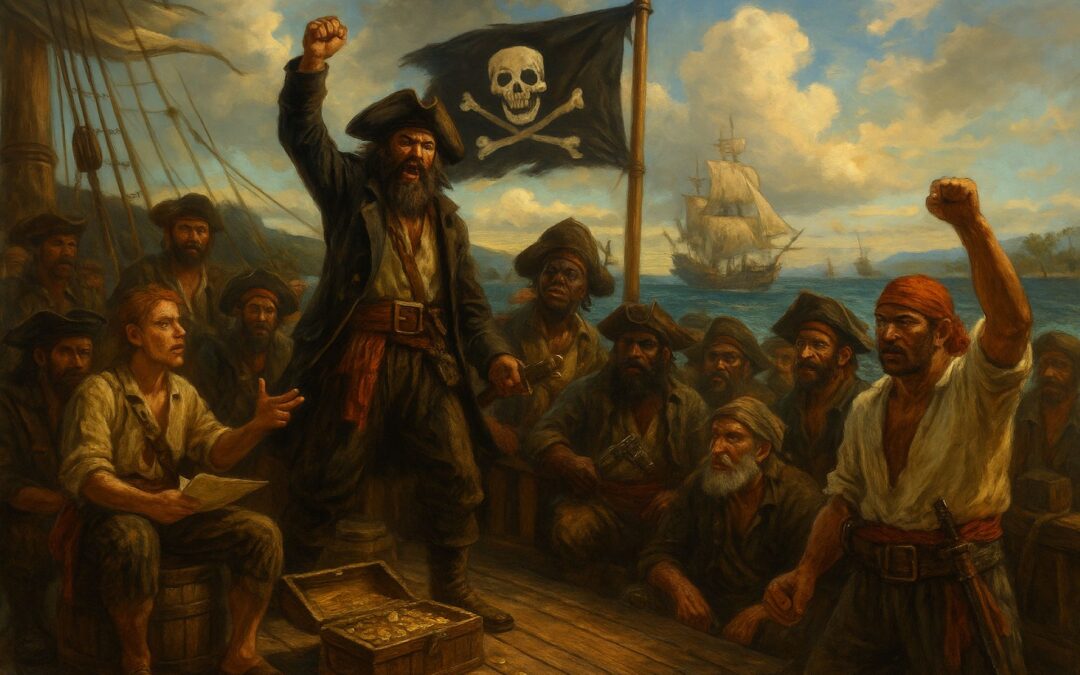
In the early 1700s, when empires carved the world with cannon fire and flags, a different kind of nation rose—not born of kings, laws, or treaties, but of mutiny, rum, and sheer audacity. It was a republic of thieves, forged by outlaws who refused to kneel.
These were not simple criminals. They were former privateers—men once employed by crowns to plunder in the name of honor, now discarded when peace no longer needed them. Betrayed by the same empires they had enriched, they turned their cannons against the world and sailed to a forgotten island in the Caribbean: Nassau.
What began as exile became revolution. On that sun-baked shore, they built something astonishing—a functioning democracy without hierarchy, a brotherhood bound by freedom and shared spoils. For a brief, blazing moment, pirates ruled their own country.
This is the story of how outlaws built a nation, defied the greatest powers on Earth, and vanished into legend.
When Privateers Became Unemployed
At the turn of the 18th century, the world’s oceans were battlefields dressed as trade routes. Every ship that carried sugar, gold, or spices also carried the scent of war. The Caribbean was the empire’s casino—Britain, Spain, and France each placing bets with cannonballs and blood. And at the center of this chaotic maritime game stood the privateer.
Privateers were not ordinary pirates. They were legalized pirates—men given royal permission to plunder enemy ships. Their licenses, known as letters of marque, were golden tickets to fortune and legitimacy. The British crown handed these letters to sailors, effectively saying: “Loot for us, not against us.” And loot they did. Merchant ships were stripped bare, Spanish galleons turned into floating carcasses, and the empire’s coffers swelled.
But like all mercenaries of empire, privateers lived at the mercy of politics. When the War of the Spanish Succession ended in 1714, peace treaties rendered their skills obsolete overnight. The letters of marque were revoked. The pay stopped. The very governments that once celebrated them now branded them outlaws. Overnight, thousands of battle-hardened seamen became unemployed and unwanted.
Imagine the bitterness: twelve years spent fighting, killing, and risking everything under the banner of patriotism—only to be told, “Thanks, you can go now.” No pensions, no gratitude, no new posts. Just dismissal.
The anger festered. These were not docile men; they were adrenaline-fed veterans with ships, cannons, and a taste for danger. Many felt betrayed by the same system they had enriched. They had spilled blood for their nations and received nothing but silence in return.
So they turned their backs on those nations.
Word spread of an ungoverned island deep in the Caribbean—a place with a natural harbor, defensible terrain, and no colonial oversight. An island abandoned by empires but coveted by the sea. It was called New Providence.
For some, it sounded like escape. For others, redemption. But for most, it was opportunity.
And so, in the years that followed, over 1,500 men—British, Irish, Scottish, American, and African—set sail for this lawless paradise. They were united by rage, desperation, and a shared desire for freedom. What they created there would become one of the strangest political experiments in history: a functioning republic of thieves.
It wasn’t born out of ideology, but necessity. And yet, against all odds, it would stand as one of the most democratic societies of its time—if only for a fleeting moment.
The Birth—and Rebirth—of Nassau
Long before the black flags of piracy fluttered over its shores, New Providence was an unassuming speck in the British Empire’s vast colonial map. In 1666, a British sailor nearly ran his ship aground on its shallow reefs. Seeing its natural harbor—calm, deep, and protected by coral—he realized its strategic potential. A settlement soon followed, christened Charles Town in honor of King Charles II.
Charles Town began as a humble colonial outpost. Wooden houses dotted the shoreline, and a modest fort rose above the coast. The settlers traded with nearby islands, fished, and lived under the illusion of safety. But safety in the Caribbean was always temporary.
In 1684, a Spanish admiral shattered that illusion. Enraged by British incursions into what Spain considered its domain, he descended upon Charles Town with fire and fury. The attack was swift, the destruction absolute. Homes were burned to embers, the fort reduced to rubble, and the settlers scattered. What had been a fragile dream of empire became a memory of smoke.
Yet the British, stubborn as barnacles, refused to give up. A decade later, they returned and rebuilt. To confuse the Spanish and pay tribute to their new Protestant monarch, they renamed the settlement Nassau, after William of Orange’s royal house of Nassau.
But Nassau’s rebirth was just as brief. In 1703, as the War of the Spanish Succession raged, Spanish and French forces struck again, leveling the island for a second time. The fort was razed, the garrison wiped out, and the settlers fled once more. By 1704, Nassau was a ghost town—technically under British rule, but in reality abandoned.
Its streets lay empty. The fort crumbled. The harbor was silent except for the wind. There were no governors, no soldiers, no magistrates—just the bones of a once-promising colony and the endless sea stretching beyond it.
To the empires of Europe, Nassau was an afterthought. Too small to defend, too remote to matter. But to the men who had been cast aside by those same empires, it was a blank slate.
Its location was perfect. Sitting in the heart of the Caribbean, Nassau lay just north of the Spanish shipping lanes and east of Florida’s trade routes. From its harbor, one could strike Spanish treasure ships bound for Europe, raid merchant convoys, and vanish before the Royal Navy could react.
It was an outlaw’s dream.
When the first former privateers arrived, they found a ruined settlement waiting to be claimed. They patched up what they could, built taverns where barracks once stood, and turned the empty fort into a symbol of defiance. Rum flowed freely, and gunpowder smoke became the new incense.
No king, no taxes, no rules—just freedom, firepower, and a thirst for gold.
In that vacuum of power, Nassau was reborn—not as a colony, but as the capital of a new world order, one run by the very men that the empires had created and abandoned.
The Pirate Republic Emerges
When the first pirate ships anchored off the shores of Nassau, the island was nothing more than the ghost of a failed colony. The British had left behind ruins, cracked stone walls, and a handful of abandoned cannons. To most, it looked like defeat. But to the pirates, it looked like home.
Here was a place beyond the reach of kings. No taxes. No governors. No rules. Only wind, rum, and opportunity.
The first thing they did was claim it. Not through negotiation or conquest—simply by existing there. They patched the fort, turned the governor’s mansion into a tavern, and raised their flags across the harbor. The once-barren island began to hum with life: sails creaking, barrels rolling, laughter echoing across the port. The pirates had turned an imperial failure into a thriving republic.
But it was not chaos without conscience. For all their drunkenness and debauchery, pirates had an unspoken code—one that valued fairness more than most monarchies did. And under the leadership of a man named Benjamin Hornigold, that code became law.
Hornigold was a veteran privateer himself, one who understood both discipline and defiance. When he saw the growing disorder among the pirates of Nassau—fights breaking out, ships clashing over loot, alliances dissolving in taverns—he realized something shocking: if they wanted to survive, they needed structure.
And so, he gathered the captains. On the shores of New Providence, under the burning Caribbean sun, Hornigold laid down what would become the foundation of the world’s first pirate democracy.
Every crew, he declared, would elect its own captain by popular vote. Power would no longer belong to the loudest or the most violent—it would belong to the chosen. Decisions, too, would be made collectively. Loot would be shared equally among crew members, regardless of rank. The captain would receive two shares, the quartermaster one and a half, and every sailor one full share. Even those injured in battle would be compensated—a man who lost a leg might receive six hundred pieces of eight, enough to live comfortably for years.
For men who had been abused and underpaid by kings, it was revolutionary.
In this strange republic, all were equal—black and white, young and old, rich and poor. Former slaves sailed beside Irishmen. Illiterate farmers commanded cannons. And for the first time in their lives, they were free not because someone had granted it, but because they had seized it.
The Pirate Republic of Nassau became more than a refuge—it was a statement. A floating experiment in liberty at the edge of civilization. Its citizens flew the skull and crossbones not just as a symbol of terror, but as a declaration: We bow to no crown.
Still, even in paradise, contradictions festered. Hornigold, for all his vision, had one peculiar rule: no attacks on English ships. He had once served the crown and couldn’t bring himself to betray it completely. To many pirates, that was unforgivable. Nassau, after all, was supposed to be a rebellion against the very empire that had discarded them.
In the same democratic fashion that had made him leader, they voted him out. The first president of the Pirate Republic was overthrown—not by mutiny, but by majority.
And his replacement was someone who would forever redefine what it meant to be a pirate.
Enter Blackbeard: The Pirate Brand
Edward Teach—better known by the name that made empires tremble—was not just a man. He was an idea.
Blackbeard didn’t rule by fear alone. He crafted fear, shaped it like a weapon. His ship, the Queen Anne’s Revenge, was his stage; the ocean, his theater. Before battle, he would weave slow-burning fuses into his long, tangled beard and light them, surrounding his head with a halo of smoke. His eyes would burn from the fumes, his face half-hidden in shadow, his silhouette monstrous. To his enemies, he looked less like a sailor and more like an apparition—a devil risen from the sea.
And it worked.
Entire merchant fleets surrendered without a fight. The mere whisper of his name could turn seasoned captains pale. Blackbeard understood something the rest of his peers did not: power didn’t always come from strength—it came from reputation.
Under his rule, Nassau thrived like never before. The harbor overflowed with stolen ships. Market stalls bloomed along the waterfront, selling silk, tobacco, sugar, and rum—all plundered from the great merchant lanes of Europe. Coins jingled in every pocket, and the night sky glowed orange with the light of endless celebration.
Pirates from every nation poured in—British deserters, French corsairs, African sailors freed from slavery, even Scandinavian adventurers who’d lost their way. Nassau became the world’s first multicultural pirate metropolis. On any given night, one could hear five languages in the same tavern, all slurred in the same drunken laughter.
There were no kings, no judges, and no sermons—only the law of the sea and the unspoken agreement that everyone lived and died by their own hand.
To outsiders, Nassau was chaos incarnate. To those within it, it was freedom at its purest.
But Blackbeard’s reign was never meant to last. He was too ambitious, too restless. He began sailing north, blockading ports in the Carolinas, making secret deals with governors, and amassing treasure. His ambitions outgrew his republic. He was building not a nation—but a legend.
And as the smoke of his ships disappeared over the horizon, Nassau began to crack. Without his commanding presence, its unity faltered. Factions formed, tempers flared, and greed returned. The pirate utopia that Hornigold had built and Blackbeard had glorified was beginning to eat itself from within.
Into this vacuum of power, chaos crept back. And leading that chaos was a man who didn’t just despise kings—he despised anyone who dared to command him.
Charles Vane: The Firebrand
If Benjamin Hornigold was the architect of order and Blackbeard the artist of fear, then Charles Vane was chaos given human form. He was the kind of man who would rather burn a ship than surrender it, the kind who treated diplomacy as cowardice and restraint as blasphemy. To many, he was the embodiment of pure pirate spirit—defiant, volatile, and unyielding. To others, he was a disaster waiting to happen.
When Vane rose to prominence in Nassau, the pirate republic was already on unstable footing. Blackbeard had vanished north, Hornigold had been exiled, and the balance of power was tilting toward madness. Vane’s charisma filled that vacuum. He was bold, loud, and terrifyingly persuasive—the kind of leader who could turn a tavern brawl into a revolution with a single shout.
But his vision for Nassau was not a republic. It was revenge. He saw the British Empire not as an enemy to defy, but as a beast to be destroyed. “The only good British ship,” he once said, “is a burning one.”
Under his rule, the island became more war camp than community. Raids grew more reckless. Ships were plundered and torched with theatrical cruelty. Vane believed that mercy was weakness, and soon, even his own men began to question his sanity.
Meanwhile, far across the Atlantic, the King of England was losing patience. Reports of “a pirate republic” in the Bahamas—led by his own disillusioned sailors—had reached London. The Caribbean trade routes, once the arteries of empire, were bleeding gold and goods into the hands of outlaws. Something had to be done.
Enter Woodes Rogers.
A former privateer turned statesman, Rogers had once been one of them—a sailor, an adventurer, a man who had risked his life for the crown. He had circumnavigated the globe, captured Spanish treasure ships, and been hailed as a national hero. But after the war, he too had been discarded. His wealth drained, his reputation faded, and his name forgotten.
Now, the empire came calling again. “Rid us of the pirates,” they said. “And the Bahamas are yours.”
Rogers accepted, but not out of loyalty. He understood the men he was sent to destroy. They were soldiers who’d been betrayed—just as he had been.
When his fleet appeared on Nassau’s horizon, he didn’t open fire. Instead, he extended mercy. He offered every pirate a royal pardon—total forgiveness for their crimes if they would only surrender.
To most, this was a lifeline. To Charles Vane, it was an insult.
Rather than parley, Vane ordered a ship in the harbor to be set ablaze and sent hurtling toward Rogers’ fleet. Flames roared against the night sky as the burning vessel drifted like a suicidal ghost into the sea.
It wasn’t strategy—it was theater. It was rage, pure and unfiltered. The pirates watched in silence as their supposed leader turned diplomacy into destruction.
Among them stood Jack Rackham, Vane’s quartermaster—a man who had served faithfully by his side, tolerated his temper, and watched his descent with growing unease. When the smoke cleared, Rackham made his move.
He called for a vote.
The same democratic rule that had dethroned Hornigold now sealed Vane’s fate. The crew, tired of his recklessness and hungry for survival, chose a new leader.
And just like that, the firebrand who ruled through fear was out. The silk-clad charmer was in.
Calico Jack and the Fall of the Republic
Jack Rackham was everything Charles Vane wasn’t—calm, charming, and almost impossible to dislike. His nickname, Calico Jack, came from his love of brightly colored cotton clothes, a flamboyant contrast to the soot and steel of pirate life. He was part sailor, part showman, and entirely unfit to run a country—but Nassau was desperate for charm over chaos.
At first, it worked. Jack was a master negotiator. He soothed tempers, settled disputes, and turned Nassau from a battlefield into something that almost resembled a community again. Markets reopened, ships traded freely, and for a brief while, it seemed the republic might survive after all.
But Jack’s strength was also his weakness. He was more interested in pleasure than power. While Hornigold wrote rules and Blackbeard built a myth, Calico Jack spent his days drinking, gambling, and charming his way through taverns.
Then came Anne Bonny.
Anne was not like other women of her time. Fierce, sharp-tongued, and unflinchingly brave, she had fled an arranged marriage and joined the pirates disguised as a man. Jack fell for her instantly. Their relationship was scandalous, but in Nassau, scandal was a currency. Soon after, they met another disguised woman—Mary Read—a formidable fighter who matched Anne in both courage and temper.
Together, the trio became legend. Two women dressed as men, and the charming rogue who adored them both. They fought side by side, raided ships, and drank until dawn. It was the kind of chaotic love story that only the high seas could produce—reckless, intoxicating, doomed.
But as their fame spread, so did their vulnerability.
By 1718, Woodes Rogers had officially taken control of Nassau, turning the republic into a crown colony. He fortified the harbor, stationed troops, and began hunting pirates relentlessly. Those who resisted were executed. Those who surrendered were pardoned.
Rackham, seeing the tide turn, decided to take the pardon. He bowed to Rogers, signed his name, and promised to abandon piracy forever.
It lasted two months.
One night, drunk on nostalgia and rum, he stole a ship from Nassau’s own harbor and sailed into the darkness—Anne by his side. Together, they returned to piracy as if the pardon had been nothing but a bad joke.
Their luck, however, had run dry. The Royal Navy caught them off Jamaica after a brief but brutal chase. When the ship was boarded, every man on deck was drunk or asleep—except Anne and Mary, who fought like demons. According to witnesses, they were the only two still standing when the British seized the ship.
Jack Rackham was tried and executed. His body hung in a cage by the shoreline as a warning.
Anne and Mary’s stories ended differently. Both claimed to be pregnant, invoking the ancient “plead the belly” law to delay execution. Mary died in prison before giving birth. Anne vanished—some say freed by her father, others say she escaped and lived quietly under a new name.
Their disappearance only added to the myth.
And with their downfall, Nassau’s heart stopped beating. The taverns emptied. The flags were lowered. The republic that had once mocked kings and empires collapsed under its own contradictions.
Freedom without unity had turned to anarchy. Anarchy without vision had turned to ruin.
The world’s first and only pirate republic was gone—swallowed by the empire it had once defied, leaving behind nothing but legend, smoke, and a black flag fluttering in memory.
The End of the Pirate Republic
By 1718, the golden haze of piracy that once hung over Nassau had turned into smoke—thick, heavy, and suffocating. The island that had once echoed with drunken laughter, clashing swords, and shanties sung beneath the stars was now silent, watched over by the cold eye of the British Empire. The age of lawlessness was over.
Woodes Rogers, the man sent to end it all, arrived not as a conqueror but as a pragmatist. He wasn’t driven by vengeance or greed; he was driven by understanding. He knew what these men had been—heroes once, then tools, then trash. He knew how it felt to be celebrated in war and discarded in peace. That empathy made him both dangerous and merciful.
Rogers came armed with two weapons: a fleet of warships and a royal pardon. His message to the pirates was simple—“Lay down your arms and walk free, or fight and hang.”
For many, it was a hard choice. They were killers, yes, but they were also fathers, lovers, and sons. The promise of freedom was tempting—real freedom, not the kind bought with blood and gold. And so, one by one, the pirates came forward, signed their names, and surrendered their flags.
Benjamin Hornigold was one of the first. The same man who had founded the republic now turned his back on it, swearing allegiance to the crown once more. In a grim twist of fate, he became a pirate hunter, sailing under the British banner and capturing the very men he had once fought beside. Some called it betrayal; others called it survival. Either way, it didn’t save him. A year later, his ship sank during a storm off Cuba, taking him to the bottom of the sea he had ruled.
Blackbeard, predictably, refused the pardon. For him, surrender was worse than death. He continued his reign of terror off the coast of the Carolinas, raiding ships, making deals with corrupt governors, and living like a phantom. His luck ran out in November 1718, when the British Navy caught up with him. The battle that followed was brutal—five gunshots, twenty sword wounds, and still he fought until his body finally gave in. His head was severed and hung from a Royal Navy ship as proof that the legend had died. Even then, sailors swore they saw his headless body swim three laps around the ship before sinking.
Charles Vane, the firebrand who once shouted, “I’d rather die a pirate than live like a servant,” got his wish. He was captured after being betrayed by his own crew and taken to Jamaica. The British didn’t make a spectacle of it—they didn’t need to. His hanging was quiet, final, and oddly poetic. He died as he lived—angry at the world.
And then there was Calico Jack Rackham—the lover, the charmer, the fool. After his drunken capture, he faced trial in Port Royal. His final request was to see Anne Bonny one last time. She came, looked him in the eye, and said words that would echo through history: “If you’d fought like a man, you wouldn’t be hanged like a dog.”
He was executed the next morning. His body was displayed in a gibbet cage by the shoreline, swaying with the tide.
Mary Read, his companion in both crime and chaos, died in prison from fever. Anne Bonny, on the other hand, simply vanished. No records, no burial, no trace. Some say her wealthy father pulled strings to free her; others claim she returned to piracy in disguise. The truth remains buried in the same sea that took all the others.
When the executions ended, Woodes Rogers turned his attention to the island itself. Nassau was rebuilt—not as a haven for rogues, but as a model British colony. He restored Fort Nassau, cleared the taverns, and reinstated trade. The brothels emptied, the rum was taxed, and order replaced rebellion. The skull-and-crossbones that once fluttered proudly over the harbor was lowered, replaced by the Union Jack.
But even Rogers, the man who restored the crown’s control, couldn’t escape the curse of the place. His victory bankrupted him. The cost of rebuilding Nassau and maintaining order drained his finances, and the empire he had served so loyally once again abandoned him. He died in debt—another man chewed up and spat out by the same system that had betrayed so many pirates before him.
And so ended the Pirate Republic of Nassau—a wild, improbable dream of freedom that had burned too brightly to last. It was never meant to survive, but for a brief, electric moment, it had offered something the world had never seen before: a society without kings, without masters, without chains.
Its fall was inevitable, but its spirit never died. The legend of Nassau lived on, carried in the songs of sailors and the whispers of storytellers. It became the birthplace of myth—the home of the Jolly Roger, the cradle of democracy at the edge of lawlessness, the place where men condemned by nations found their own form of liberty.
Empires buried it. History romanticized it.
But somewhere beneath the waves of New Providence, in the silence between cannon fire and tide, the Republic still breathes—defiant, free, and unforgettable.