
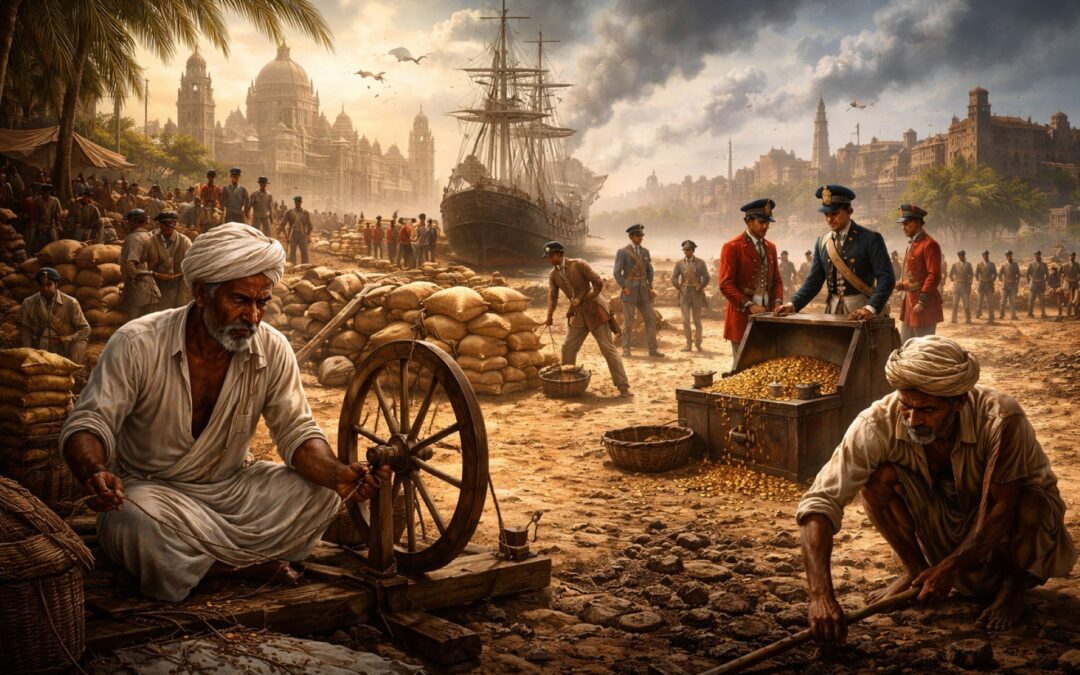
In 1700, India was not a poor country struggling to find its place in the world—it was the world’s economic center of gravity. Accounting for nearly 27% of global GDP, India was richer than all of Europe combined. Its textiles clothed continents, its steel armed empires, and its merchants connected global markets long before globalization became a buzzword.
Yet, by 1947, when India finally gained independence, that same land had been transformed into one of the poorest regions in the world. Its share of the global economy had collapsed to less than 3%, its industries lay in ruins, and its people faced widespread poverty and recurring famines.
What happened?
This dramatic reversal was not the result of natural decline, technological stagnation, or internal failure alone. It was the outcome of a deliberate and systematic process—an economic transformation engineered under British colonial rule. Unlike previous invaders who settled, ruled, and became part of India’s fabric, the British approached India with a fundamentally different objective: extraction.
Over the course of nearly two centuries, they dismantled thriving industries, restructured the economy to serve foreign interests, imposed crushing taxes, and drained immense wealth out of the subcontinent. What emerged was not just political domination, but a complete economic reconfiguration—one that turned a global manufacturing powerhouse into a supplier of raw materials and a market for foreign goods.
This article explores how that transformation unfolded. From India’s pre-colonial prosperity to the mechanisms of colonial exploitation—deindustrialization, taxation, famine, and wealth drain—we will trace how one of the richest regions in human history was systematically unmade.
Let’s begin by looking at the India that existed before colonial rule reshaped it forever.
India Before Colonialism: A Global Economic Powerhouse
Before the arrival of British dominance, India was not a fragmented, backward economy waiting to be modernized—it was one of the most sophisticated and productive economic systems in the world.
At the start of the 18th century, India accounted for roughly a quarter of global manufacturing output. Its economy was deeply integrated into international trade networks, exporting high-quality goods across Asia, the Middle East, Africa, and Europe. Indian merchants were not peripheral players—they were central actors in a thriving global marketplace.
What made this dominance possible was the sheer diversity and excellence of Indian industries.
The textile industry stood at the heart of this economic strength. Indian cotton and silk fabrics were renowned worldwide for their quality, durability, and intricate craftsmanship. Regions like Bengal and Gujarat produced fine muslins, calicoes, and silks that were in constant demand across continents. In fact, Indian textiles were so popular in Europe that they disrupted local industries, forcing European governments to impose restrictions to protect their own manufacturers.
But textiles were only one piece of a much larger economic puzzle.
India was also a major center for metalworking and steel production. Indian blacksmiths produced high-quality steel—known in later centuries as wootz steel—which was exported and used to forge some of the finest blades in the world. These products were not just functional; they were prized for their craftsmanship and became symbols of prestige across different cultures.
Equally impressive was India’s shipbuilding industry. Coastal regions such as Bengal, Surat, and the Coromandel Coast were home to thriving shipyards. Indian-built ships were known for their durability and superior construction, often outlasting their European counterparts. Entire communities were involved in the production process—from sourcing raw materials to crafting intricate fittings—creating a robust industrial ecosystem.
Beyond these industries, India had a well-developed network of merchants, bankers, and financiers. Trade was supported by sophisticated credit systems, and Indian traders operated across vast distances, connecting markets and facilitating commerce on a global scale.
This economic vibrancy created a powerful multiplier effect. Strong exports fueled domestic prosperity, supported artisanal communities, and reinforced trade networks. Industries did not operate in isolation—they were interconnected, each reinforcing the strength of the other.
In short, pre-colonial India was not just rich—it was structurally strong. It had the industries, skills, and systems necessary to sustain long-term economic dominance.
Which makes the question even more striking: how did such a resilient and prosperous system collapse so dramatically in just a couple of centuries?
To answer that, we must first understand the political upheaval that created an opening for British intervention.
The Collapse of the Mughal Empire and the Opening for British Control
The story of India’s economic unmaking does not begin with British strength—it begins with Indian fragmentation.
In 1707, the death of Aurangzeb marked a turning point. The Mughal Empire, which had once unified vast parts of the subcontinent under a relatively stable administrative and economic system, began to fracture. What followed was not an immediate collapse, but a slow and destabilizing decline.
A succession of weak rulers struggled to maintain control over the empire’s sprawling territories. Regional governors, sensing opportunity, began asserting independence. Powerful states like the Marathas, Sikhs, and various Nawabs emerged, each vying for dominance. The result was a political landscape defined by constant conflict, shifting alliances, and internal rivalries.
This fragmentation had profound consequences.
Trade routes became less secure. Administrative consistency weakened. Military resources were stretched thin as regional powers fought one another. While India’s economic foundations remained strong, the political structure that had supported and protected them was steadily eroding.
The situation reached a symbolic low point in 1739, when Nader Shah invaded India and sacked Delhi. The invasion was not just devastating in terms of immediate loss—it exposed how vulnerable the once-mighty Mughal state had become. If an external force could march into the capital and plunder it with relative ease, it signaled to the world that India was no longer politically secure.
It was in this environment of instability that the British found their opening.
Unlike traditional invaders, the British did not arrive as a unified conquering army. They came as traders, operating through the East India Company, a commercial enterprise with political ambitions. Initially, their presence was limited to coastal trading posts. But as internal divisions deepened, they began to intervene in local disputes—offering military support to one faction against another, extracting concessions in return.
This strategy proved remarkably effective.
By leveraging diplomacy, bribery, and selective use of force, the British gradually expanded their influence without needing to conquer the entire subcontinent outright. Key victories, such as the Battle of Plassey in 1757, were less about military superiority and more about exploiting internal betrayals and political fractures.
In essence, the British did not create India’s instability—but they mastered it.
They turned fragmentation into opportunity, transforming themselves from merchants into power brokers, and eventually into rulers. And once they gained control, the nature of their rule would prove fundamentally different from anything India had experienced before.
Because what followed was not just political domination—but a complete restructuring of India’s economy for foreign gain.
The British Difference: From Conquerors to Extractors
India had faced foreign invasions before. Empires had risen and fallen, rulers had come from distant lands, and battles had redrawn political boundaries time and again. But the British were not just another ruling power in this long historical cycle—they represented something fundamentally different.
Previous invaders, whether Central Asian, Persian, or Turkic, eventually settled in India. They ruled from within, built their courts and capitals on Indian soil, and relied on the prosperity of the land to sustain their power. However exploitative or imperfect their rule may have been, their wealth was largely circulated within the Indian economy. India became their home.
The British, by contrast, never saw India as home.
Through the East India Company and later the British Crown, India was treated not as a civilization to be governed, but as a resource base to be exploited. The objective was not to integrate, but to extract—to systematically transfer wealth, resources, and economic advantage from India to Britain.
This distinction is crucial.
Under British rule, India became what modern economists describe as an “extractive colony”—a system designed to maximize output for the benefit of the colonizer, with minimal reinvestment in the colony itself. Every major policy—from trade regulations to taxation—was aligned with this goal.
The early methods were subtle but effective.
The British began by inserting themselves into existing political conflicts, offering military assistance to local rulers in exchange for trading privileges, territorial rights, or financial concessions. Over time, these privileges expanded into monopolies. Trade was no longer a mutually beneficial exchange—it became a controlled system where the British dictated terms.
Once political control was established, the economic transformation began.
Industries that had once thrived independently were brought under British authority. Markets were reshaped. Trade routes were redirected. And perhaps most importantly, the rules of the economic game were rewritten to ensure that India’s wealth flowed outward, not inward.
This was not exploitation in the traditional sense of conquest and plunder—it was far more systematic.
Instead of looting and leaving, the British built a structure that allowed them to continuously extract value over decades. Taxes collected in India were used to purchase Indian goods. Those goods were exported and sold elsewhere. Profits were repatriated to Britain. And the cycle repeated, again and again.
In effect, India was turned into a machine—one that produced wealth, but not for itself.
Understanding this shift—from rulers embedded within the system to rulers operating outside it—is key to understanding everything that follows. Because once India became an extractive colony, its economic decline was no longer incidental.
It became inevitable.
And nowhere is this more clearly seen than in the destruction of India’s most powerful industry: textiles.
India’s Textile Supremacy and Its Systematic Destruction
If pre-colonial India had a defining industry, it was textiles.
For centuries, Indian fabrics dominated global markets. From the fine muslins of Bengal to the vibrant calicoes of Gujarat and the intricate block prints of the Coromandel Coast, Indian textiles were prized across Asia, Africa, and Europe. By the mid-18th century, India controlled roughly 25% of the global textile trade—an extraordinary figure that reflected both scale and quality.
This industry was not just economically significant—it was the backbone of a vast and interconnected ecosystem.
Millions of artisans, weavers, dyers, traders, and merchants depended on textile production. Entire regions specialized in different stages of the process, creating a decentralized yet highly efficient system. International trade networks carried Indian fabrics across oceans, and these same networks allowed other Indian goods to reach global markets at lower cost.
In short, textiles were not just an industry—they were a multiplier force that sustained India’s broader economic strength.
And that is precisely why they became a primary target for British intervention.
The first step in dismantling this system was control.
The British established a legal monopoly over Indian textile trade, effectively making themselves the exclusive buyers of Indian goods. This immediately disrupted long-standing trade relationships. Indian producers, who had once sold to a wide range of global markets, were now forced to sell under terms dictated by a single authority.
But control alone was not enough—they needed to reshape the economics of the industry.
Traditionally, Indian goods were purchased using foreign currency or valuable commodities. Under British rule, this system was replaced with something far more insidious. The British began paying for Indian textiles using revenue collected from Indian taxes. In effect, Indians were being paid with their own money.
The consequences were devastating.
With limited buyers and suppressed prices, artisan incomes collapsed. Skilled weavers who had once been part of a thriving export economy found themselves trapped in a system where they had no bargaining power and no alternative markets.
Yet even this was not the end.
Despite these constraints, Indian textiles continued to outperform British manufactured goods in quality and demand. This created pressure from British industrialists back home, who saw Indian competition as a threat to their own growth.
The response was ruthless.
Heavy tariffs—reportedly as high as 80%—were imposed on Indian textiles entering Britain, making exports economically unviable. At the same time, Indian producers were restricted from accessing other international markets. This created a brutal catch-22: they could not sell abroad profitably, and they could not escape British control.
In some accounts, enforcement went beyond policy into outright coercion. There are reports of looms being destroyed and artisans being physically prevented from continuing their trade—though even without such extreme measures, the economic pressures alone were enough to cripple the industry.
Gradually, the effects became irreversible.
Production declined. Skills were lost. Generations of artisans were pushed out of their craft. What had once been a globally dominant industry began to wither, not because it lacked capability, but because it had been systematically denied the ability to compete.
And as textiles collapsed, so too did the industries connected to them.
This was not just the fall of a sector—it was the beginning of a much larger process: the deindustrialization of India.
Deindustrialization: How Indian Industries Were Dismantled
The destruction of India’s textile industry was not an isolated event—it was the opening act of a much broader transformation. What followed was a systematic process that economists today describe as deindustrialization: the deliberate dismantling of a region’s manufacturing base.
This process did not happen naturally. It was engineered through policy, coercion, and structural manipulation.
Once the British had established control over trade, they began reshaping the Indian economy to serve a new purpose. India would no longer be a producer of high-value finished goods. Instead, it would become a supplier of raw materials and a consumer of British manufactured products.
To achieve this, multiple levers were pulled simultaneously.
First, restrictions were imposed on Indian manufacturing. Artisans and producers faced increasing limitations on what they could produce, how they could sell, and where they could access markets. Traditional industries that had once operated freely were now tightly controlled or outright suppressed.
Second, trade policies were weaponized.
Indian goods entering Britain were subjected to extremely high tariffs, making them uncompetitive. At the same time, British manufactured goods entered India with minimal barriers. This created a one-sided flow of trade: raw materials moved out of India, finished goods flowed back in.
The impact was immediate and severe.
Indian producers, who had once exported finished goods to global markets, now found themselves unable to compete either abroad or at home. British factory-made products, backed by industrial-scale production and favorable policies, began to replace locally made goods.
Third, the British ensured that India could not adapt or recover.
Even if Indian producers wanted to modernize or innovate, they were denied the opportunity. Access to capital, technology, and markets was tightly controlled. Policies were designed not just to weaken existing industries, but to prevent the emergence of new ones.
In some cases, enforcement crossed into outright repression. There are documented accounts of British officials destroying looms and cracking down on independent production. Whether through direct force or economic pressure, the message was clear: Indian industry was not meant to survive.
The consequences were profound.
Over time, India’s industrial base eroded. Skilled laborers lost their livelihoods. Entire crafts and traditions began to disappear. What had once been a vibrant and diversified manufacturing economy was reduced to a shadow of its former self.
By the time India approached independence in 1947, the transformation was stark. A country that had once been one of the world’s leading manufacturing centers now had less than 1% of its population employed in industry.
This was not a coincidence. It was the result of a system designed to strip India of its productive capacity and reorient it toward the needs of a distant empire.
And as industries collapsed, the people who depended on them were forced to find new ways to survive.
Most of them had only one option left: the land.
The Collapse of Supporting Industries: Shipbuilding and Metalwork
The destruction of India’s economy did not stop at textiles. Once the core manufacturing sector was weakened, the ripple effects spread outward—crippling the industries that had once supported and reinforced it.
Two of the most striking casualties were shipbuilding and metalwork—industries in which India had long been a global leader.
Before colonial dominance, India’s shipbuilding industry was both extensive and advanced. Coastal regions such as Bengal, Surat, and the Coromandel Coast were home to thriving shipyards that produced vessels for both domestic use and international trade. These were not crude constructions—they were technically sophisticated ships, built with high-quality materials and expert craftsmanship.
Indian ships were widely recognized for their durability. Contemporary observers often noted that vessels built in Indian yards could last significantly longer than their European counterparts. In Bengal, for example, large merchant fleets operated with ships capable of carrying substantial cargo across long distances, forming a critical backbone of global trade.
This industry was not isolated—it supported entire communities.
From timber suppliers and metalworkers to rope makers and artisans crafting fittings, shipbuilding created a complex industrial ecosystem. It also enabled India’s maritime trade networks, allowing goods to move efficiently across regions and continents.
But under British control, this ecosystem began to unravel.
As trade routes came under British monopoly, the demand for Indian-built ships declined. British authorities increasingly favored ships constructed in Britain, redirecting orders and investment away from Indian shipyards. Over time, local production was squeezed out—not because it lacked quality, but because it no longer had access to markets or patronage.
A similar pattern unfolded in metalworking and steel production.
India had a long history of producing high-quality steel, including the famed wootz steel, which was exported and used to craft some of the finest blades in the world. Indian metalworkers were skilled in working with iron, steel, silver, and gold, producing both functional tools and intricate works of art.
However, as British industrial goods flooded Indian markets, local metal industries faced increasing competition. British factories, backed by industrial-scale production and favorable trade policies, could produce goods more cheaply and distribute them more widely.
At the same time, Indian producers were restricted in their ability to compete or innovate.
Access to markets was controlled. Investment in local industry was limited. And as with textiles, the broader economic environment became increasingly hostile to indigenous production.
Gradually, these industries declined.
Shipyards fell silent. Metal workshops closed. Skills that had been passed down through generations began to disappear. The interconnected web of industries that had once sustained India’s economic strength started to collapse, one strand at a time.
What makes this decline particularly significant is that it was not just about the loss of individual sectors—it was about the destruction of an entire industrial ecosystem.
When textiles fell, shipbuilding and metalwork suffered. When these industries declined, trade networks weakened further. And as economic opportunities disappeared, millions of people were pushed out of skilled professions.
With industry no longer able to sustain them, they were forced into a new and far more precarious reality.
They turned to agriculture—not by choice, but by necessity.
From Producers to Peasants: The Forced Shift to Agriculture
As India’s industries collapsed, millions of people were left without livelihoods. Artisans, weavers, metalworkers, shipbuilders—entire communities that had once been part of a thriving industrial economy suddenly found themselves with no work, no markets, and no alternatives.
They did not transition into new industries.
They had nowhere to go.
With manufacturing systematically dismantled and urban economic opportunities shrinking, these displaced workers were pushed into the only sector that remained accessible: agriculture. But this was not a natural or productive shift—it was a forced migration into an already strained system.
The consequences were immediate and severe.
India’s agrarian economy, which had previously supported a balanced population of cultivators, was suddenly overwhelmed by an influx of labor. Fields that had once been worked sustainably now had to support far more people than they were designed for. The result was overcrowding, declining productivity, and falling wages.
This transformation fundamentally altered the structure of Indian society.
A country that had once been a hub of skilled craftsmanship and industrial production was rapidly converted into a predominantly agrarian economy. But this was not the kind of agricultural transformation seen in industrializing nations—it was a regression. Instead of moving from farms to factories, India was pushed in the opposite direction.
Wages in rural areas began to collapse under the weight of excess labor. With so many people competing for limited land and resources, bargaining power disappeared. Families that had once enjoyed relative economic stability as artisans were now struggling to survive as subsistence farmers.
The land itself could not absorb this pressure.
Agriculture in many parts of India was heavily dependent on seasonal rainfall. It lacked the infrastructure and technological support needed to handle such a dramatic increase in population. Even in good years, returns were modest. In bad years, they were catastrophic.
And yet, the British economic system made this situation even worse.
As more people were forced onto the land, the colonial administration began to treat agriculture as the primary source of revenue. Instead of supporting this fragile system, they exploited it, setting the stage for deeper crises to come.
This shift—from a diversified, resilient economy to an overcrowded and vulnerable agrarian system—was one of the most damaging consequences of colonial rule.
It stripped millions of people of their skills, reduced their economic agency, and tied their survival to an increasingly unstable environment.
And just as this new reality took hold, the British imposed a taxation system that would push it to the brink of collapse.
The Brutal Tax Regime and Agrarian Exploitation
As millions of Indians were pushed into agriculture, the British transformed the rural economy into their primary source of revenue. But instead of creating a sustainable system, they imposed a taxation structure so harsh that it pushed cultivators to the edge of survival.
At the heart of this system was a simple objective: maximize revenue extraction.
Land taxes were set at extraordinarily high levels—often ranging between 50% to 80% of a cultivator’s gross produce. These were not flexible rates adjusted to actual earnings. They were calculated in advance, based on estimated output, and had to be paid regardless of whether the harvest succeeded or failed.
This created an impossible situation.
In years of poor rainfall or crop failure, farmers still owed the same amount. In many cases, the taxes exceeded their actual income. To meet these demands, cultivators were forced to borrow money, sell assets, or mortgage their land. Debt became a permanent condition rather than a temporary setback.
The system was not just economically oppressive—it was enforced with brutal rigidity.
There was little room for negotiation. Tax collection was treated as a mathematical exercise, devoid of human consideration. Those who defaulted faced severe consequences. Accounts from the period describe peasants being imprisoned, publicly punished, or subjected to physical coercion. In extreme cases, families sold their children or possessions just to meet tax obligations.
When payment was still not possible, the British administration confiscated land.
This led to the creation of a large class of landless peasants, something that had been far less common in earlier periods. Farmers who once worked their own land were reduced to tenants or laborers, further eroding their economic security.
The scale of extraction was unprecedented.
British officials themselves acknowledged that taxation in India was among the highest in the world—far exceeding what had been imposed under previous Indian rulers. Yet, instead of reinvesting this revenue into local infrastructure or welfare, much of it was redirected outward, feeding the broader machinery of empire.
The effects rippled across the rural economy.
With such a large share of produce taken as tax, cultivators had little left to invest in better tools, irrigation, or improvements. Agricultural productivity stagnated. Vulnerability increased. And any shock—whether drought, flood, or disease—could push entire communities into crisis.
Perhaps most damaging was the psychological impact.
The relationship between cultivator and land, once rooted in stability and continuity, became one of constant anxiety. Survival was no longer determined by effort alone, but by an unforgiving system that demanded payment regardless of circumstance.
This fragile and overburdened agrarian structure was now primed for disaster.
And when disaster came—in the form of droughts and crop failures—it would not remain a localized crisis. Under British policies, it would escalate into something far more devastating: mass famine on an unprecedented scale.
Famines Under British Rule: A Man-Made Catastrophe
Famines were not new to India. Periodic droughts and crop failures had always been a part of agrarian life. But what changed under British rule was not the occurrence of famine—it was its scale, frequency, and deadliness.
What had once been localized crises became mass catastrophes, claiming tens of millions of lives.
The reasons for this transformation were not natural—they were systemic.
By the 19th century, India’s economy had already been reshaped into a fragile agrarian system. Millions depended on agriculture for survival, with little buffer against bad harvests. Under such conditions, droughts should have triggered relief efforts, redistribution, and emergency support.
Instead, British policies turned scarcity into disaster.
One of the most critical factors was the continued export of food during times of shortage.
Even as crops failed and people starved, large quantities of grain were exported out of India to Britain and other parts of the empire. This was not an accidental oversight—it was a direct consequence of prioritizing revenue and trade over human survival. Food existed within the country, but it became unaffordable or inaccessible to those who needed it most.
The market, left to operate under colonial rules, offered no protection.
Prices rose sharply during shortages, putting food beyond the reach of impoverished peasants. With incomes already crushed by taxation and deindustrialization, millions simply could not afford to buy the grain that was available.
At the same time, the British administration adopted a policy of non-intervention.
Guided by rigid economic doctrines, officials believed that interfering with the market would do more harm than good. Relief efforts were minimal, delayed, or deliberately restricted. In some cases, aid was conditioned on hard labor, even for those already weakened by hunger.
The human cost was staggering.
Over the course of British rule, an estimated tens of millions of people died in famines—many of them in situations where food was technically available but economically out of reach. Entire regions were devastated. Families were torn apart. Social structures collapsed under the weight of desperation.
Eyewitness accounts from the time paint a grim picture.
Bodies left unburied. Villages emptied. Parents forced to make unthinkable choices just to survive. These were not isolated tragedies—they were recurring events, each one reinforcing the cycle of poverty and vulnerability.
What makes these famines particularly significant is that they were largely preventable.
The infrastructure, resources, and administrative capacity existed to mitigate their impact. But the priorities of the colonial system lay elsewhere. Revenue had to be maintained. Trade had to continue. The machinery of extraction could not be interrupted.
And so, famine became not just a natural disaster, but a structural outcome of colonial policy.
The irony is stark.
A land that had once fed global markets was now unable to feed its own people—not because it lacked resources, but because those resources were being systematically diverted elsewhere.
This diversion—of food, wealth, and opportunity—points to the core of the colonial system.
India was not just being governed.
It was being drained.
The Wealth Drain: How India Was Systematically Bled
If deindustrialization explains how India lost its productive strength, and famines reveal the human cost of colonial policy, then the concept of wealth drain explains the bigger picture—how India’s resources were continuously extracted and transferred abroad.
This was not occasional exploitation.
It was a structured, ongoing system of economic siphoning.
At its core, the mechanism was deceptively simple. The British collected revenue in India—primarily through land taxes—and then used that same revenue to finance their operations, purchase Indian goods, and pay for administrative and military expenses. But instead of circulating within the Indian economy, a significant portion of this wealth was sent back to Britain.
This created a one-way flow.
India produced wealth. Britain absorbed it.
One of the most striking aspects of this system was that it required no equivalent return. When goods are exported under normal trade conditions, they are exchanged for value—currency, goods, or investment. But in colonial India, much of this exchange was effectively uncompensated.
Taxes collected from Indians were used to buy Indian goods, which were then exported and sold elsewhere. The profits did not return to India. Salaries of British officials, pensions, and administrative costs were also paid out of Indian revenues—but spent in Britain.
Economists later described this as a “drain of wealth”—a continuous outflow that weakened the Indian economy over time.
The scale of this drain was enormous.
Modern estimates suggest that the total wealth extracted from India during British rule could be in the range of tens of trillions of dollars in today’s terms. While exact figures vary, the magnitude alone underscores the depth of economic loss.
But beyond the numbers, the impact was structural.
When wealth is removed from an economy without reinvestment, it creates a vacuum. Capital that could have been used to build industries, improve infrastructure, or support innovation simply disappears. Growth slows. Opportunities shrink. Development stalls.
In India’s case, this effect was compounded over generations.
The country was not just losing wealth—it was losing the ability to generate future wealth. Investment declined. Industries collapsed. Human capital was underutilized. The economic engine that had once driven prosperity was steadily running out of fuel.
What makes this process particularly insidious is that it was normalized.
From the perspective of the colonial administration, this flow of wealth was not seen as exploitation—it was seen as governance. India was expected to finance its own administration, even if that administration served foreign interests.
Some British officials were candid about this reality. They openly acknowledged that India was being treated as a source of revenue to be tapped, rather than a society to be developed.
And this brings us to one of the most persistent myths about British rule—the idea that it brought development to India, particularly in the form of railways.
But when we examine that claim more closely, a very different picture emerges.
The Railway Myth: Development or Extraction Infrastructure?
One of the most common arguments in defense of British rule in India is the introduction of railways. They are often presented as a symbol of modernization—a gift of infrastructure that connected the subcontinent and laid the foundation for economic development.
At first glance, this seems compelling.
Railways did transform transportation. They connected cities, reduced travel time, and created a more integrated network across vast distances. But to understand their true purpose, we have to look beyond what they did—and examine why they were built, how they were financed, and who they ultimately benefited.
The answers reveal a very different story.
To begin with, the railways were not primarily designed for Indian development. Their core purpose was to serve the needs of the British Empire—specifically, to facilitate the extraction of resources.
Rail lines were strategically laid to connect resource-rich interior regions to ports. This made it easier to transport raw materials—such as cotton, grain, and minerals—from the heart of India to coastal areas, where they could be shipped to Britain. At the same time, the same network allowed British manufactured goods to penetrate deep into Indian markets.
In essence, railways functioned as arteries of extraction, moving wealth outward and goods inward.
The way they were financed further underscores this point.
Railway construction in India was backed by a system of guaranteed returns for British investors. The colonial government promised a fixed annual return—often around 5%—regardless of whether the railways were profitable. When revenues fell short, the difference was covered using Indian tax revenues.
This meant that Indians were effectively paying for a system that primarily served British interests.
And because profits were guaranteed, there was little incentive to build efficiently.
The cost of constructing railways in India was extraordinarily high—far higher than comparable projects in countries like the United States. Materials such as steel, locomotives, and machinery were imported from Britain, ensuring that much of the expenditure flowed back into the British economy rather than stimulating local industry.
Indian manufacturers were largely excluded from participating in the process.
Even the operational logic of the railways reflected colonial priorities.
During periods of drought and food shortage, railways were used to transport grain out of affected regions for export, rather than redistribute it to areas in need. In this way, the same infrastructure that could have mitigated famine often ended up intensifying it.
This does not mean that railways had no long-term benefits.
Over time, they did contribute to greater connectivity and economic integration within India. But these outcomes were largely byproducts, not the original intent. The system was not designed with Indian development in mind—it was designed to optimize imperial extraction.
The railway example highlights a broader pattern.
Colonial investments in India were not altruistic. They were calculated decisions, structured to generate returns for Britain, even if the costs were borne by India.
Which raises an important question:
If previous empires had also ruled India, why did the country remain prosperous under them—but decline so sharply under British rule?
To answer that, we need to look at a critical distinction between the British and those who came before them.
British Rule vs Previous Empires: A Critical Comparison
India had been ruled by foreign powers long before the British arrived. From the Delhi Sultanate to the Mughal Empire, the subcontinent had experienced centuries of conquest, taxation, and imperial control.
Yet, despite all of this, India remained one of the richest regions in the world well into the 18th century.
So what changed?
The difference lies not in the presence of foreign rule—but in the nature of that rule.
Earlier empires, such as the Mughals, were undeniably extractive in their own ways. They collected taxes, waged wars, and imposed hierarchies. But crucially, they operated within the Indian economic system, not outside it.
They ruled from India. They spent in India. Their courts, armies, and administrative structures were all based within the subcontinent. Wealth collected through taxation was largely recycled back into the local economy—whether through construction, patronage of the arts, military expenditure, or administrative activity.
Even when wealth was concentrated among elites, it did not leave the system entirely.
India remained economically vibrant because its resources continued to circulate internally.
The British model was fundamentally different.
They governed India from a position of external detachment. Key decisions were made in London. Profits were repatriated to Britain. Salaries, pensions, and dividends flowed outward. The colonial administration in India functioned not as a self-contained system, but as a node in a global imperial network.
This meant that wealth did not circulate—it exited.
The implications of this distinction are profound.
Under earlier rulers, even if wealth was unevenly distributed, it still contributed to economic activity within India. Under British rule, wealth was systematically removed, reducing the overall pool of capital available for investment, consumption, and growth.
There was also a difference in long-term incentives.
Previous rulers, having made India their home, had a stake in maintaining its stability and productivity. Their power depended on the continued prosperity of the land they governed. The British, on the other hand, had no such attachment. Their primary objective was to maximize returns, not to build a sustainable economy.
This difference shaped policy at every level.
Where earlier empires might tolerate or even encourage local industries, the British suppressed them if they competed with British interests. Where previous rulers might reinvest surplus into infrastructure or culture, the British extracted it for use elsewhere.
The result was a slow but steady erosion of India’s economic foundations.
By the time British rule ended in 1947, the contrast was stark. After nearly two centuries of colonial governance, India was no longer a global economic powerhouse—it was a deindustrialized, impoverished economy struggling to rebuild itself.
Understanding this distinction is key.
India did not decline simply because it was ruled by outsiders.
It declined because, for the first time in its history, it was ruled by a system designed not to sustain it—but to drain it.
And when that system finally came to an end, the damage it left behind was immense.
The End of Empire and the Aftermath in 1947
When British rule in India finally came to an end in 1947, it did not leave behind a modernized, prosperous nation ready to take its place in the world.
It left behind a country that had been economically hollowed out.
After nearly two centuries of colonial rule, India’s economic structure bore little resemblance to the one that had existed in 1700. The industrial base that had once powered global trade was largely gone. Traditional industries had collapsed. Manufacturing, which had once employed millions, had shrunk to a fraction of its former scale.
India had been transformed into a predominantly agrarian economy—but not a productive one.
A vast majority of the population depended on agriculture for survival, yet agricultural productivity remained low. Land was fragmented, resources were limited, and millions of cultivators struggled under conditions of poverty and insecurity. The shift from skilled industry to subsistence farming had left the economy both less diversified and more vulnerable.
Poverty was widespread.
Generations of economic extraction had drained wealth from the country, leaving behind a population with limited access to capital, education, and opportunity. Infrastructure existed—but much of it had been designed to serve colonial interests rather than domestic development.
Even India’s internal economic networks had been disrupted.
Trade routes that once connected different regions had been reoriented outward, toward imperial priorities. Local industries that had depended on these networks had withered. Financial systems that once supported commerce had weakened or disappeared altogether.
Socially, the impact was just as significant.
Colonial policies had deepened divisions along lines of caste, religion, and region. Economic hardship intensified these fractures, creating tensions that would shape the subcontinent’s trajectory long after independence. The partition of India in 1947 added another layer of disruption, displacing millions and straining an already fragile economy.
In many ways, India had to start over.
The task before the newly independent nation was not simply to grow—but to rebuild. To reconstruct industries. To restore economic balance. To create systems that could support a large and diverse population after decades of structural distortion.
And yet, despite the scale of the challenge, the post-independence period also marked a turning point.
Freed from the constraints of colonial extraction, India began the slow process of reclaiming control over its own economy. Progress was uneven, and challenges remained, but the fundamental shift was clear: for the first time in centuries, India’s resources would be directed toward its own development.
The contrast with the colonial period is telling.
Within decades of independence, large-scale famines disappeared. Industrial capacity began to rebuild. Institutions, though imperfect, were shaped with domestic priorities in mind.
This does not erase the difficulties that followed—but it highlights an important point.
The poverty that defined India in 1947 was not an ancient condition.
It was the legacy of a system that had systematically dismantled one of the world’s richest economies.
And understanding that legacy is essential—not just for interpreting the past, but for making sense of the present.
Conclusion
The story of India’s decline under British rule is not one of inevitability—it is one of design.
In 1700, India stood at the center of the global economy, powered by thriving industries, skilled artisans, and expansive trade networks. Its prosperity was not accidental; it was the result of centuries of economic evolution, innovation, and integration with the wider world.
What followed over the next two centuries was not a natural fall, but a systematic unmaking.
Through monopolies, tariffs, and coercive policies, India’s industries were dismantled. Through excessive taxation and agrarian exploitation, its population was pushed into vulnerability. Through deliberate non-intervention and export priorities, famines were allowed to devastate millions. And through the continuous drain of wealth, the very foundation of economic growth was eroded.
At every stage, the underlying logic remained the same: maximize extraction, minimize reinvestment.
This is what set British rule apart. It was not merely foreign—it was structurally extractive, operating from outside the Indian economy while feeding off it. Unlike previous empires that, for all their flaws, remained embedded within the system they governed, the British created a framework in which India’s wealth flowed outward, never to return.
By 1947, the consequences were undeniable.
A country that had once been one of the world’s leading manufacturing and trading powers had been reduced to widespread poverty, weakened institutions, and a fragile economic base. The transformation was so stark that it reshaped global economic balances for generations.
And yet, this history carries an important lesson.
India was not always poor. Its decline was not the result of cultural stagnation or inherent limitation—it was the outcome of a specific historical process. Understanding that process is essential, not just for setting the historical record straight, but for recognizing how systems of power can reshape entire societies.
Because when we look at the arc of this story—from global dominance to colonial impoverishment—we are reminded of a simple but powerful truth:
Economies do not just rise and fall.
Sometimes, they are deliberately unmade.