
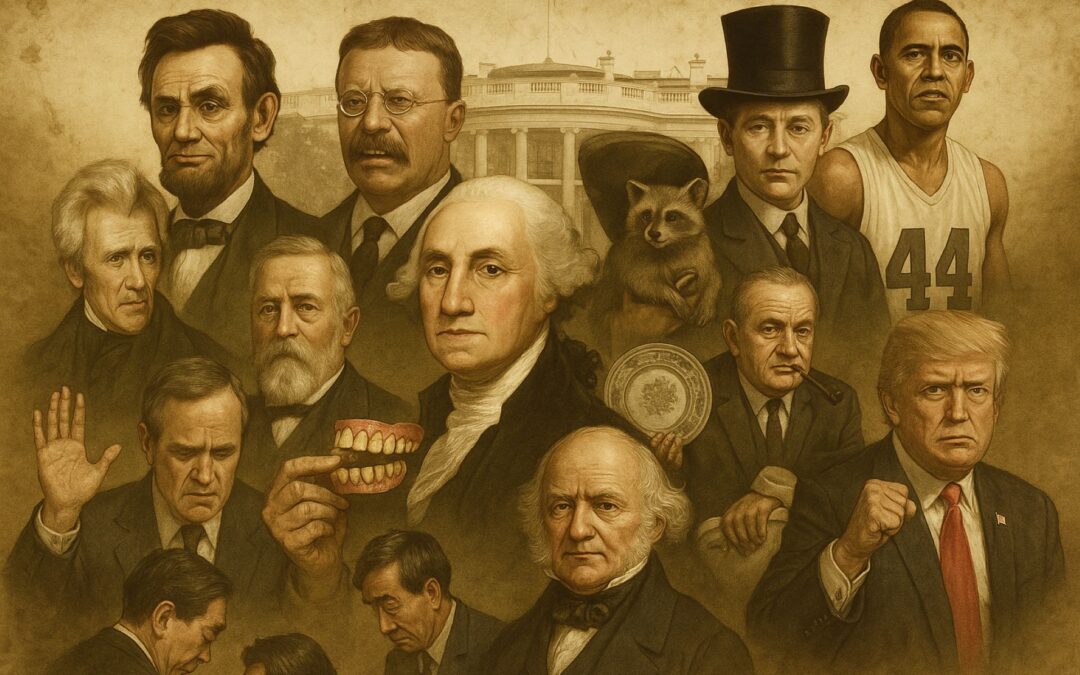
The American presidency is a role wrapped in ceremony, power, and world-shaping decisions. Yet, behind the pomp and circumstance are men as human—and as peculiar—as anyone else. Some swam naked in rivers at dawn. Others gambled away priceless artifacts or carried on scandalous affairs. A few had teeth made of hippo ivory, while one even kept a raccoon as a White House pet. These eccentricities don’t just entertain; they peel back the polished veneer and reveal the quirks, contradictions, and oddities that shaped the people behind the office. To understand the presidency is to see not just the policies, but the peculiarities that made these leaders unforgettable.
George Washington – The Haunted Smile
By the time George Washington assumed the presidency, his mouth was a battlefield. He had only a single real tooth left, and the pain of his dental woes shadowed much of his adult life. Contrary to the myth of wooden dentures, Washington’s false teeth were even more grotesque: they were cobbled together from human teeth purchased from the poor, animal molars taken from cows and horses, slabs of hippopotamus ivory, and metal springs that clamped the contraption together. The dentures creaked when he spoke, shifted uncomfortably when he ate, and distorted his jaw so badly that his face appeared swollen. He rarely smiled in portraits, not out of stoic resolve, but because showing his teeth would have revealed the nightmarish machinery inside his mouth.
John Adams – Satan at the White House
The second president was known for his sharp intellect and even sharper tongue, but his humor leaned toward the macabre. Adams owned two dogs named Juno and Satan. Juno, by all accounts, was affectionate and dignified. Satan, however, lived up to his name—mischievous, unruly, and prone to causing chaos at the White House. Historians still puzzle over why Adams chose such a devilish name for a family pet, but many suspect it was his dry wit at work. Imagine diplomats and cabinet members entering the president’s home only to be greeted by Adams’ wife Abigail introducing them to “Satan.”
Thomas Jefferson – Hypocrisy at Monticello
Jefferson’s elegant prose declared that “all men are created equal,” yet his personal life betrayed the hypocrisy of that statement. At Monticello, he carried on a long, hidden relationship with Sally Hemings, one of his enslaved women and his late wife’s half-sister. The relationship, which lasted decades, produced at least six children. Jefferson never acknowledged them publicly, though DNA evidence later confirmed the truth. Hemings remained enslaved, as did her children for much of their lives. The contradiction between Jefferson’s soaring ideals and his private actions is one of the darkest paradoxes in American history.
James Madison – The Pocket-Sized Founding Father
At 5’4” and barely 100 pounds, Madison was the smallest president to ever hold office. Known derisively as “Little Jimmy,” his slight frame belied his towering intellect. He was the principal author of the Constitution, the driving force behind the Bill of Rights, and one of the architects of America’s earliest political parties. Despite chronic health problems and a frail physique, Madison’s ideas on checks and balances, liberty, and governance form the backbone of American democracy to this day. His legacy proved that physical stature was irrelevant in shaping nations.
James Monroe – A Capital of His Own
James Monroe’s presidency is immortalized not in marble, but in geography. Thousands of miles from Washington, D.C., the capital city of Liberia—Monrovia—was named in his honor. Monroe had supported the American Colonization Society, which advocated for resettling freed African-Americans in West Africa rather than integrating them into U.S. society. In 1822, when the settlement was established, it bore his name as a tribute. The decision reflects both the racial complexities of early America and the influence of U.S. presidents abroad.
John Quincy Adams – The Naked Interviewee
Adams was a man of strange habits, none more peculiar than his daily nude swims in the Potomac River. At sunrise, he would shed his clothes and plunge into the cold water, relishing the solitude. In 1825, journalist Anne Royall saw an opportunity—she sat on his clothes while he swam and refused to budge until he agreed to an interview. It was the first recorded instance of a female journalist securing an interview with a president, and certainly the only one obtained while the commander-in-chief was completely unclothed.
Andrew Jackson – Bleeding and Unbowed
Jackson’s fiery temper and obsession with honor led him into more than 100 duels. One of the deadliest came in 1806, when lawyer Charles Dickinson insulted his wife. The two faced off with pistols. Dickinson fired first, hitting Jackson square in the chest. Miraculously, Jackson did not collapse. Instead, he aimed and calmly fired back, killing his opponent instantly. The bullet lodged near his heart and remained there for the rest of his life. Jackson’s survival and ruthlessness cemented his reputation as a man who could not be intimidated—even by mortal wounds.
Martin Van Buren – The Birth of “OK”
Van Buren’s political nickname was “Old Kinderhook,” a reference to his birthplace in Kinderhook, New York. His supporters turned it into a slogan: “Vote for OK.” At the same time, Americans were jokingly spelling “all correct” as “oll korrect.” The two merged, and the term “OK” spread like wildfire. What began as a quirky campaign chant eventually became one of the most universal words in the English language, a linguistic relic born from Van Buren’s candidacy.
William Henry Harrison – The 31-Day Circus
Harrison’s presidency remains the shortest in U.S. history—just 31 days. The White House during his brief tenure was almost comical. He brought along an exotic pet goat that freely roamed the grounds. At one point, the goat headbutted a cabinet member. To make matters worse, the drinking water in the White House was contaminated, and Harrison contracted a fatal illness. Between livestock attacks and his rapid death, his presidency felt more like a tragic sideshow than a statesman’s tenure.
John Tyler – America’s Time Traveler
Tyler fathered 15 children, more than any other president. But it’s his late-life fatherhood that created one of history’s strangest time-warps. He fathered his last child at age 70, and his children went on to have their own kids at similarly advanced ages. As a result, Tyler’s grandchildren lived into the 2010s—nearly two centuries after he was born in 1790. Through sheer biological improbability, Tyler’s family line connects the early republic directly to the modern world.
James K. Polk – The Burnout President
Polk campaigned on a bold promise: he would serve only one term and accomplish everything he set out to do. True to his word, he threw himself into his duties with unrelenting energy. Fueled by endless cups of coffee, he routinely worked 12 to 16 hours a day, driving his cabinet and staff to exhaustion. Under his leadership, the U.S. expanded massively, adding vast swaths of territory in the West. But the cost of his relentless grind was staggering. Barely three months after leaving office, Polk succumbed to illness, his body ravaged by stress and fatigue. His was the shortest retirement of any president, a grim reminder of ambition’s toll.
Zachary Taylor – Old Whitey’s Tail
Taylor was a career soldier, a man more comfortable on the battlefield than in the presidential mansion. He brought with him to the White House his warhorse, Old Whitey, who quickly became a sensation. Visitors plucked hairs from the horse’s tail as souvenirs, nearly stripping it bare. Guards eventually had to intervene to protect the poor animal from overzealous admirers. Taylor’s presidency ended abruptly after he ate a fatal combination of raw cherries and iced milk on a sweltering day. Old Whitey, tail restored, marched solemnly in his master’s funeral procession, a living symbol of a presidency cut short by stomach trouble.
Millard Fillmore – The Book Rescuer
Often dismissed as one of America’s most forgettable presidents, Fillmore nevertheless had one shining moment of heroism. When the Library of Congress caught fire in 1851, he rushed to the scene, joining firefighters and forming a bucket brigade to save priceless volumes from destruction. Though a myth later circulated that he installed the first White House bathtub, his real legacy lies in his devotion to books and learning. Fillmore may not have changed the course of history, but for a night, he was the nation’s librarian-in-chief.
Franklin Pierce – The Phantom Arrest
Pierce’s presidency was marred by personal tragedy and political failure, but a peculiar tale haunts his legacy. In 1853, he was allegedly arrested for running over an old woman with his carriage. The charge? Reckless driving—on horseback. But the story is riddled with inconsistencies. No police record exists, no newspapers covered it, and his own letters are silent on the matter. Was it slander, myth, or a cover-up? Historians still debate. The mystery endures as one of the strangest “what ifs” in presidential lore.
James Buchanan – The Bachelor President
Buchanan never married, making him the only lifelong bachelor president. His close and unusually intimate friendship with Senator William Rufus King sparked rumors in Washington society. Andrew Jackson mockingly referred to them as “Miss Nancy” and “Aunt Fancy.” In letters, Buchanan called King “my better half” and even “my wife.” Whether they were partners in love or simply bound by deep companionship remains unknown. But in a White House defined by solitude, whispers of hidden affection add complexity to his legacy.
Abraham Lincoln – Wrestling Champion
Standing at 6’4”, Lincoln towered over his contemporaries. Before politics, he earned local fame as a formidable wrestler, winning 299 of 300 matches. In 1831, he squared off against Jack Armstrong, a tough local gang leader. The fight was brutal, but Lincoln’s strength and determination carried the day. His victory won him not only bragging rights but also the gang’s respect. Over a century later, his reputation was cemented with an induction into the National Wrestling Hall of Fame. Lincoln was not only a liberator but also a brawler.
Andrew Johnson – The Tailor-in-Chief
Before politics, Johnson was a poor apprentice tailor. He taught himself to read while working in a small shop, needle and thread in hand. Even after becoming president, he honored his roots. For his inauguration, he hand-stitched his own suit, cutting and sewing the fabric himself. The gesture reflected his belief in self-reliance and his pride in having risen from humble beginnings. Johnson’s presidency may have been turbulent, but he never forgot the craft that clothed him for life.
Ulysses S. Grant – The Speeding President
Grant loved speed. His favorite pastime was racing his horse-drawn carriage through the streets of Washington, to the annoyance of pedestrians and police alike. On multiple occasions, officers stopped him, not realizing at first who he was. One officer, even after learning he had arrested the president, still issued a ticket. Grant reportedly accepted it without protest, making him the first—and only—president with a moving violation on his record. For all his military glory, he was still just another reckless driver in the eyes of the law.
Rutherford B. Hayes – Phone Number One
Hayes was the first president to have a telephone installed in the White House. The number was as simple as it gets: “1.” Despite the honor of being the first to wield this revolutionary invention, Hayes was unimpressed. He found the device confusing and impractical. When Alexander Graham Bell himself called to demonstrate it, Hayes remarked, “It’s a great invention, but who would ever use one?” Time, of course, proved him spectacularly wrong.
James Garfield – The Ambidextrous Genius
Garfield’s mind was a marvel. Fluent in multiple languages, he was said to be able to write in Greek with one hand and Latin with the other at the same time. He also published an original mathematical proof of the Pythagorean theorem, making him one of the most intellectually gifted presidents. His assassination cut short what could have been one of the most brilliant presidencies in history, leaving behind tantalizing hints of what might have been.
Chester A. Arthur – The Dandy President
Arthur was obsessed with fashion. He owned over 80 pairs of trousers and was known for changing outfits multiple times a day. At night, he would stroll past luxury shops just to admire the displays. His wardrobe was so extravagant that critics accused him of caring more about silk cravats than statesmanship. One journalist quipped that Arthur would rather lose an election than a good tailor. He embraced the criticism with style—literally.
Grover Cleveland – Hangman Sheriff
Before the presidency, Cleveland worked as sheriff in Buffalo, New York. The position included the grim duty of carrying out executions. While most men in his position delegated the task, Cleveland insisted on doing it himself. Twice, he personally pulled the lever to hang convicted murderers. He explained it as an act of responsibility, sparing others the burden of guilt. Years later, his opponents twisted this against him, mocking his comfort with the gallows. Duty and politics collided on the scaffold.
Benjamin Harrison – Fine China and Nothing Else
Benjamin Harrison was the grandson of William Henry Harrison, making them the only grandfather-grandson presidential pair. When Benjamin moved into the White House, he discovered his grandfather’s china still in use nearly five decades later. With dry humor, he remarked that the only true perk of presidential lineage was inheriting old dinnerware. His joke captured the anticlimax of dynastic politics—expecting legacies, only to receive plates.
William McKinley – The Doomed Carnation
McKinley believed in luck charms, none more so than the red carnation he wore in his lapel. The flower became his trademark, always pinned to his chest. During a public event, he handed it to a young girl who admired it. Moments later, he was assassinated. The flower that symbolized protection became a symbol of fate. In his honor, Ohio adopted the carnation as its state flower, forever binding his memory to the fragile bloom.
Theodore Roosevelt – The Bulletproof Orator
During a campaign stop in Milwaukee in 1912, Roosevelt was shot at point-blank range. The bullet tore through his coat, his eyeglass case, and the folded manuscript of his 50-page speech, slowing its velocity before lodging in his chest. Instead of collapsing, Roosevelt stood tall and addressed the crowd. “It takes more than that to kill a Bull Moose,” he declared. For 84 minutes, he spoke, blood seeping through his shirt, before finally seeking medical care. His defiance turned him into a living legend.
William Howard Taft – The Custom Tub
Taft, weighing 340 pounds, needed a bathtub big enough to fit his frame. A custom-made porcelain tub was commissioned, so large it could comfortably hold four men. The myth that he once got stuck in a bathtub persists, but it was this oversized fixture that truly became part of his legacy. Taft himself had a sense of humor about his size, once remarking that he could only make progress if he moved sideways through a doorway.
Woodrow Wilson – The Secret Presidency
In 1919, Wilson suffered a debilitating stroke that left him partially paralyzed. For the next 17 months, his wife, Edith Wilson, quietly assumed control. She decided which documents the president would see, who could visit him, and even which issues would be addressed. To the public, Wilson remained the leader. In reality, the nation was being run by the first unofficial female president—his wife. The deception has fueled debate ever since about transparency, power, and secrecy in government.
Warren G. Harding – Gambling Away History
Harding’s presidency was notorious for corruption, but his personal vices also reached the Oval Office. During a poker game with friends, he recklessly wagered and lost a priceless set of White House china dating back to James Madison. His advisors were horrified, but Harding laughed it off. In hindsight, it was emblematic of his entire administration: treating sacred institutions as chips on a table.
Calvin Coolidge – The Pardoned Raccoon
In 1926, the Coolidges received a live raccoon as a Thanksgiving dinner gift. Rather than eat it, they adopted the animal, naming her Rebecca. She became a beloved White House pet, walked on a leash by the first lady. Rebecca roamed the grounds and charmed guests, though she had a mischievous streak. While turkeys became the tradition, Rebecca remains the strangest creature ever to be pardoned at 1600 Pennsylvania Avenue.
Herbert Hoover – The Invisible President
Hoover was famously reserved, a man who detested small talk and chance encounters. To protect his privacy, the White House staff devised a system of signals and bells that warned when the president was approaching. Servants were instructed to flatten themselves against the walls or duck into nearby rooms so Hoover would not be forced into awkward greetings. To outsiders, he seemed cold and detached, but in truth, it was an extreme method of preserving his comfort. Adding to the eccentricity, Hoover and his wife Lou spoke fluent Mandarin, often conversing in the language at home to confound eavesdroppers.
Franklin D. Roosevelt – Fear of 13
FDR, the president who faced down the Depression and Nazi Germany, quivered before a simple number: thirteen. He suffered from triskaidekaphobia, an intense fear of it. He refused to sit at a table with 13 guests, avoided traveling on the 13th of any month, and declined to schedule major decisions or announcements on Friday the 13th. His phobia may seem trivial compared to the weight of world war, yet it governed his personal habits with iron discipline. Even the bravest leaders harbor private superstitions.
Harry S. Truman – The Letter That Meant Nothing
The middle initial in Harry S. Truman’s name is a phantom. It doesn’t stand for a name at all. His parents gave it to him as a compromise between his two grandfathers—Anderson Shipp Truman and Solomon Young. To honor both, they settled on a lone “S.” Though style guides often debate whether the “S” should carry a period, Truman himself signed it both ways, indifferent to the grammatical fuss. A single letter became an enduring curiosity in presidential history.
Dwight D. Eisenhower – Pacifist to General
Eisenhower was raised in a deeply religious family of pacifists who opposed war and violence. Yet this same man grew up to command the largest amphibious invasion in history and orchestrate the defeat of Nazi Germany. From pacifist roots to supreme Allied commander, the irony of his life arc is striking. Eisenhower’s personal background made him reluctant to glorify war; he knew too well its costs. His presidency reflected that pragmatism, with a military man always wary of the machine he once commanded.
John F. Kennedy – Affairs and Secrets
Kennedy’s presidency projected glamour, charm, and youthful vigor. Behind the scenes, it was tangled in affairs, recklessness, and secrets. He carried on liaisons with interns, socialites, and Hollywood stars like Marilyn Monroe. One of his partners, Ellen Rometsch, was later linked to East German intelligence, raising grave national security concerns. Kennedy’s charisma masked his appetites, but his private life was a storm of contradictions—Catholic morality in public, reckless indulgence in private. Jackie Kennedy bore the humiliation with stoicism, but the truth has never stopped shadowing his legacy.
Lyndon B. Johnson – Bathroom Meetings
Johnson was a force of nature, crude and unfiltered. He conducted staff meetings while sitting on the toilet with the door wide open, issuing orders between flushes. On trips, he relieved himself outdoors without hesitation, even in front of staff, journalists, and Secret Service agents. LBJ believed in dominance, whether through political arm-twisting or sheer disregard for personal boundaries. His methods horrified aides but also reinforced his reputation as a man impossible to ignore.
Richard Nixon – Bowling in the Basement
Nixon was consumed by paranoia and scandal, but one of his strangest quirks was entirely benign: his love of bowling. He had a one-lane alley installed beneath the White House. Dressed in his suit, often late at night, Nixon would roll frame after frame alone, clearing his head through strikes and spares. His high score reportedly surpassed 200. Amid the Watergate storm, bowling offered him a rare, quiet refuge.
Gerald Ford – The Unelected President
Ford’s rise to the Oval Office was unprecedented. He became vice president when Spiro Agnew resigned in disgrace, then ascended to the presidency when Nixon fell to Watergate. Ford never once appeared on a presidential ballot, making him the only U.S. president to serve without being elected. His accidental rise underscored the resilience—and the oddities—of the constitutional system.
Jimmy Carter – The UFO Witness
In 1969, Carter looked to the Georgia night sky and saw something he could not explain—a glowing, pulsating orb of green light. He was so convinced of its strangeness that he filed a formal report with the International UFO Bureau. During his 1976 campaign, he even promised to declassify UFO files if elected. Once in office, Cold War realities made him backtrack, but Carter remains the only president to have officially reported a UFO sighting.
Ronald Reagan – The Lifeguard Notches
Before Hollywood, before politics, Reagan spent summers as a lifeguard on the Rock River in Illinois. Over seven summers, he saved 77 people from drowning. After each rescue, he carved a notch into a wooden log, keeping count of the lives he’d pulled from the water. That log later followed him to the Oval Office, a rustic reminder of his youthful heroism. Reagan’s screen presence may have charmed America, but it was his lifeguard whistle that first proved he could lead.
George H. W. Bush – Vomit Diplomacy
Bush loved adventure—he celebrated birthdays with parachute jumps well into his 90s. But his most infamous moment came at a state dinner in Tokyo in 1992, when he suddenly slumped forward and vomited into the lap of the Japanese prime minister. The moment horrified guests and embarrassed the nation. In Japan, the incident coined a new slang word: bushuru—“to do a Bush.” Even decades later, his presidency is remembered as much for that unfortunate dinner as for the Cold War’s end.
Bill Clinton – The Scandal President
Charismatic and gifted with words, Clinton also carried appetites that nearly destroyed him. His affair with White House intern Monica Lewinsky exploded into one of the most notorious scandals in American political history. Clinton famously denied the relationship—“I did not have sexual relations with that woman”—only for evidence to prove otherwise. Impeached by the House but acquitted by the Senate, he survived politically, but the scandal forever branded his presidency.
George W. Bush – Ducking the Shoes
During a 2008 press conference in Baghdad, an Iraqi journalist hurled both shoes at Bush in protest, a grave insult in Middle Eastern culture. Bush dodged them with surprising agility, then joked, “All I can report is it was a size 10.” His lighthearted reaction disarmed the tension, but the image of a president ducking flying footwear became one of the most viral moments of his presidency.
Barack Obama – The Basketball Commander
Obama was fiercely competitive on the court. He had the White House tennis court refitted for basketball and regularly invited NBA legends like LeBron James and Kobe Bryant for pickup games. Staffers dreaded being embarrassed by his smooth left-handed jumper, but few could stop him. For Obama, basketball wasn’t just a pastime; it was a way to bond, compete, and display the cool, composed energy that defined his presidency.
Donald Trump – Wrestling Hall of Famer
Long before politics, Trump was a fixture in the world of professional wrestling. He hosted multiple WrestleMania events at his casinos and cultivated a persona fit for the spectacle. At WrestleMania 23, he entered the ring, tackled WWE chairman Vince McMahon, and shaved his head before a roaring crowd. His antics earned him a spot in the WWE Hall of Fame—the only U.S. president to claim that honor.
Joe Biden – Sworn in at a Hospital Bed
Biden’s political career began in tragedy. Just weeks after winning his first Senate race in 1972, his wife and infant daughter were killed in a car accident. His two sons were critically injured. Rather than travel to Washington, Biden was sworn in as senator at their hospital bedside, a stark and heartbreaking image of duty in the face of grief. Decades later, after a lifetime in politics and personal losses, Biden became president—his story one of resilience, mourning, and perseverance.
Conclusion
From Washington’s tortured dentures to Biden’s heartbreaking hospital oath, the history of America’s presidents is littered with bizarre, amusing, and sometimes unsettling details. These stories remind us that even the most powerful figures in the world are not immune to eccentric habits, private contradictions, or embarrassing slip-ups. They humanize the marble busts and gilded portraits, transforming them into real people with quirks as strange as any of ours. In the end, the presidency may shape history, but it’s the oddities—the naked swims, the goat attacks, the UFO sightings—that make it irresistibly memorable.