
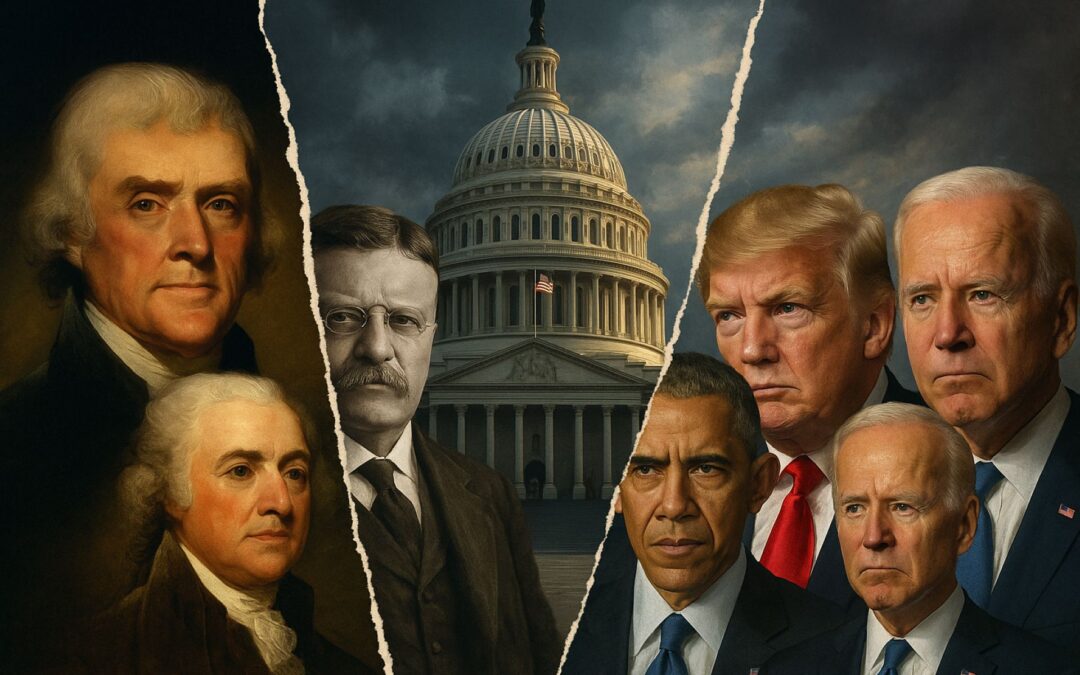
The presidency is often dressed up in grandeur—portraits in marble, speeches echoing through history, ceremonies that suggest unity and dignity. But peel back the polished façade, and what you find is raw humanity: rivalries, grudges, betrayals, and vendettas that shaped not just personal legacies but the nation itself. From the founding fathers who turned from comrades to enemies, to modern leaders who refused even the simplest traditions of courtesy, the story of America’s presidents is as much about animosity as it is about ideals. These feuds weren’t confined to whispered insults; they sparked party splits, prolonged wars, and in some cases, shook the very foundations of democracy.
Adams vs. Jefferson – From Dream Team to Mortal Enemies
In the 1770s and 1780s, John Adams and Thomas Jefferson represented the quintessential revolutionary alliance. They were men of vastly different temperaments—Adams fiery, blunt, and pragmatic; Jefferson calm, cerebral, and given to lofty ideals. Yet, they complemented each other. Together, they drafted the Declaration of Independence, with Jefferson’s elegant prose polished by Adams’s relentless drive. In Europe, they forged an intellectual brotherhood, sipping claret and debating everything from republicanism to architecture. They envisioned a nation where liberty would endure longer than any empire.
But ambition corrodes friendship. In 1796, Adams and Jefferson found themselves adversaries in America’s first contested presidential election. Under the original Constitution, the runner-up became vice president. Thus, Adams took the presidency, and Jefferson—his ideological opposite—was forced into the second seat. The arrangement was awkward, even poisonous. Adams, a Federalist, sought strong federal authority; Jefferson, a Democratic-Republican, wanted power rooted in states and farmers. The ideological gulf widened into hostility.
The 1800 rematch ignited a political inferno. Jefferson’s ally James Callender published scathing attacks, branding Adams a “hideous hermaphroditical character,” a slur so grotesque it mocked both his masculinity and leadership. Adams’s defenders retaliated with pamphlets painting Jefferson as godless, hypocritical, and morally bankrupt. Pamphleteering in the early republic was brutal—every insult dripped with venom meant to ruin reputations forever.
Jefferson’s eventual victory was decisive. Adams, consumed by bitterness, refused the dignity of handing power over in public. At four in the morning on inauguration day, he slipped out of Washington in silence, leaving Jefferson to celebrate alone. It was the first time a president snubbed his successor—a precedent that still echoes centuries later.
Beneath the personal vitriol lay deeper betrayals. Adams believed Jefferson schemed behind closed doors to undercut him while still in office. Jefferson loathed Adams’s Alien and Sedition Acts, which he saw as tyranny disguised as law. Their enmity defined early American politics, dividing the nation into Federalists and Democratic-Republicans, a split that shaped the partisan system still in play today.
Yet, their story had a redemptive coda. After years of silence, the two elder statesmen began exchanging letters in 1812. Their correspondence rekindled their friendship, producing some of the most profound political reflections in American history. And then came the poetic ending: on July 4, 1826, the 50th anniversary of the Declaration they had once signed together, both Adams and Jefferson drew their last breaths within hours of each other. Their feud was legendary, but their reconciliation immortal.
John Quincy Adams vs. Andrew Jackson – The “Corrupt Bargain” Blood Feud
The election of 1824 unfolded as one of the most chaotic in U.S. history. Four heavyweights entered the ring: Andrew Jackson, the fiery war hero of New Orleans; John Quincy Adams, the polished son of a president; William H. Crawford, a Southern powerbroker; and Henry Clay, Speaker of the House and master of political maneuver. Jackson won both the popular and electoral vote but lacked the required majority. The Constitution threw the decision to the House of Representatives, where Clay’s influence would prove decisive.
Clay detested Jackson. He considered him a reckless military man, a populist demagogue with no political refinement. Instead, Clay threw his support to Adams. When the House chose Adams as president, the ink was barely dry before Adams appointed Clay Secretary of State—the position viewed as a stepping-stone to the presidency. To Jackson’s supporters, this was not coincidence but conspiracy. They roared about a “corrupt bargain,” convinced the presidency had been stolen.
Jackson seethed for four years, his rage burning hotter with each passing month. He believed he had been robbed not just of power but of honor, his reputation sullied by elite manipulation. His supporters transformed his anger into a populist crusade, portraying him as the people’s champion against entrenched corruption.
The rematch in 1828 descended into political blood sport. Adams’s backers unleashed vicious attacks, branding Jackson a violent, ignorant brute unfit for high office. They smeared his wife Rachel as a bigamist, dredging up a clerical mistake from her first marriage. Jackson’s enemies painted him as a barbarian in uniform. Jackson’s allies retaliated with their own arsenal of venom: they accused Adams of pimping out an American girl to a Russian diplomat while serving abroad. The accusations were scandalous, unverified, and devastating.
Jackson’s triumph was overwhelming. He crushed Adams, riding a wave of populist fury straight into the White House. But victory came shadowed by tragedy. Rachel Jackson, deeply wounded by the vicious campaign slanders, collapsed and died just weeks before her husband’s inauguration. Jackson was inconsolable, convinced the stress of the attacks had killed her. At her funeral, his grief hardened into fury: “May God Almighty forgive her murderers,” he said, “I never can.”
Adams, like his father before him, refused to attend his successor’s inauguration. The bitterness was total. Jackson, in a show of defiance, threw open the doors of the White House to ordinary citizens, letting crowds pour in for a raucous, destructive celebration that scandalized Washington’s elite.
This was more than personal animosity—it fractured the political system. The feud destroyed the Democratic-Republican Party, splitting it into Jackson’s Democratic Party and Adams’s National Republicans, which later evolved into the Whigs. The echoes of this bitter contest reshaped American politics for decades, embedding partisanship as a permanent fixture of the republic.
Andrew Johnson vs. Ulysses S. Grant – Reconstruction at War
When Abraham Lincoln was assassinated in 1865, Andrew Johnson, a Southern Democrat chosen as Lincoln’s running mate for unity’s sake, suddenly inherited the presidency. Johnson’s philosophy of “restoration” was lenient toward the defeated Confederacy. He issued sweeping pardons, restored political power to former Confederate leaders, and sought rapid reintegration of Southern states with minimal conditions. For him, reconciliation meant appeasing the South.
But Ulysses S. Grant, the general who had crushed the Confederacy on the battlefield, saw a very different mission. Grant, aligned with the Radical Republicans in Congress, wanted to protect the rights of freedmen, prevent old planter elites from regaining control, and ensure that Reconstruction had teeth. The tension between the president and the war hero was inevitable.
Their feud exploded over Secretary of War Edwin Stanton, a staunch ally of Congress and enemy of Johnson’s leniency. Congress passed the Tenure of Office Act, forbidding Johnson from firing cabinet officials without Senate consent. Johnson defied it, attempting to oust Stanton and slot Grant in as temporary Secretary of War. Grant agreed reluctantly, but once the Senate reinstated Stanton, he obeyed the law and stepped aside.
Johnson was livid. He accused Grant in a public letter of duplicity, disrespect, and outright betrayal, painting him as a man who broke promises and undermined his commander-in-chief. But Grant was not one to be cowed. He fired back with a public response that was calm, precise, and utterly devastating. In plain terms, he contradicted Johnson’s claims and laid out his reasoning, defending his honor and integrity while making Johnson appear dishonest and desperate.
By 1869, when Grant prepared to assume the presidency, the animosity was unbridgeable. Johnson, humiliated and isolated, refused to accompany Grant to the inauguration. Instead, he sulked in the White House, signing meaningless papers as if clinging to the last shreds of power. Grant rode alone, a war hero turned president, while Johnson vanished into history as one of the most disgraced leaders in American memory.
But the feud was more than personal spite. At stake was the very soul of Reconstruction. Johnson’s policies would have allowed Confederate leaders to reclaim dominance and roll back emancipation. Grant, once in power, enforced civil rights with federal troops, cracked down on the Ku Klux Klan, and gave substance to the promise of freedom. Their hostility didn’t just bruise egos—it determined whether liberty for millions would be preserved or betrayed.
Theodore Roosevelt vs. William Howard Taft – Best Friends to Bitter Foes
Few presidential feuds cut as deep as the falling-out between Theodore Roosevelt and William Howard Taft. For years, Roosevelt and Taft were not merely political allies but genuine friends. Roosevelt admired Taft’s legal acumen and loyalty; Taft respected Roosevelt’s energy and vision. When Roosevelt decided not to seek another term in 1908, he handpicked Taft as his successor, convinced his friend would carry forward the Progressive agenda of busting monopolies, protecting workers, and conserving natural resources.
At first, Taft seemed the faithful steward. But once in office, his temperament diverged sharply from Roosevelt’s. Where Roosevelt was bold, aggressive, and theatrical, Taft was cautious, judicial, and more conservative in outlook. Slowly, he drifted toward the Republican Party’s old-guard conservatives, alienating reformers. He fired Roosevelt’s allies, including conservationist Gifford Pinchot, and allowed tariff policies that enraged progressives. To Roosevelt, it was betrayal on a monumental scale.
By 1912, Roosevelt’s patience snapped. Feeling his legacy undone, he stepped back into the political arena with volcanic energy. His words against Taft were blistering. He mocked his onetime protégé as a “puzzlewit” and claimed he had “less brains than a guinea pig.” He sneered at Taft’s lack of vigor, calling him “a flub-dub with a streak of the second-rate.” Roosevelt, who once praised Taft as a brother-in-arms, now ridiculed him as unfit even for ridicule.
Taft, usually mild and deliberate, broke character. Wounded by Roosevelt’s insults, he lashed out, branding his old friend a “honeyfugler”—a relic of slang meaning a smooth-talking deceiver. The insult baffled the public, who scrambled to dictionaries, but it revealed Taft’s deep hurt. Their friendship had curdled into venom.
The Republican Party split wide open. Roosevelt, unwilling to back down, formed the Progressive “Bull Moose” Party. He campaigned with manic zeal, drawing huge crowds, roaring like a prophet betrayed. The division shattered the Republican vote, allowing Democrat Woodrow Wilson to sweep into office. Roosevelt actually outperformed Taft, winning more states and electoral votes, leaving the sitting president humiliated. Taft carried only two states, his career in ruins.
The human tragedy was palpable. Taft, once buoyed by Roosevelt’s mentorship, broke down in tears as he realized how completely he had been cast aside and ridiculed. Roosevelt, consumed by vengeance, sacrificed unity for his own war of pride. What began as brotherhood ended as battlefield. Their feud not only destroyed a friendship but also reconfigured American politics, cementing the progressive-conservative schism inside the Republican Party for generations to come.
Herbert Hoover vs. Franklin D. Roosevelt – Depression Without Cooperation
By the early 1930s, the American economy had collapsed into its worst crisis in history. Banks failed daily, unemployment soared past 25%, and breadlines stretched for blocks in every city. Herbert Hoover, a man of immense intelligence and organizational skill, believed in stoic discipline and voluntary cooperation. He viewed government intervention as dangerous overreach and remained steadfast in his conviction that the crisis could be managed with patience and restraint.
Franklin D. Roosevelt, on the other hand, embodied the opposite. A master of charm and optimism, he promised bold experimentation—“bold, persistent experimentation”—to shock the economy back to life. He saw Hoover as timid, paralyzed by principle, and unwilling to take risks. Hoover, in turn, saw Roosevelt as dangerously opportunistic, a man willing to shift his policies at whim. He sneered that Roosevelt was “a chameleon on plaid”—so changeable that even a Scottish tartan couldn’t disguise it.
The bitterness was not confined to words. After Roosevelt’s landslide victory in November 1932, there remained a four-month gap before his March inauguration. It was the longest lame-duck period in American history, and those months were disastrous. Banks teetered on collapse. Hoover, desperate, begged Roosevelt to support emergency measures to stabilize the system, hoping for a united front that might calm markets. Roosevelt refused. He had no desire to be tethered to Hoover’s failed policies before assuming office.
Hoover was appalled. He considered Roosevelt’s silence an act of political cruelty, later describing it as “the most cold-blooded political act ever undertaken by a man in public life.” Roosevelt, unshaken, calculated that the worse the situation got, the stronger his hand would be once he entered power. The standoff left the nation in limbo, confidence evaporating as neither man would bend.
Their shared carriage ride to the Capitol on March 4, 1933, became an enduring symbol of their hatred. Photographs captured them sitting stiffly side by side, their faces rigid, their eyes averted. The silence was deafening, the tension unmistakable. The consequences of their feud were not confined to bruised egos; historians believe their refusal to cooperate during that interregnum deepened the banking panic and worsened the suffering of millions.
It was the clash of two philosophies—Hoover’s principled restraint versus Roosevelt’s pragmatic daring. But it was also a clash of egos, one so severe that the country itself paid the price.
Harry Truman vs. Dwight Eisenhower – From Admiration to Contempt
Few presidential relationships shifted so dramatically from respect to disdain as that of Harry Truman and Dwight D. Eisenhower. During World War II, Truman had admired Eisenhower as the Allied commander in Europe, the man who orchestrated D-Day and helped bring Nazi Germany to its knees. Truman even privately offered to support Eisenhower’s political career, believing him to be a man of unimpeachable honor who could unify a fractured nation.
But admiration soured into hostility in the early 1950s. The spark was Senator Joseph McCarthy’s witch hunt against supposed communists in government. McCarthy accused even the most decorated statesmen of treachery—including General George C. Marshall, Truman’s close friend and Secretary of State, architect of the Marshall Plan, and Nobel Peace Prize laureate. To Truman, Marshall was “the greatest American of the twentieth century.”
When Eisenhower, campaigning for president in 1952, planned to defend Marshall publicly in a speech, Truman anticipated vindication. But under pressure from political advisers worried about alienating McCarthy’s supporters, Eisenhower deleted the defense. To Truman, this was not pragmatism—it was cowardice. He was outraged that Eisenhower would sacrifice principle for votes.
Truman went on the offensive, lambasting Eisenhower in speeches and accusing him of lacking courage. Eisenhower, new to politics, took the attacks personally. The relationship between the two men deteriorated into mutual disdain. By the time Eisenhower won the election, the rift was so wide that even the transition of power became a theater of bitterness.
Truman invited Eisenhower to the White House for coffee before the inauguration, a gesture of goodwill. Eisenhower declined. Truman, stung, fumed in private and later derided him as a man who “didn’t know any more about politics than a pig knows about Sunday.” On inauguration day, the bad blood was obvious. Their conversations were minimal, their manner frosty, their smiles forced for the cameras.
The feud was more than personal insult—it carried risks for national security. The Korean War was still raging, and the transition required seamless coordination. Instead, hostility delayed crucial briefings and decision-making. A lack of trust at the highest level jeopardized strategy at a critical moment in the Cold War.
What began as genuine admiration between a president and a general collapsed into contempt between two presidents. Truman saw betrayal; Eisenhower saw insult. The result was one of the frostiest handovers of power in American history.
Harry Truman vs. Richard Nixon – A Hatred That Never Faded
Harry Truman had a temper, but rarely did it burn as long or as hot as when aimed at Richard Nixon. The animosity began in the late 1940s, when Nixon made his name by stoking Cold War paranoia. As a young congressman and later senator, he smeared opponents as communist sympathizers, rising swiftly through the ranks of the Republican Party. Truman, who had guided America through the end of World War II and into the fraught beginnings of the Cold War, despised Nixon’s brand of politics—fearmongering, opportunistic, and to Truman’s eyes, shamelessly dishonest.
When Nixon attacked Truman’s administration for “losing China” to Mao’s revolution, the insult cut deep. Truman believed Nixon had weaponized international tragedy for cheap political gain. His disgust turned personal. He began calling Nixon “a no-good lying bastard” in private conversations and, later, in public interviews. Truman once snarled that Nixon “could lie out both sides of his mouth at the same time, and if he ever caught himself telling the truth, he’d lie just to keep his hand in.” It was one of the most savage condemnations ever uttered by one president about another.
Truman’s loathing didn’t fade with time. Long after leaving office, he continued to rail against Nixon from his Missouri home, acting as a political elder who refused to forgive. At one point, he quipped that “anyone who votes for Nixon ought to go to hell.” Even in retirement, he couldn’t resist throwing darts at his nemesis.
The Watergate scandal seemed to vindicate Truman’s long-standing contempt. When Nixon resigned in disgrace in 1974, Truman was already in failing health, but his close friends recalled the satisfaction he took in seeing Nixon’s fall from grace. For Truman, it was not just politics—it was personal. He had called Nixon’s corruption of public life long before the rest of the country caught on, and in the end, he lived to see his judgment proven right.
John F. Kennedy vs. Lyndon Johnson – The Ivy League vs. Texas Grit
When John F. Kennedy selected Lyndon B. Johnson as his running mate in 1960, it was not a choice born of affection or trust. It was cold political strategy. Kennedy needed Johnson’s Southern clout, his connections in Congress, and his ability to deliver votes in states where Kennedy’s Catholicism was viewed with suspicion. Johnson accepted the role, but from the start, he chafed under the Kennedy mystique.
Johnson was a creature of raw politics: a master of backroom deals, arm-twisting, and the grinding machinery of legislation. In contrast, Kennedy and his inner circle embodied polish and glamour—Harvard-educated, urbane, and dripping with charisma. Johnson never fit. The Kennedy brothers, particularly Bobby, treated him with thinly veiled disdain, mocking his crassness and back-slapping style. Johnson, in turn, regarded Bobby as a “snot-nosed little son of a—,” an Ivy League princeling who had never sweated for power in the trenches.
The tension only deepened once Kennedy was assassinated and Johnson inherited the presidency. Johnson, suddenly wielding the authority he had always craved, made it clear he would not play caretaker to the Kennedy legacy. Instead, he sought to eclipse it. He passed the Civil Rights Act of 1964, pushed the Great Society reforms, and maneuvered through Congress with a ruthlessness Kennedy never possessed. Behind closed doors, he sneered at JFK’s reputation, once deriding him as a man “riding Caroline’s tricycle on Capitol Hill”—a pretty face with little legislative grit, unlike Johnson, who saw himself as the true master of power.
The bitterness ran so deep that Johnson moved to dismantle the Kennedy political machine itself. In 1967, he signed an anti-nepotism law, a direct rebuke of the Kennedys for installing Bobby as attorney general. The message was clear: the Kennedy dynasty would not be repeated under his watch.
Speculation swirled in later years about Johnson’s potential foreknowledge of the assassination. He had been in the motorcade, just two cars behind Kennedy, and rumors suggested suspicious behavior. But despite countless theories and decades of investigation, no credible evidence has ever tied him to the event. Still, Johnson’s behavior after Kennedy’s death—the relish with which he consolidated power, the coldness with which he pushed aside Kennedy loyalists—kept the conspiracy fires burning.
At its heart, the Kennedy-Johnson feud was about more than personal disdain. It was cultural. Kennedy embodied East Coast elitism and image-driven politics. Johnson embodied Southern grit, hardball tactics, and brute force legislative mastery. They needed each other to win the presidency, but once bound together, they could never truly tolerate each other. Their alliance was uneasy, their rivalry corrosive, and their legacy forever intertwined.
Lyndon Johnson vs. Richard Nixon – Treason in Vietnam
By 1968, Lyndon B. Johnson was a battered man. His presidency had been consumed by Vietnam, a war that grew bloodier each year despite his desperate attempts to end it. With his popularity sinking, Johnson made the stunning announcement that he would not seek reelection. Yet, he still hoped to salvage his legacy by brokering a peace agreement before leaving office. Behind closed doors, negotiators worked feverishly with North and South Vietnam to halt the fighting.
Enter Richard Nixon. Locked in a tight race with Hubert Humphrey, Johnson’s vice president, Nixon knew that if peace came before Election Day, it would almost certainly hand victory to the Democrats. So, Nixon’s campaign made a ruthless calculation: sabotage the talks. Through backchannels, his aides whispered to South Vietnamese leaders that they would get a better deal under a Nixon presidency. “Don’t trust Johnson,” they urged. “Hold out until after the election.”
Johnson got wind of the interference. FBI wiretaps and NSA intelligence confirmed Nixon’s team was meddling in delicate diplomacy. Johnson exploded. He called Nixon’s actions “treason” and insisted he had “blood on his hands.” To Johnson, it was the lowest betrayal imaginable—an American candidate undermining his own government’s efforts to end a war.
And yet, Johnson stayed silent publicly. Why? Because to expose Nixon’s plot, he would have to admit that the FBI had been secretly surveilling communications—a revelation that would have sparked a political inferno. So he swallowed the truth, fuming privately as Nixon captured the presidency.
The handoff between the two men was as frigid as any in history. Nixon visited Johnson’s ranch in Texas, but the meeting was stiff, the handshakes perfunctory, the smiles paper-thin. There was no warmth, no reconciliation—only two men glaring at each other through the lens of necessity. Nixon walked away with power, Johnson with the knowledge that his rival’s duplicity had likely prolonged the war by years and cost tens of thousands of additional American and Vietnamese lives.
History later confirmed Johnson’s suspicions in black and white. Nixon’s campaign had indeed sabotaged the peace talks, one of the most cynical acts in modern political history. Their feud was not merely personal animosity; it was a battle over morality itself, with Vietnam’s dead as the tragic collateral.
Jimmy Carter vs. Ronald Reagan – The Cold Shoulder
The 1980 election was devastating for Jimmy Carter. Inflation raged, gas lines snaked for miles, and the Iran hostage crisis made him look powerless. When Ronald Reagan swept him aside in a landslide, Carter was left with the bitter task of preparing a transition for a man whose style and substance clashed with his own in every conceivable way.
Carter was methodical, detail-obsessed, and often humorless, priding himself on mastery of policy minutiae. Reagan was the opposite: relaxed, instinctive, and charismatic, a man who trusted his gut and charm more than briefing books. Their transition meetings were a study in incompatibility. Carter arrived armed with binders, data, and exhaustive explanations. Reagan lounged back, listening with half an ear, taking no notes. To Carter, it was infuriating. At one point, unable to contain himself, he snapped at Reagan for not paying attention—an undignified eruption that only highlighted how wide the gulf between them had grown.
The personal slights didn’t end there. Weeks before the inauguration, Nancy Reagan asked the Carters if she and her husband could move into the White House guest residence early, eager to begin redecorating. To the Carters, the request reeked of arrogance and entitlement. They refused outright, leaving the Reagans stewing. What might have been a graceful transition turned into a frostbitten standoff.
Then came the ultimate humiliation. For 444 days, Carter had struggled, pleaded, and negotiated to free the American hostages held in Tehran. He endured sleepless nights and mounting criticism as the crisis dragged on. But on January 20, 1981—mere minutes after Reagan took the oath of office—the hostages were released. To the public, it looked as if Reagan had accomplished in an instant what Carter could not in over a year. The timing, almost certainly orchestrated by Iran to snub Carter, was a cruel gut punch.
The inaugural day told the story in miniature. Carter, having just lost his presidency and his pride, boarded a plane to greet the hostages in Germany. Reagan, basking in the glow of triumph, delivered his first address with the confidence of a man who had seemingly turned the page on America’s malaise.
Their feud was not one of insults hurled across microphones but of cold contempt. Carter viewed Reagan as shallow, an actor who made everything look easy. Reagan saw Carter as dour, a micromanager who had lost the people’s confidence. One embodied optimism, the other discipline—and the contrast left little room for warmth. The transition was chilly, the relationship nonexistent, and the humiliation Carter endured would linger in his memory forever.
Barack Obama vs. Donald Trump – From Roast to Revenge
The origins of the Obama–Trump feud trace back not to the campaign trail but to the tabloids. In the late 2000s, Donald Trump emerged as the loudest amplifier of the “birther” conspiracy, claiming Barack Obama had not been born in the United States. Even after Obama released his long-form birth certificate, Trump kept fueling doubt on talk shows and in interviews, insinuating the document was fake. For Obama, it was not just an attack on his presidency—it was an assault on his legitimacy, his very identity as an American.
In 2011, at the White House Correspondents’ Dinner, Obama struck back. Before a room full of Washington’s elite, he skewered Trump mercilessly. With impeccable comedic timing, he mocked Trump’s reality television career, teased his ambitions, and even played a doctored video from The Lion King as Trump’s “real” birth certificate. The audience roared with laughter; Trump sat stone-faced, humiliated. Many observers believe this public roasting hardened Trump’s resolve to one day run for president and get his revenge.
That chance came in 2016. Once elected, Trump made dismantling Obama’s legacy a cornerstone of his presidency. He targeted the Affordable Care Act, withdrew the U.S. from the Iran nuclear deal, and abandoned the Paris Climate Accord—signature Obama achievements, each gutted with relish. Trump even accused Obama of spying on his campaign, branding him corrupt and dangerous.
Obama, breaking with the unwritten rule that former presidents should avoid criticizing their successors, responded. During the COVID-19 pandemic, he blasted Trump’s handling of the crisis as a “chaotic disaster,” mocked his obsession with media coverage, and even joked that Trump seemed jealous of the virus’s press attention. The sniping was personal, unfiltered, and unprecedented.
The feud even spilled into tradition. Trump refused to hold the customary White House portrait unveiling for Obama, shattering decades of decorum. More than just personal hatred, their rivalry symbolized the widening chasm in American politics, with each man embodying opposing visions of the country. It was a feud that not only consumed their presidencies but also deepened the nation’s divide.
Donald Trump vs. Joe Biden – Democracy on the Line
If Obama versus Trump was about delegitimization and revenge, the Trump–Biden feud was about survival itself. The 2020 presidential race was ferocious from the outset. Trump branded Biden “Sleepy Joe,” mocking his age, stamina, and mental fitness. He relentlessly attacked Biden’s son, Hunter, alleging corruption tied to his business dealings abroad. Biden hit back just as hard, calling Trump “the worst president we’ve ever had” and questioning whether he had the character to even hold the office.
When the results came in, Biden had won by more than seven million votes and secured a clear Electoral College majority. But Trump refused to concede. He claimed, without evidence, that the election was stolen. Dozens of lawsuits followed, nearly all dismissed. Yet, Trump’s accusations spread like wildfire, radicalizing his base and culminating in the January 6 attack on the Capitol. For the first time since Andrew Johnson in 1869, a sitting president refused to attend his successor’s inauguration. Instead, Trump boarded Air Force One and flew to Florida on the morning of Biden’s swearing-in.
The consequences of the feud went beyond broken traditions. The delayed transition meant critical coordination on the COVID-19 pandemic was stymied. Health agencies, already stretched thin, struggled without clear guidance as cases surged. The political chaos bled into governance, with Trump’s refusal to accept defeat casting doubt on the very foundation of democratic transfer.
Their public rhetoric only escalated after the election. Biden warned that Trump’s movement represented “a threat to democracy itself.” Trump, meanwhile, continued to insist the election had been rigged, painting Biden as an illegitimate president. Unlike earlier rivalries that eventually mellowed, this feud metastasized into an existential crisis for the republic. It wasn’t merely about two men—it was about the endurance of American democracy.
Obama vs. Biden – The “BFF” Illusion
The public image of Barack Obama and Joe Biden as inseparable “bromance” partners became a meme-worthy phenomenon. Photos of them laughing together, Biden donning aviator sunglasses, and Obama affectionately placing a hand on his vice president’s shoulder were circulated endlessly as symbols of loyalty and camaraderie. Yet behind the curtain, the relationship was far more complicated.
Obama respected Biden’s experience but quietly doubted his political instincts. Before Biden announced his 2020 campaign, Obama reportedly warned him: “You don’t have to do this, Joe. You really don’t.” Translation: don’t run. Later, Obama was quoted telling a fellow Democrat, “Don’t underestimate Joe’s ability to f*** things up.” His skepticism was palpable.
When Biden finally entered the race, Obama withheld his endorsement until the Democratic primary was essentially over, allowing Biden to emerge on his own. Biden’s team felt stung, interpreting Obama’s hesitation as a lack of faith. Even during Biden’s presidency, reports surfaced that Obama privately critiqued his old running mate’s political strategies, describing his campaign as “a mess.”
For Biden, the coolness was frustrating. He had loyally stood beside Obama for eight years, often playing the attack dog or the behind-the-scenes negotiator. He believed their partnership was deeper than politics. But Obama saw him, at times, as undisciplined, gaffe-prone, and too prone to blunders.
The dynamic revealed a broader truth about political friendships. Publicly, they may sparkle with warmth and solidarity; privately, they can be riddled with mistrust, calculation, and bruised pride. The Obama–Biden relationship was no exception. The smiles and memes masked the reality: a partnership of necessity and strategy, one that never achieved the mythic closeness it projected.
Conclusion
Behind the podiums, parades, and patriotic pomp, presidents have always carried the same flaws as the rest of us: pride, jealousy, resentment, and rage. Their clashes often transcended personality, becoming battles over policy, power, and principle. Adams and Jefferson traded pamphlet smears that split a nation into parties. Jackson’s fury helped redraw the map of American politics. Roosevelt and Taft’s friendship imploded into open warfare that rewired an entire election. And in our own time, the feuds of Trump, Obama, and Biden have revealed just how corrosive political hatred can be when carried into the heart of governance.
If history proves anything, it’s that America is not only built on ideals—grudges also shape it. Presidential rivalries have left scars as deep as any policy decision, reminding us that the republic has always been steered not just by vision and unity, but also by the raw, messy, human impulse to fight, feud, and sometimes, to hate.