
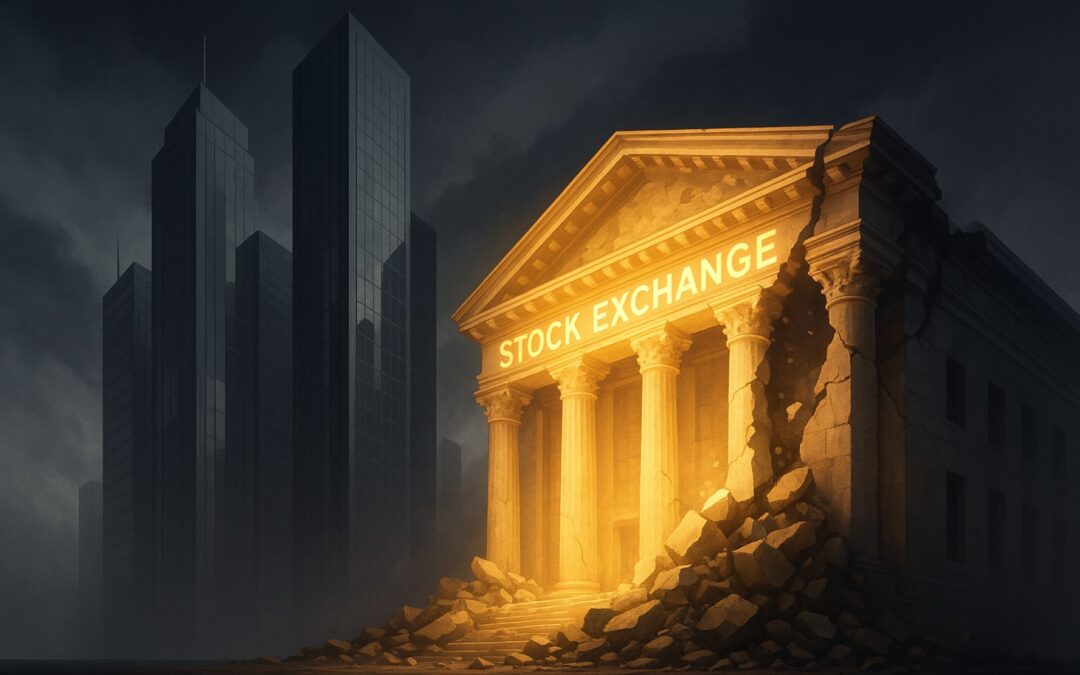
In the 1990s, an Initial Public Offering — or IPO — was the dream every ambitious founder chased. Going public meant prestige, power, and access to the vast oceans of capital that only Wall Street could provide. It was the moment when a private idea became a public institution, when ordinary investors could finally own a piece of the future.
But that world is vanishing.
In 1996, there were nearly 739 IPOs in the United States. Today, there are barely a few hundred each year. The total number of publicly listed companies has fallen by half. Some of the most valuable firms in history — SpaceX, Stripe, ByteDance — remain defiantly private, raising billions without ever setting foot on an exchange.
This isn’t a coincidence. It’s a symptom of a deeper transformation in the global economy — one where private money now rules, public scrutiny is avoided, and wealth creation happens behind closed doors. The rules of capitalism are being rewritten, and the effects reach far beyond the boardroom.
Why are companies refusing to go public? What does this mean for investors, innovation, and inequality? And is this the dawn of a more efficient system — or the quiet creation of an exclusive one?
Why Companies Used to Go Public
For most of the 20th century, the idea of “going public” carried an almost mythic status in the business world. It symbolized victory, legitimacy, and transformation. A company that went public wasn’t just raising capital — it was stepping into the financial elite, joining the ranks of household names, and earning the validation of Wall Street.
At its essence, an Initial Public Offering (IPO) is simple: a private company divides itself into shares and sells some of them to the public in exchange for money. But beneath that simplicity lies a profound economic mechanism — one that powers capitalism itself.
When a private business sells shares, it’s not merely seeking cash; it’s offering participation in its future. Each share represents a sliver of ownership, a claim on future profits, and a vote on key corporate decisions. The public, in turn, funds the company’s ambitions — new factories, research labs, international expansions — and, if all goes well, reaps a share of the success.
The IPO became the bridge between private innovation and public wealth creation. It democratized opportunity: allowing ordinary people, not just elites, to invest in promising ventures. When Apple, Amazon, or Google went public, they didn’t just make their founders rich — they made countless ordinary investors wealthy too.
But beyond the financials, there’s a psychological and cultural element. Going public used to mark the transition from a scrappy startup to an institution. It meant accountability, transparency, and scale. A private company could operate in the shadows; a public one had to publish quarterly reports, open its books, and withstand the glare of investors and the media.
That transparency built credibility. Suppliers extended better terms, customers felt reassured, and talented employees wanted in — often compensated through stock options, which made them partial owners. Public companies also gained leverage in negotiations, since their shares could be used as currency to acquire other firms or reward executives.
For founders and early investors, going public offered another crucial advantage: liquidity. Their paper wealth — shares in a private company — could finally be converted into real money. This allowed them to diversify, fund new ventures, or simply enjoy the fruits of their labor.
To put it simply, the IPO was the engine of modern capitalism — a ritual that connected private enterprise with public participation. It’s how ideas scaled, how fortunes were built, and how innovation reached the world.
But as the decades rolled on, the system began to shift. The forces that once made going public attractive slowly started to erode, replaced by new incentives that made staying private far more appealing.
The Fall of the IPO Era
If the 1990s were the golden age of IPOs, the decades that followed became their quiet decline. The contrast is stark: in 1996, there were 739 IPOs in the United States. In 2023, there were barely 225. And while the American economy has grown exponentially since the ‘90s, the number of publicly traded companies has been cut in half — from over 8,000 to just around 4,000.
At first glance, this might seem like a reflection of fewer startups or a saturated market. But that’s not the case. Innovation is booming, new companies are forming every day, and private valuations have reached astronomical heights. What’s really changed is the pathway from private to public — and the incentives behind it.
In the 1980s and 1990s, going public was practically inevitable once a company reached a certain size. It was the next logical step: the route to more capital, wider recognition, and bigger growth. Investors expected it, employees anticipated it, and founders dreamed of ringing the bell at the New York Stock Exchange.
Today, that dream has lost its shine. Many of the most successful modern companies are delaying their IPOs for a decade or more — or avoiding them entirely. Uber took nearly ten years to go public. Airbnb waited twelve. Stripe, valued at over $100 billion, has yet to list its shares. And SpaceX — the world’s most valuable private company — shows no interest in doing so until it builds a colony on Mars.
This hesitation isn’t just cultural; it’s structural. Over the past two decades, the financial ecosystem has been reshaped by forces that make private life far more comfortable and public life increasingly punishing.
Once upon a time, a billion-dollar valuation automatically meant an IPO was near. Today, it means the opposite — that a company has enough capital and power to avoid one.
Consider how the role of public markets has evolved. In the past, they were the primary source of expansion capital. A growing company needed to sell shares publicly to raise hundreds of millions of dollars for new factories, global offices, or R&D. Now, private markets can provide the same sums — often faster, with fewer conditions, and without regulatory scrutiny.
At the same time, the risks of being public have multiplied. The constant reporting requirements, market volatility, activist investors, and quarterly earnings pressure create a short-term mindset that stifles innovation. Many founders now see public listing not as an opportunity, but as a trap.
The consequences of this shift ripple far beyond Wall Street. When companies remain private, they limit access to their growth to a narrow group of institutional investors and wealthy individuals. By the time they go public — if ever — the explosive phase of value creation is already over.
Ordinary investors, once able to participate in the early growth of transformational companies, are now locked out. The stock market has become a place for finished products, not emerging ideas.
This quiet transformation marks a profound turning point in capitalism. The IPO, once a symbol of shared prosperity, is now a relic of an older era. The wealth generated by innovation still exists — but it increasingly flows through private channels, out of reach of the public markets that once defined economic opportunity.
And to understand why, we must look at the four major forces driving this retreat from the public eye — forces that have fundamentally changed how companies grow, fund themselves, and define success.
1. The Rise of Private Money
In the late 20th century, public markets were the undisputed center of gravity for corporate finance. If a company wanted to raise hundreds of millions of dollars, there was only one real path: go public. Private investors, no matter how wealthy, simply couldn’t provide that level of funding. The stock market was the gateway to scale.
But starting in the early 2000s, a quiet revolution began. Vast rivers of private capital started flowing into the global economy — from venture capital firms, private equity funds, sovereign wealth entities, hedge funds, and family offices. These weren’t small pools of money; they were oceans.
Today, private markets collectively manage tens of trillions of dollars. Sovereign wealth funds from Saudi Arabia, Singapore, and Norway alone hold more than $10 trillion in assets. U.S.-based private equity firms raise hundreds of billions annually, deploying them across industries from technology to healthcare to manufacturing. Even hedge funds and pension systems — once confined to public investments — now pour capital into private deals.
What this means is simple but transformative: startups and growing companies no longer need to go public to access massive funding. They can raise billions in the private sphere, often faster and with far fewer strings attached.
For founders, this is a dream scenario. Instead of navigating the scrutiny and bureaucracy of a public IPO, they can negotiate directly with sophisticated investors who understand risk, accept ambiguity, and offer flexibility. No quarterly earnings calls. No public controversies. No market panic when a forecast is missed by a decimal point.
Private investors also bring more than cash — they bring guidance, networks, and long-term thinking. Venture capital firms often act as partners, helping founders refine strategies and scale intelligently. Private equity firms can provide expertise in restructuring, global expansion, or acquisitions. This support is something public shareholders, scattered across millions of retail accounts, can never offer.
The result is that companies now grow up in the shadows — bigger, richer, and older before they ever reach Wall Street. In 1980, the average age of a company at IPO was 6 years. By 2021, it was 11. Many unicorns — private companies valued at over $1 billion — are delaying IPOs for a decade or more. Some, like SpaceX, show no interest in going public at all.
This shift has created a two-tiered financial world. On one side are the private investors — venture funds, sovereign capital, and private equity firms — who get access to early-stage, high-growth companies. On the other are ordinary investors, who only see these businesses once they’re mature and their meteoric rise has already happened.
It’s a profound change in how wealth is created and distributed. In the old model, the public could invest in Microsoft or Amazon when they were young and reap enormous rewards as they grew. In the new model, the biggest gains accrue behind closed doors — to those already wealthy enough to buy a seat at the table.
Private capital has become both the enabler and the gatekeeper of modern capitalism. It fuels innovation but hoards opportunity. It gives founders freedom, but at the cost of shutting the average person out of the growth story.
And because there’s now so much private money sloshing around — from Silicon Valley to the Middle East to Wall Street’s shadow banking arms — the pressure to ever go public has all but evaporated.
2. The Burden of Regulation and Compliance
If the rise of private capital opened a new path for companies, the growing burden of regulation made staying public increasingly unattractive.
In the early 2000s, the U.S. faced one of the worst waves of corporate scandals in modern history. Enron, WorldCom, Tyco — household names that collapsed under the weight of accounting fraud and executive deception. Investors lost billions. Confidence in public markets was shaken to the core.
In response, lawmakers passed the Sarbanes-Oxley Act of 2002 — a sweeping reform intended to restore transparency and protect shareholders. It required companies to overhaul their governance structures, implement internal auditing systems, and have executives personally certify the accuracy of their financial statements.
The intentions were noble. The results were mixed.
While the law did succeed in improving corporate accountability, it also made life dramatically more expensive and complex for public companies. The cost of compliance for a mid-sized public firm can easily reach $2–4 million per year. Large corporations can spend ten times that amount just to maintain regulatory alignment.
And that’s just the ongoing cost. Going public in the first place is another mountain to climb. The IPO process involves months — sometimes years — of legal filings, audits, underwriting negotiations, and Securities and Exchange Commission (SEC) scrutiny. Every number must be justified. Every risk must be disclosed. Every decision is second-guessed by regulators, analysts, and investors alike.
Once the IPO is complete, the scrutiny doesn’t end. Public companies must report their earnings every quarter, file annual 10-K reports, immediately disclose major events (like acquisitions or lawsuits), and maintain open channels of communication with investors. Each step brings exposure — and potential liability.
Mistakes are punished brutally. If a CFO misstates earnings, the stock can plummet overnight. If a CEO fails to file a disclosure on time, lawsuits follow. And if internal controls fail, the SEC can impose crippling fines or even criminal penalties.
In contrast, private companies face almost none of this. They can report selectively, make strategic decisions quietly, and pivot without headlines. They’re not forced to air every detail of their financial life in public. For many founders, especially those with long-term visions and innovative plans that may take years to bear fruit, that privacy is priceless.
There’s also the human factor: regulation doesn’t just cost money — it costs time and focus. Executives of public firms often find themselves consumed by compliance instead of creativity. Instead of developing products or refining strategy, they’re signing documents, meeting auditors, and navigating red tape.
This bureaucratic burden has turned the public markets from a place of opportunity into a gauntlet. For startups or mid-sized companies that could easily raise funds privately, it simply makes no sense to volunteer for that level of constraint.
In a way, regulation has achieved its purpose — it has made public markets safer and more transparent. But it has also made them far less attractive.
The irony is that while these laws were designed to protect investors, they’ve also helped lock them out of the best opportunities. Many of the world’s most dynamic companies prefer the freedom of private ownership to the regulatory weight of public life.
And as more firms make that choice, the gap between what’s visible and what’s valuable continues to widen — with the most exciting parts of capitalism now unfolding out of public view.
3. The Curse of Short-Termism
The moment a company goes public, it steps onto a treadmill that never stops — the quarterly cycle. Every 90 days, it must open its books, justify its performance, and convince Wall Street that the next 90 days will be even better.
In theory, this rhythm keeps companies disciplined. In practice, it often distorts priorities. Instead of focusing on innovation, strategy, or long-term vision, many executives find themselves trapped in the pursuit of short-term metrics — earnings per share, quarterly revenue targets, and market sentiment.
Miss expectations by a single cent? Billions can evaporate overnight. Deliver strong results but hint at slower growth ahead? The stock tanks anyway.
Netflix provides a perfect example. In 2022, the company lost over 20% of its market value in a single day after reporting fewer new subscribers than analysts had projected — even though its fundamentals and long-term prospects were sound. That’s the tyranny of short-termism: perception often matters more than performance.
For public companies, every decision becomes a balancing act between what’s good for the next quarter and what’s necessary for the next decade. A CEO might want to invest heavily in R&D — a new technology, a new market, or a bold innovation. But doing so means taking a temporary hit to profits. On Wall Street, that’s enough to trigger sell orders, negative headlines, and angry shareholders.
This constant scrutiny doesn’t just create pressure — it changes behavior. Executives become cautious, conservative, and reactive. Risk-taking, once the lifeblood of innovation, gets replaced by risk-avoidance. Managers cut jobs to boost margins, delay projects to “beat expectations,” and manipulate timing to please analysts.
The obsession with quarterly results has even shaped how companies communicate. Earnings calls — meant to inform — often become performances, carefully scripted to manage sentiment rather than share insight. Language is chosen to avoid triggering panic rather than to explain truth.
And hovering over it all are activist investors. These hedge funds specialize in buying large stakes in public companies and then pressuring management to make short-term moves — like cutting costs, selling divisions, or issuing special dividends — to inflate the stock price. Their goal isn’t to build lasting value; it’s to engineer a temporary surge they can profit from.
For founders with a long-term vision, this environment is suffocating. The moment you go public, you hand over part of your company not just to investors, but to a volatile audience that judges you every three months. You answer not to your mission, but to the market’s mood.
Private companies, by contrast, can breathe. They don’t have to publish quarterly results. They can experiment, fail quietly, and adjust without the glare of public scrutiny. They can build products that take years to perfect without worrying about next quarter’s profit margin.
Elon Musk once described running a public company as “being stuck in the Matrix” — a system that rewards illusion over substance. It’s no surprise, then, that he took Tesla private for a time, and continues to keep SpaceX private altogether. Without the noise of Wall Street, companies can think long-term, innovate freely, and pursue missions that transcend financial quarters.
Short-termism has turned public markets into arenas of volatility — where long-term builders are punished and short-term traders reign. For many modern founders, staying private isn’t just a preference — it’s a survival strategy.
4. The Power of Mergers and Acquisitions
There was a time when startups aimed for one dream ending: the IPO. But over the past two decades, a new outcome has become just as desirable — the buyout.
Instead of taking a company public, many founders now sell it to a larger corporation or a private equity firm. It’s faster, cleaner, and often more profitable. And it’s one of the biggest reasons the number of public companies keeps shrinking.
In the tech world, this pattern is everywhere. The giants — Google, Apple, Amazon, and Meta — have turned acquisitions into both a growth strategy and a defense mechanism. They don’t just buy companies to expand their capabilities; they buy them to eliminate future threats.
Facebook’s purchase of Instagram in 2012 is the defining case. At the time, Instagram had just 13 employees and no revenue. But Mark Zuckerberg saw its potential as a rival social platform — and bought it for $1 billion. That single move arguably secured Facebook’s dominance for another decade.
The same story repeats across the industry. Google bought YouTube before it became the internet’s video backbone. Apple acquired Beats not just for its headphones, but for its streaming infrastructure. And when Meta tried (and failed) to buy Snapchat, it simply cloned its features into Instagram, crushing competition without a dollar changing hands.
In this climate, many startups don’t even plan to go public. Their entire business model is built around being acquired. The goal is to develop a breakthrough product, scale rapidly, and attract an irresistible offer from a tech giant or investment firm. It’s the “build-to-sell” philosophy — innovation as inventory.
Private equity has amplified this dynamic. These firms raise enormous funds from institutional investors, then use that capital to buy out private or public companies, restructure them, and sell them again — usually without ever taking them public. The same company might change hands multiple times, passing through layers of private ownership without ever re-entering the stock market.
This cycle keeps firms off Wall Street’s radar but tightly within the grip of financial elites. And it’s not just happening in tech. From retail to healthcare to energy, private equity now controls vast portions of the U.S. economy.
The downside? Concentration. When giants buy up their challengers, competition erodes. When private equity consolidates industries, innovation stagnates. A handful of mega-corporations begin to dominate entire markets, setting prices, controlling distribution, and shaping consumer choice.
The case of Adobe and Figma highlights this danger. Adobe, long the leader in creative software, tried to buy Figma in 2022 for $20 billion — not out of desperation, but to neutralize competition. Regulators stepped in and blocked the deal, citing the threat to innovation. Two years later, Figma went public independently, at a valuation higher than Adobe’s offer — proving that competition, when protected, creates more value for everyone.
But for every Figma, there are dozens of startups that never see daylight. Their products are absorbed, rebranded, or quietly discontinued after acquisition. The market loses diversity, and consumers lose alternatives.
This merger-driven ecosystem also explains why the number of public companies has halved since the 1990s. Potential IPO candidates are being taken off the table before they ever reach the market — swallowed by corporations or trapped in cycles of private ownership.
For founders, selling early can seem like the rational move: less risk, more reward. But for the economy as a whole, it’s a subtle erosion of competition, transparency, and innovation.
The result? Fewer public listings. More private empires. And an economy that feels increasingly top-heavy — ruled by a shrinking circle of colossal firms that buy everything before the rest of us even hear about it.
What This Means for Ordinary Investors
For decades, public markets were the great equalizer — the gateway through which ordinary people could participate in the prosperity of capitalism. A schoolteacher could buy a few shares of Microsoft. A factory worker could invest in Apple. A nurse could put part of her savings into Amazon. The stock market was a bridge between innovation and the individual.
But that bridge is collapsing.
When companies remain private for longer, or indefinitely, the majority of their growth happens out of public view — and out of public reach. By the time they finally go public, most of the exponential gains have already been captured by venture capitalists, private equity firms, hedge funds, and sovereign wealth funds — in other words, by the rich.
Take Uber, for example. By the time it went public in 2019, it was already valued at more than $80 billion. The people who bought in at that point were late to the party. The company’s most explosive years of growth — when its valuation jumped from $10 million to $60 billion — had already played out behind closed doors, enriching a small circle of early investors and insiders.
The same pattern holds for Airbnb, Stripe, SpaceX, and dozens of other private giants. These firms are now global leaders with valuations in the tens or hundreds of billions, yet their shares remain tightly held. Ordinary investors — the very people who once built wealth by buying early — are excluded until the growth curve has flattened.
This has profound consequences for wealth distribution.
In the 1980s and 1990s, when startups went public earlier, the middle class could participate in capitalism’s upside. Buying shares in a newly listed company was an affordable bet on the future. The dot-com boom, for all its volatility, gave millions of people a stake in innovation.
Today, that same access has become gated. Only accredited investors — those with millions in assets or high incomes — are allowed to invest in most private funds. The result is a quiet concentration of wealth: innovation creates riches, but those riches now flow almost exclusively to the already wealthy.
The average retail investor, meanwhile, is left with mature public companies — safer, slower, and less explosive. Apple, Coca-Cola, or Procter & Gamble can offer stability, but not life-changing growth. The chance to “get in early” is now a privilege of the elite.
Economists worry that this imbalance is eroding one of capitalism’s most essential promises: that anyone, with discipline and foresight, can participate in progress. If the biggest gains are confined to private markets, then opportunity is no longer democratized — it’s concentrated.
And the danger doesn’t end there.
When fewer companies are publicly listed, markets become less dynamic. With limited new IPOs, investors have fewer ways to diversify their portfolios. Retirement funds and pension plans — which depend on public equities — face diminishing options for growth. The stock market becomes more stable on the surface, but less fertile underneath.
In essence, the IPO decline isn’t just about Wall Street; it’s about Main Street. It’s about who gets to build wealth and who gets left behind.
For ordinary investors, the message is sobering: the gates of opportunity haven’t closed completely, but they’re harder to find — and guarded more tightly than ever before.
The Hidden Dangers of Secrecy and Consolidation
Public companies may complain about regulations, but those very rules serve a vital purpose: they enforce accountability. Quarterly reports, audited statements, and mandatory disclosures may feel bureaucratic, but they protect investors and maintain the integrity of the system.
Private markets, by contrast, operate in the shadows. They’re opaque by design. There’s no requirement to disclose financial performance, internal risks, or management behavior. Investors must rely on trust — and that trust is easily misplaced.
The collapse of FTX in 2022 is the perfect illustration. Sam Bankman-Fried’s crypto exchange, once valued at $32 billion, imploded almost overnight when its fraudulent practices came to light. Because FTX was private, there were no public filings, no external audits, and no shareholder oversight to expose the rot earlier. Millions of users lost their money, and regulators could only step in after the fact.
Public markets, with all their rules and red tape, are designed to prevent exactly that kind of catastrophe. When a public company manipulates its numbers or hides losses, watchdogs like the SEC, auditors, and shareholders usually uncover it before total collapse. Private companies, without those safeguards, can conceal problems until they explode.
Secrecy isn’t the only threat — consolidation is the other.
When companies stay private or are repeatedly absorbed through mergers and acquisitions, the economy becomes more concentrated. A handful of mega-corporations come to dominate entire industries. This concentration of power reduces competition, raises prices, and stifles innovation.
The tech sector is the clearest example. Google controls the global search market. Meta owns the dominant platforms for social interaction. Amazon dictates how much of the world shops. These firms have built moats so wide that even well-funded startups struggle to compete — and when a rival does emerge, they’re often bought out before they can grow.
Adobe’s attempt to acquire Figma in 2022 demonstrated just how far this trend has gone. Adobe already held a near-monopoly on creative software, and Figma represented the first serious challenge in years. The $20 billion buyout proposal wasn’t about collaboration — it was about neutralization. Regulators in the U.S. and Europe ultimately blocked the deal, arguing it would harm innovation and consumer choice. Their decision proved prescient: two years later, Figma went public independently at a valuation higher than Adobe’s offer, and competition in design software flourished.
But most potential competitors aren’t so lucky. Many are quietly absorbed, integrated, or shut down after acquisition. Each one lost reduces diversity and dynamism in the marketplace.
And this concentration of power extends beyond tech. In healthcare, finance, agriculture, and retail, mergers have turned once-competitive sectors into oligopolies. Fewer companies control more of the market — and consumers pay the price.
The problem compounds when private equity firms enter the equation. These firms buy up struggling businesses, restructure them to maximize short-term profit, and often exit with little regard for long-term stability. The businesses themselves — and the jobs tied to them — become collateral in an endless churn of financial engineering.
This ecosystem — of secrecy, consolidation, and concentrated control — poses a growing risk not just to markets but to society. When transparency vanishes and competition fades, the system drifts toward fragility.
Fewer public companies means fewer eyes watching. Fewer eyes mean more power concentrated in fewer hands. And when power goes unchecked, history shows us where it leads: stagnation, inequality, and collapse.
That’s why the decline of IPOs isn’t merely a market phenomenon — it’s a cultural one. It changes who holds power, who shares in prosperity, and how accountable our economic systems remain.
The New Landscape of Capital
The decline of IPOs doesn’t mean capitalism has stopped evolving — it means it’s mutating. The mechanisms of growth are shifting from the transparent, public arena to the opaque world of private capital. The public markets still exist, but their role has fundamentally changed. They’re no longer the starting point of ambition — they’re the end stage.
In the 1980s and 1990s, an IPO was how a company became big. It was a means to raise money for expansion, to hire, to innovate, and to compete globally. The stock market was the financial equivalent of oxygen — vital and unavoidable.
Today, the oxygen comes from elsewhere. Venture capital, private equity, sovereign funds, and hedge funds have created parallel financial ecosystems that rival Wall Street in both scale and sophistication. These private markets operate with staggering liquidity and global reach, offering founders and investors alike the benefits once exclusive to public companies — but without the exposure, compliance, or volatility.
The result is a bifurcated system: one visible, one invisible.
The visible system — the public market — is highly regulated, stable, and transparent. It’s where most retirement funds, mutual funds, and retail investors operate. It’s democratic in access, but limited in opportunity. Public companies are mature, their explosive growth long behind them.
The invisible system — the private market — is fast-moving, aggressive, and elite. It’s populated by billion-dollar startups, buyout firms, and sovereign giants. It’s unregulated, opaque, and highly lucrative. Entry is restricted to the wealthy few.
The divergence between these two systems has profound implications.
In the past, wealth creation and opportunity were linked. Ordinary people could buy into a young company and grow with it. But today, by the time a business enters the public market, it has already matured. The exponential phase — where 100x returns were possible — now unfolds privately, accessible only to institutional investors and ultra-wealthy insiders.
This shift concentrates wealth in unprecedented ways. Private investors reap extraordinary gains, while public investors are left with slower-growing remnants. The promise of capitalism — that everyone can share in the rewards of innovation — is quietly eroding.
And yet, from the perspective of entrepreneurs and financiers, this evolution makes perfect sense. Private markets are more patient, more flexible, and less punitive. They allow experimentation and failure without front-page scrutiny. They offer founders the ability to retain control, shield strategy, and grow sustainably.
For investors with access, the private world is a goldmine. Private equity funds post average returns that often outperform public benchmarks. Venture capital firms regularly generate 10x or even 100x returns from early-stage bets. Sovereign wealth funds compound quietly at rates that public pensions could only dream of.
But the shadow side of this success is exclusion. The new landscape of capital rewards those already inside the gate — those with the wealth and connections to participate. For everyone else, it’s a closed system.
Public markets were once the great equalizer. Private markets are becoming the great divider.
This isn’t merely a financial evolution — it’s a philosophical one. Capitalism was built on visibility, competition, and participation. As those principles fade, so too does the balance between freedom and fairness.
The capital markets of today no longer serve the same purpose as they did thirty years ago. They still fund innovation — but not for everyone. They still build wealth — but not for the many. The lines between ownership and opportunity, between access and privilege, are being redrawn.
We are witnessing the quiet creation of two economies: one open to all, and one open only to the few.
The Future of Going Public
The IPO is not dead — but it has been dethroned. What was once a symbol of ambition is now a calculated choice, made only when it serves a strategic purpose.
In this new era, companies no longer go public to grow. They go public to cash out. By the time they hit the stock exchange, they’ve already achieved global scale, raised billions privately, and proven their business models. The IPO has become less of a launchpad and more of a liquidity event — a way for founders and early investors to unlock value.
This evolution has fundamentally changed what it means to “make it.”
In the past, an IPO was synonymous with legitimacy. Today, it’s sometimes seen as a burden — an unnecessary layer of exposure that founders would rather avoid. The prestige of ringing the bell at the New York Stock Exchange has been replaced by the satisfaction of raising billions in silence, from private backers who ask fewer questions and demand fewer public disclosures.
That said, IPOs still play a critical role — just a smaller one. Public markets remain the only arena where companies can achieve truly global liquidity. They provide currency for acquisitions, attract top-tier talent through stock-based compensation, and allow institutions like pension funds to share in corporate growth.
But the scale and timing of IPOs have shifted dramatically. Where startups once listed early — to raise the capital needed to expand — they now wait until expansion is already complete. Where once the market funded dreams, it now rewards outcomes.
The trade-off is clear:
- Private markets offer autonomy, speed, and privacy.
- Public markets offer stability, liquidity, and credibility.
The tension between these two will define the next phase of capitalism.
We may see hybrid models emerge — “direct listings” that bypass underwriters, “dual-class shares” that let founders retain control, or even tokenized equity, where blockchain technology allows broader public participation in private assets. The boundaries between private and public capital are already blurring; the next frontier will likely involve bridging them.
Regulators, too, face a dilemma. How can they preserve transparency and investor protection while making the public markets more attractive again? Some proposals include simplifying disclosure requirements for smaller companies, expanding access to pre-IPO investments for ordinary investors, or creating regulated secondary markets where private shares can be traded safely.
Ultimately, the future of going public may hinge on balance — between control and accountability, between innovation and inclusion.
The modern company faces a choice: pursue freedom and secrecy in the private realm or embrace scrutiny and access in the public one. Neither path is inherently superior — they simply serve different masters.
What’s certain is that the financial world is rewriting its rules in real time. The traditional lifecycle of a company — startup, IPO, expansion, maturity — no longer applies. Today, growth happens in the shadows, wealth concentrates in silence, and the spotlight of the public market shines on fewer and fewer players.
Whether that’s progress or peril depends on which side of the gate you stand on.
Conclusion
The decline of IPOs is more than a financial trend — it’s a cultural shift. It marks the slow retreat of transparency, the quiet consolidation of power, and the narrowing of opportunity. Where public markets once symbolized shared growth, they now feel like an afterthought — a museum of giants that made their fortunes elsewhere.
Private markets have become the new frontier: faster, richer, and ruthlessly exclusive. They reward founders with freedom and investors with outsized returns — but they also exclude the millions who once relied on public markets to build wealth. The result is a two-tiered capitalism: one open to the few who can afford access, and one left to the many who cannot.
IPOs aren’t extinct, but their purpose has changed. Companies no longer go public to grow — they go public when growth is complete. The stock market, once the cradle of innovation, is becoming its retirement home.
The question isn’t whether IPOs will vanish. It’s whether the system that replaces them will still reflect the spirit of capitalism — a system built not on secrecy, but on participation, transparency, and the shared belief that progress should belong to everyone.