
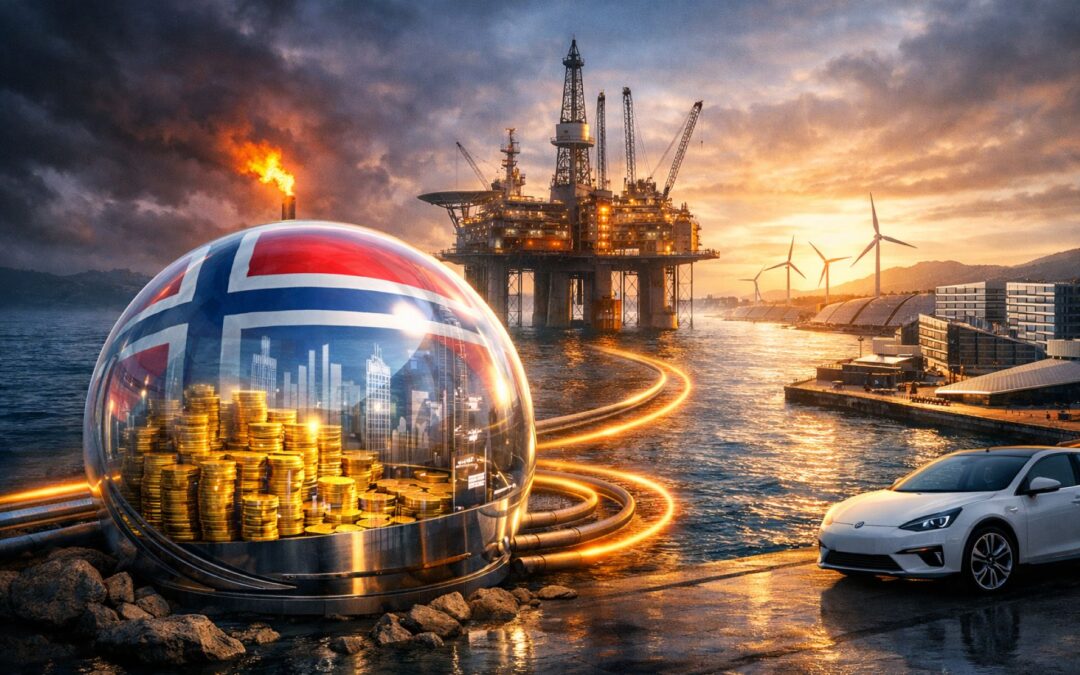
In October 1969, a drilling crew in the North Sea made a discovery that would permanently alter the trajectory of an entire nation. After years of unsuccessful exploration, the Ekofisk oil field revealed a vast reserve beneath the Norwegian continental shelf. What began as a reluctant final drill by an American oil company soon became one of the most consequential discoveries in modern economic history.
At the time, Norway was hardly a global powerhouse. For centuries it had been one of the poorer countries in Scandinavia, reliant on fishing, timber, shipping, and small-scale industry. Its rugged geography and small domestic market limited industrial development, and even by the mid-20th century Norway lagged behind neighbors like Sweden and Denmark in income and productivity.
Oil changed everything.
Within a few decades, Norway transformed from a peripheral European economy into one of the richest countries on Earth. Today, it ranks among the world’s wealthiest nations in income per capita, boasts one of the largest sovereign wealth funds ever created, and maintains one of the most generous welfare states in the developed world. Its vast Government Pension Fund Global—often called the “Oil Fund”—has accumulated nearly two trillion dollars in assets, representing hundreds of thousands of dollars for every Norwegian citizen.
Yet the story of Norway’s prosperity is more complicated than it first appears. While the country is frequently celebrated as a model of economic management and social welfare, much of its success rests on an extraordinary combination of natural resources, fortunate timing, and disciplined governance. Oil revenues funded prosperity, but they also reshaped the structure of the economy in ways that may prove difficult to sustain in a future less dependent on fossil fuels.
Norway avoided the classic “resource curse” that has plagued many oil-rich nations, but it may have created a different challenge altogether: an economy so comfortable that it never felt compelled to diversify.
The result is a paradox. Norway is simultaneously one of the most successful economic experiments of the modern era—and a country whose future may be more uncertain than its immense wealth suggests.
From Europe’s Poor Periphery to an Energy Superpower
Norway Before Oil: A Peripheral Economy
For much of its history, Norway sat on the economic margins of Europe. Its mountainous terrain, harsh climate, and scattered population made large-scale agriculture difficult, while its small domestic market limited industrial development. Unlike Sweden, which built major industrial firms, or Denmark, which developed a powerful agricultural export sector, Norway remained largely dependent on natural resources.
Fishing was the backbone of the economy for centuries, particularly cod from the cold waters of the North Atlantic. Timber exports also played an important role, as Norway’s vast forests supplied shipbuilding industries across Europe. Later, shipping emerged as another pillar of economic activity. Norwegian sailors and shipping companies became prominent in global trade during the 19th and early 20th centuries.
Even so, these industries produced only modest wealth. By the mid-20th century, Norway remained the poorest of the Scandinavian countries. Its GDP per capita lagged behind both Sweden and Denmark, and much of the population still lived in rural areas.
Industrialization arrived slowly. Hydropower provided a key advantage, allowing Norway to develop energy-intensive industries such as aluminum and fertilizer production. Yet the country still lacked the diversified industrial base that characterized other developed economies.
In short, Norway entered the 1960s as a relatively small, resource-dependent economy with limited global influence.
The Accidental Discovery That Changed Everything
The turning point came not from a grand national strategy but from a mix of persistence, international cooperation, and sheer luck.
During the 1960s, several countries bordering the North Sea began exploring the possibility of offshore oil. The Netherlands had already discovered major gas reserves, which encouraged neighboring states to examine their own continental shelves. Norway, however, was skeptical. Geological surveys had suggested that the North Sea was unlikely to contain significant oil deposits.
Nevertheless, Norway agreed to negotiate maritime boundaries with the United Kingdom and Denmark in 1965, using the “median line” principle that divided offshore territories evenly between neighboring countries. At the time, this agreement seemed routine.
In hindsight, it was one of the most consequential decisions in Norway’s history.
When exploration began, foreign oil companies carried out most of the work because Norway lacked the technology and expertise required for offshore drilling. For several years, exploratory wells produced little success. By the late 1960s, some companies were ready to abandon the effort entirely.
Then came the final drill.
In October 1969, Phillips Petroleum struck oil at the Ekofisk field. The discovery turned out to be massive—one of the largest ever found in the North Sea. Suddenly, Norway was sitting on billions of barrels of recoverable oil.
And Ekofisk was only the beginning.
Over the following decade, a series of enormous fields were discovered, including Statfjord, Gullfaks, Oseberg, and Troll. Together, these discoveries transformed Norway into one of the world’s major exporters of both oil and natural gas.
What had once been a modest Scandinavian economy had stumbled upon a geological jackpot.
But discovering oil is one thing. Managing it wisely is another.
Designing the “Norwegian Model” of Resource Management
Resource Nationalism Without Expropriation
When Norway discovered oil in the North Sea, it faced a dilemma that many resource-rich countries encounter. The country had enormous reserves beneath its waters, but it lacked the expertise, technology, and capital needed to extract them.
Instead of attempting to build an oil industry from scratch—or allowing foreign companies to control everything—Norway chose a middle path.
The government opened the sector to international oil companies that possessed the necessary drilling technology, but it established strict rules to ensure that the nation retained ultimate ownership of the resources. Oil companies could explore and profit from extraction, but the petroleum itself remained the property of the Norwegian state.
This framework became the foundation of Norway’s resource management system.
Licensing agreements allowed foreign companies to participate in exploration while requiring them to share profits through royalties and taxes. The state also maintained significant oversight over development decisions, ensuring that oil production aligned with national interests rather than purely corporate ones.
Crucially, this system avoided the mistakes that plagued many other resource-rich countries. Norway did not nationalize foreign companies outright, nor did it surrender control of its natural resources. Instead, it built a cooperative model in which private companies provided expertise while the state captured a substantial share of the value.
Building a State Energy Champion
To further strengthen national control over the petroleum sector, the Norwegian government created its own oil company in 1972: Statoil.
The goal was simple. If Norway was going to become a major energy producer, it needed domestic expertise and institutions capable of competing with the world’s largest oil companies.
Statoil quickly became the centerpiece of Norway’s energy strategy. Through partnerships with international firms, Norwegian engineers and managers gained experience in offshore drilling, reservoir management, and energy infrastructure. Over time, the company expanded its capabilities and took on a larger role in operating major fields.
Today, the company—now known as Equinor—is responsible for the majority of Norway’s oil and gas production. Although it operates as a commercial enterprise and is partially publicly traded, the Norwegian government remains the majority shareholder.
This arrangement allows Norway to benefit not only from taxes and royalties but also from direct ownership of a profitable global energy company.
Heavy Taxation and Public Ownership
Norway also ensured that oil wealth flowed into public finances rather than remaining concentrated in private hands.
The petroleum sector is subject to some of the highest tax rates in the world. Oil companies operating in Norway face a combined tax burden that can exceed 70 percent when corporate taxes and special petroleum taxes are included.
At first glance, such high taxes might appear discouraging to investment. But the scale of Norway’s reserves and the stability of its regulatory environment have kept the sector highly attractive to global energy firms.
For the Norwegian state, the result has been extraordinary revenue.
Oil taxes, royalties, and dividends from state ownership generate massive income streams that have flowed into public coffers for decades. These revenues not only financed public spending but also enabled Norway to create one of the most remarkable financial institutions ever built.
The sovereign wealth fund that would eventually redefine how nations manage natural resource wealth.
The Oil Fund: Turning Fossil Wealth Into Financial Wealth
The Creation of the Government Pension Fund Global
By the early 1990s, Norway faced an unusual challenge. Oil revenues were pouring into government coffers at a scale the country had never experienced before. While this sudden wealth created enormous opportunities, it also carried serious risks.
Economists warned about the so-called “Dutch disease,” a phenomenon in which resource booms cause currency appreciation, inflate domestic costs, and weaken other sectors of the economy. Countries that spend resource revenues too quickly often find themselves trapped in cycles of boom and bust once commodity prices fall.
Norway’s solution was remarkably simple but extremely disciplined: save most of the money instead of spending it.
In 1990, the Norwegian government established the Government Petroleum Fund, later renamed the Government Pension Fund Global. The purpose of the fund was to convert temporary oil revenues into long-term financial wealth that could benefit future generations.
Instead of allowing oil money to flood the domestic economy, Norway invested the majority of its petroleum revenues abroad in global financial markets. This strategy prevented excessive inflation at home while allowing the country to accumulate assets around the world.
Over time, the fund evolved into a massive portfolio containing investments in thousands of companies across dozens of countries. It holds equities, bonds, and real estate in markets spanning nearly every major economy.
In effect, Norway transformed underground oil reserves into a diversified global financial empire.
The Fiscal Rule: Protecting Wealth for Future Generations
Creating the fund was only the first step. The Norwegian government also introduced strict rules governing how much of that wealth could be used each year.
The most important of these is known as the fiscal rule.
Under this policy, the government is allowed to withdraw only the expected long-term real return of the fund, estimated at roughly 3 percent annually. The principal itself cannot be spent. This ensures that the core wealth remains intact and continues generating income for future generations.
The rule acts as a political guardrail. It prevents governments from dramatically increasing spending during oil booms and helps stabilize the economy during downturns.
In practical terms, this means that even though Norway possesses immense financial resources, its leaders cannot simply tap into the fund whenever they want. Spending remains tied to the sustainable returns generated by the investments.
This structure has helped Norway avoid the fiscal instability that has plagued many other resource-rich countries.
The Largest Sovereign Wealth Fund on Earth
Over the decades, disciplined management and steady inflows of oil revenues have transformed the Norwegian fund into the largest sovereign wealth fund in the world.
Today, it holds nearly two trillion dollars in assets, making it larger than the combined sovereign funds of many other energy exporters. On a per-capita basis, the wealth is staggering—equivalent to hundreds of thousands of dollars for every Norwegian citizen.
The fund now owns small stakes in thousands of companies globally, from technology giants in the United States to industrial firms in Europe and Asia. In many cases, it is one of the largest institutional investors in the world’s biggest corporations.
This global diversification serves a critical purpose.
As Norway’s oil reserves eventually decline and fossil fuels become less central to the global economy, the country will still possess a vast pool of financial assets capable of generating income for decades.
In theory, the oil fund allows Norway to convert a temporary resource boom into permanent national wealth.
But even a two-trillion-dollar safety net cannot fully shield an economy from deeper structural challenges.
Building One of the World’s Most Generous Welfare States
Education, Healthcare, and Social Protection
The enormous revenues generated by Norway’s oil and gas sector did not simply accumulate in financial markets. A significant portion of the returns from this wealth has been used to finance one of the most expansive welfare systems in the developed world.
Public services in Norway are both extensive and highly subsidized. Healthcare is universal, funded largely through taxation and public spending. Higher education is free, and students do not face the kind of tuition burdens that are common in many other developed countries. The government also provides generous parental leave, unemployment benefits, disability support, and pensions.
These programs form the backbone of Norway’s social contract.
Norway spends substantially more on social protection than many comparable economies. Disability and sickness benefits, for example, are among the highest in the OECD. Education spending is also extremely high. Norway spends roughly $20,000 per student annually, placing it among the top spenders in the developed world.
The underlying logic is straightforward. Natural resource wealth, when properly managed, can be transformed into broad-based public goods that improve quality of life for the entire population.
In Norway’s case, this philosophy has translated into a comprehensive system designed to reduce economic insecurity and promote social mobility.
High Living Standards and Low Inequality
The results of this model are visible across a wide range of social and economic indicators.
Norway consistently ranks near the top of global indices measuring human development, life satisfaction, and overall quality of life. Income inequality remains relatively low compared to many advanced economies, and poverty rates are among the lowest in the world.
Public infrastructure is well maintained, education is widely accessible, and citizens enjoy strong social protections that cushion economic shocks. Combined with high wages and stable employment, these policies have helped produce one of the highest standards of living on the planet.
Oil wealth played a crucial role in making this system possible.
The petroleum sector generates massive revenues through taxes, state ownership, and dividends from energy companies such as Equinor. These revenues ultimately flow into public finances, allowing the government to maintain extensive social programs without imposing unsustainable debt burdens.
In effect, Norway managed to convert natural resource wealth into a broad social safety net that benefits nearly every citizen.
But the very success of this system also raises an uncomfortable question.
What happens when an economy becomes so prosperous and stable that it no longer feels the urgency to evolve?
The Structural Weakness Beneath the Wealth
A Dangerous Export Concentration
For all of Norway’s success, one fundamental characteristic of its economy has remained remarkably unchanged: its dependence on natural resources.
Oil and gas dominate Norway’s export economy to an extraordinary degree. In recent years, fossil fuels have accounted for more than 60 percent of the total value of the country’s exports. No other sector comes close.
The remaining exports are relatively small by comparison. Seafood—primarily salmon and cod—makes up a single-digit share of exports. Machinery, aluminum, and other industrial goods contribute modestly but remain far behind the petroleum sector.
In other words, Norway’s economy may be wealthy, but it is not particularly diversified.
This level of concentration creates long-term vulnerability. Commodity markets are notoriously volatile, and global demand for fossil fuels is expected to decline gradually as the world transitions toward cleaner energy sources.
While Norway still possesses large reserves and remains one of Europe’s most important energy suppliers, the dominance of oil and gas raises a critical question about the country’s future economic structure.
The Absence of Industrial Diversification
Perhaps the most surprising feature of Norway’s economy is how little it diversified during decades of extraordinary prosperity.
Countries that experience resource windfalls often attempt to use those revenues to build new industries—manufacturing hubs, advanced technology sectors, or large innovation ecosystems. Norway, however, pursued a different path.
Rather than aggressively expanding industrial capacity, the country largely relied on the petroleum sector to drive economic growth while allowing other sectors to develop more slowly.
This stands in stark contrast to Norway’s Scandinavian neighbors.
Sweden produced globally dominant companies such as IKEA, Ericsson, Volvo, and Spotify. Denmark built strong pharmaceutical and industrial giants like Novo Nordisk and Maersk. Finland developed globally recognized technology firms including Nokia.
Norway, despite its immense wealth, produced relatively few globally competitive firms outside the energy and shipping industries.
The country’s ten largest companies are also remarkably old, with an average age approaching two centuries. While this longevity reflects stability, it also hints at a lack of industrial renewal.
Cheap Energy Without Industrialization
This lack of diversification is even more puzzling given Norway’s energy advantages.
Nearly 95 percent of the country’s electricity comes from hydropower, making it one of the cleanest and cheapest electricity systems in the world. In theory, such abundant energy should provide a major competitive advantage for energy-intensive industries such as manufacturing, data centers, or advanced materials production.
Yet Norway never fully developed into a major industrial hub.
Instead, much of the economy remained anchored around natural resources and services tied to the petroleum sector. Oil wealth provided high wages and stable employment, reducing the pressure to build new industries that might otherwise have emerged.
In many ways, Norway avoided the worst aspects of the resource curse—but it may also have avoided the productive tension that forces economies to constantly reinvent themselves.
And over time, that comfort can create a different kind of risk: complacency.
Productivity, Innovation, and the Complacency Problem
The Illusion of High Productivity
At first glance, Norway appears to be one of the most productive economies in the world. Measured by output per hour worked, the country consistently ranks near the very top among developed nations.
But these statistics can be misleading.
Oil and gas production generates enormous value with relatively small workforces. A single offshore platform employing a few hundred workers can produce billions of dollars in output each year. When this activity is included in national productivity calculations, it dramatically raises the overall numbers.
Remove the petroleum sector from the equation, however, and the picture changes considerably.
Without oil and gas, Norway’s productivity levels look much closer to those of other developed economies—and in some cases fall below them. Compared to innovation-driven economies like the United States or even neighboring Nordic countries, Norway’s non-oil sectors appear far less dynamic.
In other words, the country’s impressive productivity statistics are partly an illusion created by the extraordinary profitability of its energy industry.
Weak Startup and Venture Capital Ecosystems
Another sign of limited economic dynamism is the relative weakness of Norway’s startup ecosystem.
While venture capital investment and technology startups have surged across much of the developed world, Norway has lagged behind many comparable economies. Startup formation has remained relatively modest, and venture capital investment trails that of neighboring countries such as Sweden, Denmark, and Finland.
This contrast is particularly striking within Scandinavia.
Sweden, with a population roughly twice that of Norway, has produced globally recognized technology companies such as Spotify, Klarna, and Skype. Finland and Denmark have also cultivated vibrant innovation ecosystems supported by strong venture capital networks and research institutions.
Norway, despite being wealthier on a per-capita basis, has generated far fewer internationally competitive technology firms.
Part of the explanation may lie in the country’s economic structure. High wages, generous social benefits, and a strong public sector create stability—but they can also reduce the incentives and risk tolerance that drive entrepreneurial activity.
Underinvestment in Research and Development
The innovation gap becomes even clearer when looking at research spending.
Norway invests roughly 1.5 percent of its GDP in research and development, significantly below many advanced economies. By comparison, Sweden spends more than 3 percent of GDP on R&D, while Denmark and Finland also maintain substantially higher levels of investment.
These differences matter.
Research and development is often the foundation of long-term economic transformation. Countries that invest heavily in scientific research, technology development, and innovation ecosystems tend to produce the industries that drive future growth.
Norway’s relatively low R&D spending suggests that the country has not prioritized building the technological foundations for a post-oil economy.
For now, the immense revenues generated by fossil fuels make this less urgent. But over the long term, a lack of innovation investment could limit Norway’s ability to develop new industries capable of replacing the wealth generated by oil and gas.
When Wealth Creates Complacency
Fewer Working Hours and a Comfortable Economy
Prosperity changes incentives.
In Norway’s case, decades of resource wealth have created one of the most comfortable economic environments in the world. Wages are high, public services are extensive, and the welfare system provides a strong safety net against economic hardship. While these outcomes represent genuine social achievements, they can also subtly reshape the behavior of workers and institutions.
Norway has some of the shortest working hours in the OECD. Generous vacation policies, shorter workweeks, and extensive social protections are widely valued by citizens and reflect the country’s emphasis on quality of life rather than relentless productivity.
From a social perspective, this model works remarkably well. Norwegians enjoy high levels of life satisfaction, strong work-life balance, and relatively low levels of economic anxiety.
But economically, the incentives are different from those found in more competitive environments.
When wages are already high and public benefits are generous, the pressure to work longer hours, take entrepreneurial risks, or push for rapid industrial expansion becomes less urgent. Many people simply choose stability over ambition, which is entirely rational in such a prosperous environment.
Over time, however, this comfort can reduce the dynamism that drives economic transformation.
Aging Companies and Slow Industrial Renewal
Another symptom of this economic stability is the age of Norway’s largest companies.
The country’s ten largest firms have an average age approaching 170 years, an extraordinary figure in a global economy defined by rapid technological disruption and industrial turnover. Many of these companies originated in traditional industries such as shipping, energy, or natural resources.
Longevity is not necessarily a weakness—many successful companies endure for decades or even centuries. But when an entire corporate landscape becomes dominated by very old firms, it can signal a lack of renewal.
In more dynamic economies, new companies regularly displace older ones, introducing new technologies and business models that reshape entire industries. Norway, by contrast, has experienced relatively limited turnover among its largest corporations.
The oil sector helps explain part of this phenomenon. As long as petroleum continues to generate enormous revenues, the incentive to radically restructure the economy remains weak.
This does not mean Norway is stagnating. Rather, it suggests that the country’s economic evolution has slowed. Wealth has created stability—and stability, in turn, has reduced the urgency to innovate.
For now, the system works. But the longer an economy relies on past successes, the harder it becomes to adapt when the underlying conditions begin to change.
Housing Distortions in a High-Tax Economy
Tax Structures That Favor Property Investment
Norway is known for its high-tax economic model. Income taxes are substantial, corporate taxes are significant, and the country also maintains one of the highest value-added taxes in the developed world. Nearly every form of economic activity—from consumption to corporate profits—faces meaningful taxation.
But there is one notable exception.
The sale of a primary residence in Norway is largely exempt from capital gains taxation. This creates a powerful incentive for households to invest in housing rather than in other forms of capital such as businesses, startups, or financial assets.
When most economic activities are heavily taxed but housing is not, the result is predictable. Investors, families, and even ordinary households increasingly channel their savings into property.
This dynamic becomes even stronger in an economy like Norway’s, where high incomes and strong social protections provide households with both the resources and the confidence to take on large mortgages.
Over time, housing becomes not just a place to live, but one of the most attractive investment vehicles in the entire economy.
Rising Housing Prices and Household Debt
These incentives have contributed to a striking trend in Norway’s housing market.
Over the past decade, housing construction has declined while home prices have risen sharply. Since the mid-2010s, housing starts have steadily fallen even as property values increased dramatically.
Unlike the housing booms seen in cities such as London, Vancouver, or Sydney, foreign investment has not been the primary driver of Norway’s price increases. The country’s population growth has also been relatively modest compared to many other developed economies.
Instead, the housing boom appears to be driven largely by domestic financial dynamics: high incomes, favorable tax treatment, and limited alternative investment opportunities.
The consequences are increasingly visible.
Household debt in Norway has climbed to more than 200 percent of disposable income, among the highest levels in the world. Much of this debt is tied directly to mortgages and property investments.
For now, this situation remains manageable thanks to strong employment, high wages, and the enormous financial cushion provided by Norway’s sovereign wealth fund.
But the housing market illustrates a broader theme within the Norwegian economy. When a country becomes extremely wealthy and stable, capital often flows toward the safest and most predictable assets—rather than toward new industries or productive risk-taking.
The Coming Post-Oil Challenge
Global Energy Transition and Long-Term Demand Risks
For now, Norway remains one of the most important energy exporters in the world. Its oil and gas fields continue to generate enormous revenues, and Europe—especially after the disruption of Russian energy supplies—has become increasingly dependent on Norwegian natural gas.
But the long-term outlook for fossil fuels is changing.
Governments across the world are pushing policies aimed at reducing carbon emissions, expanding renewable energy, and electrifying transportation systems. While oil and gas will likely remain part of the global energy mix for decades, the long-term direction is clear: the global economy is gradually shifting away from fossil fuels.
For countries whose wealth depends heavily on hydrocarbons, this transition introduces uncertainty.
Norway faces a particularly interesting dilemma. Domestically, it is one of the greenest energy systems in the world—nearly all of its electricity comes from renewable hydropower. At the same time, the country continues to expand oil and gas exploration, even offering new drilling licenses in Arctic regions.
From a purely economic perspective, the strategy makes sense. As long as global demand for energy remains high, Norway can continue exporting fossil fuels while investing the profits into its sovereign wealth fund.
Yet the question remains: how long will this window last?
If global energy demand begins to shift faster than expected, Norway could face declining revenues from the very industry that has powered its prosperity for half a century.
Hidden Dependence on Oil Revenues
Official government statistics often emphasize that Norway’s national budget is mostly funded by non-oil revenues. At first glance, this suggests that the country has already reduced its dependence on petroleum income.
But the reality is more complicated.
A large share of Norway’s economy—particularly its highest-paying jobs—is directly or indirectly connected to the oil and gas sector. Engineers, offshore workers, service companies, equipment manufacturers, and logistics firms all form part of the broader petroleum ecosystem.
Even when these workers pay income taxes or spend money in the domestic economy, those revenues are typically classified as “non-oil” in official statistics.
In practice, however, much of this economic activity still originates from the petroleum sector.
Nearly 10 percent of private employment in Norway is tied directly to oil and gas, and the wages in this sector are among the highest in the country. As these workers spend their incomes on housing, consumer goods, and services, they generate tax revenues that appear unrelated to oil—but would likely shrink if the petroleum sector declined.
In other words, Norway’s dependence on fossil fuels may be deeper than it initially appears.
For now, the sovereign wealth fund provides an enormous financial buffer. But the structure of the domestic economy still reflects the central role that oil has played in shaping Norway’s prosperity.
A Second Resource Windfall?
The Discovery of Massive Phosphate Deposits
Just when it seemed Norway could not possibly become any luckier, another geological surprise appeared.
In recent years, geologists discovered that Norway may be sitting on one of the largest phosphate deposits in the world. Initial estimates suggested that the deposit could contain as much as 70 billion tons of phosphate-bearing rock, potentially making it the largest known reserve of its kind on the planet.
The timing of this discovery is striking.
Phosphate is a critical raw material used in fertilizers, batteries, and renewable energy technologies such as solar panels and electric vehicles. As the global economy shifts toward electrification and sustainable agriculture, demand for phosphate and related minerals is expected to rise significantly.
Early estimates suggested the deposit could be worth trillions of dollars if fully exploitable—an astonishing figure even by the standards of Norway’s resource wealth.
Once again, Norway appeared to have stumbled upon a geological jackpot.
Environmental Politics and Mining Resistance
But unlike the discovery of oil in the late 1960s, the political response to this new resource has been far more complicated.
Environmental concerns play a much larger role in modern Norwegian politics. Mining large phosphate deposits would involve significant industrial development, potential ecological disruption, and difficult trade-offs between economic opportunity and environmental protection.
As a result, the path toward developing these resources is uncertain.
Some estimates suggest that only a small fraction of the total deposit—perhaps around two billion tons—is currently economically recoverable using existing technology. This dramatically reduces the potential value of the resource compared to the earliest projections.
Even that limited extraction, however, remains politically contested. Environmental groups and several political parties have expressed skepticism about large-scale mining projects, arguing that the ecological costs could outweigh the economic benefits.
In fact, political negotiations have already slowed the approval process for new mining permits, illustrating how resource development in modern Norway faces far more scrutiny than it did during the early days of the oil industry.
This contrast reveals something important about the country’s economic evolution.
Half a century ago, oil represented opportunity and national transformation. Today, new resource discoveries raise questions about sustainability, environmental responsibility, and long-term economic strategy.
Whether Norway chooses to develop its phosphate reserves or leave them largely untouched will depend not only on economics, but also on how the country balances prosperity with environmental values.
Why the “Norwegian Model” Is Hard to Replicate
The Role of Extraordinary Natural Resources
Norway is frequently held up as an economic model. Politicians, economists, and commentators around the world often point to the country as proof that a prosperous welfare state can coexist with a highly successful capitalist economy.
But replicating Norway’s success is far more difficult than these comparisons suggest.
The most obvious reason is geography and geology. Norway sits on an unusually rich combination of natural resources. Its continental shelf contains vast oil and gas reserves. Its rivers generate enormous hydroelectric power. Its surrounding waters are among the most productive fishing grounds in the world.
Few countries possess such a diverse and valuable collection of natural advantages.
Even within the group of energy exporters, Norway stands out. Many oil-rich nations are authoritarian regimes or suffer from corruption and political instability. Norway, by contrast, discovered its petroleum resources after it had already built strong democratic institutions, a capable bureaucracy, and a relatively transparent political system.
This institutional foundation played a crucial role in ensuring that resource wealth benefited the broader population rather than a small political elite.
Strong Institutions and Democratic Governance
Norway’s success also reflects the strength of its political institutions.
When oil was discovered in the late 1960s, the country already had decades of experience managing public resources through democratic governance. Political parties, civil servants, and economic planners worked together to design policies that would capture petroleum revenues for public benefit while maintaining long-term fiscal discipline.
The creation of the sovereign wealth fund, strict taxation of oil companies, and limits on government spending were all products of deliberate institutional design.
These policies prevented many of the problems commonly associated with resource booms, such as runaway government spending, corruption, and economic instability.
In this sense, Norway demonstrates that natural resource wealth does not inevitably lead to economic mismanagement.
But it also shows how rare the necessary conditions are.
The Importance of Historical Luck
Even with strong institutions, Norway’s trajectory still depended heavily on timing and luck.
The country discovered its oil reserves at a moment when offshore drilling technology was becoming viable and global energy demand was rising rapidly. It negotiated favorable maritime boundaries that placed major oil fields within Norwegian territory. And it benefited from decades of relatively stable oil prices that generated enormous revenues.
Had any of these factors played out differently, Norway’s economic story might look very different today.
This combination of natural resources, institutional strength, and fortunate timing is difficult—if not impossible—for most countries to replicate.
The Norwegian model, in other words, is less a universal blueprint and more a historical anomaly.
Conclusion
Norway’s economic transformation is one of the most remarkable success stories of the modern era. In the span of just a few decades, a relatively modest Scandinavian economy was transformed into one of the wealthiest nations on Earth. Oil and gas discoveries beneath the North Sea provided the initial spark, but it was the country’s disciplined management of those resources that ultimately turned geological luck into lasting prosperity.
Few countries have handled resource wealth as effectively. Norway captured an extraordinary share of petroleum revenues through taxation and state ownership, invested those earnings into the world’s largest sovereign wealth fund, and used the returns to support one of the most generous welfare systems ever created. At the same time, strict fiscal rules prevented the kind of reckless spending that has undermined many other resource-rich economies.
Yet Norway’s success also reveals the limits of economic models built on exceptional circumstances.
The country’s prosperity rests on a rare combination of factors: vast natural resources, strong democratic institutions, and decades of fortunate timing in global energy markets. These advantages allowed Norway to avoid the classic “resource curse,” but they also reduced the pressure to diversify the economy in ways that many other advanced countries have been forced to do.
As the world gradually transitions away from fossil fuels, that lack of diversification could become more visible. Innovation investment remains relatively modest, industrial renewal has been slow, and large parts of the economy remain directly or indirectly tied to the petroleum sector.
For now, Norway’s enormous sovereign wealth fund provides an unprecedented financial cushion. The country has more resources saved for the future than almost any nation in history.
But even a two-trillion-dollar safety net cannot entirely remove the need for economic adaptation.
The true test of Norway’s model may not lie in how well it managed its oil wealth—but in how successfully it builds an economy that can thrive long after that oil is gone.