
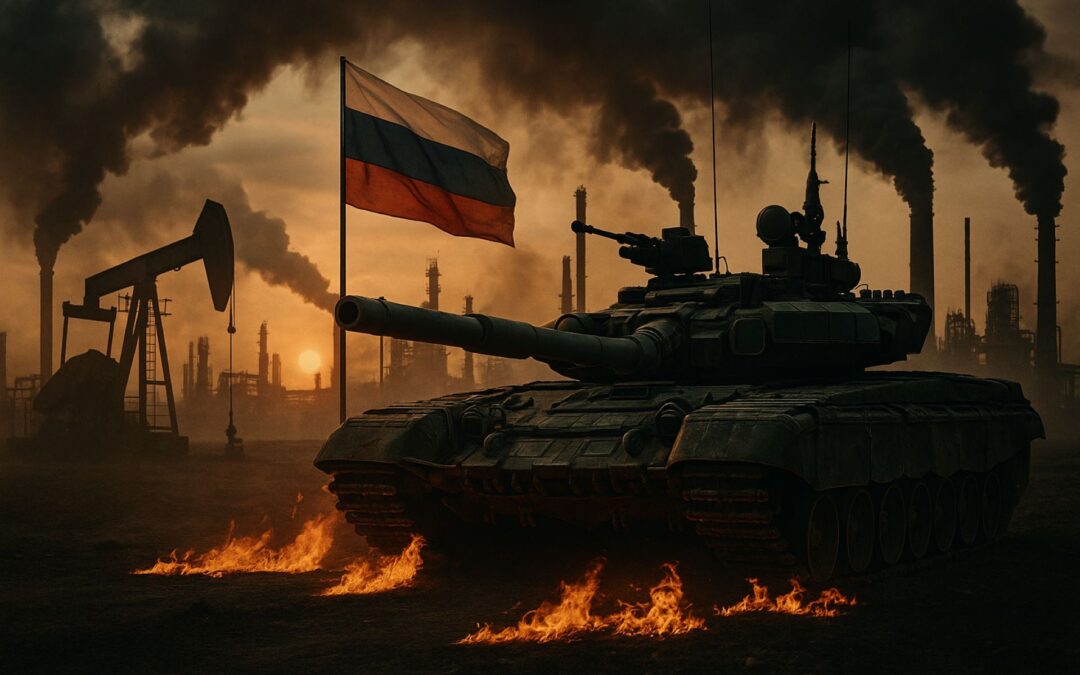
On February 24, 2022, Vladimir Putin unleashed the largest conflict Europe had seen since World War Two, ordering a full-scale invasion of Ukraine. Russian airstrikes bombarded cities, and the West responded swiftly with sweeping sanctions targeting Russia’s economy. Banks were cut off from global finance, critical goods were banned, and efforts to choke off Russian oil and gas sales were initiated.
Policymakers predicted an imminent economic collapse and a quick Russian defeat. Yet, two years later, that collapse never came. Russia appeared to defy expectations, even prospering while Europe struggled. But the illusion is fading. Russia’s economy is running out of steam—and the war machine’s fuel tank is nearing empty.
Russia’s Post-Soviet Struggles and Putin’s Rise
The collapse of the Soviet Union in 1991 did more than redraw the map of Eastern Europe—it ripped apart the very economic and social fabric of Russia. The transition from a centrally planned, command economy to an open-market system was brutal and chaotic, unlike anything the country had ever experienced. The institutions that once guaranteed employment, social welfare, and industrial output vanished almost overnight, leaving millions adrift in a sea of uncertainty.
Mikhail Gorbachev’s reforms, like perestroika and glasnost, were initially intended to modernize the Soviet system and integrate it with the global economy. He imagined a new chapter in Russian history where openness and cooperation would replace isolation and ideological rigidity. Yet, these ideals collided with the harsh realities of dismantling an entrenched, bureaucratic state apparatus.
Under Boris Yeltsin, Russia embarked on “shock therapy” — a rapid, wholesale liberalization of prices, privatization of state assets, and withdrawal of state controls. This economic jolt was intended to kick-start growth, but instead it produced an unprecedented economic meltdown. Industrial output plunged by nearly 50%, and GDP contracted sharply. Inflation skyrocketed, wiping out savings and destabilizing livelihoods.
The privatization process disproportionately benefited a small clique of politically connected insiders who rapidly amassed vast fortunes, becoming the infamous oligarchs. These magnates controlled vital sectors of the economy, wielding power often intertwined with corruption and political patronage. Meanwhile, ordinary Russians endured soaring unemployment, poverty, and a collapse of public services.
Crime flourished amid weakened law enforcement, and life expectancy dropped as healthcare systems faltered. Public trust in the government and economic system eroded. The 1990s became a decade of hardship and fragmentation, with social cohesion fraying under the pressure of inequality and disillusionment.
By the end of the decade, Yeltsin’s physical and mental health were failing, and his erratic leadership left Russia politically unstable and economically vulnerable. His resignation in 1999 opened the door for Vladimir Putin, a former KGB officer who projected strength, order, and stability—qualities desperately needed to halt Russia’s downward spiral.
Putin’s ascent coincided with a global commodity boom, especially in oil and natural gas prices. Between 1998 and 2008, the price of crude oil quintupled, transforming Russia’s resource wealth into a powerful engine of economic revival. This windfall allowed Putin to rebuild state institutions, reassert control over key industries, and increase social spending, lifting millions out of poverty and fostering a fragile but palpable sense of renewal.
Putin’s leadership was marked by a pragmatic nationalism that sought to restore Russia’s stature on the world stage. His consolidation of political power, crackdown on oligarchs who defied Kremlin interests, and emphasis on energy exports as geopolitical tools set the stage for a new era. Yet, this revival was precarious, dependent heavily on volatile commodity prices and a political model that traded openness for centralized authority.
The Fossil Fuel Foundation of Russia’s Economy and Military Ambitions
Russia’s immense endowment of natural resources forms the lifeblood of its economy and, critically, its geopolitical strategy. Among its treasures are the world’s largest proven natural gas reserves, vast coal fields, and deposits of uranium, nickel, gold, diamonds, and other strategic minerals. This extraordinary resource base gives Russia a unique position in global commodity markets, as well as leverage in international affairs.
Before the invasion of Ukraine in 2022, the Russian economy was heavily reliant on these commodities. Fossil fuels—oil, natural gas, and coal—accounted for roughly one-fifth of Russia’s GDP, nearly a third of federal government revenues, and an astonishing 50% of all exports. This reliance on energy exports meant that Russia’s fiscal health was intricately tied to global commodity prices and demand, especially from Europe and Asia.
This resource wealth provided Moscow with the financial muscle to sustain a robust military budget. Post-Soviet Russia had suffered from underfunded armed forces, aging equipment, and diminished global influence. But the commodity boom reversed much of this decline. Increased revenues enabled massive investments in military modernization programs, acquisition of advanced weapons systems, and expansion of Russia’s strategic capabilities.
Crucially, the energy sector was not only an economic engine but a cornerstone of Russia’s geopolitical ambitions. By locking European countries into long-term energy dependencies, Moscow sought to create economic entanglements that would deter political opposition or punitive measures in response to its foreign policy moves.
These long-term gas contracts created what many analysts describe as a form of “energy leverage.” The logic was simple: if Europe’s heating, electricity, and industrial sectors depended heavily on Russian gas, then Moscow would hold significant sway over European policy decisions. This dependency was meant to act as a buffer against sanctions or military retaliation.
However, this dependence came with risks. It left Russia vulnerable to shifts in global energy markets and to efforts by Western nations to diversify energy sources and reduce reliance on Russian supplies. Moreover, the economy’s overconcentration on extractive industries meant underinvestment in other sectors, limiting diversification and innovation.
From a military perspective, resource revenues funded the resurgence of the Russian armed forces, enabling the Kremlin to pursue assertive foreign policies, including the annexation of Crimea and the invasion of Ukraine. Energy wealth underwrote the costs of sustained military operations, from troop mobilization and equipment production to strategic deployments and advanced weaponry.
Yet, this foundation is not inexhaustible. Commodity price volatility, sanctions, and shifting geopolitical alliances increasingly threaten the sustainability of Russia’s resource-dependent model. The ability to leverage natural wealth for military and political power now faces significant headwinds, setting the stage for complex challenges ahead.
The Complex Interdependency with Europe
Europe and Russia have been bound by a complex and often uneasy energy relationship for decades, one that goes far beyond simple buyer-seller dynamics. Before the 2022 invasion of Ukraine, Russia supplied approximately 45% of Europe’s natural gas imports, weaving a dense web of economic interdependence. This was not accidental but a deliberate strategic calculus by Moscow, aimed at anchoring its influence over the continent through vital energy lifelines.
Natural gas pipelines crisscrossing the continent served as arteries connecting Russian fields to European homes, factories, and power plants. The Nord Stream pipelines under the Baltic Sea, the Yamal-Europe pipeline through Belarus and Poland, and numerous land routes created an infrastructure that tied Europe’s energy security tightly to Russian exports. European nations, particularly Germany, Italy, and France, came to rely heavily on these supplies to meet heating demands and industrial needs, especially in winter months.
Moscow’s strategy was to embed itself deeply within Europe’s economic fabric, making the cost of conflict or harsh sanctions prohibitively high for European nations. This economic interlock was designed as a deterrent: the logic being that Europe’s dependence would temper political and military responses to Russian aggression. It was a form of “mutually assured economic interdependence” that Moscow hoped would shield it from punitive backlash.
However, the eruption of war in Ukraine shattered this delicate balance. Western governments imposed an unprecedented array of sanctions targeting Russian banks, technology imports, and key industries. They also sought to drastically reduce reliance on Russian energy—a task easier said than done.
Europe’s energy transition was and remains incomplete. Alternatives to Russian gas, such as liquefied natural gas (LNG) from the United States or Qatar, require infrastructure expansion and often come at higher costs. Renewable energy capacity, though growing, cannot yet fully compensate for the sudden loss of Russian supplies. As a result, despite political outrage, Russian fossil fuel exports to the EU dropped only around 8% post-invasion.
In 2024, Russia’s fossil fuel exports to Europe totaled €21.9 billion, surpassing the €18.7 billion in aid the EU provided to Ukraine. This stark figure underscores the persistent economic entanglement. European industries and households, faced with soaring energy prices and supply uncertainties, have struggled to wean themselves off Russian fuel quickly.
This dependency gave Russia a significant advantage: consistent cash flows from European energy sales helped fund Moscow’s military operations in Ukraine. It also complicated Western unity, as some countries resisted rapid decoupling due to economic and social pressures.
The interdependency revealed a painful irony: the very economic ties meant to secure peace and influence became a financial lifeline for war, demonstrating the limits of energy as leverage and the deep vulnerabilities inherent in globalization.
The Facade of Economic Strength and Domestic Control
On the surface, Russia’s economy between 2022 and 2024 appeared surprisingly robust given the scale of sanctions and geopolitical upheaval. Official statistics showed a GDP growth rate of 3.6%, a remarkable feat compared to the Eurozone’s sluggish 0.5%. Russian cities buzzed with activity: markets stocked with goods, streets deemed safe, and consumer confidence seemingly intact.
This image was a carefully crafted narrative promoted by the Kremlin and amplified by state-controlled media. Putin’s government portrayed Russia as a resilient fortress defying Western attempts at isolation. The messaging was clear: external enemies were attacking, but Russia stood united, prosperous, and ready to overcome.
This façade was vital for domestic stability. Public support for Putin and the war hinged heavily on perceptions of economic well-being. Rising wages and consumer availability of goods cushioned popular opinion, allowing the government to claim success despite mounting international condemnation.
However, this picture was deceptive. The apparent growth was largely fueled by extraordinary government intervention and war-related expenditures rather than sustainable market-driven activity. Massive state spending on defense and industrial output inflated GDP figures, masking underlying weaknesses.
Inflationary pressures, labor shortages, and capital flight were quietly eroding the civilian economy. Consumer sectors outside energy and defense struggled with supply chain disruptions and dwindling investment. Many businesses faced rising costs and shrinking margins as resources funneled toward the war effort.
Moreover, data transparency issues and political pressures to maintain a positive outlook meant that official figures likely underrepresented economic hardship. Regional disparities deepened, with rural areas and smaller cities experiencing stagnation and decline, contrasting sharply with urban centers.
In reality, the so-called prosperity was a brittle veneer—an artificial construct propped up by state resources, commodity revenues, and a controlled media environment. The dissonance between official narratives and everyday experiences foreshadowed growing cracks beneath the surface.
The War Strategy Miscalculation and Stalemate in Ukraine
Putin’s 2022 invasion was predicated on a fundamental misjudgment of Ukraine’s resolve and the West’s reaction. He envisaged a swift, surgical campaign that would dismantle Ukraine’s pro-Western government and reinstall a Moscow-friendly regime within weeks. The plan even included symbolic gestures like a victory parade on Kyiv’s streets—a stark testament to the confidence, or hubris, behind the strategy.
Historically, Putin had leveraged such swift military actions to reassert Russia’s influence. The 2008 invasion of Georgia saw Russian forces rapidly seize key towns and install separatist regimes with little international pushback. Similarly, the 2014 annexation of Crimea unfolded with relative ease and limited consequences.
But Ukraine proved a very different adversary. Bolstered by strong national identity, military modernization, and widespread public support, Ukrainian forces mounted a fierce defense. Western governments provided significant military aid, intelligence, and training, enabling Kyiv to resist initial assaults effectively.
Russian troops, expecting quick victories, found themselves trapped in protracted trench warfare in eastern Ukraine. Hundreds of tanks were destroyed, and soldiers faced relentless attacks from drones, artillery, and counteroffensives. The logistical challenges of a drawn-out conflict strained Russia’s supply chains and morale.
Unlike previous conflicts where Russia’s military might went largely unchallenged, this war evolved into a grinding stalemate. The West’s rapid imposition of sanctions and military assistance to Ukraine created a multi-front challenge for Moscow, blending battlefield attrition with economic warfare.
This miscalculation forced Putin into a war of attrition, requiring sustained funding, mobilization, and political control to continue a campaign far longer and costlier than anticipated. It revealed the limitations of Russia’s military capabilities and strategic assumptions, setting the stage for the economic and political strains that would soon follow.
The Russian Government’s Economic Response to War
Confronted with the shock of a protracted conflict and aggressive Western sanctions, the Russian government swiftly implemented a series of measures to stabilize the economy and sustain the war effort. The immediate challenge was to prevent a collapse of the financial system, maintain currency stability, and ensure continuous funding for military operations.
Within days of the invasion, the Central Bank of Russia enacted an emergency hike in its key policy interest rate, driving it from already elevated levels up to an unprecedented 20%. This aggressive rate increase aimed to staunch capital flight, attract foreign currency inflows, and prop up the ruble’s value. The move was a high-risk maneuver, balancing between controlling inflationary pressures and avoiding strangulation of domestic credit markets.
Simultaneously, the government flooded the economy with liquidity through expansive fiscal spending. Massive injections of cash were directed toward the defense sector, enabling military manufacturers to ramp up production of ammunition, armored vehicles, and other critical materiel. State-owned enterprises received preferential lending and direct subsidies, creating a war-focused industrial boom.
Military expenditure surged dramatically, rising by approximately 64% in the first year of conflict, with the government’s overall spending increasing by over 50%. This financial commitment underscored the Kremlin’s determination to sustain the campaign regardless of cost.
Banking institutions were instructed to prioritize loans to defense contractors and related industries, often at below-market interest rates. As a result, corporate debt swelled by 71% since mid-2022, reflecting the credit-fueled expansion of Russia’s war machine.
Factories that had languished in previous years expanded production lines, reopening or building new facilities dedicated to producing tank tracks, shells, bullets, and other military essentials. This surge in industrial activity buoyed headline economic growth figures, creating a wartime boom that contrasted starkly with the civilian economic malaise developing elsewhere.
Yet, this approach came at a steep price. The war-induced stimulus fueled inflationary pressures, distorted resource allocation, and crowded out non-military sectors. It was a classic example of wartime economic mobilization: impressive output in defense-related industries juxtaposed against growing stagnation and hardship in the broader economy.
Inflation and Labor Market Strains
The aggressive fiscal and monetary policies designed to sustain the war effort inevitably triggered severe inflationary pressures across the Russian economy. By 2024, consumer price inflation had surged to approximately 9.5%, reflecting both demand-side and supply-side dynamics.
Central to this inflation was a wage-price spiral, where rising labor costs fed into higher prices, which in turn drove demands for yet higher wages. The war exerted acute pressure on the labor market: hundreds of thousands of working-age men were conscripted into military service, significantly reducing the civilian labor pool.
This labor scarcity intensified competition for workers between civilian industries and the military-industrial complex, driving wages upwards. Real wages increased by about 9%, but this nominal improvement masked underlying economic distortions and rising living costs.
Businesses outside defense sectors faced mounting difficulties. Labor shortages made recruitment and retention challenging, forcing companies to raise wages beyond sustainable levels. These rising costs were often passed onto consumers, fueling further inflation.
The Central Bank of Russia’s response was to hike interest rates once again, pushing the policy rate to an extraordinary 22%. This level was far above comparable benchmarks: for context, the European Central Bank maintained rates around 2%, while China’s prime lending rates hovered between 3% and 3.5%.
While these sky-high interest rates helped stabilize the ruble and rein in some inflationary momentum, they also had a chilling effect on economic growth. Higher borrowing costs discouraged consumer spending and business investment, exacerbating economic contraction outside the defense sphere.
The labor market imbalance also precipitated structural challenges. The exodus of young, skilled workers—particularly in technology and innovation sectors—further strained productivity and long-term growth potential. The emigration of as many as one million professionals since the war’s onset deepened the talent deficit, threatening Russia’s capacity to modernize and compete globally.
Civilian Economy in Decline
As the military-industrial complex consumed increasing shares of capital and labor, the civilian economy showed signs of sustained contraction and decline. The reallocation of resources toward defense production and the government’s wartime priorities squeezed non-military industries, triggering a growing recession in the broader economy.
Industrial output outside of the defense sector fell by approximately 1.6% in the first quarter of 2025. Key manufacturing segments, such as motor vehicles and household appliances, experienced sharp declines. Production of motor vehicles and consumer electronics dropped by nearly 30% between 2021 and 2024, emblematic of the wider industrial downturn.
Sanctions and export restrictions devastated foreign demand for non-energy Russian goods, closing off key markets and severing supply chains. These external shocks compounded internal challenges of rising production costs and labor shortages.
The war’s financial demands created a “crowding out” effect in credit markets. Businesses outside defense found it increasingly difficult to secure affordable loans, as banks prioritized lending to state-backed military enterprises. Elevated interest rates further dampened borrowing and investment, reducing opportunities for innovation and expansion.
Moreover, the widening gap between wages in defense industries and civilian sectors distorted labor markets. Many businesses struggled to compete with government-supported entities offering higher pay, leading to a depletion of skilled workers and erosion of managerial talent in non-military fields.
The combination of sanctions, resource reallocation, inflation, and labor market distortions has led to a bifurcated economy: a hyperactive war production engine running at full capacity, alongside a shrinking and increasingly fragile civilian sector facing recessionary pressures.
This economic imbalance poses long-term risks. Without a diversified and growing civilian economy, Russia’s capacity for sustainable development and societal well-being is severely compromised. The continued focus on war production may prolong conflict in the short term but risks deepening economic decline and social strain in the years ahead.
Russia’s Natural Resources: Lifeline and Liability
Russia’s vast natural resource wealth remains the bedrock of its economy, providing crucial revenue streams that have so far insulated it from the full brunt of Western sanctions. The country’s enormous reserves of oil, natural gas, coal, uranium, and precious metals grant it an outsized role in global commodity markets. This resource abundance has functioned as a financial lifeline for the Kremlin, especially amid escalating geopolitical isolation.
Despite concerted international efforts to limit Russia’s energy exports—such as price caps on oil and bans on shipping insurance—Moscow has skillfully navigated around these barriers. A key tactic has been redirecting discounted crude oil and refined products toward emerging markets, particularly India and China.
India’s imports of Russian crude oil have surged dramatically since the start of the Ukraine war, increasing by roughly tenfold. This shift has made India the largest single buyer of Russian oil globally, attracted by significant price discounts that help offset higher shipping and logistical costs. Meanwhile, China remains Russia’s most important energy customer, purchasing over 108 million tons of Russian crude in 2024, making Russia the country’s top crude oil supplier.
These growing Asian markets have partially compensated for the loss of European buyers, bolstered by rising global energy prices driven by geopolitical tensions, supply constraints, and market volatility. Consequently, Russia’s fossil fuel export revenues soared by approximately 34% during the first year of conflict, reaching an estimated $407 billion.
However, this heavy reliance on fossil fuel exports also exposes Russia to significant risks and vulnerabilities. The country’s federal budget and economic planning depend heavily on oil prices averaging around $70 per barrel—a benchmark used to forecast revenues and allocate expenditures. Recent downward trends in global oil prices threaten to erode this fiscal foundation, with Urals crude futures dipping toward $55 per barrel, well below budgetary assumptions.
Moreover, natural gas exports, a critical component of Russia’s energy portfolio, face mounting challenges. The shutdown of the last direct gas pipeline supplying Europe in early 2025 has resulted in an estimated $4.5 billion annual revenue loss. The much-anticipated Power of Siberia 2 pipeline, intended to dramatically expand Russian gas exports to China, has stalled, making negligible progress and failing to offset declines in traditional markets.
In sum, while Russia’s natural resource wealth has been a vital economic pillar, it simultaneously acts as a double-edged sword—providing immediate fiscal relief but binding the country’s fortunes to volatile global commodity markets and increasingly constrained export routes.
The Shrinking National Wealth Fund and Fiscal Constraints
Russia’s National Wealth Fund (NWF), established as a sovereign savings account to stabilize the economy during periods of fiscal stress, is rapidly depleting, raising serious concerns about the Kremlin’s financial resilience in the coming years.
As of recent reports, the liquid portion of the NWF—the funds immediately available for government use—has declined to approximately $36.4 billion, the lowest level observed since 2019. This depletion reflects the government’s increased reliance on the fund to plug budget deficits caused by declining energy revenues, sanctions-induced economic contraction, and rising military expenditures.
Economists warn that if current spending patterns and revenue trends persist, the NWF’s liquid assets could be exhausted by as early as next year. The exhaustion of this fiscal buffer would strip the government of a critical tool for deficit financing and debt servicing, forcing a painful fiscal adjustment or increased borrowing in a heavily sanctioned environment.
The shrinking fund heightens the Kremlin’s vulnerability to external shocks, limiting its ability to smooth out economic fluctuations or respond flexibly to unexpected expenses. It also constrains long-term investment in infrastructure, social programs, and economic diversification efforts, which are vital for Russia’s future development.
Without sufficient reserves, the government faces mounting pressure to balance competing priorities: sustaining the costly military campaign, maintaining social spending to uphold public support, and stabilizing the domestic economy. These conflicting demands pose a profound challenge, with potentially destabilizing consequences if the government fails to manage fiscal discipline effectively.
In this context, the depletion of the NWF signals not just a temporary fiscal strain but a broader structural problem—Russia’s economic model, overly reliant on energy exports and war-driven spending, is proving unsustainable in the face of prolonged conflict and international isolation.
The Long-Term Implications for Putin and Russia
In the short term, Vladimir Putin remains resolute in his strategic objective: victory in Ukraine at almost any cost. Moscow possesses sufficient economic resources, military capabilities, and political control mechanisms to endure the immediate pressures of war and sanctions. The Kremlin’s focus is on maintaining domestic stability, controlling the narrative, and suppressing dissent while continuing the military campaign.
However, the long-term prospects for both Putin and Russia are far more uncertain and precarious. Putin’s political legitimacy has historically been tied to two pillars: stability and improving living standards. For much of his tenure, rising incomes and steady economic growth bolstered his approval ratings and quelled social unrest.
The ongoing economic slowdown threatens to unravel this fragile social contract. As the civilian economy contracts, inflation eats into purchasing power, and skilled workers emigrate, ordinary Russians may grow increasingly disillusioned with the costs of prolonged conflict. The promise of prosperity and stability that underpinned Putin’s rule is eroding.
Moreover, a protracted recession and declining real wages could fuel social unrest, regional disparities, and challenges to the Kremlin’s centralized authority. The widening divide between the privileged military-industrial complex and the broader population exacerbates social tensions.
On the international stage, Russia’s economic isolation, declining investment, and technological stagnation jeopardize its long-term competitiveness and influence. The Kremlin’s ability to project power globally depends heavily on sustainable economic foundations—a capability increasingly compromised.
In essence, Putin’s war machine is running out of economic fuel. While he may sustain the conflict for now, the accumulating fiscal, social, and geopolitical pressures foreshadow a challenging future. The facade of strength risks crumbling, exposing vulnerabilities that could reshape Russia’s domestic trajectory and geopolitical posture in the years to come.