
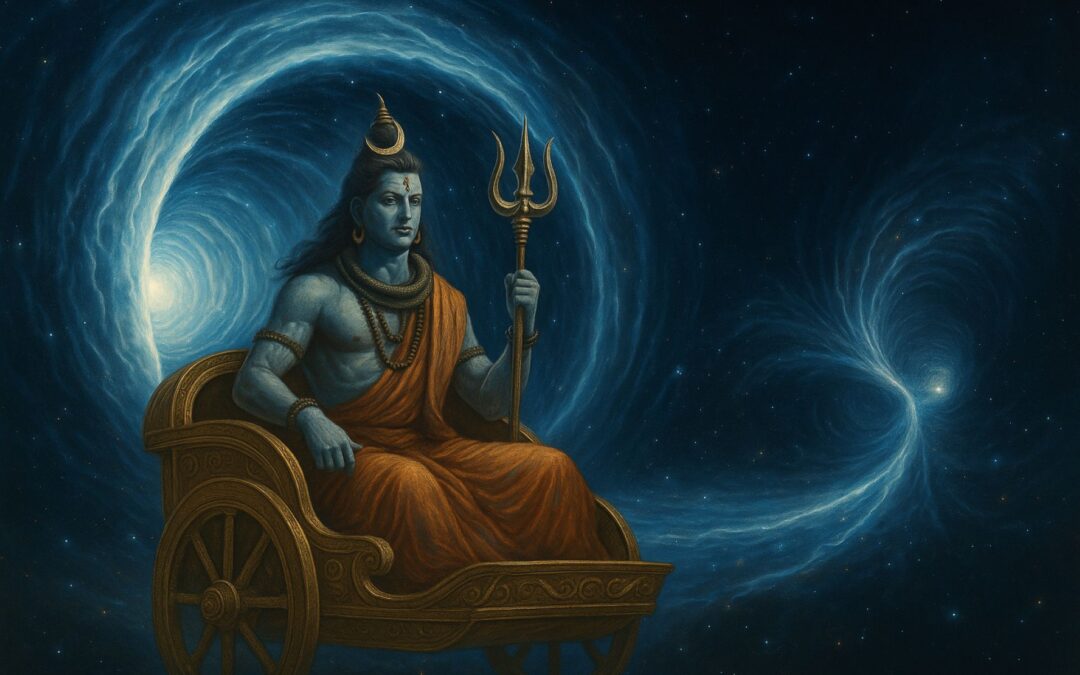
The idea that gods and divine beings travel between worlds through cosmic pathways is an ancient belief that spans numerous cultures and mythologies. But what if these descriptions weren’t merely allegorical? What if they were more closely aligned with modern scientific theories, particularly the concept of wormholes?
Ancient Hindu texts, particularly the Mahabharata, describe divine journeys that seem remarkably similar to what modern physics refers to as wormholes—bridges that connect distant parts of space-time. Could it be that the gods of ancient India understood the cosmos in ways that modern science is only beginning to explore?
The Celestial Pathways of the Gods
The Mahabharata and other ancient Hindu texts provide fascinating accounts of gods journeying between different realms of existence, utilizing celestial pathways. The most striking of these accounts involves Arjuna’s journey to the realm of Indra, the king of the gods, which takes place in an otherworldly chariot. However, what stands out about this story is not the destination itself but the manner in which the chariot travels. Instead of moving slowly through physical space, as we would expect with traditional travel, the chariot moves through a “pathway of the stars”—an instantaneous journey between realms.
This description seems to echo modern scientific theories about wormholes, which suggest that space-time can be bent or folded, creating shortcuts between distant points. Arjuna’s rapid travel through the stars—without time seeming to pass in between—parallels the idea that such cosmic doorways exist. Wormholes, according to theoretical physics, are “shortcuts” that connect two distant points in space-time, allowing matter to traverse these vast distances in the blink of an eye. In the Mahabharata, the gods’ ability to travel instantly between realms suggests a profound understanding of space and time, one that transcends the knowledge of ancient humanity.
Moreover, this concept of “pathways of the stars” could also allude to the ancient understanding that the universe is not simply a collection of stars and planets, but a vast network of interconnected cosmic energies. This fits with modern models that propose that the fabric of space-time itself is not rigid but dynamic and can be manipulated. The divine chariot might then be a symbolic representation of the technology—or perhaps spiritual knowledge—that allows access to these shortcuts between dimensions.
The Concept of Cosmic Shortcuts: Wormholes and Akash
The Hindu concept of Akash offers a profound insight into how ancient sages might have understood the nature of space. The term Akash refers to the sky or ether, but its meaning in Hindu cosmology goes much deeper. It represents an energetic field that connects all things in the universe, not as a vacuum or empty space, but as a dynamic, interwoven fabric. This aligns closely with the modern concept of space-time, which is considered by physicists to be a flexible and interconnected medium.
Ancient texts describe Akash as something that could be manipulated by those with the knowledge to do so, allowing for instantaneous travel across vast distances. This idea is in stark contrast to the empty, inert space that was traditionally thought to exist between celestial bodies. Rather, Akash is portrayed as an active, living force—a fundamental medium through which all things are connected. The sages believed that by understanding the properties of Akash, they could manipulate space itself, folding it to allow for travel between distant points in the universe.
This understanding parallels the concept of wormholes in modern physics, where space-time can be manipulated or “folded” to connect two distant regions. In both the ancient and modern contexts, space is not static but can be altered, enabling the rapid travel of matter and energy. The idea that ancient sages were aware of this energetic, foldable nature of space—and could potentially have tapped into it—suggests a level of understanding far ahead of its time. The concept of Akash thus serves as a precursor to the modern understanding of space-time as a dynamic, malleable entity.
The Pushpak Vimana and Divine Aircraft
The Pushpak Vimana, described in the Ramayana, is one of the most iconic symbols of divine technology in Hindu mythology. This celestial aircraft is said to have the ability to travel as fast as thought itself, meaning it could cover vast distances almost instantaneously. Unlike conventional vehicles that must traverse physical space, the Pushpak Vimana moves through what can be interpreted as a higher-dimensional space—potentially a wormhole or a cosmic tunnel that bypasses the limitations of traditional space travel.
The most striking feature of the Pushpak Vimana is that it didn’t travel across physical space the way modern aircraft or even spacecraft would. Instead, it moved through “doorways in the fabric of reality,” bypassing the distances between locations. This is an essential detail because, in modern theoretical physics, wormholes are often proposed as “shortcuts” through space-time that allow for faster-than-light travel. These “doorways” in the Pushpak Vimana description could, in essence, be the ancient’s way of describing the concept of wormholes—pathways that transcend the normal constraints of physical space.
The aircraft’s description suggests an advanced form of technology, but it could also be seen as a representation of spiritual or metaphysical knowledge. This interpretation implies that the gods were not simply using physical vehicles but had access to knowledge that allowed them to navigate space in ways that defy modern understanding. Just as wormholes could theoretically allow instantaneous travel across vast distances, the Pushpak Vimana may be a metaphor for the divine ability to traverse dimensions or fold space-time, suggesting an ancient understanding of the universe that is echoed in contemporary physics.
Cosmic Junctions and Divine Pathways
Hindu cosmology, with its 14 dimensions or realms, offers a complex and fascinating view of the universe. These realms are not isolated but interconnected, with certain points acting as “cosmic junctions” where the boundaries between worlds are thin and permeable. These junctions are described in the ancient texts as places where the veil between different planes of existence becomes nearly transparent, allowing for easier travel between realms.
These cosmic junctions resemble the concept of wormholes, where two separate points in space-time are linked by a tunnel or bridge. The texts describe these junctions as places of great cosmic significance—locations where divine beings could pass between different realms of existence. This notion aligns with modern theories that suggest wormholes might exist as natural features of the universe, formed when gravitational forces cause space-time to warp.
The ability of the gods to access these cosmic junctions and travel between realms points to an understanding of space-time that goes beyond the conventional. The idea that the universe is composed of multiple dimensions, and that these dimensions are interconnected through specific pathways, mirrors the theoretical models of wormholes in modern physics. Just as scientists are exploring the possibility of finding or creating wormholes to connect distant regions of space, ancient sages may have been documenting their knowledge of such cosmic pathways.
Gods Appearing in Multiple Locations
In Hindu mythology, gods often appear in multiple places at once, demonstrating their ability to be omnipresent across different realms and dimensions. This wasn’t viewed as a miraculous or magical feat but as a natural ability of those with the divine understanding of cosmic laws. In the Mahabharata, gods such as Vishnu and Shiva are shown interacting with multiple realities simultaneously, guiding warriors, protecting realms, and fulfilling their divine duties.
This ability to appear in multiple locations at once bears a striking resemblance to the quantum mechanical concept of superposition, where particles can exist in multiple states or locations simultaneously. In quantum physics, this phenomenon is part of the nature of particles at the subatomic level. The gods’ ability to be in several places at once in Hindu mythology could thus be seen as an allegorical reflection of quantum principles, suggesting that ancient sages may have had an intuitive understanding of phenomena that were not only beyond their time but are still being explored by modern scientists.
The description of divine beings occupying multiple spaces simultaneously also suggests an understanding of the universe as interconnected and non-linear, much like the way quantum mechanics operates. In this sense, the gods’ ability to occupy multiple realms could be seen as a reflection of the quantum nature of reality, where everything is interconnected, and events can unfold across various locations simultaneously, defying the traditional rules of space and time.
Lord Shiva’s Trident and Cosmic Distortions
Lord Shiva’s trident is a powerful symbol in Hinduism, representing his dominion over the three worlds: the heavens, the earth, and the underworld. However, in many ancient texts, the trident is also described as a cosmic tool capable of creating passages between these realms. When Shiva plunges his trident into the fabric of the cosmos, it is said to cause distortions in space-time—distortions that allow for travel between dimensions or realms of existence.
These distortions described in the texts sound eerily similar to the gravitational warping predicted by Einstein’s general theory of relativity, which suggests that massive objects—like black holes or other extreme gravitational phenomena—can warp the fabric of space-time, creating openings or wormholes. The idea that Shiva’s trident could open up temporary passages between worlds is a metaphorical representation of this process, suggesting that the divine trident may symbolize a form of cosmic technology that can manipulate space-time and create temporary connections between distant regions of the universe.
By creating these distortions, Shiva’s trident effectively represents a tool that can manipulate the very fabric of reality, much like the wormholes theorized in modern physics. This metaphorical understanding of Shiva’s power as it relates to cosmic distortions offers an intriguing connection between ancient iconography and contemporary scientific theories.
The Cosmic Form of Lord Krishna: A Vision of the Universe Within
In the Bhagavad Gita, Lord Krishna reveals his cosmic form to Arjuna, showing him that the entire universe exists within his body. This vision serves as a metaphor for the interconnectedness of all things within the universe, suggesting that every point in space is linked to every other point. Krishna’s revelation illustrates the idea that the universe is not composed of isolated objects and events, but is a unified, interwoven system, with each part of the universe influencing the others.
This vision mirrors modern scientific theories about space-time, which propose that the fabric of the universe is interconnected. According to Einstein’s theory of relativity, all events and objects in the universe are interconnected through the curvature of space-time. Krishna’s cosmic form—where all points in space are contained within his body—illustrates the idea that the universe is a single, cohesive entity, with everything connected to everything else.
The vision of Krishna’s cosmic form can also be seen as a symbolic representation of the universe’s interconnectedness, foreshadowing modern understandings of space-time as a unified whole. This idea that everything in the universe is connected resonates deeply with current scientific models, suggesting that ancient sages may have had an intuitive grasp of the cosmos that parallels modern physics’ understanding of space-time.
The Naval of the Universe: A Natural Doorway
In Hindu cosmology, the Naval of the Universe is described as a focal point where cosmic energy is concentrated, creating a natural doorway between different realms. These doorways, depicted in the Vedas and other ancient texts, are points of high energy where the barriers between worlds become thin, allowing gods and divine beings to pass between dimensions with ease. Modern physics proposes that extreme concentrations of energy—such as those found near black holes or in the vicinity of massive gravitational anomalies—could create micro-wormholes, small-scale versions of the cosmic shortcuts theorized in contemporary science.
The concept of the Naval represents a point of cosmic convergence, where the energies of the universe are concentrated and accessible. In this sense, it mirrors the scientific idea that certain regions of space-time could naturally lead to the formation of wormholes—gateways that allow for travel between distant regions of the universe. These ancient texts seem to describe what modern physics is beginning to hypothesize: that certain places in the universe, when they reach a high concentration of energy, can create natural openings or portals between dimensions, offering shortcuts through the fabric of space-time.
The repeated mention of the Naval in ancient texts suggests that these ancient sages were keenly aware of the underlying structure of the universe and the potential for energy to form doorways between different realms. The Naval serves as a symbolic precursor to modern theories of wormholes, suggesting that the ancients may have had access to knowledge that science is still working to understand.
Conclusion: Ancient Texts and Modern Physics—A Cosmic Convergence?
Ancient Hindu texts describe divine beings traveling through cosmic pathways, folding space to move between realms instantly. These descriptions, which appear in the Mahabharata, Vedas, and Puranas, bear a striking resemblance to modern theories of wormholes and space-time warping. From Arjuna’s journey to the realm of the gods to Lord Shiva’s trident creating passages between realms, these ancient narratives seem to align with modern scientific concepts, offering startling parallels that cannot easily be dismissed as mere coincidence.
Were the gods of ancient India using wormholes, or were the sages of those times somehow intuitively tapping into the cosmic principles that modern science is only now beginning to uncover? As we continue to delve into the mysteries of the universe, these ancient texts may hold the answers to questions that have eluded humanity for centuries. The journey to understanding the connection between ancient wisdom and modern science is just beginning.