
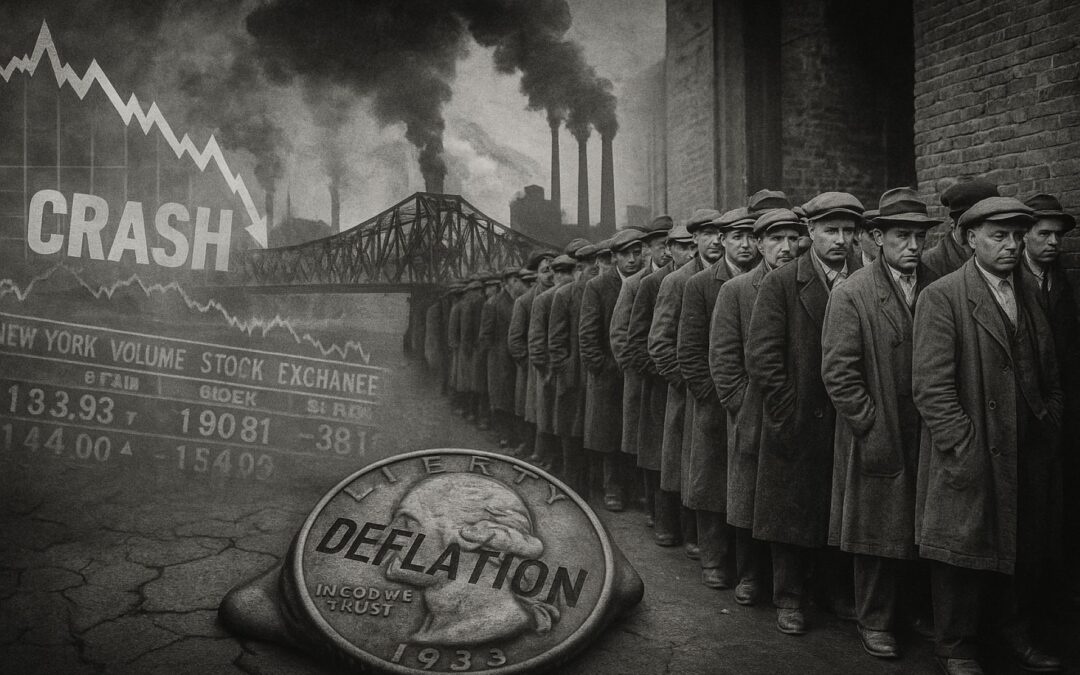
The Great Depression stands as the darkest economic chapter in modern history—a decade when the machinery of prosperity ground to a halt and the world collectively lost faith in its future. From the dazzling heights of the Roaring Twenties to the desolation of breadlines and bank runs, this was not just a financial collapse—it was a collapse of confidence, identity, and trust. Factories fell silent, savings vanished overnight, and entire nations were thrust into turmoil.
Yet, the story of the Great Depression is not merely about loss—it’s about revelation. It exposed the fragility of human systems built on speculation and greed, and it forced the world to rethink what stability, wealth, and progress truly mean. To understand how it happened is to understand the anatomy of modern capitalism itself: its brilliance, its blindness, and its breaking point.
The World Before the Fall
The aftermath of World War I was paradoxical—both ruinous and revolutionary. Across Europe, the war had left cities in rubble, treasuries empty, and millions of men dead or maimed. Yet in the United States, the war had acted as an accelerant. While the battlefields of France and Belgium were reduced to ash, America had become the arsenal of democracy—manufacturing weapons, ships, uniforms, and munitions for its allies. The war’s end didn’t slow this machinery; it merely redirected it. The industrial apparatus that had produced artillery shells now began turning out typewriters, radios, refrigerators, and cars.
For the first time in human history, ordinary people could buy mass-produced goods made by machines for the masses. Henry Ford’s assembly line, perfected with the Model T, didn’t just change the automobile industry—it changed the rhythm of modern life. It allowed workers to produce identical goods faster, at a fraction of the cost. What had once been luxuries became attainable symbols of progress. A car was no longer just a machine—it was mobility, freedom, status. A radio was no longer an elite novelty—it was a window to the world, a link between rural and urban life.
Economically, the world entered a new phase—what historians call the first wave of modern globalization. The British Empire still dominated trade routes, promoting free commerce across its colonies. The global system was neatly divided: resource-rich but industrially underdeveloped nations like those in Africa, Asia, and Latin America exported raw materials—rubber, coffee, cotton, minerals—while industrial powerhouses like Britain, Germany, and the United States refined them into finished goods. It was an elegant machine, so long as the gears kept turning.
And no gear spun faster than America’s. The war had turned the U.S. from a debtor nation into the world’s largest creditor. Its cities stood tall, its factories roared, and its optimism was infectious. In 1920, the United States produced nearly half of the world’s industrial output. With returning soldiers seeking work and women continuing to contribute to the workforce, the economy thrived. Infrastructure projects expanded cities, the automobile reshaped suburbs, and consumer credit unlocked desires that had long been financially out of reach. America was building not just wealth—but a culture of wanting.
The “Roaring Twenties” became synonymous with jazz, modernism, and indulgence. Speakeasies flourished under Prohibition, the stock market boomed, and advertising emerged as the new religion of capitalism. The message was intoxicating: buy now, pay later, and happiness will follow. Yet beneath the roaring confidence was a tremor—a widening gap between appearance and reality. Industrial growth was staggering, but it was also uneven. Farmers, crushed by falling crop prices after the war, were already slipping into debt. Europe, crippled by war reparations and economic exhaustion, could no longer buy American goods in the same quantities. The glittering skyscrapers of New York were built on credit and assumption—two forces as fragile as trust itself.
The 1920s world believed it had entered an age of permanent prosperity. It hadn’t realized it was standing on the edge of a cliff.
The Illusion of Endless Prosperity
By the mid-1920s, the American dream had become a financial hallucination. The economy seemed unstoppable—industrial output was climbing, wages were rising, and consumerism had woven itself into the national identity. But this prosperity was not built on productivity alone—it was built on credit. Easy money flooded the system. Banks lent freely, consumers borrowed eagerly, and corporations expanded recklessly. The average American family could now purchase what their parents never could—cars, radios, and electrical appliances—all bought on installment plans. The logic was simple: why wait to own when you could borrow your future today?
The newfound accessibility of consumer credit transformed society. It gave birth to the modern middle class and the illusion that everyone could live like the rich. Storefronts gleamed with promise; advertising agencies sold not just products but emotions—status, happiness, belonging. People began to equate material acquisition with success itself. It was no longer enough to live comfortably; one had to appear prosperous. This cultural shift set the tone for one of the most dangerous financial manias in history.
The stock market became the ultimate symbol of this illusion. As America’s factories expanded and profits grew, investors poured their savings into stocks, convinced that the good times would never end. Between 1921 and 1929, the Dow Jones Industrial Average skyrocketed from 63 points to 381—a nearly sixfold increase. Everyone wanted in. Teachers, farmers, taxi drivers—all suddenly transformed into amateur investors. Newspapers ran daily stock reports like sports scores, and owning shares became the new badge of modern sophistication.
But as the market surged, a darker mechanism was at play. Investors weren’t just buying stocks with their savings—they were buying with borrowed money. Margin trading allowed individuals to purchase stocks by putting down only a fraction of the cost, borrowing the rest from brokers. If the stock’s value rose, the profits were massive. If it fell, the losses were catastrophic. Yet few considered the latter. As long as prices climbed, everyone—borrower and lender alike—was making money. The system seemed infallible.
Behind the euphoria, however, the real economy was showing cracks. Productivity gains from industrialization were outpacing demand. Americans had already filled their homes with appliances and automobiles; they didn’t need more. Farmers were producing more crops than people could consume, driving prices down. In Europe, war debts and reparations crippled purchasing power. The United States was exporting optimism, but few could afford to buy it.
Still, Wall Street continued its irrational ascent, buoyed by the belief that markets only go up. Even as factory inventories piled up and consumer debt reached unprecedented levels, stock prices kept climbing. It was a speculative bubble—self-feeding, seductive, and utterly detached from reality. By 1929, 40% of all consumer borrowing was being used not to build homes or businesses—but to gamble on stocks. America was not investing in its future; it was betting it.
It’s easy to look back and see the delusion. But in the moment, it felt like destiny. The “New Era” economists of the day proclaimed that the business cycle had been conquered. Prosperity, they said, had become permanent. The illusion was complete—until the first whisper of doubt rippled through the market. Then, as history has shown time and again, confidence vanished faster than it had appeared.
The Crash That Shook the World
The collapse didn’t begin with a bang but with whispers—rumors that stocks were overpriced, that the feverish optimism had gone too far. A few cautious investors began to sell. Then, like a spark in dry grass, panic spread. On October 24, 1929—later immortalized as Black Thursday—eleven percent of the market’s value evaporated in a single trading day. The ticker tape couldn’t keep up with the pace of the decline; it ran hours behind, and traders on the floor had no real sense of how deep the losses were. Fear became contagious.
Five days later came Black Tuesday, October 29, 1929—the day confidence died. Over 16 million shares were traded, a record at the time. Prices collapsed completely. Fortunes built over decades were reduced to dust in hours. Bankers tried to stage interventions—J.P. Morgan and other financial leaders pooled millions to buy stocks and restore calm—but the psychology of the market had already broken. The public had seen the illusion crumble, and there was no restoring faith in it.
By mid-November, the stock market had lost half its value. Thousands of investors, many of them ordinary Americans who had poured their savings—or worse, borrowed money—into the market, were ruined. Some took their own lives. Others simply walked away from Wall Street and never returned. For those who had bought on margin, the fall was particularly devastating. They owed more to the banks than their stocks were now worth.
The banking system, too, began to unravel. Banks had lent recklessly to investors, using their deposits as collateral. When those investors defaulted, banks were left holding worthless paper. To make matters worse, depositors panicked and rushed to withdraw their money, fearing their bank would fail next. These “bank runs” were lethal. Because banks at the time kept only a fraction of deposits on hand, even a rumor of instability could destroy them. As lines of anxious customers formed outside, banks collapsed one by one.
Between 1930 and 1933, over 9,000 banks failed in the United States—nearly a third of the system. When a bank went under, there was no insurance, no safety net. Lifetimes of savings vanished overnight. The flow of credit—the lifeblood of the economy—dried up completely. Businesses couldn’t borrow to stay afloat, and individuals couldn’t borrow to buy homes or goods.
The financial crash triggered a chain reaction that reached far beyond Wall Street. Businesses dependent on loans couldn’t pay employees. Workers lost jobs, which meant fewer consumers to buy products. With declining sales, more businesses shut their doors, laying off even more workers. The collapse fed on itself. By 1932, the Dow Jones Industrial Average had fallen from its 1929 peak of 381 to just 41—an 89% decline. Nearly one in four Americans was unemployed. The optimism of the Roaring Twenties had turned into a nationwide reckoning.
Yet, the crash of 1929 was merely the opening act. What followed was a complete breakdown of trust—in money, in banks, in government, in the very system that had once promised endless prosperity.
The Anatomy of Deflation
When people talk about inflation, they think of rising prices. Deflation, on the other hand, is its sinister twin—prices fall, but so does everything else: wages, profits, confidence, and ultimately, hope. To the untrained eye, cheaper goods might seem like a blessing, but during the Great Depression, deflation was a death spiral.
The logic was cruelly simple. As prices fell, people postponed purchases. Why buy a car for $700 today when it might cost $500 next month? Businesses, desperate to attract buyers, slashed prices further. But lower prices meant shrinking profits, which forced companies to cut wages or fire workers. Those newly unemployed people, in turn, spent even less, worsening the problem. What started as a financial panic metastasized into an economic paralysis.
Factories that had once run 24-hour shifts to meet booming demand now sat silent. Machines were shut down, workers dismissed, and warehouses filled with unsold goods. The great industrial cities—Detroit, Chicago, Pittsburgh—became ghost towns of shuttered plants and empty streets. Farmers, too, were caught in the nightmare. Agricultural prices collapsed as consumers stopped spending. Wheat, corn, and cotton piled up with no buyers. In some places, crops were burned for fuel because they couldn’t fetch enough to cover the cost of harvesting.
Deflation also made debt unbearable. Every dollar owed became harder to repay because the value of money kept increasing. If a farmer borrowed $1,000 when wheat was selling at $1 per bushel, he needed 1,000 bushels to pay it back. But if wheat dropped to 50 cents a bushel, he now needed 2,000 bushels to settle the same debt. This simple arithmetic destroyed lives. Mortgages went unpaid, homes were foreclosed, and once-proud landowners became tenants or wanderers.
Even the banks that survived the initial crash were crippled. Loans went bad, reserves dried up, and the few depositors left hoarded cash rather than risk losing it again. Money, the lubricant of commerce, stopped moving. Economists called it a “liquidity trap”—when fear itself prevents money from circulating.
By 1932, prices in the United States had fallen nearly 25%. Industrial output had been cut in half. National income dropped by 42%. The economy was in cardiac arrest, and no one knew how to restart it. Traditional remedies—lower interest rates, balanced budgets, and free markets—were useless in a world where no one could afford to spend.
Worse still, the suffering was visible everywhere. Men stood in endless breadlines for a bowl of soup. Families huddled in shantytowns built from scrap metal and cardboard—places bitterly nicknamed “Hoovervilles,” after President Herbert Hoover, who had failed to prevent the collapse. Children scoured garbage dumps for food. The American dream, once radiant, now lay in ruins.
Deflation was more than an economic phenomenon—it was psychological. It changed how people thought, how they acted, and how they trusted. It taught an entire generation to fear risk, debt, and exuberance. Every dollar became sacred. Every purchase felt dangerous. The flow of life itself slowed to a crawl.
In that frozen world, confidence—the one element no government could print—became the rarest commodity of all. And until that confidence could be restored, recovery was impossible.
Government Missteps and a Failing Cure
When the economic engine sputtered and died, the U.S. government found itself paralyzed by outdated ideas. The prevailing wisdom of the time—rooted in classical economics—was that markets were self-correcting. If left alone, they would eventually balance themselves. The role of government, therefore, was to stay out of the way. It was a comforting theory, but it was disastrously wrong.
President Herbert Hoover embodied that philosophy. A successful businessman and humanitarian, Hoover initially believed the crisis was temporary—just another dip in the business cycle. He urged Americans to remain confident, promising that “prosperity is right around the corner.” But by the time he left office in 1933, unemployment had soared to nearly 25%, industrial production had fallen by half, and the banking system was in shambles.
In a desperate attempt to protect American jobs, Hoover signed the Smoot-Hawley Tariff Act of 1930—a decision that history now views as one of the most catastrophic economic blunders ever made. The Act raised import taxes on over 20,000 foreign goods by roughly 20%, under the misguided assumption that Americans would then buy domestic products instead. Instead, it triggered an international trade war.
Within months, 25 other nations retaliated by imposing tariffs on American exports. Global trade, which had been a vital artery of economic growth, collapsed by two-thirds. American factories that still relied on foreign buyers found themselves with warehouses full of unsold goods. Workers were laid off, further reducing domestic spending. The vicious cycle deepened.
At the same time, the U.S. remained bound to the gold standard, a monetary system that limited the amount of currency the government could issue. Every dollar in circulation had to be backed by an equivalent amount of gold held in reserve. This rigid rule might have seemed prudent in times of stability, but during a deflationary crisis, it was economic suicide. With prices falling and credit frozen, the government needed to inject liquidity—print money—to get the economy moving again. But the gold standard made that impossible.
As banks failed and deposits vanished, the money supply shrank by nearly a third between 1929 and 1933. In effect, the government was watching the economy bleed out while refusing to give it a transfusion. Even attempts to balance the federal budget—an obsession for Hoover—only made things worse. Tax increases and spending cuts, designed to restore fiscal discipline, drained what little purchasing power people still had.
By 1932, the country was collapsing not just economically but psychologically. Homeless families camped in city parks. Soup kitchens lined the streets. Farmers, desperate and broken, stormed foreclosure auctions to stop banks from seizing their land. Public trust in government evaporated. Hoover, once seen as a capable technocrat, was now reviled as indifferent to human suffering.
When Franklin D. Roosevelt took office in March 1933, he inherited a nation on its knees. The economy was barely breathing. The banking system had all but ceased to function. Roosevelt understood what Hoover did not: the Depression wasn’t just a financial problem—it was a crisis of confidence, and confidence could only be restored by bold, visible action. He promised “a new deal for the American people,” and for the first time in years, hope stirred.
The New Deal: Rebuilding a Shattered Nation
Roosevelt’s response was unlike anything the United States had ever seen. The New Deal wasn’t one program or policy—it was a sweeping reinvention of the relationship between government, business, and the people. It sought to address three urgent priorities: relief for the unemployed and poor, recovery of the economy, and reform of the financial system to prevent future collapses.
The first step was triage—stopping the bleeding. On his second day in office, Roosevelt declared a nationwide bank holiday, temporarily closing every bank in the country to halt the wave of panic withdrawals. During the closure, federal inspectors examined balance sheets to determine which banks were solvent. When the banks reopened days later, Roosevelt addressed the nation by radio—his first “Fireside Chat.” He explained that only stable banks would resume operations and urged citizens to trust the system again. It worked. Deposits began to flow back into banks instead of under mattresses.
Next, Roosevelt tackled the problem of liquidity by taking the U.S. off the gold standard, freeing the government to print more money and stimulate spending. With the shackles of gold removed, the Federal Reserve could expand the money supply and inject credit where it was needed most. The immediate effect was subtle but profound—prices stabilized, and deflation began to ease.
To combat mass unemployment, Roosevelt launched an unprecedented series of public works programs. The Civilian Conservation Corps (CCC) put young men to work building parks, roads, and forests. The Works Progress Administration (WPA) employed millions more in constructing bridges, schools, hospitals, and even artistic projects—murals, theaters, and libraries. These programs didn’t just create jobs; they gave people purpose and dignity in a time of despair.
At the same time, Roosevelt’s administration moved swiftly to reform the financial system. The Glass-Steagall Act separated commercial banking from investment banking to prevent speculation with depositors’ money. The Federal Deposit Insurance Corporation (FDIC) was established to guarantee deposits up to a certain amount, ensuring that no depositor would ever again lose their life savings to a bank failure. The Securities and Exchange Commission (SEC) was created to regulate Wall Street and enforce transparency in trading.
But Roosevelt’s most profound legacy lay in his social reforms. The Social Security Act of 1935 introduced a national safety net, providing pensions for the elderly and unemployment benefits for the jobless. The National Labor Relations Act empowered workers to unionize and bargain collectively, giving them a voice in a system that had long silenced them. Minimum wage laws, overtime pay, and child labor restrictions were implemented, reshaping the moral foundation of capitalism itself.
Critics at the time accused Roosevelt of socialism, but history would vindicate him. The New Deal didn’t end the Great Depression overnight—it took another decade and the industrial mobilization of World War II to fully restore the economy—but it rebuilt the architecture of trust. It restored faith in government, stabilized the financial system, and redefined the American social contract.
Perhaps most importantly, it changed how nations saw economic crises. Before the 1930s, recessions were viewed as natural storms to be weathered. After the New Deal, they were seen as challenges to be managed. Roosevelt proved that when capitalism collapses under its own weight, democracy can still step in to lift its people from the rubble.
The United States that emerged from the 1930s was not the same nation that had entered the decade. It was more cautious, more compassionate, and infinitely wiser—a country that had learned the hard way that prosperity without prudence is only an illusion waiting to shatter.
A Crisis Without Borders
The Great Depression did not respect borders, currencies, or ideologies. What began as an American financial collapse quickly metastasized into a global economic contagion. The interconnectedness that had once fueled prosperity now became a mechanism for shared suffering. The world economy of the 1920s was a delicate web—interdependent and overextended. When one strand snapped, the entire structure trembled.
By 1930, the United States was not only the world’s largest economy but also its primary lender. European nations, particularly Britain, France, and Germany, had borrowed heavily from American banks after World War I to rebuild their shattered economies and repay war debts. These debts, in turn, funded U.S. prosperity. When Wall Street crashed, that financial lifeline was severed overnight. American banks recalled foreign loans to stay solvent, leaving European borrowers bankrupt and desperate.
The results were catastrophic. In Britain, exports plummeted as global trade collapsed. Industrial centers in Northern England, Scotland, and Wales—once the engines of empire—fell silent. Unemployment soared past 20%, and hunger marches filled the streets. In France, agricultural prices nosedived, and small farmers—already burdened by debt—faced ruin. The country slipped into a long stagnation marked by political instability and social unrest.
Germany’s plight, however, was the most dire. The nation was still reeling from the economic chaos of the 1920s, when hyperinflation had rendered its currency worthless. The postwar reparations imposed by the Treaty of Versailles had crippled its finances, and its recovery depended almost entirely on American loans. When those loans evaporated, the German economy imploded. Factories closed, unemployment skyrocketed to nearly 30%, and despair spread like wildfire. This despair would soon find its voice in extremism.
The Nazi Party, once a fringe movement, began to thrive in the vacuum left by economic collapse. Adolf Hitler promised stability, jobs, and national pride to a humiliated people. By 1933, he had risen to power, transforming Germany’s economic suffering into political rage. The Great Depression didn’t just destroy wealth—it dismantled democracies and paved the way for authoritarianism.
Across the globe, the story was the same, though the symptoms varied. In Japan, exports of silk and textiles—its economic lifeblood—fell by more than 50%. Facing starvation and desperation, Japan turned inward, embracing militarism and imperial conquest. The invasion of Manchuria in 1931 marked the beginning of its expansionist path, one that would eventually ignite the Pacific front of World War II.
In Latin America, nations dependent on exporting commodities like coffee, sugar, and copper found their economies gutted. Brazil’s coffee prices collapsed so dramatically that the government began burning coffee beans for fuel just to reduce supply. In Chile, copper exports evaporated; in Argentina, beef shipments to Europe declined sharply. These nations, which had borrowed heavily during the boom years, now defaulted en masse, triggering waves of social upheaval and the rise of populist leaders.
The Depression also struck the colonial world. In Africa, raw material prices plunged, decimating economies built around European extraction. Workers in mines and plantations faced wage cuts or dismissal, intensifying resentment against colonial rule. In India, falling agricultural prices led to mass poverty and debt among peasants, further fueling the independence movement.
The collapse of world trade—down by two-thirds from 1929 to 1934—turned once-vibrant global markets into barren deserts. The same interconnected system that had spread prosperity now transmitted despair. It wasn’t just an American crisis anymore—it was a planetary reckoning.
And in its wake, the world began to fracture. Economic isolationism, nationalism, and protectionism spread like a virus. Nations built walls instead of bridges, tariffs instead of treaties. The spirit of cooperation that had briefly defined the 1920s gave way to fear, suspicion, and conflict.
By the late 1930s, the political consequences were irreversible. The Depression had not only rewritten economies but rewritten history itself. It created the conditions for the rise of fascism, the militarization of Japan, and ultimately the eruption of the Second World War.
The Great Depression did not merely reshape finance—it redrew the global map.
Lessons Etched in History
Out of the wreckage of the Great Depression came a new understanding of how fragile prosperity truly is. Before the 1930s, governments viewed the economy as a self-sustaining organism—a system that, left to its own devices, would heal itself. The crisis shattered that illusion. The world learned, often painfully, that unregulated capitalism could implode under its own excesses, and that in times of panic, markets are driven not by logic but by emotion.
The first lesson was about inflation and deflation. Economists discovered that a little inflation is not the enemy—it’s a sign of movement, of money circulating. Moderate inflation encourages spending and investment; deflation, by contrast, breeds paralysis. The obsession with keeping money “sound” through the gold standard had starved the global economy. Once the gold shackles were removed, flexibility returned, and recovery—slowly—became possible.
The second lesson was about government intervention. The Depression proved that in crises, governments cannot afford to be spectators. The policies of Roosevelt’s New Deal—and similar efforts in Britain and Scandinavia—showed that strategic government spending could reignite demand and create a safety net for citizens. This concept would later be codified into the economic philosophy of Keynesianism, named after British economist John Maynard Keynes. Keynes argued that during downturns, governments must spend when no one else can, stimulating consumption and preventing economic free fall.
The third lesson concerned regulation and oversight. The pre-Depression era had been one of reckless speculation and laissez-faire attitudes toward banking and markets. The reforms of the 1930s—the SEC, FDIC, and Glass-Steagall Act—established the guardrails that would prevent future collapses of similar magnitude for nearly a century. These weren’t mere bureaucratic measures; they were psychological ones, designed to restore public confidence.
But beyond policy and theory, the Depression’s most profound lessons were human. It revealed that recessions are not abstract numbers—they are lived realities. Behind every percentage point of unemployment were families losing homes, parents skipping meals, children growing up in poverty. The Depression redefined how societies saw poverty itself—not as a personal failure, but as a systemic collapse. Compassion became an economic principle.
The crisis also reshaped culture. The roaring exuberance of the 1920s gave way to an era of reflection, restraint, and realism. Art, music, and literature turned somber. Steinbeck’s The Grapes of Wrath and Dorothea Lange’s haunting photographs of Dust Bowl migrants captured not just suffering but endurance—the quiet dignity of survival.
On a global scale, the Depression led nations to rethink the balance between freedom and stability. Too much freedom in markets bred chaos; too much control bred tyranny. The postwar world would strive to find the middle path—building international institutions like the IMF, World Bank, and later the United Nations to ensure cooperation, stability, and shared prosperity.
Perhaps the greatest lesson of all was philosophical: prosperity is not permanent. It is a delicate equilibrium of trust, discipline, and shared responsibility. The Great Depression taught humanity that confidence is the true currency of civilization. Once it vanishes, no amount of gold can replace it.
When the world finally emerged from its long night—spurred by the industrial mobilization of World War II—it carried with it scars that would shape policy, politics, and psychology for generations. The Depression did not just change economies; it changed the way people thought about progress itself.
It reminded humanity that wealth without wisdom, growth without restraint, and ambition without empathy are the surest paths to collapse. And from that truth, modern economic civilization was reborn.
Conclusion
The Great Depression was more than an economic event—it was a reckoning that reshaped the moral and financial fabric of the modern world. It taught nations that markets are not self-sustaining machines but delicate ecosystems governed by confidence, cooperation, and regulation. It revealed that when wealth becomes untethered from reality, collapse is inevitable.
And yet, from the rubble emerged resilience—the courage to reform, rebuild, and reimagine society. Out of its despair came the foundations of modern economic policy, social security, and the belief that governments bear responsibility for their citizens’ well-being. The world that rose from the Depression was wiser, humbler, and more self-aware—a world that finally understood the true price of unchecked prosperity and the enduring value of human perseverance.